Tag Archives: Corinth

Cenchrea – A Busy Harbor Near Corinth

by Ferrell Jenkins

Corinth is located on the Isthmus that connects the mainland of Greece with the Peloponnese, making it an important center for commerce and travel. Murphy-O’Connor says “Strabo put it very succinctly” with these words: “It is situated on the Isthmus and is master of two harbours, of which the one [Cenchreae] leads straight to Asia, and the other [Lechaeum] to Italy” (Geography 6.8.20; BA 47:3).

              Lechaeum was the western port located on the Corinthian Gulf where ships sailed to and from Europe. Cenchrea was the eastern port located on the Saronic Gulf where ships sailed to and from Asia and Egypt.

              There are numerous spellings of Cenchrea. In Greek the name is Kenchreai (with a variety of spellings). Cenchrea is mentioned by name only twice in the New Testament. When Paul completed 18 months of work at Corinth, he, along with Priscilla and Aquila “put out to sea for [the Roman province of] Syria” (Acts 18:18). The first stop named is Ephesus, where Priscilla and Aquila remained, but Paul continued his voyage to Caesarea (Acts 18:21-22). Before leaving Cenchrea Paul (or Aquila) got a hair cut because he had made a vow. The traditional view is that this reference is to Paul, but the Greek text makes it impossible to know for certain.

              The second reference to Cenchrea is in Romans 16:1-2, where Paul commends Phoebe, “a servant (diakonon) of the church which is at Cenchrea.” He urges the saints at Rome to receive her and to help her. He says, “for she herself has also been a helper of many, and of myself as well.” We think Paul wrote Romans from Corinth during his three month stay in Greece on the third journey (Acts 20:2-3), and that Phoebe carried the letter to Rome.

              Paul was ready to sail for Syria but because of a plot against him by the Jews he decided to return through Macedonia (Acts 20:3). Cenchrea is not named, but is implied in this text.

              Cenchrea continued as a city until the sixth century A.D., but no buildings remain around the harbor today. In addition to the artificial breakwaters which “are now submerged because of subsidence and/or a relative sea level rise of about 2 meters since their construction, the Roman harbor was distinguished by various warehouses and support buildings, monumental statues, and several temples…” (Hohlfelder in ABD). Ruins of the Sanctuary of Aphrodite, the Temple of Isis, a Byzantine church, warehouses, and commercial fish tanks have been discovered.

              Our photo is made from the south pier looking across the harbor to the north. From here Paul, Aquila, Priscilla, and likely the brethren who took the contribution from Macedonia and Achaia, sailed. Phoebe lived, and the church gathered, somewhere nearby.

Photo © Ferrell Jenkins 2006. First published in Biblical Insights.
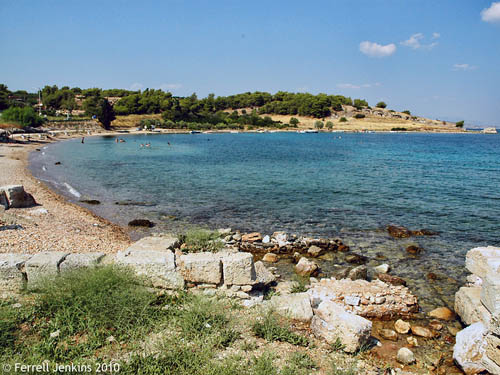
The port of Cenchrea with view toward the northern breakwater. Photo by Ferrell Jenkins.
Ruins of The port of Cenchchrea with a view toward the northern breakwater. Photo by Ferrell Jenkins.

The Lord had many people at Corinth

Corinth is located about two miles south of the narrow isthmus which forms the land bridge, and controlled access, between the main land mass of Greece and the Peloponnesus. Corinth seemed to have flourished from the 8th to the 5th centuries B.C., and there are signs of habitation much earlier. In 146 B.C. the Greek history of Corinth was terminated when the Roman consul Mummius destroyed it. All that remains today of the old Greek city are the seven columns of the Temple of Apollo. Julius Caesar rebuilt Corinth in about 46 /4 4 B.C. as a Roman colony and settled many Roman soldiers there. Corinth became the capital of the Roman province of Achaia and had direct communications with Rome. There were enough Jews in the city to account for a synagogue (Acts 18). Perhaps the two most noticeable sites at Corinth today are the ruins of the temple of Apollo and the Acrocorinth (the mountain or high point of Corinth). The temple of Apollo was built in the 6th century B.C., but only seven of the original 38 Doric monolith columns are standing. There were numerous other pagan temples in the city including one dedicated to Asklepios, the god of healing.

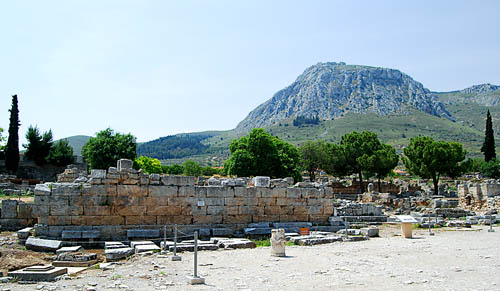
Ruins of the Temple of Apollo at Corinth, a city where Apostle Paul preached (Acts 18).
The ruins of the Temple of Apollo at Corinth with the Acro Corinth in the background.

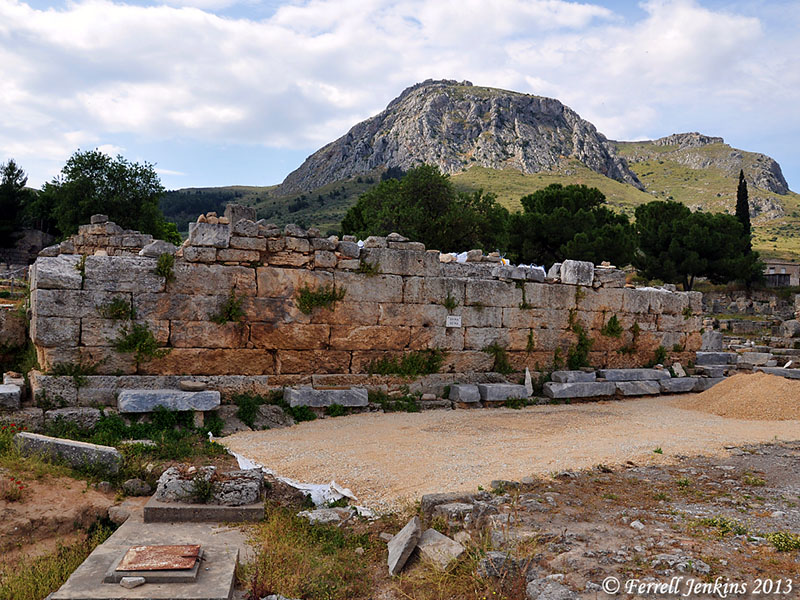
The judgment-seat (Greek, bema) was a speaker’s platform on which the judge sat or stood for the trial of one against whom an accusation had been made. In the excavations a t Corinth which have been conducted since 1896 the bema has been exposed in the agora. It is likely that Paul stood before Gallio at this place (Acts 1 8:12). The bema is dated to A.D. 44, but could be as early as the time of Augustus. The gospel was successful in this pagan city. Paul preached “Christ and Him crucified” (1 Cor. 2:2; 15:1-4). Paul was fearful but the Lord told him, “Do not be afraid any longer, but go on speaking and do not be silent; for I am with you, and no man will attack you in order to harm you, for I have many people in this ci ty” (Acts 18:9-10 ). Paul remained in Corinth for a year and six months.

Erastus inscription at Corinth. Photo by Ferrell Jenkins.
A portion of the Erastus inscription at Corinth.

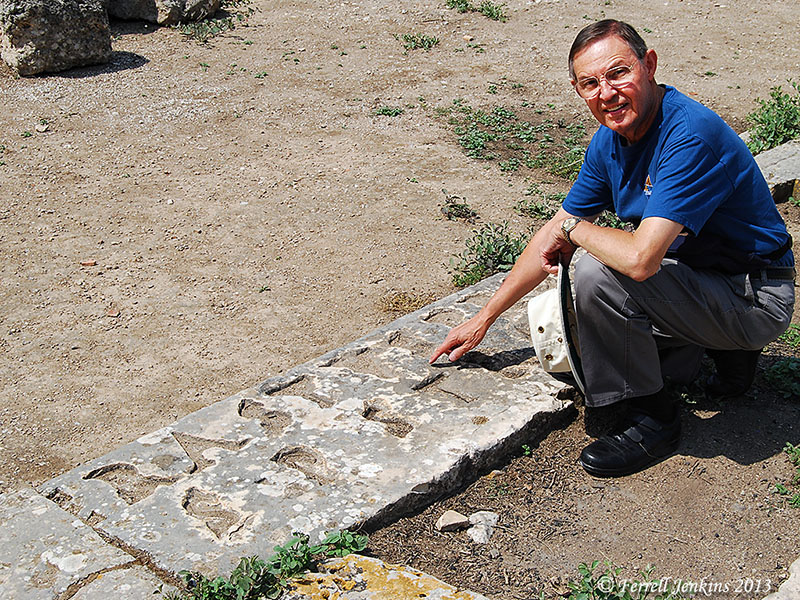
Inscribed in a limestone pavement near the theater at Corinth is a phrase which reads in Latin: ERASTVS PRO AEDILITATE S P STRAVIT. The translation goes something like this: Erastus , in return for the aedileship, laid the pavement at his own expense. It is possible, but not certain, that this Erastus was the friend of Paul (Rom. 16:2-3; 2 Tim 4:20). If so, then Erastus may have been one of the few (contrast, not many) of the socially elite at Corinth who accepted the gospel (1 Cor 1:26).

The Lord had many people at Corinth

The Meat Market at Corinth

Paul taught the saints at Corinth to,

Eat whatever is sold in the meat market without raising any question on the ground of conscience. (1 Corinthians 10:25 ESV)

The Greek word used here for “meat market” is makellon. Archaeological discoveries at Corinth include inscriptions mentioning the meat market and the fish market.

Henry J. Cadbury writes about visiting the Corinth excavations in July, 1933. He says he especially wanted to see “first hand the Erastus inscription….” Some of his comments in the article are still interesting today.

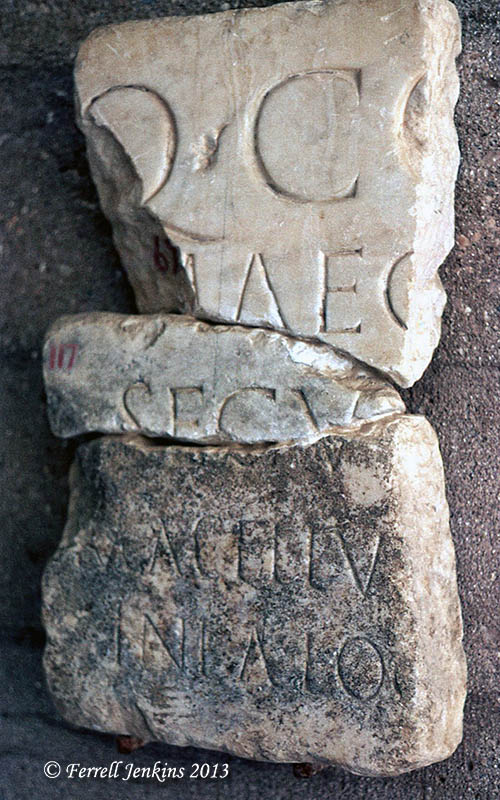
But what was particularly unexpected by me was to note among the inscribed fragments of marble in the new museum one containing quite clearly MACELLV.

As the piece has only seven other letters and these quite unintelligible the discovery of this single word is extremely tantalizing. But since the fragment in question was found in 1898, now thirty-five years ago, while so far as I know its one clear word has never been brought into connection with Paul’s reference to a Corinthian macellum, it is worth while now to do so. And the fragment does not stand quite alone; nine other fragments of the same inscription have been found, and furthermore another copy apparently of a similar inscription is represented by eleven fragments.

Citing A. B. West and L. R. Taylor, Cadbury says the various inscriptions mentioning the macellum at Corinth date to the “last years of Augustus or to the reign of Tiberias.”

In my earliest years of traveling to Corinth I saw this inscription each time I was there. Below is a digitized slide photo from 1971. This inscription was in an open hall surrounding the courtyard of what Cadbury called in 1934 “the new museum” at Corinth. At some point, perhaps in the 1990s the inscription was no longer on display. My guide at the time was well informed and had likewise seen the inscription. Inquiry in the office of the museum provided no information. Finally, a few years ago (probably 2008 or 2012) I found one of the workers preparing for the renovation of  a “newer” museum at Corinth. She informed me that the inscription was in their storeroom and that it would eventually be displayed again.

In the photo below you will see the Latin word MACELLV[M] in the fourth line from the top. Paul used the same Greek word in 1 Corinthians 10:25.

Makellum inscription at Corinth Museum in 1971. Photo by Ferrell Jenkins.

Makellum inscription at Corinth Museum in 1971. Photo by Ferrell Jenkins.

Cadbury refers to published inscriptions from Corinth. This is No. 124. It is thought to have consisted of three blocks. The beginning of the five lines in the first block of No. 124 reads as follows:

Q . C O
M A E C
S E C V
M A C E L L V
I N E A . L O C

New Testament Christians did not live in a vacuum, and the books of the New Testament were not written in a vacuum. Understanding the historical and social context of these writings helps us to better apply them to our own time.

Documentation: Henry J. Cadbury. “The Macellum of Corinth.” JBL 53:2 (1934): 134-141.

The Erastus inscription at Corinth

Even though the relationship between the Apostle Paul and the Corinthians was always a strained one, we know the names of numerous saints at Corinth who were helpful to Paul in his ministry.

Paul calls attention to a person named Erastus who was a “city treasurer.” He would be one of the few (“not many”) Christians who were among the socially elite at Corinth (1 Corinthians 1:26). A person named Erastus is mentioned three times in the New Testament. Whether these are two or three different persons, or all the same person, I do not know. Here are the biblical references:

  1. “And having sent into Macedonia two of his helpers, Timothy and Erastus, he himself stayed in Asia for a while.” (Acts 19:22 ESV)
  2. “Gaius, who is host to me and to the whole church, greets you. Erastus, the city treasurer, and our brother Quartus, greet you.” (Romans 16:23 ESV) [We understand that Romans was written from Corinth. The Greek term for “city treasurer” is oikonomos.]
  3. “Erastus remained at Corinth, and I left Trophimus, who was ill, at Miletus.” (2 Timothy 4:20 ESV)

It is of interest that during the 1929 archaeological excavation of the area near the theater (see here), a plaza was located that contained a stone inscription bearing the name of Erastus and indicating that he was a public official.

Ferrell Jenkins points to the Erastus Inscription at Corinth.

Ferrell Jenkins points to the Erastus Inscription at Corinth.

John McRay says the pavement in which this inscription was found dates to before A.D. 50. The letters are 7 inches high. The complete inscription reads:

ERASTVS-PRO-AEDILIT[at]E S-P-Stravit
In full: Erastus pro aedilitate sua pecunia stravit.

The English translation of the inscription is, “Erastus in return for his aedileship laid (the pavement) at his own expense.” (Archaeology and the New Testament, 331).

Originally the letters were filled with bronze, but most of that was removed long ago. The name ERASTVS is seen in the closeup below.

The name Erastus in the inscription near the theater. Photo by Ferrell Jenkins.

The name Erastus in the inscription near the Corinth theater. Photo by Ferrell Jenkins.

For those who have interest in a more technical discussion of this inscription may find it in David W.J. Gill, “Erastus The Aedile.” Tyndale Bulletin 40.2 (1989): 298. Gill asks,

Are we to identify the Erastus inscription with the Erastus of Romans? It needs to be pointed out that the evidence will not allow a certain identification or a certain rejection.

We are not able to answer the question with certainty, but the possibility that this man was among the disciples at Corinth, and a friend of Paul, is intriguing.

Paul stood before Galilo at Corinth

Luke records, in the book of Acts, an important historical event involving Paul during the 18 months he worked at Corinth

12 But when Gallio was proconsul of Achaia, the Jews made a united attack on Paul and brought him before the tribunal,
13 saying, “This man is persuading people to worship God contrary to the law.”
14 But when Paul was about to open his mouth, Gallio said to the Jews, “If it were a matter of wrongdoing or vicious crime, O Jews, I would have reason to accept your complaint.
15 But since it is a matter of questions about words and names and your own law, see to it yourselves. I refuse to be a judge of these things.”
16 And he drove them from the tribunal.
17 And they all seized Sosthenes, the ruler of the synagogue, and beat him in front of the tribunal. But Gallio paid no attention to any of this. (Acts 18:12-17 ESV)

The photo below shows the actual platform or bema mentioned in Acts 18. Popular English versions use the terms tribunal, judgment seat, place of judgment, or judge’s bench.

The bema in the agora of Corinth. The Acrocorinth is in the distance. Photo by Ferrell Jenkins.

The bema in the agora of Corinth. Photo by Ferrell Jenkins.

The bema dates to A.D. 44, but could be as early as the time of Augustus (Murphy-O’Connor, St. Paul’s Corinth, 28).

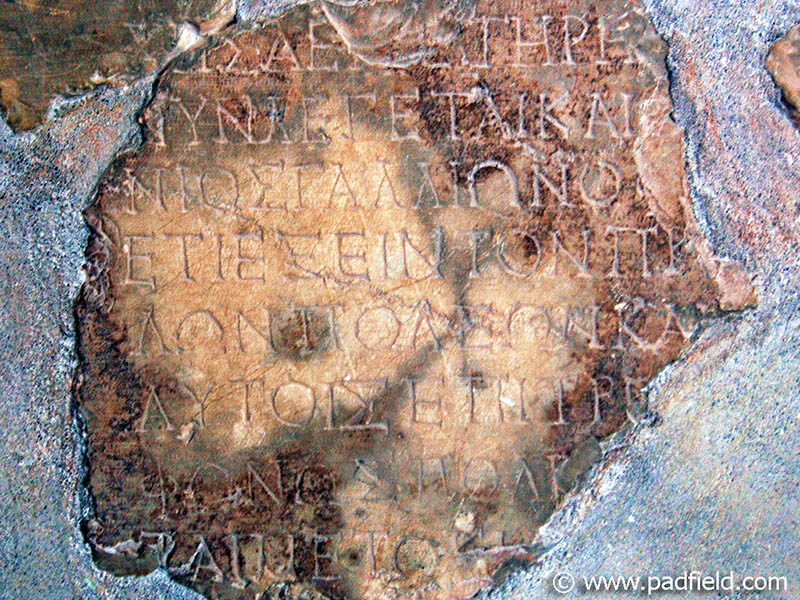
An inscription found at Delphi names Gallio the proconsul of Achaia. Gallio was the brother of the famous Roman Stoic philosopher Seneca. Gallio’s terms as proconsul of Achaia is usually dated to either A.D. 51/52 or 52/53. This is an important chronological help in our study of Paul’s journeys. In the largest fragment of the inscription, the name of ΓΑΛΛΙΩ (GALLIO)  may be seen in the center of the third line from the top.

The Delphi (Gallio) inscription. Photo by David Padfield.

The Delphi (Gallio) inscription. Photo by David Padfield.

I have been to Delphi at least two times, but the broken pieces of the Gallio Inscription were in a storage room. I did have written permission to see the fragment, but the slides I made were of poor quality. Thanks to David Padfield for permission to use the nice photo above which is now displayed in the museum at Delphi.

Corinth, where Paul stood before Gallio

Corinth is one of my favorite places to visit. I think that is because it plays such a prominent role in the New Testament story. Paul first came to Corinth on his second journey, after visiting Philippi, Thessalonica, and Berea in Macedonia (now northern Greece), and Athens in Achaia. Another reason I enjoy going here is becaue we know the names of so many people associated with the city: Chloe, Aquila, Priscilla, Crispus, Gaius, Apollos, Stephanos, Erastus, et al.

Luke’s historical account is recorded in Acts 18. Paul met Aquila and Priscilla, natives of Pontus, who had been expelled from Rome because of a decree by the Emperor Claudius. There was success in the work at Corinth as individuals heard the gospel of Christ and were baptized.

But there was also opposition. Soon, the Jews brought charges against Paul and had him brought before the proconsul Gallio.

But while Gallio was proconsul of Achaia, the Jews with one accord rose up against Paul and brought him before the judgment seat, saying, “This man persuades men to worship God contrary to the law.” But when Paul was about to open his mouth, Gallio said to the Jews, “If it were a matter of wrong or of vicious crime, O Jews, it would be reasonable for me to put up with you; but if there are questions about words and names and your own law, look after it yourselves; I am unwilling to be a judge of these matters.” And he drove them away from the judgment seat. (Acts 18:12-16)

The Gallio inscription, now exhibited in the museum at Delphi, provides the date for the time when Gallio was proconsul. This, in turn, helps us build a chronology for Paul’s ministry. Based on this information we generally think of Paul entering Corinth in the fall of A.D. 51, and leaving in the spring of A.D. 53.

Our photo shows the “judgment seat” (Greek, bema) in the agora (marketplace) at Corinth. The Acrocorinth is the mountain in the background. The Temple of Aphrodite stood on the Acrocorinth in New Testament times.

Earlier I have written two posts on dealing with Corinth. Check here for Did the apostle Paul attend the Isthmian Games?, and here for The Corinth Canal. We visited both sites yesterday.

The Corinth Canal

The city of Corinth is located about two miles south of the narrow isthmus which forms the land bridge, and controlled access, between the main land mass of Greece and the Peloponnesus.

The isthmus is less than five miles wide. In ancient times small ships were dragged across the isthmus on a paved road called the diolkos. Small portions of the diolkos may still be seen. Larger ships unloaded their cargo which was carried across and reloaded. This avoided the long 200 mile journey around the Peloponnesus. Nero abandoned his attempts to dig a canal across the isthmus (A. D. 67).

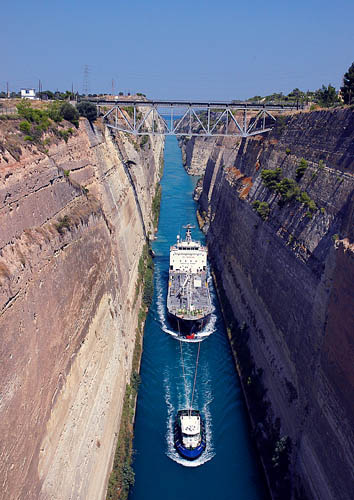
A canal was constructed between 1881 and 1893. Here is a photo of that canal with a tug boat pulling a ship through the canal.

Corinth Canal. Photo by Ferrell Jenkins.

The apostle Paul likely came to Corinth about A.D. 51, during the reign of the Roman Emperor Claudius, and remained there for eighteen months (Acts 18). The book of Acts records the success of that work:

Crispus, the leader of the synagogue, believed in the Lord with all his household, and many of the Corinthians when they heard were believing and being baptized. (Acts 18:8).

Archaeological excavations have been conducted at the ancient city of Corinth since 1896 by the American School of Classical Studies in Athens.