Tag Archives: Apostle Paul

A place called Fair Havens

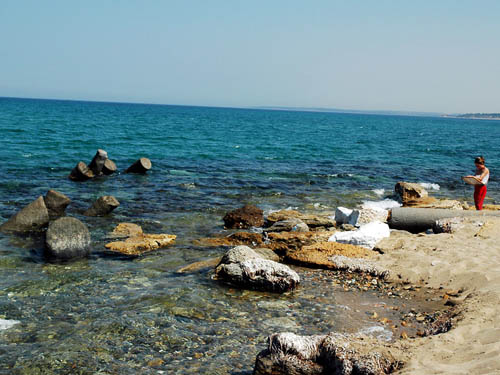
Last year I wrote here about a visit to Fair Havens on the island of Crete. I have been thinking about the rugged beauty of that place and decided to share a different photo with you. This one emphasizes the mountains surrounding the harbor of Fair Havens. The white Greek Orthodox chapel adds to the beauty of the area today.
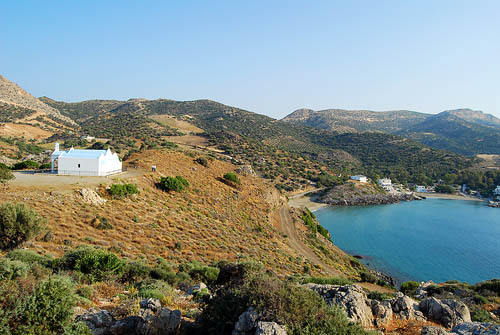
Mountains surrounding Fair Havens in Crete. Photo by Ferrell Jenkins.

Mountains surrounding Fair Havens in Crete. Photo by Ferrell Jenkins.

Crete is associated with Paul’s voyage to Rome. The biblical account is found in Acts 27:7-15. Note verses 7 and 8.

When we had sailed slowly for a good many days, and with difficulty had arrived off Cnidus, since the wind did not permit us to go farther, we sailed under the shelter of Crete, off Salmone; and with difficulty sailing past it we came to a place called Fair Havens, near which was the city of Lasea.

The ship sailed under the shelter of Crete and came to Kali Limenes (Fair Havens) near the city of Lasea. Because Fair Havens was not a suitable harbor for wintering, the pilot and captain of the ship decided to sail on in hopes of reaching “Phoenix, a harbor of Crete, facing southwest and northwest,” and spend the winter there. Because of a severe wind, called Euraquilo, which came down from the land, they were driven by the wind and eventually wrecked on the island of Malta.

Hellenistic pier found at Akko – Ptolemais

A harbor from the Hellenistic period was found at Akko on the Mediterranean coast. Here is a brief description of the discovery provided by the Israel Antiquities Authority.

The part of the floor that has been revealed so far extends for a distance of 15 meters and is 4 meters wide (the full dimensions of the floor have not yet been exposed). The floor was built of rectangular, smoothly dressed kurkar stones that were placed atop a foundation course of roughly hewn kurkar stones arranged next to each other as “headers”. In probes that were conducted beneath the floor, numerous fragments of ceramic jars of Aegean provenance (from Rhodes, Kos and elsewhere) were found that were used to transport wine, as well as tableware and cooking vessels. Among the other artifacts recovered were a Greek style bronze arrowhead and bronze coins that are covered with marine encrustations. A preliminary identification of the finds shows that the floor was constructed in the Hellenistic period (end of the third century until the middle of the second century BCE) as part of a national project.

Akko Crusader wall. Excavated area of Hellenstic Harbor. Photo: Kobi Sharvit, IAA.

Akko Crusader wall. Excavated area of Hellenistic pier. Photo: Kobi Sharvit, IAA.

The photo below shows some of the kurkar stone pavement discovered one meter under the present water level.

The floor from the Hellenistic period. Photo: Kobi Sharvit, IAA.

The floor from the Hellenistic period. Photo: Kobi Sharvit, IAA.

Akko (Acre or Accho) is mentioned in Judges 1:31 as a city of the tribe of Asher. During the late 3rd or early 2nd century B.C. Akko was given the name Ptolemais by Ptolemy I or II of Egypt. Ptolemais is the name we read in the New Testament. Paul and his companions stopped at Ptolemais for one day on the return from his third journey in the Greco-Roman world.

When we had finished the voyage from Tyre, we arrived at Ptolemais, and we greeted the brothers and stayed with them for one day. (Acts 21:7 ESV)

Several things are learned from this text (and context). The previous stop was a few miles north at Tyre where they had stayed for seven days (Acts 21:4-6). After Ptolemais they arrived at Caesarea.

Paul’s companions included all of those “messengers” of the churches who were taking the contributions of the churches of Macedonia and Achaia to the poor among the saints at Jerusalem (Romans 15:25-27; 2 Corinthians 8-9). A list of names is given in Acts 20:4.

A view of the Mediterranean from the Crusader ramparts at Akko. Photo by Ferrell Jenkins.

A view of the Mediterranean from the Crusader ramparts. Photo by Ferrell Jenkins.

Epaphras worked hard for the Laodiceans

Laodicea is mentioned only in Paul’s epistle to the Colossians (2:1; 4:13-16) and in the Revelation of John (1:11; 3:14). Paul says that Epaphras worked diligently for the saints in Colossae, Laodicea, and Hierapolis.

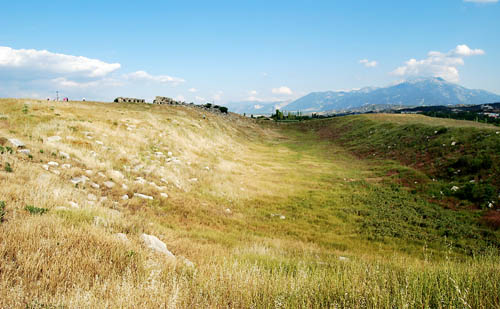
Here is a photo of the ruins of the stadium at Laodicea. Mount Cadmus can be seen in the distance to the east. Colossae was located at the foot of Mount Cadmus. Hierapolis was located to the north of Laodicea.

The stadium at Laodicea. Photo by Ferrell Jenkins.

The stadium at Laodicea. Photo by Ferrell Jenkins.

The stadium was an enclosed structure used for gladiatorial games. An inscription tells that a wealthy family dedicated it to Vespasian and Titus. One still can make our the unexcavated ruins of the 1000 feet long stadium.

The traveler of Hierapolis

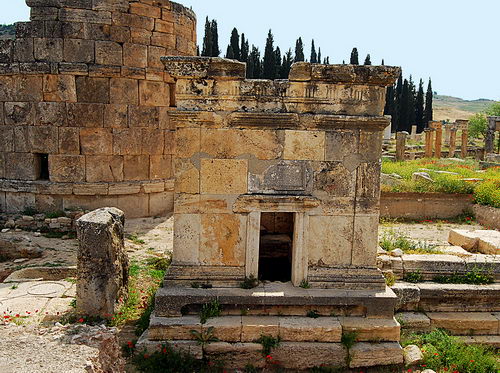
The tomb of a merchant named Flavius Zeuxis at Hierapolis is often called the “Traveler’s Tomb.” The marble inscription above the entrance states that he circumnavigated the southern cape of Peloponnesus 72 times on his way to Italy. It has been estimated that this would have amounted to about 150,000 miles.

The tomb of Flavius Zeuxis at Hierapolis. Photo by Ferrell Jenkins.

The tomb of Flavius Zeuxis at Hierapolis. Photo by Ferrell Jenkins.

This gentleman was roughly contemporary with the Apostle Paul, but he traveled more miles than Paul.

Paul spoke of the dangers associated with his many journeys.

I have been on journeys many times, in dangers from rivers, in dangers from robbers, in dangers from my own countrymen, in dangers from Gentiles, in dangers in the city, in dangers in the wilderness, in dangers at sea, in dangers from false brothers (2 Corinthians 11:26)

Alexandria Troas # 3

For # 1 scroll down to November 7, or click here. For # 2 scroll down to November 10, or click here.

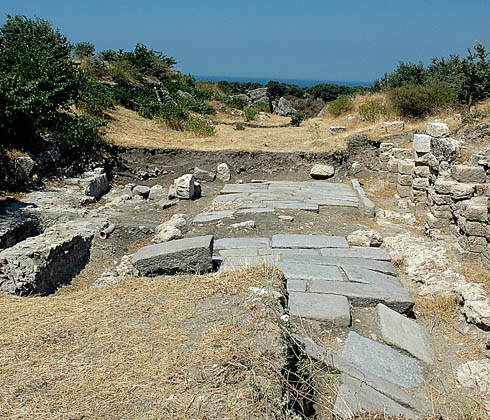
Recent excavations by the University of Münster have uncovered a portion of the Roman road at Troas. A member of the staff said, “We like to think that this is the road traveled by the apostle Paul when he entered the city.” Perhaps this photo helps illustrate the statement in Acts 16:8 which says “they came down to Troas.” The Aegean Sea is visible in the distance.

Recently excavated Roman road at Troas. Photo by Ferrell Jenkins 2006.

Recently excavated Roman road at Troas. Photo by Ferrell Jenkins 2006.

Alexandria Troas # 2

For # 1 scroll down to November 7, or click here.

Paul visited Troas on the return from his third journey. His companions, including the men who were taking the contribution to the poor among the saints at Jerusalem arranged time to be with the disciples on the first day of the week. When they met to break bread Paul spoke for a long time and raised Eutychus (Acts 20:4‑12). After the raising of Eutychus, Paul’s companions set sail for Assos, but Paul decided to travel about 20 miles south by land from Troas to Assos and meet the ship there (Acts 20:13‑14).

On another occasion, while awaiting the return of Titus from Corinth, Paul was very discouraged during his stay at Troas (2 Cor. 2:12ff.). He did not write a letter to the church at Troas, but in his last letter he requested Timothy to bring the cloak, the books, especially the parchments, which he had left at Troas with Carpus (2 Tim. 4:13).

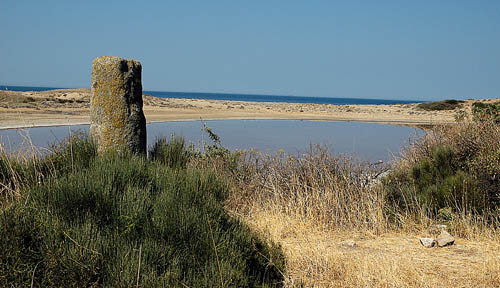
The inner harbor at Troas. Photo by Ferrell Jenkins.

The inner harbor at Troas. Photo by Ferrell Jenkins.

Earlier visits to Troas have allowed us to see only a few exposed ruins and a pathetic looking artificial harbor. The entry to the harbor is now clogged up; water flows into the harbor from the Aegean Sea, but none flows out. Over the past ten years archaeologists from the University of Münster and other institutions have been excavating in Troas. We will show some of the new discoveries in the next post.

The outter harbor at Troas. Photo by Ferrell Jenkins.

The outter harbor at Troas. Photo by Ferrell Jenkins.

Alexandria Troas

The terms Troy, Troas, and Troad were derived from the name of the ancient people known as the Troes. The Troes lived in the Troad. This region became part of the Roman province of Asia, and was a substantial portion of the area known as Mysia which included the cities of Troas, Assos and Pergamum.

The term Troas or Troad was used to describe the region where Alexander first defeated the Persians in the Battle of Granicus. The city of Alexandria Troas, located about 10 miles from ancient Troy was first called Antigonia. Lysimachus changed the name to Alexandria in about 300 B.C., but there were many cities named for Alexander, so this one came to be called Alexandria Troas.

Colin Hemer points out that “Troas was a nodal point on what became a sophisticated system of international routes, organized functionally with regard to complex variables of speed and safety, of season and weather and conditions by land and sea.” Troas was, therefore, an ideal place from which the Gospel would spread into Europe.

Troas was made a Roman colony by Augustus, and became one of the important cities of northwest Asia. A man of Macedonia appeared in a night vision to Paul at Troas and immediately his traveling party sailed for Macedonia (Acts 16:8‑11). Timothy, Silas, Luke, and perhaps others, were with Paul at Troas.

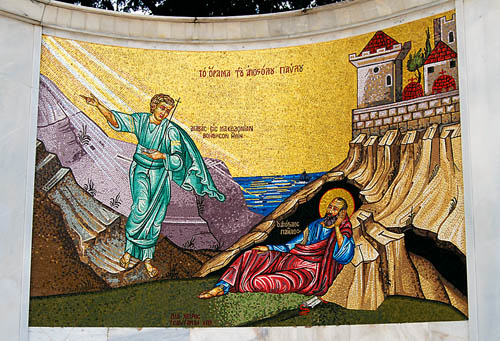
This photo from Berea illustrates the vision of the man of Macedonia calling on Paul to come over into Macedonia.

A man of Macedonia appears to Paul at Troas. Photo by Ferrell Jenkins.

A man of Macedonia appears to Paul at Troas. Photo by Ferrell Jenkins.

Ask in the next village

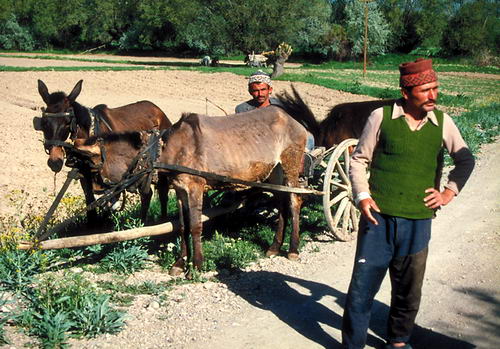
Once while visiting the site of Lystra our group enjoyed some time with local farmers who were working the fields below the tell (huyuk, in Turkey). I asked our guide to ask the men if they had heard of the apostle Paul. When he asked them, a puzzled look came over the face of the farmer who was doing most of the talking. He said, “No, but you might ask in the next village.”

The farmer said, "Ask in the next village." Photo by Ferrell Jenkins.

The farmer said, "Ask in the next village." Photo by Ferrell Jenkins.

Paul visited Lystra on his first journey (Acts 14). On the second journey he came through Lystra where Timothy lived. From that point on Timothy remained a faithful companion and co-worker with Paul in the spread of the gospel throughout the Roman Empire.

Paul came also to Derbe and to Lystra. And a disciple was there, named Timothy, the son of a Jewish woman who was a believer, but his father was a Greek,  2 and he was well spoken of by the brethren who were in Lystra and Iconium.  3 Paul wanted this man to go with him; and he took him and circumcised him because of the Jews who were in those parts, for they all knew that his father was a Greek.  (Acts 16:1-3 NASB)

Is the Apostle Paul known in your village? I mean, is the teaching of Christ and Him crucified known there? (1 Corinthians 2:2).

Saul (Paul) in Damascus

Damascus is first mentioned in the Bible at the time of Abraham (Gen. 14:15; 15:2-3). As the capital of Syria, the city had much contact with the kingdoms of Israel and Judah.

All of the New Testament references to Damascus are related to the conversion of Saul of Tarsus (Acts 9; 22; 26; 2 Cor. 11:32; Gal. 1:17). Saul had participated in the stoning of Stephen and was active in the persecution of the disciples of Christ in Jerusalem. He asked the high priest for authority to go to Damascus and seek out men and women who belonged to the Way and bring them bound to Jerusalem.

The Lord appeared to Saul as he approached Damascus and told him to go into the city where he would be told what he must do (Acts 9:6). Saul stayed at a house on the street called Straight. Ananias came to him and told him to arise and be baptized so that his sins might be washed away (Acts 22:16; 9:18). Saul stayed with the disciples for several days and immediately began to proclaim Jesus in the synagogues as the Son of God (9:20).

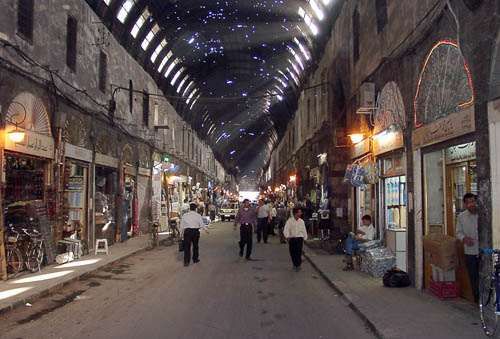
The street called Straight (Acts 9:11), the ancient Via Recta of the Roman city, now lies about 20 feet below the present street which runs the length of the old city, east to west. At the east end of the street a Roman gate has been elevated to the present level and partially restored. A small monumental arch can be seen near the middle of the street.

The photo below is one I made on Straight Street in 2002. This is not the main shopping street in the old city, but is historically significant.

The street called straight in Damascus. Photo by Ferrell Jenkins.

The street called straight in Damascus. Photo by Ferrell Jenkins.

A river in Pamphylia

This week I am busy with a number of projects, but I wanted to share a beautiful photo that I made early one morning in the mid-80s. This is a river that flows from the Tarus Mountains into the Mediterranean at Antalya, Turkey. Antalya is know in the Bible as Attalia. Paul and Barnabas sailed from Attalia at the conclusion of the first preaching journey.

When they had spoken the word in Perga, they went down to Attalia. From there they sailed to Antioch, from which they had been commended to the grace of God for the work that they had accomplished. (Acts 14:25-26)

Attalia was in the Roman province of Pamphylia in the days of Paul.

A river in Pamphylia with the Tarus Mountains in the background.