Tag Archives: agriculture

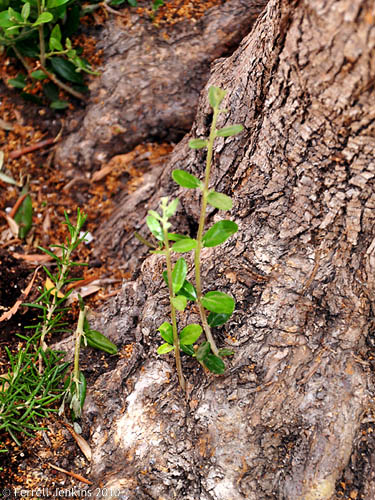
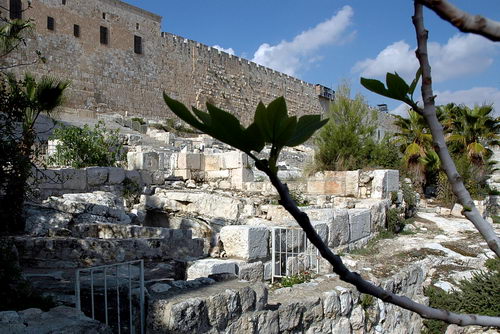
The olive shoots

The Bible is filled with illustrations from the agricultural practices and daily life activities of ancient Israel. We frequently pass over these images because we no longer understand the practices.

Here is an interesting one. In describing the happy home, one of the Psalms of Ascent says this,

Your wife will be like a fruitful vine within your house; your children will be like olive shoots around your table. (Psalms 128:3 ESV)

I must have photographed a dozen different examples of what the writer is alluding to. Perhaps this one will help you to enjoy it a little better.

Olive shoots coming from an olive tree. Photo by Ferrell Jenkins.

Olive shoots coming from an olive tree. Photo by Ferrell Jenkins.

What happens after the olives are harvested?

Oded Borowski says the grape vines and the olive trees were the main fruit trees cultivated by Israelite farmers.

The main product of the vine was wine; olives were grown for oil. Both of these products were produced in special installations (winepress and olive press, respectively) as part of the harvesting season. The end products were stored in jars for local use, for barter, and for tax payments. The latter is well attested by the Samaria ostraca, which record the quantities of oil and wine received at the collection center in Samaria. Biblical and extrabiblical references indicate that there were different types and grades of wine and oil. (Daily Life in Biblical Times, 29)

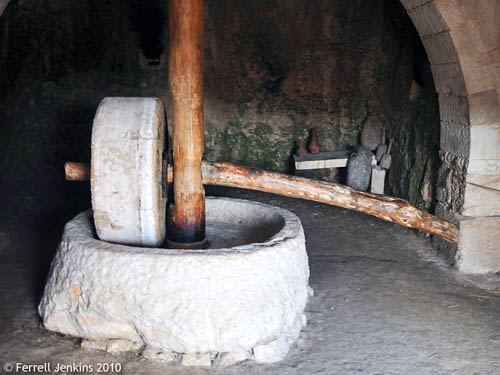
The fresh olives are placed on one stone and crushed by rolling another stone over them. The olive is really between a rock and a hard place. The large top stone (the crushing stone) is turned by a person or an animal causing the stone to roll over the olives that have been placed on a hewn stone installation. The photo below was made at the Nazareth Village.

Olive crusher at Nazareth Village. Photo by Ferrell Jenkins.

Olive crusher at Nazareth Village. Photo by Ferrell Jenkins.

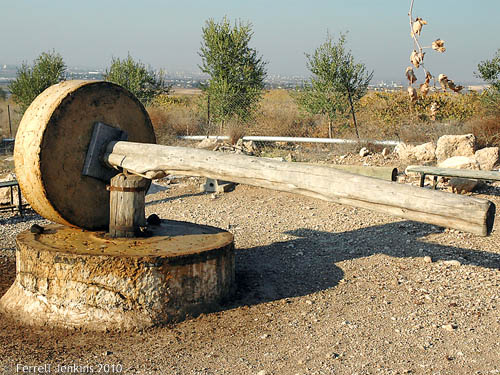
The olive crusher is most often seen outside near the olives. Here is a stone at Gezer. The view is toward the coastal plain.

Olive crusher at Gezer with view toward Coastal Plain. Photo by Ferrell Jenkins.

Olive crusher at Gezer with view toward Coastal Plain. Photo by Ferrell Jenkins.

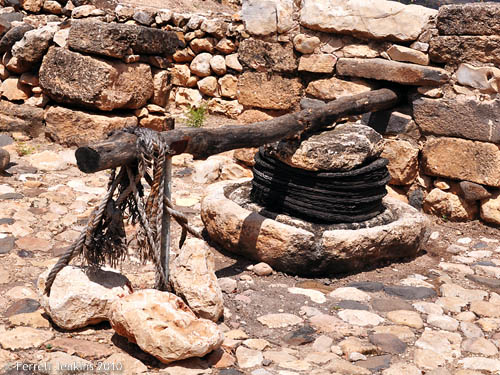
Once the olives are crushed the pulp is put into bags or baskets with holes in the side. Heavy weights are placed on the bags to squeeze out the oil. This photo shows a simple oil press set up at Hazor.

Simple Olive Press at Hazor. Photo by Ferrell Jenkins.

Simple Olive Press at Hazor. Photo by Ferrell Jenkins.

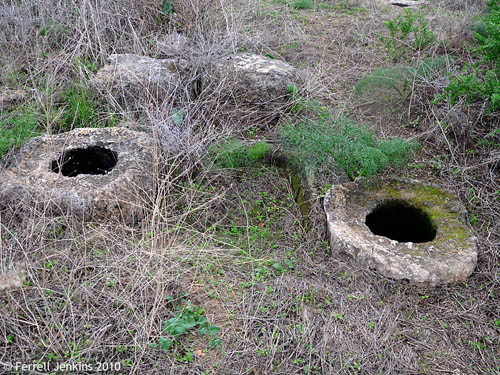
The archaeological excavations at Tel Mikne/Ekron revealed that the city was a large industrial oil production center. Only a few of these vats are visible at the site today. The tell is partially cultivated and the rest is overgrown. The small museum at the nearby kibbutz is closed and all of the artifacts have been moved to Ashdod. I was told that they are not on display at this time.

Crushing basin with a pressing vat on either side. Photo by Ferrell Jenkins.

Crushing basin with a pressing vat on either side. Photo by Ferrell Jenkins.

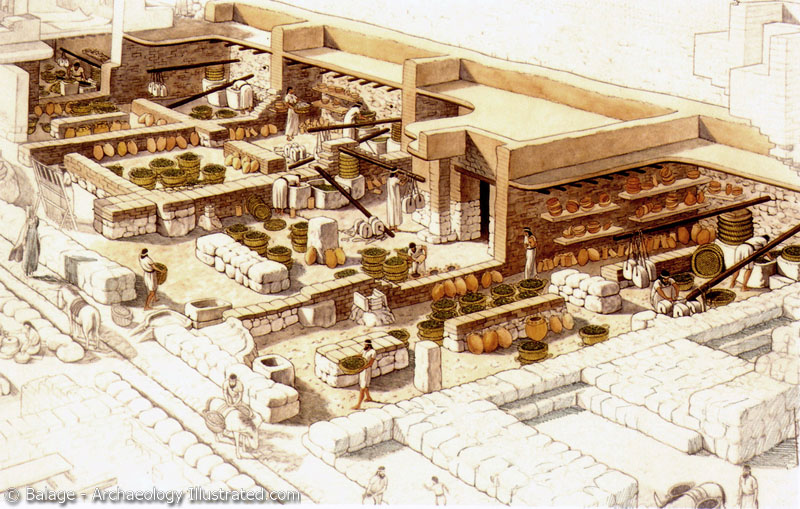
Based on the excavations, artist Balage has drawn the olive oil production center at Tel Mikne/Ekron.

Olive oil production at Ekron. Art by Balage, Archaeology Illustrated.

Olive oil production at Ekron. Art by Balage, Archaeology Illustrated.

Once the oil is retrieved it is stored in large ceramic jars. When Gedaliah became governor of Judah after the Babylonian destruction of Jerusalem he told the residents to “gather wine and summer fruits and oil, and store them in your vessels” (Jeremiah 40:9-10).

Olive harvesting

The Mosaic law gave instructions about certain daily agricultural activities such as the gathering of grapes and the harvesting of olives.

When you beat your olive trees, you shall not go over them again. It shall be for the sojourner, the fatherless, and the widow. (Deuteronomy 24:20 ESV)

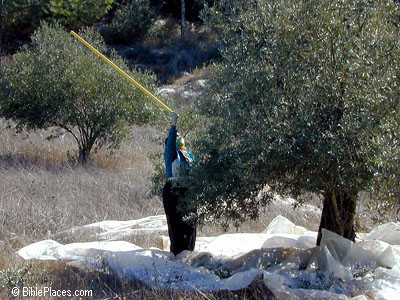
Notice the reference to beating the olive trees here and in Isaiah 17:6. I have seen this in Italy, but have not been in Israel at the time of harvesting. Thanks to the generous use policy of Todd Bolen’s Pictorial Library of Bible Lands I am able to use this photo he made in the Shephelah. I encourage you to buy the entire set for use in your church or school classes.

Olive harvesting in the Shephelah. Photo courtesy: BiblePlaces.com.

Olive harvesting in the Shephelah. Photo courtesy BiblePlaces.com.

King and Stager describe the olive tree, the necessary climate, and the length of time necessary for trees to produce olives.

The hardy, long-lived olive tree is an evergreen growing five to eight meters high and with a trunk up to one meter wide. Found mainly in the highlands and in the foothills between the coastal plain and the central mountain range, the olive tree thrives in the rocky, shallow soil of the hillsides during the Mediterranean’s hot, dry summers and cool, rainy winters. It requires an average annual temperature of fifteen degrees centigrade (fifty-nine degrees fahrenheit). Because olives can be grown on mountain slopes with very little soil, the tree does not compete with cereals for fertile, arable soil. The olive tree grows in the Levant but not in Egypt or Mesopotamia, because a certain chill, needed to cause the olives to mature, cannot be achieved in the warmer climes. It takes years for olive trees to mature to full, producing trees, and then they bear fruit only every other year. It is commonly said that one plants an olive yard not for one’s self but for one’s grandchildren. Trees begin to flower only after five or six years. (Life in Biblical Israel, 95-96)

William Albright translated the first line of the Gezer Calendar (925 B.C.) this way,

His two months are (olive) harvest

The time of harvest may vary depending on the type of olive and the particular place. In Israel and the Palestinian West Bank we think of October and November as the two months of harvest.

The Olive – first among the trees

The promised land, which the Israelites were about to enter, is described as a land of trees and crops.

a land of wheat and barley, of vines and fig trees and pomegranates, a land of olive trees and honey, a land in which you will eat bread without scarcity, in which you will lack nothing, a land whose stones are iron, and out of whose hills you can dig copper. (Deuteronomy 8:8-9 ESV)

Note that the land is a “land of olive oil.” In addition to using the olive for food, and in cooking, several other uses are mentioned in the Bible.

  • Oil for anointing the body – Deuteronomy 28:40.
  • Oil for anointing sheep – Psalm 23:5.
  • Medication – Isaiah 1:6; Mark 6:13.
  • Anointing priests, et al. – Exodus 29:7; Psalm 133.
  • Oiling the shields of war – Isaiah 21:5.

When an unworthy man by the name of Abimelech promoted himself to be the king of his people, Jotham went up on Mount Gerizim and spoke to the leaders of Shechem. The full story is in Judges 9. In Jotham’s parable (or fable) the trees of the forest called on various trees to rule over them. The trees first called on the olive tree to reign over them (v. 8). Look at the words of the olive tree as he excused himself.

But the olive tree said to them, ‘Shall I leave my abundance, by which gods and men are honored, and go hold sway over the trees?’ (Judges 9:9 ESV)

After that, the fig and the vine likewise excused themselves. Finally, the worthless bramble accepted their offer boasting of what he could do for them.

The photo below is a rather typical scene in the central mountain range of Palestine/Israel. Rather than the vast acres of olives trees in a row, like I have seen in Spain, these are scattered. A few other trees are mixed among the olives.

Scattered olive grove on a hill below Mar Elias Monastery. Photo by Ferrell Jenkins.

Scattered olive grove on a hill below Mar Elias Monastery. Photo by Ferrell Jenkins.

Mar Elias Monastery is located on the east side of the main road between Jerusalem and Bethlehem. One religious tradition from the Byzantine period has it that Mary rested at this place on her way to Bethlehem. Another has it that Mary stopped here for water on the flight to Egypt and water flowed from a rock. See The Holy Land by Murphy-O’Connor for more info.

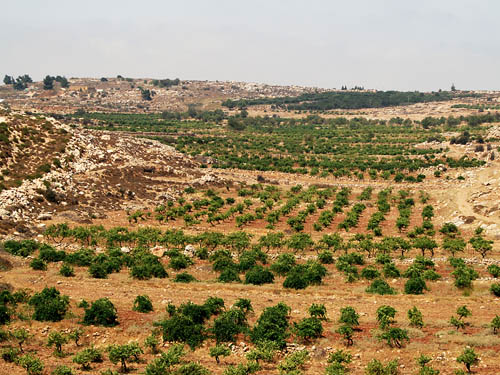
The next photo is of terraced olive groves in the central mountain range south of Shiloh.

Terraced olive groves south of Shiloah. Photo by Ferrell Jenkins.

Terraced olive groves south of Shiloh. Photo by Ferrell Jenkins.

Presentation quality photos are available by clicking on the images above.

Paul’s illustration of the olive tree in Romans 11

The illustration used by Paul in Romans 11 to describe the relation between the Jews and the Gentiles is both memorable and instructive.

17 But if some of the branches were broken off, and you, although a wild olive shoot, were grafted in among the others and now share in the nourishing root of the olive tree,
18 do not be arrogant toward the branches. If you are, remember it is not you who support the root, but the root that supports you.
19 Then you will say, “Branches were broken off so that I might be grafted in.”
20 That is true. They were broken off because of their unbelief, but you stand fast through faith. So do not become proud, but fear.
21 For if God did not spare the natural branches, neither will he spare you.
22 Note then the kindness and the severity of God: severity toward those who have fallen, but God’s kindness to you, provided you continue in his kindness. Otherwise you too will be cut off.
23 And even they, if they do not continue in their unbelief, will be grafted in, for God has the power to graft them in again.
24 For if you were cut from what is by nature a wild olive tree, and grafted, contrary to nature, into a cultivated olive tree, how much more will these, the natural branches, be grafted back into their own olive tree. (Romans 11:17-24 ESV)

His point is simple. The Jews were cut off because of their unbelief. Gentiles were grafted in through their faith in Christ. The Jews may again be a part of the tree by accepting Christ. In the photo below we see that new branches have been grafted in the older, well-rooted stump.

Olive tree with grafts at Nazareth Village. Photo by Ferrell Jenkins.

Olive tree with grafts at Nazareth Village. Photo by Ferrell Jenkins.

In this close view one can see distinctly the grafting of the “wild olive shoot” into the old stump to be able to “now share the nourishing root of the olive tree.”

Grafts on an old olive stump. Photo by Ferrell Jenkins.

Grafts on an old olive stump. Photo by Ferrell Jenkins.

Paul addresses the problem of arrogance on the part of Gentile Christians. He reminds them that, as branches, they are dependent on the root.

do not be arrogant toward the branches. If you are, remember it is not you who support the root, but the root that supports you. (Romans 11:18 ESV)

Remember that Jesus is the root of David (Revelation 5:5; 22:16). He informed the woman of Samaria that “salvation is from the Jews” (John 4:22 ESV).

In directing tours I have encountered a few guides who think that a Christian group is interested only in “Christian sites.” This is far from true. In most of our churches the majority of the classes at any given time will be from the Old Testament.

For whatever was written in former days was written for our instruction, that through endurance and through the encouragement of the Scriptures we might have hope. (Romans 15:4 ESV)

Click on the photos for images large enough for use in your teaching.

More to come about the uses of the olive and oil production.

The Vineyard

The prophet Isaiah records the song of the LORD for His vineyard that had become unfruitful.

1 Let me sing now for my well-beloved A song of my beloved concerning His vineyard. My well-beloved had a vineyard on a fertile hill.
2 He dug it all around, removed its stones, And planted it with the choicest vine. And He built a tower in the middle of it And also hewed out a wine vat in it; Then He expected it to produce good grapes, But it produced only worthless ones.
3 “And now, O inhabitants of Jerusalem and men of Judah, Judge between Me and My vineyard.
4 “What more was there to do for My vineyard that I have not done in it? Why, when I expected it to produce good grapes did it produce worthless ones?
5 “So now let Me tell you what I am going to do to My vineyard: I will remove its hedge and it will be consumed; I will break down its wall and it will become trampled ground.
6 “I will lay it waste; It will not be pruned or hoed, But briars and thorns will come up. I will also charge the clouds to rain no rain on it.”
7 For the vineyard of the LORD of hosts is the house of Israel And the men of Judah His delightful plant. Thus He looked for justice, but behold, bloodshed; For righteousness, but behold, a cry of distress. (Isaiah 5:1-7 NAU)

The photo was made in the hill country of Judah south of Bethlehem near the Patriarchs Way. This region of the country is filled with vineyards.

Vineyard in the hill country of Judah near the Patriarchs Way. Photo by Ferrell Jenkins.

Vineyard in the hill country of Judah. Photo by Ferrell Jenkins.

One sows and another reaps

Jesus took advantage of the opportunity to teach the woman of Samaria at the well where they met (John 4). She went into the city and told the men about Jesus (John 4:28-29). When the disciples of Jesus returned from the city where they had gone to buy food they encouraged Jesus to eat. He said, “I have food to eat that you do not know about.” The disciples misunderstood this, thinking He had reference to material food. This conversation led Jesus to say,

Do you not say, ‘There are yet four months, then comes the harvest’? Look, I tell you, lift up your eyes, and see that the fields are white for harvest. Already the one who reaps is receiving wages and gathering fruit for eternal life, so that sower and reaper may rejoice together. For here the saying holds true, ‘One sows and another reaps.’ I sent you to reap that for which you did not labor. Others have labored, and you have entered into their labor.” (John 4:35-38 ESV)

The disciples apparently did not know that Jesus had been teaching the woman, and that she had gone into the city to tell others about Him. Jesus is reminding the disciples of a common thing in the agricultural practices of that time. One sows and another reaps. It may have been sowing time, but some were ready to be reaped. The fields were ready to be harvested.

The words of the prophet Amos provide insight into this episode. He said,

“Behold, days are coming,” declares the LORD, “When the plowman will overtake the reaper And the treader of grapes him who sows seed; When the mountains will drip sweet wine And all the hills will be dissolved. (Amos 9:13 ESV)

In modern times, with the use of some mechanical farm equipment, it is becoming difficult to find scenes exactly like the practices of the time of Jesus. But we still see things that remind us of these teachings. The photo below shows a field in Jordan just above the Jordan valley floor near Deir Allah. On a clear day one could see the valley.
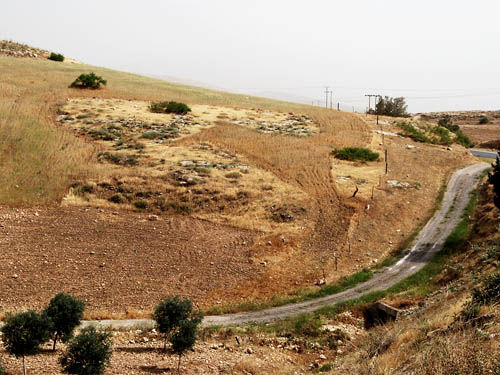
The field has been plowed while grain grows nearby. Photo by F. Jenkins.

The field has been plowed while grain grows nearby. Photo by F. Jenkins.

Notice the rocks in the field. The plowman has worked around them. In the days of broadcast sowing, like in the parable of the sower (Luke 8), this scene has all of the elements. Good soil, rocky soil, road, and certainly thorns.

Extend our view to the left in the photo above. You will see, in the photo below, sheaves in the field that has been plowed. Indeed, the plowman overtakes the reaper.
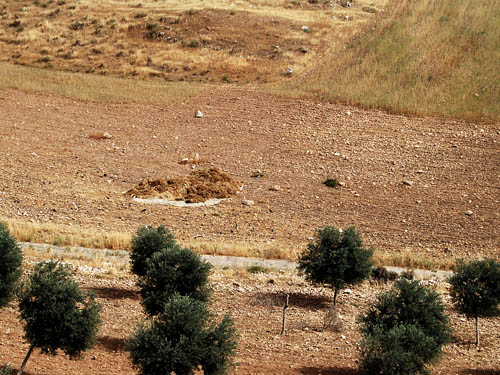
Harvested grain in a field already plowed for sowing. Photo by Ferrell Jenkins.

Harvested grain in a field already plowed for sowing. Photo by Ferrell Jenkins.

It is true today in the preaching of the gospel. One plows and another reaps. Paul says, “I planted, Apollos watered, but God was causing the growth” (1 Corinthians 3:6).

If we had more sowing, there would be more reaping.

A land of fig trees

The land promised to the descendants of Abraham is described in Deuteronomy 8:8 as,

a land of wheat and barley, of vines and fig trees and pomegranates, a land of olive oil and honey.

Figs at the Temple Mount excavation. Photo by Ferrell Jenkins.

Figs at the Temple Mount excavation. Photo by Ferrell Jenkins.

Figs were important because they could be eaten when ripe, or prepared as fig cakes and eaten later. In the account of David avenging the destruction of Ziklag, an Egyptian was found in the field and brought to David. He was given bread and water. The text says,

They gave him a piece of fig cake and two clusters of raisins, and he ate; then his spirit revived. For he had not eaten bread or drunk water for three days and three nights. (1 Samuel 30:12 NAS)

I am not sure how the fig cakes were prepared and preserved. Today it is common to see dried figs in Israel. The photo shows dried figs purchased in the Palestinian Authority territory at Jericho.

Dried figs from Jericho. Photo by Ferrell Jenkins.

Dried figs from Jericho. Photo by Ferrell Jenkins.