Photography in the Israel Museum. Can it be?

Carl Rasmussen, author of the Zondervan Atlas of the Bible, reports here on his HolyLandPhotos’ Blog that he took a group to the Israel Museum today and that photography (without flash) was allowed in the archaeology section. Prof. Rasmussen concludes, “A new era has begun!!”

Several times I have criticized museums that do not allow photography of archaeological artifacts.

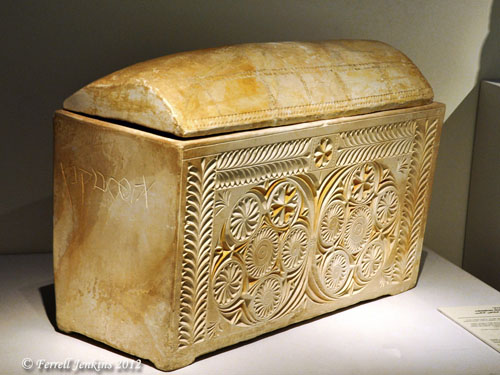
A photo such as the one below can be helpful to teachers who prefer to have their own photos for use in teaching. The highly decorated Caiaphas Ossuary was discovered during the construction of a water park in Jerusalem’s Peace Forest. The remains of six individuals were found inside the ossuary including that of a man about 60 years of age. The name of Caiaphas is inscribed on both ends of the “bone box.” The single line visible in this photo is translated “Joseph son of Caiaphas.” Many scholars believe that this is likely the high priest Caiaphas before whom Jesus stood prior to His crucifixion.

So Annas sent Him bound to Caiaphas the high priest. (John 18:24 NAU)

The Caisaphas Ossuary in the Israel Museum, Jerusalem.

The Caiaphas Ossuary in the Israel Museum, Jerusalem. Photo by Ferrell Jenkins.

HT: Barry Britnell

Acts 2 — Photo Illustrations

Acts 2 is one of those highly significant chapters of the Bible. It is a pivotal point, or as the late James D. Bales called it in one of his books, “The Hub of the Bible.” The reason is because so many Old Testament prophecies looked forward to their fulfillment in the events of Acts 2 (e.g., Isaiah 2, Joel 2, Daniel 2), and because many New Testament texts look back to the beginning of the gospel in that chapter (e.g., Ephesians 2). In fact, Peter refers to the events of Pentecost as “the beginning” (Acts 11:15).

The prophet Isaiah said,

Now it will come about that In the last days The mountain of the house of the LORD Will be established as the chief of the mountains, And will be raised above the hills; And all the nations will stream to it. And many peoples will come and say, “Come, let us go up to the mountain of the LORD, To the house of the God of Jacob; That He may teach us concerning His ways And that we may walk in His paths.” For the law will go forth from Zion And the word of the LORD from Jerusalem. (Isaiah 2:2-3 NAU)

From the beginning of His ministry, Jesus spoke of the establishment of the kingdom during the lifetime of some of those who heard him (Mark 1:14-15; 9:1).

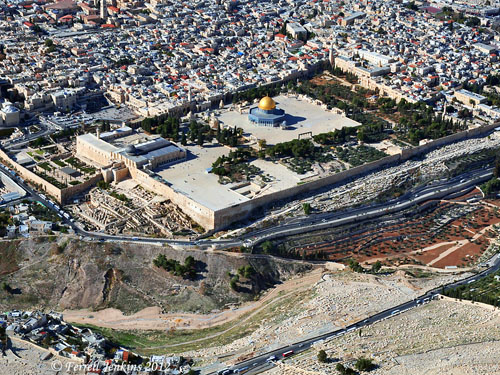
Our aerial photo shows the enclosed Islamic sanctuary area that is commonly called the Haram es-Sherif. Benjamin Mazar says that this area is about 40 acres. He points out that Josephus and the Mishna give smaller dimensions, and says that they apparently refer to “the Soreg or sacred enclosure” (The Mountain of the Lord, 119-120). Other writers say the area is 36 acres in size. Certainly large enough for the crowds who came to Jerusalem for festivals such as the Passover and Pentecost.

Solomon’s temple stood on Mount Moriah (2 Chronicles 3:1). Centuries later Herod the Great built the large platform and enclosure walls. Stones from that wall can still be seen in many places around this vast enclosure. The picture shows the southern wall and the eastern wall (the long one). The Kidron Valley and a portion of the slope of the Mount of Olives is visible in the bottom of the photo.

Aerial view of the temple precinct from the time of Herod the Great. Today the area is occupied by Moslem shrines, Al Aksa Mosque and the Mosque of Omar (Dome of the Rock). Photo by Ferrell Jenkins.

Aerial view of the temple precinct from the time of Herod the Great. Today the area is occupied by Moslem shrines, Al Aksa Mosque and the Mosque of Omar (Dome of the Rock). Photo by Ferrell Jenkins.

Click on the photo for an image suitable for use in teaching.

The New Testament (Greek) makes a distinction between the entire temple precinct, courts and all (Greek, hieron), and the sanctuary where only the priests were allowed (Greek, naos). John 2:14-15 uses hieron. John 2:19-21 uses naos.

Hieron is the term used in Acts 2:46. The new converts met in the temple precinct. They most likely assembled in one of the large porticoes built around the inside of the enclosure wall (cf. Acts 3:11; 5:12).

Day by day continuing with one mind in the temple, and breaking bread from house to house, they were taking their meals together with gladness and sincerity of heart,  praising God and having favor with all the people. And the Lord was adding to their number day by day those who were being saved. (Acts 2:46-47 NAU)

It also was within this precinct that the large crowd of devout Jews “from every nation under heaven” assembled on Pentecost. Here, Peter preached the gospel of the death, burial, and resurrection of Jesus for the first time.

July 4, 2012 in the United States of America

Flag of the United States of America. Photo by Ferrell Jenkins.

Flag of the United States of America. Photo by Ferrell Jenkins.

Another Giveaway by Bible Places Blog

Bible Places Blog is giving away a 6-DVD set featuring 36 half-hour lectures by Dr. Jodi Magness on The Holy Land Revealed. You have two (maybe three) chances to win. Be warned. I have entered this time!

Click here for details.

Acts 1 — Photo Illustrations

Many churches study the book of Acts in various classes. I thought I might begin a series of brief blogs using at least one photo for each chapter in Acts. We will not run these photos daily, but one or two a week. The photos normally will be 800 pixels wide — wide enough for use in PowerPoint presentations. It will be best to leave some space around them. This will allow room for an identifying caption. There is no need to write for permission to use these photos for educational, non-commercial, purposes. I would appreciate a comment or note telling me how you used the material.

The first chapter of Acts includes:

  • The promise to the 11 apostles that they would be baptized with (in) the Holy Spirit (1:4-5; Cf. John 14-16).
  • Jesus’ restatement of the Great Commission (1:8).
  • The ascension of Jesus from the Mount called Olivet (1:9-12). In the Gospel, Luke says the ascension took place at Bethany (Luke 24:50). Bethany is on the eastern slope of the mountain.

Then they returned to Jerusalem from the mount called Olivet, which is near Jerusalem, a Sabbath day’s journey away. (Acts 1:12 ESV)

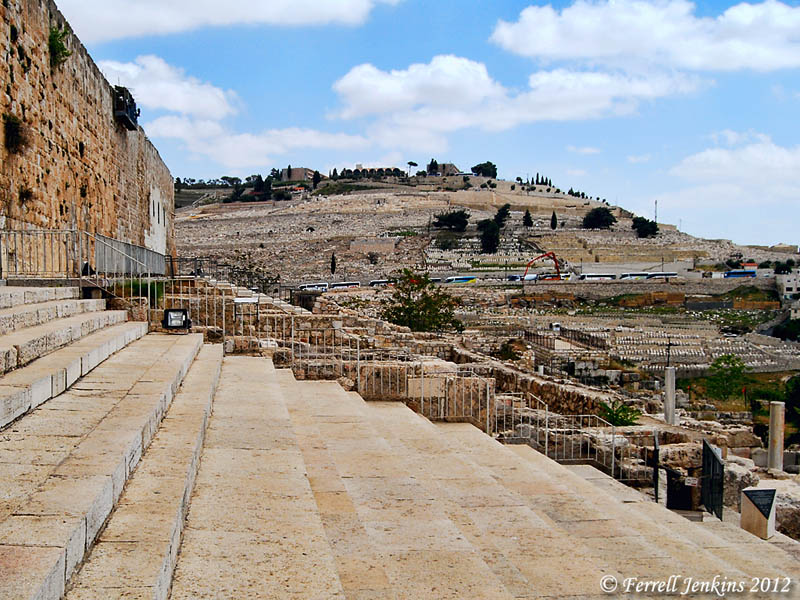
The photo shows the western slope of the Mount called Olivet from the steps on the southern end of the Temple enclosure (precinct) built by Herod the Great.

The Mount called Olivet from the Temple Mount. Photo by Ferrell Jenkins.

The Mount called Olivet from the Temple Mount. Photo by Ferrell Jenkins.

Other events in Acts 1 include:

  • The meeting of the 11 apostles in the upper room (1:13).
  • The record of the death of Judas (1:16-20).
  • The selection of Matthias to replace Judas (1:20-26).

Mosaic of Samson and the foxes discovered in Galilee synagogue

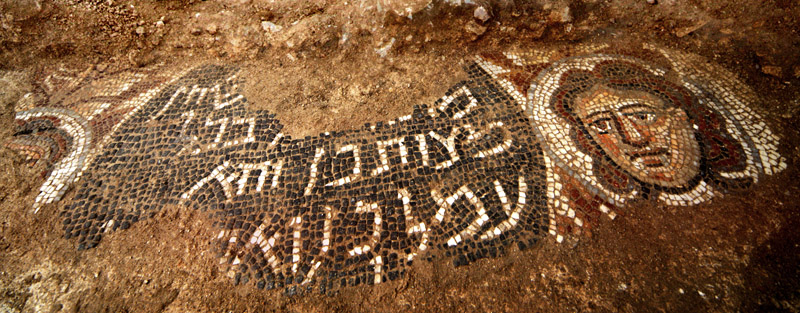
Excavations at Huqoq in Galilee have uncovered a mosaic floor depicting exploits of Samson. The photo below shows a female face and a partial Hebrew inscription referring to “rewards for those who perform good deeds .” No photo of the Samson portion of the mosaic has been provided.

Huqoq Galilee Synagogue Mosaic showing Samson. Photo by Jim Haberman.

Huquq Synagogue Mosaic with female face and inscription. Photo by Jim Haberman.

At the moment the most best information I have is from the Israel Antiquities Authority. Everything set off below, and the photo above, is from that source.

—•—

A monumental synagogue building dating to the Late Roman period (ca. 4th-5th centuries C.E.) has been discovered in archaeological excavations at Huqoq in Israel’s Galilee.

The excavations are being conducted by Jodi Magness of the University of North Carolina at Chapel Hill and David Amit and Shua Kisilevitz of the Israel Antiquities Authority, under the sponsorship of UNC, Brigham Young University in Utah, Trinity University in Texas, the University of Oklahoma and the University of Toronto in Canada. Students and staff from UNC and the consortium schools are participating in the dig

Huqoq is an ancient Jewish village located approximately two to three miles west of Capernaum and Migdal (Magdala). This second season of excavations has revealed portions of a stunning mosaic floor decorating the interior of the synagogue building. The mosaic, which is made of tiny colored stone cubes of the highest quality, includes a scene depicting Samson placing torches between the tails of foxes (as related in the book of Judges 15). In another part of the mosaic, two human (apparently female) faces flank a circular medallion with a Hebrew inscription that refers to rewards for those who perform good deeds.

“This discovery is significant because only a small number of ancient (Late Roman) synagogue buildings are decorated with mosaics showing biblical scenes, and only two others have scenes with Samson (one is at another site just a couple of miles from Huqoq),” said Magness, the Kenan Distinguished Professor in the department of religious studies in UNC’s College of Arts and Sciences. “Our mosaics are also important because of their high artistic quality and the tiny size of the mosaic cubes. This, together with the monumental size of the stones used to construct the synagogue’s walls, suggest a high level of prosperity in this village, as the building clearly was very costly.”

—•—

The web site of Dr. Magness may be accessed here.

Several centuries before the synagogue at Huqoq was built, Jesus visited synagogues in Galilee.

Jesus went throughout all of Galilee, teaching in their synagogues, preaching the gospel of the kingdom, and healing all kinds of disease and sickness among the people. (Matthew 4:23 NET)

HT: Joseph Lauer

Header: The view from Adullam

The header we have chosen to use today shows a view of the Judean shephelah south from Adullam. The photo is a panorama of three images.

The cave of Adullam is associated with David. When he left Gath he went to Adullam before sending his parents to Moab for safety.

So David left there and escaped to the cave of Adullam. When his brothers and the rest of his father’s family learned about it, they went down there to him. (1 Samuel 22:1 NET)

In fact, David spent much time at Adullam. I suggest you read the entire account in 2 Samuel 23:13ff.

For more information on Adullam, and a photo of the cave associated with David, click here.

Leeches in Sea of Galilee; Palestinian Village; Jericho

Sea of Galilee invaded by leeches. For the second time in 7 years the lake has an explosion of leeches. The article in Haaretz says,

Standing in the water for as little as two minutes will cause your legs to be covered in hundreds of leeches. These particular types are not blood-suckers, making them relatively easy to remove once one is out of the water

Causes for the large number of leeches include “human activity, including pollution, poisoning and overpumping.”

Read the full article here.

The Sea of Galilee was central to much of the ministry of Jesus.

While walking by the Sea of Galilee, he saw two brothers, Simon (who is called Peter) and Andrew his brother, casting a net into the sea, for they were fishermen. (Matthew 4:18 ESV)

Palestinian Village uses Roman irrigation system to continue terraced farming near Bethlehem. Read the story, with beautiful photo, in The New York Times here.

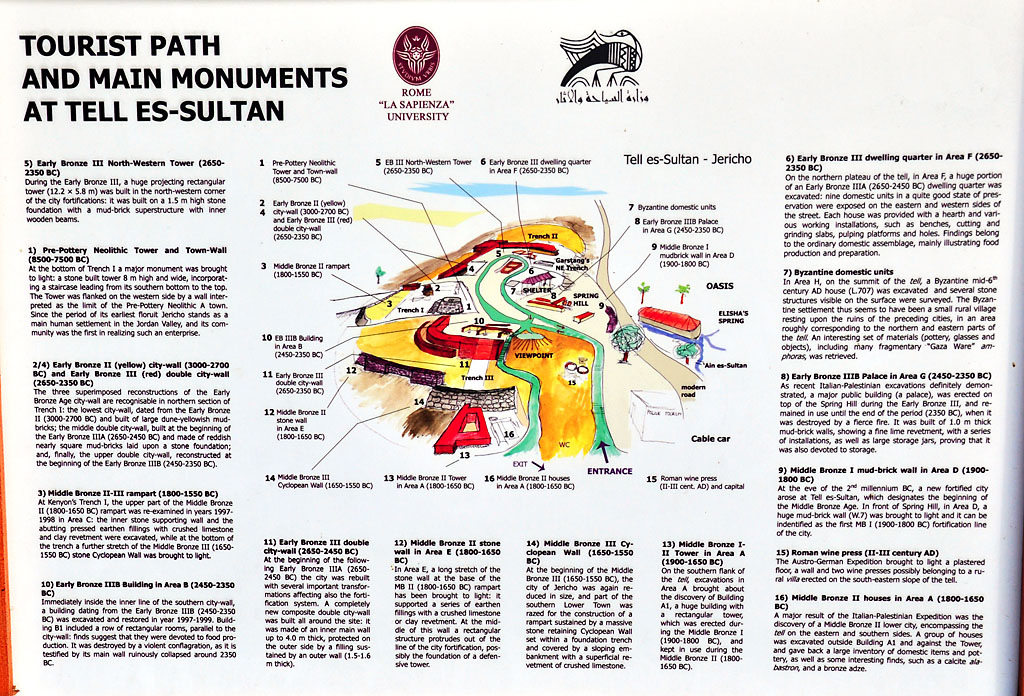
Tell es-Sultan/Jericho. Sepienza University in Rome, in cooperation with the Palestinian General Directorate of Antiquities, has published a Palestine Archaeological Databank and Information System. Check here for maps and other information. Our readers will likely be interested in the excavation reports on Tell es-Sultan/Jericho here. Click on the Results 2012 photo for the most recent work by the Italian-Palestinian Expedition at Jericho. Every visitor to the site will welcome is the new paths, identifying signs, and general clean-up of the site.

I was especially pleased to see the Digital Visit plan of the site. Click on it was a colorful, readable plan of the site like the central portion of the one shown below. Prof. Lorenzo Nigro is the director of the excavation.

Tourist Path and Main Monuments at Tell es-Sultan/Jericho. Photo by Ferrell Jenkins.

Tourist Path and Main Monuments at Tell es-Sultan/Jericho. Photo by Ferrell Jenkins.

Jericho is important in Old Testament history (Joshua 6).

HT: Bible Places Blog; Jack Sasson; Barry Britnell; “La Sapienza” Expedition to Palestine.

Roman artifacts in the Samsun Archaeology Museum

Our main interest in visiting the Black Sea coastal cities of Samsun and Sinop is because they are part of the ancient Roman province of Pontus. Somewhere in Pontus, probably Amisos (now Samsun), was the beginning point for the messenger who carried Peter’s first epistle to the elect of the diaspora residing in Pontus, Galatia, Cappadocia, Asia, and Bithynia (1 Peter 1:1).

The Archaeology Museum in Samsun has only a few items from the first century Roman period on display, but they are significant.

A marble head of Augustus is displayed prominently. Augustus was the Roman Emperor from 30 B.C. to A.D. 14. He is mentioned only once in the New Testament, but his influence in the eastern part of the Empire is evident in many way. The apostles traveled along roads built in the days of Augustus.

Luke records that the decree for a census to be taken of all the inhabited earth went out from Augustus.

Now in those days a decree went out from Caesar Augustus, that a census be taken of all the inhabited earth. (Luke 2:1 NAU)

This accounts for Mary and Joseph traveling from Nazareth to Bethlehem at the time of the birth of Jesus.

Roman Emperor Augustus. Displayed in Samsun Archaeology Museum. Photo by Ferrell Jenkins.

Augustus. Displayed in Samsun Archaeology Museum. Photo by Ferrell Jenkins.

I was surprised at the many references to Augustus on this blog. Just put the word Augustus in the search box to locate posts that mention him.

There is a first century image is that of a young athlete in the museum. He is full height, with arms missing.

Young Roman athlete in Samsun Archaeology Museum. Photo by Ferrell Jenkins.

Young Roman athlete in Samsun Archaeology Museum. Photo by Ferrell Jenkins.

The Apostle Paul used several illustrations from athletics. He told the young preacher Timothy that discipline and self control were necessary in his work as a preacher.

Every athlete exercises self-control in all things. They do it to receive a perishable wreath, but we an imperishable. So I do not run aimlessly; I do not box as one beating the air.  But I discipline my body and keep it under control, lest after preaching to others I myself should be disqualified. (1 Corinthians 9:25-27 ESV)

The Samsun Archaeological Museum

Hidden in Plain Sight. While driving around Samsun we saw a brown sign pointing to the Archaeology Museum, but we were not able to locate the building. We knew it was there because Mark Wilson mentions it in Biblical Turkey (340), as do some other guide books. I mentioned earlier that very few people in this region speak English. There was one girl at the hotel who could speak English. We met one young man in a local store who had been living in New York who spoke English, and a lady from the Netherlands. We always get by, and the locals are almost always helpful.

When we inquired about the Archaeology Museum we were always directed to the Gazi Museum. That is a museum devoted to the early history of Mustafa Kemal Atatürk, the founder of the Republic of Turkey. We enjoyed visiting that museum, but it still was not what we were looking for. After much effort, we finally found a policeman who pointed us in the right direction. Then, while we were standing on the street corner with an inquiring look, a Moslem lady asked if she could help us. She was from the Netherlands. She went in a store to inquire. They pointed us back to the Gazi Museum. When we indicated that was not the museum, we were finally pointed directly across the main street, beyond a little park, to the Archaeology Museum. By this time one of the local men indicated we should follow him. Success, at last.

The museum is small, but contains artifacts ranging from the Chalcolithic Period (as early as 4300 B.C.) to the Roman Period.

Excavation at Ikiztepe. Ikiztepe is a site located about 4 miles northwest of Bafra (see our discussion of the Halys River in yesterday’s post). In recent excavations, evidence of “cultures of the Chalcolithic Age, the Bronze Age and the Transition Age (Before Hittites) have been determined” (Museum brochure).

An article in Hurriyet Daily News says that discoveries at Ikiztepe range from the Chalcolithic Age to the Hellenistic period.

The most interesting findings unearthed during the excavations are skulls, which underwent surgical operation. In the graveyard on the highest hill in the ancient site, dating back to 2300-2100 BC, eight out of the 690 skeletons had skulls with traces of surgical operation. These skulls have archaeological importance since they are the only ones unearthed in Anatolia. They also show that people who lived there did not have the characteristics of Mediterranean people but of southern Russians and Bulgarians.

Read the full article here.

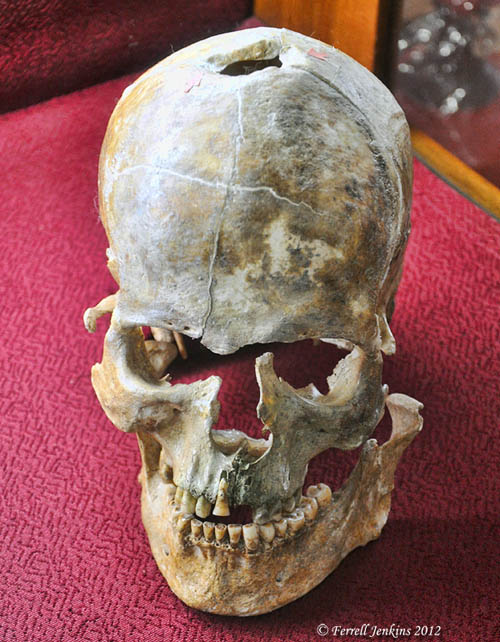
Ancient brain surgery that cut a hole in the skull to relieve pressure is referred to as trepanation. A few of the skulls found at Ikiztepe are displayed in the museum. They are said to belong to Bronze Age III. I think that would be in the neighborhood of 1600 B.C. Here are two of the photos I made that show the hole drilled in the skull.

Example of Trepanation, Bronze Age III, Ikiztepe. Samsun Archaeological Museum. Photo by Ferrell Jenkins.

Example of Trepanation, Bronze Age III, Ikiztepe. Samsun Archaeological Museum. Photo by Ferrell Jenkins.

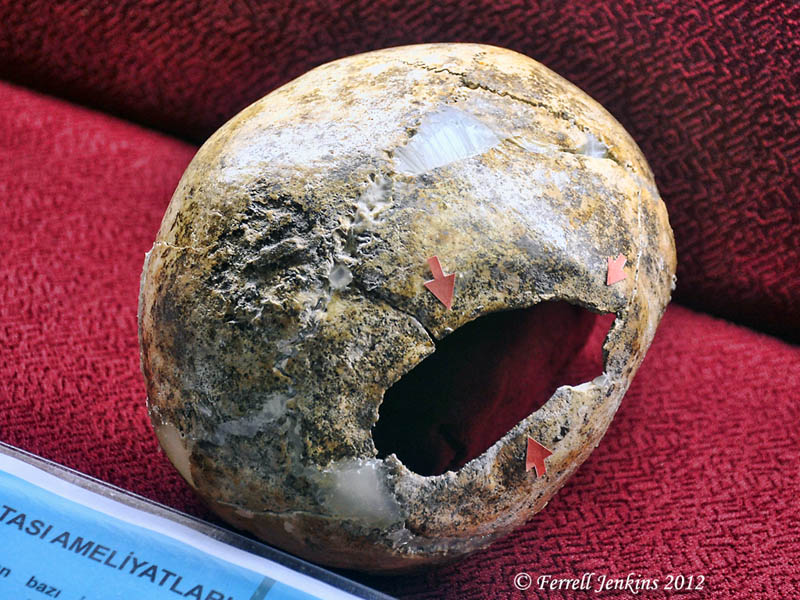
The surgery in the case below required a much larger hole.
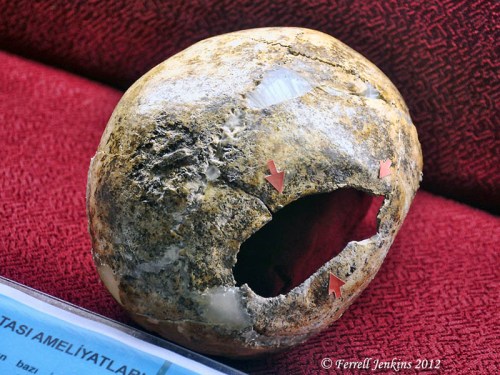
Example of Trepanation, Bronze Age III, Ikiztepe. Samsun Archaeological Museum. Photo by Ferrell Jenkins.

Example of Trepanation, Bronze Age III, Ikiztepe. Samsun Archaeological Museum. Photo by Ferrell Jenkins.

There is no indication whether the surgery was successful, or what happened to the surgeon if it failed.

Joe Zias, in an article in Mikhmanim (Spring 1999), says there have been 29 skulls showing trepanation (trephination) discovered in Israel. He says the survival rate based on “inflammatory or bone remodeling” indicate a 77 percent survival rate in these cases. You may read his entire article about this and other medical issues in ancient Israel here.

In a future post I plan to show you a few of the Roman period ruins, the time of Peter’s epistles (1 Peter 1:1).