Category Archives: Turkey

Hierapolis and Aphrodisias

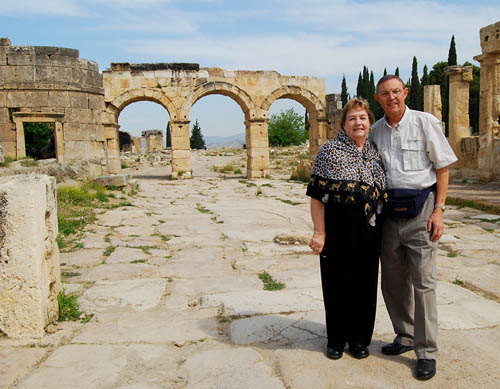
This morning we visited Hierapolis, a city famous for its hot mineral springs and terraced travertine formations. Tradition associates this city with Philip. It is not clear whether Philip the apostle, or Philip the evangelist is intended. A colonnaded street and the Arch of Domitian (emperor A.D. 81-96) was erected by Julius Frontinus, proconsul of Asia about A.D. 82-83. The book of Revelation was written about the time of Domitian’s death.

Elizabeth and I have been traveling some of these roads together since 1967.
Papias (about A.D. 60 to A.D. 130) was a disciple of the apostle John and a companion of Polycarp. Fragments of his writings about the apostles survive in Irenaeus and Eusebius. He is said to have been Bishop of Hierapolis. Eusebius (active about A.D. 185), tells us that Papias wrote as follows:

Matthew also issued a written Gospel among the Hebrews in their own dialect, while Peter and Paul were preaching at Rome, and laying the foundations of the Church. After their departure, Mark, the disciple and interpreter of Peter, did also hand down to us in writing what had been preached by Peter. Luke also, the companion of Paul, recorded in a book the Gospel preached by him.

Afterwards, John, the disciple of the Lord, who also had leaned upon His breast, did himself publish a Gospel during his residence at Ephesus in Asia. (Euseius, Against Heresies III.1.1)

Paul commended Epaphras for his labor on behalf of all of the churches of the Lycus River valley.

For I testify for him that he has a deep concern for you and for those who are in Laodicea and Hierapolis. (Colossians 4:13).

On the way to the Aegean coast we visited the fabulous new excavations at Aphrodisias. The National Geographic Society sponsored the excavations here for about 30 years. Many of the items from the Roman time are well preserved. These include the Roman stadium, the temple of Aphrodite, the odeon, the baths, and some marvelous sculp­tures in the Museum.

Tonight we are at Kusadasi, the Turkish resort town on the Aegean. Our hotel is about 12 miles from the ancient site of Ephesus which we hope to see tomorrow.
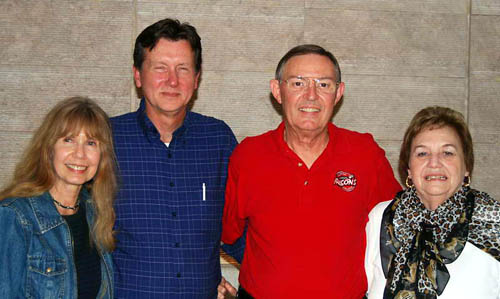
Dr. Mark Wilson speaks to our group

Dr. Mark Wilson and his wife, Dindy, shared the evening meal with us at the hotel this evening. Afterwards, Mark spoke to the group about his work in Turkey. Dr. Wilson is the founder and director of the Asia Minor Research Center, and spends about nine months each year working and doing research in Turkey. He has updated several of the works of Sir William M. Ramsay, and written several helpful books on the book of Revelation. You will find much helpful material by Dr. Wilson on the Seven Church Network web site.

Our group listened carefully as Dr. Wilson spoke of the importance of Turkey to the study of the New Testament. Members of the group asked several interesting questions. Several of our tour members were with us last year on the Ancient Crossroads Tour of Biblical and Historical Turkey. This photo shows Dindy and Mark Wilson with Ferrell and Elizabeth Jenkins after tonight’s session.

Izmir (Smyrna of the Book of Revelation)

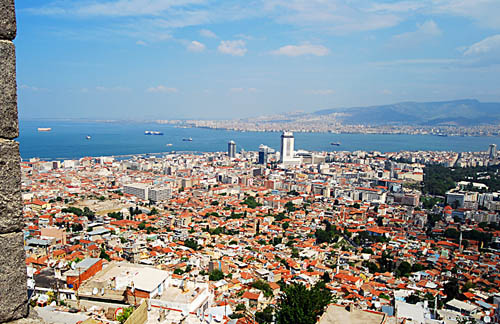
This morning we flew from Istanbul to Imzir, Turkey’s second largest city. Our sightseeing included Mount Pagos with its magnificent view of the city and harbor. Most of the ancient city of Smyrna is buried underneath the modern buildings. A portion of the Agora (marketplace) of Smyrna has been unearthed in the past. Houses have been demolished the a large area adjoining the agora, and preparations are being made for additional excavations. This will be exciting to watch.

There are two important archaeological museums in Izmir. We made short visits to each of them. In the older museum we saw the likeness of Flavius Damianus, an imperial priest under Emperor Septimius Severus, wearing a diadem. This provides an impressive image of the place of emperor worship in Asia Minor in the days following the writing of the book of Revelation.

And to the angel of the church in Smyrna write: ‘The first and the last, who was dead, and has come to life, says this: ‘I know your tribulation and your poverty (but you are rich), and the blasphemy by those who say they are Jews and are not, but are a synagogue of Satan. ‘Do not fear what you are about to suffer. Behold, the devil is about to cast some of you into prison, so that you will be tested, and you will have tribulation for ten days. Be faithful until death, and I will give you the crown of life. ‘He who has an ear, let him hear what the Spirit says to the churches. He who overcomes will not be hurt by the second death.’ (Revelation 2:8-11).

Significant biblical artfacts in the Istanbul Museum

My favorite place in Istanbul is the Archaeological Museum. There are several buildings. One contains items from the Ancient Orient, that is, from Mesopotamia, Assyria, Babylon, and a collection of Hittite items. Another has numerous items from the Greco-Roman world. On the third floor artifacts from Syria, Palestine, Lebanon, and Cyprus, are displayed.

The Ottoman Empire controlled Palestine in from the 16th to the 20th centuries. The earliest archaeology in Palestine was done at Megiddo, Tanaach, and Gezer. Since the Turks were in charge, many of the artifacts were brought to Istanbul. These items have not always been easy to see. Once or twice, in past years, I had to made a “donation” to the museum in order to get in room where these items are exhibited. Even now, it is difficult (for older visitors) because there are no elevators going to the third floor.

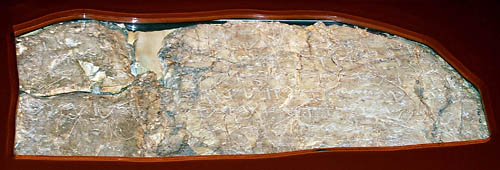
There is not time now to mention all of these items. However, I am pleased to share with you what I consider an unusually good photo made without a tripod and special lighting. It is the famous Siloam Inscription. We sometimes call its the Hezekiah;s tunnel inscription.

This inscription was cut from Hezekiah’s tunnel in Jerusalem shortly after it was discovered in 1880. The tunnel was built to connect Gihon Spring with the Pool of Siloam (ca. 710 B.C.; 2 Kings 20:20; 2 Chronicles 32:30; cf. John 9:7). Palestine was part of the Turkish empire at the time of the discovery and this is how the inscription came to be in Istanbul. The inscription, written in the ancient Hebrew script, describes the completion of the tunnel when the workers met near the middle on the last day of work. It reads, in part:

while there were still three cubits to be cut through, (there was heard) the voice of a man calling to his fellow, for there was an overlap in the rock on the right (and on the left). And when the tunnel was driven through, the quarrymen hewed (the rock), each man toward his fellow, axe against axe; and the water flowed from the spring toward the reservoir for 1,200 cubits, and the height of the rock above the head(s) of the quarrymen was 100 cubits. (Ancient Near Eastern Texts 321)

I have walked through Hezekiah’s tunnel several times and have seen the place from which the inscription was taken.

Aslan

We had a nice day in Istanbul. Sightseeing included the Blue Mosque, the Hagai Sophia, Topkapi Palace, and the Archaeological Museum. We toped off the day with a cruise on the Bosphorus. This is the strategic waterway that connects Russia (and the countries that were formerly part of the USSR) and the Mediterranean and the rest western world.

After I review my photos I will try to upload an additional one or two for your enjoyment. Below is something I wrote a few days ago about Aslan. Read and enjoy.

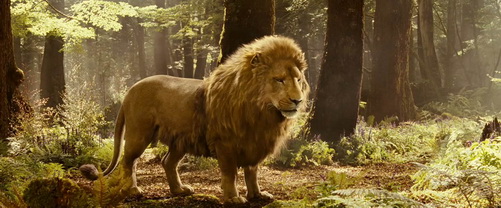
Everyone familiar with the Chronicles of Narnia remember that Aslan is the name of the lion. Note this paragraph about Aslan from Wikipedia.

Aslan is a word meaning lion. Lewis came up with the name during a trip to the Ottoman Empire, where he was impressed with the Sultan’s elite guards also called Aslan because of their bravery and loyalty.

I noticed a restaurant in Istanbul with the name Aslan. You may also recall that Edmund was tempted by Turkish delight. It is good stuff.

The Disney movie, Prince Caspian, opens May 15. The official website is here.

Check our page about C. S. Lewis here.

Istanbul was Constantinople; We are not banned.

The Today Show with Matt Lauer was here last week. Now it is our turn. This is where Europe meets Asia. The Bosphorus is the vital waterway linking the Black Sea to the Mediterranean. We plan to visit the Blue Mosque, the Hagia Sophia, and the Topkapi Palace with its priceless jewels. Our visit also includes the Istanbul Archaeological Museum which houses numerous discoveries of biblical interest. Everyone should visit the Grand Bazaar at least once. The bazaar is made up of more than 4,000 little shops under one roof. Everything from cheap trinkets to expensive jewelry and carpets may be found in the bazaar.

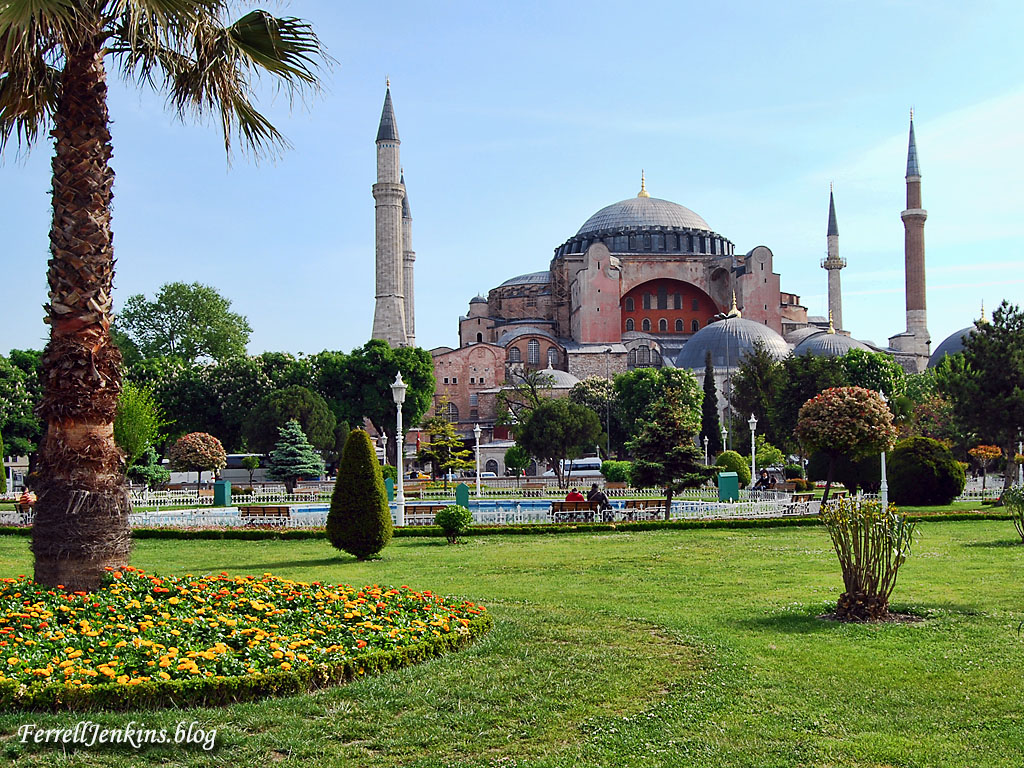
Here is a photo of the famous Hagai Sophia. This structure was built by the Emperor Justinian as a church between 532 and 537 A.D. Later it was converted to a mosque, and in now a museum. It is one of Istanbul’s most famous landmarks.

Hagai Sophia in Istanbul, formerly Constantinople. Photo: FerrellJenkins.blog.

Hagai Sophia in Istanbul, formerly Constantinople. Photo by Ferrell Jenkins.

Have you heard the song, “Istanbul (not Constantinople)”? The lyrics begin this way:

Istanbul was constantinople
Now its istanbul, not constantinople
Been a long time gone, constantinople
Now it’s turkish delight on a moonlit night

Let’s not forget that Constantinople was Byzantium.

On time arrival. We arrived safely in Istanbul this afternoon to beautiful weather. A few members of our group had come to the country early (as much as two weeks) to enjoy the sites. Others used their frequent flyer points. Everyone is here, and there is no lost luggage.

We are not banned. Perhaps the ban on WordPress has been lifted. I logged in with no problem. We hope this will continue to be true. Let us hear by Email if you have any difficult accessing the page. Use this Email address: fjtours [at] gmail [dot] com.

The 5 p.m. call to prayer just started (by loud speaker) at a nearby mosque. It reminds us where we are.

Ferrell’s Travel Blog banned in Turkey

Since sometime after our Ancient Crossroads Tour of Historical and Biblical Turkey (May and June, 2007), WordPress has been banned in Turkey.

Recently I checked with some friends in Istanbul. They tell me that this is the message they get when they try to access this page:

Access to this site has been suspended in accordance with decision no: 2007/195 of T.C. Fatih 2. Civil Court of First Instance.

A friend in Izmir (biblical Smyrna) says he is able to access this page. Izmir is our second stop. Perhaps we will be able to post here from some Turkish locations.

I have neither time nor interest to try to explain why this has happened. (It has nothing to do with this blog.)I can say that I don’t like censorship.

Because of this, I have setup a blog on Blogger. We will be posting there regarding the Steps of Paul and John Tour, at least while we are in Turkey. Please go to this URL:

fjtours.blogspot.com

If you have not read our posts from last May and June, please check the archives for those months to do so.

Where in the world?

Many of you probably saw the Today Show this morning. This is the week for Matt Lauer’s “Where in the world…” series. We have always enjoyed these programs because they remind us of so many places we have visited on our tours.

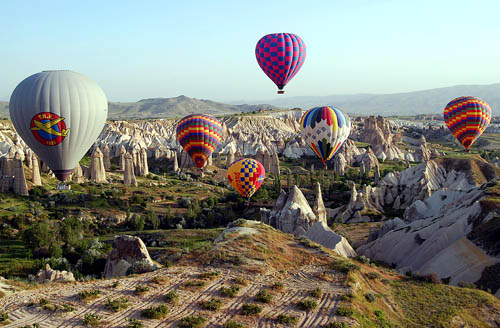
This morning Matt was in Istanbul, Turkey. We will be heading there in a few days to begin our Steps of Paul and John tour. There were a few scenes from other places in Turkey, including Ephesus and Cappadocia. We visited Cappadocia last summer on our Ancient Crossroads tour of historical and biblical Turkey. Here is a photo I made during a hot air balloon over the mysterious landscape of Cappadocia. Note the cultivated vineyards in the foreground below our balloon.

Two of the New Testament epistles were addressed to saints living in Cappadocia.

Peter, an apostle of Jesus Christ, To those who reside as aliens, scattered throughout Pontus, Galatia, Cappadocia, Asia, and Bithynia, who are chosen. (1 Peter 1:1).

All of the places mentioned in 1 Peter 1:1 are located in modern Turkey. It is a fascinating place to visit.

The stadium at Aphrodisias

Aphrodisias, located in southwest Turkey, was an ancient city of Caria in Asia Minor. It is not mentioned in the Bible, but is close to the cities of Laodicea, Hierapolis and Colossae. Robert F. Tannenbaum, an ancient historian, describes the location of the city this way:

A quiet, fertile valley folded into the Mediterranean hills, clear streams, tall poplars, ancient ruins more than 1,400 years old—a picture of pastoral quiet. (Biblical Archaeology Review, Sept/Oct 1986)

The site has been excavated since 1966, beginning under the direction of Kenan Erim of New York University. Marble was readily available at a nearby quarry and the excavation has brought to light a multitude of marble inscriptions and statues from the Roman period including a statue of the Emperor Domitian. Buildings include a theater, an agora, a bath, temples, and a well-preserved stadium.

Louw-Nida describes a stadium as an “open, oval area (frequently including a racetrack) around which was built an enclosed series of tiers of seats for those who came to watch the spectacles – arena, stadium.” When Paul spoke of running the race in 1 Corinthians 9:24, he used the Greek term stadion. The term was also used as a measure of distance and is found in John 6:19. It was about one-eighth of a Roman mile. Most large Greek and Roman cities had a stadium. The figure of the stadium is in mind in Hebrews 12:1-2, where a host of witnesses watch as we run the race.

Therefore, since we have so great a cloud of witnesses surrounding us, let us also lay aside every encumbrance and the sin which so easily entangles us, and let us run with endurance the race that is set before us, fixing our eyes on Jesus, the author and perfecter of faith, who for the joy set before Him endured the cross, despising the shame, and has sat down at the right hand of the throne of God. (Hebrews 12:1-2)

The stadium at Aphrodisias is the best preserved I have seen and I wanted to share it with you in the photo I made in 2006. Picture yourself in the stadium.

This article, with minor changes, was published in Biblical Insights, September, 2006.

Domitian, a hated emperor

One coin at a time is Brett Telford’s blog about coins. He has a marvelous photo of a silver Tetradrachm showing the image of Domitian. It was struck in Tarsus about A.D. 93-95. Please take a look.

Telford says,

The portrait reveals an emperor weary from insecurity and suspicion of conspiracy in the later years of his reign. His gaze bears witness to the demons that incited his paranoia. Domitian’s reign of terror began at around AD 93 and lasted until his death in AD 96… about the same time that this coin was struck.

After an interesting discussion of Ethelbert Stauffer’s theory that the titles of Domitian equal 666, Telford comments on the coincidence that this coin was minted at Tarsus, home of the apostle Paul.

This coin isn’t without its own Biblical reference. Tarsus, the city in which this coin was minted, was the birthplace of the Apostle Paul. Isn’t it ironic then, that a coin of the purported Biblical “Beast” was struck in the very city that brought us the most notable of early Christian missionaries.

Previously I have called attention to my books on Revelation. I failed to mention another brief publication about Domitian. Several years back Arthur M. Ogden and I wrote a series of exchanges. This publication, Did Domitian Persecute Christian? is available free in PDF at BibleWorld.

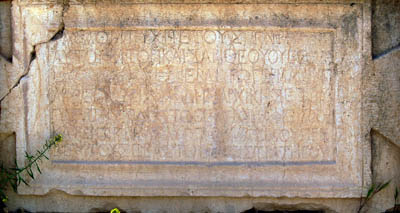
I have seen various inscriptions on which the name of Domitian has been scratched off. It means that he was a person of damnable memory. Recently on our trip to Jerash in Jordan we saw two inscription discovered when the theater was being restored. Here is a photo of one of them.

The inscription, which dates to the year A.D. 90/91, bears the title of the Emperor Domitian, but his name has been erased. The emperor is said to be the son of “divine (theou) Vespasian.” At the moment I can’t put my hands on it, but I recall that a translation of both inscriptions is included in the Newsletter of the American Schools of Oriental Research, Oct., 1974. Inscriptions like this definitely need to be in a controlled environment rather than outside in the weather.

On our upcoming Steps of Paul and John tour the name of Domitian will be used often.

HT: Georg S. Adamsen, Revelation Resources.