Category Archives: Travel

The Reformation and Restoration in Scotland

For those with an interest in Church History, Scotland provides many links. Scotland was influenced by the work of both Martin Luther and John Calvin, who were already advancing the Reformation principles in the early part of the 1500s. Sixteenth century Scottish leaders, who began their work a few years later, included George Wishart and John Knox.

Those of us with a background in the Restoration Movement in America find ourselves in agreement with many of the principles of the Reformation, but not with all of them. Thomas and Alexander Campbell came to America from Northern Ireland. In that area the people “were predominantly Anglo-Scottish in blood and Protestant in religion” (West). Thomas Campbell came to America in 1807. In 1808, when Alexander set out for America he was shipwrecked on the rugged shores of Scotland. Alexander entered Glasgow University where his father has studied earlier. He studied Greek, Logic, and Experimental Philosophy. He came in contact with several independent movements and was especially influenced by James and Robert Haldane. John Glas and Robert Sandeman influenced the young Campbell also. Their churches were congregational in government with a plurality of elders and deacons. They rejected human creeds, advocated weekly observance of the Lord’s Supper. See West, The Search for the Ancient Order, I:36-52.

In America, Barton W. Stone and the Campbells rejected the Calvinistic doctrines of inherited depravity, the direct operation of the Holy Spirit, etc. They determined that the New Testament was the standard of authority for Christians, and that baptism for forgiveness of sins is immersion. Infants did not need to be baptized because they are not sinners.

Writings of some of the Restoration leaders are available online at the Restoration Movement Page.

King James VI (James Stuart) of Scotland was King of Scots, King of England, and King of Ireland. He “authorized” the translation of the Bible that we still know as the King James Bible (1611). King James was born in Edinburgh Castle. The finished product was largely the work of William Tyndale whose New Testament was printed in 1525. His work on the Old Testament was completed by Miles Coverdale and the entire English Bible was first printed in 1535. Tyndale was strangled and burned at the stake in 1536. A nice time line on the Reformation can be studied at the Friends of Tyndale page.

Prior to the work of Tyndale in Scotland, Martin Luther was pushing the Reformation in Germany. Zwingli was at work in eastern Switzerland., and John Calvin was working with Theodore Beze in Geneva, Switzerland.

This beautiful and sunny morning I visited the John Knox house in Edinburgh. It is a house dating to the time of Knox and has been sparsely furnished in period furniture. It serves as a museum of the work of Knox. There are several printed volumes (including the Geneva Bible) of the time on display. The Knox house is located on the Royal Mile.
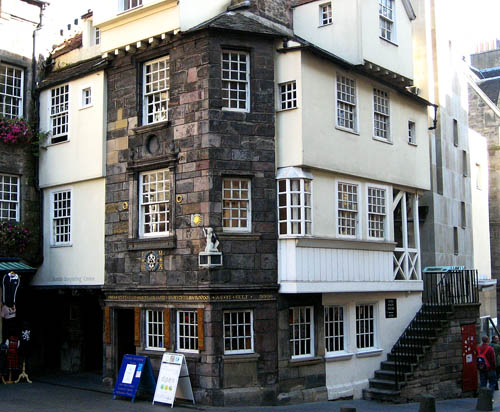
John Knox House, Edinburgh, Scotland.

This modern scribe, sitting at a table in the Knox house, is thinking about correcting some of the Calvinistic ideas advanced by Knox.
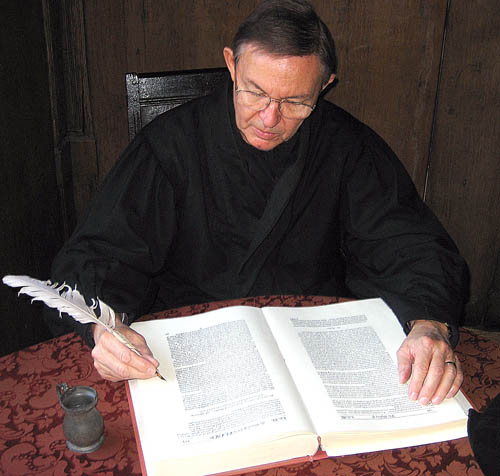
Modern Scribe in the John Knox House in Edinburgh.

I believe these men failed in some regards, but I am grateful for the work they did to bring us this far. To paraphrase the words of Bernard of Clairvaux, “If we can see further it is because we are standing on the shoulders of giants.”

“Let us therefore, as many as are perfect, have this attitude; and if in anything you have a different attitude, God will reveal that also to you; however, let us keep living by that same standard to which we have attained. Brethren, join in following my example, and observe those who walk according to the pattern you have in us.” – The Apostle Paul, Philippians 3:15-17.
Visiting Edinburgh

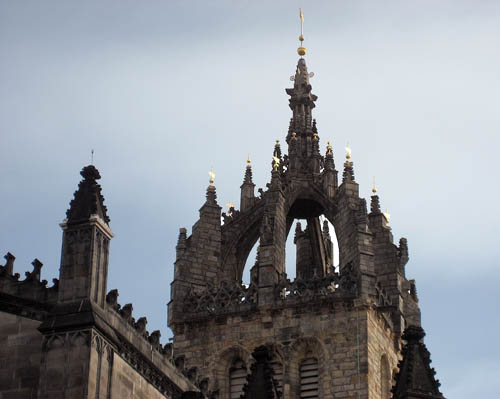
This morning we did the typical sightseeing of Edinburgh. This included Princes Street , the Royal Mile, a visit to St. Giles Cathedral, and the mighty Edinburgh Castle. St. Giles was built as a Roman Catholic church in about A.D. 1124. John Knox began preaching at St. Giles in 1559. Of course, by that time it was a church of the Reformation. Knox had been a friend of Wishart. After spending some time in Geneva with John Calvin he returned to Edinburgh. He is considered the father of the Socttish Reformation. This photo shows the crown of St. Giles, a dominant feature of the Edinburgh skyline.

St. Giles, Edinburgh, Scotland. Photo by Ferrell Jenkins.

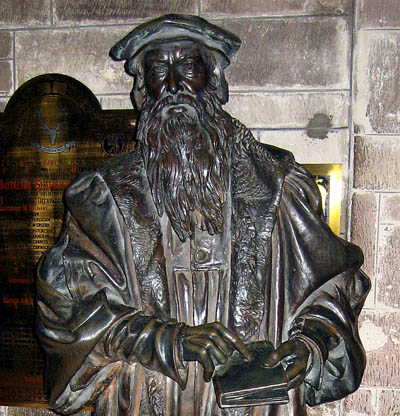
There is a nice statue of John Knox in the building. The most impressive thing about the Reformation is that it pointed men to the Scriptures, rather than to the authority of Rome. Notice that Knox is holding the Bible in one hand and pointing to it with the other. With this we are certainly in agreement.

John Knox in St. Giles. Photo by Ferrell Jenkins.

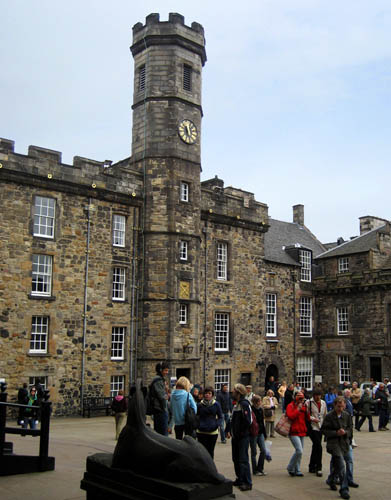
Some parts of the massive Edinburgh Castle date to the 12th century. The photo below is of the 15th century palace where Mary, Queen of Scots, gave birth to James VI, later to become King James I of England. He is the King James of the King James Version of the Bible (the “authorized” version) of 1611.

Edinburgh Castle. Photo by Ferrell Jenkins.

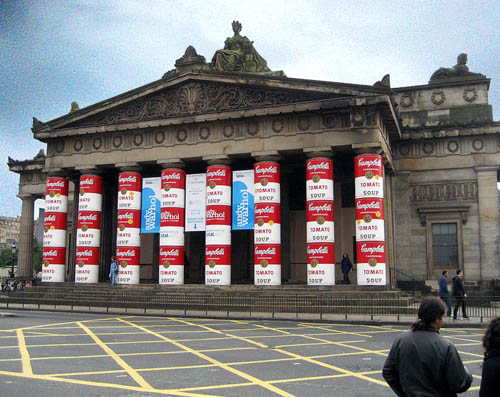
The afternoon was free of planned activity so that the tour members could spend time as they wished. Elizabeth and I visited the National Galleries of Scotland to see a special exhibition of Andy Warhol stuff. The front of the building was decorated with Campbell Soup cans. Someone we love works for Campbell Soup so we wanted to get a photo for him. His initials are very similar to mine! It was cold and windy today, and the sky was drab. I must confess to enhancing the sky a bit (lot).

National Galleries of Scotland, Warhol Exhibition. Photo by Ferrell Jenkins.

After seeing the Warhol Exhibition I decided to try my hand at such tomfoolery. I thought about placing a Dr. Pepper on a table, but decided against it.

From the Highlands to the Lowlands

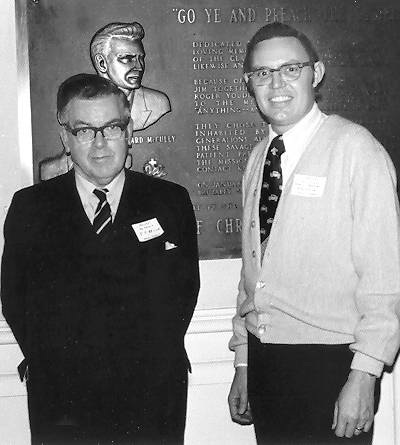
We left Inverness about 8 a.m. this morning headed south for Edinburgh. I began to notice road signs pointing to Elgin. This was the birth place of the late New Testament scholar, F. F. Bruce (1910-1990). He taught at Edinburgh, Leeds, Sheffield, and closed his academic career as Rylands Professor of Biblical Criticism and Exegesis at the University of Manchester. I have been greatly helped by the writings of Bruce, and was delighted to have the opportunity to meet him at a professional meeting in 1975. He was very gracious to an insignificant young teacher, and I have since appreciated that meeting.

F. F. Bruce and Ferrell Jenkins in 1975.

Elgin, Scotland, has a nice web page with a list of Famous Children. Alexander Graham Bell is listed among the famous from Elgin. (Poor guy never had to drive in front of a teenage girl with a cell (mobile  here) phone to her ear!). But F. F. Bruce, author of more than 30 books, is not listed among the Famous Children. Perhaps that will be corrected.

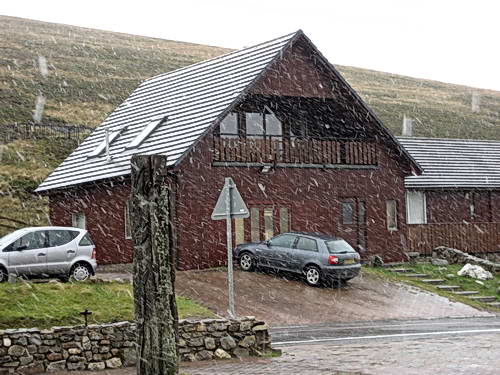
By the time we reached the area around Balmoral, summer residence of Queen Elizabeth and the Royal Family, the weather was very cold and windy. About the time we stopped at a ski lift snow flakes began to fall. The workers in the restaurant said it was the first snow of the season. Here is a photo I took. What appears to be white strips are actually snow flakes that were falling close to the camera.

Snow in the area of Balmoral. Sept. 17, 2007. Photo by Ferrell Jenkins.

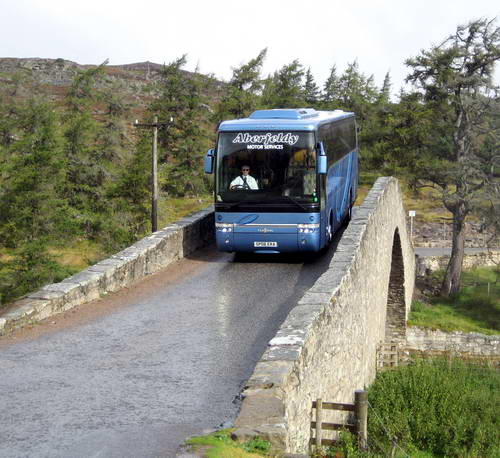
Because the Queen is at Balmoral we were not permitted to visit the estate. We did visit the Presbyterian church where the Queen, head of the Church of England, attends when she is in Scotland. Not enough time to tell you about this. If you saw The Queen, staring Helen Mirren, you saw scenes typical of this region. Here is a photo of our coach coming over a one lane bridge.

Coach coming over bridge near Balmoral. Photo by Ferrell Jenkins.

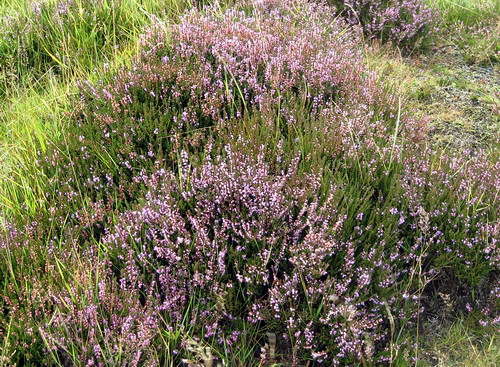
Heather is in abundance on the hills of the Highlands. Here is a close up.

Heather near Balmoral. Photo by Ferrell Jenkins.

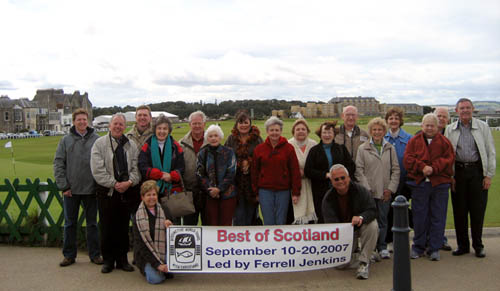
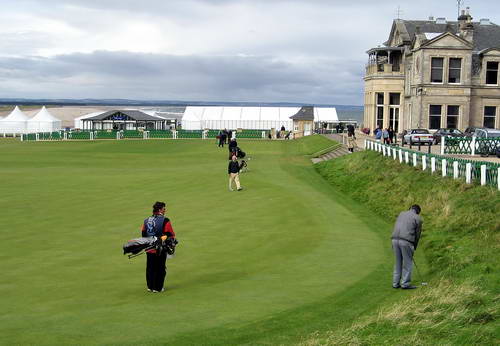
After lunch in Braemor we continued to St. Andrews, famous to all golfers as the birthplace of golf. We made a group photo here. The 18th hole is to the left.

Best of Scotland Group Led by Ferrell Jenkins.

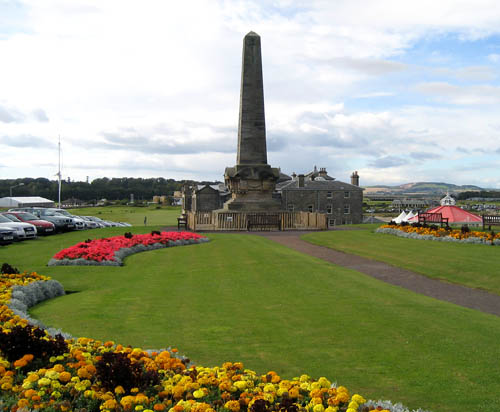
St. Andrews is home to one of the oldest universities. One of the blogs I read regularly is PaleoJudaica, a weblog by Jim Davila of St. Andrews University. St. Andrews has an important place in the Reformation Movement. John Knox preached here. At least four leaders of the Reformation, including Patrick Hamilton and George Wishart, were martyred in St. Andrews. I suspect that not many people who visit the Old Course know that the monument on the hill overlooking the course is a Martyrs Monument.

Martyrs Monument at St. Andrews. The Old Course in the distance. Photo by Ferrell Jenkins.

This golfer was having a little problem with the rough. That’s the North Sea in the distance. We had sun most of the time while here, but the wind was high and cold.

In the Rough at St. Andrews. Photo by Ferrell Jenkins.

We arrived in Edinburgh by 6:30 p.m. after an eventful day of beautiful scenery and unusual weather.

A cold, but enjoyable weekend in Inverness

Yesterday was Saturday, the Sabbath, the day of rest of the ancient Israelites (Ex. 20:8).. Today is Sunday, the Lord’s Day (Rev. 1:10; Acts 20:7). This day commemorates the resurrection of the Lord Jesus Christ. Christians of New Testament times gathered on this day to worship the Lord.

To a Floridian it has been cold here in Inverness, Scotland. Yesterday morning it was about 44 degrees. The forecast for this morning is 42, with a high of 50 for the day. The rain and wind makes it even colder in the northeast of Scotland. It is not raining at the moment and the wind is calm.

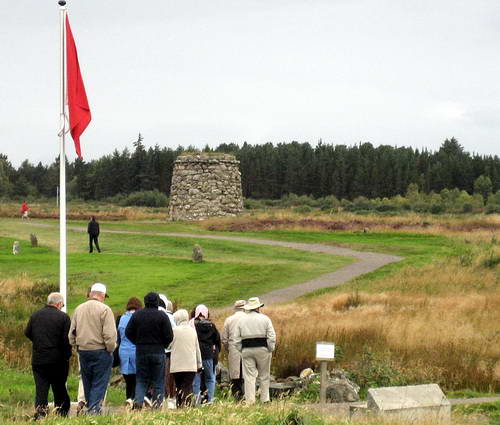
Yesterday we went to a famous battlefield nearby called Culloden. Here in 1746 the Jacobites (those who favored the kings named James) were defeated by the Government Army. This was the last battle fought on British soil.

Culloden Battlefield, Inverness, Scotland. Photo by Ferrell Jenkins.

Later we made the perfunctory stop at a woolen mill. Actually, many of the folks on the tour enjoy this. It gives them a chance to pick up a souvenir. Not everyone is looking at the clothing, as this picture of Herbert shows.

Gold at the Woolen Mill

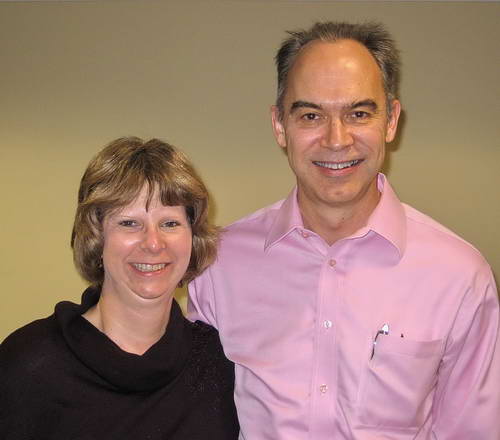
The weather was much better today. It was still cold, but the wind was calm even during periods of showers. Tim and Ann Byers, now living in Aberdeen, came to worship with us. It was a pleasure to see them. Both had been among my students at Florida College. Tim is now on work assignment in Scotland. He has produced a computer program called Everyone’s Guide to the Bible. I suggest you look into this good program. The web site is http://christianfriendssoftware.com. Here is a photo of Tim and Ann that I made this morning. They joined us for the afternoon sightseeing and we had a good visit.

Tim and Ann in Scotland.

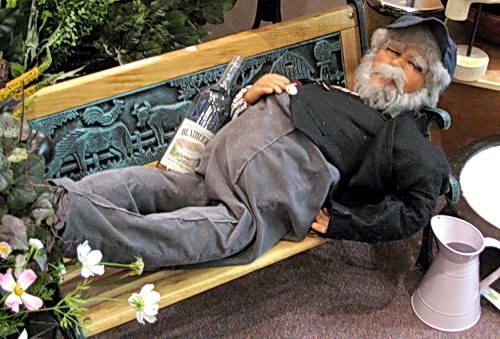
In the afternoon we went a few miles from Inverness to the Spreyside Heather center where we enjoyed a nice lunch. They even had jewelry made from heather. After that we continued to Cairngorm Mountains and took the funicular railway to near the top. The highest peak of the mountain, the highest in the UK, is 4,296 feet above sea level. Haze covered the top of the mountain, but we enjoyed the train ride and a cup of hot chocolate at the restaurant. There were some neat displays at the Spreyside Heather center. I suspect this one below illustrates the danger of Scotch Whiskey.

Scotch Whiskey. Display at the Spreyside Heather Center. Photo by Ferrell Jenkins.

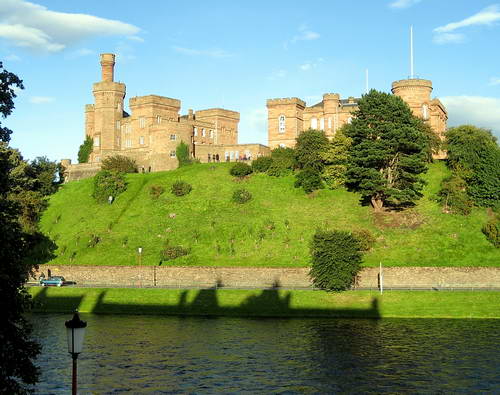
Our hotel in Inverness is situated directly across from the Inverness Castle. It is a fairly new construction that serves as the town center (city hall, etc.). The river in the foreground is the Ness River. It flows east from Loch Ness to the North Sea.

Inverness Castle. Photo by Ferrell Jenkins.

Tomorrow we leave early for St. Andrews and Edinburgh. Thanks for dropping by.

Isle of Skye, Loch Ness, and Inverness

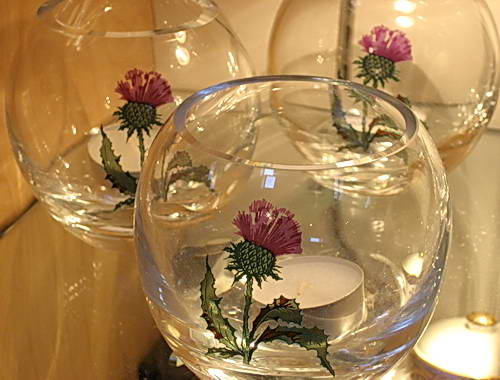
This morning we followed the shores of lovely Loch Linnhe to Glen Coe, site of the notorious 1692 massacre of the McDonald clan by the Campbells. At the Park shop I made this photo of some candleholders with thistles on them. The thistle is the national flower of Scotland.

Thistles on Candleholders. Photo by Ferrell Jenkins.

At Mallaig we boarded a ferry to Armadale on the Inner Hebridean Isle of Skye. We had lunch at McDonalds (not the one you first think of when you hear the name) at the Clan Donald Center, and then strolled the beautiful grounds of the park. We had a lot of sunshine today and this made the visit very enjoyable. The park has a new resource center with a good display about the people who once ruled this area. Many Americans have a Scottish ancestry, at least in part.

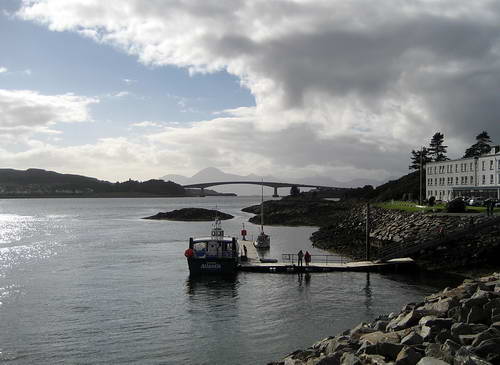
We drove over the Skye Bridge to return to the mainland. This photo shows the bridge with the Isle of Skye on the left and the mainland on the right.

Skye Bridge. Photo by Ferrell Jenkins.

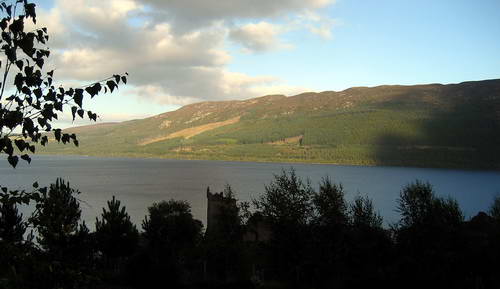
We continued north to Loch Ness. Here is a photo across the lake at Urqhart Castle. No one is our group claimed to have seen Nessie, the mysterious Loch Ness monster.


Loch Ness. Photo by Ferrell Jenkins.

We arrived in Inverness, the capital of the Highlands, about 6:45 p.m. Our hotel faces the River Ness. We plan to be here for the next two days.

From Oban to Iona (and back)

This morning we left Oban on the ferry for the Isle of Mull. It took about 50 minutes. From there we drove about 1 1/2 hour on a single track road with pull over area to the end of the island. There we took another ferry for a few minutes to Iona in the Atlantic Ocean. These islands are part of the Inner Hebrides.
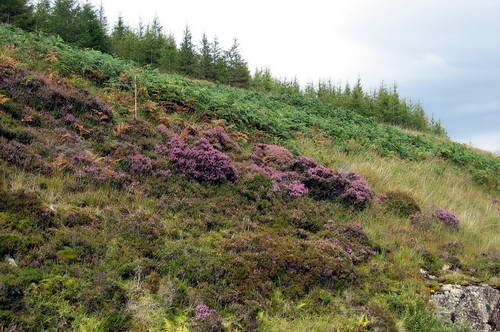
Along the way we had nice sunny weather. One of the beautiful sights was the lush pastures and contented sheep. Another was the heather growing along the roadside — the heather on the hill. In Brigadoon, one of the songs goes like this:

Can’t we two go walkin’ together, out beyond the valley of trees?
Out where there’s a hillside of heather, curtsyin’ gently in the breeze.
That’s what I’d like to do: see the heather–but with you.
The mist of May is in the gloamin’, and all the clouds are holdin’ still.
So take my hand and let’s go roamin’ through the heather on the hill.

Heather on the Hill. Photo by Ferrell Jenkins.

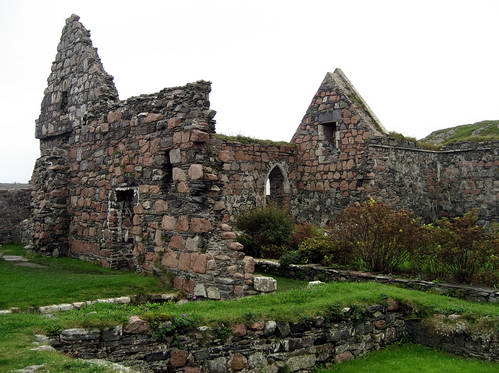
When we reached Iona it was windy and a bit chilly. In 597 A.D. Saint Columba came from Ireland to Iona to spread Christianity. From here Columba prepared the famous Book of Kells, an illuminated Gospels, now displayed in the Trinity College Library in Dublin, Ireland. It is not certain that anything remains on the island from the time of Columba, but there are numerous medieval ruins. Here is a photo of the ruins of the Iona Nunnery.

Iona Nunnery. Photo by Ferrell Jenkins.

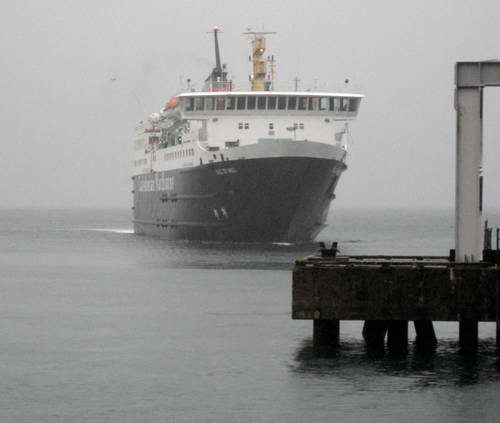
By the time we left the island the rain had begun. This is the way it looked when our ferry arrived at the Isle of Mull to take us back to Oban.

The Oban-Mull Ferry in the rain. Photo by Ferrell Jenkins.


Stirling Castle, Loch Lomond, Inveraray, and Oban

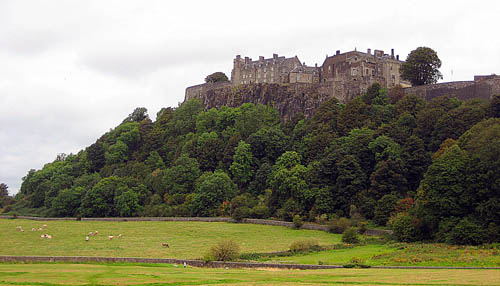
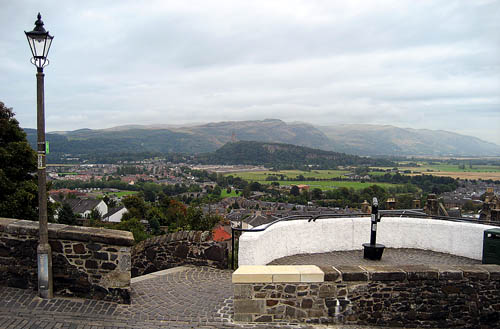
This morning we visiting Stirling Castle and its lovely gardens. The castle was home to most of the King Jameses. The castle looks down upon Bannockburn, Scotland’s proudest battleground where, in 1314, Robert the Bruce secured Scotland’s independence when he defeated the English. The photo below illustrates that the castle rises high above the plain and served as a suitable place for a fortress.

Stirling Castle

From Stirling Castle we are able to see the William Wallace monument at Abbey Craig. This monument recalls Wallace’s defeat of the English at Stirling Bridge in 1397.

Wallace Monument at Abbey Craig

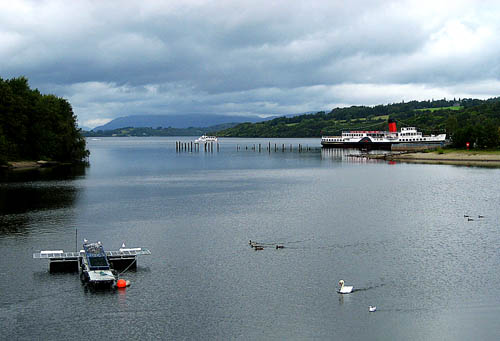
We stopped for lunch on the shore of Loch Lomond. Today we had some nice periods of sunshine, as this photo shows.

Loch Lomond. Photo by Ferrell Jenkins

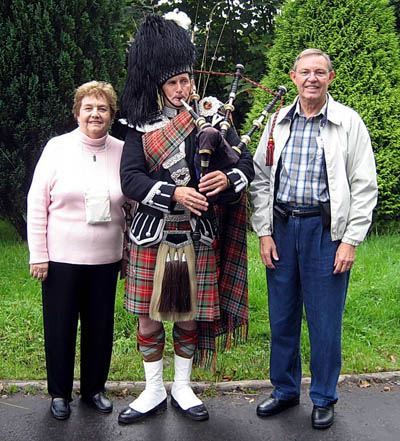
In the afternoon we made a short stop in the tiny town of Inveraray. Elizabeth and I had out photo made with a bagpiper.

Ferrell and Elizabeth and a Scottish Bagpiper at Inveraray.

Tonight we are staying at Oban, a seaport on the firth of Lorn. This small city is called the Gateway to the Isles.

Arrival in Glasgow, Scotland

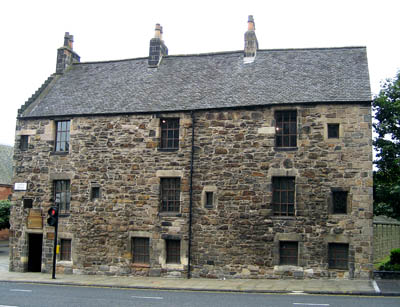
We had an on time flight from Newark to Glasgow on Continental Airlines. Glasgow, Scotland’s largest city, was founded by St. Mungo in A.D. 550. We visited the old area of the city around the Cathedral. The photo below is of the oldest building in the city. It was constructed in A.D. 1471. This University of Glasgow was in this area in previous times. It is here that both Thomas and Alexander Campbell attended university, and where they began their break with the Presbyterian church. They would become leaders in what we call the Restoration Movement in America.

Oldest House in Glasgow, Scotland. Photo by Ferrell Jenkins

You notice that there is no beautiful sky in the background. It even drizzled a little this morning. In the afternoon there were some beautiful periods of bright, sunny skies.

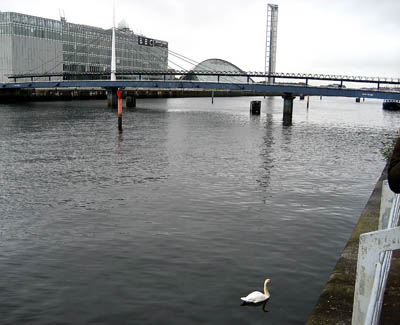
Glasgow was founded on the Clyde River. The swan adds a nice touch in this photo of the river. Glasgow was the home of Professor William Barclay, whose word studies have proved valuable to many preachers

Clyde River in Glasgow, Scotland. Photo by Ferrell Jenkins.

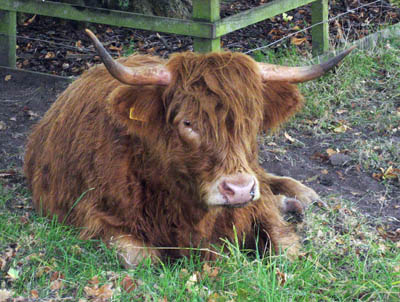
In the afternoon we visited The Burrell Collection, a nice museum in a beautiful natural setting in the outskirts of Glasgow. It holds the private collection of Sir William Burrell. Some Scottish long hair coos (we say cows) were on display in fields around the museum.

Scotland long hair coo (cow) at the Burrell Museum, Glasgow, Scotland.

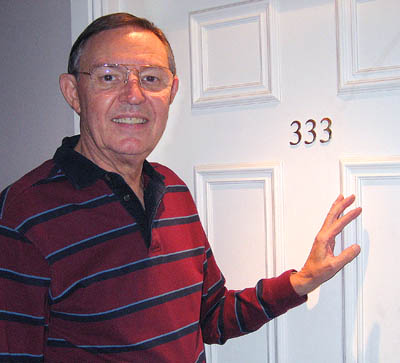
Out hotel tonight is north of Glasgow at Cumbernauld. It is a resort hotel with a beautiful golf course. This photo outside my room tonight shows that I am only half bad, contrary to what some have said!

Ferrell at Room 333. Westerfield Hotel, Cumbernauld, Scotland

Everyone in the group is doing well. Every piece of luggage arrived with us, and we are enjoying the cooler weather.


Off to the Highlands

This evening our group will be leaving for a Best of Scotland tour.

Best of Scotland Banner 2007

We hope to post a few blogs from Scotland in the next few days. The first one will probably be Wednesday, Sept. 12.

Elizabeth and I spent the night at the Country Inn and Suites near the Newark Liberty International Airport. I intended to do more on the Internet, but the wired connection from the room was as slow as molasses on a winter day. Hope to do better in Scotland.

Weeping for the Jordan

“Weeping for the Jordan” is the title of a short news item in Christianity Today, Sept., 2007, p. 17. The article from the RNS says the lower portion of the Jordan River “is so polluted that the World Monuments Fund (WMF) has designated it an Endangered Cultural Heritage Site.”

We often point out to audiences that the Jordan has much less water flowing through it now than it did even 50 years ago. This is because Israel uses much of the water of the Jordan and its tributaries for water and agricultural irrigation. Jordan has dams on the Yarmuk and Jabbok rivers, tributaries from the east.

There is not full agreement among scholars, but many believe that the site where Jesus was baptized by John is a few miles north of the Dead Sea. In 1967 I was able to visit that site. Since the 1967 war it has not been possible for tourists to visit there. A few years back a site was excavated in Jordan that has been claimed to be Bethany Beyond the Jordan (Jn. 1:28).

The CT article points out that the Jordan River is “highly polluted with sewage and agricultural runoff” near Bethany Beyond Jordan, but that some tourists do not realize this and wade in the water.

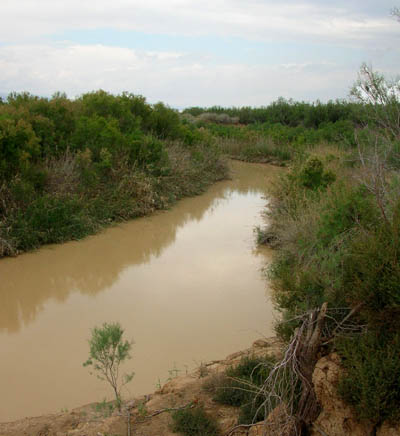
In 2006 I was able to take my group to Bethany Beyond Jordan and visit the Jordan River. Here is one of the photos made at that time.

Jordan River at Bethany Beyond the Jordan.

We are hopeful of visiting this site again in 2008. Perhaps it is in the area where John did some of his baptizing (cf. Jn. 10:40). The Israelites crossed the Jordan somewhere near here (Josh. 3), and the prophets Elijah and Elisha crossed in the opposite direction near here (2 Kings 3).

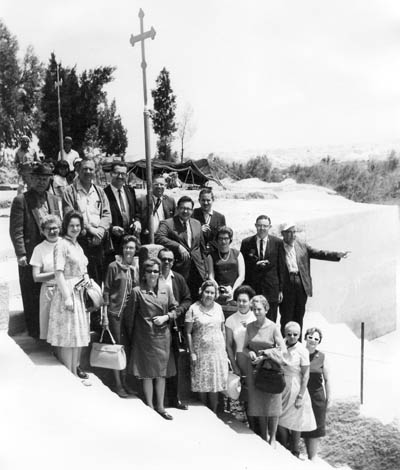
This photo was made on the West side of the Jordan River, in the country of Jordan, in 1967. This is directly across from the Bethany Beyond Jordan site.

1967 Bible Land Group led by Ferrell Jenkins and William E. Wallace.

The photo was made on or about May 5, 1967. Notice the attire. Women wore hosiery and other items to help their body hold an ideal shape. Most men wore a coat, and many wore ties on the plane and throughout the entire trip, even in hot weather. Some hotels would not allow a man in the dining room unless he was wearing a coat. Were these the good old days?