Category Archives: Photography

“Known but mostly unknown”

The late Paul W. Lapp is well known among students of archaeology for his 1963 article saying that the archaeology of Palestine (West Bank and Israel) is “known but mostly unknown.” Lapp died in a swimming accident in Cyprus in April, 1970) a few months prior to his 40th birthday.

Lapp’s article in Biblical Archaeologist (Vol. 26) begins this way:

Palestine (West Bank Jordan and Israel today) is perhaps the most excavated land in the world. Certainly the archaeological history of no country is better known. Since the beginning of archaeological work in Palestine at Tell el-Ḥesī in 1890 there have been few periods when there were not several expeditions in the field.

He continues by asking,

How Much Do We Know?

With some knowledge of the scope of archaeological activity in Palestine visitors in Jerusalem frequently ask: Are there still new sites to dig? Are there still exciting finds to be made in Palestine? One might go on to ask: Isn’t our knowledge of biblical times fairly complete? Don’t we have a picture of daily life at the time of Jesus which can be modified only in detail by future discoveries? The confidence with which archaeological conclusions are frequently drawn and the long books devoted to daily life in Palestine at the time of Jesus might suggest an affirmative answer.

My viewpoint here is that such a tiny fraction of the archaeological material has been excavated, and such a small fraction of that satisfactorily published, that even the most assured archaeological conclusions must still be considered far from final. This does not mean that all archaeological conclusions must be basically vague and noncommittal. Our knowledge of Palestinian archaeology has been built step by step, from the best hypothesis explaining evidence available at an early stage of exploration to the best hypothesis to explain evidence currently at hand. Without the discipline of continuous updating of hypotheses as new evidence comes to light chaos would prevail. The nonspecialist would find it much more difficult to judge among interpretations than is now the case. All that is stressed here is that in view of the vast amount of unknown material, archaeologists will be forced to modify or reformulate many, if not all, their hypotheses regarding the development of Palestine as the flood of new evidence continues to grow. Palestinian archaeology may be past infancy but has hardly gotten beyond childhood.

I have no current figures about the percentage of known sites that have been excavated. Often in speaking about the archaeology of Israel and the West Bank I say that the surface has hardly been scratched.

What got me to thinking about Lapp’s article was this aerial photo of Tel Dan that I made in May. Prof. Avraham Biran began the excavations at Tel Dan in 1966 and worked at the site for more than 30 years. Others have continued the work. If you have been to Tel Dan you will recognize the three main areas that have received attention (1) the Middle Bronze city gate, (2) the Iron Age gate complex, and (3) the High Place (bama). Would you agree that there may still be some work to be done at the site?
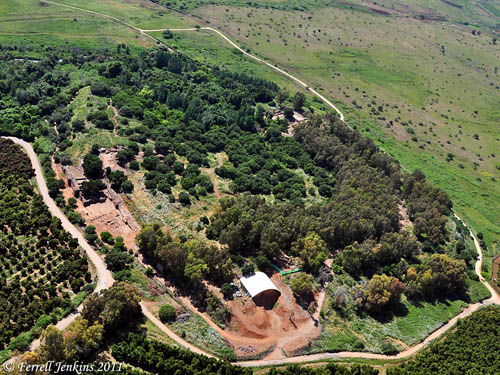
Aerial view of Tel Dan. Photo by Ferrell Jenkins. 2011.

Aerial view of Tel Dan. Photo by Ferrell Jenkins. 2011.

Is there still much archaeological work to be done? Is it still mostly unknown? Are you kidding? Extend this thought to Jordan, Syria, Lebanon, Turkey, Greece, Turkey, et al.  This is why we must sometimes be satisfied with a limited amount of evidence.

Got to go. Today is Grandson Day prior to school beginning tomorrow.
Video on Jerusalem

Prof. Aren Maeir shares this video on Jerusalem: Filmed in 3D. We probably have a few readers who do not regularly visit his Tel es-Safi/Gath blog. Lots of good stuff there.

Jerusalem | Filmed in Imax 3D from JerusalemGiantScreen on Vimeo.

Mount Hermon from the Damascus Road

Mount Hermon is the southern end of the Anti-Lebanon mountain range. The mountain is about 20 miles long and has three peaks. At 9,232 feet above sea level it is the highest mountain of Canaan, or Roman Syria, named in the Bible. The mountain now is shared by the countries of Lebanon, Syria, and Israel. The photo below shows mount Hermon from the east, a few miles south of Damascus toward Quneitra. This is roughly the route of the famous Damascus Road taken by Paul as he went from Jerusalem to Damascus. This photo was made the middle of May, 2002. There was more snow on the west side of the mountain in Lebanon than you see here.

View of Mount Hermon from the East. Photo by Ferrell Jenkins 2002.

View of Mount Hermon from the East. Photo by Ferrell Jenkins 2002.

The first biblical reference to Mount Hermon is found in Moses’ account of the Israelite conquest of transjordan (Deuteronomy 3:8). He says that Israel took the land from the hand of two Amorite kings “from the valley of Arnon to Mount Hermon.” The Sidonians, of ancient Phoenicia, called the mountain Sirion, and the Amorites called it Senir (Deuteronomy 3:9). The half-tribe of Manasseh lived in the area of Bashan which is south of Mount Hermon (1 Chronicles 5:23). The Mountain of Bashan is probably a reference to Mount Hermon (Psalm 68:15). Hermon is mentioned in four references in the poetic books of the Old Testament (Psalm 42:6; 89:12; 133:3; Song of Solomon 4:8).

The heavens are yours; the earth also is yours; the world and all that is in it, you have founded them. The north and the south, you have created them; Tabor and Hermon joyously praise your name. (Psalm 89:11-12 ESV)

This post is a slightly revised post from 2009, but the photo is a new one digitized from a slide made in 2002.

Damascus is important in biblical history

Damascus is one of the oldest continuously inhabited cities mentioned in the Bible. It is mentioned no less than 60 times. Syria is mentioned a few times more.

Abraham went north of Damascus to rescue lot from the Mesopotamian kings (Genesis 14). He named (or considered?) Eliezer of Damascus as his heir (Genesis 15:2). I think it is most likely that Abraham, and the other patriarchs, traveled through Damascus on their way to the promised land.

The city continued to be important in biblical history during the time of the United and Divided Kingdoms of Israel and even to New Testament times (think conversion of Saul, Acts 9).

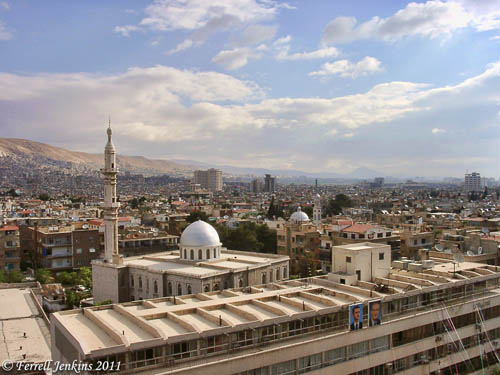
This photo was made from my hotel window in Damascus. The view is to the west (left side of photo) and north (right side of photo).  Damascus is built against the Anti-Lebanon mountains on the west. The desert on the east of the city stretches to the Euphrates River. Note two of the ever present photos of the young president Asad and his father on the building at the bottom of the photo.

Damascus. View west and north. Photo by Ferrell Jenkins.

Damascus. View west and north. Photo by Ferrell Jenkins 2002.

Mount Hermon is in the Anti-Lebanon range a few miles south of Damascus.

Hama, Syria = Hamath of the Bible

The city of Hama has been in the news quite a bit lately as the unrest of the citizens has been put down by the Syrian government. This is not something new to that city.

In 1982 Hama was the scene of the bloodiest episode of Syria’s modern history. (Footprint Syria & Lebanon Handbook 215).

At that time the protest was against the father of current president Bashar al-Asad. Estimates of the number killed range from 10,000 to 25,000.

Perhaps many Bible students read or see/hear the news about Syria today and fail to realize that this city is the site of an important city in the history of Israel. Hama is at the site of Biblical Hamath  (2 Kings 14:25; 2 Chronicles 8:4).

He [Jeroboam] restored the border of Israel from Lebo-hamath as far as the Sea of the Arabah, according to the word of the LORD, the God of Israel, which he spoke by his servant Jonah the son of Amittai, the prophet, who was from Gath-hepher. (2 Kings 14:25 ESV)

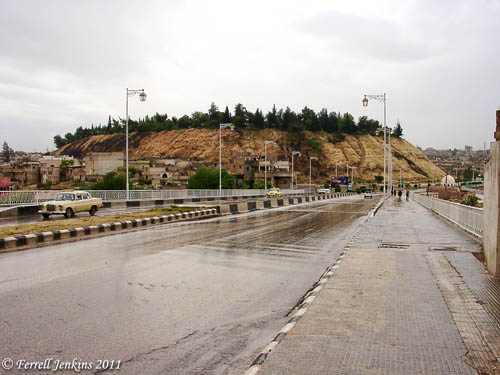
Our photo shows the tell or mound of Hamath situated on the left bank of the Orontes River as we approach from the north.

Citadel Mound of Hamath on the left bank of the Orontes River. Photo by Ferrell Jenkins.

Citadel Mound of Hamath on the left bank of the Orontes River. Photo by Ferrell Jenkins.

The work of Danish archaeologists at Hamath between 1931 and 1938 revealed occupation from the 6th millennium B.C. to the Middle Ages (Marie-Louise Buhl, Anchor Bible Dictionary). German archaeologists have been working in Hama recently, but I do not know whether it involves the tell.

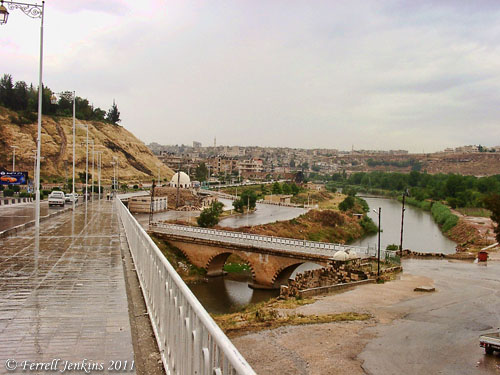
The next photo shows a small portion of the tell with the Orontes River below. It was raining when we visited Hama in 2002.

Hamath on the Orontes. Photo by Ferrell Jenkins.

Hamath on the Orontes. Photo by Ferrell Jenkins.

King Toi of Hamath is mentioned twice in the Bible (2 Samuel 8:9-10; 1 Chronicles 18:9-10). One scholar recently equated biblical King Toi with a King Tatais whose name is known from inscriptions. See here.

Current news becomes much more interesting and meaningful once we know the history of a place.

Roman sword & menorah engraving discovered

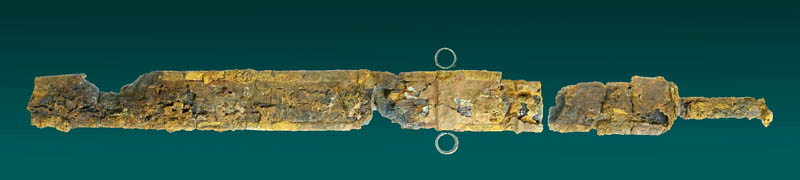
The Israel Antiquities Authority announced Monday the discovery of a Roman sword still in a scabbard and a stone with the engraving of the temple menorah.

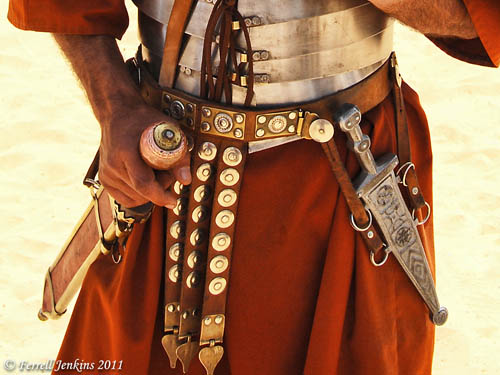
Roman sword in scabbard. IAA photo by Clara Amit.

Roman sword in scabbard. IAA photo by Clara Amit.

During the course of work the Israel Antiquities Authority carried out in Jerusalem’s ancient drainage channel, which begins in the Siloam Pool and runs from the City of David to the archaeological garden (near the Western Wall), impressive finds were recently discovered that breathe new life into the story of the destruction of the Second Temple. The excavations are being conducted on behalf of the Israel Antiquities Authority, in cooperation with the Nature and Parks Authority and are underwritten by the City of David Foundation.

A 2,000 year old iron sword, still in its leather scabbard, was discovered in work the Israel Antiquities Authority is doing in the channel, which served as a hiding refuge for the residents of Jerusalem from the Romans at the time of the Second Temple’s destruction. In addition, parts of the belt that carried the sword were found. According to the excavation directors Eli Shukron of the Israel Antiquities Authority and Professor Ronny Reich of the University of Haifa, “It seems that the sword belonged to an infantryman of the Roman garrison stationed in Israel at the outbreak of the Great Revolt against the Romans in 66 CE. The sword’s fine state of preservation is surprising: not only its length (c. 60 cm), but also the preservation of the leather scabbard (a material that generally disintegrates quickly over time) and some of its decoration”.

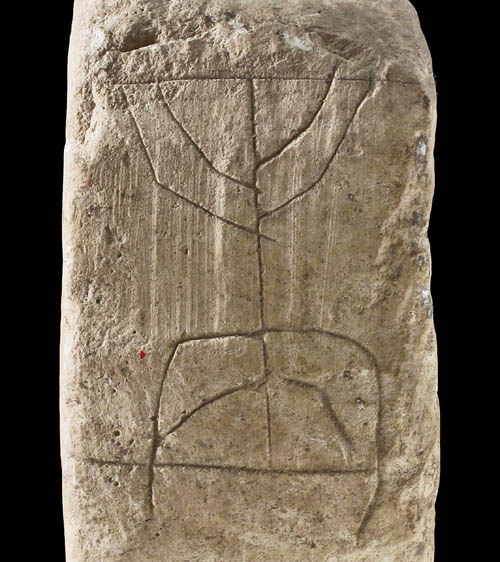
A stone object adorned with a rare engraving of a menorah was found in the soil beneath the street, on the side of the drainage channel. According to Shukron and Professor Reich, “Interestingly, even though we are dealing with a depiction of the seven-branched candelabrum, only five branches appear here. The portrayal of the menorah’s base is extremely important because it clarifies what the base of the original menorah looked like, which was apparently tripod shaped”. The fact that the stone object was found at the closest proximity to the Temple Mount to date is also important. The researchers suppose a passerby who saw the menorah with his own eyes and was amazed by its beauty incised his impressions on a stone and afterwards tossed his scrawling to the side of the road, without imagining that his creation would be found 2,000 years later.

Menorah found beneath 1st century street. IAA photo by Vladimir Naykhin.

Menorah found beneath 1st century street. IAA photo by Vladimir Naykhin.

An AP report with several enlargeable photos is available here.

I think this blog was the first one to report walking through the sewer more than 15 months ago. See here.

Two words are used for sword in the Greek New Testament. The more common word is machaira which describes a short, tongue-shaped sword or dagger. The term rhomphaia, which describes a long sword, is used only in Luke 2:35 outside the book of Revelation. It is used 6 times in Revelation. Probably all but one of these finds Christ as the bearer of the sword (1:16; 2:12; 2:16; 6:8; 19:15; 19:21). The book of Revelation has a setting in the Roman Empire outside of Palestine. The use of rhomphaia seems to be the appropriate term.

In one of the news reports about the recently found sword, archaeologist Elie Shukron is quoted as saying that the sword was the type used by Roman centurions, but that it was probably taken from the Roman garrison by one of the Jewish rebels (see here). This seems much more plausible to me.

G. K. Beale comments on the sword coming out of the mouth of Jesus:

The Christians in Asia are to understand that Jesus will do battle in this manner not only against the evil nations (19:15) but also against all those among the churches who compromise their faith (2:16). The consensus is that this sword alludes to that of the Roman soldier, used in battle, further enhancing this idea. (The Book of Revelation in NIGTC, 212)

This photo was made at the RACE show (Roman Army and Chariot Experience) in the hippodrome at Jerash, Jordan. It shows the centurion wearing both swords.

Roman Centurion at Jerash with two swords. Photo by Ferrell Jenkins.

Roman Centurion at Jerash with two different swords. Photo by Ferrell Jenkins.

HT: Bible Places Blog; Joseph Lauer.

The wilderness — a dry and weary land

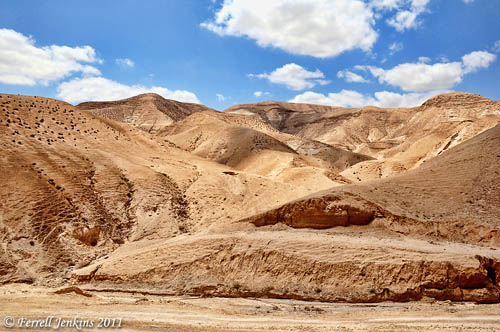
Wilderness of Judea. Photo by Ferrell Jenkins.

A scene in the Wilderness of Judah. Photo by Ferrell Jenkins.

A Psalm of David, when he was in the wilderness of Judah. O God, you are my God; earnestly I seek you; my soul thirsts for you; my flesh faints for you, as in a dry and weary land where there is no water. (Psalm 63:1 ESV)

The plain of Acco from Haifa north

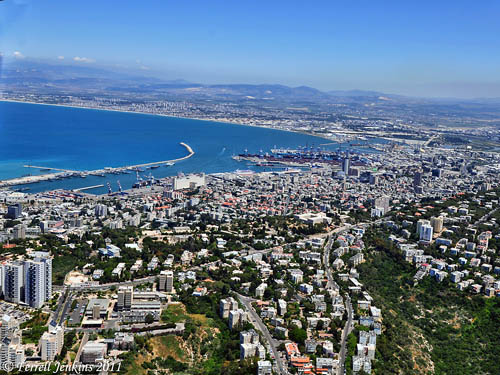
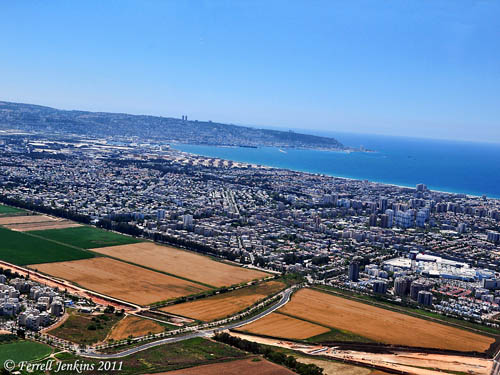
Please refer to yesterday’s post about the plain of Acco. In the photo below we begin over Mount Carmel and look north toward Acco, and east toward the mountains of upper Galilee. The city of Haifa, Israel’s third largest city after Jerusalem and Tel Aviv, is below. This photo had to be made without the window of the plane being opened and lacks a little of the sharpness I like. I think it does illustrate the narrow “plain” as it stretches along the Mediterranean coast.

View of Plain of Acco from above Mount Carmel and Haifa. Photo by Ferrell Jenkins.

View of the Plain of Acco from above Mount Carmel and Haifa. Photo by Ferrell Jenkins.

Our next photo looks southwest over the southern portion of the plain. Notice the narrow strip of city buildings and the beautiful farm land. The land extending out into the Sea is that little hump that teachers learn to draw when they sketch the coastal outline of Israel. Don’t overlook that there is more to Mount Carmel. It extends from the northwest to the southeast for about 14 ½ miles.

Southwest view of the Plain of Acco. Mount Carmel is in distance. Photo by Ferrell Jenkins.

Southwest view of the Plain of Acco. Mount Carmel is in distance. Photo by Ferrell Jenkins

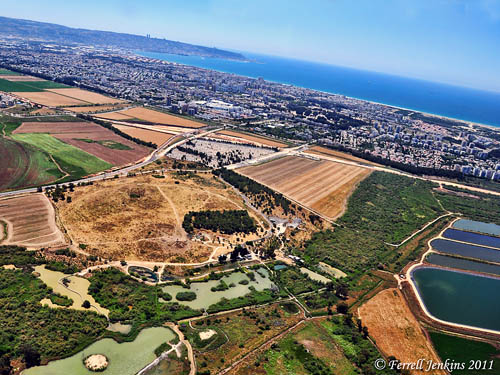
The next photo is much the same except that it was made a few miles inland. A tell (archaeological mound) is seen on the plain of Acco. This site is known as Afek (Aphek) of the tribe of Asher (Joshua 12:18; 19:30). Don’t confuse this with Afek (Aphek) in the account of Israel losing the ark of the covenant to the Philistines (1 Samuel 4). More about that another time.

Afek of Galilee with southwest view of Plain of Acco toward Haifa. Photo: F. Jenkins.

Afek of Galilee with southwest view of Plain of Acco toward Haifa. Photo: F. Jenkins.

Now that we have discussed the plain of Acco, we suggest you refer to our posts mentioning the plain of Sharon (here), and the plain of Philistia (here).

Monday meandering — August 1

My upgrade to BibleWorks 9 arrived about a week ago. I am enjoying getting acquainted with some of the new features and resources. For information see here.

Bible Works 9

Mark Hoffman has given a sort of pre-review at his Biblical Studies and Technology Tools website here. Hoffman was a beta tester for the new version.

Hoffman also talks about Logos for Android here. As a user of Logos (Libronix) I was delighted to see this beta app for the Android. I am enjoying access to many of the Logos books and have downloaded a couple of significant volumes.

Carl Rasmussen, author of Zondervan’s Atlas of the Bible, recently visited a well preserved portion of the Caesarea aqueduct. But it is not the portion of the aqueduct that most tourists see immediately north of Caesarea. This portion is about 3 miles north-northwest of Caesarea. Nice photos included on his HolyLandsPhoto blog here.

Carl also reports that a new paved road now goes directly to Yodfat (Jotapata). This is an improvement over the hour long walk to the site. See here. He visited Qumran, caves 1 and 11. See here.

Since I wrote the two paragraphs above there is a new post about the Middle Bronze I Age tombs (2200-2000 B.C.) located about 16 miles northeast of Jerusalem at Dhahr Mirzbaneh (east of Ein Samiya). Click here.

These three posts by Prof. Rasmussen include photos with a link to additional photos at his Holy Land Photos site.

The Center for the Study of New Testament Manuscripts (CSNTM) announces that they have added Free Audio and Video at iTunes U.

The Center for the Study of New Testament Manuscripts (CSNTM) has always been committed to helping others understand the reliability of our New Testaments, the history of translations, the study of the text, and significant figures who have made this possible.

Beginning today, CSNTM is making a series of videos concerning New Testament manuscripts, textual criticism, history of the New Testament, and expert commentary on key verses available as a free download on iTunes U.

Featured in the videos are interviews and footage shot around the world of important people involved in the work of the Center. Dr. Daniel B. Wallace will also be featured as he explains important aspects in the study of the text of the New Testament.

CSNTM homepage is here. The direct link to the series on Biblical Criticism at iTunes U is here. Inexpensive way to get a great education. Daniel Wallace does a superb job with these presentations. Take some time to listen and study.

Dr. Wallace will debate Bart D. Ehrman at SMU in Dallas Saturday October 1 on the subject Can We Trust the Text of the New Testament? There is a charge for admission, but perhaps this material will be available later on audio/video. Info here.

Tomb of Philip found at Hierapolis?

Italian professor Francesco D’Andria announced the discovery of the tomb of the Apostle Philip at Hierapolis. See more, with a photo, here.

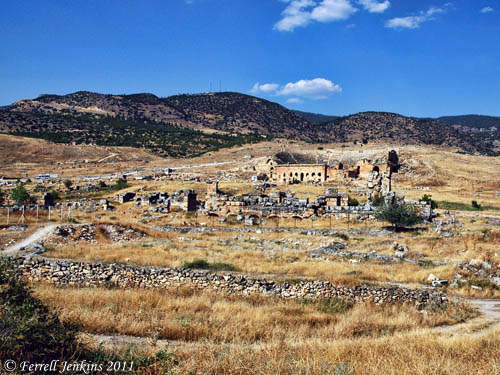
The structure at Hierapolis known as the Martyrium of Philip dates to the 5th century A.D. It is located in the distance above the theater.

Hierapolis. The Martyrium of Philip is in the distance beyond the theater. Photo by Ferrell Jenkins.

The Martyrium of Philip is in the distance beyond the theater. Photo by F. Jenkins.

Early tradition associates Philip with the city, but scholars differ over whether it was Philip the apostle (Matthew 10:3) or Philip the evangelist (Acts 21:8). The brief reports of the discovery by Prof. D’Andria does not provide enough information for us to be able to draw a conclusion. The question of which Philip is addressed by Mark Wilson in Biblical Turkey and Fant and Reddish in A Guide to Biblical Sites in Greece and Turkey. I will leave it for the moment.

This new discovery will more likely reflect the 5th century Byzantine tradition about Philip.

Hierapolis is mentioned only once in the New Testament, as one of the cities of the Lycus River Valley.

For I bear him witness that he has worked hard for you and for those in Laodicea and in Hierapolis. (Colossians 4:13 ESV)

Hierapolis is also known as the home of Papias (about A.D. 60 to 130) who was a disciple of the apostle John and a companion of Polycarp. Fragments of his writings about the apostles survive in Irenaeus and Eusebius.

We have commented on Hierapolis several times over the years. See here. Use the Search box to locate the other posts if you have additional interest in the city.

HT: Doy Moyer