Category Archives: Photography

Don’t underestimate the donkey

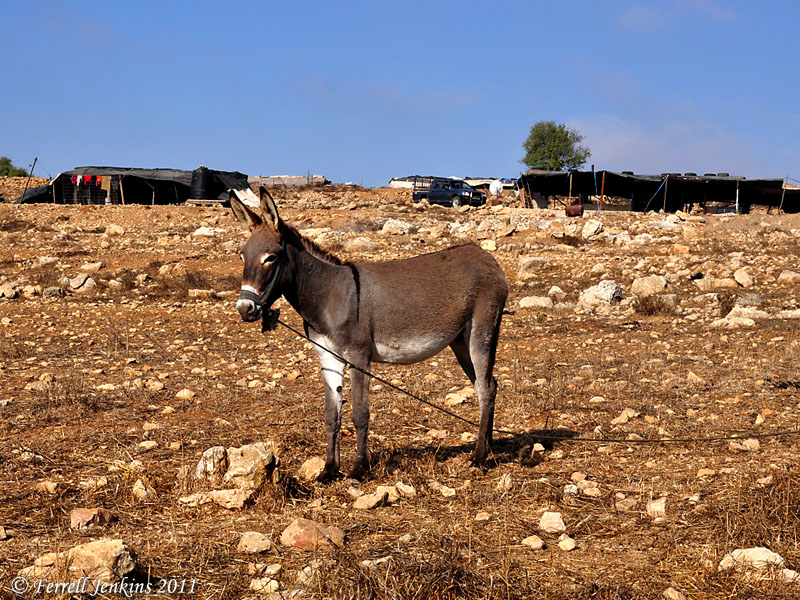
Yesterday when our driver was trying to locate the way to el-Jib (= Gibeon) we passed an area in the territory of Benjamin where someone, presumably a Bedouin, had two tents, some small fields, a truck, and a donkey tethered out front.

Donkey and Bedouin Tents Near Gibeon. Photo by Ferrell Jenkins.

Donkey and Bedouin Tents Near Gibeon. Photo by Ferrell Jenkins.

There are many biblical references to the donkey. I will list just one for now. The importance of the donkey is seen in the Ten Commandments. The neighbor’s donkey is not to be coveted. Most urban dwellers of today would never think of doing that. But in Bible times the donkey was used in the fields, carried heavy loads, provided transportation for the owner, and supplied fertilizer for some crops.

“You shall not covet your neighbor’s house; you shall not covet your neighbor’s wife, or his male servant, or his female servant, or his ox, or his donkey, or anything that is your neighbor’s.” (Exodus 20:17 ESV)

Today was a slow day — finalizing some matters and packing to return home. Resting a little, too.  Ready to begin the long flight back home in a short time. Did I complete the “bucket list” for this trip? Not quite. Probably completed about 80% of it. Well that leaves some places to begin with for the next trip. Like my friend Larry often says, “Life is good!”

A day in the West Bank

There was a time that it was easy to visit sites in the Palestinian West Bank. That is no longer true. Car rental companies will not permit their cars to be taken into the West Bank. We hired a driver and vehicle (4WD) to take us several places. I think we were fortunate to obtain the services of a tourist bus driver who happened to have a day free. Even for him going into the West Bank was not easy.

First it is necessary to choose the appropriate border crossing. Then instead of taking what formerly was the most direct route drivers must go in circles to avoid running into the fence (or wall). This is especially true near Jerusalem.

Our first stop was Gibeon (Joshua 9-10). The last time I was there to see the excavations by James Pritchard of the University of Pennsylvania I drove directly to the ruins. This time it was extremely difficult to reach the same ruins. We were successful in our efforts and got some good photos that we hope to share later.

We also stopped at Shiloh where the tabernacle was set up after the ancient Israelites entered Canaan  (Joshua 18:1). A team from the Israel Antiquities Authority was excavation in three different areas low on the tel in areas mostly from the Islamic and Byzantine period.

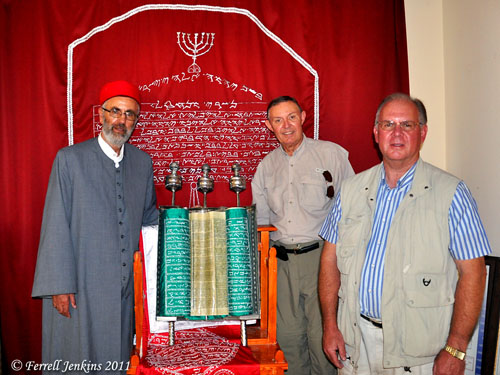
Next we went to Mount Gerizim to visit the Samaritans Museum. Husney W. Cohen, a priest and director of the Museum, was kind to show us around and explain the Samaritan viewpoint about several biblical events. Samaritans believe the temple was to be built on Mount Gerizim rather than Jerusalem. They think Abraham offered Isaac on the mountain. They accept only the first five books (the Pentateuch) of the Old Testament. In this photo you see Cohen, myself, and Leon Mauldin with the ancient scroll. This scrolls look to be much newer, or better preserved, than the old one I photographed many years ago (here).

wSamaritan Scroll at Mount Gerizim

Samaritan Scroll at Mount Gerizim. Husney W. Cohen, Ferrell Jenkins, Leon Mauldin.

I understood Husney W. Cohen to say that he was third in line to become the High Priest of the Samaritans.

We had hoped to visit the archaeological work on Mount Gerizim, but it was closed due to some construction.

We made a short stop at Jacob’s well (John 4). Then we visited the new Tel Balata Archaeological Park. Tel Balata is the site of biblical Shechem (Genesis 12:1). While in Nablus we also made a short stop at the traditional Tomb of Joseph (Joshua 24:32).

We left the central mountain rain through Wadi Farah (now called Wadi Tirza by the Israelis.   We were short on time and did not try to stop at Tirza (1 Kings 15:33). The springs that once flowed through the valley are now practically dry. I understand this is because the water is being piped away by Israel for use by the settlements.

We stopped at Jericho and made a visit to Tell es-Samarat (the site of Herod’s hippodrome) and Herod;s Palace (Matthew 2). New signs have been erected to point to these places, but the roads to them are terrible. The sites are in terrible condition and there are no explanatory signs.

In the future we hope to show some photo of some of these places.

Travel in the Plain of Acco and the Plain of Sharon

We saw most of what we had intended today, but due to a late start from Tiberias it was a long day. We got to Jerusalem a little late, went immediately to the dining room, and then made it to our room about 9:30 p.m.

We drove from Tiberias to Acco (Akko, Acre), a city of the biblical tribe of Asher, is mentioned in Judges 1:31. The city was known as Ptolemais in New Testament times. Paul stopped at Ptolemais and stayed with the brethren for a day on the return from his third journey (Acts 21:7).

We continued north along the Plain of Acco past Achziv (English versions use Achzib) (Joshus 19:29) to the Ladder of Tyre. More explanation latter. This natural formation has served as a natural boundary for centuries.

In the late afternoon we stopped in the Plain of Sharon, a few miles north of Caesarea, at the town of Beit Hananya to see a portion aqueduct that carried water to Caesarea. This portion of the aqueduct was constructed during the reign of the Roman Emperor Hadrian in the early second century A.D.

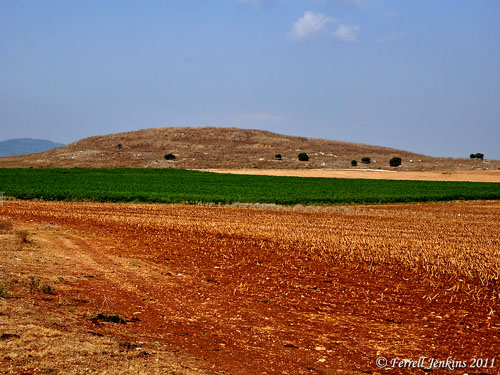
For a photo I want to share Tel Hannathon, the site of a town once belonging to the tribe of Zebulon.

The border circled around it on the north to Hannathon, and it ended at the valley of Iphtahel. (Joshua 19:14 NAU)

Tel Hannathon. Photo by Ferrell Jenkins.

Tel Hannathon. Photo by Ferrell Jenkins.

Hannathon is one of those places mentioned in the Bible that is simply passed over by most readers and teachers. The city was a real place in Bible times, occupied by real people who really did the things recorded in Scripture. Don’t let the details pass you by. Sometimes they can be highly significant.

We have an exciting day planned for tomorrow with a driver who will go with us to visit sites in the West Bank. Most of the rental car companies in Israel do not allow their cars to be driven in the West Bank.

Roman temples and hard to reach cities

Today was a busy day and one of the most productive of this trip. Several of the places we visited are difficult to reach today, but at the time of their glory they were on main routes of travel.

Our first stop was at Omrit in northern Israel, about 4 miles SW of Banias. Two temples have been found here. One of them dates to the late first century B.C. Some scholars suggest that this is the Temple of Augustus built by Herod the Great.

Omrit is not mentioned in the Bible, but may prove to be significant in accounts of the ministry of Jesus. It was located in the region known as Ituraea. Philip, the son of Herod the Great, was “tetrarch of the region of Ituraea and Trachonitis” (Luke 3:1).

Though not new to us, we stopped for a while to make some photos at Hazor.

Next stop was for lunch at McDonald’s.

We stopped at Khirbet (or Horbat) Amudim, site of an ancient synagogue. Our main interest was in seeing the area of travel between Cana and the towns around the Sea of Galilee.

A stop at Hannathon allowed us to get a photo of the tel. This site is mentioned as being in the territory of Zebulon in Joshua 19:14.

Yodfat (or Jotapata) is important because it is where Josephus led Jewish rebels against the invading Romans in 66 A.D.

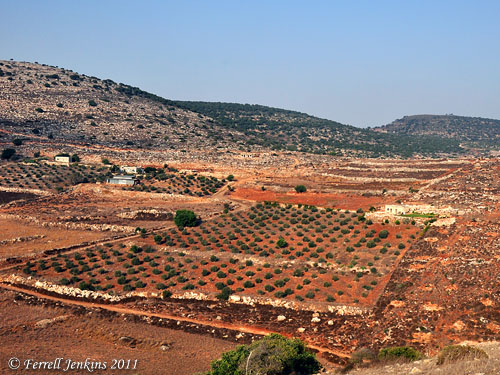
The photo below is of one of the beautiful valleys around Yodfat.

Fertile valley below Yodfat. Photo by Ferrell Jenkins.

Fertile valley below Yodfat. Photo by Ferrell Jenkins.

With the help of a local farmer we were led to an overlook where we could see Khirbet Kana (Cana), likely the site of the events of John 2. We had too little time left to make the full walk to the site. Always a reason for another visit.

We arrived back at the hotel in Tiberias about 7 p.m. In coming weeks we hope to share some of the new photos. with our readers.

A beautiful day in Galilee

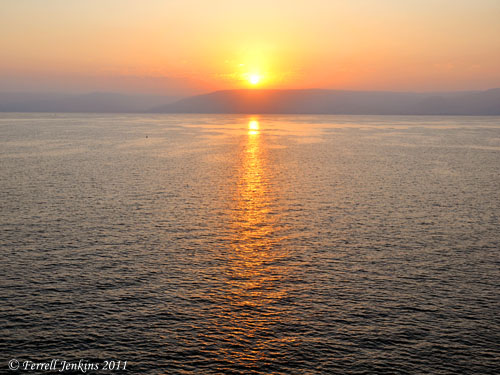
Sunrises on the Sea of Galilee can be extremely beautiful. I know that I have posted several photos of the sunrise, but I wanted to share another one from this morning.

Sunrise on the Sea of Galilee. Photo by Ferrell Jenkins - 09-04-11

Sunrise on the Sea of Galilee. Photo by Ferrell Jenkins - 09-04-11

Much of the ministry of Jesus was conducted on and around the Sea of Galilee. One of the important events recorded in Scripture is the calling of disciples.

Passing alongside the Sea of Galilee, he saw Simon and Andrew the brother of Simon casting a net into the sea, for they were fishermen. (Mark 1:16 ESV)

We went to Nazareth this morning to worship with the church there. Afterwards we spent a good bit of time in Mash’had, a small Arab town between Nazareth and the traditional site of Cana,  trying to locate the tell where the ancient city of Gath Hepher, the home of the prophet Jonah,  is thought to be located. Hopefully we will be able to tell you more about that experience later.

In May I wrote about locating and walking on a portion of the Roman Road near Golani Junction here. I wanted to share this experience with Leon, so we returned there.

There were some other things, but this will be enough for today.

It is hot at this time of the year, and especially when tramping around over hill and vale.

Somthing new, something old in Israel

No, we did not attend a wedding today. Leon and I are trying to see some places we have missed before. I have traveled here more than Leon, so I don’t like passing up a place he hasn’t visited.

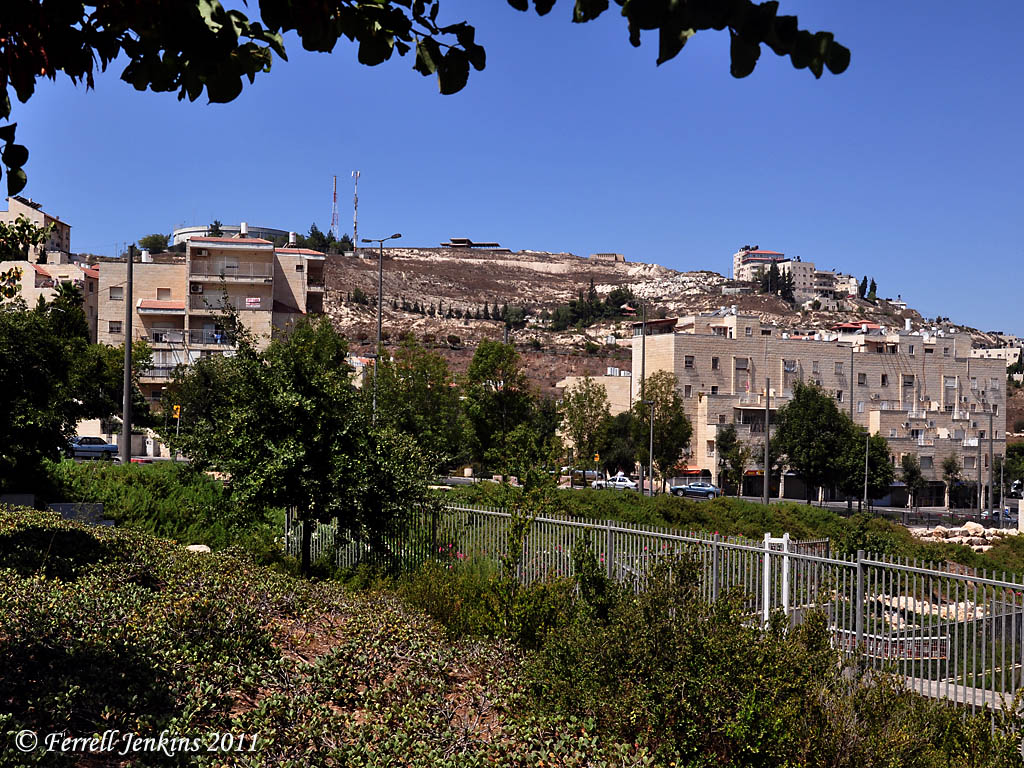
As we left Jerusalem this morning we missed a turn and ended up in one of the new Israeli suburbs called Pisgat Ze’ev Ma’arav (West). This suburb is on the east side of Tell el-Ful (Hill of Beans in Arabic), identified as biblical Gibeah. In an effort to find our way back to the main street to get on the highway to go to the Jordan Valley I saw a side of Tell el-Ful that I had not seen before. I had always seen the tell from the West, but now I was was looking at the East side.

How does one recognize Tell el-Ful? Beans no longer grow on the mound. Prior to the 1967 war, when the Old City of Jerusalem and the area under consideration was in Jordan, the late King Hussein of Jordan was beginning to build a palace on the top of the tell. The uncompleted structure still stands there as a silent monument to a failed plan.

The view from the east is impressive. The tell can be seen framed between the new buildings of Pisgat Ze’ev Ma’arav (West). I was beginning to fume a bit about missing the road I intended to take until I saw Tel el-Ful (Gibeah).

Gibeah of Saul (Tel el-Ful) from the east. Photo by Ferrell Jenkins.

Gibeah of Saul (Tel el-Ful) from the east. Photo by Ferrell Jenkins.

Several biblical references mention Gibeah as the home of Saul. In fact the city is even called Gibeah of Saul in 2 Samuel 21:6, and Gibeah of Benjamin in 1 Samuel 13:2. Saul was the first king of Israel from about 1050 to 1010 B.C.

William F. Albright excavated Tell el-Ful and found evidence of a fortress. Many think this would have been the palace of King Saul. An iron plowshare was also found in the excavation.

There is a nice photo by Eli Berckovitz of the skeleton structure of King Hussein on Wikipedia here.

We visited some new places, too. But it is late, and those will have to wait.

David escaped to the Cave of Adullam

One of the important places on our “bucket list” was the Cave of Adullam. The main reason we had never visited Adullam before is that it requires a long, difficult, walk or a four-wheel-drive vehicle. We made arrangements with Haelah Desert Tours, a company at Aderet, a moshav on the north side of Adullam, for a guide/driver who could take us there. Once we reached the forested mound we enjoyed a wonderful view to the north, east, and south. Our guide, Daphna, inquired first about our interest in the site. How did we even know about the site, she wondered. She is a Sabre, a native-born Israeli, who lives at Aderet.

The view below is to the east where you will see the border between Israel and the West Bank. The central mountain range is visible in the distance.
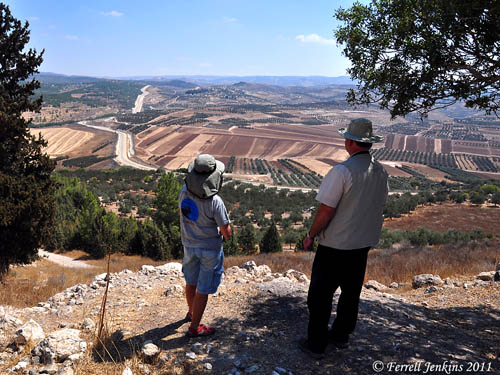
Daphna, our guide, and Leon look east from Tel Adullam. Photo by Ferrell Jenkins.

Daphna, our guide, and Leon look east from Tel Adullam. Photo by Ferrell Jenkins.

There is a large cave at Adullam. Is it the cave where David stayed while fleeing from Saul? Can’t say, but if it was not this one it had to be another one near by. The next photo was made from inside the cave.
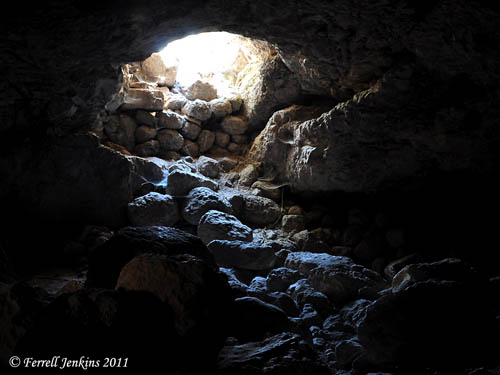
View north from interior of the Cave of Adullam. Photo by Ferrell Jenkins.

View north from interior of the Cave of Adullam. Photo by Ferrell Jenkins.

Adullam is significant in several biblical accounts. Here are a few.

Judah stayed with an Adullamite man named Hirah. He married the daughter of a Canaanite man named Shua.

At that time Judah left his brothers and stayed with an Adullamite man named Hirah. There Judah saw the daughter of a Canaanite man named Shua. Judah acquired her as a wife and had marital relations with her. (Genesis 38:1-2 NET)

The episode of Onan and his failure to fulfill his responsibility to bring up children to his deceased brother (the Levirate marriage; Genesis 38:3-10).

Joshua defeated the king of Adullam during the Conquest (Joshua 12:15), and became one of the Shephelah (lowland) cities of the tribe of Judah (Joshua 15:35).

The cave of Adullam is associated with David. When he left Gath he went to Adullam before sending his parents to Moab for safety.

So David left there and escaped to the cave of Adullam. When his brothers and the rest of his father’s family learned about it, they went down there to him. (1 Samuel 22:1 NET)

In fact, David spent much time at Adullam. I suggest you read the entire account in 2 Samuel 23:13ff.

When the prophet Micah warned Judah about the coming Assyrian invasion he said,

…the leaders of Israel shall flee to Adullam (Micah 1:15 NET)

Just like David did about three centuries earlier.

One more point. Jesus was a descendant of David and Judah, both of whom had an association with Adullam (Revelation 5:5).

What a wonderful experience.

My thanks to Gordon Franz and Carl Rasmussen with whom I have corresponded about Adullam.

Update. In my orignal post I made a mistake in saying that Judah married the daughter of Hirah. I caught this mistake a few days ago and have now corrected it. Judah married the daughter of a Canaanite man named Shua.

Places less visited in Israel

Today we got a fairly early start and went through the Shephelah to Lachish. This takes about an hour or so from Jerusalem. We did not go to visit Lachish, but to continue east to a small kibbutz called Shekef. From here we would try to locate Tel Eiton (also Tel ‘Eton and Tel Aitun). I had been in the area before but did not locate the tel. The reason for going so far out of the way to get to the site is that it is situated on Israel’s border with the Palestinian West Bank. Just before reaching Shekef we began to  drive on the new highway 358 to Beersheba, parallel to the border. Soon we realized that we must be bypassing the place we want to go.

We backtracked and eventually after doing what men “never do”, ask for directions, we located Tel Eiton. Palestine is on the east side of the mound and a military firing range is on the west side. We decided it would be best to stick to the gravel road without straying too far to the left or the right — sort of like Joshua.

“Be very firm, then, to keep and do all that is written in the book of the law of Moses, so that you may not turn aside from it to the right hand or to the left,  so that you will not associate with these nations, these which remain among you, or mention the name of their gods, or make anyone swear by them, or serve them, or bow down to them.  (Joshus 23:6-7 NAU)

Tel Eiton currently is equated with biblical Eglon by many scholars. Recent excavations have been conducted under the direction of Prof. Avi Faust, now of Bar Ilan University.

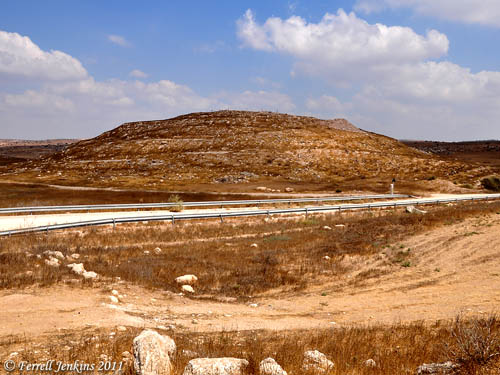
Here is a photo of the tel from the south and perhaps a little to the east.

Tel Eiton (Tel Aitun), possibly biblical Eglon.

Tel Eiton (Tel Aitun) from the south (and east). Photo by Ferrell Jenkins.

Eglon is mentioned at least eight times in the Bible, all in the book of Joshua (10:3, 5, 23, 34, 36, 37; 12:12). The Scripture emphasizes that Israel defeated the king of Eglon. Notice the relationship between Lachish, where we started our trek, and Eglon.

And Joshua and all Israel with him passed on from Lachish to Eglon, and they camped by it and fought against it.  They captured it on that day and struck it with the edge of the sword; and he utterly destroyed that day every person who was in it, according to all that he had done to Lachish.  Then Joshua and all Israel with him went up from Eglon to Hebron, and they fought against it.  (Joshua 10:34-36 NAU)

We also visited the following places.

Tel Bet Mirsim, a site identified as Debir by William F. Albright (Joshua 10:38, 39). Albright identified Tel Eiton as Libnah, but scholars today question this.

Tel Halif, north and slightly east of Beersheba, is thought by some to be biblical Ziklag, . Others place the biblical city at Tel Shera, northwest of Beersheba.

Finally we visit the Brook Besor and Tel el-Farah South. Israel calls the site Tel Sharuhen (1 Samuel 30). This tel is located in the Plain of Philistia, not far from the borders with Egypt and the Gaza Strip.

Hopefully we will be able to share more photos and information about this places with you at a later time. It is all very fascinating to the student of the Bible. Right now it is too late and I need to be sleeping.

Traveling in Israel

Last evening I arrived in Israel with Leon Mauldin. We made our way from the Ben Gurion Airport at Lod in the Plain of Sharon up to Jerusalem in the mountains of Judah.

There is always a bit of jet lag to deal with. I got a good night of sleep on the flight from Atlanta to Tel Aviv, but didn’t do so well the first night at the hotel. Nonetheless, after a late start and securing a data card for the air card we spent a good bit of time in the Shephelah (lowlands) of Israel (Deuteronomy 1:7).

We have determined for this trip that we will concentrate on places we have not seen before, or where we think we need new photos for use in teaching.

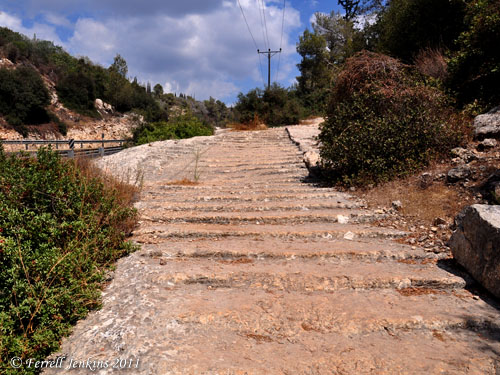
Our first major stop was 4.2 km west of Mata on Highway 375. I am not sure of the date of this unusual stretch of Roman Road, but I think most of the Roman roads date to the late first century or the second century A.D.

These steps would have made the trip up into the mountains of Judea easier for both man and beast.

Roman Road 4.2 km west of Mata on Hwy 375. South side of road. Photo by Ferrell Jenkins.

Roman Road 4.2 km W of Mata on Hwy 375. S of Hwy. Photo by Ferrell Jenkins.

Incidentally, this road is only a short distance from the Valley of Elah.

Later we photographed three significant archaeological mounds (tel or tell, depending on the languages), and saw several others.

  • Tel Goded (Tell ej-Judeideh is thought my many to be Moresheth-Gath, the home of Micah the prophet (Micah 1:1, 14).
  • Tel Burna is thought by the current excavators to be Libnah (2 Kings 19:8).
  • Tel Zayit is thought by the current excavators to be Libnah.

Yes, you read that correctly. More at a later time, perhaps.

Most of our time was spent searching for the correct field road to get close enough to Tel Batash, the site of Timnah, for a photograph. We succeeded! We remember Timnah because Samson got into trouble with a woman of Philistia there (Judges 14).

Be assured that this is fun as well as educational. Who knows what excitement awaits us tomorrow.

Short video on Masada

The Israel Nature and Parks Authority has prepared a short video on Masada. The narrator presents a brief history of the fortress of Masada while beautiful scenes of the site are shown.

Arutz Sheva (Israel National News) provides a link to the video with an article about Masada here. (A direct link to the video on You Tube is here.) Elad Benari, author of the article, describes Masada in these words:

The top level had four bedrooms and a semicircular balcony, from which there was a spectacular view of the Dead Sea, Ein Gedi, and the Moab Mountains. A sophisticated and hidden staircase led to a middle level in which a large hall was built, surrounded by a veranda whose poles were placed at the edge of the cliff. The staircase went down to the bottom level, in which a large hall surrounded by vestibules was established. The walls of the hall were decorated with spectacular frescoes. A private bathhouse was built adjacent to the hall for the occupants of the northern palace.

At the peak were 29 large warehouses, each one 27 meters long. Excavations of the site found hundreds of pottery vessels in which huge amounts of food were stored. Thus, using a rare combination of natural conditions and human endeavors, Masada became a cliff that was almost impossible to conquer.

The great halls of the palaces were unsuitable for housing families, and thus became headquarters and public buildings.

The building near the north wall, which served as a stable in the days of Herod, was later turned into a synagogue. This is one of the Jewish people’s most ancient synagogues, known to be in use during the period of the second Holy Temple in Jerusalem, an unusual occurrence as synagogues became the accepted place to pray only after the destruction of the second Temple.

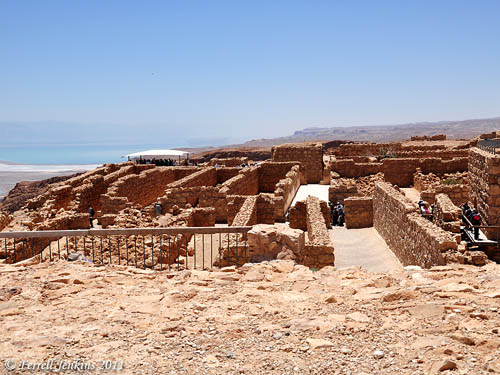
Our photo shows some of the large warehouses at the fortress. The Dead Sea and the mountains of Edom are visible in the left background.

Warehouses at Masada with the Dead Dea visible in the distance. Photo by Ferrell Jenkins.

Warehouses at Masada with the Dead Sea visible in the distance. Photo by Ferrell Jenkins.

It is possible that David visited the site of Masada long before it was turned into a fortress by King Herod. Gordon Franz has examined evidence for this suggestion at his Life and Land blog here.

One of the verses examined is Psalm 18:2 in which the term for fortress is the Hebrew metsudah (our English masada)

To the choirmaster. A Psalm of David, the servant of the LORD, who addressed the words of this song to the LORD on the day when the LORD rescued him from the hand of all his enemies, and from the hand of Saul. He said: I love you, O LORD, my strength.
2 The LORD is my rock and my fortress and my deliverer, my God, my rock, in whom I take refuge, my shield, and the horn of my salvation, my stronghold. (Psa 18:1-2 ESV)

HT: Joseph I. Lauer