Category Archives: Photography

Not much remains at Capernaum

Capernaum, on the northern shore of the Sea of Galilee, played a significant role in the ministry of Jesus. The town became the Galilean center for the ministry of Jesus.

And leaving Nazareth he went and lived in Capernaum by the sea, in the territory of Zebulun and Naphtali, (Matthew 4:13 ESV)

The aerial photo below was made on approach to Capernaum from the east. The site most visited by tourists may be seen left of the center of the photo. You may recognize the new church and the ruins of the synagogue. This property is owned by the Franciscans. To the right you will see the Greek Orthodox Church and the property they own. Evidence of some excavations may be seen.

There is not much remaining of ancient Capernaum. This is not surprising in light of the pronouncement of Jesus.

And you, Capernaum, will you be exalted to heaven? You will be brought down to Hades. For if the mighty works done in you had been done in Sodom, it would have remained until this day. (Matthew 11:23 ESV)

Aerial View of Capernaum. Photo by Ferrell Jenkins.

Aerial View of Capernaum. Photo by Ferrell Jenkins.

Lecture on Khirbet Qeiyafa — the Elah Fortress

The Lynn Wood Archaeological Museum announces a lecture by Dr. Michael G. Hasel about Khirbet Qeiyafa, also known as the Elah Fortress.

On Wednesday, October 12, Dr. Michael G. Hasel, professor of Near Eastern Studies and Archaeology at Southern Adventist University, will be sharing  the latest archaeological discoveries from the biblical site of Khirbet Qeiyafa. Recent trends in archaeology have questioned the historicity of David and Solomon’s Kingdom. Since 2009, Southern Adventist University has been uncovering the remains of this city-fortress dating to the time of King David. The discovery of this biblical city is a powerful argument for the reliability of the biblical account. The lecture will be held at 7 p.m. in Lynn Wood Auditorium on the campus of Southern Adventist University, 4960 Industrial Drive, Collegedale, TN. The Lynn H. Wood Archaeological Museum Lecture Series is free and open to the public.

For more information check the Museum website here.

The photo below is one I made in September showing Khirbet Qeiyafa clearly visible on the hill above the Valley of Elah. A copy of the photo suitable for use in teaching is available by clicking on the image.

View of Khirbet Qeiyafa from across the Valley of Elah. Photo by Ferrell Jenkins.

View of Khirbet Qeiyafa from across the Valley of Elah. Photo by Ferrell Jenkins.

It was in the Valley of Elah where the conflict between David and Goliath took place (1 Samuel 17). The brook of Elah lies in the valley below the fortress.

The location of Mount Sinai

Horeb is probably the range of mountains (cf. Exodus 17:6), and Sinai the peak. The terms are used interchangeably in several passages (cf. Acts 7:30,38 with Exodus 3:1ff.). Several sites have been suggested for Mount Sinai. Here are the major ones.

1. Some have suggested the Land of Midian because of what appears to be volcanic action (Exodus 19:18). It is argued that there has been no volcanic activity in the Sinai Peninsula, but that there has been in Midian. The Bible says, “the Lord descended upon it in fire.” This was miraculous activity.

2. Mt. Serbal at Wadi Feiran. There is no plain large enough for the encampment of Israel. This tradition goes back to Eusebius (4th century A.D.).

3. The traditional site is a peak known as Jebel Musa (Mount Moses). The elevation is 7,519 feet. The plain of el-Raha (Arabic for the Rest) at the foot of Jebel Musa has enough water for an encampment of considerable duration. G. Ernest Wright says, “we are left with the traditional location of Mt. Sinai as still the most probable” (20th Century Encyclopedia of Religious Knowledge, 1033). Grollenberg comments more from emotion than from reason:

“A visit to the traditional Mount Sinai suffices to dispel all these doubts. The huge granite formations are an awe-inspiring spectacle. The atmosphere, the light and the colours, the incredible stillness, all conspire to make the scene an unforgettable setting for the meeting of God with man” (Atlas of the Bible, 48).

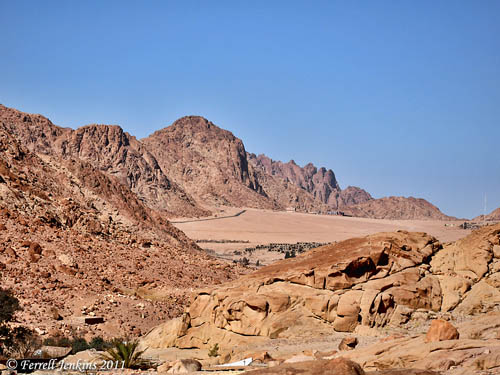
The photo below was made above Saint Catherine’s Monastery with a view toward el-Raha, the Rest.

View of el-Raha, the Rest, at Jebel Musa. Photo by Ferrell Jenkins.

View of el-Raha, the Rest, at Jebel Musa. Photo by Ferrell Jenkins.

4. Some scholars have suggested sites much further north in the Sinai peninsula.

There is no way to know for certain the location of Mount Sinai, but the traditional site fits well with much of the biblical evidence. Rasmussen says the “meeting of Moses and Aaron at the ‘mountain of God’ could well have been this spot (Exod. 4:27)” (Zondervan Atlas of the Bible Revised Edition. 105).

Click on the photo for an image suitable for use in teaching presentations.

Bible Land Food display to teach children

During a recent series of lessons on Daily Life in Bible Times I presented some material on the foods of Bible times. I emphasized that the foods ancient Israel had were those suitable to the terrain in which they lived — predominantly the mountains. One of the major biblical references about the foods is Deuteronomy 8:7-9.

 For the LORD your God is bringing you into a good land, a land of brooks of water, of fountains and springs, flowing forth in valleys and hills; a land of wheat and barley, of vines and fig trees and pomegranates, a land of olive oil and honey; a land where you will eat food without scarcity, in which you will not lack anything; a land whose stones are iron, and out of whose hills you can dig copper.  (Deuteronomy 8:7-9 NAU)

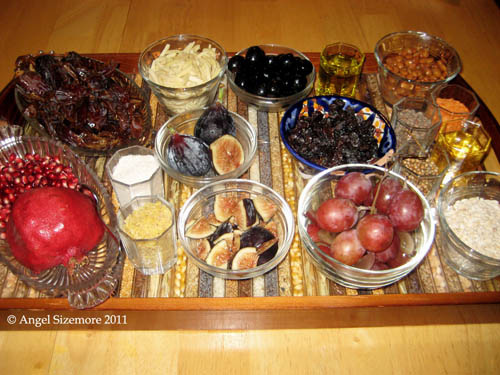
Later I learned that one of the ladies had prepared a Bible Land Food display to show the children during their Bible classes. I requested that Angel Sizemore allow me to use this material here. Here is her brief account.

— • —

After the September weekend lectures you presented at Centreville (Virginia) church of Christ, I had an idea for my class.  (I am teaching the 3rd & 4th graders this quarter). I thought that many of them may not have known what some of the food items you mentioned looked or tasted like. My family already eats most all of the items you mentioned, so I already had them in my kitchen. I had samples of several things cut up so they could taste them.

I showed the food to my own class first; then went over to the 5th & 6th grade class to show them; and finally to the little ones in the 1st & 2nd grade class. It was a HUGE hit with the children of all ages! I have heard from several of their parents that their kids really enjoyed it, and a couple of them had to scour the produce sections looking for their kid’s new favorite foods (like dates and pomegranates!).

Anyway, thank you for helping me to learn so much, and for inspiring me to teach more about it to our own little ones.

Bible Land Foods display by A. Sizemore. Ferrell's Travel Blog.

Bible Land Foods display by A. Sizemore.

Angel provided a list of the foods on the tray. (Click on the photo for a larger image.)

Foods included:
  • Dates — some whole and some cut up so they could taste it
  • Almonds — slivered
  • Black olives
  • Olive oil
  • Lentils — some dry brown and red lentils, and cooked brown lentils to taste
  • Coriander seed — threw that in because of the description of manna
  • Honey
  • Barley
  • Red grapes — some cut up so they could eat them
  • Raisins
  • Figs — some whole and some cut up so they could taste it
  • Cracked wheat [we also spoke of barley]
  • Whole wheat flour
  • Pomegranate — half of a fruit intact, some seeds so they could taste it
  • Cheese — not pictured but added to display — made with mix of goat/sheep milks
The kids enjoyed tasting everything, even stuff I didn’t intend for them to eat (like the raw lentils and olive oil)!
— • —
Note: Most of these foods have been discussed on the Travel Blog. Just use the search box to locate the posts. I have found that the search works best if you use only a single word. Try fig instead of figs. Try wheat instead of cracked. You will find coriander though I did not mention it in the lesson in Virginia.
Thanks to Angel for allowing us to share this wonderful teaching aid with our readers.

“Come up in the morning to Mount Sinai”

After the original tables of stone containing the Ten Commandments written by the finger of God were broken, Moses was told to be ready and “come up in the morning to Mount Sinai.”

Be ready by the morning, and come up in the morning to Mount Sinai, and present yourself there to me on the top of the mountain. (Exodus 34:2 ESV)

The Christian martyr Stephen reminded his audience that Moses received living oracles on Mount Sinai.

He received living oracles to give to us. (Acts 7:38 ESV)

Perhaps this is one of the reasons so many persons put forth the effort to approach the top of a mountain presumed to be Mount Sinai.

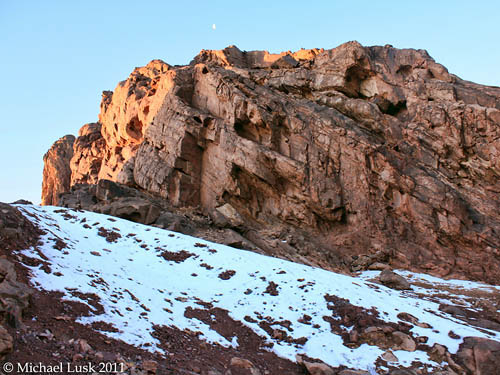
We began telling you about Michael’s trek to the top of the mountain on the morning of January 26, 2011. As he approached the top of the 7,519 feet high Jebel Musa he recorded several instances of snow.

Snow near summit of Jebel Musa, Jan. 26, 2011. Photo by Michael Lusk.

Snow near summit of Jebel Musa, Jan. 26, 2011. Photo by Michael Lusk.

One can never be sure about weather conditions. Reader Beverly Sansom left this comment yesterday:

Yes, we climbed the same mountain in mid-March 2011. Our view of the sunrise was but a sliver due to clouds, but the mountain grandeur was breathtaking. At the top were other Christians singing “How Great Thou Art” in a foreign language. We joined in!

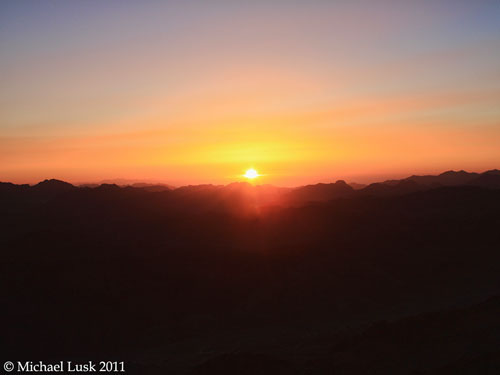
Michael had a good morning from the perspective of a photographer. Here is one of his sunrise photos.

Sunrise from top of Jebel Musa - Traditional Mount Sinai

Sunrise from top of Jebel Musa, January 26, 2011. Photo by Michael Lusk.

Thanks to Michael for sharing these photos with our readers.

Jebel Musa — the traditonal Mount Sinai

If you have followed this blog for several months you may recall that I had a group leaving Egypt the evening before the Egyptian Revolution began on January 25, 2011. Five members of our party had made arrangements to visit the Sinai peninsula, including a visit to Jebel Musa, the traditional Mount Sinai, following the tour.

The group of five left for Sinai on the morning of January 25 with no knowledge of the situation in Cairo. After one night at Saint Catherine and a visit to Saint Catherine’s Monastery three of the tours members (a couple from Indiana and a single man from Florida) returned to Cairo. The couple went directly to the airport and departed that evening. I am not sure that they had any indication of a problem in Cairo. The younger man had made arrangements to visit Abu Simbel and some other places in Egypt that we had not visited during the tour. My wife and I continued through the Sinai to Taba and crossed into to Israel at Eilat.

The single man, Michael Lusk, was the only member of our party to climb to the top of Jebel Musa. Michael was anxious to get up early and make the two and one half hour climb to the top in time for the sunrise. I don’t recall the temperature that morning, but it was cool at the hotel during the night and early morning. When I climbed the mountain in April of 1986 I wore jeans over pajamas, an undershirt covered by a T-shirt, a flannel shirt, and the thick jacket. By the way, Michael made it out of Egypt on the last Delta flight to leave after the Revolution began. He left his hotel early due to the curfew and spent all night in the airport awaiting the flight.

When I asked Michael, a former student, if he would allow me to run a few of his photos here, he was pleased to do so. This first photo shows Jebel Musa (the Mountain of Moses), traditional Mount Sinai. A small building can be seen on top of the mountain just to the right of center. There has been a small chapel on the summit of the mountain since the 4th century A.D. A church was built here by Emperor Justinian (early 6th century A.D.) and a new chapel was built on the ruins in 1934.

It was here, according to the 1500 year old tradition, that Moses met the LORD and received the Ten Commandments.

The LORD came down on Mount Sinai, to the top of the mountain; and the LORD called Moses to the top of the mountain, and Moses went up. (Exodus 19:20 NAU)

This photo would have been made on the return from the top. Note the camel and rider in the bottom right of the photo.
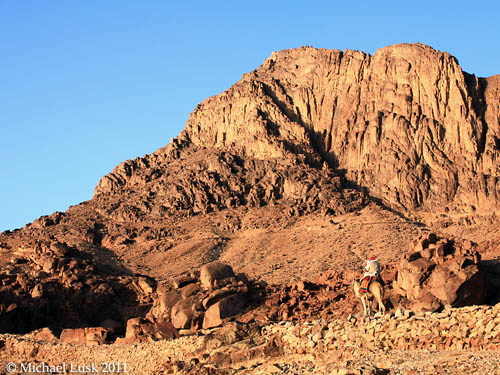
Jebel Musa, traditional Mount Sinai. Photo by Michael Lusk.

Jebel Musa, traditional Mount Sinai. Photo by Michael Lusk.

The next photo shows one of the camel drivers (leaders) waiting for someone to hire him to take them back to the monastery. It is possible to hire the camel to take you up the winding slope to where the 3,000 granite steps begin. Notice also his heavy clothing for the cold January nights.
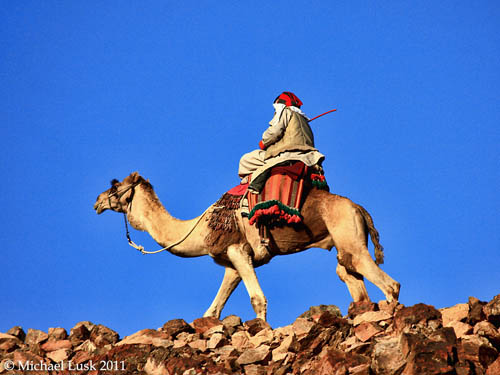
A camel waiting to take a tired walker back to the monastery. Photo by Michael Lusk.

A camel waiting to take a tired walker back to the monastery. Photo by Michael Lusk.

Seven hundred and fifty steps below the summit one comes to a site called Elijah’s Basin. This, according to the tradition, is where the prophet Elijah came when he fled from the wrath of Jezebel after the defeat of the prophets of Baal. Here, the prophet received instructions from the LORD to return and complete his work.

So he arose and ate and drank, and went in the strength of that food forty days and forty nights to Horeb, the mountain of God. (1 Kings 19:8 NAU)
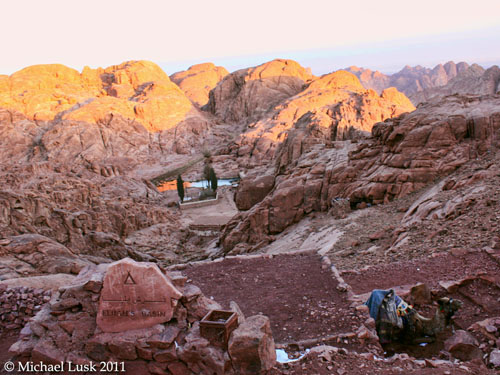
Elijah's Basin on Mount Sinai. Photo by Michael Lusk.

Elijah's Basin on Mount Sinai. Photo by Michael Lusk.

This photo shows the morning light beginning to illuminate portions of the mountain peaks. In the basin you will see some snow. I think the red (orange) glow may be caused by the light striking the area.

In a future post we will share, thanks to Michael, the sunrise from the summit.

The water system at Gezer

Water is necessary for life. Much has been learned about the provisions made for water in the cities of the biblical world. We know about the tunnels dug to bring water into the city at Hazor, Megiddo, Gibeon and Jerusalem, and about the well at Lachish.

For many years we have known about the water tunnel at Gezer. Now, as a result of the current Gezer Water System Expedition, new information is coming to light about the water system there. This project is a joint effort of New Orleans Baptist Theological Seminary and the Israel Nature and Parks Authority.

I appreciate this comment by Dan Warner, associate professor of Old Testament and Archaeology at NOBTS:

“The research at Gezer is important to Baptists because of our commitment to understand the Bible within its historical context,” Warner said. “Any information we can gain to give better insights into the cultures of the biblical world helps us interpret the Bible.

“Most think of the Canaanites as an old, rustic culture — not so,” Warner noted. “Digging the water system took great technical and hydraulic skill. This was a very advanced and sophisticated culture that had pronounced impact in biblical times.”

A news release from NOBTS says,

It is believed the Canaanites cut the massive tunnel around the time of Abraham using flint tools. Measuring nearly 13 feet wide by 24 feet high at the opening and stretching 150 feet into the ground at a 38 degree slope, the Gezer tunnel is the largest ancient water system ever unearthed.

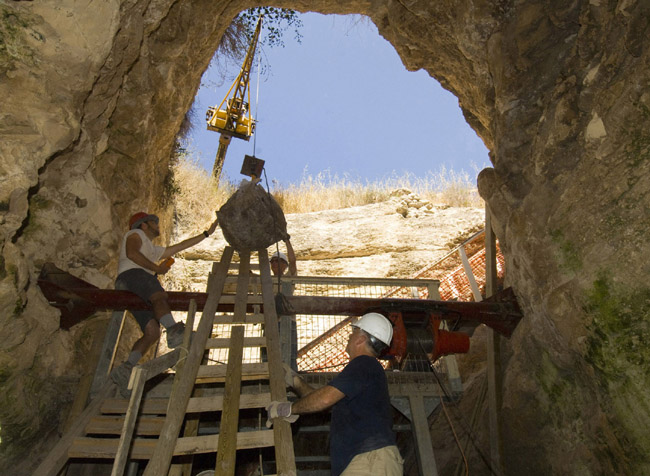
Late in the last week of the 2011 dig, the NOBTS team found the natural cave at the end of the massive rock-hewn water system — the prime objective of this season’s dig. It is believed that the system’s original water source is located in or near the opening of the cave.

Two reports on the recent work may be read here. Here is one of the photos available with the reports.

Gezer Water System

Excavating the Gezer Water System. Photo by Art Beaulieu. Courtesy BP & NOBTS.

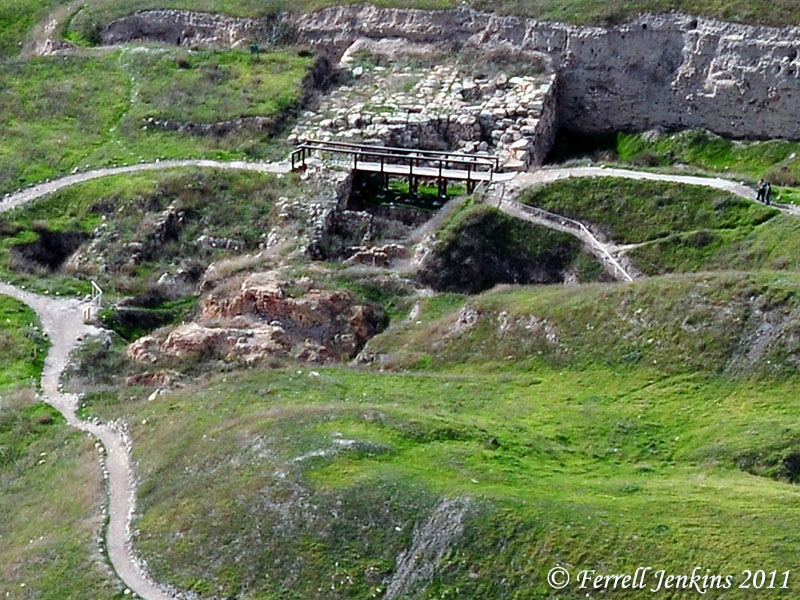
The photo below is an aerial shot that I made in December, 2009. This shows the massive Canaanite wall and the entrance to the water system to the right of center in the photo. The path goes down into the shaft that is now being excavated.

Aerial view of the Canaanite Wall and Water System at Gezer. Photo by Ferrell Jenkins.

Aerial view of the Canaanite Wall and Water System at Gezer. Photo by Ferrell Jenkins.

We included an aerial photo of Tel Gezer suitable for use in presentations here. From that same post we summarized the biblical information about Gezer.

  • The king of Gezer fought against Joshua and the Israelites during the conquest (Joshua 10:33; 12:12).
  • Gezer was allotted to Ephraim (Joshua 16:3).
  • Gezer became a city of the Levites (Joshua 21:21). It was designated as a city of refuge (1 Chronicles 6:67).
  • Israel failed to drive out the Canaanites who lived in Gezer (Joshua 16:10; Judges 1:29).
  • By the time of David the Philistine seem to be living at Gezer (2 Samuel 5:25; 1 Chronicles 14:16; 20:4).
  • Pharaoh, king of Egypt, captured Gezer, burned it, and gave it as a dowry to his daughter, Solomon’s wife (1 Kings 9:16).
  • Solomon (re)built the cities of Hazor, Megiddo, and Gezer (1 Kings 9:15-17).

The excavators are looking for volunteers for the 2012 season. This provides a good chance to do the kind of work you hire someone else to do at home. 🙂

Update: I failed to call attention to the web site of the Center for Archaeological Research at NOBTS here, and Can You Dig It? archaeology blog here. Under PHOTOS you will find a large gallery of photos and videos of the recent excavation.

HT: Joseph Lauer

Pardon the absence

Since returning from Israel we have been trying to catch up, preparing for some lectures on Daily Life in Bible Times at the Church of Christ in Centreville, Virginia, and now trying to catch up from that and get ready for the next series.

I am still working on sorting the photos that have been made in Egypt and Israel this year.

Thanks for continuing to follow the blog.

The fig and the sycamore fig

A friend (he really is) on Facebook left this comment about yesterday’s post.

is the fig of the Bible the same as what we call figs? They used a fig dresser; we don’t.

He seems to be thinking of the fig mentioned in Amos 7:14.

Then Amos answered and said to Amaziah, “I was no prophet, nor a prophet’s son, but I was a herdsman and a dresser of sycamore figs. (Amos 7:14 ESV)

Other English versions use the terms grower, tender, or took care of. Amos tended the sycamore fig — the ficus sycomorus.

The question results from some confusion in translating the various biblical words into English. According to Fauna and Flora of the Bible, the fig we showed yesterday is the ficus carica. The fig mentioned in Amos 7:14 is the ficus sycomorus.

The sycamore fig growing in the lowlands at Neot Kedumim. Photo by Ferrell Jenkins.

The sycamore fig growing in the lowlands at Neot Kedumim. Photo by Ferrell Jenkins.

The description of the ficus sycomorus in Fauna and Flora of the Bible says,

The sycamore tree belongs to the Nettle family, like the mulberry and fig trees. It grows in many places in Palestine, especially in the plain, from Gaza to Jaffa and Haifa, and in the Jericho valley.…

The leaves are evergreen and heart-shaped, and the fruit looks like figs, but its taste is unpleasant. However, it was eaten by poor people, and Amos (7:14) was a gatherer of sycamore fruit. The Hb. [Hebrew] verb may indicate the way the sycamore fruits were eaten, so that the proper translation may not be ‘gatherer of sycamore fruit’, or ‘cultivator’, but ‘one who nips (with a nail or with iron) the fruits to make them edible’.

See more about the Sycamore fig and Zaccheus here.

The fig tree

When the children of Israel came to the end of the period of Wilderness Wandering, the LORD reminded them of the wonderful land into which He was bringing them.

“For the LORD your God is bringing you into a good land, a land of brooks of water, of fountains and springs, flowing forth in valleys and hills; a land of wheat and barley, of vines and fig trees and pomegranates, a land of olive oil and honey; a land where you will eat food without scarcity, in which you will not lack anything; a land whose stones are iron, and out of whose hills you can dig copper. (Deuteronomy 8:7-9 NAU)

The fig is the first fruit tree specifically named in the Bible. Adam and Eve used the leaves of the fig tree to make coverings (loincloths) for themselves when they learned their condition before God.

Then the eyes of both of them were opened, and they knew that they were naked; and they sewed fig leaves together and made themselves loin coverings. (Genesis 3:7 NAU)

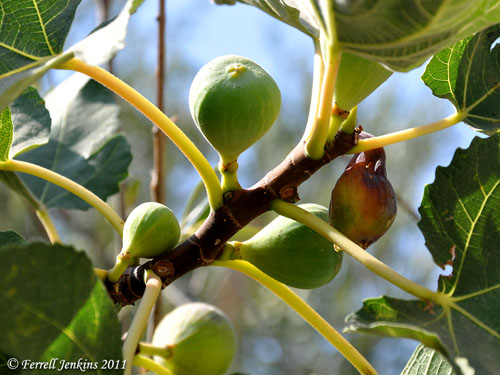
During the past two weeks we noticed ripe figs in several places in Israel and the West Bank. The photo below of the ripe figs was taken at Tel Balata (= Shechem).

Ripe figs at Shechem, Early September. Photo by Ferrell Jenkins.

Ripe figs at Shechem, Early September. Photo by Ferrell Jenkins.