Category Archives: Old Testament

The tabernacle in the wilderness

A full size model of the Israelite tabernacle has been constructed in Timna Park, 17 miles north of Eilat. This was one of the big reasons I wanted to visit Eilat on this trip. The tabernacle was built while the Israelites were at Mount Sinai (Exodus 25-40). The tabernacle was a movable tent of worship which was taken each place Israel wandered during the forty years in the wilderness. Stephen spoke of the tabernacle this way:

“Our fathers had the tabernacle of testimony in the wilderness, just as He who spoke to Moses directed him to make it according to the pattern which he had seen. (Acts 7:44)

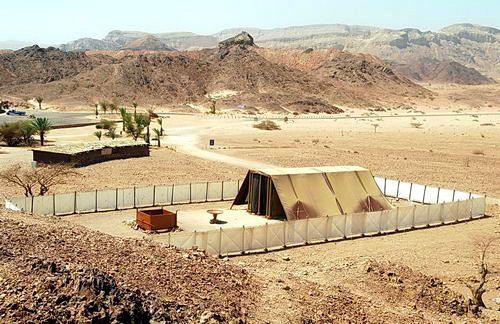
I walked up hill above the tabernacle model and took this view of the tabernacle with the laver and the altar of burnt offering in the courtyard.

The tabernacle in the wilderness. Photo by Ferrell Jenkins.

The tabernacle in the wilderness. Photo by Ferrell Jenkins.

If you are ever near Eilat, drop by and see this wonderful model.

The wilderness – Zin and Paran

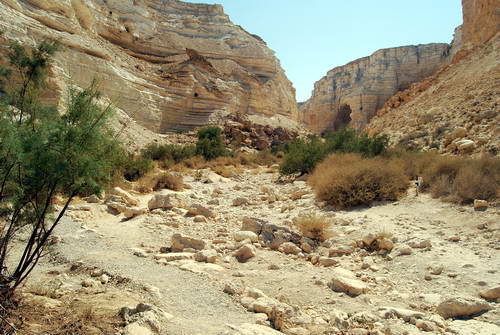
Yesterday we drove from Beersheba to Eilat. The whole region is inhospitable and uninviting. Here is a photo of a section of the Wadi Zin. The wadi is dry now, but when there is rain it will become a river in the desert.

Wadi Zin. Photo by Ferrell Jenkins.

Wadi Zin. Photo by Ferrell Jenkins.

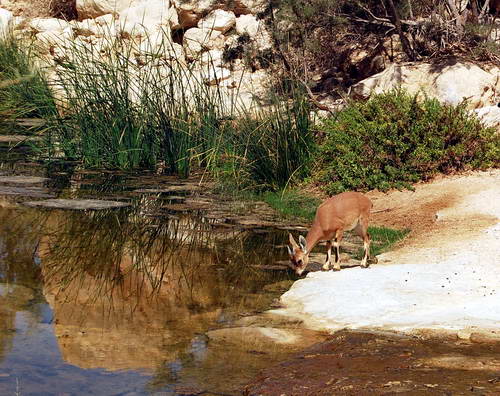
In Wadi Zin there are some small springs and a cool water pool. We did not take time to hike to the pool, but stopped by a small spring to watch the Ibex. Here is a young Ibex drinking water that reminds me of Psalm 42:1.

As a deer pants for flowing streams, so pants my soul for you, O God. (Psalm 42:1)

A young Ibex in Wadi Zin. Photo by Ferrell Jenkins.

A young Ibex in Wadi Zin. Photo by Ferrell Jenkins.

When the time came for Moses to die, the Lord told him that he would not be allowed to enter the promised land,

because you broke faith with me in the midst of the people of Israel at the waters of Meribah-kadesh, in the wilderness of Zin, and because you did not treat me as holy in the midst of the people of Israel. (Deuteronomy 32:51)

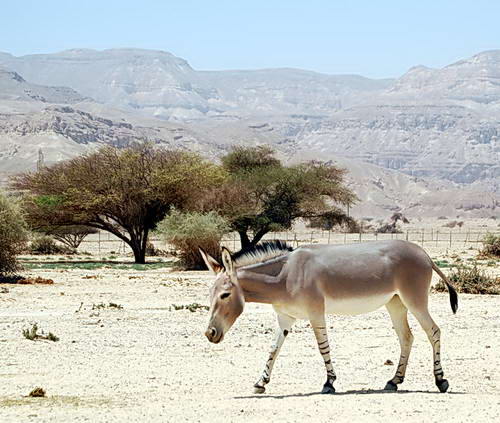
Today we visited the Yotvata Hai-Bar Nature Reserve, located about 20 miles north of Eilat in the Arabah. I made photos of many of the animals in the reserve.

A Somalia Wild Donkey at the Yotvata Hai-Bar Reserve. Photo by Ferrell Jenkins.

A Somalia Wild Donkey at the Yotvata Hai-Bar Reserve. Photo by Ferrell Jenkins.

Ishmael is described in these terms:

He shall be a wild donkey of a man, his hand against everyone and everyone’s hand against him, and he shall dwell over against all his kinsmen.” (Genesis 16:12)

Sometimes the LORD used simple facts to illustrate His wisdom. He asked Job,

“Who has let the wild donkey go free? Who has loosed the bonds of the swift donkey, (Job 39:5)

We are located less than a mile from the border with Jordan. In the afternoon we drove down to the Taba border crossing with Egypt. We also saw some of the beautiful coral and colorful fishes in the Red Sea.

The temperature today was 45 degrees celcius. Go figure! (For those of you who are metrically challenged, that is 113 degrees farenheit. It was really hot. We were expecting it to be 105!)

Traveling south

Monday we left Jerusalem and drove to Beersheba. I was able to get some great photos of agricultural practices in the hill country of Judea. The Negev (southland in some English versions) begins at Beersheba. It is an area plagued by lack of water, always dependent on the amount of rain it receives in the winter months. (I am speaking primarily of biblical times, but even with irrigation the area is still fairly barren.). The account of Hagar and Ishmael is illustrative of the conditions in the area (Genesis 21:8-21)

We stopped at Tel Be’er Sheva. The Genesis account says,

Abraham planted a tamarisk tree in Beersheba and called there on the name of the LORD, the Everlasting God. (Genesis 21:33).

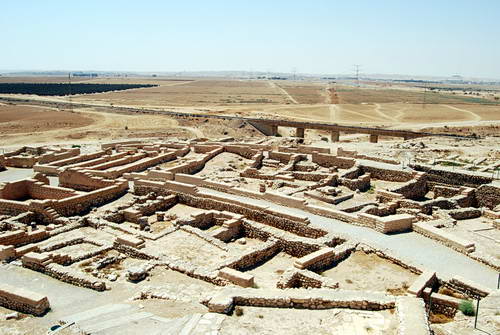
There is a nice observation tower on the mound that allows one to get a view of the complete excavated area. The photo also shows the terrain. The highway in the distance is the main highway from Beersheva to Eilat.

View of Excavation at Tel Be'er Sheva. Photo by Ferrell Jenkins.

View of Excavation at Tel Beersheva

We saw so much yesterday that it would take me hours to write a summary. We stopped at Wadi Zin and the Wilderness of Zin where the Israelites wandered. See Numbers 13:21 and 20:1. Since I am not too fond of Manna, I think a few days would be enough for me! By 8 p.m. we arrived at Eilat.

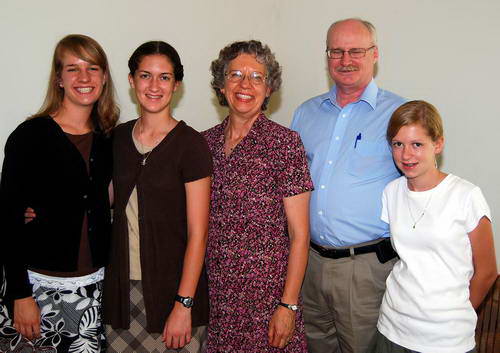
Sunday we visited with some Christian friends who live north of Tel Aviv. Ken and Vickie Boyd are here for two years in connection with Ken’s job. We met with them for worship. Vickie prepared a wonderful lunch that was far superior to the hotel buffets we had been eating. The Boyd’s were students of mine in the ancient days. We wish them well in their time in Israel.

Jessica, Savanah, Vickie, Ken, Heather

Jessica, Savanah, Vickie, Ken, Heather

In the afternoon we stopped at Aphek for a few photos. In New Testament times this was known as Antipatris. More later, perhaps. We also went to Gezer, but were to late to do a complete visit or to get good photos.

The Herodium, Tekoah, and Ashkelon

Today we visited the Herodium with our friend Elie who is known to many readers as the guide for several of our tours. Since this is the Sabbath in Jerusalem there was almost no traffic this morning. We left and went south past Bethlehem along the new road that connects various Israeli settlements. Elie met us at a designated place in Efrata and we went together from there to the Herodium.

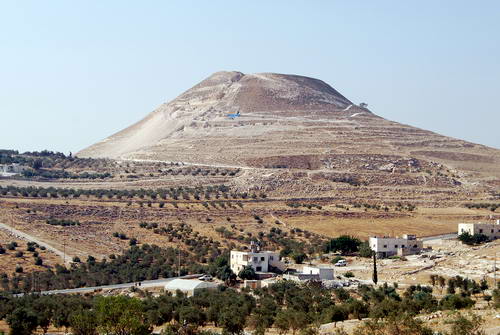
I don’t have a lot of time to give you all of the details of the Herodium, but here are a few facts to help. The artificial conical structure was built by Herod the Great at one of his fortresses. The fortress is located about 8 miles south of Jerusalem, 3 1/2 miles east of Bethlehem, on the western edge of the Wilderness of Judea. Herod was the king who tried to kill Jesus (Matthew 2). The photo below shows the north side of the Herodium. The tomb of Herod the Great was discovered about half way up the north side in 2007 by Prof. Ehud Netzer. You may see a blue tarp to the left of center. That marks the location of the tomb.
North side of the Herodium. Photo by Ferrell Jenkins.

North side of the Herodium. Photo by Ferrell Jenkins.

While in the vicinity we passed by Tekoah, the home of Amos the prophet (Amos 1:1), and the Valley of Decision in the wilderness of Tekoah (2 Chronicles 20. See especially verses 20 and 26). I also made some photos of vineyards and terraced farming.

Elie took us to a point from which one could understand the route of David from Bethlehem to the Valley of Elah. He had other oblications, so we left him and made our way to the coastal plain. Along the way we stopped for a photo of Tel Erfani. In earlier years several scholars identified it as Gath. A city, name Qiryat Gat, was built nearby and named for the ancient site. Many scholars now believe that Gath is to be identified with Tel es-Safi (see yesterday’s post).

We continued to Ashkelon to see the newly reconstructed Canaanite gate. The sign at the site says,

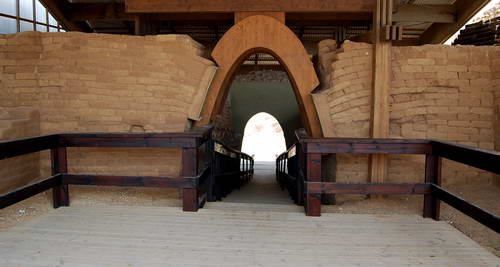
This is the most ancient arched gate in the world. It consists of an arched corridor with arched openings on both ends. The gate was constructed in approximately 1850 BCE as part of th city’s fortification system, and is built mostly of mud brocks with some calcareous limestone. It is 15 meteres long, over 2 meters wide, and almost 4 meters high.

This photo shows the gate from the west (sea side).
The Canaanite Gate at Ashkelon. Photo by Ferrell Jenkins.

The Canaanite Gate at Ashkelon. Photo by Ferrell Jenkins.

According to 1 Samuel 6:17 there were five important Philistine cities: Ashdod, Gaza, Ashkelon, Gath, and Ekron. We were only a few miles north of Gaza. We tried diligently to locate Tel Ashdod, but were unable to do so.

Visiting the Judean Hills

We were able to visit several sites in the Judean Hills yesterday. Many of them were in the territory of the Israelite tribe of Dan.

Zorah was the birthplace of Samson. The biblical record says,

And the Spirit of the LORD began to stir him in Mahaneh-dan, between Zorah and Eshtaol.  (Judges 13:25)

Both of these towns are within an area now designated a forested park land.

When the Ark of the Covenant was returned by the Philistines on a cart pulled by milk cows, it came into the Zorek Valley near Beth Shemesh (1 Samuel 6). The ark was later taken to Kiriath-jearim before being moved to Jerusalem by David (2 Chronicles 1:4). We visited all of these sites.

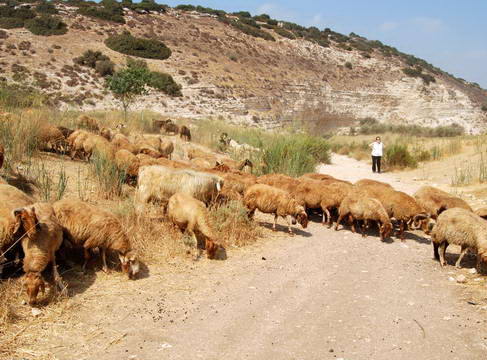
We also visited the sites around the Valley of Elah where young David met Goliath the Philistine from Gath in a decisive battle (1 Samuel 17). While we were in the process of picking up five smooth stones for our grandson, Drew, a shepherd drove a flock of sheep across the brook. You can see from the photo that Elizabeth and I were separated for a while.

Elizabeth and I were temporarily separated in the brook of Elah by a flock of sheep. Photo by Ferrell Jenkins.

Elizabeth and I were temporarily separated in the brook of Elah by a flock of sheep. Photo by Ferrell Jenkins.

Understand that the brook (nachal) of Elah has water in it only during the rainy season. We also visited Tell es-Safi, thought to be the site of Gath, one of the major Philistine cities and the home of Goliath. The excavator, Aren Maeir, has a marvelous aerial photo of the top of the tell posted at the Tell es-Safi/Gath blog. We did not have time to climb to the top, but maybe we can get back to it another day.

The Persian background of Iran

The August, 2008, issue of National Geographic has a good article on the Ancient Soul of Iran. The emphasis is on the rich Persian history of the area. The article is online at ngm.com. The article includes many of those fabulous NG photographs. Most of them were shot in low light to evoke the past glory of Iran. There are more photos at the website than in the magazine. You might be able to buy a copy of the magazine at your local bookseller.

Iran is the only major area of the Bible world that I have been unable to visit. Maybe that will change within the next few years. Marguerite Del Giudice says,

In fact, the first thing people said when I asked what they wanted the world to know about them was, “We are not Arabs!” (followed closely by, “We are not terrorists!”

The article features the people of Iran, and not the government. There are some interesting comments on the influence of Zoroastrianism’s teaching.

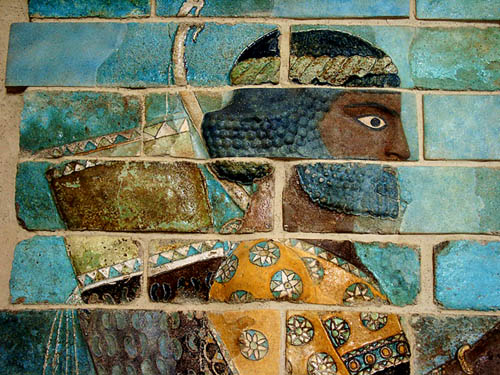
Many of the great museums of the world have ancient Persian artifacts. This is especially true of the Louvre, the British Museum, and the Oriental Institute of the University of Chicago. Here is a photo from the Louvre of one of the Persian archers.

Archer from the Palace of Darius in the Louvre. Photo by Ferrell Jenkins.

Archer from the Palace of Darius in the Louvre. Photo by Ferrell Jenkins.

The Persians played a significant role in the Restoration of the Judeans to their land after the Babylonian Exile. Here are a few highlights.

  • Cyrus, who conquered Babylon, allowed the Jews to return to their land in 536 B.C. See 2 Chronicles 36, and compare the Cyrus Cylinder (in the British Museum).
  • Darius I allowed the Jews to rebuild the temple in Jerusalem (520-516 B.C.; Ezra 6:1-5).
  • Xerxes is the Ahasuerus of the book of Esther.
  • During the reign of Artaxerxes I, the second group of Jews return under the leadership of Ezra (458 B.C.). Nehemiah returned to rebuild the walls of Jerusalem (444 B.C.).

Tutankhamum and the World of the Pharaohs

The premier exhibition of Tutankhamum and the World of the Pharaohs is current open in Vienna. Maybe you will not be able to get to Vienna, but there are some wonderful photos on line. The exhibit web page is here.

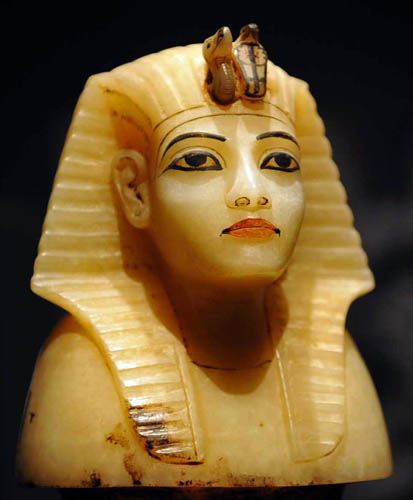
To get to the photos click on the English (UK) flag at the top of the page. (Pay attention. This will not work on the German page.) Then click on Press and Media. The photo here shows the top of one of the canopic jars in the the King Tut tomb. This jar, made of alabaster, was used to store one of the major organs of the body. Click on the photo for a larger image.

The top of a canopic jar from the tomb of Tutanhkamum. Photo by Sandro Vannini.

The top of a canopic jar from the tomb of Tutanhkamum. Photo by Sandro Vannini.

Howard Carter discovered the intact tomb of King Tut in 1922. Tut lived between 1341 and 1323 B.C. This is about a century after Moses was in Egypt if we depend on the dates given in certain Old Testament references like 1 Kings 6:1.

Now it came about in the four hundred and eightieth year after the sons of Israel came out of the land of Egypt, in the fourth year of Solomon’s reign over Israel, in the month of Ziv which is the second month, that he began to build the house of the LORD.

The fourth year of Solomon’s reign would have been about 966 B.C.

When one sees the wealth represented in the tomb of King Tut he must be impressed with the statement made by the writer of Hebrews regarding the treasures of Egypt.

By faith Moses, when he had grown up, refused to be called the son of Pharaoh’s daughter, choosing rather to endure ill-treatment with the people of God than to enjoy the passing pleasures of sin, considering the reproach of Christ greater riches than the treasures of Egypt; for he was looking to the reward. (Hebrews 11:24-26 NASB)

Seal of Zedekiah’s minister found

The Jerusalem Post is reporting here on the discovery of a seal impression belonging to Gedalyahu ben Pashur (English versions have Gedaliah the son of Pashhur). The relevant text from Jeremiah reads,

Now Shephatiah the son of Mattan, Gedaliah the son of Pashhur, Jucal the son of Shelemiah, and Pashhur the son of Malchiah heard the words that Jeremiah was saying to all the people (Jeremiah 38:1 ESV)

Here are a few excepts from the Jerusalem Post article:

The seal impression, or bulla, with the name Gedalyahu ben Pashur, who served as minister to King Zedekiah (597-586 BCE) according to the Book of Jeremiah, was found just meters away from a separate seal impression of another of Zedekia’s ministers, Yehukual ben Shelemyahu, which was uncovered three years ago, said Prof. Eilat Mazar who is leading the dig at the site.

Other Biblical-era bullae were previously found a quarter century ago at the City of David site. In 1982, the Israeli archeologist Yigal Shiloh discovered a cache of bullae in a nearby site, including one with the name of Gemaryahu ben Shaphan – mentioned in the Bible as a minister and scribe during the reign of King Jehoiakim (608-597 BCE).

Hopefully a nice photo of the seal with be forthcoming shortly.

HT: Paleojudaica

Update. For a photo of the inscription check the Trumpet.

New study material online (including Español)

Over at BibleWorld I have posted the following items including Español el material de estudio de la Biblia.:

  • La Authoridad Biblica (under Foreign Language Materials). This book is for class or individual study.
  • Introduction to the Prophets. (This, and the other items below, are under Old Testament Studies.) Brief introductory outline showing the role of the prophets in Israel.
  • Analysis of the Book of Isaiah. This is the analysis by George L. Robinson.
  • Comparison of Kings of Israel, Judah, and Foreign Rulers. Helpful chart with dates for all rulers.

One you get to BibleWorld click on the Download Study Material in PDF link. Then scroll to the material you would like to take a look at and download if you wish.

Here is the link to BibleWorld.

Sinaitic Manuscript now online (with some problems)

The AP news release about the Sinaitic Manuscript can be read here [now broken]. The release correctly points out that the manuscript from the fourth century is the oldest complete New Testament. Of course, we have manuscripts of portions of the New Testament from the early second century.

The British Library says the full text of the Codex Sinaiticus will be available to Web users by next July, digitally reconnecting parts that are held in Britain, Russia, Germany and a monastery in Egypt’s Sinai Desert.

It is significant that all parties owning portions of the manuscript have agreed to work together to make the material available online. In the past I have made a few photos of the open pages of the manuscript in the British Museum. But with the glare of the glass it was always difficult to get a good photo. More recently the British Museum manuscript has been displayed in the new British Library, but in a dimly lit room.

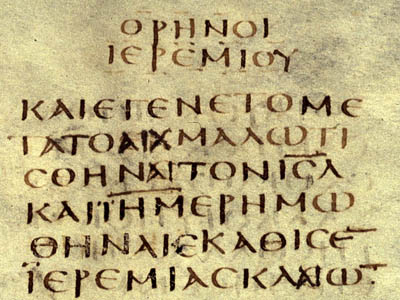
Now you eventually will be able to read the manuscript online. The manuscript includes some portions of the Old Testament, too. To illustrate the high quality of the manuscript I am posting a photo of the first few lines of the Lamentation of Jeremiah over the destruction of Jerusalem by the Babylonians in 586 B.C. This is from a manuscript in Leipzig.

Notice that the words for Israel and Jerusalem are abbreviated. They are the words with the line over them. The name of Jeremiah is seen in the last line.

The first release of the Codex Sinaiticus Project went online a few minutes ago here. The only New Testament book in the present collection is Mark. At the moment the page is not behaving correctly, but I think that will be corrected in time. I am unable to see the image of the MS, but the transcription shows up fine. Take a look, and be patient. You will find some valuable information about the manuscript and the project.

I think I am getting a message saying the system is out of memory. Try later after the crowd leaves home!