Category Archives: Old Testament

Reeds, Rushes, or Bulrushes along the Nile

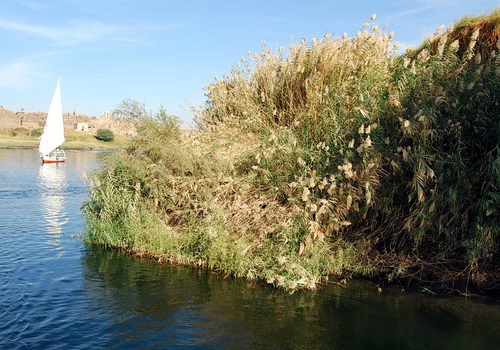
One of the best known stories of the Bible is the account of the mother of Moses hiding the baby among the reeds, rushes, or bulrushes along the edge of the Nile. The terms mentioned above are used interchangeably in various English Bible versions.

Read the full account in Exodus 21. Here are the first few verses.

A man from the household of Levi married a woman who was a descendant of Levi.  The woman became pregnant and gave birth to a son. When she saw that he was a healthy child, she hid him for three months.  But when she was no longer able to hide him, she took a papyrus basket for him and sealed it with bitumen and pitch. She put the child in it and set it among the reeds along the edge of the Nile.  (Exodus 21:1-3 NET Bible)

In the past few days we traveled on the Nile River and saw many examples of the reeds or rushes along the banks of the River.

Reeds or rushes along the edge of the Nile River. Photo by Ferrell Jenkins.

Reeds or rushes along the edge of the Nile River. Photo by Ferrell Jenkins.

Tirhakah of Cush

Frequently the Bible records the statements of various foreign rulers. One such record is that of the Assyrian king Sennacherib.

When he heard them say concerning Tirhakah king of Cush, “Behold, he has come out to fight against you,” he sent messengers again to Hezekiah saying,  “Thus you shall say to Hezekiah king of Judah, ‘Do not let your God in whom you trust deceive you saying, “Jerusalem will not be given into the hand of the king of Assyria.”  (2 Kings 19:9-10)

The Theological Wordbook of the Old Testament comments on the term Cush (Ethiopia) as it is used in several Old Testament prophecies.

In several cases, especially in the prophets, Ethiopia is used in parallel construction as a synonym of Egypt (Isa 20:3-5; Ezek 30:4; Nah 3:9). This probably represents the dominance of Ethiopia (or, more precisely, Nubia) over Egypt between 750 and 663 B.C. Terhakah was a notable Nubian pharaoh who tried, unsuccessfully, to block Sennacherib’s westward expansion (2Kings 19:9 ; Isa 37:9). After 663 B. C. Egypt was independent of Nubia (Jer 46:9; Ezek 25:4, 5, 9).

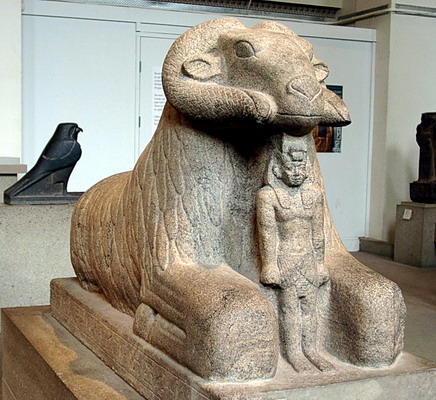
Tirhakah under the protection of the god Amun. British Museum photo by F. Jenkins.

Tirhakah under the protection of the god Amun. British Museum photo by Ferrell Jenkins.

This colossal statue shows Tirhakah standing under the protection of the god Amun shown as a recumbent ram. The gray granite sculpture, dating to about 675 B.C., was found at Karnak. This granite is typical of the Aswan area.

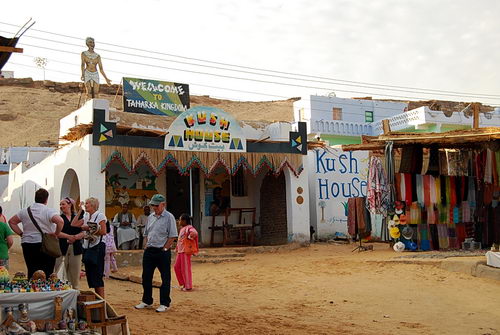
Yesterday afternoon we visited a Nubian Village on the banks of the Nile River at the first cataract of the Nile at Aswan. The Nubians at the village originally lived south of Aswan in the ancient territory of Cush. When the new High Dam was built on the Nile the Nubians were moved to other settlements.

One of the interesting things I observed at the village was a shop of some sort called House of Kush (Cush). A sign on top of the building added “Welcome to Taharka Kingdom.”

House of Kush at Nubian Village, Aswan, Egypt. Photo by Ferrell Jenkins.

House of Kush at Nubian Village, Aswan, Egypt. Photo by Ferrell Jenkins.

This photo is especially for Mrs. Caldwell’s class at the Florida College Academy. I hope you are enjoying the photos of Egypt.

Visiting the Ptolemaic Temple at Edfu

At Edfu, 64 miles south of Luxor, we visited the temple of the sun god Horus who is represented by the falcon. Begun by Ptolemy III in 237 B.C. and completed by 57 B.C., it is the finest example of the ancient Egyptian temples that I have seen. At Luxor we saw Alexander the Great represented as a Pharaoh. His successors, the Ptolemies, brought this practice to an extreme in the temple at Edfu. Ptolemy is pictured repeatedly on the limestone walls standing before Horus; Horus is always the taller figure. Idolatry was not something new to the Greeks, of course (Acts 17; 1 Corinthians 8:5-6).

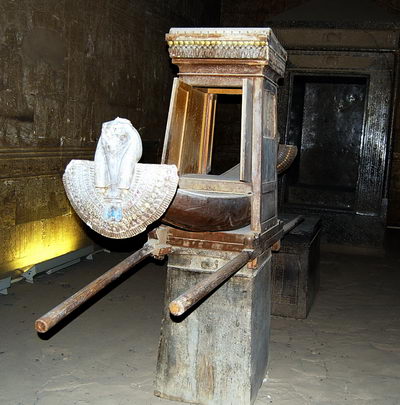
There is a scene inside the temple showing 12 priests carrying an ark on poles. This box on a boat contained the important books pertaining to the temple and the religion of Horus. I think it dates to the time of Pharaoh Neco (late seventh century BC). Neco was the Pharaoh who killed Josiah, the king of Judah, at Megiddo. He continued to Carchemish where he met defeat at the hands of Nebuchadnezzar, king of Babylon. A replica of the ark is on display in the most holy place in the temple.

The ark at Edfu. Photo by Ferrell Jenkins.

The ark at Edfu. Photo by Ferrell Jenkins.

A visit to Edfu demonstrates that, in the Ptolemaic period, we are no longer observing an Egypt ruled by Egyptians but one ruled by foreigners. The prophecy of Ezekiel had been fulfilled.

Thus says the Lord GOD, “I will also destroy the idols And make the images cease from Memphis. And there will no longer be a prince in the land of Egypt; And I will put fear in the land of Egypt. (Ezekiel 30:13).

Descendants of Ham no longer controlled the land, but it was dominated by foreigners who were descendants of Japheth. In the 7th century A.D. the country came under the control of Arab rulers who were descendants of Shem. This same rule by foreigners now continues in the present Egyptian government headed in recent time by presidents Nasser, Sadat, and Mubarak. The modern Egyptians are simply caretakers of the ruins of ancient Egypt.

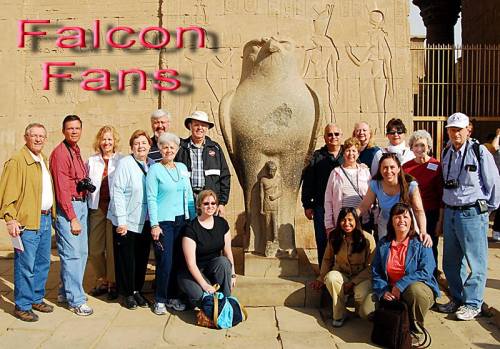
We do a lot of studying and learning on the tour, but we also have fun. Of our 42 person on the tour, about 15 have attended Florida College. Two board members are among the group. The college mascot for the sport teams is the Falcon. We posed with Horus, the falcon god, for a photo.

Note: I left the boat at Aswan to come to a nice Internet Cafe. It seems that I failed to include the photo referenced above on my flash drive. I will try to get it on later.

Note: We are back in Cairo. Here is the photo.

Florida College Falcon fans at Edfu, Egypt. Photo by Sharon Cobb.

Florida College Falcon fans at Edfu, Egypt. Photo by Sharon Cobb.

Luxor and the World Powers

Luxor was known as Thebes in Old Testament times. Both Jeremiah and Ezekiel prophesied the Lord’s judgment of the city. Jeremiah says,

The LORD of hosts, the God of Israel, says, ‘Behold, I am going to punish Amon of Thebes, and Pharaoh, and Egypt along with her gods and her kings, even Pharaoh and those who trust in him’” (Jeremiah 46:25; see also Ezekiel 30:14-16).

A visit to the ruined and unoccupied temples of Karnak and Luxor, where Amon (or Amun) was worshipped as a great god, certainly convinces us of the fulfillment of this prophecy. Shortly after the time of Jeremiah (about 586 B.C.), Egypt and Thebes began to decline as a world power.

In 663 B.C. the Assyrian king Ashurbanipal had already conquered Thebes (Hebrew, No Amon). The prophet Nahum, in prophesying the fall of Nineveh, calls attention to this event (3:8ff.).

Jeremiah and Ezekiel prophesied during the Babylonian period of world dominance. Darius the Great (521-486 BC), who befriended the Judeans, helping them rebuild the temple in Jerusalem, depicted himself as a Pharaoh on a shrine door now displayed in the British Museum.

The young Alexander of Macedon came to Thebes in 336 BC and left reliefs of himself portrayed as a Pharaoh making offerings to the god Amon. Cassander rebuilt the city in 315 B.C. The later Ptolemaic kings who succeeded Alexander built temples to the gods at Edfu and Kom Ombo and regularly pictured themselves as worshiping the gods of Egypt. Likewise, the Roman emperors built temples beside the ancient temples of the Pharaoh. The temple of Philae has a small temple to Augustus ( 30 B.C. to A.D. 14) and another to Trajan (A.D. 98-117).

Luxor, Egypt

We boarded our cruise boat today shortly before noon. After lunch we spent a few hours at Karnak where the great temple complex is located.

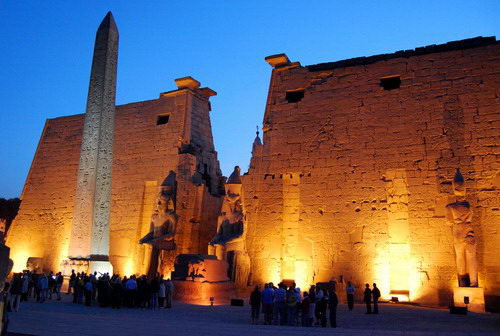
In the late afternoon we went to Luxor temple. This is the temple of Ramses II situated on the banks of the Nile River. I tried making a few photos of the beautifully lit entrance with the statues of the Pharaoh and the obelisk. Here is one of those.

Luxor was known as Thebes in the Old Testament.

Luxor Temple in Egypt. Photo by Ferrell Jenkins.

Luxor Temple in Egypt. Photo by Ferrell Jenkins.

It is difficult for me to write more or post more photos at this time because there are only a couple of computers on the cruise ship and the cost is steep — about $10 for 30 minutes. I simply wanted all of our readers, especially those with family members and friends on the tour, to know that everyone in our group is doing well.

Our boat remains docked at Luxor tonight. Tomorrow morning we visit the Valley of the Kings. At about 1 p.m. the boat departs for destinations along the Nile River.

Egypt and the Bible

The land of Egypt is an important part of the Bible world, and the country played an important role in biblical history. Egypt is mentioned more than 600 times in the Bible. One may add to this numerous reference to the various cities, such as Alexandria, On, and Pi-beseth, that are mentioned where the word Egypt is not used.

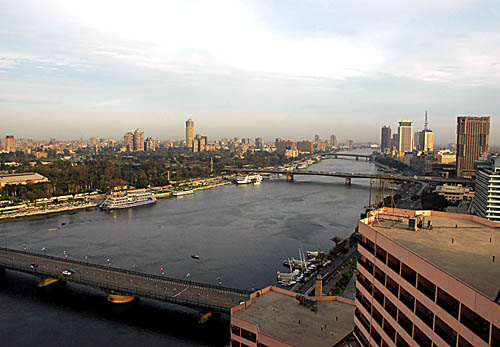
Cairo on the Nile River. Photo by Ferrell Jenkins.

Cairo on the Nile River. Photo by Ferrell Jenkins.

A number of significant Bible stories take their setting in Egypt. Abraham sojourned there (Genesis 12:10). During Joseph’s stay in Egypt he went throughout the land storing grain (Genesis 41:46-48). Moses was born there, adopted by the daughter of a Pharaoh, and trained in all the wisdom of the Egyptians (Acts 7:20-22).

We have every reason to think that these men would have seen the pyramids and other “antiquities” of their time. The Step Pyramid of Djoser, located at Saqqara, was built about 2640 B.C. Shortly thereafter in the twenty-sixth century B.C. came the famous Giza pyramids. Modern man stands in awe of these ancient tombs. This was during the Old Kingdom period of Egyptian history (2800 to 2250 B.C.).

Neither Abraham, Joseph, nor any of the Israelites had anything to do with the building of the pyramids. The pyramids of Giza had been standing more than 500 years when Abraham visited Egypt.

Except for Danny and Sara, who came a day earlier, everyone in our group was tired from the long flight and the loss of seven or more hours. We still made good use of the time by visiting the Citadel and the Mohammed Ali Mosque. Then we went to Old Cairo to visit a Coptic church and the Ben Ezra Synagogue. These churches are built within what has been called Fort Babylon. Hopefully we will get back to visit the church associated with Joseph, Mary, and Jesus, and the Coptic Museum.

See the earlier post about the Ben Ezra Synagogue.

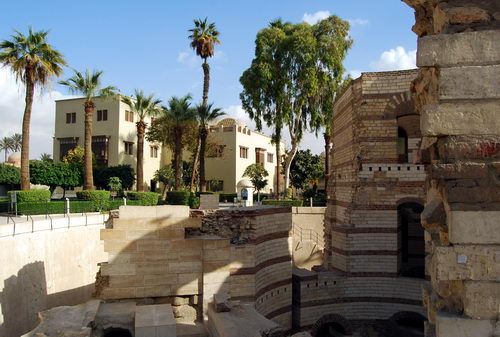
This photo shows a portion of what is marked as a Roman Fort. In the past there have been signs with the phrase Fort Babylon. This ruin (on the right of the photo) is part of the Roman fort that was known as Fort Babylon in Roman times. At that time the Nile River flowed beside the Fort, but has since changed its course. The buildings to the left are part of the newly restored Coptic Museum.

Roman Tower (Fort Babylon, on right) and the Coptic Museum. Photo by Ferrell Jenkins.

Roman Tower (Fort Babylon, on right) and the Coptic Museum. Photo by Ferrell Jenkins.

More illustrations of apocalyptic imagery

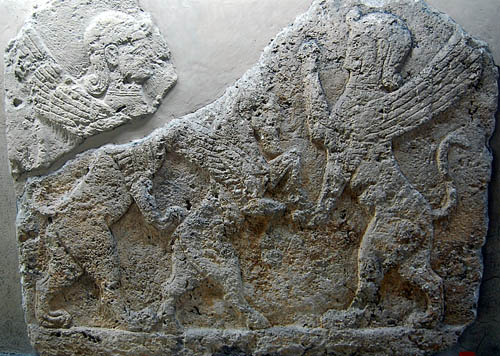
We mentioned in earlier posts on apocalyptic literature that composite images were common among the Assyrians, Babylonians, and Persians. This was also true of the Hittites who lived in the upper Euphrates area. The Anatolian Civilization Museum at Ankara contains many of the reliefs from Carchemish on the Euphrates. The one below shows two human-headed sphinx standing. There is also a winged horse standing between them. They appear to be dancing.

Human-headed sphinxs standing; winged horse standing. Photo by F. Jenkins.

Human-headed sphinx standing; winged horse standing. Photo by F. Jenkins.

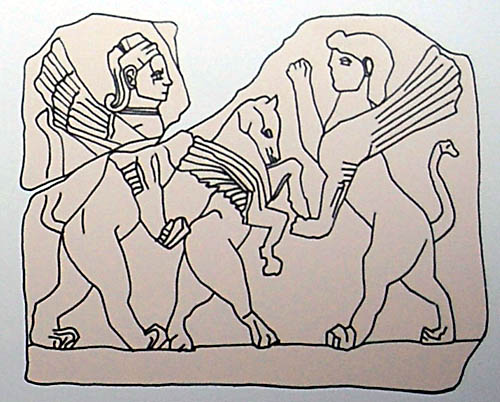
This drawing from the Museum may show the image more clearly. Notice the bird head on the tail of the sphinx on the right.

Drawing of the human-headed sphinx and standing horse.

Drawing of the human-headed sphinx and standing horse.

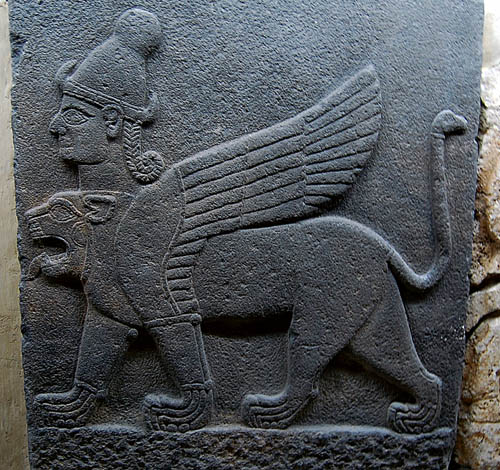
This one is of special interest. It shows a lion with wings and a human head.  The tail shows the head of a bird. There are four images in composite form. This basalt orthostat also comes from Carchemish.

Three-headed sphinx.

Three-headed sphinx.

Judeans who were taken captive to Babylon traveled in this region on their way to their place on the Chebar (Kebar) River in southern Mesopotamia. We know that Nebuchadnezzar made his headquarters at Riblah in the land of Hamath. Because this region was part of the Fertile Crescent we can be sure that the Judeans traveled in the area on their long trip from Judea to Babylon. See 2 Kings 25:6-7.

We are not saying that Ezekiel borrowed his composite creatures from the culture around him. We are saying that such was common and that it would not have been unusual or strange to Ezekiel or his hearers/readers.

Notice, again, Ezekiel’s description of the creatures he saw:

These are the living beings that I saw beneath the God of Israel by the river Chebar;  so I knew that they were cherubim.  Each one had four faces and each one four wings, and beneath their wings was the form of human hands.  As for the likeness of their faces, they were the same faces whose appearance I had seen by the river Chebar. Each one went straight ahead. (Ezekiel 10:20-22 NASB)

For the images in the book of Daniel we could show numerous composite creatures from Babylon.

Apocalyptic imagery is not strange

Visits to the great museums of the world provide many illustrations that help us understand the background of biblical images. This is especially true when we think of the apocalyptic imagery in Ezekiel, Daniel, Zechariah, and Revelation. The Greek name of the Book of Revelation is apocalypsis. In the opening sentence of the book we are told that it is an apocalypse.

In two previous posts we have called attention to the cherubim of the Bible. In this post I want to further this discussion and call attention to the multi-headed creatures that we encounter in apocalyptic literature. In the great throne scene of Revelation 4 we see four living creatures.

The first living creature was like a lion, the second creature like an ox, the third creature had a face like a man’s, and the fourth creature looked like an eagle flying. Each one of the four living creatures had six wings and was full of eyes all around and inside. They never rest day or night, saying: “Holy Holy Holy is the Lord God, the All-Powerful, Who was and who is, and who is still to come!” (Revelation 4:7-8 NET)

In Ezekiel we see figures representing four living beings with human form. Each living being had four faces and four wings. Each face was of a different creature.

Their faces had this appearance: Each of the four had the face of a man, with the face of a lion on the right, the face of an ox on the left and also the face of an eagle. (Ezekiel 1:10 NET)

One notes immediately that in early Christian art the Four Evangelists (or we might say, the four writers of the gospels) were likened to the same creatures.

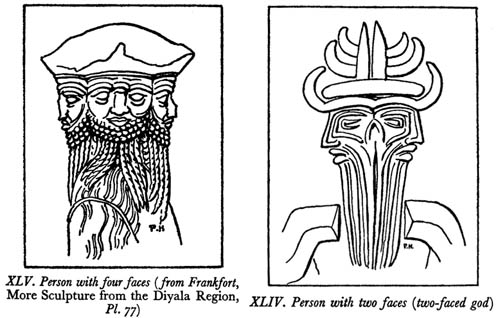
Andre Parrot, in Babylon and the Old Testament, calls attention to the imagery used in Ezekiel. He provides two drawings of images uncovered by the archaeological spade in Mesopotamia. One shows a two-faced image; the other a four-faced image.

Drawings from Parrot, Babylon and the Old Testament.

Drawings from Parrot, Babylon and the Old Testament.

The location of the images is not given. The four-faced image seems to be an image that is now on display at the Oriental Institute of the University of Chicago. This is a museum you must not miss if you visit the Chicago area. Here is a nice photo made by David Padfield.

Four-faced image from Mesopotamia. Photo by David Padfield.

Four-faced image from Mesopotamia. Photo by David Padfield.

One notices immediately that these two-faced and four-faced images all have human heads. We need only turn to the sculpture of Assyria, Babylon, and Persia to find many composite creatures bearing features of four or more creatures. That will have to wait for another time.

In closing I must return to the title of this post. “Apocalyptic imagery is not strange.” That is, it was not strange to those to whom the apocalyptic books of the Bible are addressed. It may be strange to us at first glance, but that can easily change by investigating the culture in which these books were written and read.

What Were the Cherubim?

What Were the Cherubim?
By W. F. Albright

Today we think of a cherub as a tiny winged boy, following the tradition of Renaissance artists. This conception was directly borrowed from pictures of Graeco-Roman “loves” or Erotes, familiar to us from the excavations of Pompeii. The actual appearance of the cherubim of the Old Testament was already forgotten before the time of Christ, and Josephus (first century A.D.) says that “no one can tell what they were like.”

Since the veil of the Tabernacle was decorated with embroidered cherubim, and the walls and the religious objects of Solomon’s temple lavishly adorned with them. we ought to be able to identify them in contemporary Syro-Palestinian art. The account of the Ark of the Covenant shows that only a creature with wings can be considered. If, therefore, we study all known representations of animals and hybrid creatures, partly animal, we find one which is much more common than any other winged creature, so much so that its identification with the cherub is certain: that is the winged sphinx or winged lion with human head. In Egypt the wingless sphinx and the griffin appear; in Babylonia and Assyria the winged bull with a human head prevails; but in Syria and Palestine it is the winged sphinx which is dominant in art and religious symbolism.

King Hiram of Byblus [Byblos] seated on his cherub-throne, tenth century B.C. Drawing by A. H. Detweiler.

The God of Israel was often designated as “He who sitteth (on) the cherubim” (I Sam. 4:4, etc.). The conception underlying this designation is well illustrated by representations of a king seated on a throne supported on each side by cherubim, which have been found at Byblus [Byblos], Hamath, and Megiddo, all dating between 1200 and 800 B.C. One shows King Hiram of Byblus (period of the Judges) seated upon his cherub throne. Pottery incense altars found at Taanach and Megiddo are archaeological parallels to the wheeled lavers (“bases”) of Solomon’s temple, which were decorated with lions and cherubs, according to I Kings 7:36.

The primary function of the cherub in Israelite religious symbolism is illustrated by two biblical passages. A very ancient hymn, found twice in the Bible, has the words, “And He rode upon a cherub and did fly” (I Sam. 22:11 [2 Sam. 22:11], Ps. 18:11 [English, Ps. 18:10]); the second is Ezek. 10:20. The conception of the deity as standing or as enthroned on an animal or hybrid creature was exceedingly common in the ancient Near East, but it was most common in Syria and Northern Mesopotamia between 2000 and 700 B.C. In Babylonia the figure of a deity is replaced in certain cases by a winged shrine and later by a thunderbolt. So in Israelite symbolism between 1300 and 900 B.C., the invisible Glory (Jehovah) was conceived as enthroned upon the golden cherubim or standing on a golden bull.

– – – – – – – – – –

This article was published in The Biblical Archaeologist, Feb., 1938, and is included in the Biblical Archaeologist Reader I: 95-97. A few corrections and notes have been added in brackets.

The drawing by A.H. Detweiler shows King Hiram of Byblus [Byblos] seated on his cherub-throne, tenth century B.C.

I plan to follow this article with some photographs to help illustrate the subject.

Ineffective teaching no longer excusable

Examples of the use of visuals in teaching are abundant in Scripture. Think of these.

God used visuals.

  • The rainbow (Genesis 9:12-18).
  • The stars He showed to Abraham (Genesis 15:5).
  • The burning bush through which he spoke to Moses (Exodus 3:3-4).

Ezekiel has been called the dramatic prophet because of his use of so many object lessons.

  • He made a sketch of Jerusalem on a brick to teach about the siege against Jerusalem by the Babylonians (Ezekiel 4:1-3).

Jesus used visuals in His teaching. There are too many illustrate to cite all of them. Think about these.

  • A little child (Matthew 18:3-6)
  • The birds of the air and the lilies of the field (Matthew 6:26-28).
  • A Roman coin (Matthew 22:15ff.).

Repeatedly on this page, and elsewhere, I have said that every church needs to have good maps and photographs available for use by the teachers. Specifically, I have recommended the Pictorial Library by Todd Bolen. On the Biblical Studies Info site, under Scholarly, I keep a list of excellent sources where one may find photographs suitable for use in teaching the Bible. Many of them are free of charge. Scroll down to Photos.

Today I want to call attention to maps for use in teaching. There are several good sites listed under Maps at the Biblical Studies Info page. David Barrett has made his Bible Mapper available free of charge. This marvelous program allows one to make his own maps. There is a learning curve, but the results are remarkable. The resultant map shows exactly what the teacher wants to emphasize in class.

The folks over at Biblos.com have posted many Bible Study Tools including visuals and a marvelous Bible Atlas. You get to it directly at BibleAtlas.org.  Hundreds of maps have been made using Bible Mapper, but they are specific to certain places. Let me illustrate.

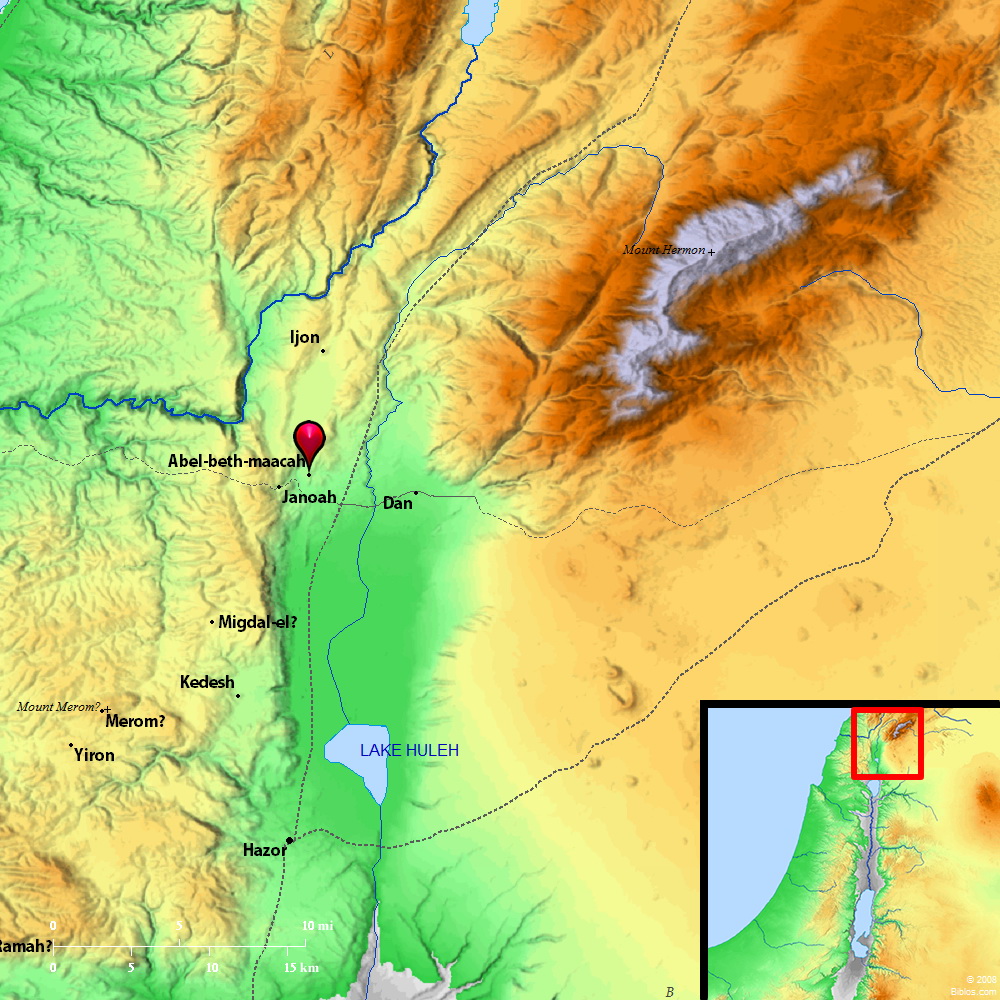
Recently I wrote here about an event at Abel-Beth-Maacah. If I were teaching on this subject I could use this map from BibleAtlas.org.

Map of Abel-beth-maacah. Courtesy of Biblos.com.

Map of Abel-beth-maacah. Courtesy of Biblos.com.

The original map is 1000 x 1000 (click on the map to see the original). It can be inserted into a PowerPoint presentation without any further work. There is plenty of space for the teacher to include some calls outs with additional information.

It is true that once you have inserted a map like this into your presentation it will take some additional study for you to be able to use it effectively. But your lesson will be much more interesting and you will more easily make your point.

Take advantage of these marvelous teaching aids. We extend our hearty thanks to the folks at BibleAtlas.org and all the others who labor and invite us to share in their labors. David Padfield frequently reminds us of the teaching of Jesus.

Freely you received, freely give. (Matthew 10:8 NAS)