Category Archives: Old Testament

Passing through the grainfields

All three of the Synoptic Gospels record the incident of Jesus and His disciples passing through the grainfields on a Sabbath.

On a Sabbath, while he was going through the grainfields, his disciples plucked and ate some heads of grain, rubbing them in their hands. But some of the Pharisees said, “Why are you doing what is not lawful to do on the Sabbath?” (Luke 6:1-2 ESV)

I thought I would put together some photos to help you visualize what happened here. First, we have a photo of a wheat field below Mount Tabor. The photo is made looking north west from near the site of ancient En-dor. The area is famous as the home of the medium visited by King Saul (1 Samuel 28:7).

Wheat field below Mount Tabor. Photo by Ferrell Jenkins.

Wheat field with view NW to Mount Tabor. Photo by Ferrell Jenkins.

Now, imagine the disciples taking grain in their hands.

Picking heads of grain. Photo by Ferrell Jenkins.

Picking heads of grain. Photo by Ferrell Jenkins.

And then rubbing the heads to separate the grain from the chaff.

Rubbing grain to separate the head from the chaff. Photo by Ferrell Jenkins.

Rubbing grain to separate the head from the chaff. Photo by Ferrell Jenkins.

The last two photos were made in the vicinity of Mount Nemrut in eastern Turkey. Larger images, suitable for use in teaching, are available by clicking on the photos.

The Gate at Dan

The late Avraham Biran worked for several decades at the city of Dan. In addition to locating the massive city walls, the high place, and the house of David inscription, he found a pedestal or rostrum within the gate where it is thought the king would sit when he visited Dan. Here is a view of the pedestal as we see it today. Note the standing stone to the left of the podium. Click on the photo for an image large enough for use in presentations.
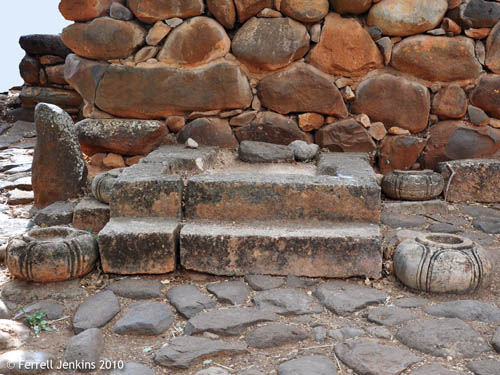
Rostrum inside the gate at Dan. Photo by Ferrell Jenkins.

Rostrum inside the gate at Dan. Photo by Ferrell Jenkins.

Prof. Carl Rasmussen has a photo showing a canopy built over the podium several years ago at Holy Land Photos. Just search for Dan, and you will also see some photos showing details of certain parts of the podium.

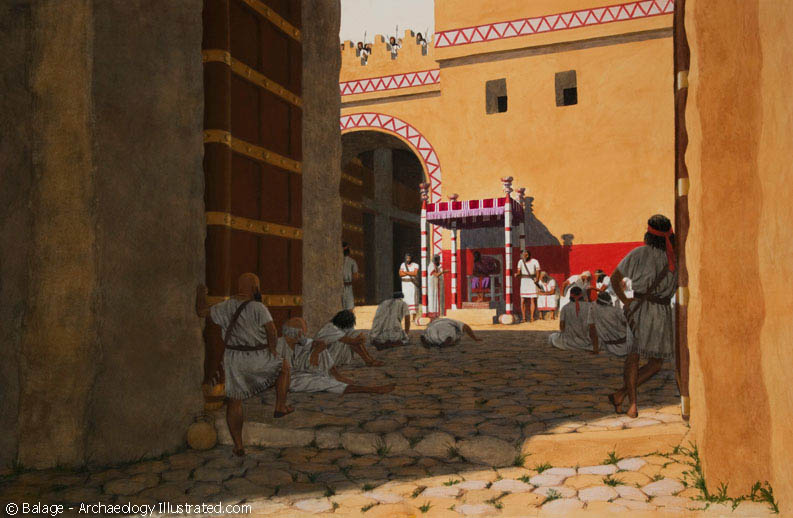
Balage Balogh has provided us with an illustration showing the way this area of the gate might have looked in biblical times. The illustration is based on information gleaned from the excavation at Dan. Take a look at other illustrations at Archaeology Illustrated. [At the moment this page is slow in loading. It is worth the wait.]
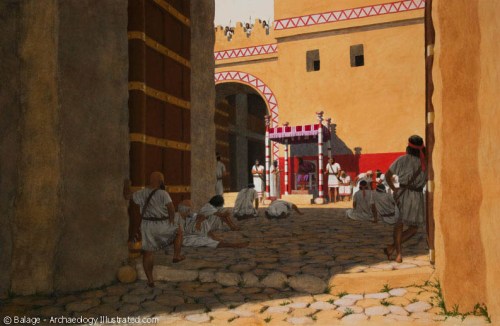
© Dan City Gate. Illustrated by Balage Balogh.

In several places in the Old Testament we have examples of the king sitting in the gate of a city. David sat in the gate at Jerusalem after the death of Absalom.

Then the king arose and took his seat in the gate. And the people were all told, “Behold, the king is sitting in the gate.” And all the people came before the king. Now Israel had fled every man to his own home. (2 Samuel 19:8 ESV)

The officials of the king of Babylon sat in the middle gate at Jerusalem.

Then all the officials of the king of Babylon came and sat in the middle gate: Nergal-sar-ezer, Samgar-nebu, Sar-sekim the Rab-saris, Nergal-sar-ezer the Rab-mag, with all the rest of the officers of the king of Babylon. (Jeremiah 39:3 ESV)

Eli, the judge, had a seat at the gate of Shiloh.

As soon as he mentioned the ark of God, Eli fell over backward from his seat by the side of the gate, and his neck was broken and he died, for the man was old and heavy. He had judged Israel forty years. (1 Samuel 4:18 ESV)

The king of Israel and the king of Judah sat at the entrance of the gate of Samaria.

Now the king of Israel and Jehoshaphat the king of Judah were sitting on their thrones, arrayed in their robes, at the threshing floor at the entrance of the gate of Samaria, and all the prophets were prophesying before them. (1 King 22:10 ESV)

I trust the photo and illustration with make these biblical texts more vivid when you read them in the future.

The Explorations in Antiquity Center at LaGrange, Georgia, has a wonderful display of the various aspects of the city gate. We reported on the Center along with two reviews by David Padfield here, and here, and here. the Explorations in Antiquity web site may accessed here. The photo is provided by David Padfield.
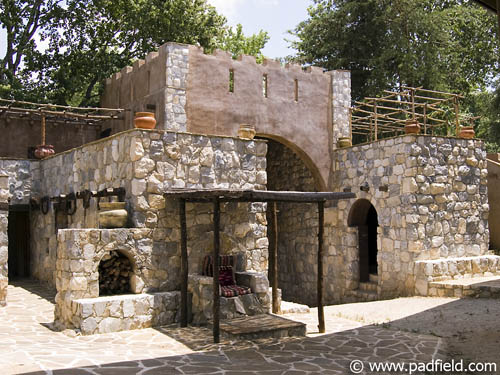
The city gate at the Exploration in Antiquity Center. Photo by David Padfield.

The city gate at the Exploration in Antiquity Center. Photo by David Padfield.

Tired of watching the second hand on your watch?

Well, now your troubles are over. You can watch the Tell es-Safi/Gath Excavation in progress each day (Monday through Friday) at 6 a.m. to 1 p.m., and on Sunday through Thursday from 2:30 p.m. to 4:30 p.m. That is Israel time, which is 7 hours ahead of Eastern time in the USA.

In the Eastern time zone in the USA the live video feed may be seen from 11 p.m. to 6 a.m. (Monday-Friday) and 6:30 a.m. to 8:30 a.m. (Sunday-Thursday). Not the best times for the working American. But, what if it were the World Cup? Same response.

Well, I hope to catch the show beginning tonight at 11 p.m. I will get to watch those young college age volunteers wiping the matter from the corners of their eyes. This all reminds me of the conversations I have with my wife when I travel in Israel and she remains at home. I usually talk at 6 a.m., and she talks at 11 p.m. I say “Good Morning!” and she says “Goood Niighht…”.

Can’t make the show at all? Then go back to other exciting things like watching the second hand on your watch.

Seriously, this is a great thing. I suppose it is a first. Digging into the past streaming live. Dr. Aren Maeir, the director of the Tell es-Safi/Gath dig, keeps us updated on the progress of the dig.

Go to the Bar Ilan University web page and look for the banner about the streaming video here.

The direct URL to the feed is: http://media.motion-stream.com/biulive.

The dig blog may be read here.

Last December I made some aerial photographs above Tell es-Safi. Here is a photo showing a view to the southeast. This ancient Philistine city is located at the point where the coastal plain (to the west) meets the Shephelah (to the east). You should be able to make out the line of the Elah brook along the bottom and right of the photo.

Today we are trying to post these photos in a 1024 x 768 pixel size to make this more usable in PowerPoint presentations. Let us know if this is helpful. It require more time and attention, but we may be able to do this occasionally if you find it useful.

Tell es-Safi - Gath. Aerial SE view by Ferrell Jenkins.

Aerial view of Tell es-Safi/Gath looking SE. Photo by Ferrell Jenkins.

Dr. Maeir posted an aerial view of the tell at the end of the 2009 season here. Our next photo is a close look at Areas E (left) and A (right). Both areas continue to be worked this season.

Tell es-Safi/Gath Areas E and A. Photo by Ferrell Jenkins.

This site is important for those interested in the biblical history of Israel. Gath was one of the five cities of the Philistines, and the home of Goliath (Joshua 13:3; 1 Samuel 6:17; 17:4).

Excitement in the Shephelah

Luke Chandler hands out a teaser about “Fantastic (somewhat secret) new finds at Khirbet Qeiyafa” here. Whether his “Best case scenario” or the “Alternate scenario” turns out to be correct, there are discoveries that date to the Early Iron Age (about 1200 to 900 B.C.).

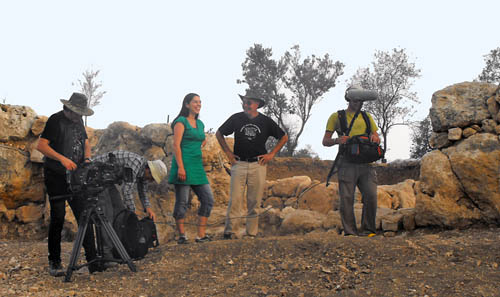
BBC is filming a documentary including Khirbet Qeiyafa and Gath. Luke posts a larger photo showing the BBC team with Dr. Yossi Garfinkel, director of the excavation, at the western gate. I recall that National Geographic did some filming there last year.

BBC filming documentary at Khirbet Qeiyafa. Photo by Luke Chandler.

BBC filming documentary at Khirbet Qeiyafa. Photo by Luke Chandler.

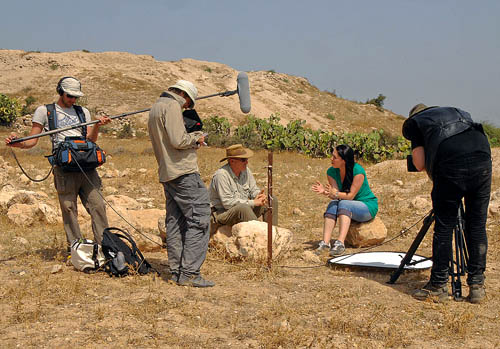
Earlier, the BBC team had been at Tell es-Safi/Gath with Professor Aren Maeir. The interviewer (in green) is Dr. Francesca Stavrakopoulou, a biblical scholar from Exeter University in the U.K. With a doctorate from Oxford, she worked at Tell es-Safi three years ago.

BBC filming documentary at Tell es-Safi/Gath. Photo: dig website.

BBC filming documentary at Tell es-Safi/Gath. Photo: dig website.

Aren describes today at the dig as “Just another fantastic day…” I will leave it for you to check out the other photos and a sketch of some of the discoveries of the day here. One thing that relates to what we posted earlier is about evidence of metallurgy at the site. Maeier says,

Adi and Naama continue to uncover additional evidence of metallurgy, apparently both Iron and Copper production!

Both Khirbet Qeiyafa, overlooking the Valley of Elah, and Gath, have a connection with the account of David and Goliath (1 Samuel 17).

Elisha’s Fountain at Jericho

When we think of the Old Testament prophets, we likely think first of the literary prophets such as Isaiah, Daniel, Jeremiah, Amos, et al. We may also think of Elijah and Elisha, two of the oral prophets. These two men served the Lord in the last part of the ninth century B.C.

The first reference to Elisha is when Elijah is told to anoint Elisha as his successor (1 Kings 19:16-21). Elisha is plowing with oxen when Elijah comes by and throws his mantle over him, a symbolic way of showing that Elisha was being called to serve in the prophetic office. Elisha’s sacrifice of his oxen shows that he accepted the call.

The next reference to Elisha does not come until the time when Elijah is taken into heaven (2 Kings 2). Elijah’s mantle (cloak) is used this time to strike the Jordan River. The waters were divided and the two prophets crossed into Transjordan on dry ground, just as the Israelites had crossed in the opposite direction centuries earlier.

When it becomes clear that Elisha will see Elijah no more, he returned and stood on the bank of the Jordan. He took Elijah’s mantle and struck the waters. They were divided and Elisha crossed back to the west bank.

The men of Jericho came to Elisha and explained the situation of their city. They said, “the situation of this city is pleasant…but the water is bad and the land is unfruitful” (2 Kings 2:19). The prophet asked for a jar. He told the men to put salt in it. He threw salt in the waters and they were purified. The writer says they have been purified to this day.

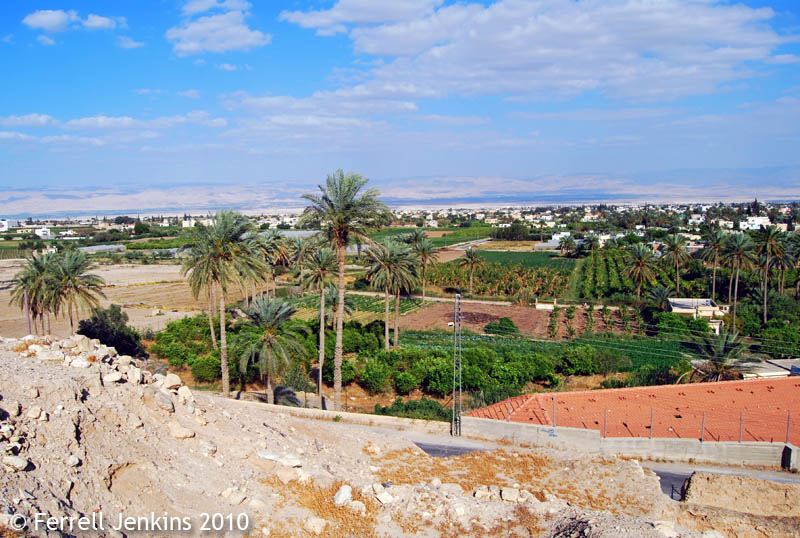
View east from Tell es-Sultan/Jericho. Photo by Ferrell Jenkins.

View east from Tell es-Sultan/Jericho. Photo by Ferrell Jenkins.

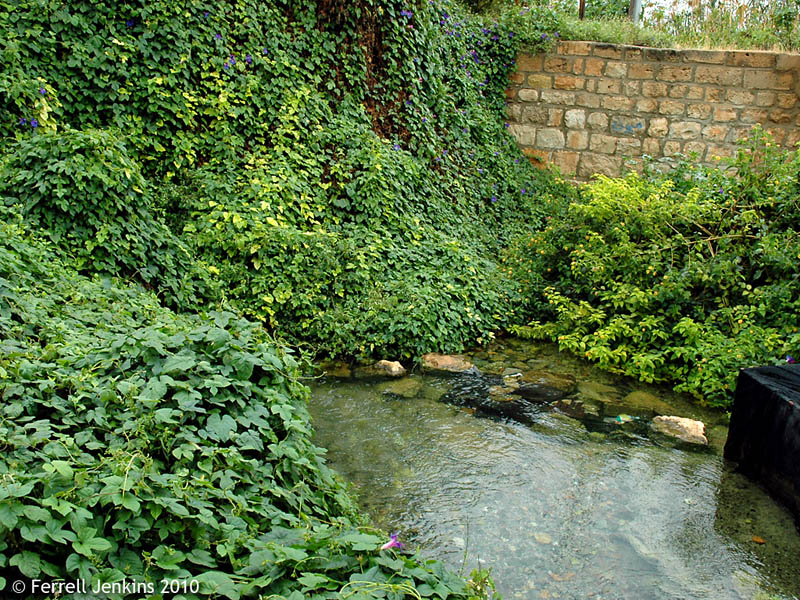
Jericho is still a city of palm trees (Deuteronomy 34:3). Below the ancient mound (Tell es-Sultan) to the east there is a spring called Elisha’s Fountain. The photo above was made from the tell with a view to the east. The mountains of Transjordan can be seen in the distance. Close to the tell there is a building with a red tile roof. This is the pumping station that provides water for modern Jericho. The next photo shows the spring as it exits the ground [at the present time]. Perhaps this is the same spring mentioned in the Bible.

Elisha's Fountain at Jericho. Photo by Ferrell Jenkins.

Elisha's Fountain at Jericho. Photo by Ferrell Jenkins.

This article was published in Biblical Insights, August, 2009.

Following current excavations

Prof. Aren Maeir reports the discovery of evidence of Philistine metallurgy at Tell es-Safi/Gath. He says the slag “is definitely copper-based material.” He mentions two experts in ancient metallurgy who came to supervise the excavation of the context of the metallurgical areas.

They found additional evidence of bronze production, including additional fragments of a crucibles, possible tuyeres, and many more small fragments of slag. This definitely is becoming very interesting!

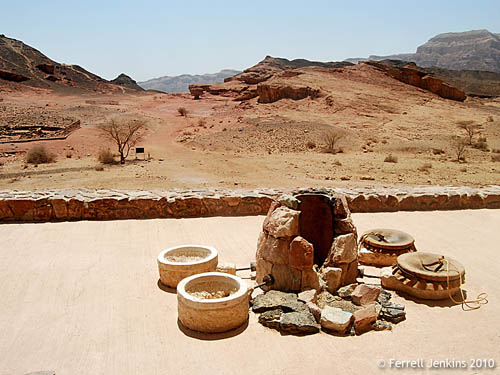
If I correctly understand what I read, the tuyere is the tube through which air is pumped into the crucible to make the heat in the furnace more intense. Perhaps this illustration of the copper mining process at Timna will be helpful. I am talking in an area where I know very little. If this is not correct, I will be pleased to receive a comment with a better explanation.

Copper smelting at Timna. Photo by Ferrell Jenkins.

Copper smelting at Timna. Photo by Ferrell Jenkins.

There are a few references to copper in the Bible. The land promised to the Israelites is described as,

“a land whose stones are iron, and out of whose hills you can dig copper.” (Deuteronomy 8:9 ESV)

The process of smelting is mentioned in the book of Job.

“Iron is taken out of the earth, and copper is smelted from the ore.” (Job 28:2 ESV)

More information is available at the Tell es-Safi/Gath Excavations website here.

Excavations in Jordan resulting in evidence of copper smelting in 10th century B.C. Edom is reported here.

Being able to keep up with some of the excavations by means of the blogs is exciting. Todd Bolen has compiled a list of 2010 Excavation Blogs at the Bible Places Blog here.

Fragment of Cuneiform tablet found in Jerusalem

The Jerusalem Post reports here the discovery of a fragment of a cuneiform tablet in Jerusalem.

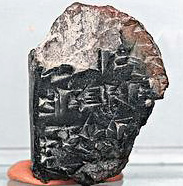
Cuneiform fragment. Photo: Jer.Post.

Cuneiform fragment. Photo: Jerusalem Post.

Hebrew University excavations recently unearthed a clay fragment dating back to the 14th century BCE, said to be the oldest written document ever found in Jerusalem.

The tiny fragment is only 2 cm. by 2.8 cm. in surface area and 1 cm. thick and appears to have once been part of a larger tablet. Researchers say the ancient fragment testifies to Jerusalem’s importance as a major city late in the Bronze Age, long before it was conquered by King David.

The minuscule fragment contains Akkadian words written in ancient cuneiform symbols. Researchers say that while the symbols appear to be insignificant, containing simply the words “you,” “you were,” “them,” “to do,” and “later,” the high quality of the writing indicates that it was written by a highly skilled scribe. Such a revelation would mean that the piece was likely written for tablets that were part of a royal household.

The cuneiform fragment was discovered during wet sifting of the excavation. Prof. Eilat Mazar, director of the dig, said information was not released until last week “because researchers wanted to wait until analysis of the piece was complete so as to be absolutely certain of the details of the find.”

Duane Smith reports that the fragment is published in the current Israel Exploration Journal by Mazar, Horowitz, Oshima, and Goren. The fragment has been dubbed “Jerusalem 1.” The suggestion is made that this fragment may be related to the Amarna tablets sent by rulers of ancient Canaan to the Pharaoh of Egypt in the 14th century B.C.. Smith discusses the fragment in relation to the scribes of the Late Bronze Age Jerusalem here.

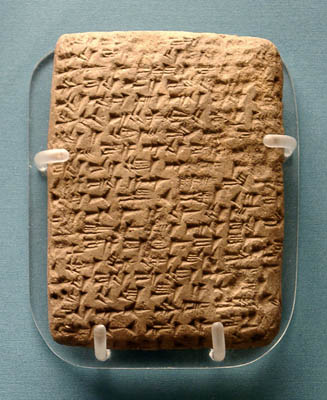
Several museums have examples of the Amarna tablets on display. Here is a photo of the letter from Yapahu, king of Gezer. In it he “begs pharaoh for help in defending his city against raids by the Hapiru.”

Amarna Tablet from Gezer. British Museum. Photo: F. Jenkins.

Amarna Tablet from Gezer. British Museum. Photo: F. Jenkins.

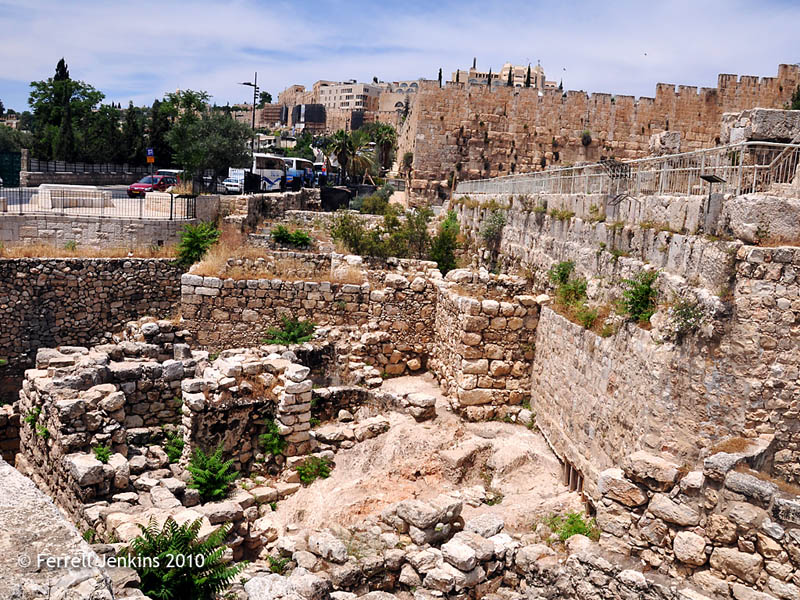
We discussed Mazar’s Ophel Excavation February 23 here. Since that time I have visited Jerusalem and am delighted to share a photo of the area under consideration. Click on the photo for a larger image.

Mazar's Ophel Excavation Area. Photo by Ferrell Jenkins.

Mazar's Ophel Excavation Area. Photo by Ferrell Jenkins.

HT: Joseph I. Lauer; See the Bible Places Blog for more analysis.

Kinneret Regional Project uncovers synagogue

Several weeks ago I added a link to the Kinneret Regional Project on the Bible Places page of the Biblical Studies Info Page. My intention was to write about the project and show a photo of Tel Kinneret (Kinrot; Arabic Tell el-‘Oreme) on the northwestern shore of the Sea of Galilee.

Now word comes of the discovery of a fourth century synagogue at Horvat Kur, about a mile northwest of Tel Kinneret. The press release here says that the discovery “adds new evidence [along with the synagogues at Capernaum, Chorazin, Kh. Hammam, and Magdala] for a very tight net of synagogues in a relatively small area on the Northwestern shores of the Lake of Galilee.”

Todd Bolen created a map using Google Earth to identify Horvat Kur, Tel Chinnereth (Kinneret), Tabgha, Mount of Beatitudes, Cove of the Sower, and Capernaum. This great resource for studying the ministry of Christ may be accessed at the Bible Places Blog.

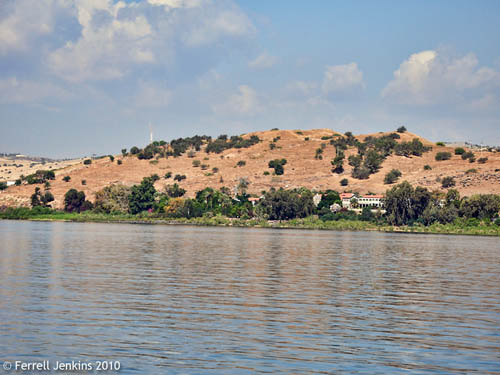
Earlier I mentioned that the day in early May when my group took a boat ride on the Sea of Galilee was a great one for making photos. I caught this wonderful view of Tel Kinneret from the boat. The buildings on the shore below the tel belong to Pilgerhaus Tabgha, a guesthouse operated by the German Association of the Holy Land.

Tel Kinerot from the Sea of Galilee. Photo by Ferrell Jenkins.

Tel Kinneret from the Sea of Galilee. Photo by Ferrell Jenkins.

From the Kinneret Regional Project site you may download several good resources. The 2004 report by Pakkala, et al., begins with this description of Tel Kinneret.

The site boasts remains from the Chalcolithic to the Ottoman period. In its heyday in the Early Iron Age, i.e. the 11th/early 10th century BCE, Kinneret developed into a regional center, controlling the surrounding region and becoming one of the most important urban sites of the country.

The body of water that we commonly call the Sea of Galilee is known as the Sea of Chinnereth in the Old Testament (Numbers 34:11; Joshua 13:27). Chinnereth is listed as one of the fortified cities of the tribe of Naphtali in Joshua 19:35.

I think most tourists to Galilee overlook Tel Kinneret. They are excited about having seen the Roman boat at Nof Ginosaur, and the guide is beginning to tell them about Taghba, Capernaum, or the Mount of Beatitudes. Or it may be because the site is obscured from the highway by the electric power station below it.

HT: Joseph I. Lauer

Reaching 400,000

Moments ago someone recorded hit number 400,000 for this blog. Your words of appreciation are greatly appreciated. In the past few weeks, while traveling on the West Coast, numerous people told me they found the posts helpful. The comments left on the blog, and the Emails received are also appreciated.

400,000 hits at ferrelljenkins.wordpress.com.

Ferrell's Travel Blog recorded his number 400,000 this evening.

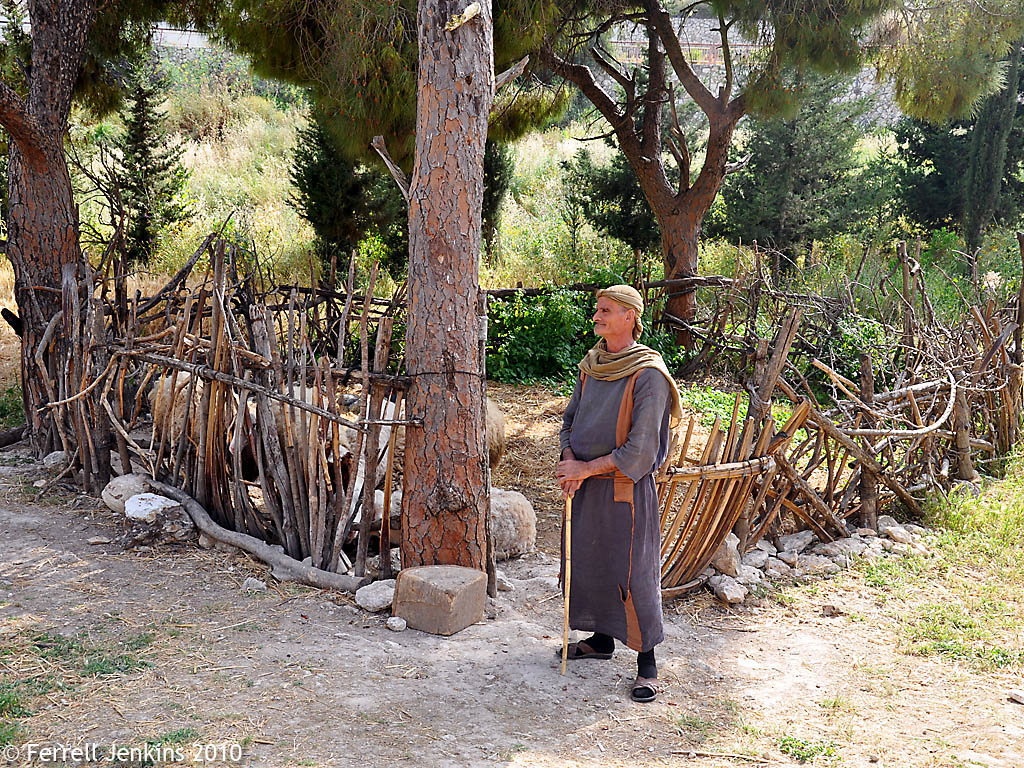
As a marker of this milestone I am posting a photo I think many of you will be able to use in the Bible classes you teach. Click on the photo for a larger image suitable for use in PowerPoint.

Shepherd and sheepfold at Nazareth Village. Photo by Ferrell Jenkins.

Shepherd and sheepfold at Nazareth Village. Photo by Ferrell Jenkins.

This photo might be used in teaching any of the texts mentioning the sheepfold (Genesis 49:14; Numbers 32:16; Judges 5:16; 1 Samuel 24:3; 2 Chronicles 32:28; Psalm 28:13; Psalm 78:70).

It provides a good illustration of the teaching of Jesus in John 10.

“Truly, truly, I say to you, he who does not enter by the door into the fold of the sheep, but climbs up some other way, he is a thief and a robber.  “But he who enters by the door is a shepherd of the sheep. “To him the doorkeeper opens, and the sheep hear his voice, and he calls his own sheep by name and leads them out. (John 10:1-3 NAU)

“I believe we have found Ai…”

“I believe we have found Ai…” These are the words of Dr. Bryant Wood regarding the excavation at Khirbet el-Maqatir, a few miles east of the West Bank town of Ramallah.

You will be able to see this video clip and another one describing the activities of a day at a dig on the ABR blog here.

Many scholars have long said that the Bible is wrong in saying that Ai was destroyed by Joshua and the Israelites. Other scholars, associated with the Associates for Biblical Research have been suggesting for several decades that the current location of Ai is incorrect. Now Dr. Wood and his team are able to conduct excavations at an alternative site. Good reading. Take it seriously.

Read Joshua 8 for the biblical account of the capture of Ai.

Posted from AA 1086 over Wyoming.