Category Archives: New Testament

Friday in Jerusalem (and environs)

Today we spent a full day in and around the city of Jerusalem. There was plenty of sunlight for good photos almost all day. The days are short at this time of the year. Photography dependent on good sunlight is over by about 4 p.m.

We went to an overview on Mount Scopus for some photos of Jerusalem. Then we continued to the Mount of Olives for another view of the city.

In years past it was easy to drive over the southern end of the Mount of Olives to Bethany. Now, due to the fence (wall) built by Israel it is more difficult. Bethany was the home of Mary, Martha, and Lazarus (John 11). It is known that there has been a church at Bethany associated with Lazarus since Byzantine times. Ths photo show a portion of the exterior of a fairly new church built in the early 1950s.
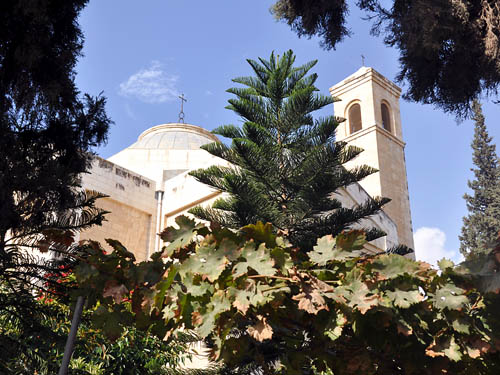
Church dedicated to Lazarus at Bethany. Photo by Ferrell Jenkins.

Church dedicated to Lazarus at Bethany. Photo by Ferrell Jenkins.

We visited a site called St. Peter in Gallicantu, considered by the owners as the house of the Jewish High Priest in the time of Jesus. Then we made some photos of the Valley of Hinnom and stopped by the Ketef Hinnom excavation. This site revealed tombs dated to the period before the destruction of Jerusalem by the Babylonians (586 BC). This is where the silver amulet inscribed with a portion of the Priestly Blessing (Number 6) was discovered.

Ferrell Jenkins at the Jewish Burial Tombs from the Iron Age. Photo by Leon Mauldin.

Jenkins at the Jewish Burial Tombs from the Iron Age. Photo by Leon Mauldin.

We went to the Herodium for some photos. On the return to Jerusalem we stopped for a photo of the Tower of David. It is actually part of the Turkish wall, but the lower portion of the wall was built by Herod the Great. This view, showing the golden glow of the late afternoon sun, reminded me of the beautiful song, Jerusalem of Gold, that became so popular after the June was of 1967.

The Tower of David in the afternoon golden glow. Photo by Ferrell Jenkins.

The Tower of David in the afternoon golden glow. Photo by Ferrell Jenkins.

Each of these places deserve more attention, but it is time to get some rest for another exciting day Saturday.
More on the Magdala Excavation Project

Fishhook from the 2008 Magdala Project dig.

Fish-hook from the 2008 Magdala Project dig.

The Magdala Project blog is giving some info on the current excavations at the site of Magdala on the west short of the Sea of Galilee. Reports include information on the first century synagogue, a 2006 preliminary report, and ship iconography as portrayed on mosaics of the first to third centuries AD.

Several nice photos are included on the blog including one of a fish-hook discovered  from the 2008 Magdala Project dig, and a stone anchor from the 2007 season.

The article by K. C. Hanson on “The Galilean Fishing Economy and the Jesus Tradition” is extremely helpful for those seeking to understand the role of the disciples of Jesus who were fishermen.

The photo of the fish-hook  provides a nice illustration of a text from Matthew 17:24-27.

When they came to Capernaum, the collectors of the two-drachma tax went up to Peter and said, “Does your teacher not pay the tax?” He said, “Yes.” And when he came into the house, Jesus spoke to him first, saying, “What do you think, Simon? From whom do kings of the earth take toll or tax? From their sons or from others?” And when he said, “From others,” Jesus said to him, “Then the sons are free. However, not to give offense to them, go to the sea and cast a hook and take the first fish that comes up, and when you open its mouth you will find a shekel. Take that and give it to them for me and for yourself.” (Matthew 17:24-27 ESV)

We have mentioned Magdala several times. Check here, and use the Search box for other references.

HT: Bible Places Blog

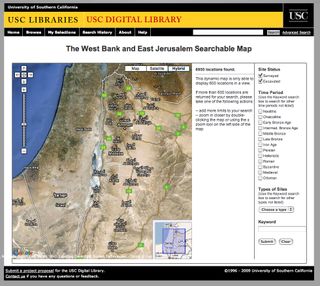
Unique Archaeology Map of the West Bank and East Jerusalem

Suzanne Muchnic, of the Los Angeles Times, reports on a new online map that will be of interest to students of the archaeology of Palestine. Here is a portion of that report.

A searchable map detailing 40 years of Israeli archaeological work in the West Bank and East Jerusalem, developed for the USC Digital Library, has won the 2009 Open Archaeology Prize from the American Schools of Oriental Research.

Project leaders Lynn Swartz Dodd of USC and Rafi Greenberg of Tel Aviv University are expected to accept the award on behalf of an international team composed of Americans, Israelis and Palestinians.

The West Bank and East Jerusalem Digital Map

The digital map apparently won the approval of jurors because it offers a body of information previously unavailable to the public about sites surveyed or excavated since 1967, when Israel occupied the West Bank and East Jerusalem.

USC’s website is part of an effort to establish a framework for the disposition of the region’s cultural heritage in the event of a peace agreement between Israel and Palestine. Interactive satellite maps on the website show about 7,000 archaeological locales, including Shiloh, where the original tabernacle of the Hebrews is thought to have been located, and the Qumran caves, where the Dead Sea scrolls were found.

The public can access the West Bank and East Jerusalem Archaeology Database at http://digitallibrary.usc.edu/wbarc. Users must have Google Earth to get full use of the information.

Read the complete article in The Los Angeles Times. A UCLS news release may be read here.

This is a remarkable map. It includes only sites in the West Bank and East Jerusalem that have been surveyed or excavated. A search may be made by archaeological period, or by type: burial, cave, cistern, winepress, synagogue, mikveh, tell, etc.

I have added a link to this map on the Biblical Studies Info Page under Scholarly/Archaeology.

This video features Lynn Swartz Dodd and Ran Boytner discussing the importance of this project.

Earlier we reported here on the interactive map of the Dead Sea by A.D. Riddle and David Parker showing the history of change. We look forward to more material of this sort in the years to come as scholars make their information available to the wider public.

HT: Joseph Lauer.

Earthquakes still a problem in the Middle East

The Israel Antiquities Authority and the National Commission for UNESCO say that “Heritage sites in Israel are in danger of being destroyed in the event of natural disasters.” The meeting of international experts took place in the Crusader fortress at Akko.

Jerusalem, Masada, Caesarea … are they here to stay? The Israel Antiquities Authority and the Israel National Commission for UNESCO (the United Nations Education, Scientific and Cultural Organization) have warned today (Wednesday) that the heritage sites in Israel are at risk of destruction in the event of natural disasters and being vandalized by man.

Not only Israel, but Jordanian sites such as Petra are in danger of earthquake damage. Other sites in Israel, such as Ashkelon and Caesarea, are in danger of erosion and collapse. Then, there is always the problem of vandalism.

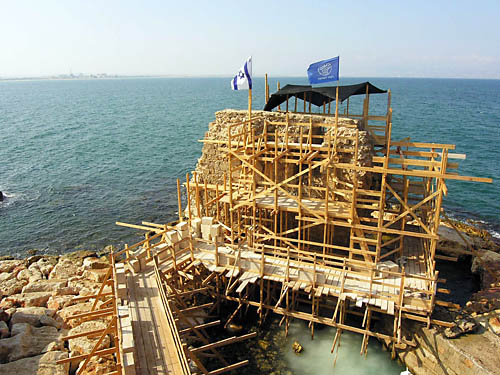
Repairing the wall of the Crusader Fortress at Akko. Photo: IAA.

Fortifying the wall of the Crusader Fortress at Akko. Photo: IAA.

The complete report may be read here. The report included this photo showing repair being made on the walls of Akko.

Akko (or Acre) is known in the many English versions of the Bible as Acco (Judges 1:31). In New Testament (Roman) times the city was call Ptolemais (Acts 21:7).

The Great Rift runs all the way from northern Syria through Lebanon, Israel, the Arabah, and into eastern Africa. In Israel the area is called the Jordan Valley or the Dead Sea Rift, It is not surprising that earthquakes are mentioned frequently in the Bible. The prophet Amos dates his visions to “two years before the earthquake” (Amos 1:1). The earthquake he makes reference to must have been so memorable that everyone would know what he was talking about. Zechariah (14:5) also calls attention to this earthquake in the days of Uzziah king of Judah.

Jesus, in predicting the fall of Jerusalem to the Romans, said, “and in various places there will be famines and earthquakes” (Matthew 24:7; see Luke 21:11).

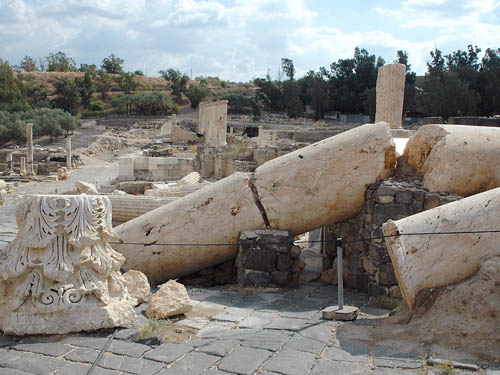
We have a wonderful example of the power of an earthquake in the Jordan Valley at the site of Bethshan [Bet-she’an, Beth-shean], about 25 miles south of the Sea of Galilee. The city was destroyed by an earthquake in A.D. 749. This photo shows the evidence brought to light during recent archaeological excavations in the city.

Earthquake damage at Beth-shean in the Jordan Valley. Photo by Ferrell Jenkins.

Earthquake damage at Beth-shean in the Jordan Valley. Photo by Ferrell Jenkins.

HT: Joseph I. Lauer

Ephesus: “Turkey’s ancient splendour”

A recent article in stuff.co.nz calls Ephesus “Turkey’s ancient splendour.” Here a few excerpts from the article by Brenda Webb of the Marlborough Express.

The ruins of Ephesus on Turkey’s west coast are among the best preserved and most impressive in the Mediterranean.

Imagine 250,000 people living in an area roughly the size of Picton township [a New Zealand town of about 3000 population].

Throw in an amphitheatre that seats 25,000 people, a massive three-story library, several temples, an agora (market place), a brothel, Roman baths complex, a gymnasium and various basilicas, temples and fountains.

This gives some idea of the size and complexity of the amazing ancient city of Ephesus, one of the 12 cities of the Ionian League and a once thriving Mediterranean port where skillful artisans and rich merchants gathered.

Today it’s a frantically busy historical site, so it’s best to visit early morning or late afternoon and avoid peak holiday season of July and August.

Half an hour inland from the Turkish coastal city of Kusadasi, Ephesus retains much of its former grandeur thanks to sensitive excavation and preservation that began around 100 years ago and continues today, with only 20 per cent of the site uncovered.

It certainly is a work in progress – the day we visited a huge crane was removing rubble from yet another new excavation site beside the magnificent amphitheatre that took 60 years to build.

In was here that gladiatorial combats were said to be held during Roman times as well as less brutal concerts and theatrical performances.

The acoustics in the amphitheatre are fantastic. We watched and listened in awe as an Italian tourist recited poetry on the stage, his words clearly reaching us some distance away.

Ephesus was first inhabited as long ago as 6000 BC but reached its peak in Roman times and most of the remains you see today date from then.

Despite its age and years of plundering, Ephesus remains surprisingly intact, especially its marble streets, the much photographed library and massive amphitheatre.

Some of the best-preserved artefacts, statues and tools have been taken to the nearby Ephesus Museum in Selcuk but some amazing structures remain and it is its completeness that gives it the edge over other historical sites in the Mediterranean.

Read the rest of the article here.

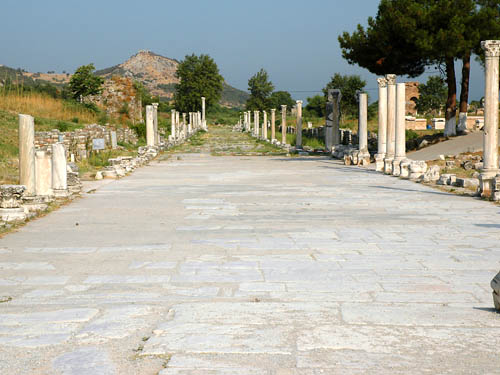
The Arcadian Way - Ephesus

The Arcadian Way runs from the Theater (to our back) and the harbor (now silted up). Photo by Ferrell Jenkins.

Luke describes some of the work of Paul at Ephesus in these words:

And he entered the synagogue and continued speaking out boldly for three months, reasoning and persuading them about the kingdom of God. But when some were becoming hardened and disobedient, speaking evil of the Way before the people, he withdrew from them and took away the disciples, reasoning daily in the school of Tyrannus. This took place for two years, so that all who lived in Asia heard the word of the Lord, both Jews and Greeks. (Acts 19:8-10 NAU)

For the full account of Paul’s work in Ephesus read Acts 18-20.

HT: Biblical Paths.

Sunset at Hierapolis

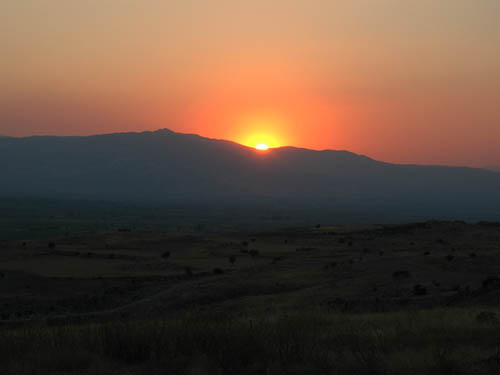
This is a sunset view I made at Pamukkale (biblical Hierapolis; Colossians 4:13). Hierapolis is famous for hot mineral springs and terraced travertine formations. It is now a World Heritage site.

For I bear him witness that he [Epaphras] has worked hard for you and for those in Laodicea and in Hierapolis. (Colossians 4:13 ESV)

Sunset at Hierapolis in the Lycus River Valley. Photo by Ferrell Jenkins.

Sunset at Hierapolis in the Lycus River Valley. Photo by Ferrell Jenkins.

The Western Wall tunnel

Most first time visitors to the Western Wall in Jerusalem, whether in 1967 or 2009, probably think they are looking at a wall seen by Jesus and other first century characters prior to AD 70. In a sense they are. That is, they are seeing the same wall, but not at the first century level.

The Western Wall is the western side of the temple platform enclosure built by Herod the Great. Jesus drove money changers out of the temple precinct (hieron) (John 2:13-17). In their discussion with Jesus the Jews called attention to the length of time the temple (naos) had been under construction (John 2:19-21).

Jesus answered them, “Destroy this temple, and in three days I will raise it up.” The Jews then said, “It took forty-six years to build this temple, and will You raise it up in three days?” But He was speaking of the temple of His body. (John 2:19-21 NAU)

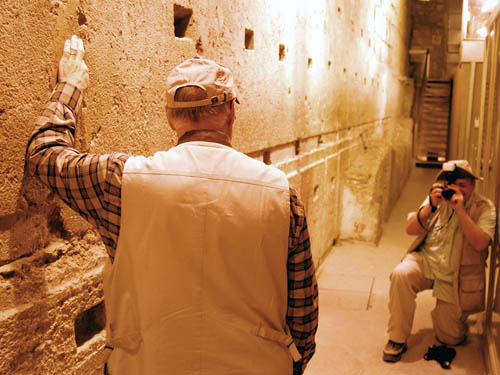
The photo below shows the largest visible stone in the western side of the Temple precinct. According to the Western Wall Tunnel web site, this stone is the largest one in the tunnel. It is 41 feet long, 11.5 feet high, and 15 feet deep. The web site says that this stone is 20 feet above the street level of the first century.

The largest visible stone in the Western Wall tunnel. Photo by Ferrell Jenkins.

The largest visible stone in the Western Wall tunnel. Photo by Ferrell Jenkins.

The Tunnel was dug in the years following 1967, but an exit was not cut on the north end until 1996.

Pressing on toward the goal

Paul’s admonition to the brethren at Philippi is often used in sermons.

Not that I have already obtained it or have already become perfect, but I press on so that I may lay hold of that for which also I was laid hold of by Christ Jesus. Brethren, I do not regard myself as having laid hold of it yet; but one thing I do: forgetting what lies behind and reaching forward to what lies ahead, I press on toward the goal for the prize of the upward call of God in Christ Jesus. (Philippians 3:12-14)

Most often we hear speakers compare what Paul said to the effort put forth by individuals running in a race. This is certainly not inappropriate. However, many years back I ran across a statement by E. M. Blaiklock that changed my thinking. Blaiklock was a noted classicist. This particular comment comes from Cities of the New Testament.

One mark of the Roman colony is perhaps to be detected in the letter which Paul wrote, over ten years later, to the Macedonian church which he had come to love. It is a hidden metaphor from the chariot race. Exhorting his Philippians to effort and single-minded endurance, Paul writes: ‘This one thing I do-forgetting the things behind, and stretching out to those before, I make for the mark, the prize of the upward calling’.

Commentators generally have not marked the fact that Paul appears to have in mind, not the athletic contests of the Greeks, from which he commonly drew illustration, but the chariot racing of Rome. He was writing to a Roman colony. He was writing also from Rome itself, and never was there such rivalry of racing colours, and circus fever than at that time. The common talk of the soldiers of the soldiers was of the chariot racing, and Paul would gain a vivid impression of this most perilous of sports.

Such a race as that which forms the substance of Paul’s figure is described well in Ben HUR. The charioteer stood on a tiny platform over sturdy wheels and axle. His knees were pressed against the curved rail, and his thighs flexed. He bent forward at the waist, stretching out hands and head over the horses’ backs. This is surely what he means by ’stretching out to the things before’. The reins were wound round the body, and braced on the reins the body formed a taut spring. It can easily be seen how completely the charioteer was at the mercy of his team’s sure feet and his own fine driving skill. Euripides, in his Hippolytus, tells how the hero fell and was killed in such conditions. Ovid describes the same disaster in Book XV of his Metamorphoses. In his intense preoccupation the driver dare not cast a glance at ‘the things behind’. The roaring crowd, crying praise or blame, the racing of his rivals, all else had perforce to be forgotten. One object only could fill the driver’s eye, the point to which he drove at the end of each lap.

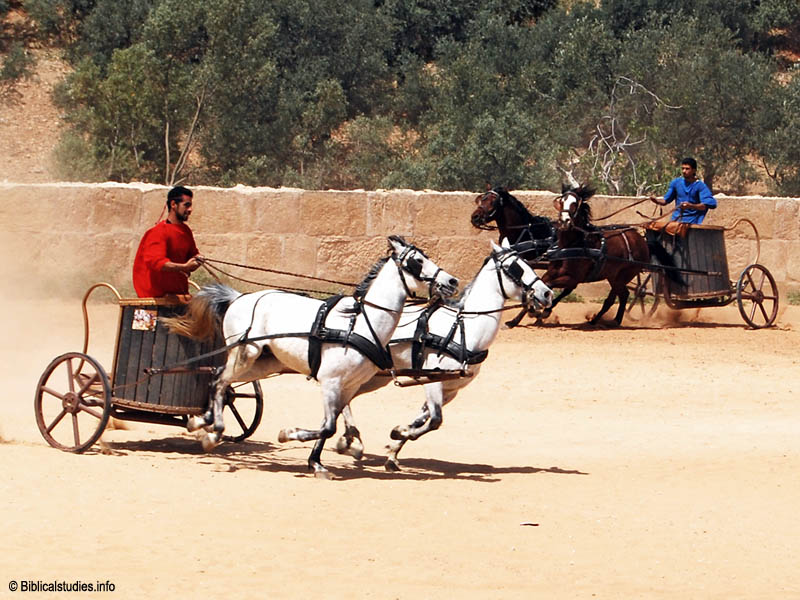
Here is a photo that might help to illustrate what Blaiklock said. It was made at the RACE show (Romy Army and Chariot Experience) at Jerash, Jordan.

Chariot race at the RACE show in Jerash, Jordan. Photo by Ferrell Jenkins.

Chariot race at the RACE show in Jerash, Jordan. Photo by Ferrell Jenkins.

This is a reprint from April 30, 2008, but with a different photo suitable for use in presentations. Click on the image for the larger photo.

Paul’s burial in Rome

The apostle Peter gets the most attention in Rome, but Paul also has his share of shrines. Paul was taken to Rome in the custody of the Roman Empire (Acts 27-28).

I appeal to Caesar. (Act 25:11)

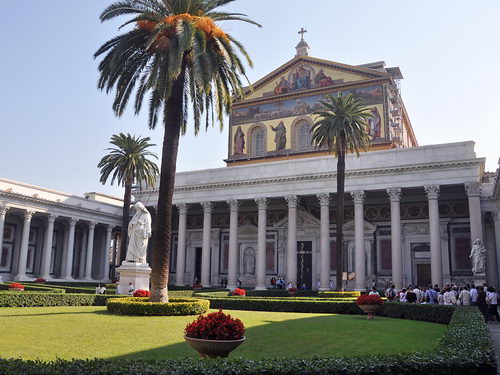
Tradition has it that Paul was buried outside the walls of Rome where we now find the Basilica of St. Paul Outside the Walls.

The basilica of St. Paul Outside the Walls in Rome. Photo by Ferrell Jenkins.

The basilica of St. Paul Outside the Walls in Rome. Photo by Ferrell Jenkins.

The statue in front of the church shows Paul with a drawn sword and a book. The inscription reads PREDICATORI VERITATIS and DOCTORI GENEIUM. Paul was a preacher of truth and a teacher of the Gentiles.

For this I was appointed a preacher and an apostle (I am telling the truth, I am not lying) as a teacher of the Gentiles in faith and truth. (1Timothy 2:7 NAU; see also 2 Timothy 1:11)

Tomb of Caecilia Metella on the Appian Way

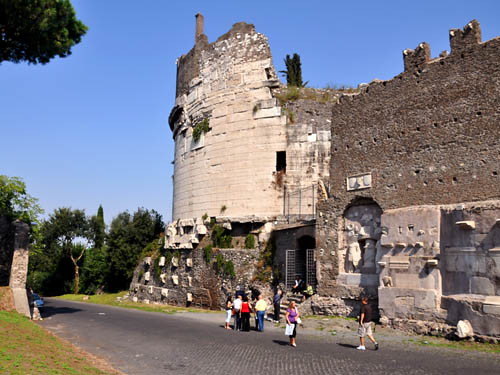
Several ancient structures may be seen along the Appian Way south of Rome. One of the most impressive is the Tomb of Caecilia Metella. The woman for whom this tomb is named was the wife of a certain M. Crassus who shared power in Rome with Julius Caesar and Pompey.

The decorations on the tomb seem to date it to the beginning of the Augustan period (Wycliffe Historical Geography 538). I think we can safely conclude that Paul passed this structure on his way to Rome (Acts 28:13-14).

The Tomb of Caecilia Metella on the Appian Way. Photo by Ferrell Jenkins.

The Tomb of Caecilia Metella on the Appian Way. Photo by Ferrell Jenkins.