Category Archives: New Testament

Pentecost morning at Nebi Samwil

Last evening at sundown the Jews began to celebrate their modern interpretation of  Pentecost (Shavu’ot). Christians know this from the Old Testament scriptures as the feast of weeks (Leviticus 23:15; Deuteronomy 16:9).

The church had it beginning with the preaching of the gospel in its fullness on the first Pentecost after the resurrection of Christ (Acts 2).

When we noticed that the sky was clear with a few nice clouds, we decided to go to Nebi Samwil (Prophet Samuel), a site suggested as the location of Mizpah by some scholars. Others suggest Tell en-Nasbeh, a mound located at Al Bira in the West Bank. I will have to postpone commenting further due to the fact that my flight will soon be called.

Samuel, the last judge of Israel, called all of the people of Israel to Mizpah and judged them (1 Samuel 7:5-6). Samuel also anointed Saul to be the first king of Israel at Mizpah (1 Samuel 10:1). Mizpah became the headquarters of Gedaliah as governor of Judah after the Babylonian destruction of Jerusalem  (2 Kings 25:23).

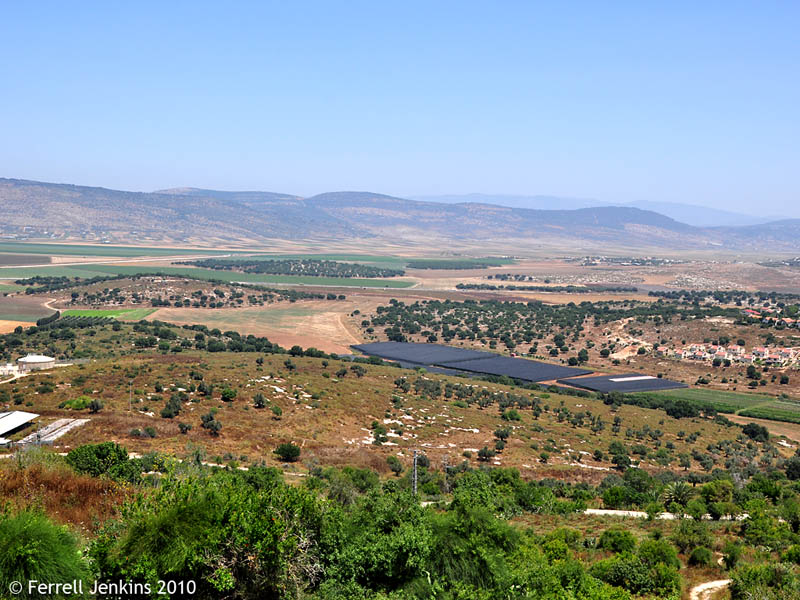
Back to Pentecost. Pentecost is celebrated in much the same way as a sabbath. I said all of that to say, there was very little traffic this morning as we made our way to Nebi Samwil. This distant photo shows how clear the view was on the southern side of the ridge where Nebi Samwil sits. The view on the north side of the territory of Benjamin was not quite as clear, but it was still nice.
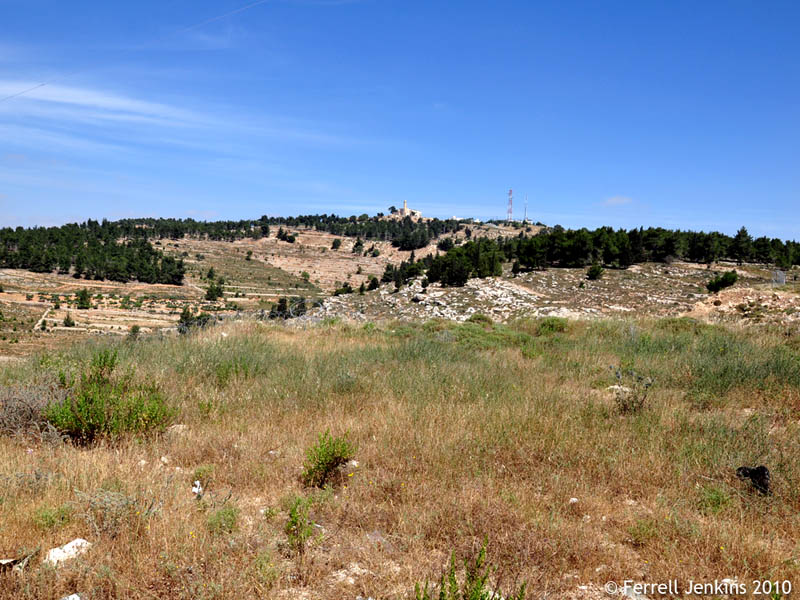
Nebi Samwil on the Ridge. Photo by Ferrell Jenkins.

Nebi Samwil on the Ridge. Photo by Ferrell Jenkins

The lady in the photo below is my lovely wife of more than 55 years. She has been with me on numerous tours to Israel, but she has made two trips when it was just the two of us. I must say that she is not that much into tells. A day or two ago I took her to Tell Jerusalem Mall, and that made up for a lot. 🙂  We have had a great time these past 9 days since our group returned home.

Elizabeth at Nebi Samwil. Photo by Ferrell Jenkins.

Elizabeth at Nebi Samwil. Photo by Ferrell Jenkins.

Thanks for sharing this trip with us. Please continue to read the travel blog on a regular basis. If there is some particular photo you would like to see let me know by leaving a comment.
A view of Capernaum

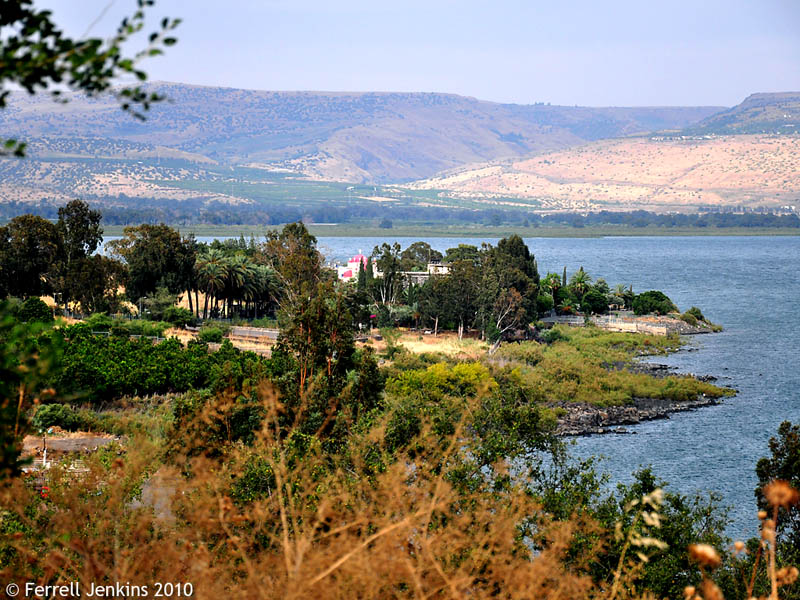
Looking back over the photos I have taken in the past three weeks, I noted this unusual one of Capernaum from the hill above, up toward the Mount of Beatitudes. This photos shows the northeast corner of the Sea of Galilee with a portion of the plain of Bethsaida visible.

Capernaum became the Galilean center for the ministry of Jesus.

And leaving Nazareth he went and lived in Capernaum by the sea, in the territory of Zebulun and Naphtali, (Matthew 4:13 ESV)

Capernaum from the Hill Above. Photo by Ferrell Jenkins.

Capernaum from the Hill Above. Photo by Ferrell Jenkins.

On this afternoon, May 15, the sky was fairly clear. The eastern shore of the Sea of Galilee is visible. Those are dried thistles in the foreground of the photo.

Tomorrow is our last day in Jerusalem. Perhaps we will be able to post something late in the day before departing for home.

Models can be valuable teaching aids

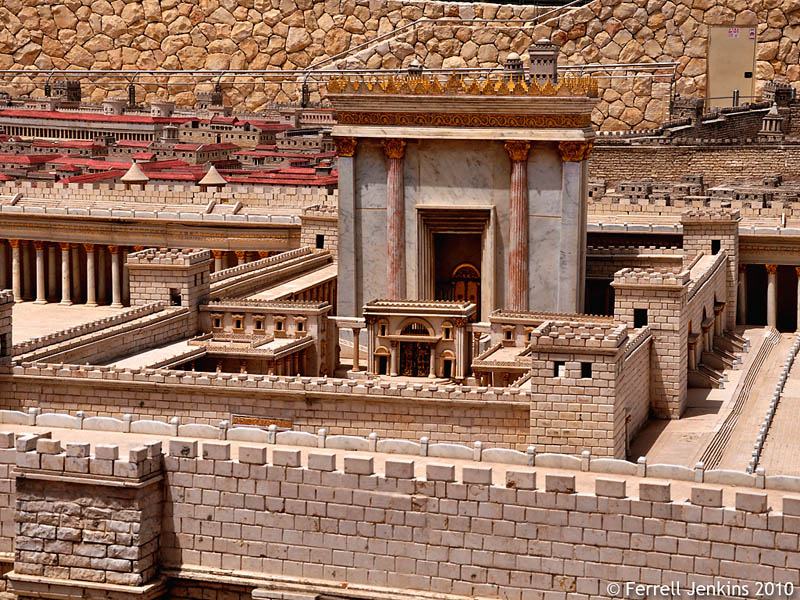
Model reconstructions can be helpful in teaching when the original is not available. Such is true of the temple of biblical times. Herod’s temple was a magnificent building, according to the disciples of Jesus.

And as he came out of the temple, one of his disciples said to him, “Look, Teacher, what wonderful stones and what wonderful buildings!” (Mark 13:1 ESV)

Jesus left the temple and was going away, when his disciples came to point out to him the buildings of the temple. (Matthew 24:1 ESV)

Using the hints from the New Testament, Josephus, and other Jewish sources, some scholars have made a model of the Second Temple (Herod’s Temple). For many years this model was located on the grounds of the Holyland Hotel, but recently has been moved to the grounds of the Israel Museum. Click for a larger image.

Second Temple Model at the Israel Museum. Photo by Ferrell Jenkins.

Second Temple Model at the Israel Museum. Photo by Ferrell Jenkins.

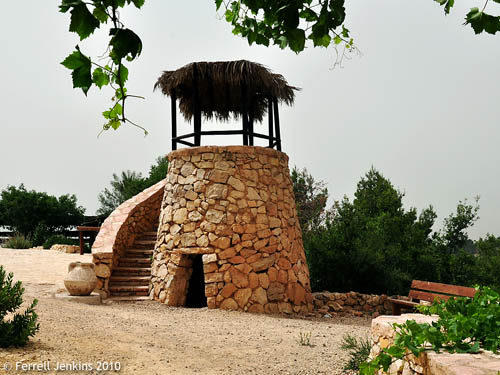
Watchtowers were used in vineyards (Isaiah 5:2; Luke 14:28; see here), and as lookout posts.

Then he who saw cried out: “Upon a watchtower I stand, O Lord, continually by day, and at my post I am stationed whole nights. (Isaiah 21:8 ESV)

The concept is used figuratively of the LORD’S care for His people.

for you have been my refuge, a strong tower against the enemy. (Psalm 61:3 ESV)

The name of the LORD is a strong tower; the righteous man runs into it and is safe. (Proverbs 18:10 ESV)

Yesterday afternoon we stopped by Yad Hashmona in the Judean Hills near Abu Ghosh (Kiriath-jearim) to visit the Biblical Village. Yad Hashmona operates a guest house and guiding center. Some readers will recognize it as the site of the campus of Master’s College IBEX program.

The Biblical Village provides a wonderful site for teaching, and photos of the reconstructions should be helpful too.

Watchtower, Biblical Garden, Yad Hashmona. Photo by Ferrell Jenkins.

Watchtower, Biblical Village, Yad Hashmona. Photo by Ferrell Jenkins.

Actually I wrote about this to provide Todd his regular fix of Israel while he is in exile in Texas. 🙂

Acco, Akko, Acre, Tell el Fukhar

Saterday afternoon we drove from Tiberias to Akko. On my previous tour I failed to get any photos of the ancient tel of Acco (also spelled Akko and Acre). The mound is known as Tell el Fukhar (hill of clay pottery) in Arabic.

Excavations by Prof. Moshe Dothan between 1973-1985 demonstrated that the site was first inhabited in the Early Bronze Age (about 3000 B.C.).

Tel Akko (Acco, Acre). Photo by Ferrell Jenkins.

Tel Akko (Acco, Acre). Photo by Ferrell Jenkins.

Acco is mentioned only once in the Bible. The city is within the territory originally allotted to the tribe of Asher, but the tribe was unable to conquer it.

Asher did not drive out the inhabitants of Acco, or the inhabitants of Sidon or of Ahlab or of Achzib or of Helbah or of Aphik or of Rehob, (Judges 1:31 ESV)

After about 100 B.C. the coastal city was known as Ptolemais (Acts 21:7). Paul spent one day with the brethren here on the return from his third journey.

The Cove of the Sower

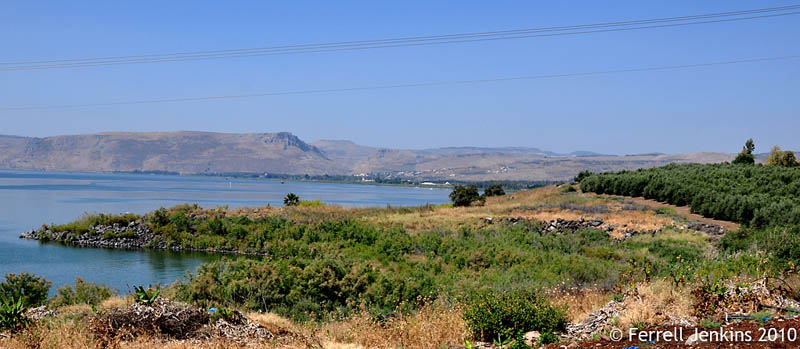
A few times before I have tried to get some good photos of the cove of the sower, and wrote about it in August, 2008. Saturday I put forth some extra effort to make a good photo at the spot on the north end of the Sea of Galilee called the Cove of the Sower. Some have suggested that this would have been the place where Jesus could speak to large numbers who assembled to hear Him.

Read the full account given by Mark in 4:1-20. Here is the way it begins:

He began to teach again by the sea. And such a very large crowd gathered to Him that He got into a boat in the sea and sat down; and the whole crowd was by the sea on the land.  And He was teaching them many things in parables, and was saying to them in His teaching,  “Listen to this! Behold, the sower went out to sow. (Mark 4:1-3)

Read the parallel accounts in Matthew 14:1-15 and Luke 8:4-10.

B. Cobbey Crisler conducted some experiments at places where the Bible records that large crowds gathered. The attempt was to see if the large number were able to hear a speaker without the aid of modern sound equipment. The places were Kadesh-barnea, Shiloh,  and The Cove of the Sower in Galilee. I suggest you read the entire article (“The Accoustics and Crowd Capacity of Natural Theaters in Palestine.” Biblical Archaeologist, 1976. Vol. 39. Num. 4.

The study indicated that the Cove of the Sower would allow between 5000 and 7000 people to hear.

Over the years different crops have been planted in the area, and this makes it difficult to compare older and more recent photos. The highway runs just above the level of the top of the olive trees. This photo is made looking west.

Cove of the Sower by Ferrell Jenkins

Cove of the Sower. Photo by Ferrell Jenkins

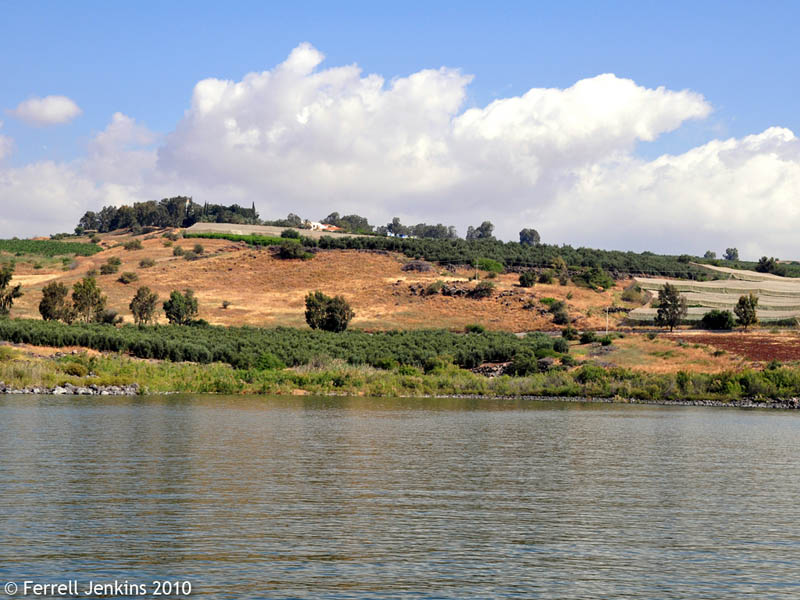
A couple of weeks ago I made the following photo from a boat a short distance south of the shore.

Cove of the Sower From the Sea of Galilee by Ferrell Jenkins.

Cove of the Sower From the Sea of Galilee. Photo by Ferrell Jenkins.

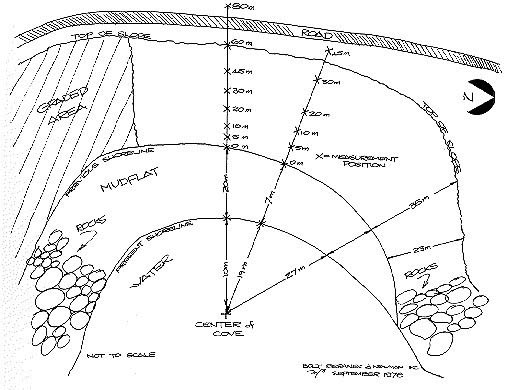
The following sketch from Crisler’s article in Biblical Archaeologist may help you to understand this better.

Cove of Sower sketch from Crisler's article in BA.

Cove of Sower sketch from Crisler's article in Biblical Archaeologist.

The terrain and the crops have changed since Crisler wrote.

Friday in lower Galilee

Today we drove from Tiberias past the Horns of Hattin, a site where the Crusaders thought Jesus spoke the beatitudes, through the Bet Netofa Valley to Sepphoris.

Sepphoris is an interesting site with a history dating from the Iron Age to modern times. The site has seen a considerable amount of archaeological excavation. Much of the work has been under the direction of my Temple Terrace neighbor, Dr. James Strange of the University of South Florida.

When I asked Elizabeth to select today’s photo, she picked the one I made of the Bet Netofa valley from atop the fortress at Sepphoris. This valley served as a main travel route from Nazareth, Sepphoris, Yodfat, and Cana to the cities around the Sea of Galilee. We think that Jesus must have used this route as he traveled from Nazareth to Capernaum.

And he went down to Capernaum, a city of Galilee.  (Luke 4:31a ESV)

Across the valley to the north is the location of Yodfat, the home of Josephus, and Khirbet Kanna, thought to be the site of Cana of Galilee (John 2). Click on the photo for a larger image.

View of the Bet Notofa Valley north of Zepphoris. Photo by Ferrell Jenkins.

View of the Bet Netofa Valley north of Zepphoris. Photo by Ferrell Jenkins.

We also visited Bethlehem of Galilee, a McDonald’s, and made some photos of Tel Megiddo before returning to our hotel on the shore of the Sea of Gailiee.

After dinner we sat for a while on the deck overlooking the sea. The Sea of Galilee is located in a rift nearly 700 feet below sea level. The heat can be oppressive during the day in this basin. In the evening a pleasant breeze flows in the area; it can even feel cool. I thought of the Biblical text that speaks of Jesus healing the sick and oppressed after sunset.

That evening at sundown they brought to him all who were sick or oppressed by demons. (Mark 1:32 ESV)

The Scriptures are amazing, aren’t they. The Book and the Land blend together to reveal a wonderful harmony and a magnificent Savior.

From Jerusalem to the Dead Sea

We got a late start this morning from Jerusalem. Our evening destination was the southern end of the Dead Sea (near Sodom) at En Boqeq. We took the long way to get here by traveling south around Bethlehem, then west to the Elah Valley, Bethshemesh, and Gath. Eventually we got on Highway 6, a wonderful toll road named in honor of the late Prime Minister Yitzhak Rabin. The road runs south ending a few miles north of Beersheba. From there we went down past Arad to the Dead Sea.

We saw numerous camels along the way. This is the region known in the Bible as the Negeb (Negev, South).

And Abram journeyed on, still going toward the Negeb. Now there was a famine in the land. So Abram went down to Egypt to sojourn there, for the famine was severe in the land. (Gen 12:9-10 ESV)

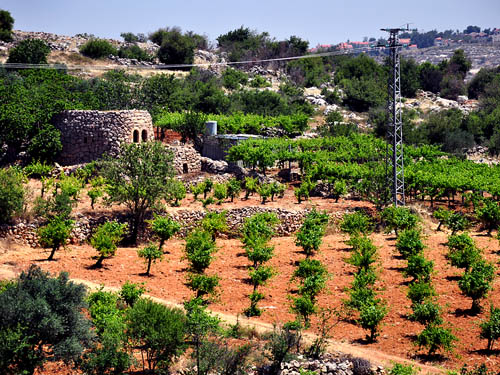
There are nice vineyards a few miles southwest of Bethlehem that remind me of Isaiah 5 and Matthew 21:33-46.

Let me sing for my beloved my love song concerning his vineyard: My beloved had a vineyard on a very fertile hill. He dug it and cleared it of stones, and planted it with choice vines; he built a watchtower in the midst of it, and hewed out a wine vat in it; and he looked for it to yield grapes, but it yielded wild grapes. And now, O inhabitants of Jerusalem and men of Judah, judge between me and my vineyard. (Isaiah 5:1-3 ESV)

Vineyard with a Watchtower SW of Bethlehem. Photo by Ferrell Jenkins.

Vineyard with a Watchtower SW of Bethlehem. Photo by Ferrell Jenkins.

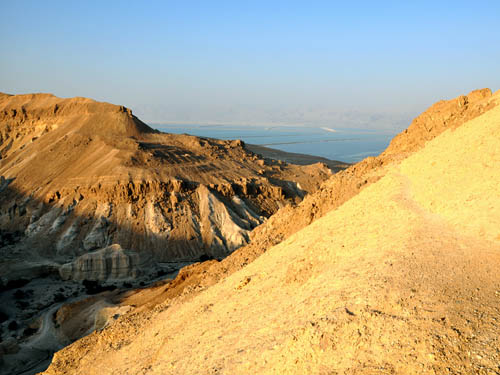
The sun was low as we approached the Dead Sea. This is the view from the Sodom-Arad Road. The rugged bad lands (the wilderness of Judea) begins a few miles north of Jericho and continues south until it finally blends with the Sinai peninsula.

The Dead Sea from the Sodom-Arad Road

The Dead Sea from the Sodom-Arad Road. Photo by Ferrell Jenkins.

Here and there in Jerusalem

Today we visited the Temple Mount, presently the site of the Dome of the Rock and the Al-Aksa Mosque. This site is thought to be the place where Abraham made preparations to offer Isaac.

He said, “Take your son, your only son Isaac, whom you love, and go to the land of Moriah, and offer him there as a burnt offering on one of the mountains of which I shall tell you.” (Genesis 22:2 ESV)

The temple of the LORD was constructed by Solomon on Mount Moriah.

Then Solomon began to build the house of the LORD in Jerusalem on Mount Moriah, where the LORD had appeared to David his father, at the place that David had appointed, on the threshing floor of Ornan the Jebusite. (2 Chronicles 3:1 ESV)

The Babylonians destroyed Solomon’s temple in 586 B.C. After the Jews returned from Babylonian Exile, the temple was rebuilt. In the days of Herod the Great the temple was virtually reconstructed beginning in about 20 B.C. (John 2:20). The temple was destroyed by the Romans in 70 A.D.

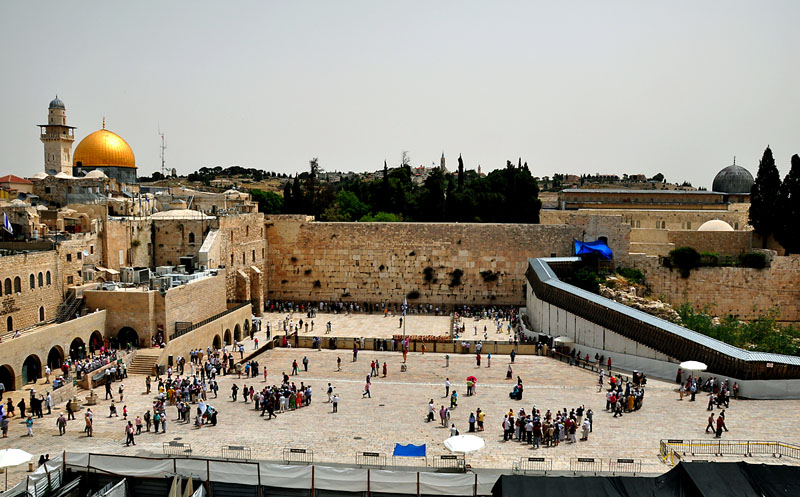
The photo today shows the Western Wall which served as the retaining wall built by Herod the Great around the Temple Mount. On the temple platform you will see the Dome of the Rock and the Al-Aksa Mosque. The Mount of Olives is in the distance to the east of Jerusalem.

Western Wall Plaza. Photo by Ferrell Jenkins.

Western Wall Plaza. Photo by Ferrell Jenkins.

Click on the photo for a larger image.

We visited several other sites in the Old City of Jerusalem, the Shrine of the Book and the Second Temple Model at the Israel Museum.

A full day in Jerusalem

Our visits today included the City of David excavations. What a tremendous work has been done here. After visiting the work done by Eilat Mazar, of what she thinks is the palace of David (many think this is an overstatement of the evidence), we visited the work done by Yigal Shiloh from 1978 to 1985, walked through the Canaanite water system, visited the Pool of Siloam, then left the area along steps leading up toward the Temple Mount. At some point along the way we were in the sewer of ancient Jerusalem until exiting on the street. We walked completely around the City of David.

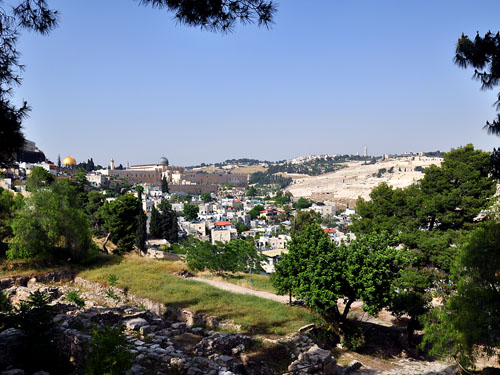
For a photo today I want to share a view of the Temple Mount area to the Mount of Olives. This photo was made from St. Peter in Gallicantu, the supposed house of Caiaphas and Annas.

View of theTemple Mount and Mount of Olives.

View of the Temple Mount and the Mount of Olives. Photo by Ferrell Jenkins.

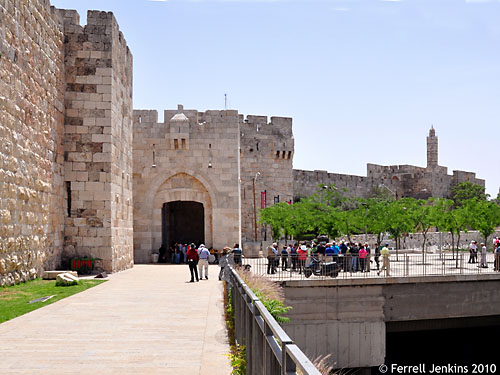
We also visited Jaffa Gate and saw the newly renovated gate.  Here is how it looks today. Nice, I think.

Jaffa Gate - Newly renovated 2010. Photo by Ferrell Jenkins.

Newly renovated Jaffa Gate, 2010. Photo by Ferrell Jenkins.

After visiting the Church of the Holy Sepulcher, the Pool of Bethesda, other sites along the way, and St. Peter in Gallicantu, we returned to the comfort of our hotel.

The Jordan River today

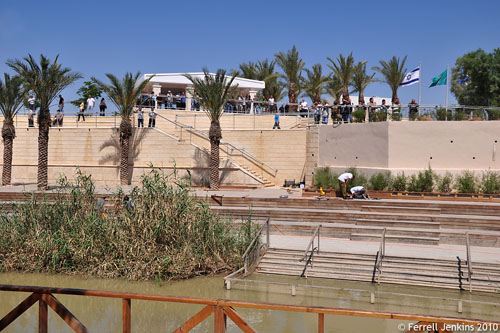
Today we returned to the Jordan Valley (Roman Perea) to a site designated Bethany Beyond the Jordan in the country of Jordan. Enough evidence was presented to easily convince various religious orders to build new churches in the area. The site on the west bank of the Jordan that I visited in 1967 has been closed to the general public since June of 1967 I think.

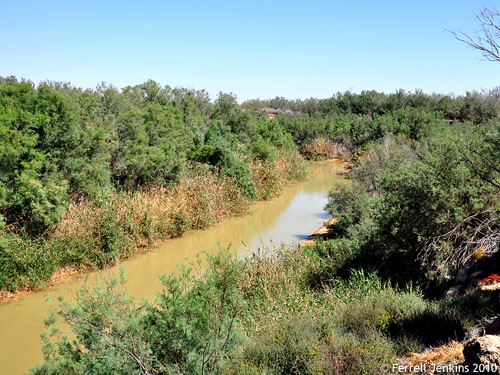
You will see by the photo that I made this morning that the river is extremely low. Just last evening I read the article from The Jerusalem Post by way of the Bible Places Blog about the study that says the river will be dry by next year.

Jordan River at Bethany Beyond the Jordan. Photo by Ferrell Jenkins.

Jordan River at Bethany Beyond the Jordan. Photo by Ferrell Jenkins.

Now that Jordan is seeing many tourists come to the eastern side of the river, Israel is preparing to open the site on the western side of the river. There were several people on the Israel side today where construction continues.

Jordan River Baptism Site in Israel and Jordan. Photo by Ferrell Jenkins.

Jordan River Baptism Site in Israel and Jordan. Photo by Ferrell Jenkins.

In spite of the fact that the river water is reported to be mostly sewage, several were being baptized, or dipping themselves, in the water when we were there.

These things took place in Bethany beyond the Jordan, where John was baptizing. (John 1:28 NAU)

We also visited Mount Nebo and Madaba before traveling south about 4 hours to Petra for the night.