Category Archives: New Testament

New difficulties on the “Jesus Trail”

We have reported about Larry’s hiking on the “Jesus Trail” from Nazareth to Bethsaida. Larry’s last post was at the end of Day 3. On his trek from Moshav Arbel eastward he encountered a new problem — the strong East winds.

Almost everyone who has visited Israel has learned of the West winds that make their way through the depressions around the Sea of Galilee and create storms on the Sea. Unless you travel in the “transitional season” or in the (dry) summer season you may not have learned about the East wind. This wind is called the sirocco. In Egypt it is known as the khamsin, and in Israel as the sharav.

Denis Baly, The Geography of the Bible (1974 ed., pp. 51-53), explains these winds. He says they occur in the transitional seasons from early April to mid-June (that is now), and from mid-September to the end of October. Baly says,

It is this intense dryness and the fine dust in the air which are so exhausting, for other hot days, though troublesome, do not have the same effect. People with a heart condition, nervous complaints, or sinus trouble are particularly affected, but even the mildest-tempered person is apt to become irritable and to snap at other people for no apparent reason. Tourists find the sirocco especially frustrating, for not only does travel become fatiguing, but the fine yellowish dust which fills the air drains it of all color, blots out all but the immediate vicinity, and makes photography a mockery.

Here is how Larry described his day in an Email to me overnight.

No blog last night because of the storm. I woke to high winds from the east which dusted up the air so badly that photos were mostly useless. Worst part was that it was directly against me and really HOT. Pushing against 20+ mph winds really took the steam out of me. By the end of the day I was utterly exhausted.  Drank my full 3 litres and had good dinners and breakfasts, but energy levels are still very low.

The photo below is one of the aerial shots we made a week ago. It was made while flying over the west shore of the Sea of Galilee, with the view to the west. You can see Mount Arbel and the Wadi Hamam below. The Via Maris runs in this valley which is also called the Valley of the Doves. You will notice two lines of mountains further west.

I am rather sure that this is the route Larry was walking yesterday. Larry has lived in Washington state for many years. I think he is not bothered by the sudden rains, but the intense heat and strong wind from the east may be another matter. I want you to think about the fact that all of the biblical characters from the Patriarchs to Jesus and His disciples encountered conditions similar to these (and worse).

Aerial view of Arbel and the Via Maris. Photo by Ferrell Jenkins.

Aerial view of Arbel, Wadi Hamam, and the Via Maris. Photo by Ferrell Jenkins.

Baly cites several biblical references to the east and south winds that bring in the hot air and the dust storms. He says, “Where the mountains come close to the sea a strong sirocco pours down the slopes like a flood, at 60 miles an hour or more, stirring the sea into a fury.”

By the east wind you shattered the ships of Tarshish. (Psalm 48:7 ESV)

In the prophecy against Tyre, Ezekiel says,

“Your rowers have brought you out into the high seas. The east wind has wrecked you in the heart of the seas. (Ezekiel 27:26 ESV)

Notice Elihu’s comments to Job about the south wind.

Do you know the balancings of the clouds, the wondrous works of him who is perfect in knowledge,  you whose garments are hot when the earth is still because of the south wind?  (Job 37:16-17 ESV)

Jesus also observed the effect of the south wind:

And when you see the south wind blowing, you say, ‘There will be scorching heat,’ and it happens. (Luke 12:55 ESV)

Do you remember Jonah’s problems after enjoying the shade of his plant?

When the sun rose, God appointed a scorching east wind, and the sun beat down on the head of Jonah so that he was faint. And he asked that he might die and said, “It is better for me to die than to live.” (Jonah 4:8 ESV)

Baly calls attention to the effect of the spring siroccos on the crops.

The spring siroccos destroy the winter grass and may damage the crops if they come too soon, and hence they appear constantly in the Bible as a symbol of the impermanence of riches or of human life.

Note these additional references in your own study: Psalm 103:16; Isaiah 40:6-8; Hosea 13:15; Ezekiel 17:10; James 1:11.

When Larry goes back on line I am sure his vivid descriptions of his experience will be well worth reading. Here is the link.

Update: Larry is back in Jerusalem Wednesday evening.
Following Larry on the “Jesus Trail”

Last week Larry and I spent the week traveling here and there in Israel to many places not easily accessible to a tour group. Friday afternoon I dropped Larry in Nazareth where he would spent the night and begin the next morning walking the five-day jaunt on the Jesus Trail from Nazareth to Capernaum and Bethsaida.

He tells about the beginning in Nazareth here. He reports on finding the Roman Road earlier on Friday, May 13 here.

The events of Saturday, May 14, from Nazareth through Sepphoris (Zippori) to Cana of Galilee, is recorded here.

Day 2 (May 15) of the journey from Cana (Kefr Kanna) of Galilee to Ilaniya is recounted here. He includes photos of flowers and butterflies that he saw along the way, and records his encounter with three vicious-appearing sheep dogs.

By the time you look at these blogs you will be ready to continue following the rest of the journey without any notification from me.

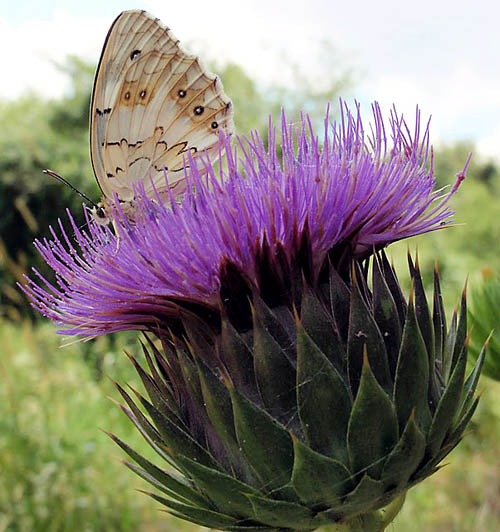
I am taking the liberty to include two of Larry’s many photos to entice you to take a look at his blog. The first shows one of the beautiful butterflies on a thistle bloom. There are several varieties of thistles (or briers) mentioned in the Bible. (If I am wrong about this, I know one of our readers who will send the correct information.)

Butterfly on a thistle bloom. Photo © Larry Haverstock.

Butterfly on a thistle bloom. Photo © Larry Haverstock.

This is where Larry spent the second night of his “Third Journey.”

Accommodation on the Jesus Trail - Night 2. Photo © Larry Haverstock.

Accommodation on the Jesus Trail - Night 2. Photo © Larry Haverstock.

No matter how “primitive” our accommodations may be, we are reminded of Jesus’ statement about his own situation on earth:

Jesus said to him, “The foxes have holes and the birds of the air have nests, but the Son of Man has nowhere to lay His head.” (Matthew 8:20 NAU)

Here is a self-photo of Ferrell (l) and Larry (r) on the Roman Road near Golani Junction.

Ferrell Jenkins & Larry Haverstock on Roman Road at Golani Jct.

Ferrell Jenkins & Larry Haverstock on Roman Road at Golani Jct.

For better photos of the Road see Larry’s blog (linked above) or this blog, here.


Safe arrival home

John Howard Payne (1791-1852) said it well, if not best, in “Home, Sweet Home.”

Mid pleasures and palaces though we may roam,
Be it ever so humble, there’s no place like home;
A charm from the sky seems to hallow us there,
Which, seek through the world, is ne’er met with elsewhere.
Home, home, sweet, sweet home!
There’s no place like home, oh, there’s no place like home!

I arrived on time this morning in Atlanta  non-stop from Tel Aviv after almost 13 hours. After clearing customs and the USA security I waited for my flight to Tampa. It was a little strange going through security in Atlanta and watching how the agents acted. I don’t recall hearing anyone in Israel yelling at the passengers or being rude to them. Neither belts not shoes had to be removed in Tel Aviv.

Waiting at Tampa International for my wife to meet me. I did not intend to be traveling on Sunday, but got mixed up on the 11:20 p.m. flight and the 12:05 a.m. flight. By the time I discovered it I did not have opportunity to make the change. I got an extra day in Israel to rest a little before departure.

Now I have to sort the nearly 4700 hi-res digital photos I made. Half of those were made in three hours on the flight over Galilee.

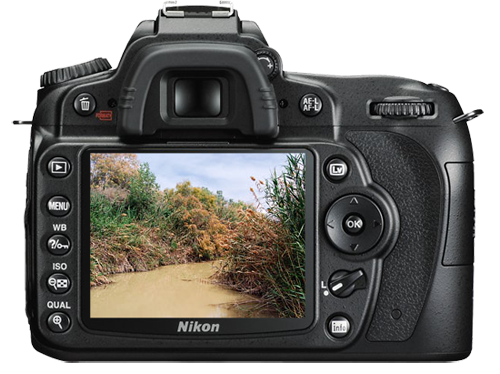
Nikon D90 showing photo of the Jordan River. Photo by Ferrell Jenkins.

My Nikon D90 showing photo of the Jordan River.

Several requests for info on a variety of subjects went unanswered. If you don’t receive a reply within a week or two please write again. To paraphrase the statement of Jesus about the evil or trouble of each day, “Sufficient unto the day are the Emails thereof.” 🙂

Take therefore no thought for the morrow: for the morrow shall take thought for the things of itself. Sufficient unto the day is the evil thereof. (Matthew 6:34 KJV)

“So do not worry about tomorrow; for tomorrow will care for itself. Each day has enough trouble of its own. (Matthew 6:34 NAU)

Thanks for following this recent trip. Hopefully we can continue to share important biblical information with you on a regular basis.

I learned by Email this morning that Larry completed his first day of the Jesus Trail o.k.

A Roman Road in Galilee

Larry Haverstock was part of our tour group in 2010 and again in 2011. He and I have been traveling in Israel for the past week. He divides his time here this year into three journeys. The two week tour was the first journey.The past week was his second journey, and the next week will be his third journey. The third journey he will be all alone to walk the Jesus Trail from Nazareth to Bethsaida. This is a five day trek.

On our way from Tiberias to Nazareth, with several other stops here and there, we stopped at the area near Golani Junction to locate the stretch of Roman road that is part of the Jesus Trail. While we were looking for the road a strong rain came. We fled to the nearby McDonald’s and then decided that the trail would be too slick to return. Later in the day we returned and found the road without difficulty.

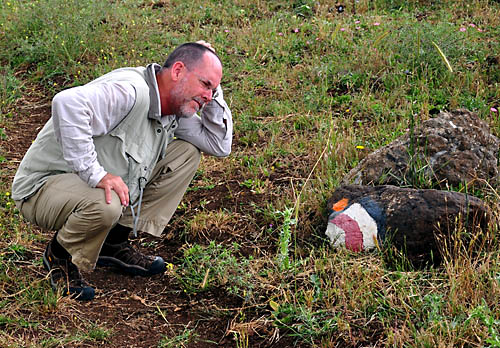
In this photo Larry pretends that he does not understand the trail markings. I would say he is well prepared in every way.

Larry tries to figure out the traill markings. Photo by Ferrell Jenkins.

Larry tries to figure out the trail markings. Photo by Ferrell Jenkins.

Since ordering Hiking the Jesus Trail and Other Biblical Walks in the Galilee I have wanted to see the Roman road which is part of the Trail between Cana and Capernaum.

The Jesus Trail web site describes the Roman road:

About 100 m past Golani Junction, you will come to a ridge with the remains of an ancient Roman road that linked Acre and Tiberias.  Jesus likely used this road on his journey from Nazareht to the Sea of Galilee, as it was a major east-west thoroughfare during his time.

Exquisite roads were one of the hallmarks of the Roman Empire.  the Romans were the first to create a comprehensive system of paved roads over such a large territory.  The roads served the primary purpose of supporting military and trade development.  The road networks also facilitated the movement of ideas and technology and allowed foods, fashions and other cultural artifacts to spread. As the Internet became the “information superhighway” of the 21st century, so were Roman roads at the time of the Roman empire.

The info in the guidebook is similar. This is just an excerpt.

Here is one of the photos I made this afternoon. The view is east toward the Sea of Galilee.

Roman Road near Golani Junction. Photo by Ferrell Jenkins.

Roman Road near Golani Junction. Photo by Ferrell Jenkins.

Information about the Jesus Trail is available from the web site here. Info on ordering the attractive guidebook for $24.95 (postpaid many places) is available here.

In the late afternoon I dropped Larry in Nazareth about 2 blocks from where he would check in and stay for the night. After a soft drink at Tishreen restaurant near Mary’s Well we said good bye to each other. That was as close as I could get to his overnight hotel in the car. Tomorrow Larry will hike from Nazareth to Sepphoris (Zippori) and then to Cana. I understand that the hiking time for that portion of the trip takes six hours.

Hopefully we will have some reports from along the way.

In the parable of the great dinner Jesus said,

And the master said to the servant, ‘Go out to the highways and hedges and compel people to come in, that my house may be filled. (Luke 14:23 ESV)

He also speaks of being forced (by Roman soldiers?) to go a mile.

And if anyone forces you to go one mile, go with him two miles. (Matthew 5:41 ESV)

Tabgha on the Sea of Galilee

Sacred Destinations describes Tabgha in these words:

Tabgha (also spelled Tabhka) is not a city, but a small area on the northwest shore of the Sea of Galilee, not far from Capernaum. In ancient times, Tabgha was known as Heptapegon – “Place of the Seven Springs.” These seven springs produce warm water, which increases the production of algae in this part of the lake, which attracts more fish. Fisherman have thus flocked to Heptapegon for thousands of years.

By the 4th century AD, Heptapegon had become a popular place for Byzantine pilgrims to rest and have their picnics, thanks to its shady trees and excellent fishing. It is probably not coincidence that two of the three pilgrimage destinations in this relate to abundant food: the miracle of the loaves and fishes during Jesus’ Galilean ministry and a lakeside fish breakfast after Jesus’ resurrection.

For more information read here. Sacred Destination is a nice site to use in locating brief info about biblical sites in Israel and other countries.

Today we spent some time again in the Hula Valley. This time on the ground instead of in the air. As we returned to Tiberias we noted that the air around the Sea of Galilee had cleared considerably since this morning. A wonderful scene presented itself as we approached Tabgha.

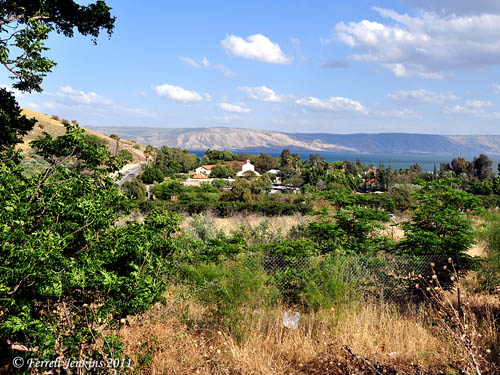
The view in our photo shows the church at Tabgha from the North West. Look carefully and you will see the Northeastern portion of the Sea of Galilee, the shore, and the biblical area known as Bashan. In New Testament times the region was known as the land of the Gerasenes.

Then they sailed to the country of the Gerasenes, which is opposite Galilee. (Luke 8:26 ESV)

Then all the people of the surrounding country of the Gerasenes asked him to depart from them, for they were seized with great fear. So he got into the boat and returned. (Luke 8:37 ESV)

Tabgha on the NW corner of Sea of Galilee. Photo by Ferrell Jenkins.

Tabgha on the NW corner of Sea of Galilee. Photo by Ferrell Jenkins.

New photos of the pinnacle of the temple

A few months ago we wrote about the pinnacle of the temple here and here. At that time I included comments by William Barclay, Benjamin Mazar, William Hendriksen, and Josephus, Leen Ritmeyer, and Mackowski.

Today I made a new photo of the southeast corner of the Herodian temple precinct.

The southeast corner of the temple precinct. Photo by Ferrell Jenkins.

The southeast corner of the temple precinct. Photo by Ferrell Jenkins.

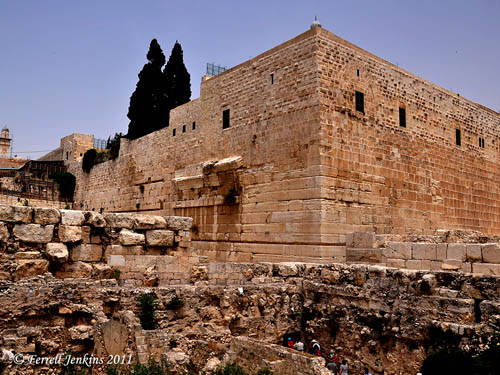
Here is a new photo of the southwest corner of the temple precinct. Notice the people at the bottom of the photo.

Southwest corner of the Herodian temple precinct. Photo by Ferrell Jenkins.

Southwest corner of the Herodian temple precinct. Photo by Ferrell Jenkins.

And he led Him to Jerusalem and had Him stand on the pinnacle of the temple, and said to Him, “If You are the Son of God, throw Yourself down from here; (Luke 4:9 NAU)

See also Matthew 4:5.  Be sure to read or review the previous posts.

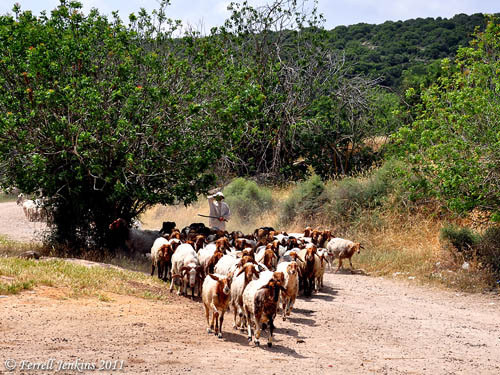
Shepherd with sheep and goats at Socoh

Today we visited sites in the Shephelah (lowlands, foothills, Deuteronomy 1:7). We discussed the importance of the Sorek Valley, Beth Shemesh, Timnah, Eshtaol, Zorah. Think of Samson. We noted the important sites associated with the Valley of Elah: Azekah, Khirbet Queiyafa (the Elah Fortress), and Socoh. Think of David and Goliath.

At Socoh (1 Samuel 17:1) we had one of those nice moments on tour when something unexpected comes along. We saw two shepherds bringing their sheep and goats to water. The photo below is one of several that I made.

Shepherd with sheep and goats at Soccoh. Photo by Ferrell Jenkins.

Shepherd with sheep and goats at Socoh. Photo by Ferrell Jenkins.

I am reminded of the teaching of Jesus about the importance of the shepherd.

When he saw the crowds, he had compassion on them because they were bewildered and helpless, like sheep without a shepherd. Then he said to his disciples, “The harvest is plentiful, but the workers are few. Therefore ask the Lord of the harvest to send out workers into his harvest.” (Matthew 9:36-1 NET)

We also made stops at Lachish and Gath before dinner along the Mediterranean Sea at Joppa, and then heading for the airport.

Our group is scheduled to depart for the USA shortly after midnight. Six tour members are staying over for varying length to pursue additional visits throughout the area.

Thank you for following the blog these past two weeks. I have written less than usual due to the demands of the tour, and this will continue for another week as I spend time in additional study here. Stay with me.

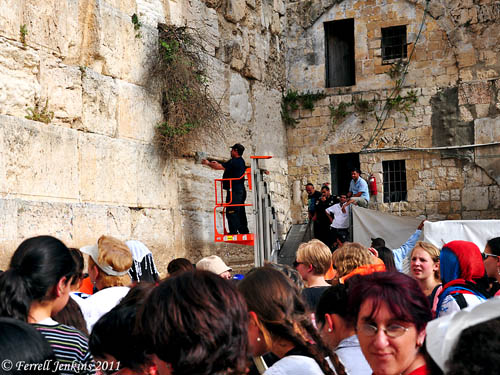
Prayers disturbed by a snake in the wall

Our group went to the Western Wall this afternoon. The Western Wall, sometimes called the Wailing Wall by non-Jews, is part of the enclosure built by Herod the Great around the temple precinct in Jerusalem. The temple and everything else on the top of the platform was destroyed by the Romans in A.D. 70.

The Western Wall is now a place for prayer. Men have a large portion of it for their use. To the south there is a small area for women. I entered the enclosure north of the men’s section to get a photo of Wilson’s Arch. When I came out I noticed a workman on the lift trying to get something out of the wall with a long stick. At first I thought he was removing some of the paper prayers that had been left in the wall by worshipers. I learned from one of our ladies who was there that a snake had been seen by the ladies.

Of more interest to me was that the snake was somewhere around the lintel of Barclay’s Gate.

Women watch at the Western Wall while workmen remove snake from the wall. Photo by Ferrell Jenkins.

Women watch at the Western Wall while workmen remove snake from the wall. Photo by Ferrell Jenkins.

It is not often that one see’s men on the women’s side of the Western Wall plaza. Well, I never have before.

A number of biblical references come to mind. The prophet Amos says,

18 Alas, you who are longing for the day of the LORD, For what purpose will the day of the LORD be to you? It will be darkness and not light;
19 As when a man flees from a lion And a bear meets him, Or goes home, leans his hand against the wall And a snake bites him.
20 Will not the day of the LORD be darkness instead of light, Even gloom with no brightness in it?  (Amos 5:18-20 NAU)

I imagine the same thing would happen to a woman as well as to a man.

We recall the serpent of the Garden of Eden (Genesis 3). Paul used that event as an illustration.

 But I am afraid that, as the serpent deceived Eve by his craftiness, your minds will be led astray from the simplicity and purity of devotion to Christ. (2 Corinthians 11:3 NAU)

Earlier today we visited the Herodian Family tomb, the Second Temple Model, Shrine of the Book, and the archaeological section of the Israel Museum. I had visited the renovated Museum in January and was ready to take the group to some of the more significant biblically related artifacts. For the earlier discussion of some of these things see here (Old Testament) and here (New Testament).

In the afternoon we entered the Old City and visited the Jewish Quarter and the Western Wall.

We look forward to completing our planned visit of the Old City tomorrow. Lots of walking in the Old City.

Everyone in the group is doing well and seems to be enjoying the experience. We have about a dozen who have been here at least once before. They are seeing new things every day and enjoying a revisit to things they saw on a previous tour.

The baptism site in Israel

We had a surprise for the tour group today.

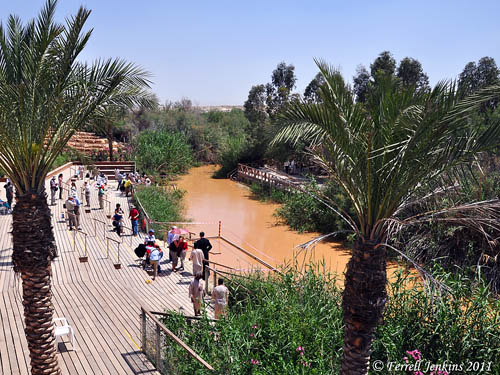
Arrangements had been made through our tour operator to visit the traditional site where John the Baptist worked, and where Jesus was baptized in the Jordan River.  This site, called Qasr al-Yahud, has been closed since 1967 except for the use of the Greek Orthodox Church on special occasions such as Epiphany. The area from the main highway to the site is still military. We had to get special permission and arrive at an appointed time in order to enter.

The photo shows a portion of the  yet incomplete new site, the Jordan River, and the access point across the river in Jordan. The Jordanian site claims to be Bethany beyond the Jordan.

25 They asked him, and said to him, “Why then are you baptizing, if you are not the Christ, nor Elijah, nor the Prophet?”
26 John answered them saying, “I baptize in water, but among you stands One whom you do not know.
27 “It is He who comes after me, the thong of whose sandal I am not worthy to untie.”
28 These things took place in Bethany beyond the Jordan, where John was baptizing.
29 The next day he saw Jesus coming to him and said, “Behold, the Lamb of God who takes away the sin of the world!
30 “This is He on behalf of whom I said, ‘After me comes a Man who has a higher rank than I, for He existed before me.’
31 “I did not recognize Him, but so that He might be manifested to Israel, I came baptizing in water.”
32 John testified saying, “I have seen the Spirit descending as a dove out of heaven, and He remained upon Him.
33 “I did not recognize Him, but He who sent me to baptize in water said to me, ‘He upon whom you see the Spirit descending and remaining upon Him, this is the One who baptizes in the Holy Spirit.’
34 “I myself have seen, and have testified that this is the Son of God.” (John 1:25-34 NAU)

Traditional Baptism Site on the Jordan River. Photo by Ferrell Jenkins.

Traditional Baptism Site on the Jordan River. Photo by Ferrell Jenkins.

This location is also the in the area where ancient Israel crossed from the Plains of Moab into the promised land.

The new site will be nice once it is completed and the road is upgraded.

We also visited Wadi Qelt, Qumran, the Dead Sea, and Masada today.

Living springs of water

Today we traveled north from Tiberias on the Sea of Galilee to Hazor. About the time our bus stopped the rain began. We waited a while, but left the bus as soon as the rain let up. This gave an opportunity to visit the gate, the Canaanite palace, and a few other areas before the rain started again. Finally we left and went on to Dan. There we were able to visit the site with only sprinkles.

By this time of the year I had come to expect that major rains (the latter rains, Joel 2:23) would be over, but still delighted to see the rains coming to a land that has suffered drought for a few years.

From Dan we continued to Banias, the site of New Testament Caesarea Philippi. This is the area where Peter confessed Jesus to be the Christ, the Son of the Living God, and where Jesus made the promise to build His church.

Now when Jesus came into the district of Caesarea Philippi, He was asking His disciples, “Who do people say that the Son of Man is?” And they said, “Some say John the Baptist; and others, Elijah; but still others, Jeremiah, or one of the prophets.”  He said to them, “But who do you say that I am?”  Simon Peter answered, “You are the Christ, the Son of the living God.” And Jesus said to him, “Blessed are you, Simon Barjona, because flesh and blood did not reveal this to you, but My Father who is in heaven.  “I also say to you that you are Peter, and upon this rock I will build My church; and the gates of Hades will not overpower it.  “I will give you the keys of the kingdom of heaven; and whatever you bind on earth shall have been bound in heaven, and whatever you loose on earth shall have been loosed in heaven.”  Then He warned the disciples that they should tell no one that He was the Christ. (Matthew 16:13-20 NAU)

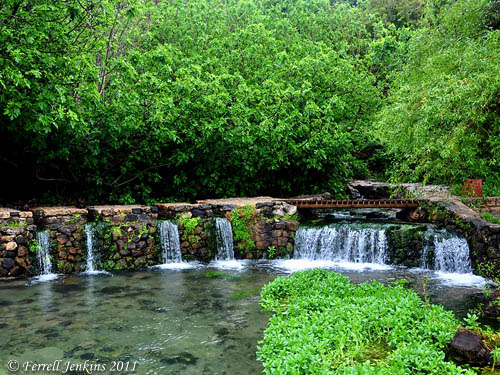
It was still raining some, but I was much impressed with the force of the water today. I have been here on probably every tour since the site has been under Israeli control. I don’t recall ever seeing so much water surging from the earth. This is a good sign, I think.

Here is a photo made looking north toward the source of the River Banias, the easternmost source of the Jordan River.

Looking to the source of the Banias River. Photo by Ferrell Jenkins.

Looking to the source of the Banias River. Photo by Ferrell Jenkins.

The photo below shows the same area from the north. Here we are immediately above the outlet of the powerful springs.

River Banias, a source of the Jordan, from the North. Photo by Ferrell Jenkins.

River Banias, a source of the Jordan, from the North. Photo by Ferrell Jenkins.

We got only an occasional glimpse of Mount Hermon to see the patches of snow on it.