Category Archives: Jordan

High over Galilee

Today we spent three hours in the air flying from Tel Aviv. Major sites we photographed included Appolonia, Caesarea Maritima, Tel Dor, Haifa, Plain of Acco, Acco, Aphek (in the north), Hazor, Dan, Hula Valley, Jordan Valley, areas around the Sea of Galilee, Beth Shan, Jezreel Valley, and Megiddo.

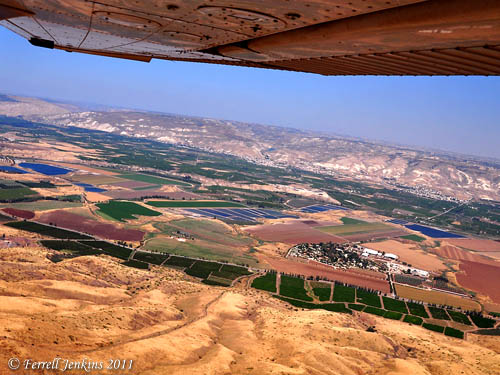
I made almost 2400 images. Hopefully I will have a few dozen good photos. The one I wish to share tonight shows the Jordan Valley between the Sea of Galilee and Beth Shan. The view is from West to East, looking to Jordan and the mountains of Gilead.

Jordan Valley between Sea of Galilee & Beth Shan. Photo by Ferrell Jenkins.

Jordan Valley between Sea of Galilee & Beth Shan. Photo by Ferrell Jenkins.

Roman chariot races at Jerash

Several times in the past we have called attention to the RACE show at Jerash, Jordan. RACE stands for Roman Army Chariot Experience. The show is conducted in the Roman hippodrome at Jerash, one of the cities of the Decapolis in the time of Jesus.

Large crowds followed Him from Galilee, Decapolis, Jerusalem, Judea, and beyond the Jordan. (Matthew 4:25 CSB)

BBC News has posted a short video about the Roman chariot races and the Roman Army show. Click here to view.

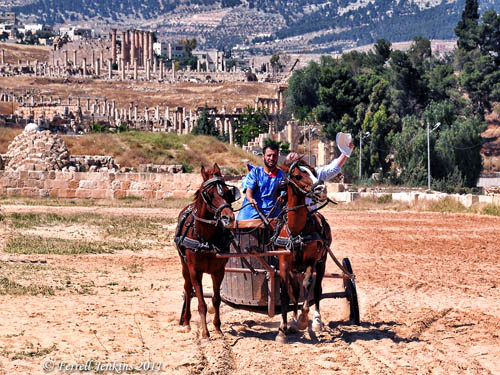
Our photo shows one of the tourists being taken for a wild ride after the show. It appears he may have lost his hair during the ride. Note the background of the ruins of Roman Jerash and the mountains of biblical Gilead.

Chariot Race in the Roman Hippodrome at Jerash. Photo by Ferrell Jenkins.

Chariot Race in the Roman Hippodrome at Jerash. Photo by Ferrell Jenkins.

Click on the photo for a larger image.

HT: Bible Places Blog.

Lead books or lead balloons?

In the past 24 hours I have received a couple of Emails about the “new” “ancient” lead codices. The best photos I have seen are in the Mail Online here. The account from Yahoo News is here. Put a few words in Yahoo or Google and you will have numerous links.

First Impressions. My first impression, based on the limited information, is that this may be another of those spectacular claims with no substance. I was busy with appointments earlier today and was delighted when I had time to check the blogs to see that Todd Bolen had written a good summary of information at the Bible Places Blog here. There is no reason for me to try to rehash this material. I urge you to take a look at Todd’s summary. He says, “Personally I am inclined to believe that this find is genuine.” My first inclination leans the other way. I know it is not much of a argument, but this report lacks the “ring of truth.” I remember that F. F. Bruce said that second thoughts are best. With more information my thoughts may change. Let’s be patient.

The Sealed Book in Revelation. There is no reason at this point to  link these lead books with the sealed book of Revelation 5-7. Revelation is an apocalyptic book of symbols. Other ancient sealed books have been found in modern times. Examples: some of the Elephantine papyri, a papyrus document from Wadi Daliyeh near Jericho had seven seals still in place (Jenkins, Studies in the Book of Revelation, 18).

Jim Davila has posted numerous notes about the lead codices at Paleojudaica over the past few weeks. Follow all of Todd Bolen’s links and you will know about as much as can be known for the moment.

Mahanaim — where Jacob wrestled with an angel

The name Mahanaim is found 13 times in the Old Testament. The site is where Jacob and Laban met and made a covenant. Mahanaim seems to mean “two camps” (Genesis 32:2). This is where Jacob’s name was changed to Israel after he wrestled with a man (angel, Hosea 12:4). When morning came Israel crossed over Penuel (Genesis 32:31).

Two large tells face each other and the Jabbok River flows in an S-curve between them. The tells are now named Tall adh-Dhahab East and Tall adh-Dhahab West. These tells are located a few miles east of the Plains of the Jordan and Tell Deir Allah (likely the site of biblical Succoth). Some scholars identify Dhahab West as Mahanaim and Dhahab East as Penuel. Other scholars reverse the identifications.

When Transjordan was divided among the tribes, Mahanaim was located in the territory of Gad on the boundary with East Manasseh (Joshua 13:26, 30). It was one of the cities allotted to the Levites (Joshua 21:38; 1 Chronicles 6:80).

After the death of Saul, Abner made Ishbosheth, the son of Saul, king over all Israel from Mahanaim (2 Samuel 2:8, 12, 29).

When David fled from his rebellious son Absalom he fled across the Jordan to Mahanaim (2 Samuel 17:24, 27; cf. 2 Kings 2:8). Absalom met his death in a nearby forest.

A Gileadite by the name of Barzillai took care of King David while he stayed at Mahanaim (2 Samuel 19:32). The city became one of Solomon’s administrative centers (1 Kings 4:14).

Song 6:13 describes gazing upon the Shulammite girl to be like looking on “the dance of the two camps” or “dance of two companies” (CSB, JPS, NAU, NKJ). Other translations use the expression “the dance of Mahanaim” (ASV, NIV, NJPS, TNIV) or “dance of the Mahanaim” (NET).

Recent excavations at Dhahab West, conducted by a German team, have revealed what they believe to be part of a monumental building of Herod the Great. They think this was the Hellenistic and Roman site described by Josephus as Amathus.
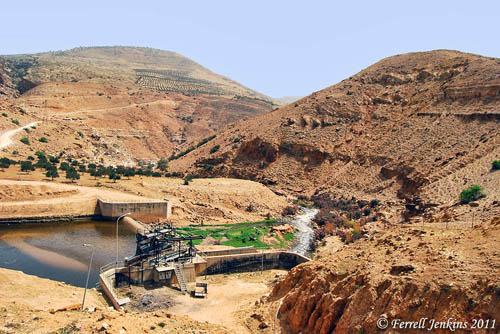
Tall adh-Dhahab East (left) and Tall adh-Dhahab West (right). Photo by Ferrell Jenkins.

Tall adh-Dhahab East (left) and Tall adh-Dhahab West (right). These are thought to be the sites of Mahanaim and Penuel. Photo by Ferrell Jenkins.

Our photo shows both tells. (Tall adh-Dhahab East is on the left. Tall adh-Dhahab West is on the right.) There is a pumping station on the Jabbok to provide agricultural irrigation. The Jabbok continues in the valley separating the two hills and tells.

Click on the photo for an image suitable for use in teaching presentations.

The donkey: beast of burden

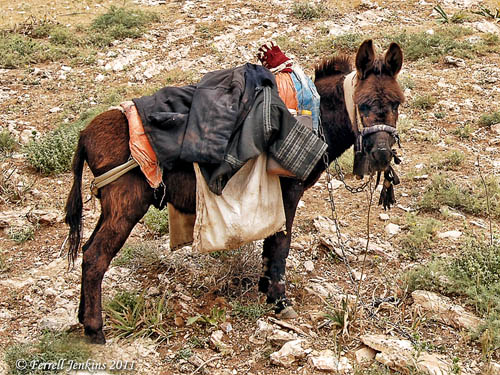
Donkeys are mentioned throughout the Bible beginning in Genesis 16:12. This photo shows the donkey belonging to a shepherd in the area of Gilead in Transjordan.

A donkey in Gilead (Transjordan). Photo by Ferrell Jenkins.

A donkey in Gilead (Transjordan). Photo by Ferrell Jenkins.

Abraham took a donkey when he went to the land of Moriah to offer Isaac.

So Abraham rose early in the morning and saddled his donkey, and took two of his young men with him and Isaac his son; and he split wood for the burnt offering, and arose and went to the place of which God had told him. (Genesis 22:3 NAU)

Jesse loaded a donkey with food supplies to send to Saul when the Israelites fought against the Philistines in the Valley of Elah.

Jesse took a donkey loaded with bread and a jug of wine and a young goat, and sent them to Saul by David his son. (1 Samuel 16:20 NAU)

Qumran after 62 years

February 15 was an anniversary of the discovery of Qumran on the shores of the Dead Sea. Note the article in The Jewish Chronicle Online.

In 1949 the site was identified by European and US archeologists, and on February 15 1949 a team lead by Roland de Vaux and Gerald Lankester Harding began excavating the area. The excavations continued until 1956.

The article does not say that east Jerusalem and Qumran was part of the Hashemite Kingdom of Jordan at the time, or that G. Lankester Harding was the Director of Antiquities. He is author of The Antiquities Of Jordan.

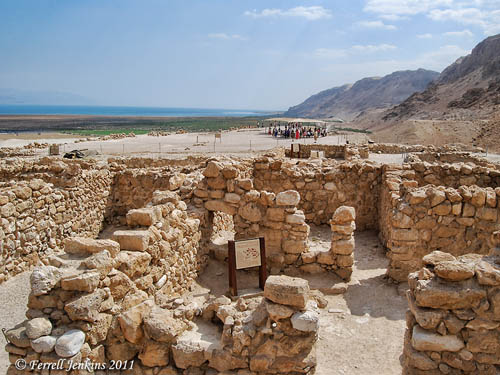
Qumran study room. NE view to Dead Sea. Photo by Ferrell Jenkins.

Qumran study room. NE view to Dead Sea. Photo by Ferrell Jenkins.

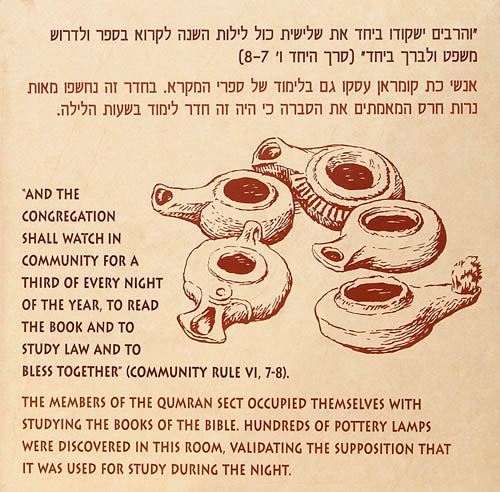
The sign in the proposed Study Room is shown below.

Sign in Qumran Study Room. Photo by Ferrell Jenkins.

Sign in Qumran Study Room. Photo by Ferrell Jenkins.

Haaretz, an Israeli daily newspaper, runs an article from 1955 about the scrolls here. It states that all seven scrolls were at that time “all seven Dead Sea Scrolls are now  in Israel’s hands.”

Haaretz added that “we have learned from reliable sources that $1 million was requested for the scrolls, but they were purchased for slightly more than $250,000,” a “bargain,” according to archaeologist Prof. William Albright, who played an important part in their acquisition.

Albright estimated the scrolls’ value at half a million dollars, and guessed that their relatively low price reflected, among other things, “propaganda by Prof. [Samuel] Zeitlin, who denied the antiquity of the scrolls, a point of view which is no longer accepted.”

We have written about Qumran and the Dead Sea Scrolls many times. Just use the search box to locate the articles, or begin here.

HT: Paleojudaica

Traditional baptism site to open in Israel

The traditional site where John the Baptist baptized Jesus has been closed for more than four decades. In the past few years pilgrims and tourists have been able to visit the site known as Bethany Beyond the Jordan from the Jordanian side of the Jordan River.

In those days Jesus came from Nazareth of Galilee and was baptized by John in the Jordan. (Mark 1:9 ESV)

These things took place in Bethany across the Jordan, where John was baptizing. (John 1:28 ESV)

Now word comes, after a year’s delay, that the site will open on the Israeli side.

Kasr al-Yehud, the probable site where John the Baptist baptized his cousin Jesus of Nazareth, will be opened to the public with a special ceremony on January 18 after 42 years as a closed military zone which pilgrims could only visit after coordinating with the Civil Administration for Judea and Samaria. The site is located in the Jordan Valley in the West Bank, but starting on the 18th it will be operated by the jurisdiction of the Israel’s Nature and Parks Authority, after Israeli authorities invested millions of shekels to build facilities there to handle a large number of tourists. The 18th is significant because it is the traditional day when Greek and Russian Orthodox Christians make an annual pilgrimage to the site to celebrate the Feast of the Epiphany. Vice Premier Silvan Shalom, who was instrumental in the project, said he hoped Kasr al-Yehud would become a symbol for cooperation among Israel, Jordan and the Palestinian Authority, as it would be a major attraction for tourists who would also want to visit other Biblical sites in the area. (ICEJ news)

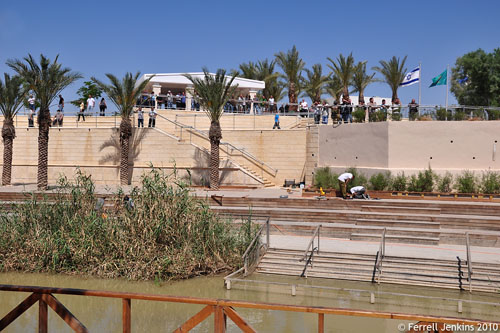
Last May my group visited the Jordan River at the Jordanian site that is suggested as Bethany beyond the Jordan. Construction of a visitor’s center on the Israeli side seemed to be almost finished. That day a group, perhaps mostly military, was at the site, but it was not open to the general public. You can see workers on the steps leading down to the water.

Jordan River baptism site. View from Jordan to the west. Photo by Ferrell Jenkins.

Jordan River baptism site. View from Jordan to the west. Photo by Ferrell Jenkins.

The Israeli visitor’s center is actually in the West Bank, but under Israeli control.

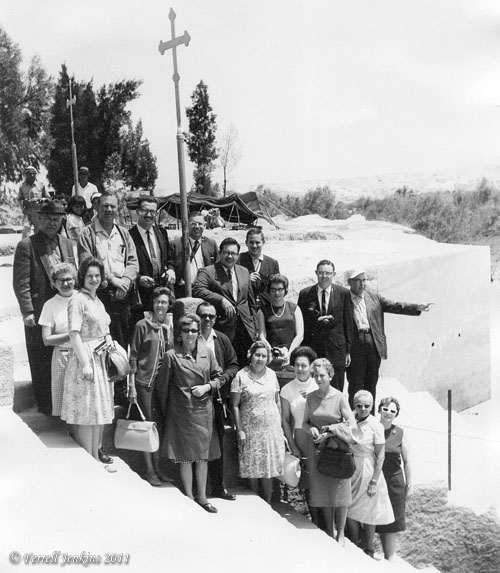
My first trip to the Bible Lands was in April and May of 1967. At that time the western side of the Jordan River was open to tourists. Of course, the site was still in Jordan at the time. Take a look at my group of 19 tour members. It is true that in those days most of the men wore suits, dress shirts and ties, even in the hot weather. The women wore dressy clothes, hosiery and other feminine attire no longer in use.

Just a flash from the past. Take a look at the old photo made on the western bank of the Jordan.

Ferrell Jenkins group at the traditional baptism site on the Jordan River.

1967 group at the traditional baptism site on the west bank of the Jordan River.

Did you notice those purses the women are carrying? In those days that was allowed as a carry-on on the airplanes. Many of the men carried a camera bag of similar size. That was it. No rolling suitcases. Oh, for the good ole days.

HT: BiblePlaces Blog.

Why use a front end loader at an archaeological dig?

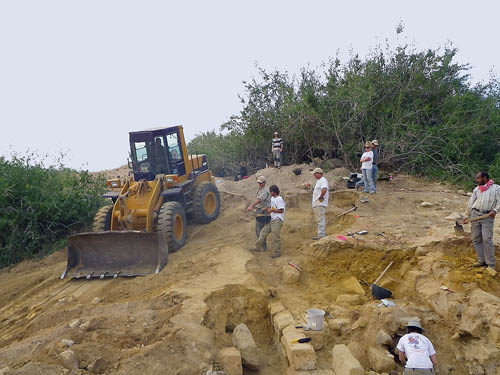
Dr. David Graves reports on the use of a tractor with a front end loader at Tall el Hammam in Jordan. He explains how the tractor is used at the beginning of excavations of a monumental Roman building. See the brief report with a larger photo here. Note especially his reference to “contaminated piles of dirt” and “night diggers.”

David Graves - Roman excavation at Tall el-Hammam

Use of a tractor with front end loader at Tall el-Hammam. Photo by David Graves.

We recently reported on the Tall el-Hammam excavation here.

Searching for Sodom — in the sea and on the land

The search for the city of Sodom has become as elusive and controversial as the search for Noah’s ark. From Genesis to Revelation the Bible calls attention to the city of Sodom. It is first mentioned in Genesis 10:19; the last reference is in Revelation 11:8. The wickedness and destruction of the city became a symbol of final destruction throughout the Bible. Isaiah spoke concerning Judah and Jerusalem:

If the LORD of hosts had not left us a few survivors, we should have been like Sodom, and become like Gomorrah. (Isaiah 1:9 ESV)

The apostle Paul picks us the same theme in Romans 9:29.

The emphasis on Sodom, and the inability to visit a specific site only heightens the curiosity.

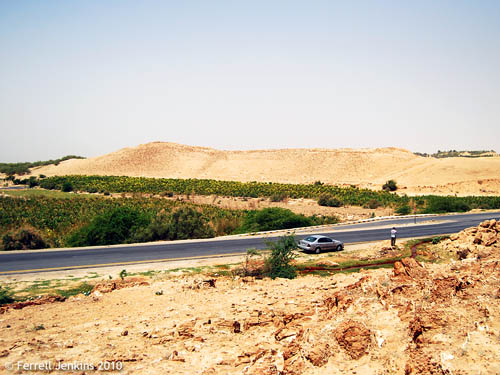
Dr. Steven Collins, Dean, College of Archaeology, Trinity Southwest University, thinks that Tall el-Hammam is the site of Sodom. Info about the excavation project may be located here. Other scholars suggest that Tall el-Hammam is the site of Abel-shittim (Numbers 33:49; Shittim, Numbers 25:1), in the plains of Moab. See Rainey and Notley, The Sacred Bridge, 125. The Israelite spies went out from here to view the promised land, especially Jericho (Joshua 2:1).

Tall el-Hammam in the Jordan Valley of Jordan. Photo by Ferrell Jenkins.

Tall el-Hammam in the Jordan Valley of Jordan. Photo by Ferrell Jenkins.

Earlier in the month the media reported (here, for example) that a Russian team was planning to begin an underwater exploration of the northeast portion of the Dead Sea — that is, on the Jordan side of the Dead Sea.

In the past it has been common for scholars to suggest that Sodom were located in (or at) the southern end of the Dead Sea at Bab edh-Dhra.

The excavation at Tall el-Hammam is now in progress. Dr. David Graves has been working there for several years. He has also been looking for the Roman site of Livius. I wish to call attention to several things Graves has mentioned recently on his Deus Artefacta blog.

  • A video of Dr. Collins setting forth his argument for the location of Sodom and Gomorrah at Tall el-Hammam. Click here.
  • The front team for the current season of excavation. Click here.
  • Someone from the Russian team was to visit Tall el-Hammam.
  • Season Six Begins at Tall el-Hammam video. Click here.
  • Gary Byers, Assistant Dig Director, on December 23 reported more details about the Russian proposal. Read the entire report here. It appears that the Russian team is making claims greater than the reality.

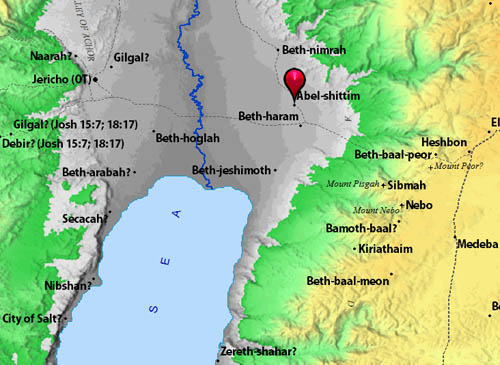
The site marked Abel-Shittim on the map below is known today as Tall el-Hammam. You may see a larger map at BibleAtlas.org.

Site of Abel-Shittim in the Jordan Valley. BibleAtlas.org.

Site of Abel-Shittim in the Jordan Valley. BibleAtlas.org.

I’m not convinced yet, but I’ll continue to watch.

Palestine Exploration Fund’s photostream

The Palestine Exploration Fund has posted some fascinating historical photos from the nineteenth and early twentieth-century that will be of interest to students of historical geography and archaeology. The link is here.

Once you get there scroll down to the second line of photos where you will see a photo made sometime between 1930 and 1936 of John Garstang working at Jericho. He is making photos of the abundance of pottery found at that spot.

Working through this collection is going to be fun.

The photos are marked “© All rights reserved.” Those who wish to use them for educational purposes should be able to do so under the copyright Fair Use provision.

HT: Paleojudaica and Biblical Paths.