Category Archives: Israel

Murex is the source of Royal Purple

From 1967 to 1975 I took a group to Lebanon each year except one. Tyre was always an important stop on the tour. Tour members were interested in understanding the prophecies of Ezekiel and the historical context associated with both the Babylonian king Nebuchadnezzar and Alexander the Great.

It was possible in the early days to find Murex shells like the two I have included in the photograph below. Click on the image for a larger photo suitable for use in teaching.

Murex shells collected at Tyre. Photo by Ferrell Jenkins.

Murex shells collected at Tyre. Photo by Ferrell Jenkins.

There are different species of the Murex. A display in the British Museum mentions Purpura haemastoma, Murex trunculus, and Murex brandaris. I think the shells above are Murex trunculus. If a reader knows otherwise, please leave a comment. The Museum sign says,

The prized purple dye, for which the Phoenicians were renowned, came from a gland of the murex snail. Each snail yielded only a drop of yellow liquid which darkened to purple on exposure to light. Processing required slow simmering for almost two weeks. Up to 60,000 snails were needed for a pound of dye. Different tints were achieved by varying the amounts of extract from different species.

Patricia M. Bikai writes about the value of Royal Purple and the legend about the discovery of it.

Royal Purple had an enormous value, worth as much as 10 to 20 times its weight in gold (Born 106-11, 124-128).

According to legend, Royal Purple was discovered by Melkart (Hercules), the city-god and king of Tyre, when he and the nymph Tyros were walking along the Phoenician shore with their dog. The dog, playing with a large Murex, bit into it and it stained his mouth purple. Melkart then dyed a robe with it and gave it to Tyros. (Bikai in Martha Sharp Joukowsky, ed., The Heritage of Tyre, 68)

The citizens of the island city of Tyre remember the history of their city. On my last visit in 2002 I noticed a sign announcing the opening of the Murex cafe. I wonder if they have wifi.

Murex Cafe at Tyre, Lebanon. Photo by Ferrell Jenkins.

Murex Cafe at Tyre, Lebanon. Photo by Ferrell Jenkins.

Purple was the royal color in ancient times. The prophet Ezekiel mentions blue and purple as symbolic of Tyre.

Your sail was made of fine embroidered linen from Egypt, and served as your banner. Your awning was of blue and purple fabric from the coasts of Elishah. (Ezekiel 27:7 CSB)

The great harlot of Revelation 17 is clothed in purple.

The woman was dressed in purple and scarlet, adorned with gold, precious stones, and pearls. She had a gold cup in her hand filled with everything vile and with the impurities of her prostitution. (Revelation 17:4 CSB)

Scroll down two or three posts to read more about Phoenicias and purple.

About 30,000 Dead Sea Scrolls to be put online

The Israel Antiquities Authority announced today a partnership with Google R&D Center in Israel to make the Dead Sea Scrolls available online. The project will be called the Leon Levy Dead Sea Scrolls Digital Project because the major lead gift is from the Leon Levy Foundation. Here are some excepts from the IAA press release.

A major lead gift from the Leon Levy Foundation, with additional major funding from the Arcadia Foundation and the support of Yad Hanadiv Foundation, will enable the Israel Antiquities Authority to use the most advanced and innovative technologies available to image the entire collection of 900 manuscripts comprising c. 30,000 Dead Sea Scrolls fragments in hi-resolution and multi spectra and make the digitized images freely available and accessible to anyone anywhere in the world on the internet. This is the first time that the collection of Scrolls will be photographed in its entirety since the 1950’s.

The IAA announced this morning that it is collaborating with the Google R&D center in Israel in this milestone project to upload not only all of the digitized Scrolls images but also additional data online that will allow users to perform meaningful searches across a broad range of data in a number of languages and formats, which will result in unprecedented scholarly and popular access to the Scrolls and related research and scholarship and should lead to new insights into the world of the Scrolls.

The innovative imaging technology to be used in the project has been developed by MegaVision, a U.S. based company, and will be installed in the IAA’s laboratories in early 2011. The MegaVision system will enable the digital imaging of every Scroll fragment in various wavelengths in the highest resolution possible and allow long term monitoring for preservation purposes in a non-invasive and precise manner. The images will be equal in quality to the actual physical viewing of the Scrolls, thus eliminating the need for re-exposure of the Scrolls and allowing their preservation for future generations.  The technology will also help rediscover writing and letters that have “vanished” over the years; with the help of infra-red light and wavelengths beyond, these writings will be brought “back to life”, facilitating new possibilities in Dead Sea Scrolls research.

Uploading the images to the internet will be achieved with the assistance of Google-Israel and will be accompanied by meta-data including transcriptions, translations and bibliography.

According to Shuka Dorfman, IAA General Director, “we are establishing a milestone connection between progress and the past to preserve this unique heritage for future generations. At the end of a comprehensive and profound examination we have succeeded in recruiting the best minds and technological means to preserve this unrivaled cultural heritage treasure which belongs to all of us, so that the public with a click of the mouse will be able to freely access history in its fullest glamour. We are proud to be embarking on a project that will provide unlimited access to one of the most important archaeological finds of the 20th Century, crucial to Biblical studies and the history of Judaism and early Christianity. We are profoundly grateful to Shelby White and the Leon Levy Foundation for their lead major gift and to the Arcadia Foundation for its major gift to this project.”

The IAA press release with a link to several photographs is available here.

IAA photo from the pilot project in St. Paul

IAA photo from the pilot project in St. Paul

If you thought the Dead Sea Scrolls had not been made public, take a look at this sentence from the News Release:

This is the first time that the collection of Scrolls will be photographed in its entirety since the 1950’s.

HT: Joseph Lauer

When purple is blue

The Mosaic law commanded the Israelites to put a blue cord on the corner tassels of their garments.

“Speak to the Israelites and tell them that throughout their generations they are to make tassels for the corners of their garments, and put a blue cord on the tassel at each corner. (Numbers 15:38 CSB)

“Dyeing To Be Holy” is the title of a feature article in The Jewish Daily Forward by Nathan Jeffay. The article says that the source of the dye used to obey the command of the law has been lost for more than 1,200 years.

Roman emperors from the first century BCE onward wanted tekhelet reserved as a status symbol for the governing classes, meaning that it became progressively more difficult for Jews to obtain it. This, together with other political and economic factors, meant that by the eighth century, Jews had lost the tradition of how to obtain the dye, and tzitzit became the all-white fringes that are familiar today.

But now, a Jerusalem-based not-for-profit organization, Ptil Tekhelet, claims to have rediscovered it. “This is the experience of a mitzvah’s renaissance,” said the man leading the group of Talmud-studying snorkelers, Mois Navon, a computer programmer, ordained rabbi and Ptil Tekhelet board member. “For a biblical commandment to be returned to the people is really something significant.”

In the past, rabbinic sources have stated that tekhelet comes from a snail called the hilazon. But hilazon isn’t a biological species name, just a rabbinic name. The mystery was figuring out the species to which they were referring.

The modern search for the answer began in earnest in the early 20th century, when Isaac Herzog, who went on to become the first Ashkenazi chief rabbi of Israel, wrote a doctoral thesis in which he concluded that a snail called the Murex trunculus (the scientific name for hilazon) was the “most likely candidate” for the source of tekhelet.

Hilazon snail. Photo courtesy Ptil Tekhelet.

Hilazon snail. Photo courtesy Ptil Tekhelet.

The report continues,

Key to Herzog’s conclusion was the fact that archaeological digs uncovered large ancient dyeing facilities close to Haifa, and mounds of Murex trunculus broken open, apparently to access their dye.

But Herzog hit a snag. The snail’s dye was purplish blue, not the pure blue described in the Talmud. It took until the early 1980s for this riddle to be solved. In research unrelated to the search for the biblical dye, Otto Elsner, a professor at Shenkar College of Engineering and Design, near Tel Aviv, noticed that on sunny days, Murex trunculus dye became more blue and less purple. It turned out that the missing link between Herzog’s experiments and biblical dyeing methods was ultraviolet light, which transforms the blue-purple colorant to unadulterated blue.

Read the full article here.

There are some dissenting comments with the article.

HT: Joseph Lauer

CBS 60 Minutes to include feature on archaeology in Jerusalem

The promo for 60 Minutes, October 17, 2010, includes the following:

Lesley Stahl reports on an archeological dig in Jerusalem that is stirring up controversy.

This is likely a reference to the City of David excavations.

The watershed ridge — Part 2

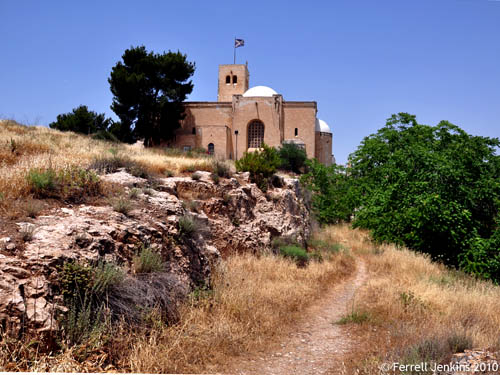
Walking to the top of Bible Hill we continue to look north with St. Andrews Church before us. Looking over to the right you may see some of the building of the old city of Jerusalem.

Bible Hill, the water parting ridge, and St. Andrews. Photo by Ferrell Jenkins.

Bible Hill, the water parting ridge, and St. Andrews. Photo by Ferrell Jenkins.

Next we take a look north east. The western side of the Old City wall is clearly visible. Jaffa Gate and the Citadel are can be seen near the middle of the wall. The tower of the Church of the Dormition is visible at the extreme right of the photo. The Valley of Hinnom lies between Bible Hill and the Old City.

View north east from Bible Hill. Photo by Ferrell Jenkins.

View north east from Bible Hill. Photo by Ferrell Jenkins.

As we look to the west we see the flat top of Bible Hill and some of the buildings of Jerusalem on the slope of the ridge.

View to the east from Bible Hill. Photo by Ferrell Jenkins.

View to the east from Bible Hill. Photo by Ferrell Jenkins.

The watershed ridge

Those who study Bible geography learn about the extension of the Lebanon Mountains that runs south through Upper Galilee, Lower Galilee, the mountains of Samaria, and the mountains of Judea. Every mountain ridge has a right side and a left side. The ridge of the central mountain route in Israel provides the watershed to the east and the west.

St. Andrew’s (Scottish) Church sits on the watershed ridge in Jerusalem. When you travel from the west side of the old city of Jerusalem crossing the Hinnom Valley on the way south to Bethlehem and Hebron, you pass the watershed ridge and St. Andrew’s Church on your right. The Menachem Begin Heritage Center Museum and the Church sit up above the road and are lost to view as you watch the traffic.

This view, showing the east side of the watershed ridge, looks north to the Church.

The watershed ridge in Jerusalem. Photo by Ferrell Jenkins.

The watershed ridge in Jerusalem. Photo by Ferrell Jenkins.

St. Andrew’s Church has an interesting history which is described briefly.

St Andrew’s Church, Jerusalem, was built as a memorial to the Scottish soldiers who were killed fighting the Turkish Army during World War I, bringing to an end Ottoman rule over Palestine. It is a congregation of the Church of Scotland. (Wikipedia)

A cornerstone on the Church indicates that the stone was laid on May 7, 1927, by Field Marshal the Viscount Allenby in commemoration of the liberation of Jerusalem on December 9, 1917. We have a photo of the liberation here. Another plaque in the Church indicates that King Robert Bruce wished for his heart to be buried here.

Before his death Bruce required Sir James Douglas to carry his heart to Jerusalem, in redemption of his unfulfilled vow to visit the Holy City. Accordingly Sir James set out, bearing with him the embalmed heart. On his way he fell fighting the Moors in Spain. The heart was recovered and found its resting-place at Melrose, while the body rests at Dunfermline, Scotland. (Vilnay, Israel Guide 1978, 87)

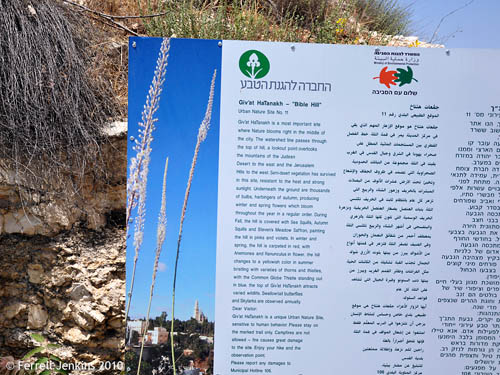
The barren hill on which the Church is built is called Bible Hill.

Sign marking Bible Hill, the watershed ridge in Jerusalem. Photo by Ferrell Jenkins.

Sign marking Bible Hill, the watershed ridge in Jerusalem. Photo by Ferrell Jenkins.

This hill marks a portion of the boundary of the biblical tribe of Judah. Notice the reference to “the top of the mountain.”

Then the boundary goes up by the Valley of the Son of Hinnom at the southern shoulder of the Jebusite (that is, Jerusalem). And the boundary goes up to the top of the mountain that lies over against the Valley of Hinnom, on the west, at the northern end of the Valley of Rephaim. (Joshua 15:8 ESV)

In another post we hope to show you more photos of the watershed ridge and the view on each side of it from this same location. Meanwhile, take a look at several photos of the Church, and a satellite view of the area at Bible Walks.

Jericho celebrates 10,000 years on 10-10-10

Since the excavations of Tell es-Sultan by Kathleen Kenyon (1952-1958), Jericho has publicized itself as the oldest city in the world. Kenyon thought she had found the earliest known fortifications.

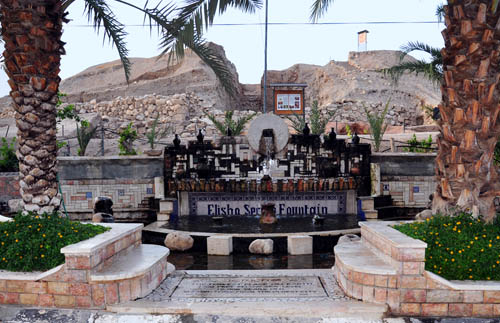
Tell es-Sultan has been neglected as a tourist site over the years. In May I was pleased to see that the site had been cleaned up a bit with clearly marked paths and new signs. One new thing I saw was a fountain marked as “Elisha Spring Fountain.” It is probably the same water one would find in the toilet [for those who have not traveled outside the USA, that is a Restroom].

Jericho Fountain and Tel es-Sultan

Elisha Spring Fountain & Tell es-Sultan (Jericho). Photo by Ferrell Jenkins.

Elisha’s Spring is on the east side of the tell. See our earlier post here. But, back to the 10,000 years. The mosaic in front of the fountain touts Jericho as “the lowest place on earth” and  “10,000 years old.” In fact, Jericho is about 82o feet below sea level (Encyclopaedia Judaica, 2nd ed., Vol. 11).

Jericho sign in 2010 claims to be oldest city. Photo by Ferrell Jenkins.

Jericho sign in 2010 claims to be oldest city. Photo by Ferrell Jenkins.

The Palestinian Prime Minister held his weekly Cabinet meeting at Jericho Sunday “to mark the town’s birthday.” Authorities said the choice of October 10, 2010 (10-10-10) was random.

Biblical Jericho attracts a steady flow of pilgrims, but the small Jordan Valley oasis is making a major push these days to become a magnet for tourists, presenting itself as the oldest city on earth. Marking the 10,000th birthday Sunday is entirely random, though, with archaeologists saying they could be off by hundreds of years in dating the first human settlement in the area.

Read the complete article, which is mostly about Hisham’s Palace from the 8th century A.D., here.

One Sunday my wife and I were eating with an attorney and his wife. Through the window we could see the sign of the restaurant next door. It said something about serving the world’s best chicken. I asked my friend about the legality of signs like that. He said it was “acknowledged puffery.” I suspect we should view the signs at Jericho, and a lot of other places, in the same light.

Todd Bolen has a post about this subject, with additional photos, on the Bible Places Blog here.

Report on Khirbet Qeiyafa — the Elah Fortress

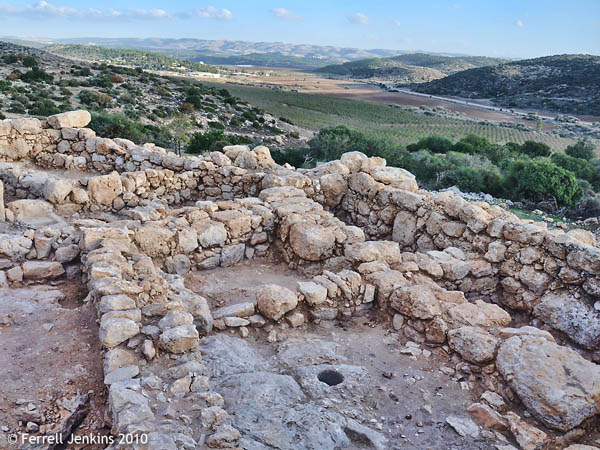
Luke Chandler has participated in the excavation at Khirbet Qeiyafa the past two summers. Recently he posted two brief articles on some of the discoveries during the past summer. Read here and here.

This area is associated with the events of 1 Samuel 17 (David and Goliath).

View to southeast over Elah Valley from Khirbet Qeiyafa. Photo by F. Jenkins.

View to southeast over Elah Valley from Khirbet Qeiyafa. Photo by Ferrell Jenkins.

A waterfall in the stronghold of En Gedi

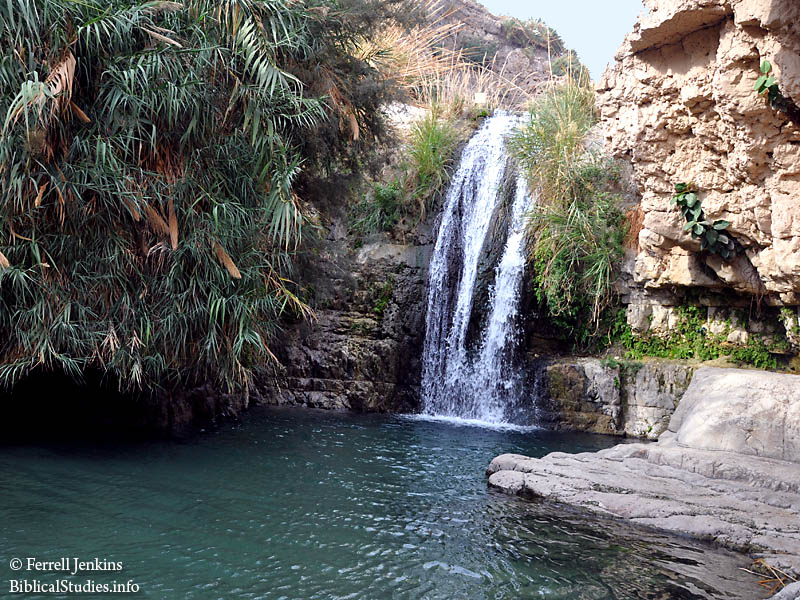
This week I haven’t had time to post much. Today, as I head home, I thought I would share this photo of one of the waterfalls at En Gedi.

Waterfall at En Gedi. Photo by Ferrell Jenkins.

One of the small waterfalls at En Gedi. Photo by Ferrell Jenkins.

This area, on the shore of the Dead Sea, is associated with David and Saul.

David went up from there and stayed in the strongholds of Engedi. (1 Samuel 23:29 NAU)

Five year long ossuary forgery trial may be coming to an end

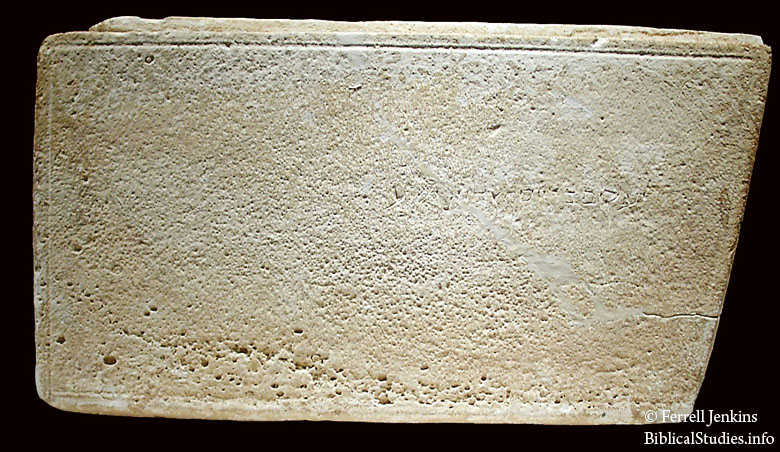
More than five years ago prosecutors in Israel brought charges against Oded Golan for forging the inscription on the ossuary bearing the Aramaic title, “Ya’akov bar Yosef akhui diYeshua” [James the son of Joseph the brother of Jesus].

Matthew Kalman reports that the trial seems to be coming to an end.

The indictment leveled 44 charges of forgery, fraud and deception against Golan and 13 lesser counts against a co-defendant, antiquities dealer Robert Deutsch. The trial of Golan, Deutsch and three other defendants opened at the Jerusalem District Court in September 2005.

Last Sunday, the defense ended its summing up with just two men left in the dock, bringing to an end five years of court proceedings that spanned 116 sessions, 133 witnesses, 200 exhibits and nearly 12,000 pages of witness testimony. The prosecution summation alone ran to 653 pages.

Yet despite the flood of strong scientific testimony, the feeling in the tiny courtroom, where fewer than a dozen people (including only one reporter) have followed the proceedings, was that the prosecution had failed to prove the items were forgeries or that Golan and Deutsch had faked them.

You may read Kalman’s full report here.

The "James" Ossuary. Photo by Ferrell Jenkins.

The "James" Ossuary. Photo by Ferrell Jenkins.

Once the judge issues his decision we still will not have certainty about this artifact.

HT: Joseph I. Lauer