Category Archives: Israel

The last week in the Gospel of John

If we consider the Gospel of John a sort of “Day Planner” for Jesus, we have nearly complete activity recorded for two weeks of the earthly ministry of Jesus. The first is in John 1:19—2:11 where activity for six of the seven days is recorded. I think the omitted day is the sabbath.

The next nearly complete week is the last week, leading up to the resurrection. John gives more attention to the last week than any other Gospel. Even here we have activities for only six of eight days. This section begins in John 12:1 and continues into John 20. Here is the way I have reconstructed it. Where John does not record the activity I have omitted the scripture reference.

  • Sunday — The King enters Jerusalem — 12:12-19
  • Monday — Cleansing the Temple —
  • Tuesday — Visit of the Greeks — 12:20-36
  • Tuesday — Jewish rejection — 12:37-50
  • Wednesday — No events recorded in the Gospels
  • Thursday Evening — Passover Meal, including Washing Disciples Feet (only in John) — 13:1-38
  • Thur. Eve — Farewell discourses — 14—16
  • Thur. Eve — Prayer — 17
  • Thur. Eve — Annas (only in John) — 18:12-14
  • Thur. Eve — Caiaphas — 18:24-28
  • Friday — Pilate — 18:28—19:16
  • Friday — Crucifixion — 19:16-42
  • Sabbath —
  • First Day — Resurrection — 20

It should be noted that the appearance before Annas and Caiaphas were the Jewish (Religious) trials. The appearance before Pilate [and Herod Antipas] were the Roman (Civil) trials.

John does not record the pronouncement of woes on the religious leaders, the institution of the Lord’s Supper, and the account of the agony in the Garden of Gethsemane.

With this sparse attention given to two weeks, no wonder John says,

Now there are also many other things that Jesus did. Were every one of them to be written, I suppose that the world itself could not contain the books that would be written. (John 21:25 ESV)

There is a medieval wood carving of the last week of Jesus in Notre Dame (Paris). In this photo you see the representation of the last supper, the washing of the disciples’ feet, and the agony in Gethsemane. (Sorry, this was made nearly a decade ago and I don’t have a hi-res photo.)

Wood carving of Last Week of Jesus in Notre Dame. Photo by Ferrell Jenkins.
Wood carving of Last Week of Jesus in Notre Dame. Photo by Ferrell Jenkins.
Jesus visited Bethany often

The crowds of pilgrims who had come to Jerusalem for Passover overloaded the system. Many of them likely slept in the open on the Mount of Olives and other places near the city. On Monday evening,

And he entered Jerusalem and went into the temple. And when he had looked around at everything, as it was already late, he went out to Bethany with the twelve. (Mark 11:11 ESV)

Luke tells us that it was His custom to do so.

And he came out and went, as was his custom, to the Mount of Olives, and the disciples followed him. (Luke 22:39 ESV)

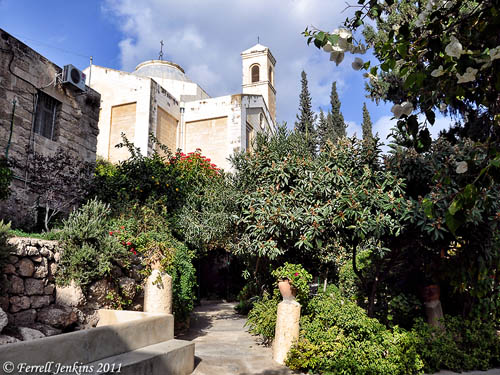
Bethany, the village of Mary, Martha and Lazarus (John 11:1), was located on the eastern slope of the Mount of Olives about two miles from Jerusalem (John 11:1, 18). The photo below shows the Church of St. Lazarus at Bethany. The walk from the main street goes through a pleasant garden. This was the Jerusalem-Jericho road before the building of the tunnel and the new highway.

Church at Bethany. Photo by Ferrell Jenkins.

Church at Bethany on eastern slope of Mount of Olives. Photo by Ferrell Jenkins.

Here on the eastern slope of Olivet we find the traditional tomb of Lazarus. In the time of Jesus the mountain was likely filled with olive trees.  Jerusalem may be seen only after one reaches the crest of the mountain.

Jesus also visited in the home of Simon the leper at Bethany, where a woman anointed his head with oil as He reclined at the table (Matthew 26:6-7).

Tradition places the ascension of Jesus on the top of the Mount of Olives, but Luke says it took place at Bethany (Luke 24:50-51).

Early morning view across the Sea of Galilee

The photo below shows an early morning scene across the Sea of Galilee from Tiberias. Perhaps we should say across “the Sea of Tiberias” as John does.

After these things Jesus went away to the other side of the Sea of Galilee (or Tiberias). (John 6:1 NAU)

After these things Jesus manifested Himself again to the disciples at the Sea of Tiberias, and He manifested Himself in this way. (John 21:1 NAU)

The view is from the Caesar hotel in Tiberias across the roof tops of some of the older buildings of Tiberias to the north east. The northern shore is clearly visible, as well as the area of biblical Bashan and of the Geshurites to the east (Joshua 12:5; 13:11).

NE view across the Sea of Galilee from Tiberias. Photo by Ferrell Jenkins.

NE view across the Sea of Galilee from Tiberias. Photo by Ferrell Jenkins.

The photo was made January 30, 2011, a time when the heavy clouds might be expected. Notice the shallow water in the lower right corner of the photo.

The joy of hidden treasures

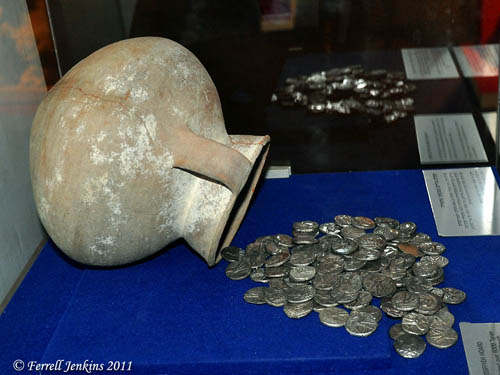
It doesn’t happen every day, but hoards of coins are sometimes found in archaeological excavations and other places by chance. The photo below shows a small portion of the Ussfiyeh Hoard of coins now displayed in the Erezt Israel Museum, Tel Aviv University, Israel. I think Ussfiyeh is a Druze town on Mount Carmel, but I have found nothing else about the site. If a reader knows more, please share.

Ussfiyeh Hoard of Tyrian Shekels & Other Coins. Eretz Israel Museum.

Ussfiyeh Hoard of Tyrian Shekels & Other Coins. Eretz Israel Museum.

The information sign with the display reads as follows:

The Ussfiyeh hoard originally contained 6000 Tyrian shekels, half-shekels and Augustaean denarii. Although Temple shekels bore pagan designs, they were accepted as Temple taxes in Jerusalem. The hoard probably represents a delivery of Temple tax intercepted and hidden away due to the events of the Jewish War which broke out in 66 C.E.

Jesus used an illustration related to a treasure found in a field.

The kingdom of heaven is like treasure hidden in a field, which a man found and covered up. Then in his joy he goes and sells all that he has and buys that field. (Matthew 13:44 ESV)

Click on the photo for a larger image suitable for use in teaching.

Homemade in the Golan Heights

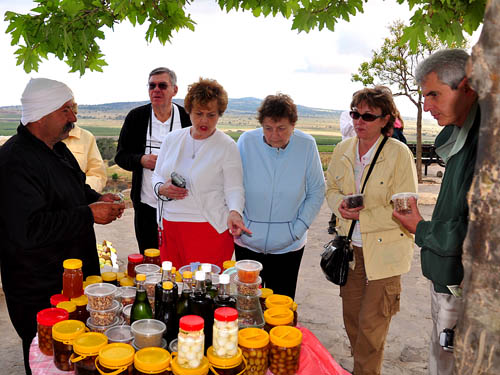
Today I am traveling, but I thought I would share a photo that illustrates one of the educational and sometimes fun things about travel in cultures other than our own. This Arab peddler has set up his table in the Golan Heights at the overlook from Israel into Kuneitra (Quneitra), Syria.

He seems to have a nice variety of the local goodies: olives, olive oil, nuts, and various fruits. Are those pickled eggs? He has already made two sales and it appears he is about to make a third. It can be really chilly in the Golan Heights, even in early May. Some of the potential customers would probably more quickly buy a sweat shirt.

Peddling homemade goodies in the Golan Heights. Photo by Ferrell Jenkins.

Peddling homemade goodies in the Golan Heights. Photo by Ferrell Jenkins.

Lead books or lead balloons?

In the past 24 hours I have received a couple of Emails about the “new” “ancient” lead codices. The best photos I have seen are in the Mail Online here. The account from Yahoo News is here. Put a few words in Yahoo or Google and you will have numerous links.

First Impressions. My first impression, based on the limited information, is that this may be another of those spectacular claims with no substance. I was busy with appointments earlier today and was delighted when I had time to check the blogs to see that Todd Bolen had written a good summary of information at the Bible Places Blog here. There is no reason for me to try to rehash this material. I urge you to take a look at Todd’s summary. He says, “Personally I am inclined to believe that this find is genuine.” My first inclination leans the other way. I know it is not much of a argument, but this report lacks the “ring of truth.” I remember that F. F. Bruce said that second thoughts are best. With more information my thoughts may change. Let’s be patient.

The Sealed Book in Revelation. There is no reason at this point to  link these lead books with the sealed book of Revelation 5-7. Revelation is an apocalyptic book of symbols. Other ancient sealed books have been found in modern times. Examples: some of the Elephantine papyri, a papyrus document from Wadi Daliyeh near Jericho had seven seals still in place (Jenkins, Studies in the Book of Revelation, 18).

Jim Davila has posted numerous notes about the lead codices at Paleojudaica over the past few weeks. Follow all of Todd Bolen’s links and you will know about as much as can be known for the moment.

Follow-up on fake tomb stones

The following comment by Carl Rasmussen is being elevated to a more prominent place here.

The “tombs” above the pool of Siloam are now labeled as “Children’s Cemetary!” Yes, something “fishy” is going on!

Leen Ritmeyer followed up on the subject here, and with several photos taken less than a month ago by his son Nathaniel here. It seems clear from some of the photos that the stones are not attached to any tomb. In fact there are no typical tombs at the site above the Pool of Siloam.

The final photo was taken 29 May 2009 when no tombs were visible.

A grave matter

Ancient burial places create serious problems for archaeologists. Ultra-Orthodox Jews often create a scene at digs when they know or suspect that there may be Jewish tombs in the area.

The cemeteries of the Holy Land have become a ground for religious and political skirmishes. Leen Ritmeyer reported on fake Arab tombs near the Temple Mount here.

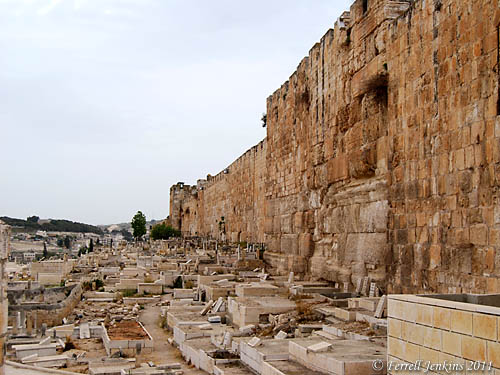
Muslim tombs have been on the eastern wall of the Old City for a long time. This photo was made looking south from outside the Lion’s Gate (or St. Stephens’ Gate). Perhaps every reader knows that this is across the Kidron Valley from the Mount of Olives which we mentioned in the previous post.

Muslim Cemetery along the East Wall of the Old City near Lion's Gate. Photo by Ferrell Jenkins.

Muslim Cemetery along the Eastern Wall of the Old City of Jerusalem near Lion's Gate. Photo by Ferrell Jenkins.

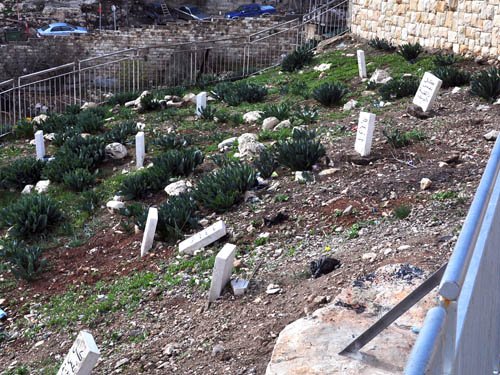
In early February I noticed a large number of new tombstones with Arabic inscriptions in a small plot above the Pool of Siloam. Suspicious, to say the least.

New Tombstones above the Pool of Siloam. Photo by Ferrell Jenkins.

New Tombstones above the Pool of Siloam. Photo by Ferrell Jenkins.

Later, if not sooner, all of these matters will become obvious.

“Do not marvel at this; for an hour is coming, in which all who are in the tombs will hear His voice, and will come forth; those who did the good deeds to a resurrection of life, those who committed the evil deeds to a resurrection of judgment. (John 5:28-29 NAU)

Cemetery on the Mount of Olives

The Washington Post reports here on US and Israeli efforts to end the desecration of Jewish graves on the Mount of Olives. Both religious and political considerations are mentioned.

It is amazing to view the Mount of Olives and see how much of the mountain is now covered with graves. This aerial view may help you to visualize the situation.The cemetery under discussion is shown in the lower right quarter of this photo.

Jerusalem - the Old City and the Mount of Olives. Photo by Ferrell Jenkins.

Jerusalem - the Old City and the Mount of Olives. Photo by Ferrell Jenkins.

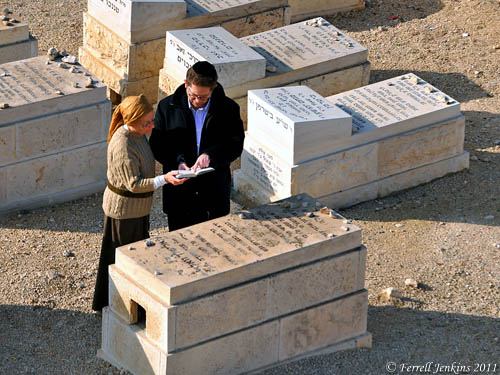
Sometimes when we look at the big picture we miss some important details. The next photo puts a human face and emotion on the situation.

Cemetery on the Mount of Olives. Photo by Ferrell Jenkins.

Cemetery on the Mount of Olives. Photo by Ferrell Jenkins.

At the time of Absalom’s rebellion, David crossed the Mount of Olives as he fled Jerusalem.

But David went up the ascent of the Mount of Olives, weeping as he went, barefoot and with his head covered. And all the people who were with him covered their heads, and they went up, weeping as they went. (2 Samuel 15:30 ESV)

HT: Paleojudaica.

Banias — easternmost source of the River Jordan

The Nahr (River) Banias is the easternmost source of the River Jordan. The source of the Banias is located at a site we know as Caesarea Philippi in the New Testament. It is well known to those who study the ministry of Jesus (Matthew 16:13-19).

Banias is located on the eastern side of the Beka or Hula Valley.  The valley is called the Beka in Lebanon, and a little further south the Hula Valley. The elevation is about 1150 feet above sea level in the foothills of Mount Hermon.

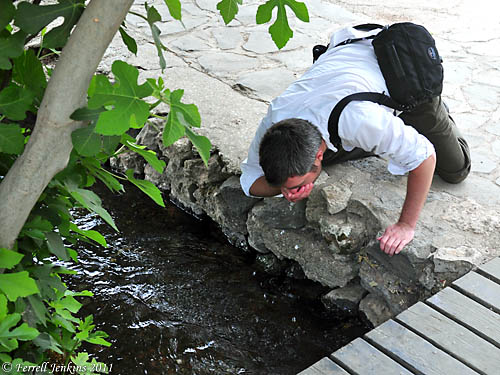
The photo below shows the place where the water emerges from the earth. Perhaps you are reminded of the text from the prophet Jeremiah:

for my people have committed two evils: they have forsaken me, the fountain of living waters, and hewed out cisterns for themselves, broken cisterns that can hold no water. (Jeremiah 2:13 ESV)

Getting a drink at the source. River Banias, Caesarea Philippi.

Getting a drink at the source. River Banias, Caesarea Philippi. Photo by Ferrell Jenkins.

Other posts about this site are listed below. Check them all.

Three other rivers we have recently mention, Flea River, the Senir, and the Dan, join with the Banias to form the River Jordan.