Category Archives: Israel

Abraham at Beersheba (Beer Sheba)

Bible students associate the town of Beersheba (Beer Sheba; Be’er Sheva) with the patriarch Abraham (Genesis 21-22).

  • The first reference to Beersheba is when Abraham sent Hagar and Ishmael to wander in the wilderness of Beersheba (21:14). This is the region known as the Negev.
  • Abraham dug a well and called the place Beersheba (21:30-31). Abraham and Abimelech, the king of Gerar, made a covenant. Abraham presented seven ewe lambs to Abimelech. The name Beersheba means “the well of the seven.”
  • Abraham planted a tamarisk tree at Beersheba and called upon the name of the LORD, the Everlasting God (21:33).

Archaeological excavations were conducted at Tel Beersheba by Tel Aviv University Institute of Archaeology under the direction of Yohanan Aharoni (1969-1973). The excavation indicated that there was no city at the site before the Iron Age. The outer gate of the reconstructed Iron Age city, an older well, and a tamarisk tree, in the photo below, serve as a reminder that Abraham lived in this general vicinity.This tamarisk tree has been cut back and is putting out fresh branches.

Abraham planted a tamarisk tree at Beersheba, and there he called on the name of the LORD, the Everlasting God. (Genesis 21:33 NAU)
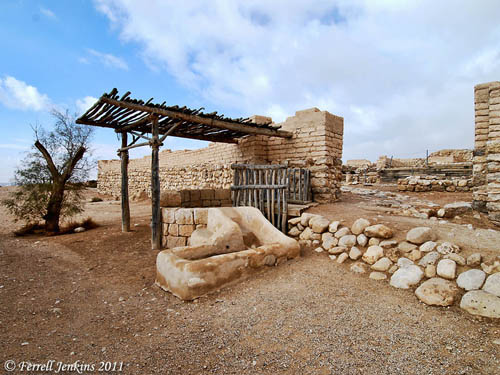
The outer gate, well, and tamarisk tree at Tel Beersheba. Photo by Ferrell Jenkins.

The outer gate, well, and tamarisk tree at Tel Beersheba. Photo by Ferrell Jenkins.

The Negev is suitable for the tamarisk tree. Here is a larger tamarisk at the entry to the site. This photo was made in the month of December. Heavy clouds are visible to the west.
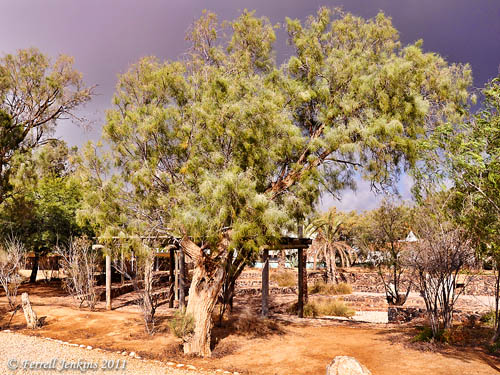
Tamarisk trees at Tel Beersheba. Photo by Ferrell Jenkins.

Tamarisk trees at Tel Beersheba. Photo by Ferrell Jenkins.

Fauna and Flora of the Bible describes the tamarisk this way:

The Tamarisk is a small, fast-growing tree with durable wood, to be found abundantly in deserts, dunes and salt marshes.

Tamaris Aphylla is leafless and has green branches and a wide crown. It has small white flowers, and its fruit is a capsule with feathery seeds. (p. 182)

Photos suitable for use in teaching are available by clicking on the images above.
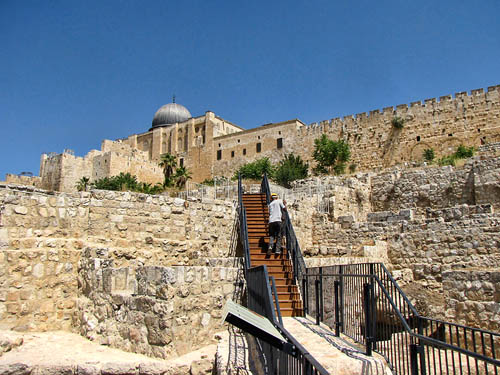
More on the Ophel City Walls site

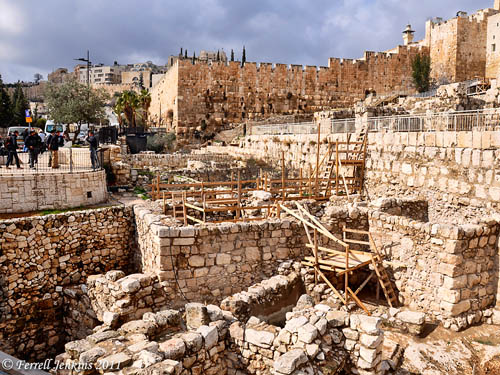
The Israel Antiquities Authority provided several good photos of the Ophel City Walls site. I thought this was an especially nice photo. The view from the site looks at the new steps leading to and from the excavation. The southern wall of the temple mount enclosure is visible in the distance.

Ophel city walls site. Photo: IAA

Ophel City Walls site. Photo: Israel Antiquities Authority.

Leen Ritmeyer provides insight into the excavation dating back to the mid-1970s when he supervised some of the excavations under the direction of Prof. Benjamin Mazar. Take a look here.

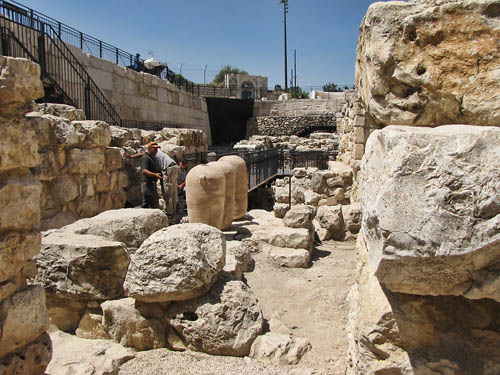
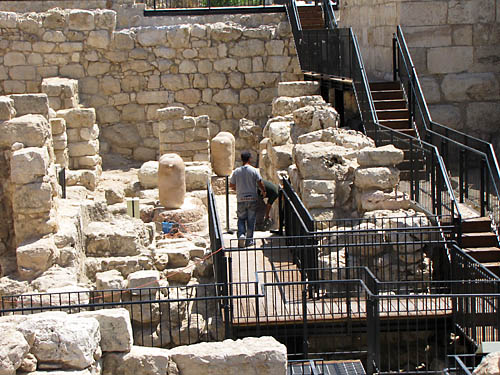
The next photo shows workmen putting the finishing touches on some of the stones. Three pithoi are visible. The view is toward the southwest.

Ophel City Wall site. Photo: Israel Antiquities Authority.

Ophel City Wall site. Photo: Israel Antiquities Authority.

Ophel City Walls site opened in Jerusalem

The Israel Antiquities Authority announced the opening today of what is being called the First Temple Period Ophel City Walls Site in the Walls Around Jerusalem National Park.

In a festive ceremony that was held Today – Tuesday, June 21, 2011, the Ophel City Wall site, a complex of buildings uncovered along the route of the fortifications from the First Temple period (tenth-sixth centuries BCE), and the display of the earliest written document ever uncovered in Jerusalem was inaugurated. The opening of the site, located in the Walls Around  Jerusalem National Park, and the exhibit in the Davidson Center are made possible through the generous donation by Daniel Mintz and Meredith Berkman.

Upon completion of the excavation and conservation work at the Ophel City Wall site, visitors will now be able to touch the stones and walls whose construction tells the history of Jerusalem throughout the ages.  It is now possible to walk comfortably through the built remains, in places that were previously closed to the public, to sense their splendor and learn about the history of the region by the signage and the different means of presentation and illustration.

This photo shows construction work in the area a few months ago.

Ophel First Temple Site during construction of park. Photo by Ferrell Jenkins.

Ophel First Temple Site during construction of park. Photo by Ferrell Jenkins.

Here is a more recent view showing workmen putting final touches on the nice stairs and overviews for those who enter the site through the Davidson Center.

Ophel Site Park. IAA.

Ophel Site Park being prepared for opening. Photo: Israel Antiquities Authority.

The IAA news release continues,

The architecture at the site that was exposed includes an impressive building thought to be a gate house, a royal edifice, a section of a tower and the city wall itself. Dr. Mazar suggests identifying the buildings as part of the complex of fortifications that King Solomon constructed in Jerusalem: “…until he had made an end of building his own house, and the house of the Lord, and the wall of Jerusalem round about” (1 Kings 3:1). In addition to the fortifications of the First Temple period, sections of the Byzantine city wall and two of its towers were exposed. This wall was built at the initiative of the Byzantine empress Eudocia in the fifth century CE. In addition to the complex of fortifications, the excavation of two rooms from the Second Temple period (first century CE) was completed, which were preserved to a height of two stories.

The highlight of the excavations is the complete exposure of the gate house. The plan of this impressive building includes four rooms of identical size, arranged on both sides of a broad corridor paved with crushed limestone. The plan of the gate house is characteristic of the First Temple period (tenth-sixth centuries BCE) and is similar to contemporaneous gates that were revealed at Megiddo, Be‘er Sheva’ and Ashdod. The excavator, Eilat Mazar, suggests identifying the gate house here with the ‘water gate’ mentioned in the Bible: “…and the temple servants living on Ophel repaired to a point opposite the Water Gate on the east and the projecting tower” (Nehemiah 3:26). The ground floor of a large building that was destroyed in a fierce conflagration can be seen east of the gate. Mazar suggests that this structure was destroyed by the Babylonian conquest of the city in 586 BCE. Twelve very large, clay store jars (pithoi), which probably contained wine or oil, were discovered on the floor of the building. Engraved on the shoulder of one of these pithoi is the Hebrew inscription “לשר האו…”. The inscription indicates that this pithos belonged to one of the kingdom’s ministers, perhaps the overseer of the bakers.

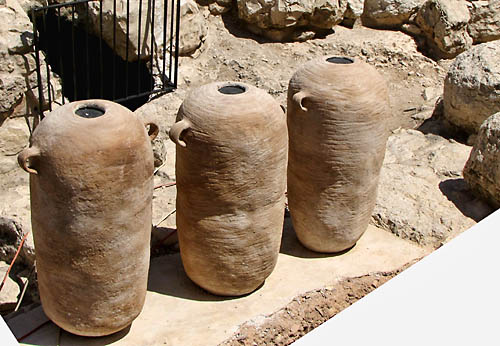
This photo shows (replicas of?) some of the pithoi on display at the site.

Pithoi displayed at the Ophel Site. Photo: Israel Antiquities Authority.

Pithoi displayed at the Ophel Site. Photo: Israel Antiquities Authority.

A fragment of a clay tablet written in Akkadian cuneiform script was discovered in the recent re-excavation of the area by Dr. Mazar. The tablet is typical of those “used in antiquity throughout Mesopotamia for international correspondence.”

Analyses of the writing and the clay used to produce the tablet show that the document originated in the Jerusalem region. It seems that it is a copy of a letter that the king of Jerusalem at the time, Abdi-Heba, sent to the king of Egypt. It was customary that a copy of this correspondence would be kept in the archives of the city Salem, which was Jerusalem in that period. The fragment of the tablet constitutes credible evidence of the status of Jerusalem as an important royal city in Canaan, which was administered as a city-state under the auspices of the pharaonic Egypt kingdom.

We have posted info about the first temple period (suggested) gate and wall here, and about the clay tablet earlier here and here.

The site also may be viewed from Ma’aleh Ha-Shalom Street a short distance east of Dung Gate.

HT: Joseph Lauer

Hezekiah’s Pool – a modern garbage dump

Ha’aretz reports on the political “garbage” associated with an effort to clean up Hezekiah’s Pool in the Old City of Jerusalem.

After years of neglect, Hezekiah’s Pool in the Old City of Jerusalem is finally being cleaned up. The work is being done by the Jerusalem Municipality, the Environmental Protection Ministry and Jerusalem Development Authority. As with anything in Jerusalem, the cleanup may cause a diplomatic crisis with Egypt and Jordan – and a conflict with the Waqf Muslim religious trust and the Coptic Church.

Hezekiah’s Pool, also known as the Pool of the Pillar, is located in the Christian Quarter, not far from Jaffa Gate. It is ancient and covers over three dunams (three-quarters of an acre ). But it is completely hidden from the public, with stores and homes surrounding it. Thousands of tourists coming through the gate and the Arab market pass right by it without having a clue that the historic site is nearby.

The pool was used at least from Second Temple times and was an important part of Jerusalem’s ancient water system until the 19th century.

However, over recent decades, the pool became an unofficial garbage dump for neighborhood residents, who used it to dispose of tons of trash.

In winter, water still collects there, and some Christian Quarter residents use parts of the ancient water system as an improvised sewage system.

Hezekiah’s Pool has turned into a serious health hazard in a densely populated area.

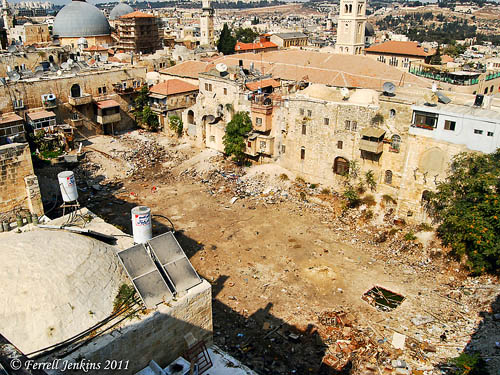
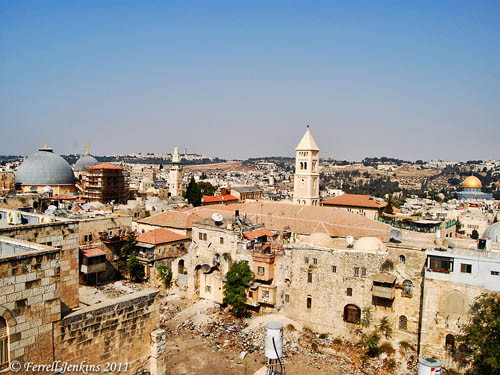
I think the last time I asked permission to go to the roof of the Petra Hotel to make a photo of Hezekiah’s Pool was in September, 2008. At that time the cleanup had already begun. The previous time I viewed the pool it was much more trashy. This pool is just a short distance from Jaffa Gate. Note the proximity of the Pool to the Church of the Holy Sepulchre and the Lutheran Church tower.

Hezekiah's Pool from roof of the Petra Hotel. Photo by Ferrell Jenkins.

Hezekiah's Pool from roof of the Petra Hotel. Photo by Ferrell Jenkins.

The next photo provides more perspective. You can see the pool in the bottom of the photo. In the middle of the photo (top to bottom) you can see the dome of the Church of the Holy Sepulchre (left), the Lutheran Church tower (just right of center), and the Dome of the Rock (right). In the distance to the east is Mount Scopus (left) and the Mount of Olives.

Hezekiah's Pool in the Christian Quarter of Jerusalem. Photo by Ferrell Jenkins.

Hezekiah's Pool in the Christian Quarter of Jerusalem. Photo by Ferrell Jenkins.

Jerome Murphy-O’Connor describes Hezekiah’s Pool.

This great reservoir is entirely surrounded by buildings, and is accessible through the Coptic Khan…. At present the dry pool is used as a rubbish dump by the dwellings which surround it on all sides, but a much needed restoration project is on the drawing board. — The Holy Land

Murphy-O’Connor says the pool “is thought to date from the Herodian period when it was fed by an aqueduct (visible outside Jaffa Gate) coming from Mamilla Pool.” He says Josephus mentions the pool under the name Amygdalon (Almond Tree) (War 5:468). He says this name, Amygdalon, is probably a deformation o f the Hebrew migdal (tower). The reference is to the towers of Herod’s palace.

Israel Antiquities Authority announced in February, 2010, the discovery of the high-level aqueduct that brought water into Hezekiah’s Pool in the Roman City of Jerusalem. See our earlier comments here.

The complete Ha’aretz article may be read here. An aerial view of this area is available here.

P.S. You know the pool has nothing to do with Hezekiah, don’t you?

HT: Joseph Lauer

A new tomb at Nazareth Village

Nazareth Village has become a necessary stop on my tours to Israel. The eyes of ministers and Bible class teachers are opened quickly to the reality of Bible stories. Some of the “exhibits” change with the season; others remain constant.

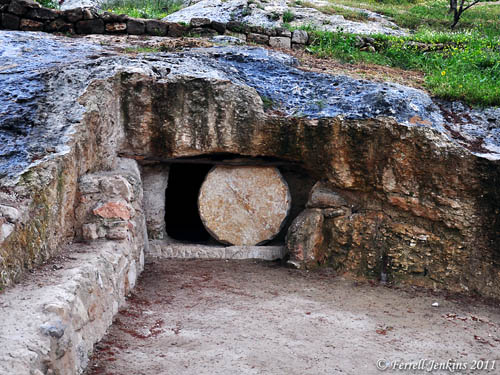
There was something new at Nazareth Village this year — a tomb cut out of the rock with a rolling stone.

New tomb with rolling stone at Nazareth Village. Photo by Ferrell Jenkins.

New tomb with rolling stone at Nazareth Village. Photo by Ferrell Jenkins.

This new tomb “where no one had yet been buried” is a good reminder of the type of tomb in which Jesus was buried (John 19:41 NET).

After Joseph bought a linen cloth and took down the body, he wrapped it in the linen and placed it in a tomb cut out of the rock. Then he rolled a stone across the entrance of the tomb.  (Mark 15:46 NET)

An image suitable for use in teaching is available by clicking on the photo above.

Herodium and the tomb of Herod the Great

Shmuel Browns has an article in Popular Archaeology on “Netzer’s Legacy: The Wonders of Herodium” here. One of the comments by Browns caught my attention as being especially important for all of us who use photos in our teaching.

When visiting an archaeological site, one often cannot see the artifacts that were discovered there as they have been removed and are displayed at a museum.

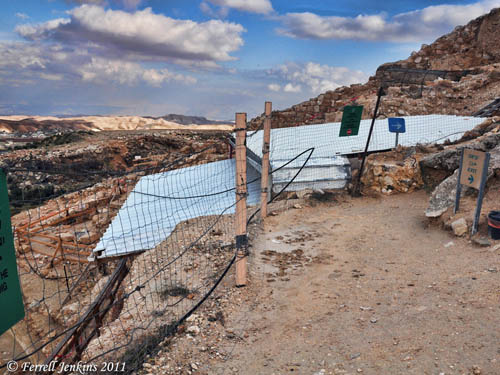
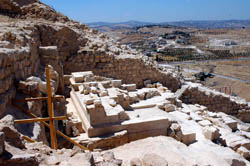
Browns gives an illustration of part of the Roman bath from the lower city at Herodium. I often think about how important it is to be at an archaeological site at just the right time. When I visited the Herodium in January, and again in May, this is what I saw at the place of Netzer’s most recent work.

Herodium - Place of Herod's Mausoleum. Photo by Ferrell Jenkins.

Herodium - Place of Herod's Mausoleum. View to the East. Photo by Ferrell Jenkins.

How disappointing. My thought is that some day the Antiquities department will have this site prepared for visitors. Until then…

Herod's Tomb. Shmuel Browns.

Herod's Tomb. View to NW. Shmuel Browns.

Browns has a couple of nice photos of the Mausoleum as it looks under the tin roof. I am including a thumbnail of one of his photos to encourage you to go to the article. A site begins to look different after the winter rains. Unless it is continually cleaned (which requires money), it deteriorates quickly.

Herod the Great is known in Scripture as the wicked king who inquired about the birth of Jesus in order to eliminate any opposition to the throne.

After Jesus was born in Bethlehem in Judea, in the time of King Herod, wise men from the East came to Jerusalem  saying, “Where is the one who is born king of the Jews? For we saw his star when it rose and have come to worship him.”  When King Herod heard this he was alarmed, and all Jerusalem with him.  After assembling all the chief priests and experts in the law, he asked them where the Christ was to be born. (Matthew 2:1-4 NET)

Joseph, Mary, and Jesus did not stop to see the tomb of Herod on their return from Egypt.

But when he heard that Archelaus was reigning over Judea in place of his father Herod, he was afraid to go there. After being warned in a dream, he went to the regions of Galilee.  He came to a town called Nazareth and lived there. (Matthew 2:22-23a NET)

Chris McKinny recently posted a paper on “The Growth of Herod’s Kingdom” at Seeking a Homeland here. The well-documented paper includes maps and charts.

Tom Powers reported in February that the Israel Post has issued a series of stamps featuring Herod’s building projects. Click here for photos of the beautiful stamps.

HT: Bible Places Blog.

Where at Caesarea did Herod Agrippa die?

In response to our recent post on the theater at Caesarea Maritima (here), a friend asks, “I was wondering, do you put any stock in Todd Bolen’s contention that the Agrippa I death event happened in the sea side amphitheater, rather than in the theater?”

Boy, am I embarrassed. It is great to have knowledgeable friends, though. I read Todd’s insightful article at The Bible and Interpretation site in July 2010. I was impressed with the article and intended to call attention to it on this blog. For a variety of reasons I failed to get to it, and then let it slip my mind.

The Bolen article challenges Josephus’s location for the place of Herod Agrippa’s death. Here is the synopsis of the argument.

The death of Herod Agrippa I occurred in Caesarea according to both Josephus and the book of Acts. Josephus writes that the king was in the theater when the crowd hailed him as a god and he was struck down. Details in Josephus’s account, however, indicate that the episode occurred in the city amphitheater next door to the temple where the emperor was worshipped.

The article is already too concise and well documented for me to recount the arguments. Bolen believes “that Josephus’s designation of the location was inaccurate. Analysis of his account indicates that the amphitheater, rather than the theater, was the setting for Herod’s public address.” There are four indications showing the Josephus was inaccurate.

  1. The time of day.
  2. The occasion of Agrippa’s death.
  3. An encounter between Pilate and a large crowd a decade earlier.
  4. Josephus’s imprecise use of terms designating buildings of entertainment.

The article may be read in its entirety here. Several informed comments have been added by readers. There are several nice aerial photos with identifications.

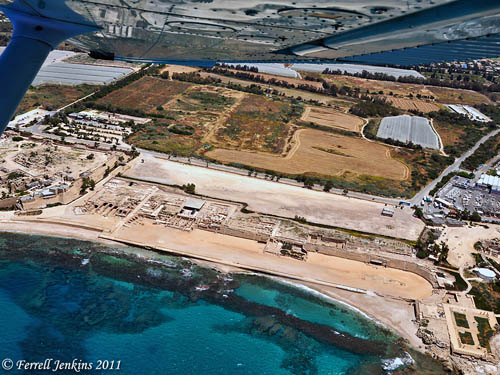
The photo below shows the amphitheater (commonly called the hippodrome) running parallel with the coastline. I note that Murphy-O’Connor refers to this as the “Herodian amphitheatre.” At the right (south) bottom of the photo you will see the upper level of what he calls the “Palace of the Procurators.” The Roman theater, which is pictured in our previous post, is to the right of this scene.

Caesarea amphitheater (hippodrome). Photo by Ferrell Jenkins.

Caesarea amphitheater (hippodrome). Photo by Ferrell Jenkins.

Along the top of the photo, under the wing of the plane, is the later amphitheater (or hippodrome) dating to the late Roman period. A line of trees provides a good outline of the structure.

Here in 306 the emperor Maximinus had Christian martyrs executed before him. Its stones were robbed out when Christianity suppressed such bloody and brutal entertainment. (Murphy-O’Connor, The Holy Land, 5th ed., 248)

The Herodian harbor is located to the left (north) of this photo.

The Nimrud ivories

Ray Moseley writes an article for Al-Arabiya about the Nimrud Ivories in the British Museum. The exquisite ivories date to the time of the Assyrian empire.

The British Museum in London has recently saved for the nation a horde of the so-called Nimrud ivories—1,000 intact pieces, 5,000 fragments—after a public fund-raising campaign that netted £1.17 million. That was about a third of the value of the ivories, and another third of the collection was donated by the British Institute for the Study of Iraq. The remaining third is expected to be returned to Iraq.…

The first group of ivories, dating from the 9th and 8th centuries BC, was excavated by the archaeologist Austin Henry Layard in 1845 at Nimrud, just south of Mosul on the Tigris River. They came from the ruins of the palace of Shalmaneser III, who ruled from 859 to 824 B.C., and more came to light a few years later.

The complete article may be read here. Some readers will enjoy the connection with archaeologist Max Mallowan and his wife, crime-novelist Agatha Christie, who used a knitting needle and cold cream to clean some of the ivories.

“Oh what a beautiful spot it was,” the novelist wrote. “The Tigris just a mile away, and on the great mound of the Acropolis, big stone Assyrian heads poked out of the soil. In one place there was the enormous wing of a great genie.”

The earliest ivories belong to the reign of Ashurnasirpal, but the largest number came from Fort Shalmaneser, a palace/fort built by Shalmaneser III (858-824 B.C.). He is the Assyrian king who brags about defeating “Ahab the Israelite” at the battle of Qarqar in 853 B.C. (Monolith from Kurkh), and of taking tribute from the Israelite king Jehu (Black Obelisk). The writers of the Bible had no reason to include either of these facts in their writings.

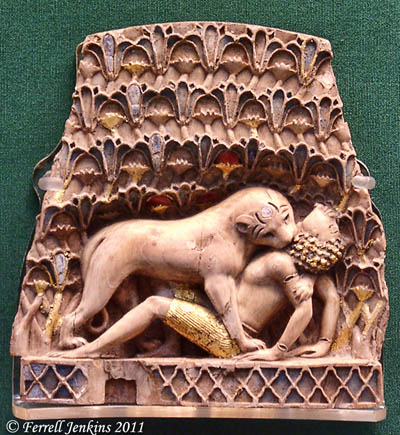
Our photo shows a relief in ivory of a lioness devouring a man with negroid features (a Nubian boy) in a thicket of stylized lotus and papyrus plants. This piece belongs to the Nimrud ivories displayed in the British Museum.

Assyrian Nimrud Ivory in British Museum. Photo by Ferrell Jenkins.

Assyrian Nimrud Ivory in British Museum. Photo by Ferrell Jenkins.

Moseley’s says the British Museum “recently put some of it’s collection on permanent display and intends to make other available for traveling exhibitions.”

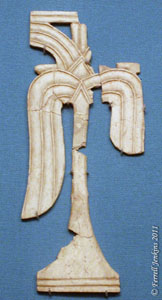
Samaria Ivory. British Museum. Photo: Ferrell Jenkins.

Samaria Ivory. British Museum. Photo: Ferrell Jenkins.

Bible writers spoke of Ahab’s ivory house at Samaria (1 Kings 22:39; Amos 3:15; 6:3-4). Both the British Museum and the Israel Museum display some of the ivories excavated at Samaria that follow the same general motif as those from Nimrud. The Israelites may have sent workers to learn from the Assyrians, Phoenicians, and Egyptians, or they may have hired foreign craftsmen to do their work, or imported the ivory pieces. The piece in the photo to the right is exhibited in the British Museum.

HT: Joseph Lauer

The theater at Caesarea Maritima

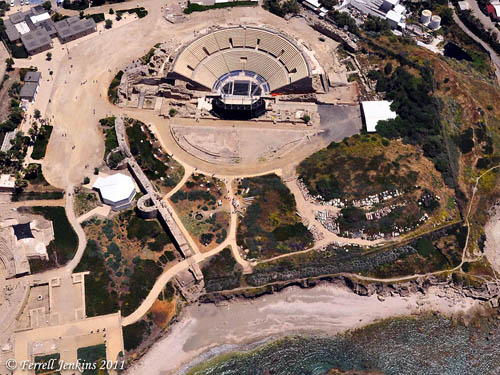
The theater at Caesarea Maritima was built originally by Herod the Great but was added to and modified in later centuries. The seating capacity in its final stage was about 4,000.

The first aerial photo shows the position of the theater (facing west) in relation to the Mediterranean Sea.

The theater at Caesarea Maritima on the Mediterranean. Photo by Ferrell Jenkins.

The theater at Caesarea Maritima on the Mediterranean. Photo by Ferrell Jenkins.

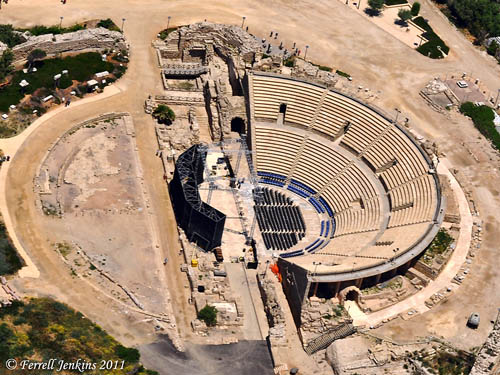
The next photo is an aerial closeup. Most of the seating has been restored since the excavation in the early 1960s.

The theater at Caesarea Maritima. View is South (bottom) to North (top). Photo by Ferrell Jenkins.

View of the theater South (bottom) to North (top). Photo by Ferrell Jenkins.

When we look at the theater from above it appears as a small piece of a model. Musical concerts are held in the restored theater.

King Herod Agrippa I (A.D. 37-44), the grandson of Herod the Great, visited Caesarea. In a dispute with the people of Tyre and Sidon, he put on his royal apparel and addressed them.

On an appointed day Herod, having put on his royal apparel, took his seat on the rostrum and began delivering an address to them. The people kept crying out, “The voice of a god and not of a man!”  And immediately an angel of the Lord struck him because he did not give God the glory, and he was eaten by worms and died. (Acts 12:21-23 NAU)

Josephus informs us that this speech took place in the theater (Ant. 19.344). The NET Bible study notes are helpful in explaining the differences between Luke’s account and that of Josephus. (Scroll down to Acts 12:23 for these notes.)

Josephus, Ant. 19.8.2 (19.343-352), states that Herod Agrippa I died at Caesarea in A.D. 44. The account by Josephus, while not identical to Luke’s account, is similar in many respects: On the second day of a festival, Herod Agrippa appeared in the theater with a robe made of silver. When it sparkled in the sun, the people cried out flatteries and declared him to be a god. The king, carried away by the flattery, saw an owl (an omen of death) sitting on a nearby rope, and immediately was struck with severe stomach pains. He was carried off to his house and died five days later. The two accounts can be reconciled without difficulty, since while Luke states that Herod was immediately struck down by an angel, his death could have come several days later. The mention of worms with death adds a humiliating note to the scene. The formerly powerful ruler had been thoroughly reduced to nothing (cf. Jdt 16:17 ; 2 Macc 9:9; cf. also Josephus, Ant. 17.6.5 [17.168–170], which details the sickness which led to Herod the Great’s death).

We have included two larger images suitable for use in teaching. Just click on the image.

Protecting Israel’s coastline

Last December we reported on damage to Israel’s Mediterranean coastline here (Ashkelon) and here (Caesarea). Now we learn, in an article by Karin Kloosterman, that Israel is spending lots of money to protect the eroding coastline.

A new government initiative worth $135 million will turn about 10 miles of stretches of the Israeli coast into a series of reinforcements and public parks to be enjoyed by locals and tourists. Some of the parks will run through archeological sites of interest.

Kloosterman’s article features the work of geological archaeologist Dr. Beverly Goodman, University of Haifa. Goodman explains the importance of the coastline.

“What we are looking at in Caesarea, on the coastal cliffs, is that we have areas where the coastline has changed so much – and we actually have antiquities that are being eroded into the sea.”

The article says,

Goodman had just finished recording details about the seafloor and archeological remains. After the storm, she returned to her underwater lab to find that some 80 percent of what she’d surveyed had been destroyed or washed away.

You may find a few humorous things in Kloostermann article.

Historically, Israel’s coastal area is important not only for today’s population. According to the Christian Gospels, the Apostle Peter was imprisoned in Caesarea after being arrested in Jerusalem, and an inscription bearing the Christian scriptural name Pontius Pilate was found here.

Our readers will know that it was Peter who first preached the gospel at Caesarea (Acts 10-11), but that it was Paul who was imprisoned at Caesarea (Acts 23-26).

Reporters do have deadlines! Otherwise, the article is fascinating and may be read here.

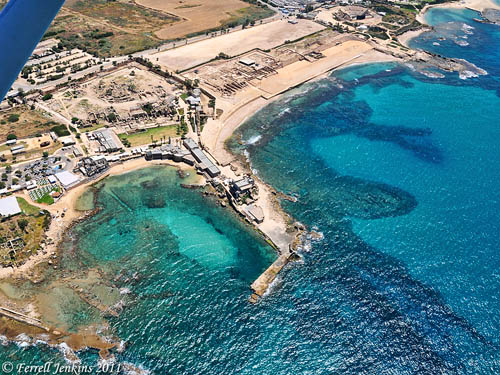
Our aerial photo, made May 11, shows the main part of Caesarea. The Herodian harbor is on the left. The hippodrome is in the upper center of the photo, and the Roman theater is to the extreme upper right.

Aerial view of Caesarea Maritima. Photo by Ferrell Jenkins.

Aerial view of Caesarea Maritima. Photo by Ferrell Jenkins.

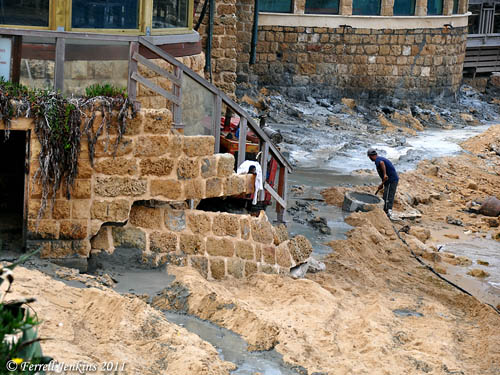
This photo, made April 28, shows some of the damage done to one of the old buildings at the ancient harbor.

Caesarea storm damage from December 2010. Photo by Ferrell Jenkins.

Caesarea storm damage from December 2010. Photo by Ferrell Jenkins.

HT: Joseph Lauer