Category Archives: Israel

Acts 10 — Photo Illustrations

Joppa (Yafo, Jaffa) is about 35 miles northwest of Jerusalem on the coast of the Mediterranean Sea. Yafo is on the south side of Tel Aviv.

Joppa has a history dating back to the 15th century B.C. when it is mentioned in the town lists of Pharaoh Thutmose III.

In this post I will limit my comments to some of the significant events of the Book of Acts related to Joppa.

  • Tabitha (Dorcas) lived in Joppa. When she died the disciples sent for Peter who was a Lydda. He came to Joppa and raised Dorcas (Acts 9:36-42). (Acts 10:6).
  • Peter stayed many days in Joppa with Simon the tanner (Acts 9:43). His house was by the sea (Acts 10:6). A house near the port is shown as the house of Simon, but there is no way to know this with certainty.
  • Peter received the housetop vision and learned that he was to go to Caesarea to preach the gospel to the Gentiles at the house of the Roman centurion Cornelius (Acts 10:23).

On one of the narrow streets of Joppa is a fairly modern house identified as the House of Simon the Tanner. Directly behind the house stands the lighthouse standing watch over the harbor. We take claims like this one with a grain of salt. But I often tell members of my tour groups, “It may not have been here, but it was not far from here.”
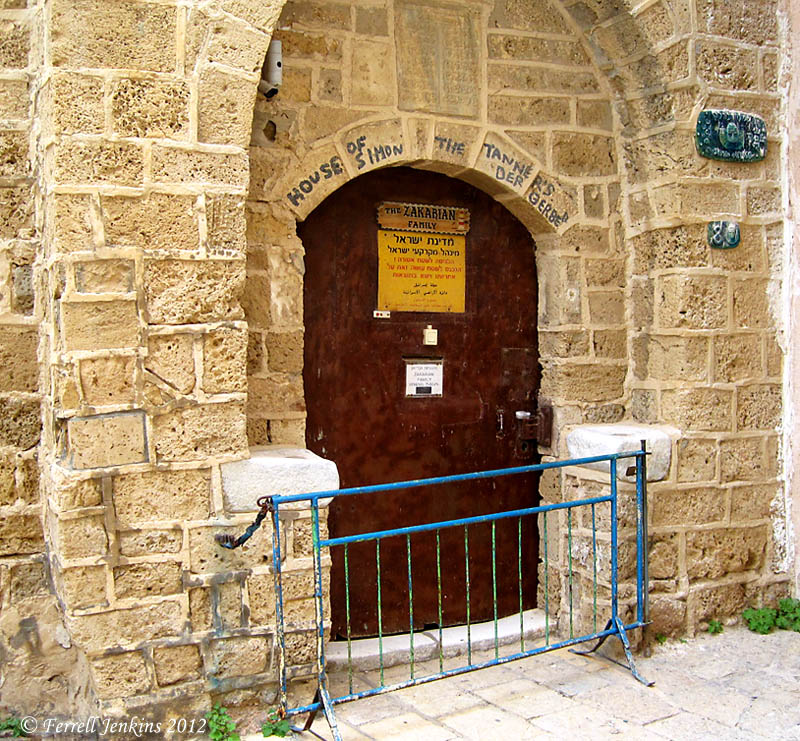
The traditional house of Simon the Tanner at Joppa. Photo by Ferrell Jenkins.

The traditional house of Simon the Tanner at Joppa. Photo by Ferrell Jenkins.

At least some houses during Bible times were build with a flat roof which could serve some practical uses. In the case of Peter it provided a good place to pray and to fall into a trance.
Acts 9 — Photo Illustrations

Damascus is first mentioned in the Bible at the time of Abraham (Gen. 14:15; 15:2-3). As the capital of Syria, the city had much contact with the kingdoms of Israel and Judah.

All of the New Testament references to Damascus are related to the conversion of Saul of Tarsus (Acts 9; 22; 26; 2 Cor. 11:32; Gal. 1:17). Saul had participated in the stoning of Stephen and was active in the persecution of the disciples of Christ in Jerusalem. He asked the high priest for authority to go to Damascus and seek out men and women who belonged to the Way and bring them bound to Jerusalem.

The Lord appeared to Saul as he approached Damascus and told him to go into the city where he would be told what he must do (Acts 9:6). Saul stayed at a house on the street called Straight. Ananias came to him and told him to arise and be baptized so that his sins might be washed away (Acts 22:16; 9:18). Saul stayed with the disciples for several days and immediately began to proclaim Jesus in the synagogues as the Son of God (9:20).

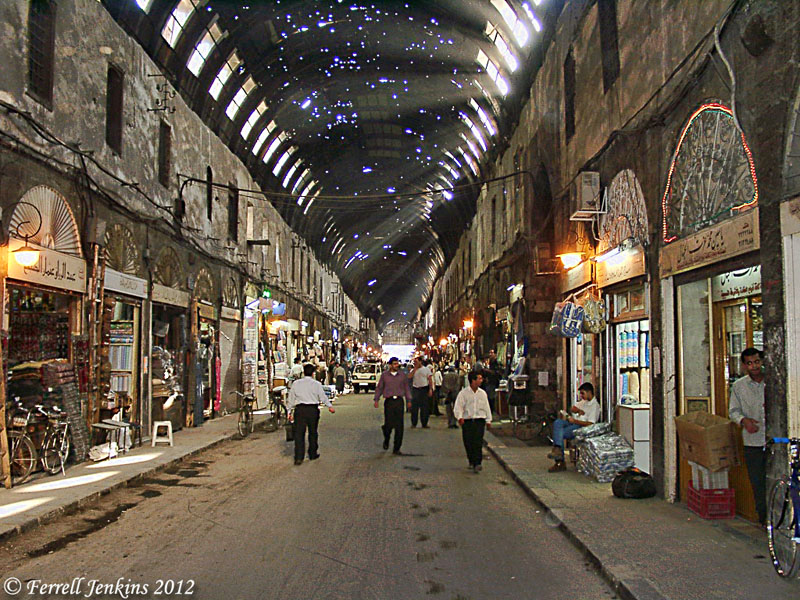
The photo below is one I made on Straight Street in 2002. This is not the main shopping street in the old city, but is historically significant.

The street called Straight in Damascus (the Via Recta). Photo by Ferrell Jenkins.

The street called Straight in Damascus (the Via Recta). Photo by Ferrell Jenkins.

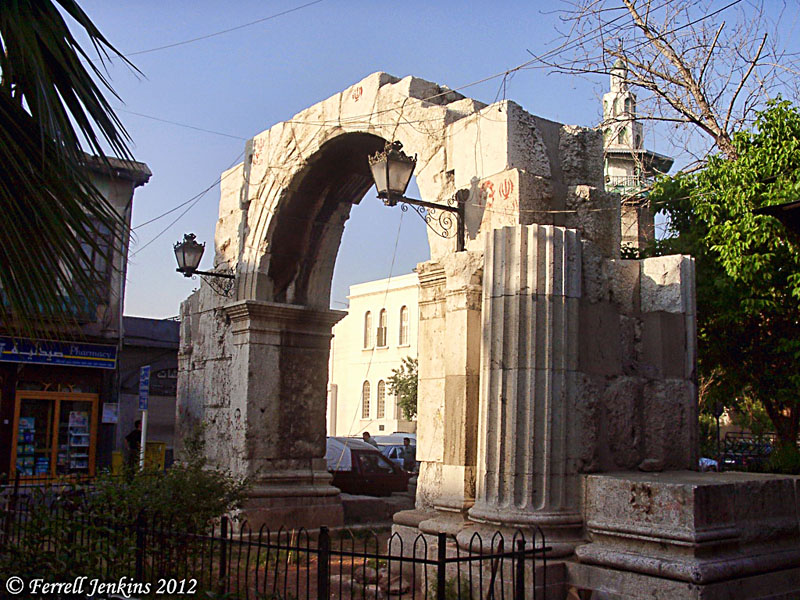
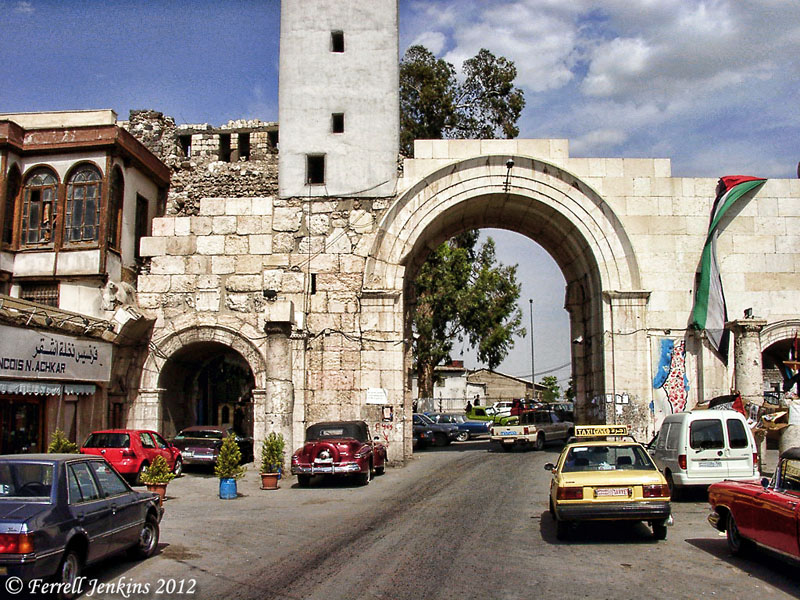
The street called Straight (Acts 9:11), the ancient Via Recta of the Roman city, now lies about 20 feet below the present street which runs the length of the old city, east to west. At the east end of the street a Roman gate has been elevated to the present level and partially restored.

Roman arch at the east end of Straight Street. Photo by Ferrell Jenkins.

Roman arch at the east end of Straight Street. Some of the stone work on the left of the central arch is original. The gate is now called Bab Sharki (Eastern Gate). Photo by Ferrell Jenkins.

A small monumental arch, pictured below, can be seen near the middle of the Via Recta.

Roman Gate on Straight Street in Damascus. Photo by Ferrell Jenkins.

Roman Gate on Straight Street in Damascus. Photo by Ferrell Jenkins.

Note: This post is repeated, with editing, from Sept. 26, 2008 where it was entitled “Saul (Paul) in Damascus.” Another post on Damascus and Paul may be read here.

Acts 8 — An Ethiopian

So he [Philip] got up and went; and there was an Ethiopian eunuch, a court official of Candace, queen of the Ethiopians, who was in charge of all her treasure; and he had come to Jerusalem to worship, (Acts 8:27 NAU)

Where was Ethiopia in the first century? One might immediately think of the modern country of Ethiopia. And, I am certain that many modern Ethiopians might think so.

Nubia Today. Wikipedia Commons.

Nubia Today. Wikipedia Commons.

By checking numerous reliable sources, it becomes obvious that the terms Ethiopia in Acts 8 describes the ancient kingdom of Meroë. It was also known as Cush and Nubia in ancient times.

The ETHIOPIA referred to here is not the modern country of the same name but the ancient kingdom of Meroë, which lay along the upper Nile S of Aswan to Khartoum in the Sudan. (The International Standard Bible Encyclopedia, Rev. Vol. 2).

The map of the region of Nubia also shows the 6 cataracts of the Nile from Aswan in Egypt to Khartoum in Sudan.

One of the older sources says that the country we now call Ethiopia took rise about the middle of the first century A.D.

Another kingdom, that of Axum in the mountain region of Abyssinia proper, seems to have taken its rise about the middle of the 1st cent. A.D., but that does not come into view in our present inquiry. (Feltoe, (Hastings) Dictionary of the Apostolic Church).

R. H. Smith, in The Anchor Yale Bible Dictionary, says,

The place name “Ethiopia” (possibly meaning “land of the people of burnt faces,” i.e., dark skin; cf. Jer 13:23) appears, as such, only once in the Bible (Acts 8:27), but in the LXX it usually translates the Heb kūš (Cush), a name which appears several dozen times in the OT.

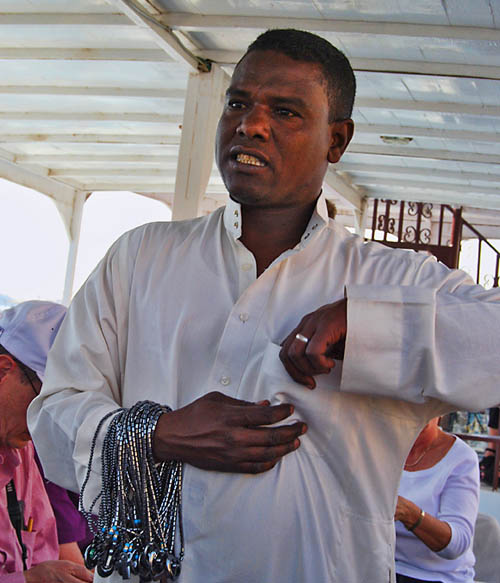
Nubian man at Philae Island near Aswan. Photo by Ferrell Jenkins.

Nubian man at Philae Island near Aswan. Photo by Ferrell Jenkins.

The building of the new Aswan dam by modern Egypt formed Lake Nasser, stretching south from Aswan for about 340 miles into northern Sudan. This made it necessary for the Nubians to be resettled around Aswan. Some of the famous monuments of Abu Simbel were covered by the lake. The Nubians are easily distinguished from the Egyptians because of their dark skin. They (and the Cushites) were distinct in the ancient Egyptian paintings and statuary.

Many of the Nubians have been employed in the tourism business. I wonder how they are surviving since the recent revolution.

Can the Ethiopian change his skin Or the leopard his spots? Then you also can do good Who are accustomed to doing evil. (Jeremiah 13:23 NAU)

The distance from Jerusalem to Ethiopia could be as much as 1500 miles. Quite a trip in a chariot.

Check the posts about Aswan here, and one about the Nubians here.

Good tips for any day

Over at the HolyLandPhotos’ Blog, Prof. Carl Rasmussen has begun a series of Travel Tips each Tuesday about places you should visit. So far all of them are in Israel.

  1. The newly opened baptism site at the Jordan River (here).
  2. Notre Dame restaurant [hotel, too] in Jerusalem. Many groups have their days full of activity with dinner provided at the hotel. The collection of artifacts and replicas, including the stone table from Magdala, make it worth a visit. I haven’t been there, but now it is on my bucket list. See here.
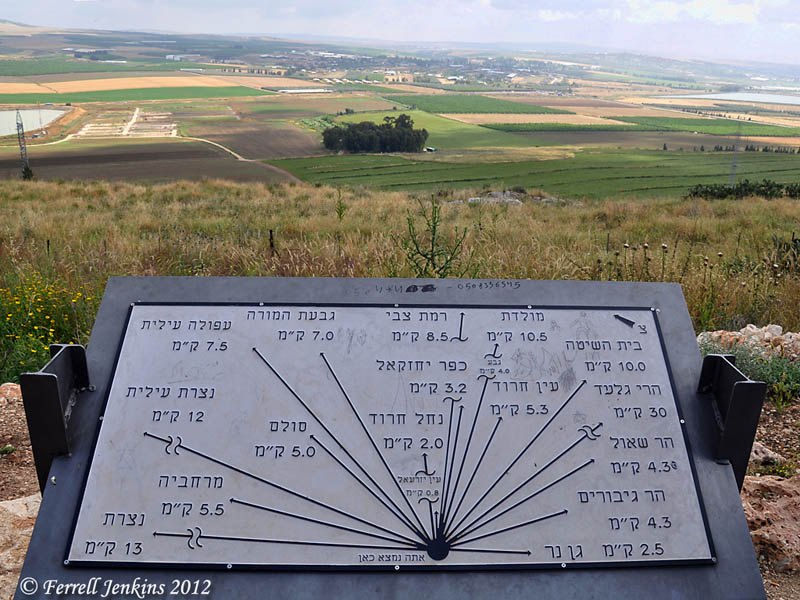
  3. Jezreel. Carl provides a list of important biblical events that transpired in the vicinity of Jezreel. See here.
The sign at the Jezreel pointing to historical sites in the area. Photo by Ferrell Jenkins.

The sign at Jezreel pointing to historical sites in the area. Photo by Ferrell Jenkins.

Free Book. Logos is offering The Epistle to the Hebrews by Brooke Foss Westcott as the free book for August. This book is from the 14-volume Classic Commentary on the Greek New Testament. Click here.

Todd Bolen’s Roundup. Todd Bolen’s Bible Places Blog is the best place on the Internet to keep up with a wide variety of archaeological work and other significant news from the Bible world. He usually has a Weekend Roundup, and sometimes a Midweek Roundup. The other days provide a more in depth look at Bible Places.

Shmuel Browns, a licensed Israel Tour Guide, is an accomplished photographer. Take a look here at his recent pictures from the desert, Mount Gerizim, Mar Saba Monastery in the wilderness of Judea, etc.

Acts 8 — Photo Illustrations

Samaria, the capital of the northern kingdom of Israel, was well known in Old Testament times. In New Testament times the term Samaria seems to be used of a region. See Luke 17:11; John 4:4-7; Acts 1:8; 8:1,9,14; 9:31; 15:3.

The city of Samaria had been rebuilt by Herod the Great and named Sebaste in honor of the Emperor Augustus. Whether Acts 8:5 has in mind Sebaste or some other city of the region of Samaria is impossible to determine with certainty.

Philip went down to the city of Samaria and proclaimed to them the Christ. (Acts 8:5 ESV)

If we follow the reading “the city of Samaria” we might properly think of Sebaste. There is strong manuscript evidence for this reading. Some manuscripts omit the definite article (the). This would allow the translation we find in the Christian Standard Bible:

Philip went down to a city in Samaria and proclaimed the Messiah to them. (Acts 8:5 CSB)

For the moment I am going to assume that Philip went to the city known as Samaria in Old Testament times, and Sebaste in New Testament times.

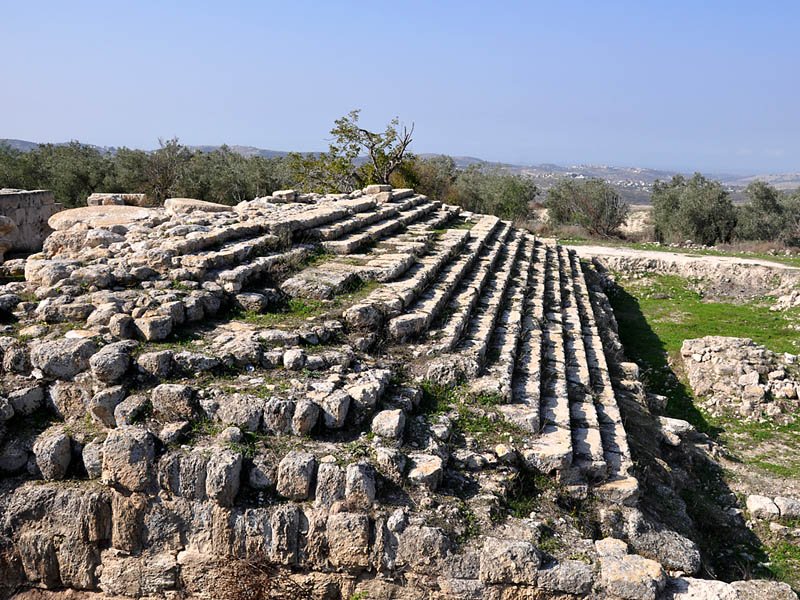
Herod the Great built a temple to Augustus with a monumental staircase over the palace area of the Israelite kingdom. The temple was destroyed, but later rebuilt along the same plan by Septimius Severus (emperor, A.D. 193-211). The monumental staircase still stands at the top of the tell.

Samaria - Site of Augustus Temple built by Herod the Great. Photo by Ferrell Jenkins.

Site of Augustus Temple built by Herod the Great at Samaria. Photo by Ferrell Jenkins.

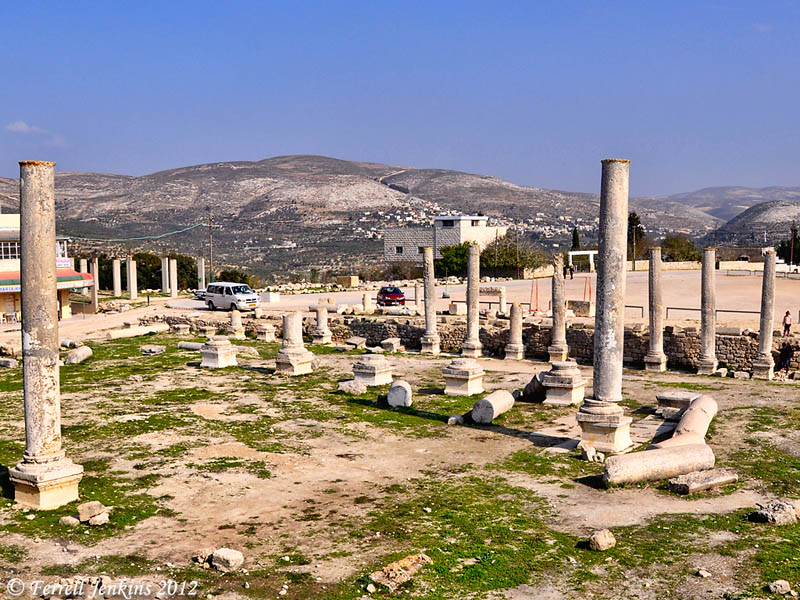
In addition to the ruins of the temple, other Roman remains at Samaria include a stadium, a forum, a small theater, and a long colonnaded street.

This photo shows a portion of the ruins of the forum and mountains surrounding Samaria.

Samaria-Sebaste Forum ruins. Photo by Ferrell Jenkins.

Samaria-Sebaste Forum ruins. Photo by Ferrell Jenkins.

Everything we have seen that was build by Herod the Great is magnificent, even in ruins. Samaria-Sebaste would have been no exception.

Makhtesh Ramon in the Wilderness of Zin

Mitzpe Ramon is situated on a cliff overlooking Makhtesh (Crater) Ramon. According to Alon, the crater is…

“about 30 km [18.64 miles] long, up to 8 km [5 miles] wide and some 400 m [1,312 ft.] deep. Its outer rim reaches about 1,000 m [3,280 ft.] above sea level. The crater floor has been hollowed down to its earliest geological strata” (Israel National Parks & Nature Reserves, 420).

Ibex enjoy the view at Mitzpe Ramon in the Wilderness of Zin. Photo by Ferrell Jenkins.

Ibex enjoy the view at Mitzpe Ramon in the Wilderness of Zin. Photo by Ferrell Jenkins.

Makhtesh Ramon is located within the region known as the wilderness (Hebrew midbar, desert) of Zin. The children of Israel lived in this region during the period we commonly call the wilderness wandering. From here the spies were sent to spy out the promised land.

So they went up and spied out the land from the wilderness of Zin to Rehob, near Lebo-hamath. (Numbers 13:21 ESV)

Acts 7 — Photo Illustrations

In the speech recorded in Acts 7, Stephen speaks of “the tabernacle of testimony in the wilderness” which God commanded Moses to make according to the pattern he had been given (7:44; cf. Exodus 25:9; Hebrews 8:5).

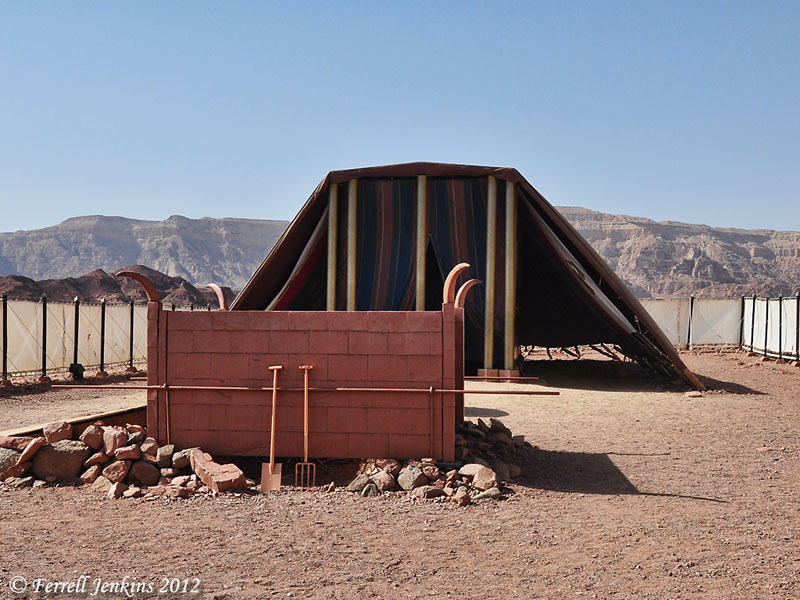
A full size model of the Israelite tabernacle has been constructed in Timna Park, 17 miles north of Eilat. The original tabernacle was built while the Israelites were at Mount Sinai (Exodus 25-40). The tabernacle was a movable tent of worship which was taken each place Israel wandered during the forty years in the wilderness.

The photo below shows the front of the Tabernacle with the altar of burnt offering in front of it.

Tabernacle in the Wilderness at Timna. Photo by Ferrell Jenkins.

Tabernacle in the Wilderness at Timna. Photo by Ferrell Jenkins.

When some men from the Synagogue of the Freedmen argued with Stephen, “they were unable to cope with the wisdom and the Spirit with which he was speaking” (Acts 6:10). They secured false witnesses to say that Stephen has spoken “blasphemous words against Moses and against God” (6:11). They also charged that he constantly speaks against “the holy place and the Law” (6:13-14).

The following brief summary by the late Princeton scholar, Charles R. Erdman, explains Stephen’s argument in a nutshell.

Stephen had been accused of blasphemy for declaring that God could be worshiped without the Temple and its rites; but, in referring to sacred history, he reminded his hearers in his first sentence that “the God of glory appeared unto … Abraham, when he was in Mesopotamia”—surely this was outside the Holy Land and the Temple. So he had revealed himself to Joseph in Egypt, and to Moses in the wilderness. Even when the Temple was finally built, Solomon, in his prayer of dedication, had reminded the people that the Most High could not be confined to the precincts of any building [1 Kings 8:27].

Step by step, the revelation of God had become more perfect, and it had reached its culmination in Christ, so Stephen seems to argue: first God revealed himself through a man, and then a family, and then a nation, and then a ceremonial, and finally in his Son. Toward the appearance of the Messiah all Jewish history had moved as to its goal; and now, through Christ, believers can worship God not only in the sacred mountain and the Temple, but wherever they turn to him “in spirit and truth.” God has a message for each of us even when surrounded by pagans and unbelievers, as Abraham in Mesopotamia; or when imprisoned and alone, as was Joseph in Egypt; or when driven into some wilderness by presumption and anger, as was Moses; or when worshiping by some ritual, as in the tabernacle; or when bowing beneath the beauties of some superb tabernacle, as did Solomon. However, all our experiences should be interpreted as designed to point us to Christ, and to lead us to find fellowship with God in him.

Gan Hashlosha National Park

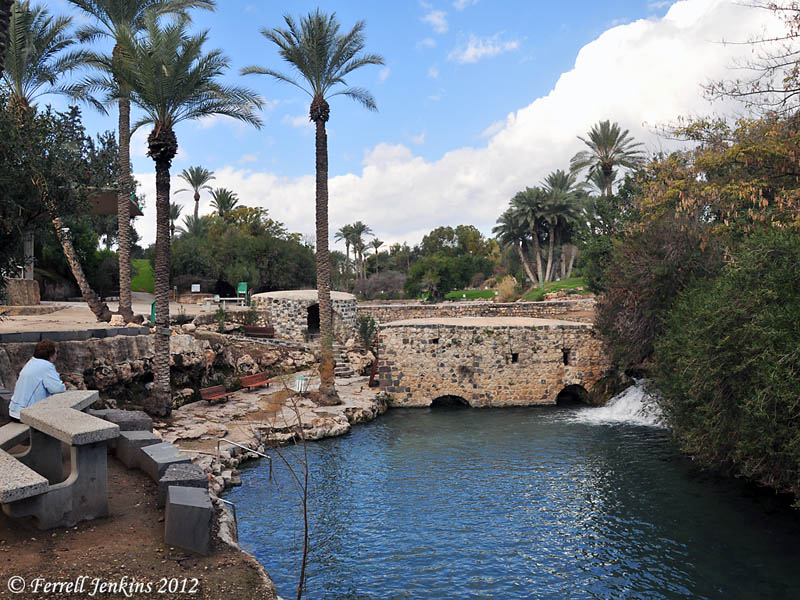
Gan Hashlosha National Park is one of the most beautiful places in Israel. It is located in the eastern end of the beautiful and green Jezreel Valley. (At this point it might be referred to as the Harrod Valley.) Gan Hashlosha means the garden or park of the three. The name commemorates three early Jewish settlers who were killed by a land mine while looking for a place to establish a kibbutz sometime between 1936 and 1939.

The Arabic name for the site is Sakhne, which means “hot springs.” I recommend a stop here on your next visit to Israel. It is a pleasant place where many tourists enjoy dipping their feet in the warm waters.

Gan Hashalosha National Park in Israel. Photo by Ferrell Jenkins.

Gan Hashalosha National Park in Israel. Photo by Ferrell Jenkins.

According to Azaria Alon’s, Israel National Parks & Nature Reserves,

The water in Nahal Amal is saline and not fit for drinking.

The place, only a few miles from the Jordan Valley, provides a fitting illustration for a text about the place where John the Baptist was baptizing after he moved from Bethany Beyond the Jordan.

John also was baptizing at Aenon near Salim, because water was plentiful there, and people were coming and being baptized
(John 3:23 ESV)

Do not misunderstand. Once while visiting here I told my group that this was a place not far from Aenon near Salim and provided a good illustration. A little later I overheard one of the ladies telling another who had missed my explanation, “This is where John baptized.” In fact, they both missed the explanation.

Perhaps we will discuss Aenon near Salim in another post.

Acts 6 — Photo Illustrations

Acts 6 records the selection of seven devout men to tend a need that has arisen among the new disciples of Christ. The function of these men seems similar to that of those later referred to as deacons (Philippians 1:1; 1 Timothy 3:8ff.).

One of these men, Stephen, had a leading role in the spread of the word and the resultant obedience to the faith by many. Even priests were becoming obedient to the faith. But there was opposition which eventually led to the stoning of Stephen.

Then some of those who belonged to the synagogue of the Freedmen (as it was called), and of the Cyrenians, and of the Alexandrians, and of those from Cilicia and Asia, rose up and disputed with Stephen.  (Acts 6:9 ESV)

These Freedmen were liberated slaves (“Former Slaves” in the CEB). The term Libertines used in the KJV and the ASV probably leaves the wrong impression to a modern reader.

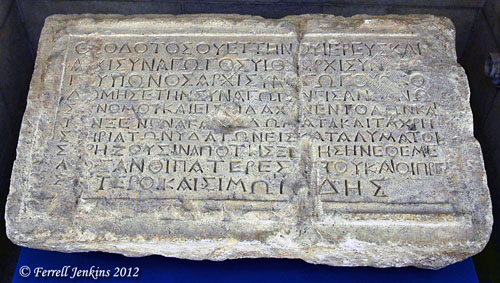
An inscription was discovered by French Archaeologist Raymond Weill in 1914 (some say 1913) in the area of the hill of Ophel or the City of David, south of the Temple Mount in Jerusalem.

The inscription is known as the Theodotus Inscription. Theodotus was the name of the priest and synagogue ruler whose name is the first word of the inscription. It is 25″ wide and 17″ high. This synagogue was for the use of Jews of the Diaspora when they visited Jerusalem. Saul of Tarus in Cilicia was probably comfortable among those who assembled there.

Herschel Shanks says this synagogue,

“is one of the most dramatic archaeological finds of the century. Like the Masada synagogue, it serves to confirm rather than to challenge our expectations regarding the existence of pre-destruction synagogues. For the Talmud tells us that before the Roman destruction of the Temple there were 394 synagogues in Jerusalem and gives us much the same picture of the synagogue as the one offered by the Jerusalem synagogue inscription. (Judaism in Stone: The Archaeology of Ancient Synagogues, 20)

Theodotos Inscription from Synagogue of Freedmen. Photo by Ferrell Jenkins.

Theodotos Inscription from Synagogue of Freedmen. Photo by Ferrell Jenkins.

This inscription was formerly displayed in the Rockefeller Museum, but is now exhibited in the Israel Museum. Click on the image for a larger one.

The translation of the Greek inscription reads as follows:

“Theodotus son of Vettenus, priest and synagogue leader, son of a synagogue leader, grandson of a synagogue leader, rebuilt this synagogue for the reading of the Law and the teaching of the commandments, and the hostelry, rooms and baths, for the lodging of those who have need from abroad. It was established by his forefathers, the elders and Simonides.” (Shanks, BAR, July/Aug 2003.)

The phrase “synagogue leader” which is used three times in the inscription is the Greek term archisunagogos. Luke uses the same term three times in his history of the early church (Acts 13:15; 18:8; 18:17). In each case he is writing about a synagogue leader of the Diaspora Jews.

Kinneret Bot

https://si0.twimg.com/profile_images/283752039/kinneret_reasonably_small.jpgWhile doing some searching for information I came across an interesting account on Twitter. Kinneret Bot is a computer that tweets “the water level of Lake Kinneret/the Sea of Galilee, Israel.” You can get to KB here.
Thursday the water level was 211.67m below sea level. For most Americans that is 694.46 feet below sea level. We reported the level of the lake November, 2010, at 701.71 ft. below sea level. This shows considerable improvement, but it is nearly three months before much rain can be expected.

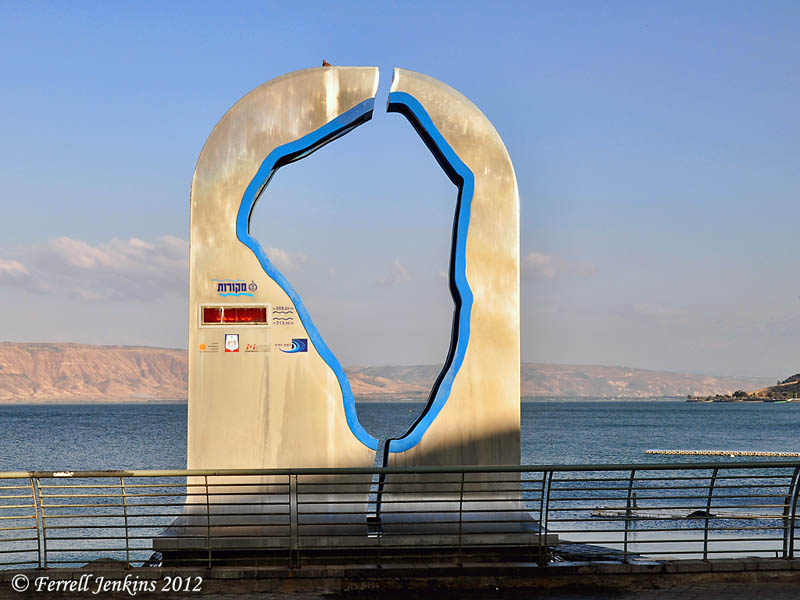
I enjoy visiting the pier at Tiberias on the Sea of Galilee. The gauge that measures the level of the Sea is a nice attraction. The view that we captured in this photos shows the southeastern shore of the Sea.

Gauge on the pier at Tiberias showing level of Sea of Galilee. Photo by Ferrell Jenkins.

Gauge on the pier at Tiberias showing level of Sea of Galilee. Photo by Ferrell Jenkins.

The Sea of Galilee is also called the Sea of Tiberias by the Gospel of John.

After these things Jesus went away to the other side of the Sea of Galilee (or Tiberias). (John 6:1 NAU)

After these things Jesus manifested Himself again to the disciples at the Sea of Tiberias, and He manifested Himself in this way. (John 21:1 NAU)

Update: Sorry that the link to Kinneret Bot was incorrect. Refresh your browser and check again. Thanks JG.