Category Archives: Israel

Greek NT Manuscripts Discovered in Albania

Daniel B. Wallace reports on the discovery of what is being called a “treasure trove” of Greek New Testament manuscripts. Wallace heads up the Center for the Study of New Testament Manuscripts (www.csntm.org). Last summer a team went to the National Archive in Tirana, Albania, to photograph some manuscripts.

According to Wallace, there are now 5752 New Testament manuscripts known and catalogued. These range from the small John Rylands fragment of the Gospel of John to complete manuscripts of the New Testament.

Seventeen formerly lost manuscripts were found to be in the Albanian archive. This was not the most exciting part of the discovery in Albania. Wallace explains,

This was not the only good news of the day, nor even the most momentous. The catalog revealed several other Greek New Testament manuscripts that had never been catalogued by western scholars. Simple arithmetic told us this: There were forty-seven Greek New Testament manuscripts listed in the National Archive catalog, while the K-Liste noted only thirty in Albania (thirteen plus the seventeen that had been presumed lost). Thus, Tirana was housing at least seventeen manuscripts unknown to western scholarship and as many as thirty-four! Since the dawn of the 21st century, an average of two or three Greek New Testament manuscripts is brought to light each year. A cache of 17 to 34 manuscripts is a remarkable find, regardless of the age and pedigree of the manuscripts.

Codex Beratinus from the 6th century was the oldest manuscript in the Archive.

The oldest manuscript in the collection is Codex Beratinus, a codex that had been dyed in purple, with silver and gold letters written on it. Containing only Matthew and Mark today, this codex, written in the sixth century, is very rare because it is a royal codex. Only a handful of purple biblical codices still exist.

You may read the complete account here.

Wallace mentions one of the manuscripts that does not contain the account of the woman taken in adultery (John 7:53-8:11). He gives us a good discussion of how textual critics deal with this question.

The Parchment and Pen blog has carried a series of articles on textual criticism. To find all of these worthwhile articles scroll down and look for Dan Wallace Contra Mundane in the left column. Click here and look for these good articles.

Back to travel. The whole issue of determining the original text of the New Testament comes down to some practical issues. A visit to Israel and Jordan might include the following places:

  • Bethany beyond the Jordan (John 1:28). Or should it be Bethabara?
  • The Pool of Betheda (John 5:2). Or should it be Bethzatha, Bethsaida, or Belzetha? And should that verse (4) about the stirring of the water even be in the text?
  • The country of the Gadarenes (Matthew 8:28). Or should it be Gergesenes or Gerasenes?

A news release about the Albanian manuscript discovery may be read here. A PDF copy is available here.

Added Note: Video report. WFAA, Dallas, aired a brief report about Dr. Wallace and the Albanian discovery. I could not get it to work in Firefox, but it is o.k. in Explorer. Click here. I wish TV and newspaper reporters could think of something better than “a modern Indiana Jones!”
Senator McCain visits the Western Wall

USA Today reports that Senator John McCain visited the Western Wall during his visit in Israel. This is not uncommon for political figures. Travelers to Israel want to see the Western Wall, or as many of them call it, “The Wailing Wall.”

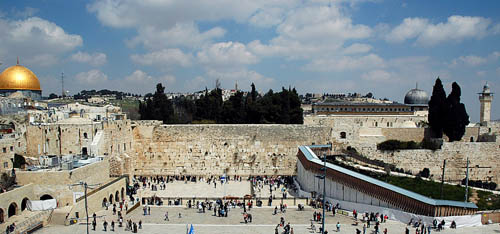
The Western Wall is the western side of the enclosure wall built around the temple mount by Herod the Great. Herod’s wall would have been seen by Jesus and His disciples on their many visits to Jerusalem. Since 1967, after Israel took control of the Old City of Jerusalem, a large portion of the Western Wall has been exposed. The portion we see in our photograph now serves as a place for prayer. It is divided into two portions, one for men, and one for women.

The temple platform is where Solomon’s temple (966-586 B.C.), the temple of Zerubbabel (built 520-516 B.C.), and Herod’s temple (building began about 19 B.C.), once stood. According to the Gospel of John, work continued on Herod’s temple for 46 years.

Then the Jewish leaders said to him, “This temple has been under construction for forty-six years, and are you going to raise it up in three days?” (John 2:20, NET Bible).

The Western Wall in Jerusalem. Photo by Ferrell Jenkins.
The temple platform, now the location of the Mosque of Omar (the Dome of the Rock with the gold dome), and the Al-Aqsa mosque with the silver dome, is now administered by a Muslim group called the Waqf. Currently it is not possible for tourists to visit the temple platform.

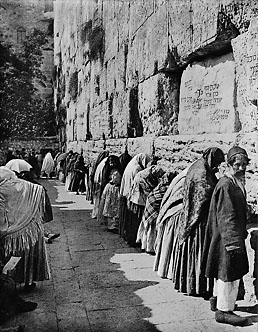
The Wailing Wall between 1900 and 1920. Matson Photograph Collection.

This old photo from the Matson Collection shows the Wailing Wall sometime between 1900 and 1920. This is the way the wall looked when I first saw it in May, 1967. At that time the area was under Jordanian control and no worshipers were present. Notice how small the area is, and how few rows of stone are visible.

The Home of Elisha

Abel Meholah (or Abel-meholah), NAS, ESV is a tell in the Jordan Valley, about 10 miles south of Beth-shean. It is mentioned only three times in the Bible. The Midianites, who were fleeing from Gideon’s army of 300, fled as far as the border of Abel Meholah (Judges 7:22).

Solomon (reigned 970-931 B.C.) set up administrative officers over Israel. Baana, the son of Ahilud, was over the fifth district that included Abel Meholah.

Baana the son of Ahilud, in Taanach, Megiddo, and all Beth-shean that is beside Zarethan below Jezreel, and from Beth-shean to Abel-meholah, as far as the other side of Jokmeam (1 Kings 4:12, ESV).

Many of us likely would find Abel Meholah of interest as the home of Elisha the prophet. When Elijah met the LORD at Horeb, the mountain of God, he was told to do three things: (1) Anoint Hazael king over Aram [Syria]; (2) Anoint Jehu king over Israel; (3) Anoint Elisha from Abel Meholah to take his place as prophet. This took place around the middle of the 9th century B.C. See 1 Kings 19:11-16.

Elijah and Elisha were two of the more important oral prophets of Israel. Elijah was among the settlers of Gilead, on the east side of the Jordan (1 Kings 17:1).

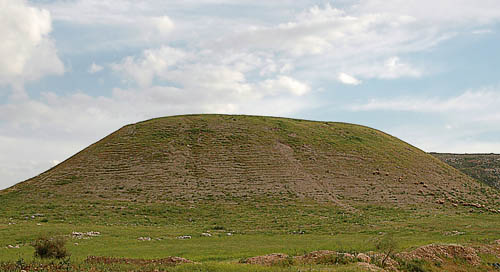
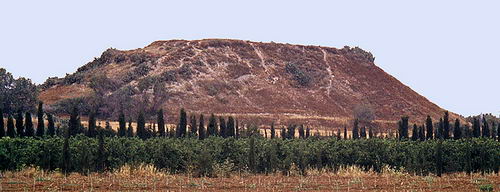
The identification of Abel Meholah is uncertain. Two sites east of the Jordan River have been suggested. The biblical statements seem to favor a site on the west side of the Jordan. Four sites have been suggested. Check the Anchor Bible Dictionary for details and a bibliography. Our photo is of Tell Abu Sus. Future excavations may help settle this question. This is a beautiful example of a tell. Who knows what might be buried within it?

Abel Meholah in the Jordan Valley. Possible home of the prophet Elisha. Photo by Ferrell Jenkins.

The popularity of inspirational religious tours

USA Today has an article about “Inspirational religious tours” about the variety of tours available to people who wish to follow the steps of this or that religious person. Here are some comments about Israel and Jordan that you might find interesting.

Kevin Wright says the volatile political situation in the Middle East can present challenges for religious-themed tour operations. “The perception of violence is always the number one challenge for tour operators and travel providers selling trips to the Holy Land,” he explains. “However, any violence that takes place in the Middle East is typically far removed from the traditional tourist sites. Hence, the biggest challenge for travel companies selling the Holy Land is overcoming the misperceptions of violence in tourist areas.”

Lately, that perception hasn’t slowed visitation to Israel and Jordan—both countries had record numbers of visitors last year. Israel hosted more than half a million Americans in 2007, an all-time high, (according to the country’s tourism commissioner), and Jordan’s Tourism Board said the country’s tourism revenues increased by more than 13% in 2007.

Is they have for millennia, the world’s holy sites continue to exert a powerful draw over the faithful and the curious. These days, with modern transportation and updated standards of travel, it’s getting easier to walk in the footsteps of the holy ones, with much less of that ancient travail.

Read the entire article here.

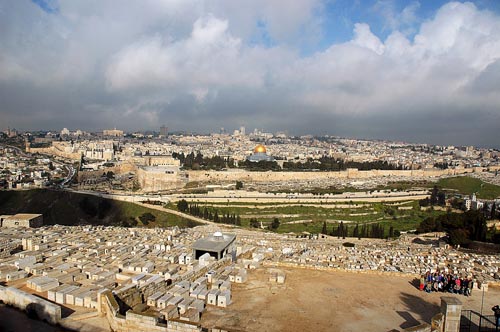
The tours I direct are study tours, but almost everyone who travels with us finds the tour inspirational. Most of those who travel with us do so in an effort to increase their understanding of the Bible. This view of Jerusalem from the Mount of Olives is inspirational to a lot of people.

Jerusalem From the Mount of Olives. Photo by Ferrell Jenkins.

A Day in Capernaum

I just ran across the third edition of A Day in Capernum by Franz Delitzsch. Yes, the Delitzsch of the famous Keil and Delitzsch 19th century commentaries on the Old Testament. The book was written in 1870, but the third edition was published in 1892. In the days before motorized vehicles, visitors had to travel by foot or horseback. This had a distinct value in allowing more time to meditate and understand the importance of the travel routes, etc. The writer visits some of the other places around the Sea of Galilee and tells how long it took to move from one place to another.

Works of this kind are of value because they reflect the scholarship and understanding of the time. You may read the work online, or download it in PDF from Google Book Search. Here is the directly link to A Day in Capernaum.

Google Book Search is a wonderful place to find many older works in their entirety. Some pages of many newer works are also availalbe.

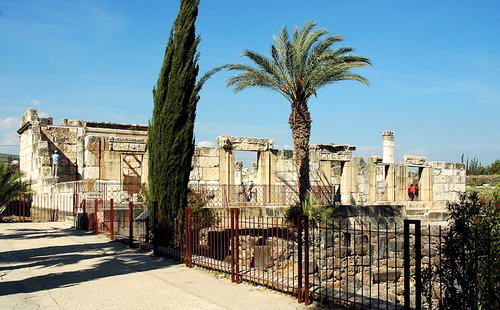
Things have changed a lot at Capernaum since Delitzsch was there. We believe the foundation of the synagogue from the time of Jesus is known. The synagogue from the late 4th or early 5th century A.D. has been partially reconstructed mainly by the late archaeologist Stanislao Loffreda. The photo shows how it looks today.

Reconstructed Capernaum synagogue from 4th or 5th century A.D. Photo by Ferrell Jenkins.

The most important thing about Capernaum is that Jesus came and settled in the city and that it was the scene of much of His ministry and miracles (Matthew 4:13; 11:23).

The Tell es-Safi/Gath Archaeological Project

Prof. Aren Maeir, director of the Tell es-Safi/Gath Archaeological Project, asked permission to post my 1969 photo of the tell which we posted here. I was honored to do so. He has given us some directional info that I overlooked. He says that it is “of the northeastern portion” of the tell. He comments on the changes that have taken place since 1969.

Not only is the foto very nice, it is very interesting, since there are quite a few changes that can be seen on the tell since then. In particular, the intense 4X4 vehicle activity has taken a toll on the site, and a current view shows various parts that have been eroded away.

Maeir’s post includes a recent photo showing the northeastern part of the tell from another angle. Take a look here.

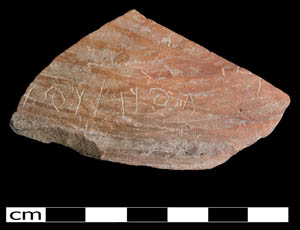
Back in 2005, I think, a pottery shard, inscribed with the Semitic letters AWLT and WLT, was found. Maeir says,

BOTH names that appear on the sherd (AWLT and WLT…) are etymologically very close to Goliath. All are quite similar to Indo-European, names such as Lydian Wylattes/Aylattes, which in the past have been etymologically compared to Goliath (way before this find).

I can’t resist posting a tiny photo here.

Goliath Inscription on Pottery from Tell es-Safi/Gath.

There is a wonderful high resolution photo of the shard online with other information. Read here.

The excavation at Tell es-Safi/Gath this year will be July 6-August 1. Click here for some information about the dig if you have interest. This site, near the valley of Elah, provides a wonderful background for the conflict between the Philistines and the Israelites, between David and Goliath.

Then a champion came out from the armies of the Philistines named Goliath, from Gath, whose height was six cubits and a span. (1 Samuel 17:4)

The Queen of Adiabene and a Rolling Stone

Queen Mother Helena of Adiabene came to Jerusalem with her son, King Izates, as a convert to Judaish in A.D. 46. Adiabene was located in northern Mesopotamia east of the Tigris River. During the famine in Judea, mentioned in Acts 11:28-30, the queen sent to Egypt for grain and to Cyprus for dried figs (Josephus, Ant. 20.51).

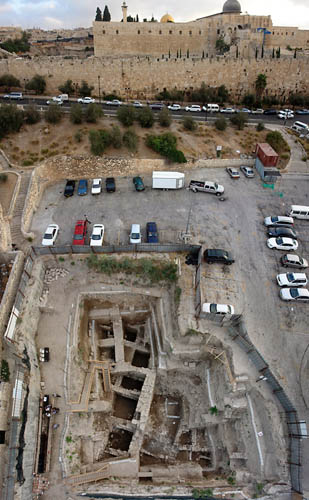
A recent excavation south of the Dung Gate, called the Givati garage area, has revealed a massive building which is being suggested as the palace of Queen Helena. So far there is no absolute proof that the Queen is to be identified with the structures, but it is a good suggestion. The reference in Josephus to the palace of the Queen in the lower city is helpful (Jewish Wars 6.355).

The press release of the Israel Antiquities Authority, December 3, 2007, says:

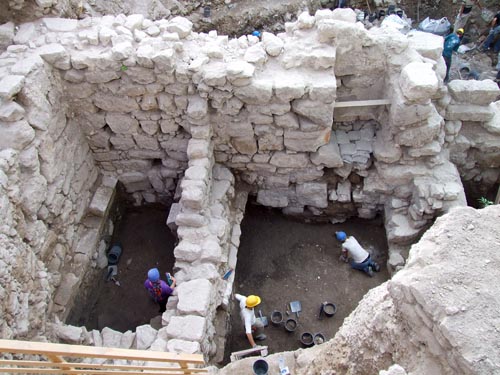
In the excavations the Israel Antiquities Authority is carrying out with the Nature and Parks Authority and the Ir David Foundation, an impressive architectural complex is being uncovered that includes massive foundations; walls, some of which are preserved to a height in excess of five meters and built of stones that weigh hundreds of kilograms; halls that are preserved to a height of at least two stories; a basement level that was covered with vaults; remains of polychrome frescoes; water installations and ritual baths (miqve’ot).

This photo shows the excavation at the bottom and the south wall of the old city of Jerusalem at the top. The City of David is directly to the right of the excavation.

Skyview of the excavation thought to be a palace belonging to Queen Adiabene. Photo supplied by the Israel Antiquities Authority.

The photo below shows details of one portion of the excavation.

Excavation thought to be palace of Queen Adiabene. Photo provided by Israel Antiquities Authority.

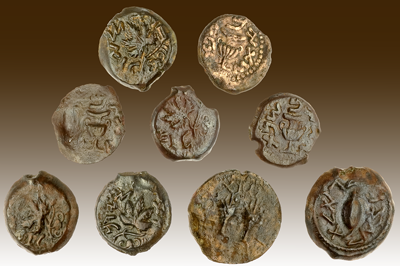
The excavation turned up stone vessels, pottery, and coins belonging to the end of the Herodian Temple [Israelis call this the Second Temple] period. This means prior to A.D. 70 when the Romans destroyed the temple. These coins bear images of, among other things, a vine leaf, a chalice, and an amphora with handles.

Coins found in the Givati excavation. Photo supplied by the Israel Antiquities Authority.

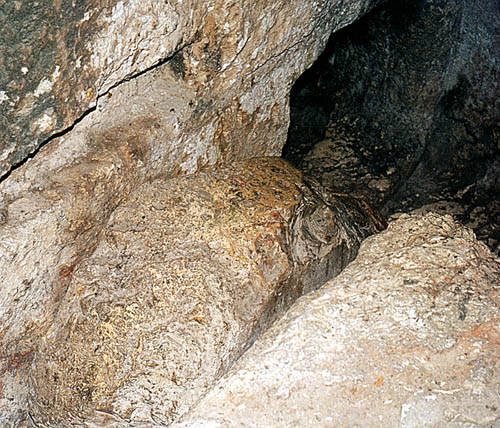
A large burial complex was dug north of the city for the burial of the Queen and her family. This is the tomb referred to in modern times as the Tomb of the Kings. It is a good place to see a rolling stone and a tomb hewn from solid rock. The property is under French control and the last three or more times I have been there it has been closed, and I was unable to rouse anyone by ringing the bell.

Tomb of the Kings, Jerusalem. The tomb of Queen Adiabene. Photo by Ferrell Jenkins.
This rolling stone is of the same type that covered the tomb of Jesus. When Joseph of Arimathea was granted permission from Pilate to bury Jesus, the historical record says,
And Joseph took the body and wrapped it in a clean linen cloth, and laid it in his own new tomb, which he had hewn out in the rock; and he rolled a large stone against the entrance of the tomb and went away. (Matthew 27:59-60)

More on the Rapaihu seal and Gath

Jim West has published a letter from Robert Deutsch and a page from a published book by Deutsch and Lemaire, Biblical Period Personal Seals in the Shlomo Moussaieff Collection, showing a seal that “probably belonged to the father of Rapayahu from Jerusalem.”

Read the entire letter and see the seal here.

Aren Maeir also notes a Tell es-Safi/Gath connection with the Rephaim here. He says,

Notice the name Rapaihu – basically it means the Rapa of Yahu. How does that connect to Gath and Safi?

Well, here it is: In the late 9th century BCE, Stratum A3, at Tell es-Safi/Gath (the level which we believe was destroyed by Hazael of Aram, a short 3-4 letter post-firing, incised inscription (as yet not fully published), was found on the body of storage jar, which has preliminarily been read as rpa’. This reading is reminiscent of the connection in the biblical narrative between the Rephaim and the Philistines in general, and the association of the enigmatic yldy hrph (roughly, “the offsprings of the rph) to several figures originating from the city of Gath (e.g., II Sam 21: 16-22).

Here is a photo I made of the tell of Gath in 1969 before the area was cluttered with power lines.

Tell Gath in 1969. Photo by Ferrell Jenkins.

The Philistine city of Gath provides us with the memorable statement of David when he mourned for Saul and Jonathan.

“Tell it not in Gath, Proclaim it not in the streets of Ashkelon, Or the daughters of the Philistines will rejoice, The daughters of the uncircumcised will exult” (2 Samuel 1:20 NASB).

Eighth Century B.C. Seal Found in the City of David

The Israel Antiquities Authority reports on the discovery of another seal from the area of the City of David. Read the full account here.

Finds recovered from the excavations in the City of David reveal an interesting development in the ancient world: whereas during the 9th century BCE letters and goods were dispatched on behalf of their senders without names, by the 8th century BCE the clerks and merchants had already begun to add their names to the seals.

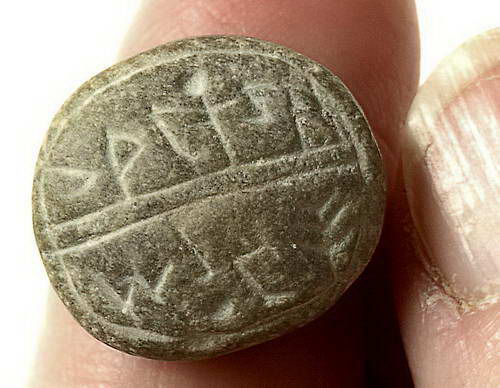
In an excavation the Israel Antiquities Authority is conducting together with the Nature and Parks Authority and the Elad Association, a complete seal bearing an ancient Hebrew inscription with the name of its owner – Raphaihu (ben) Shalem – as well as parts of other seals with writing on it were found.

Here is a nice photo of the seal, courtesy of IAA.

Rephaihu (ben) Shalem seal discovered in the City of David. Courtesy of IAA.

Seals were commonly used during Old Testament times. Jeremiah speaks of sealing and signing a deed (Jeremiah 32:10). Jezebel sealed letters with Ahab’s seal (1 Kings 21:8). Numerous seals bearing the names of biblical characters have been found over the years. It is suggested that this seal belonged to a clerk or merchant of some importance in the 8th century B.C.

Professor Ronny Reich and Eli Shukron are the excavators of the project where this find was made.

HT: BiblePlaces Blog; PaleoJudaica.

Rivers in the Desert

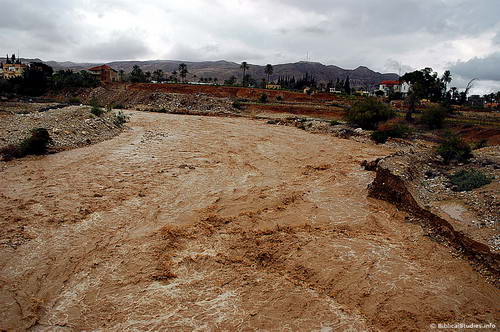
Todd Bolen, over at BiblePlaces Blog, calls attention to an article in the Jerusalem Post about an American tourist who was killed in a Flash Flood at En Gedi. He calls attention, in one of the links, to some photos I made April 2, 2006 of a flash flood in the Wilderness of Judea. Afterwards I wrote an article about it for Biblical Insights. Read Todd’s blog and then read my article below. Todd also includes a beautiful photo of Nahal David at a more tranquil time.

————————————

Rivers in the Desert is the title of Nelson Glueck’s 1959 history of the Negev. These rivers also may be seen in the Judean wilderness and in the Sinai. Thomas Levy followed up on some of Glueck’s research in a Biblical Archaeology Review article in 1990.

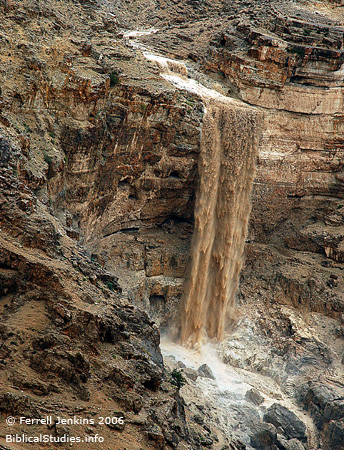
Wilderness of Judea Waterfall - April 2, 2006. Photo by Ferrell Jenkins.

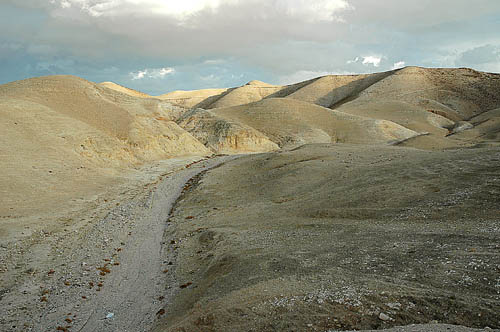
If one travels in the desert during the summer months he will see a dry, desolate bad land with only an isolated tamarisk tree or shrub where the last water of the winter rain flowed. In the winter it can be different. Israel has two dominant seasons: winter and summer. The summer is dry and the winter is wet. The early rains begin about mid-October and continue till the late rains of early April. See Deuteronomy 11:14 and Joel 2:23.

he wilderness of Judea receives very little rain, but the area is affected by the rains that fall in the central mountain range (Jerusalem and the Mount of Olives; Bethlehem; Hebron). We sometimes describe the road that runs along that range as the water parting route. The rain that falls must seek its lowest level. From an elevation of about 2500 feet above sea level the water flows east through the wadis to an elevation of more than 1300 feet below sea level at the Dead Sea.

Levy reminds us that “Nahal, incidentally, is Hebrew for a dry river bed or valley that flows at most a few times a year. In Arabic, the word is wadi. The two words are used interchangeably in Israel today.” The wadi is similar to the arroyo of the American southwest.

Wilderness of Judea Waterfall - April 2, 2006. Photo by Ferrell Jenkins.

Several members of my group told me of being awakened during the morning of April 2 by the severe storms in Jerusalem. At breakfast I explained to the group that this would be no problem for our planned sightseeing; we would just go to the Dead Sea and Masada. Eli, our guide, told the group that when we came out of the new tunnel that now cuts through the mountain between Mount Scopus and the Mount of Olives, it would probably be dry. In fact it was still raining on us almost all the way to the Jordan Valley.

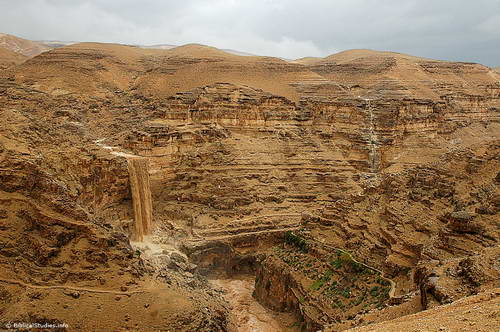
Our driver decided to pull off the highway onto the old road that overlooks the Wadi Kelt (Qilt) on the way down to Jericho. On the south side of the wadi there is an overlook allowing a view of the Monastery of Saint George of Koziba. There we saw one of the most fascinating sights that can be imagined. It rained an astounding 4.41 inches in Jerusalem. This is about three times what the city normally gets for the entire month of April.

In this normal desert land there was a tremendous waterfall pouring down the side of the cliff into the wadi. Our guide said, and another experienced guide is reported to have told his group, that he had never seen it like this. That evening Todd Bolen and his wife were my guests for dinner at the hotel. Todd has lived and taught in Israel for the past ten years. He has provided us with excellent photos in his Pictorial Archive of Bible Lands (see bibleplaces.com). He was excited about the photos I had taken that day and included three of them on his blog. He was headed for Galilee the next day. He reported seeing hail at En Gev on the Sea of Galilee. The Jerusalem Post ran a photo of the flooded road at the Megiddo junction, and reported that five people had died as a result of the heavy rains.

Not only could we not get to Masada that day, but we could not go to Qumran on the shores of the Dead Sea. A couple of days later when we visited these sites we saw the damage to the road in multiple places where the wadis descended to the Dead Sea. Debris could be seen in the Dead Sea.

Wadi Qelt (Kelt) in the Wilderness of Judea. Photo by Ferrell Jenkins.

In forty years of travel in the Bible Lands, this was one of my most exciting days for photography. I am delighted to share it with you.

The photo below is of a typical dry wadi in the Wilderness of Judea.

A dry wadi in the Wilderness of Judea. Photo by Ferrell Jenkins.