Category Archives: Israel

Traveling south

Monday we left Jerusalem and drove to Beersheba. I was able to get some great photos of agricultural practices in the hill country of Judea. The Negev (southland in some English versions) begins at Beersheba. It is an area plagued by lack of water, always dependent on the amount of rain it receives in the winter months. (I am speaking primarily of biblical times, but even with irrigation the area is still fairly barren.). The account of Hagar and Ishmael is illustrative of the conditions in the area (Genesis 21:8-21)

We stopped at Tel Be’er Sheva. The Genesis account says,

Abraham planted a tamarisk tree in Beersheba and called there on the name of the LORD, the Everlasting God. (Genesis 21:33).

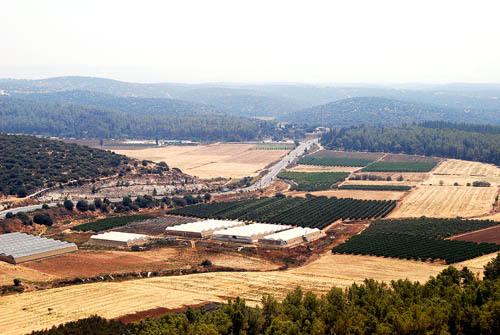
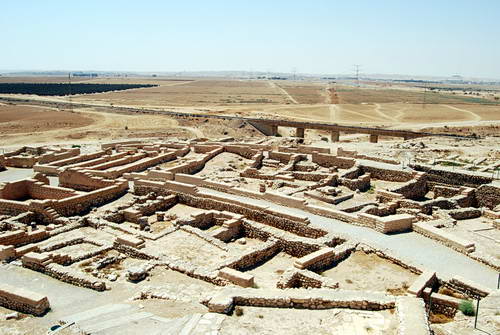
There is a nice observation tower on the mound that allows one to get a view of the complete excavated area. The photo also shows the terrain. The highway in the distance is the main highway from Beersheva to Eilat.

View of Excavation at Tel Be'er Sheva. Photo by Ferrell Jenkins.

View of Excavation at Tel Beersheva

We saw so much yesterday that it would take me hours to write a summary. We stopped at Wadi Zin and the Wilderness of Zin where the Israelites wandered. See Numbers 13:21 and 20:1. Since I am not too fond of Manna, I think a few days would be enough for me! By 8 p.m. we arrived at Eilat.

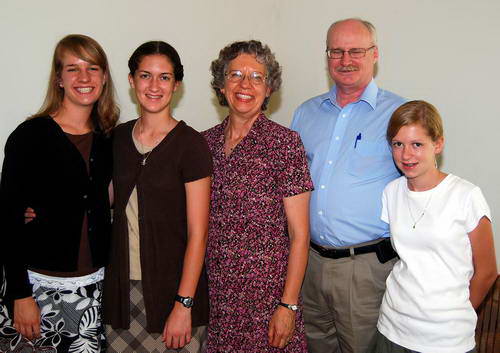
Sunday we visited with some Christian friends who live north of Tel Aviv. Ken and Vickie Boyd are here for two years in connection with Ken’s job. We met with them for worship. Vickie prepared a wonderful lunch that was far superior to the hotel buffets we had been eating. The Boyd’s were students of mine in the ancient days. We wish them well in their time in Israel.

Jessica, Savanah, Vickie, Ken, Heather

Jessica, Savanah, Vickie, Ken, Heather

In the afternoon we stopped at Aphek for a few photos. In New Testament times this was known as Antipatris. More later, perhaps. We also went to Gezer, but were to late to do a complete visit or to get good photos.

Sunday evening in Jerusalem

We had a good day, but I do not have time this evening to give a report on the activities of the day. Tomorrow we plan to leave early for a trip to Beersheba, the Negev (including the wilderness of Zin), and Eilat on the Gulf of Eilat/Aqaba.

The Herodium, Tekoah, and Ashkelon

Today we visited the Herodium with our friend Elie who is known to many readers as the guide for several of our tours. Since this is the Sabbath in Jerusalem there was almost no traffic this morning. We left and went south past Bethlehem along the new road that connects various Israeli settlements. Elie met us at a designated place in Efrata and we went together from there to the Herodium.

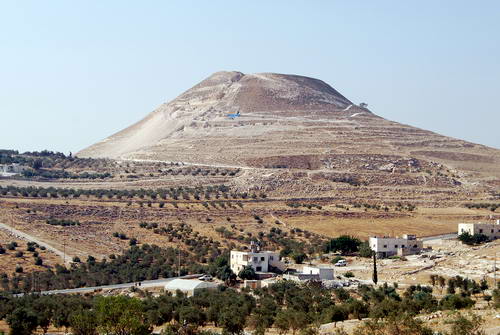
I don’t have a lot of time to give you all of the details of the Herodium, but here are a few facts to help. The artificial conical structure was built by Herod the Great at one of his fortresses. The fortress is located about 8 miles south of Jerusalem, 3 1/2 miles east of Bethlehem, on the western edge of the Wilderness of Judea. Herod was the king who tried to kill Jesus (Matthew 2). The photo below shows the north side of the Herodium. The tomb of Herod the Great was discovered about half way up the north side in 2007 by Prof. Ehud Netzer. You may see a blue tarp to the left of center. That marks the location of the tomb.

North side of the Herodium. Photo by Ferrell Jenkins.

North side of the Herodium. Photo by Ferrell Jenkins.

While in the vicinity we passed by Tekoah, the home of Amos the prophet (Amos 1:1), and the Valley of Decision in the wilderness of Tekoah (2 Chronicles 20. See especially verses 20 and 26). I also made some photos of vineyards and terraced farming.

Elie took us to a point from which one could understand the route of David from Bethlehem to the Valley of Elah. He had other oblications, so we left him and made our way to the coastal plain. Along the way we stopped for a photo of Tel Erfani. In earlier years several scholars identified it as Gath. A city, name Qiryat Gat, was built nearby and named for the ancient site. Many scholars now believe that Gath is to be identified with Tel es-Safi (see yesterday’s post).

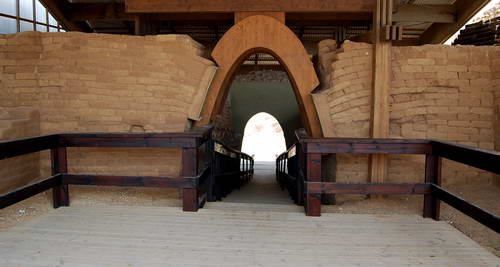
We continued to Ashkelon to see the newly reconstructed Canaanite gate. The sign at the site says,

This is the most ancient arched gate in the world. It consists of an arched corridor with arched openings on both ends. The gate was constructed in approximately 1850 BCE as part of th city’s fortification system, and is built mostly of mud brocks with some calcareous limestone. It is 15 meteres long, over 2 meters wide, and almost 4 meters high.

This photo shows the gate from the west (sea side).

The Canaanite Gate at Ashkelon. Photo by Ferrell Jenkins.

The Canaanite Gate at Ashkelon. Photo by Ferrell Jenkins.

According to 1 Samuel 6:17 there were five important Philistine cities: Ashdod, Gaza, Ashkelon, Gath, and Ekron. We were only a few miles north of Gaza. We tried diligently to locate Tel Ashdod, but were unable to do so.

The valley of Elah and the Shephelah

Today we went back to the Valley of Elah and went to the top of Tel Azekah. Azekah is one of the keys to understanding the geography of the battle between David and Goliath. The Philistines were gathered between Soccoh and Azekah. Israel was camped in the valley of Elah.

Now the Philistines gathered their armies for battle; and they were gathered at Socoh which belongs to Judah, and they camped between Socoh and Azekah, in Ephes-dammim. Saul and the men of Israel were gathered and camped in the valley of Elah, and drew up in battle array to encounter the Philistines. The Philistines stood on the mountain on one side while Israel stood on the mountain on the other side, with the valley between them. (1 Samuel 17:1-3)

The photo below was made from atop Tel Azekah. As you to look the east toward the Shephelah and the coastal plain, you see the mountain on the east of the valley. The mountain where the Israelites stood is on the left in the photo.

The Valley of Elah from Azekah. Photo by Ferrell Jenkins.

The Valley of Elah from Azekah. Photo by Ferrell Jenkins.

After this we went on to Bet Guvrin and Maresha. Maresha was fortified by Rehoboam (2 Chronicles 11:5-10). King Asa fought and defeated a large army of Zerah of Ethiopia (Cush) (2 Chronicles 14:9-12). There is some information to suggest that Herod the Great was born here.

While in the vicinity we stopped by Tel Godet, possibly Moresheth, the home of Micah the prophet. Micah worked in the hill country while Isaiah was working in Jerusalem (8th century BC). More than a century afterward Jeremiah spoke of Micah’s prophecy concerning Jerusalem.

“Micah of Moresheth prophesied in the days of Hezekiah king of Judah, and said to all the people of Judah: ‘Thus says the LORD of hosts, “‘Zion shall be plowed as a field; Jerusalem shall become a heap of ruins, and the mountain of the house a wooded height.’ (Jeremiah 26:18.)

Our next stop was Lachish where I participated in the excavation in 1980. Too much to tell and show in one blog. A couple of interesting personal notes. As we drove in we met a gentlemen who works for the antiquities department. He lives in Lackish and has followed the history of the dig. A little later he came by and invited us to his home for tea. We enjoyed a nice visit with Chanan and Edna (they are close to our age) and we enjoyed sharing family stories as well as info about Lachish. Thanks for the hospitality.

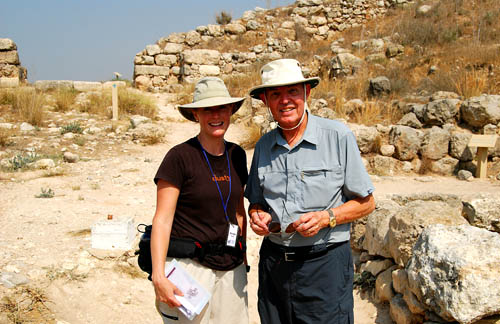
The other personally interesting things is that there was an American group visiting the site. I spoke to the leader of the group, a young lady named Danielle from California. When I told her my name she said, “I read your blog.” Well, that made my day. I said, “How did you learn of my blog?” She said, “Through Todd Bolen.” We both bragged on the quality of Todd’s resources. Here a photo of the two of us in the gate of Lachish. The room to the right is the Room of the Letters, where the Lachish letters relating to the Babylonian destruction of th city were found.

Danielle and Ferrell in the gate of Lachish.

Danielle and Ferrell in the gate of Lachish.

Danielle, send me an Email and I will sent you a hi-res photo.

Coincidentally, today Todd Bolen has a post about significant sites in the shephelah (lowlands in some English versions). Read the full post here.

Visiting the Judean Hills

We were able to visit several sites in the Judean Hills yesterday. Many of them were in the territory of the Israelite tribe of Dan.

Zorah was the birthplace of Samson. The biblical record says,

And the Spirit of the LORD began to stir him in Mahaneh-dan, between Zorah and Eshtaol.  (Judges 13:25)

Both of these towns are within an area now designated a forested park land.

When the Ark of the Covenant was returned by the Philistines on a cart pulled by milk cows, it came into the Zorek Valley near Beth Shemesh (1 Samuel 6). The ark was later taken to Kiriath-jearim before being moved to Jerusalem by David (2 Chronicles 1:4). We visited all of these sites.

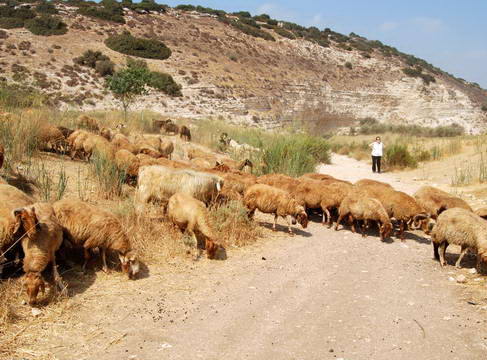
We also visited the sites around the Valley of Elah where young David met Goliath the Philistine from Gath in a decisive battle (1 Samuel 17). While we were in the process of picking up five smooth stones for our grandson, Drew, a shepherd drove a flock of sheep across the brook. You can see from the photo that Elizabeth and I were separated for a while.

Elizabeth and I were temporarily separated in the brook of Elah by a flock of sheep. Photo by Ferrell Jenkins.

Elizabeth and I were temporarily separated in the brook of Elah by a flock of sheep. Photo by Ferrell Jenkins.

Understand that the brook (nachal) of Elah has water in it only during the rainy season. We also visited Tell es-Safi, thought to be the site of Gath, one of the major Philistine cities and the home of Goliath. The excavator, Aren Maeir, has a marvelous aerial photo of the top of the tell posted at the Tell es-Safi/Gath blog. We did not have time to climb to the top, but maybe we can get back to it another day.

In Jerusalem

Elizabeth and I had on-time flights to Israel. Can’t say as much for the car rental company at the Ben Gurion airport. Anyway, we are safely in our hotel in Jerusalem. We are looking forward to a good night of rest.

Maybe by tomorrow evening we will have some new info to post.

Was John the Baptist a member of the Dead Sea Sect?

Identifying the Dead Sea Sect. We are speaking of the Jewish group responsible for preparing and hiding the scrolls that were discovered in and around Qumran on the shores of the Dead Sea beginning in 1947. The sect living here was likely the Essenes. I am aware of the numerous controversies about Qumran, but have not been impressed by the alternative views.

Was John the Baptist an Essene? It has been popular among some scholars to claim that John was an Essene. A suggestion is made that John’s parents died while he was yet a child. The Essenes were known to have cared for orphan children. So, they cared for John. Some comparisons may be drawn concerning John and the Essenes.

  1. John was in the deserts (Luke 1:80). The Essenes were in the desert.
  2. Both John and the Essenes used Isaiah 40:3 to describe themselves as the voice in the wilderness.
  3. The baptism (or washing) practiced by John and the Essenes required a change of heart.

There are significant differences between John and the Essenes.

  1. The Essenes hid themselves away from society in the wilderness. John was a very public figure.
  2. John had a much more strict diet (Luke 7:33) than did the Essenes.
  3. John preached Jesus as the Messiah. The Essenes did not recognize Jesus as Messiah, but they thought that the Teacher of Righteousness would arise from within their group.
  4. There was a strong organization among the Essenes that is missing among John’s disciples.

In the early days of my study about the Dead Sea Scrolls I found the book by F. F. Bruce, Second Thoughts on the Dead Sea Scrolls. I am pleased to inform you that you may download this book free of charge here.

Here is a photo of Cave 4 at Qumran. Many of the important scrolls were located here.

Cave 4 at Qumran. Photo by Ferrell Jenkins.

Cave 4 at Qumran. Photo by Ferrell Jenkins.

Did Zoroastrianism influence Christianity?

There are many subjects on which I would enjoy commenting, but I have determined to keep this Blog as a travel blog pertaining primarily to biblically related sites. And, I don’t have time to take care of another blog.

We had a comment on The Persian background of Iran that needs some comment. Our reader says,

And incidentally, there’s much more of Iran in the bible. The original “apple” was actually a pomegranate — which comes from Iran, for example. Mithraism, a Persian religion, was the basis for the celebtration of Christmass. The whole concept of hell and heaven and angles was introduced from Zoroastrianism into Judaism and then Christianity.

The Bible does not speak of an “apple” in the Garden of Eden. In Genesis 3:3 and 3:6 we are told that Adam and Eve had been told not to eat “from the fruit of the tree which is in the middle of the garden.” The fruit was good for food. Earlier, in Genesis 1:29 we are told that God gave man “every tree which has fruit yielding seed, it shall be food for you.” The Hebrew words are the same for fruit, tree, and food in both Genesis 1 and Genesis 2. We certainly do not know that the fruit was pomegranate.

The issue of whether Judaism and Christianity have borrowed some basic concept from Zoroastrianism is debatable. Notice the comment by Lewis and Travis in Religious Traditions of the World (Zondervan, 1991).

The relation between Zoroastrianism and the chief monotheistic religions, Judaism, Christianity, and Islam, is debated. Part of the problem is due to the fact that the collection of Zoroastrian teaching was not completed until the fourth century C.E. [A.D.], leaving in some doubt who may have influenced whom in such matters as angels, resurrection, and eschatology. (57)

If one takes the New Testament as the complete and final revelation of the will of God for man, as I do, any changes in doctrine after New Testament times must be considered as departures from the faith. The argument goes something like this:

  • The New Testament is the completed revelation of the mind of God to man (Ephesians 3:1-7; 1 Corinthians 2:6-13; Ephesians 4:5; Jude 1:3; Romans 1:16; I Corinthians 1:21, et al.). The Scripture is the inspired word of God (2 Timothy 3:16-17).
  • Jesus is God (John 1:1; Hebrews 1:8; Colossians 1:15-17). He became flesh (John 1:14). He died on the cross for the sins of mankind (1 Corinthians 1:23; 2:2, 8; 15:3-4; Hebrews 9:28; Acts 2:36; 4:10).
  • The Bible warns about going beyond this teaching (1 John 4:1; Galatians 1:6-8; 2 John 1:9-11).

It is true that Mithraism was a significant competitor of Christianity in the second century Roman Empire. It was one of the favorite mystery religions of the Roman soldiers. At Caesarea Maritima on the Mediterranean coast, in one of the substructures of a public building, evidence has been found indicating that one of the vaults served as a Mithraeum in the early 2nd century A.D.
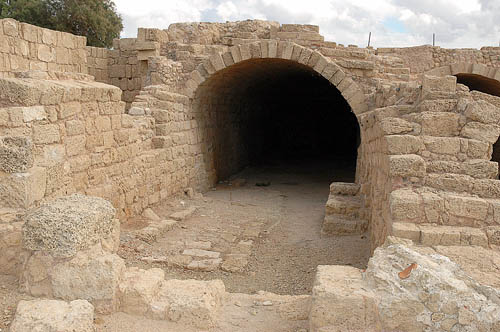
Building at Caesarea Maritima converted to a Mithraeum in the early 2nd century A.D. Photo by Ferrell Jenkins.

Building at Caesarea Maritima converted to a Mithraeum in the early 2nd century A.D. Photo by Ferrell Jenkins.

Christmas, as a religious holiday, is not known in the New Testament. In this case we must say that later Christianity borrowed aspects of it from pagan sources. See my article on The Truth About Christmas here for more details.

If you are interested in a complete study about the relation between Persia and the Bible, I suggest Edwin M. Yamauchi’s Persia and the Bible with foreword by Donald J. Wiseman) Baker, 1990.

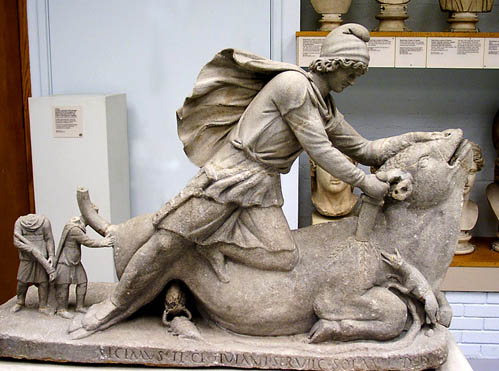
Yamauchi tells us that “the central cult image of Mithraism was the statue of the tauroctony or depiction of Mithras slaying the bull.” He says over 500 representations of this image have been found. Here is one I photographed in the Britism Museum.
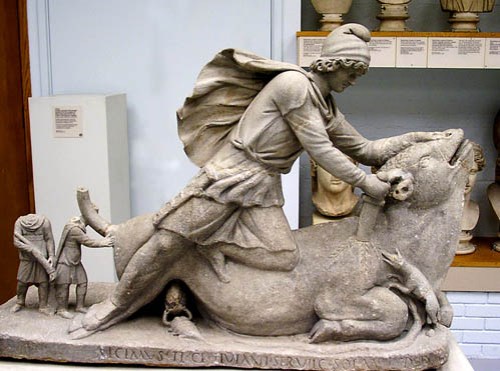
The Sun-god Mithras slaying a bull. Photo by Ferrell Jenkins in the British Museum.

The Sun-god Mithras slaying a bull. Photo by Ferrell Jenkins in the British Museum.
Summary of the blogs

Over at the Biblical Studies Info Page, under Scholarly, then Blogs, I keep a list of several blogs that I regularly check. Here is a brief summary of some current items you might find of interest.

Todd Bolen calls attention to the continuation of the Western Wall excavations here. This excavation is on the extreme western side of the Western Wall plaza.

Aren Maer gives a wrap-up of the recent excavations at Gath (Tell es-Safi) here.

Ben Witherington includes a seminar paper by one of his doctoral students in review of Barth Ehrman’s Lost Christianities here. This has to do with the formation of the canon.

Mark Copeland has posted good photographs of 299 Sermon Charts pained by Steve Hudgins here. Steve pained a few charts for me, and some of my tour banners, years back. This shows the type of visual aids that some of us used. It was before flannel boards, opaque projections, overhead projections, and PowerPoint. The biggest problem is that the audience knew when we were only half finished! I doubt any of you will want to use a chart like this now, but you can get some great ideas for sermon starters, put them in PowerPoint, and see if they will gel.

Claude Mariottini has called attention to the problem of Fake Degrees, even among ministers and professors of biblical studies, here. Every now and then I see some preacher who wouldn’t know how to write a research paper advertising himself as Dr. So-and-so. Shameful.

Seal of Zedekiah’s minister found

The Jerusalem Post is reporting here on the discovery of a seal impression belonging to Gedalyahu ben Pashur (English versions have Gedaliah the son of Pashhur). The relevant text from Jeremiah reads,

Now Shephatiah the son of Mattan, Gedaliah the son of Pashhur, Jucal the son of Shelemiah, and Pashhur the son of Malchiah heard the words that Jeremiah was saying to all the people (Jeremiah 38:1 ESV)

Here are a few excepts from the Jerusalem Post article:

The seal impression, or bulla, with the name Gedalyahu ben Pashur, who served as minister to King Zedekiah (597-586 BCE) according to the Book of Jeremiah, was found just meters away from a separate seal impression of another of Zedekia’s ministers, Yehukual ben Shelemyahu, which was uncovered three years ago, said Prof. Eilat Mazar who is leading the dig at the site.

Other Biblical-era bullae were previously found a quarter century ago at the City of David site. In 1982, the Israeli archeologist Yigal Shiloh discovered a cache of bullae in a nearby site, including one with the name of Gemaryahu ben Shaphan – mentioned in the Bible as a minister and scribe during the reign of King Jehoiakim (608-597 BCE).

Hopefully a nice photo of the seal with be forthcoming shortly.

HT: Paleojudaica

Update. For a photo of the inscription check the Trumpet.