Category Archives: Israel

Ashkelon and the Seacoast

This has been a busy month for me. It was the month of two cataract surgeries, but I won’t be able to get the needed glasses for reading until about the second week of January. With each surgery it takes about two days to get over the dilation and do any serious reading and computer work.

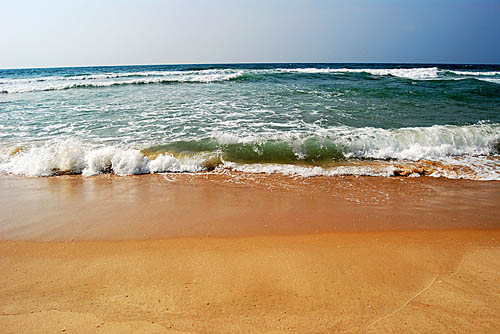
I want to share a photo of the beach and Mediterranean Sea at Ashkelon. The city is in the news this week due to the conflict between Israel and Gaza. Ashkelon is the closest Israeli town to the Gaza Strip.

The Sea at Ashkelon. Photo by Ferrell Jenkins.

The LORD spoke against the Philistine cities through the prophet Jeremiah (ch. 47). These verses caught my attention.

How long will you cry out, ‘Oh, sword of the LORD, how long will it be before you stop killing? Go back into your sheath! Stay there and rest!’ But how can it rest when I, the LORD, have given it orders? I have ordered it to attack the people of Ashkelon and the seacoast. (Jeremiah 47:6-7 NET)

Jesus lived in Nazareth

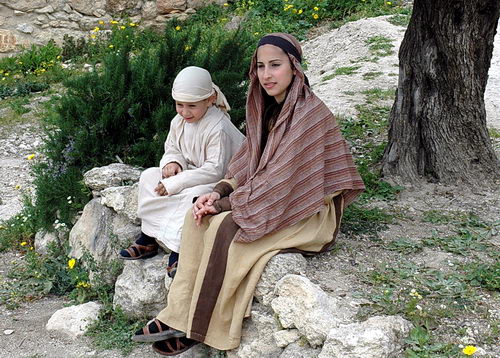
This photo of two children was made at the Nazareth Village (a nice place to visit).

Children at the Nazareth Village. Photo by Ferrell Jenkins.

Children at the Nazareth Village. Photo by Ferrell Jenkins.

All four Gospels and the book of Acts make a reference to Nazareth as the place where Jesus lived in his early years. This one from the Gospel of Luke is set at a time when Jesus was about 12 years of age (Luke 2:42), and before He was 30 (Luke 3:23).

And he went down with them and came to Nazareth and was submissive to them. And his mother treasured up all these things in her heart. And Jesus increased in wisdom and in stature and in favor with God and man. (Luke 2:51-52 ESV)

The Wise Woman of Abel-Beth-Maacah

No sooner had King David put down the rebellion of his son Abaslom when a Benjamite by the name of Sheba led a rebellion against him. The men of Israel rebelled against David and followed Sheba, but the men of Judah remained loyal to the king.

Realizing that Sheba was a greater threat than Absalom had been, David called on Abishai to take servants (warriors) and capture Sheba. Joab’s men when out from Jerusalem to capture Sheba. This pursuit took Joab’s men all the way to the north of the Israelite territory, to a town named Abel-Beth-Maacah. Some English versions use Abel Beth Maacah, or a similar variant. In modern Israel this town is almost on the border with Lebanon between Kiryat Shmona and Metulla.

Sheba traveled through all the tribes of Israel to Abel of Beth Maacah and all the Berite region. When they had assembled, they too joined him. So Joab’s men came and laid siege against him in Abel of Beth Maacah. They prepared a siege ramp outside the city which stood against its outer rampart. As all of Joab’s soldiers were trying to break through the wall so that it would collapse, a wise woman called out from the city, “Listen up! Listen up! Tell Joab, ‘Come near so that I may speak to you.” (2 Samuel 20-14-16 NET)

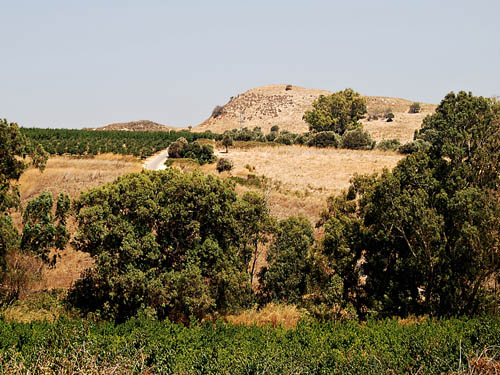
Our photo, looking east, shows the massive mound thought to be the site of Abel-Beth-Maacah. This photo was made the last day of August. The dry tell stands out distincting from the surrounding orchards. Apples are grown in this area. On a clear day one would be able to see the Beka Valley and Mount Hermon beyond the tel.

Abel-Beth-Maacah in northern Israel. Photo by Ferrell Jenkins

Abel-Beth-Maacah in northern Israel. Photo by Ferrell Jenkins

The wise woman reasons with Joab. She tells him that this town formerly was a place where people would ask for advice to end a dispute. She said,

I represent the peaceful and the faithful in Israel. You are attempting to destroy an important city in Israel. Why should you swallow up the LORD’s inheritance? (2 Samuel 20:19 NET)

Joab agreed that he would not destroy the city if she would hand over Sheba. She agreed to throw the head of Sheba over the wall. She did what she promised and the destruction was averted. Joab went back to the king in Jerusalem.

Abel-beth-Maacah is mentioned in at least two other passages.

  1. The city was conquered by Ben-hadad, king of Aram [Syria] (1 Kings 15:20).
  2. The city was captured by Tiglath-pileser, king of Assyria, in the days of Pekah of Israel.

Bethlehem and Shrines

Shrines. Throughout the lands where Bible events transpired church buildings have been erected over this or that “sacred spot.” These buildings, whether in Jerusalem, Nazareth or Bethlehem are little more than show places. Tourists stream through them at a steady rate observing the ancient ornamentation.

In Bethlehem the traditional place where Jesus was born, now covered by the Basilica of the Nativity, would hardly remind one of anything he reads in the New Testament. The visitor now finds a building which reveals “a succession of slow decay and hasty repairs” The Middle East, 1966 ed., 622). In this building he sees mosaics with gold backgrounds dating from the 12th century, and art of the middle ages. The ruins of the large buildings erected by Justinian in the 6th century simply serve to cover the 4th century building by Constantine. The student of church history never forgets that all of this was the activity of an apostate church and does not reflect New Testament Christianity.

Their value. The shrines do serve a useful purpose. We have no record to indicate that the earliest Christians built any shrines at the sites associated with the ministry of Jesus. One can imagine, however, that fathers would tell their sons and that residents would tell visitors where certain events happened. If this information was faithfully transmitted from the first to the fourth century when the first shrines were erected, then the shrine has kept alive the memory till now.

The shrines have preserved sites, which if left in the open would have eroded or been damaged or built over so that the memory would be lost.

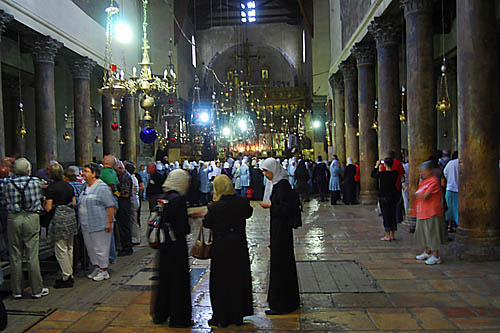
This photo shows the interior of the Greek Orthodox Church that is said to be built over the birthplace of Jesus.

Interior of the Church of the Nativity. Photo by Ferrell Jenkins.

Interior of the Church of the Nativity. Photo by Ferrell Jenkins.

Our study about Bethlehem brings to our mind the reality of the earthly ministry of Jesus. In Bethlehem we see the expression of the love of God who sent His own son to the earth.

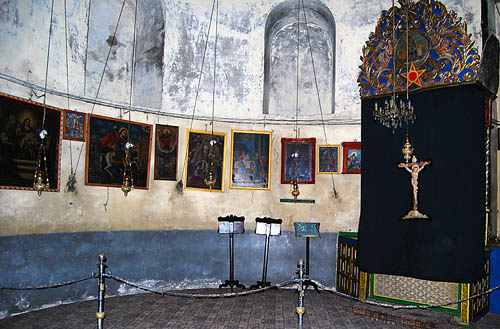
The next photo shows the Armenian chapel in the Church of the Nativity. It stands between the Greek Orthodox and Roman Catholic churches.

Armentian altar in the Church of the Nativity. Photo by Ferrell Jenkins.

Armenian altar in the Church of the Nativity. Photo by Ferrell Jenkins.

Bethlehem – the Birthplace of Jesus

Years ago we would say that Bethlehem is located in the hill country of Judea about six miles south of Jerusalem. Today, Jerusalem stretches all the way to Bethlehem. It is no longer easy to get to Bethlehem. The massive wall built by Israel (Israelis call it the “fence”) separates Bethlehem from Israel.

During the Patriarchal period the town was called Ephrath (Genesis 48:7; 35:9-27). Later, as part of the territory allotted to the tribe of Judah, it was the home of Ruth and Boaz and became the birthplace and early home of David (1 Samuel 17:12, 15). The town was sometimes called the “city of David” (Luke 2:4, 11), but is most famous as the birthplace of Jesus (Micah 5:2; Luke 2:4-15; Matthew 2:1-16).

When one visits the Bible lands today he must realize that 2,000 years of history, involving both repeated building and the destruction of what has been built, has left nothing to remind one of the original place where Jesus was born. Justin Martyr (ca. A.D. 160) said Joseph “took up his quarters in a certain cave near the village.” Origen (mid-third century) said the cave where Jesus was born was being shown and even the enemies of the faith were talking of it. Jerome, a resident of Bethlehem (A.D. 386-420), tells how the birthplace of Jesus and other places associated with the ministry of Jesus were defiled from the time of Hadrian to the reign of Constantine. The Church of the Nativity now stands at this spot.

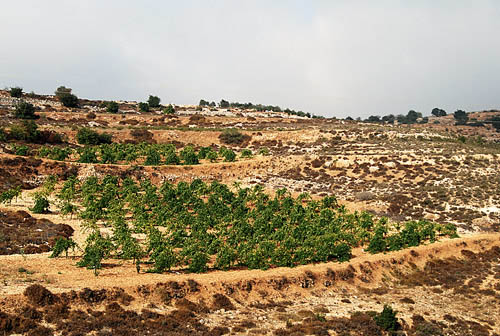
Today I have chosen to include a photograph of vineyards in the hill country immediately to the west of Bethlehem.

Terraces in the hill country of Judea near Bethlehem. Photo by F. Jenkins.

Terraces in the hill country of Judea near Bethlehem. Photo by F. Jenkins.

Gordon Franz has written a good article about Bethlehem which is posted on the ABR web site. Read it here.

Jerome in Bethlehem

Recently I was reading a manuscript written by a friend on the general subject of how we got the Bible. Of course, he mentioned Jerome and his work of translating the ancient Hebrew and Greek manuscripts into what would be called the Latin Vulgate.

The earliest English versions of the Bible were translated from the Latin Vulgate. Even though the translations of today rely mostly on the Hebrew and Greek texts, we are still indebted to the work of Jerome.

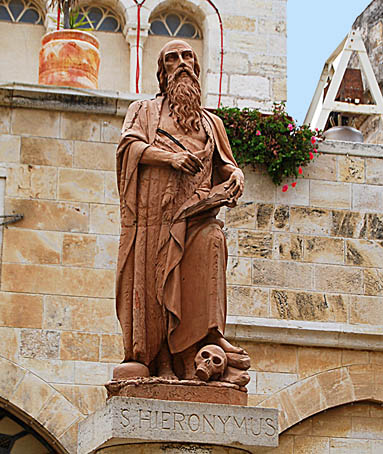
Jerome lived in Bethlehem from about 384 A.D. to 420 A.D. In the front of the Church of St. Catherine in Bethlehem there is a modern statue of Jerome showing him in the act of writing. Everyone always asks about the skull at the foot of the statue. Some have suggested that Jerome kept a skull on his desk to remind him of his mortality. That would do it for me!

Statue of Jerome in front of St. Catherine's Church. Photo by Ferrell Jenkins.

Statue of Jerome in front of the church of St. Catherine in Bethlehem. Photo by Ferrell Jenkins.

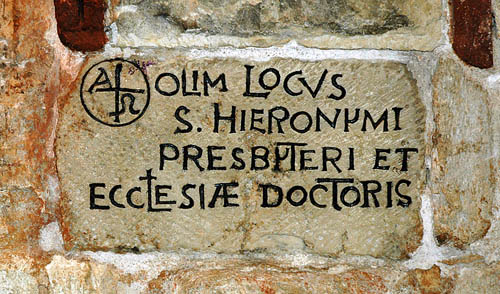
Underneath the Church of the Nativity there are a series of grottoes or caves. One of these is said to have been the place where Jerome did his work of translation and writing. This sign presently marks the place where he once lived.

The place where Jerome once lived. Photo by Ferrell Jenkins.

The place where Jerome once lived. Photo by Ferrell Jenkins.

McGarvey’s Land of the Bible

J. W. McGarvey was one of the best scholars of the 19th century Restoration Movement. He was president of the College of the Bible in Lexington, KY. One of my first books was his practical New Commentary on Acts of Apostles (1892). He had earlier (1868) written A Commentary on Acts of Apostles dealing with some of the critical issues of the book. McGarvey addressed some of the critical questions of the day in The Authorship of Deuteronomy, Jesus and Jonah, and Biblical Criticism.

McGarvey visited Palestine in 1879. His former students paid for the trip [I like that!], with the understanding that he would write a book. They would get their money back from the sale of the book. His book, Lands of the Bible, was published by J. B. Lippincott & Co., London and Philadelphia, in 1881. The title page indicates that 15,000 copies were printed. Impressive for a book on that subject.

J. W. McGarvey’s Lands of the Bible is available at the Restoration Movement pages here. For other works by McGarvey and other Restoration leaders begin with the home page here.

When I led my first group to the Bible Lands in 1967, one friend in the group had studied McGarvey’s book carefully. He took a tape measure with him. When we came to certain sites he took out the tape to take measurements. He wanted to be sure he was at the same place McGarvey visited.

Chapter IX in McGarvey’s book is titled “Argument from the Agreement of the Land and Book.” I have an outline of this material in my Introduction to Christian Evidences [OP], and use some of this material in my Daily Life in Bible Times series. One would be mistaken not to move beyond McGarvey, Thompson, Robertson, and the other early explorers. On the other hand, it would be amiss to dismiss what these scholars wrote.

What prompted all of this? Todd Bolen recently wrote a post on The Acoustics of Mounts Gerizim and Ebal in which he quotes from one of McGarvey’s letters here. I urge you read his post now. Also follow the link to the Biblical Studies and Technology Tools post showing the valley between Ebal and Gerizim using digital mapping tools.

I wanted to contribute something to this study by including here a scan of the plate from my original edition of Lands of the Bible (opposite page 288).
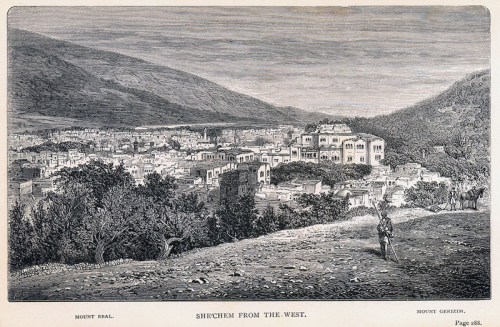
Shechem from the West. McGarvey, Land of the Bible.

Shechem from the West. McGarvey, Land of the Bible.

Todd Bolen has a great photo of Mount Ebal from Mount Gerizim. I would like to add the other side of the valley. Here is a photo showing Mount Gerizim from above Mount Ebal. It is an aerial shot made for me by the well known photographer Zev Radovan.
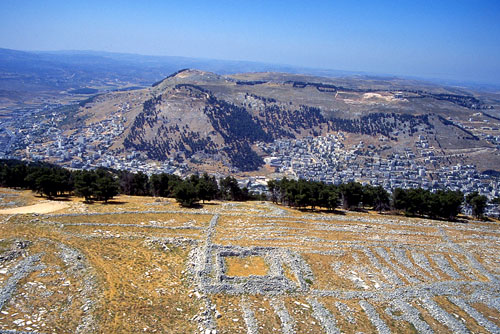
View of Mount Gerizim from above Mount Ebal.

View of Mount Gerizim from above Mount Ebal.

Maybe later we will discuss some of the important biblical events that took place in this area. For not let us note that this is where the blessings and curses of the law were read after the children of Israel entered the promised land (Deuteronomy 11:19). Here is the account of that event:

All Israel with their elders and officers and their judges were standing on both sides of the ark before the Levitical priests who carried the ark of the covenant of the LORD, the stranger as well as the native. Half of them stood in front of Mount Gerizim and half of them in front of Mount Ebal, just as Moses the servant of the LORD had given command at first to bless the people of Israel. Then afterward he read all the words of the law, the blessing and the curse, according to all that is written in the book of the law.  There was not a word of all that Moses had commanded which Joshua did not read before all the assembly of Israel with the women and the little ones and the strangers who were living among them. (Joshua 8:33-35 NASB)

Healing of the blind man at Bethsaida

There are several accounts in the Gospels (Matthew, Mark, Luke, John) of Jesus giving sight to the blind.

  • Two blind men were healed (Matthew 9:27-31).
  • A blind, mute, demon-possessed man was healed by Jesus (Matthew 12:22).
  • Two blind men near Jericho were given sight (Matthew 20:29-34). It may be that the blind beggar named Bartimaeus was one of these (Mark 10:46-52).
  • A blind man was brought to Jesus at Bethsaida and healed (Mark 8:22-25).
  • The man who was blind from birth, and was told to go wash in the pool of Siloam in Jerusalem (John 9).

My eyes have experienced several problems over the past few years. I am fortunate to have received excellent care from a team of competent professionals. Earlier this week I had my first cataract surgery. I have been surprised that most of my friends who knew about the surgery asked “which eye?” I always said, “right,” but I wonder if their response would have been different if I had said “left.”

When you had your cataract surgery I thought it was minor and routine. When I had mine it was more serious! Actually it was not too difficult. I can tell that I see better in the right eye, but I must wait a couple of weeks to see what will be done about the lens I have been wearing before I will know how effective it has been. And then there is the left eye.

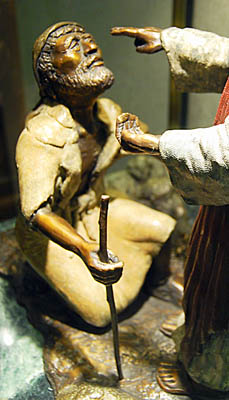
Well, all of this got me to thinking about the miracles of Jesus in the healing of the blind. One of the physicians at the clinic where I go has a nice piece of sculpture in his waiting area.

"Miracle of Sight" at Tampa Eye Clinic. Photo by Ferrell Jenkins.
Miracle of Sight.

I suspect that this sculpture is based on the account of the blind man in John 9. It could possibly be the account of the man at Bethsaida (Mark 8).

Bethsaida is now identified with et-Tell. In with Jesus through Galilee according to the fifth Gospel, the late Bargil Pixner points out that the man was healed in stages. He then says,

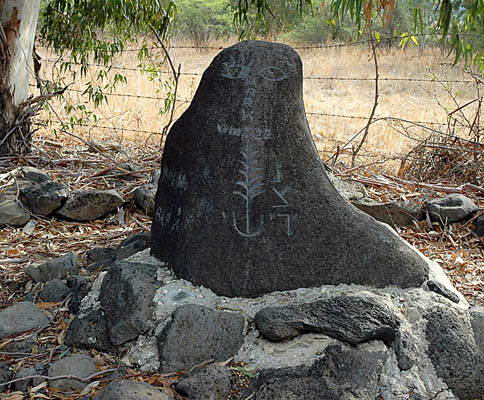
The place of the healing near Bethsaida is marked today by a memorial stone on which two eyes have been chiselled, one half-closed and the other open brightly. (page 95)

I had the opportunity to meet Pixner once at Tabgha and have him autograph a copy of his book. I asked him if he knew how long the marker had been at the site. He told me exactly and then added, “I put it there.” You might like to see that memorial stone.

Memorial stone placed at Bethsaida by Bargil Pixner. Photo by Ferrell Jenkins.

Final SBL report

Sunday afternoon I attended a session on Rome and Religion: A Cross-Disciplinary Dialogue. The featured speaker was Karl Galinsky, a distinguished professor of classics from the University of Texas. His topic was The Cult of the Roman Emperor: Uniter or Divider. Galinsky began by saying that he was pleased to see that New Testament scholars had finally discovered the “historic context of the New Testament.”

Galinsky emphasized that the Emperor cult existed. He said that we must not think of it as the prominent cult, but as being intertwined with the other cults known throughout the Roman Empire. Another speaker, Barbette Stanley Spaeth, cited evidence of the emperor cult in Corinth. I found the information significant in the study of the book of Revelation as well as the epistles of Paul.

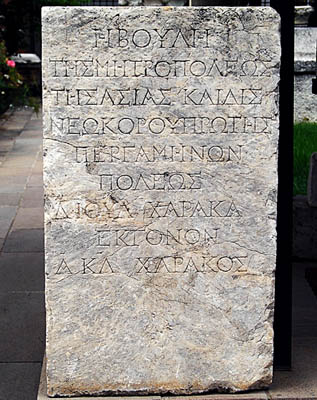
A Travel Note: The photo below shows an inscription which is now displayed in the garden of the archaeology museum in Bergama, Turkey (ancient Pergamum; Revelation 3:12-17). The inscription states that Pergamum was metropolis of Asia and twice NEOKOROS. This last word was the one commonly used when a city of Asia Minor was awarded the right to build a temple to the Emperor. This type of information must be taken into account when we consider the setting of the Book of Revelation.

Inscription at Pergamum claiming that the city was twice NEOKOROS. Photo by Ferrell Jenkins.

Inscription at Pergamum claiming that the city was twice NEOKOROS. Photo by Ferrell Jenkins.

Monday morning I attended another session on Biblical Lands and Peoples in Archaeology and Text. This one dealt with Samaria and the Samaritans. There were seven presenters. I especially enjoyed hearing Robert J. Bull of Drew University. Bull excavated a site called Tell er Ras on Mount Gerizim between 1964 and 1968 when it was under the control of the Hashemite Kingdom of Jordan. I enjoyed seeing his photos, drawings, and explanations. His work uncovered evidence of Hadrian’s temple in the early second century A.D. In more recent excavations Y. Magen claims to have discovered the Samaritan temple destroyed by John Hyrcanus. Magen was not present. Some of the speakers indicated that a final report has not been made by Magen and they did not comment on the matter.

This whole area is of great significance to students of the New Testament. The conversation between Jesus and the woman of Samarian dealt with this issue.

“Our fathers worshiped in this mountain, and you people say that in Jerusalem is the place where men ought to worship.” (John 4:20).

Learning more at the SBL meeting

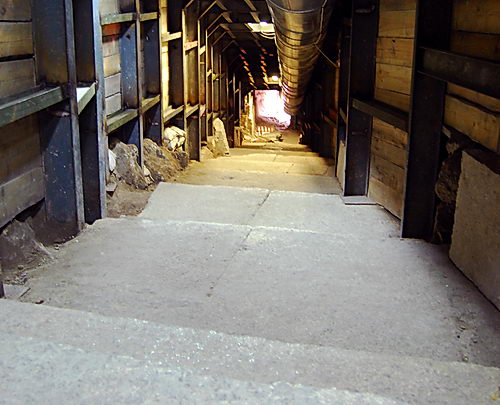
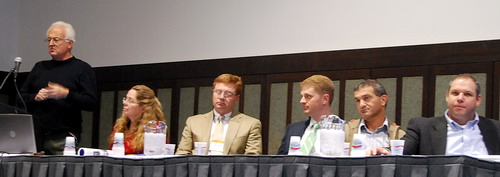
Sunday afternoon I attended two good sessions for a total of 10 papers or presentations. The first was on Biblical Lands and Peoples in Archaeology and Text. Ronny Reich of Haifa University spoke on the discovery of the road leading from the Pool of Siloam to the Temple Mount in Jerusalem. I saw a portion of this street and the tunnel underneath it earlier this year.

Street leading from Pool of Siloam up to the Temple Mount. Photo by Ferrell Jenkins.

Street leading from Pool of Siloam up to the Temple Mount. Photo by Ferrell Jenkins.

Doron Ben-Ami of the Israel Antiquities Authority spoke about the Givati Garage excavation south of Dung Gate. The structure found there is very large and is thought to have belonged to the family of Queen Helena of Adiabene. You can find more information and photos here.

One young scholar read a paper on Roman Jerusalem as a Setting of Earliest Christianity. He cited someone as saying that Acts might have been written in the middle of the second century. That theory is almost as old as the material he was dealing with. He thought that Luke’s account of the beginnings of Christianity was “magical.” Well, some presentations are well researched and profitable, and others are not.

Bible Lands and Peoples in Archaeology and Text presenters. Reich is speaking. Photo by Ferrell Jenkins.

Bible Lands and Peoples in Archaeology and Text presenters.Photo by Ferrell Jenkins.

More later about the second section I attended.