Category Archives: Israel

Jesus spoke in the treasury of the Temple

The events of John 8 take place in the Temple precinct in Jerusalem. At this time He claims to be the light of the world (John 8:12). Notice verse 20.

These words he spoke in the treasury, as he taught in the temple; but no one arrested him, because his hour had not yet come. (John 8:20 ESV)

This photo of the Second Temple Model shows the area of the Court of the Woman where the “treasury” or offering boxes were located.
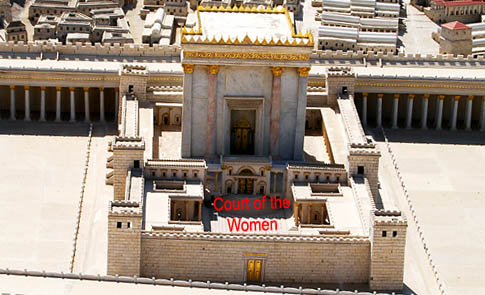
Second Temple Model showing the Court of the Women. Photo by F. Jenkins.

Second Temple Model showing the Court of the Women. Photo by F. Jenkins.

Alfred Edersheim includes the following information about the Court of the Women with an explanation of the 13 offering boxes found there. The info follows without indentation.

——

The Court of the Women obtained its name, not from its appropriation to the exclusive use of women, but because they were not allowed to proceed farther, except for sacrificial purposes. Indeed, this was probably the common place for worship, the females occupying, according to Jewish tradition, only a raised gallery along three sides of the court. This court covered a space upwards of 200 feet square. All around ran a simple colonnade, and within it, against the wall, the thirteen chests, or ‘trumpets,’ for charitable contributions were placed. These thirteen chests were narrow at the mouth and wide at the bottom, shaped like trumpets, whence their name.

Their specific objects were carefully marked on them. Nine were for the receipt of what was legally due by worshippers; the other four for strictly voluntary gifts. Trumpets I and II were appropriated to the half-shekel Temple-tribute of the current and of the past year. Into Trumpet III those women who had to bring turtledoves for a burnt- and a sin-offering dropped their equivalent in money, which was daily taken out and a corresponding number of turtledoves offered. This not only saved the labour of so many separate sacrifices, but spared the modesty of those who might not wish to have the occasion or the circumstances of their offering to be publicly known. Into this trumpet Mary the mother of Jesus must have dropped the value of her offering (Luke 2:22, 24) when the aged Simeon took the infant Saviour ‘in his arms, and blessed God.’ Trumpet IV similarly received the value of the offerings of young pigeons. In Trumpet V contributions for the wood used in the Temple; in Trumpet VI for the incense, and in Trumpet VII for the golden vessels for the ministry were deposited. If a man had put aside a certain sum for a sin-offering, and any money was left over after its purchase, it was cast into Trumpet VIII. Similarly, Trumpets IX, X, XI, XII, and XIII were destined for what was left over from trespass-offerings, offerings of birds, the offering of the Nazarite, of the cleansed leper, and voluntary offerings. In all probability this space where the thirteen Trumpets were placed was the ‘treasury,’ where Jesus taught on that memorable Feast of Tabernacles (John 7 and 8; see specially 8:20). We can also understand how, from the peculiar and known destination of each of these thirteen ‘trumpets,’ the Lord could distinguish the contributions of the rich who cast in ‘of their abundance’ from that of the poor widow who of her ‘penury’ had given ‘all the living’ that she had (Mark 12:41; Luke 21:1).

But there was also a special treasury-chamber, into which at certain times they carried the contents of the thirteen chests; and, besides, what was called ‘a chamber of the silent,’ where devout persons secretly deposited money, afterwards secretly employed for educating children of the pious poor.

It is probably in ironical allusion to the form and name of these treasure-chests that the Lord, making use of the word ‘trumpet,’ describes the conduct of those who, in their almsgiving, sought glory from men as ‘sounding a trumpet’ before them (Matthew 6:2)—that is, carrying before them, as it were, in full display one of these trumpet-shaped alms-boxes (literally called in the Talmud, ‘trumpets’), and, as it were, sounding it.

Alfred Edersheim, The Temple: Its Ministry and Services as They Were at the Time of Jesus Christ, electronic ed. (Garland, TX: Galaxie Software, 2000).

Hebrew seal of “Saul” found in Jerusalem

A Hebrew seal dating to the time of the First Temple was displayed yesterday in the City of David in Jerusalem.

Hebrew Seal bearing name of "Saul." Photo by Vladimir Naykhin, IAA.

Hebrew Seal bearing name of "Saul." Photo by Vladimir Naykhin, IAA.

The news release issued by the Israel Antiquities Authority follows:

The seal, which is made of bone, was found broken and is missing a piece from its upper right side. Two parallel lines divide the surface of the seal into two registers in which Hebrew letters are engraved:

לשאל
]ריהו

A period followed by a floral image or a tiny fruit appear at the end of the bottom name.

The name of the seal’s owner was completely preserved and it is written in the shortened form of the name שאול (Shaul). The name is known from both the Bible (Genesis 36:37; 1 Samuel 9:2; 1 Chronicles 4:24 and 6:9) and from other Hebrew seals.

This name appears many other times in the Bible. Our minds are immediately drawn to the name of Saul, the first king of Israel.

Now there was a man of Benjamin whose name was Kish the son of Abiel, the son of Zeror, the son of Becorath, the son of Aphiah, the son of a Benjamite, a mighty man of valor.  He had a son whose name was Saul, a choice and handsome man, and there was not a more handsome person than he among the sons of Israel; from his shoulders and up he was taller than any of the people. (1 Samuel 9:1-2 NAU)

Saul, the son of Kish, lived several decades before the First Temple period. Saul was king of Israel from about 1050-1010 B.C. The temple was built by Solomon about 966 B.C. Do not make the mistake of saying that this is the seal of Saul the king. Seals and bullae (seal impressions) are fairly common. What they reveal is that the names found are the ones we might expect in given time periods, and similar, or sometimes identical, to those names found in the Bible.

The news release continues:

According to Professor Reich, “This seal joins another Hebrew seal that was previously found and three Hebrew bullae (pieces of clay stamped with seal impressions) that were discovered nearby. These five items have great chronological importance regarding the study of the development of the use of seals. While the numerous bullae that were discovered in the adjacent rock-hewn pool were found together with pottery sherds from the end of the ninth and beginning of the eighth centuries BCE, they do not bear any Semitic letters. On the other hand, the five Hebrew epigraphic artifacts were recovered from the soil that was excavated outside the pool, which contained pottery sherds that date to the last part of the eighth century.

It seems that the development in the design of the seals occurred in Judah during the course of the eighth century BCE. At the same time as they engraved figures on the seal, at some point they also started to engrave them with the names of the seals’ owners. This was apparently when they started to identify the owner of the seal by his name rather than by some sort of graphic representation.

It appears that the “office” which administered the correspondence and received the goods that were all sealed with bullae continued to exist and operate within a regular format even after a residential dwelling was constructed inside the same “rock-hewn pool” and the soil and the refuse that contained the many aforementioned bullae were trapped beneath its floor. This “office” continued to generate refuse that included bullae, which were opened and broken, as well as seals that were no longer used and were discarded into the heap of rubbish that continued to accumulate in the vicinity.
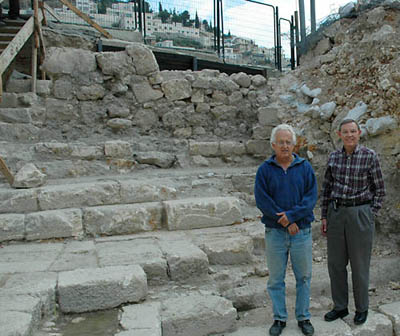
Professor Ronnie Reich is well known for his work in uncovering the Pool of Siloam and the street leading from the Pool to the Temple Mount. The Pool of Siloam is mentioned in John 9. This photo was made at the Pool of Siloam in 2005.
Professor Reich and Ferrell Jenkins at the Pool of Siloam. Photo by Leon Mauldin.

Professor Reich and Ferrell Jenkins at the Pool of Siloam. Photo by Leon Mauldin.

HT: Joseph Lauer

He had to pass through Samaria

The Gospel of John informs us that Jesus had to pass through Samaria (4:4). The most direct travel route between Judea and Galilee was through Samaria. Josephus says, “it was the custom of the Galileans, when they came to the holy city at the festivals, to take their journeys through the country of the Samaritans….” (Ant. XX.118). He also informs us that the trip took three days (Life of Flavius Josephus 1.269). This route ran along the central mountain range, sometimes called the water-parting route.

Carson says geography determined that Jesus had to go through Samaria, but some scholars believe the term had indicates necessity. The following conversation with the woman of Samaria and the visit with the people of Sychar may explain why He had to go through Samaria.

We know that Jesus and His disciples encountered problems when traveling through Samaria (Luke 9:51-56). When Jesus sent out the twelve He told them not to enter any city of the Samaritans (Matthew 10:5).

The Jews, on their way from Galilee to Judea, could travel through Transjordan (Perea). It seems that Jesus took this route when He traveled through Jericho up to Jerusalem (Luke 19).

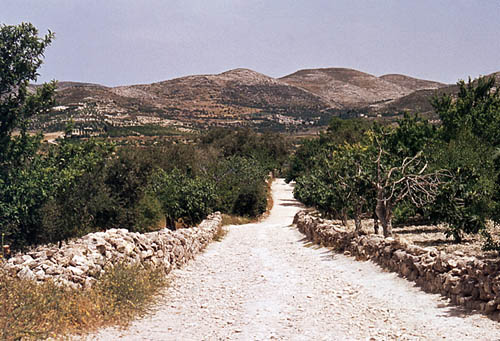
This photo was made in 1981 from the hill of Samaria with a view of the surrounding “mountains of Samaria” (Amos 3:9). One can easily imagine Jesus and His disciples traveling paths such as this.

samaria_path_mountains_1981-t

Shebna – Presumptuous Steward

The May/June issue of Biblical Archaeology Review carries an article by Robert Deutsch about how an artifact bought on the antiquities market helped to solve a 42-year-old excavation puzzle.

Back in 1870 Charles Clermont-Ganneau excavated a tomb on a cliff overlooking the Kidron Valley in Silwan, but he was unable to read the inscription over the tomb. He cut the inscription from the rock and sent it to the British Museum.

In 1953 Nahman Avigad translated the inscription:

This is [the sepulcher of…] -yahu who is over the house. There is no silver and gold here but [his bones] and the bones of his slave-wife with him. Cursed be the man who will open this.

Numerous scholars have identified this Shebna with the person by the same name who was the secretary and head steward of King Hezekiah. This was the view taken by Avigad in 1953.

Inscription from the tomb of Shebna. Photo by Ferrell Jenkins in the British Museum.

Inscription from the tomb of Shebna. Photo by Ferrell Jenkins in the British Museum.

The LORD spoke out against the arrogance of Shebna through the prophet Isaiah.

Thus says the Lord GOD of hosts, “Come, go to this steward, to Shebna, who is over the household, and say to him: What have you to do here, and whom have you here, that you have cut out here a tomb for yourself, you who cut out a tomb on the height and carve a dwelling for yourself in the rock? (Isaiah 22:15-16 ESV)

Avigad says that Shebna’s sepulcher “stands in the midst of the necropolis where persons of rank and high distinction were laid to rest” (Israel Exploration Journal 3 (1953): 152)

Deutsch picks up on this discovery and continues with the saga of a bulla [impression of a seal] found at Lachish in the 1960s. One of the small pieces of clay had the name of Shebnayahu on it. The bulla was broken and the archaeologists were uncertain whether one of the words read son of the king or servant of the king.

Deutsch says,

The puzzle remained unsolved for 42 years. Aharoni has long since passed away. Then in 2007, another bulla stamped with the same seal surfaced on the Jerusalem antiquities market. A simple examination leaves no doubt that it is an impression of the same seal as the Lachish bulla. It, too, is broken off at the right edge. But on this bulla, part of an additional letter to the right of ha-melekh, “the king,” has survived: a dalet! The word before ha-melekh ended in a dalet. The word was eved, “servant.” The seal that made this impression belonged to “the servant of the king”!

You may read Deutsch’s full article with photos and drawings online here.

The carpenter in New Testament times

Jesus is called a carpenter in Mark 6:3. In Matthew’s account He is called the carpenter’s son. The study note in the NET Bible suggests that this was probably a derogatory term. Those who used the term thought of Him as “a common laborer like themselves.”

Lane says the term carpenter (Greek tekton) “commonly designates a worker in any hard material: wood, metal or stone, and so comes to mean a builder.”

Louw-Nida says,

There is every reason to believe that in biblical times one who was regarded as a tekton would be skilled in the use of wood and stone and possibly even metal.

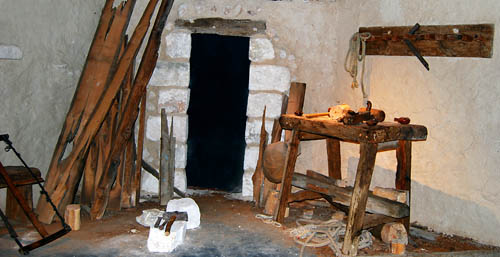
A carpenter’s shop is exhibited at Nazareth Village. It is correct in showing tools for stone cutting as well as wood working.

Carpenter shop at The Nazareth Village. Photo by Ferrell Jenkins.

Carpenter shop at Nazareth Village. Photo by Ferrell Jenkins.

A land of fig trees

The land promised to the descendants of Abraham is described in Deuteronomy 8:8 as,

a land of wheat and barley, of vines and fig trees and pomegranates, a land of olive oil and honey.

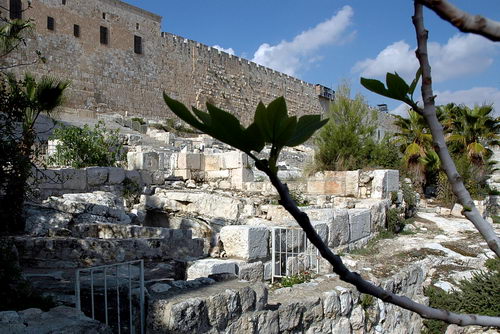
Figs at the Temple Mount excavation. Photo by Ferrell Jenkins.

Figs at the Temple Mount excavation. Photo by Ferrell Jenkins.

Figs were important because they could be eaten when ripe, or prepared as fig cakes and eaten later. In the account of David avenging the destruction of Ziklag, an Egyptian was found in the field and brought to David. He was given bread and water. The text says,

They gave him a piece of fig cake and two clusters of raisins, and he ate; then his spirit revived. For he had not eaten bread or drunk water for three days and three nights. (1 Samuel 30:12 NAS)

I am not sure how the fig cakes were prepared and preserved. Today it is common to see dried figs in Israel. The photo shows dried figs purchased in the Palestinian Authority territory at Jericho.

Dried figs from Jericho. Photo by Ferrell Jenkins.

Dried figs from Jericho. Photo by Ferrell Jenkins.

They were fishermen

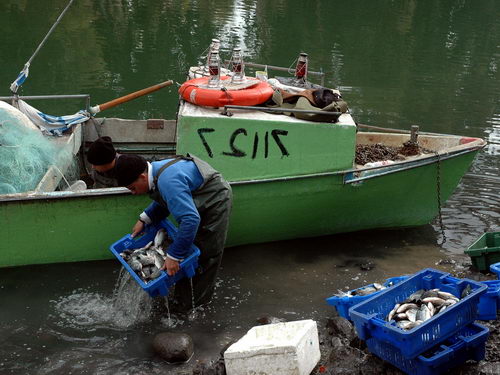
The first disciples called by Jesus were fishermen. In the previous post we indicated the significance of fishing on the Sea of Galilee. The best time to see fishermen on the Sea is early in the morning. The photo below was made early one morning where the Jordan River exits from the Sea of Galilee. These fishermen have been fishing with nets and have brought in a nice catch.

Fishermen on the Sea of Galilee bringing in the catch. Photo by Ferrell Jenkins.

Fishermen on the Sea of Galilee bringing in the catch. Photo by Ferrell Jenkins.

This reminds us of the call Jesus gave to the disciples one day in ancient Galilee.

Now as Jesus was walking by the Sea of Galilee, He saw two brothers, Simon who was called Peter, and Andrew his brother, casting a net into the sea; for they were fishermen. And He said to them, “Follow Me, and I will make you fishers of men. Immediately they left their nets and followed Him.” (Matthew 4:18-20 NAS)

Taxes the easy way

Working on tax return preparation for the past two days got me to thinking about this episode from the ministry of Jesus:

24 When they came to Capernaum, the collectors of the two-drachma tax went up to Peter and said, “Does your teacher not pay the tax?” 25 He said, “Yes.” And when he came into the house, Jesus spoke to him first, saying, “What do you think, Simon? From whom do kings of the earth take toll or tax? From their sons or from others?” 26 And when he said, “From others,” Jesus said to him, “Then the sons are free. 27 However, not to give offense to them, go to the sea and cast a hook and take the first fish that comes up, and when you open its mouth you will find a shekel. Take that and give it to them for me and for yourself.” (Matthew 17:24-27 ESV).

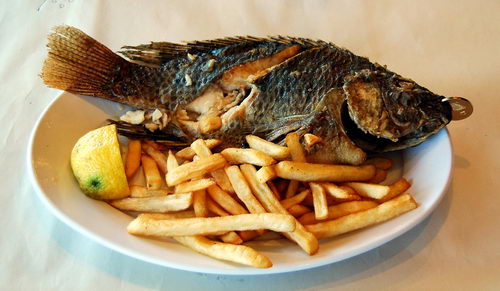
Fishing is still important on the Sea of Galilee. Our groups usually have at least one meal of the famous St. Peter’s Fish when we are in the Galilee.

A fish from the Sea of Galilee with a coin in its mouth. Photo by F.Jenkins.

A fish from the Sea of Galilee with a coin in its mouth. Photo by Ferrell Jenkins.

Mendel Nun spent more than 50 years fishing the Sea of Galilee. He became an expert in the history of fishing on the Sea.  His article, “Cast Your Net Upon the Waters: Fish and fishermen in Jesus’ Time” (Biblical Archaeology Review, 19:06), includes information on this episode. Because this is a lengthy quotation I will leave it full width for easier reading.

– – – – – –

The musht is the only large fish in the lake that moves in shoals, which of course is a key to the identification of the fish in the story in Luke, although not the only one.

The flat shape of the musht makes it especially suitable for frying. The skeleton consists of an easily detachable backbone and relatively few small bones, and thus it is easy to eat. It has long been known as St. Peter’s fish. Recently, it has even been exported under this name. But, alas, the name is a misnomer.

Presumably the fish got its name because of an incident recorded in the Gospel of Matthew (Matthew 17:24–27). In this episode, the tax collectors come to Capernaum to collect the half-shekel Temple tax that each Jew was required to pay annually. Jesus tells Peter, “Go to the sea and cast a hook, and take the first fish that comes up, and when you open its mouth you will find a shekel; take that and give it to them for me and yourself.”

The musht was probably given the name St. Peter’s fish because of this miracle. However, this cannot have been the fish Peter caught with a hook and line. The reason is simple: Musht feeds on plankton and is not attracted by other food. It is therefore caught with nets, and not with hook and line. The fishermen on the lake have, since time immemorial, used a hook baited with sardine to fish for barbels, which are predators and bottom feeders. Peter almost surely caught a barbel. There can be only one explanation for the confusing change of name. It was good for tourism! The Sea of Galilee has always attracted pilgrims; musht (today raised mostly in ponds) is part of the unique local cuisine. It is delicious, especially when freshly fried. In ancient times, just as today, the fishing boats delivered their catch to the eating places on shore. Indeed, the proverbial metaphor for speed in the Talmud is “as from the sea into the frying pan.” This expression was part of daily speech in Tiberias and clearly refers to musht and not barbels; the latter are best when boiled.

The first Christians were local people and were therefore familiar with the various fish. They of course knew that the fish Peter caught could only have been a barbel and not a musht. However, as pilgrims began to come from distant regions, it no doubt seemed good for business to give the name “St. Peter’s fish” to the musht being served by the early lakeside eating houses. The most popular and easily prepared fish acquired the most marketable name! But even if Peter did not catch a musht, he deserves to have his name associated with the best fish in the lake.

The empty tomb

The women who came to the tomb of Jesus on the first day of the week found the stone rolled away from the tomb. When they entered the tomb the body was not there (Luke 24:1-3).

The two men (Matthew says angel) said,

He is not here, but has risen. Remember how he told you, while he was still in Galilee, that the Son of Man must be delivered into the hands of sinful men and be crucified and on the third day rise.” (Luke 24:6-7 ESV)

Several tombs of the type in which Jesus was buried have survived the centuries. This one was discovered during road construction a few years ago near Mount Carmel.

A Roman Period tomb with a rolling stone. Photo by Ferrell Jenkins.

A Roman Period tomb with a rolling stone. Photo by Ferrell Jenkins.

The women told the apostles what happened when they went to the tomb.

1 Now on the first day of the week Mary Magdalene came to the tomb early, while it was still dark, and saw that the stone had been taken away from the tomb. 2 So she ran and went to Simon Peter and the other disciple, the one whom Jesus loved, and said to them, “They have taken the Lord out of the tomb, and we do not know where they have laid him.” (John 20:1-2 ESV)

The Gospel of John records the reaction of Peter and the other disciple [John]:

3 So Peter went out with the other disciple, and they were going toward the tomb. 4 Both of them were running together, but the other disciple outran Peter and reached the tomb first. 5 And stooping to look in, he saw the linen cloths lying there, but he did not go in. 6 Then Simon Peter came, following him, and went into the tomb. He saw the linen cloths lying there, 7 and the face cloth, which had been on Jesus’ head, not lying with the linen cloths but folded up in a place by itself. 8 Then the other disciple, who had reached the tomb first, also went in, and he saw and believed; 9 for as yet they did not understand the Scripture, that he must rise from the dead. 10 Then the disciples went back to their homes. (John 20:1-10 ESV)

I asked Frank and Norm, two living disciples, to stoop and look into an empty tomb much the way Peter and John did on that first day of the week.

Two disciples look into an empty tomb. Photo by F. Jenkins.

Two disciples look into an empty tomb. Photo by F. Jenkins.

The tomb of Jesus

The New Testament describes the tomb and burial of Jesus:

When it was evening, there came a rich man from Arimathea, named Joseph, who also was a disciple of Jesus. He went to Pilate and asked for the body of Jesus. Then Pilate ordered it to be given to him. And Joseph took the body and wrapped it in a clean linen shroud and laid it in his own new tomb, which he had cut in the rock. And he rolled a great stone to the entrance of the tomb and went away. Mary Magdalene and the other Mary were there, sitting opposite the tomb. (Matthew 27:57-61 ESV)

The Church of the Holy Sepulchre likely contains the empty tomb of Jesus. Since 1810 the tomb has been covered by a monument that hides the original appearance of the tomb. In fact, even in the 4th century Constantine changed the natural appearance of the area by cutting away some of the natural stone.

The tomb is similar to other tombs from the first century. This one is small, but that would be consistent with the fact that it was the personal tomb of Joseph of Arimathea. The museum of the Studium Biblicum Franciscanum in the Old City has a model of the tomb showing a side view. From right to left one enters the tomb when the rolling stone is moved away. The first room serves as a vestibule. The second room contains a bench or shelf cut into the rock. This was called the arcosolium. The wrapped body would be placed on this bench.

Model of the tomb in the Church of the Holy Sepulchre. Photo by F. Jenkins.

Model of the tomb in the Church of the Holy Sepulchre. Photo by F. Jenkins.

Believers appreciate the loving care Joseph gave the body of Jesus.