Category Archives: Israel

The Exploration in Antiquity Center

The Explorations in Antiquity Center at LaGrange, Georgia, is the brainchild of Dr. James Fleming. Fleming has lived and worked in Israel since 1973. Numerous tour groups have visited his Biblical Resources center there. I first met Jim many years ago in the home of Richard Cleave in Jerusalem. Cleave is the author/photographer/publisher of The Holy Land Satellite Atlas and other photographic and geographic materials. In that meeting I saw that the three of us shared a common passion in wanting to use what we had learned about the Bible lands in teaching others.

The Explorations in Antiquity Center web page says,

Dr. Fleming established Biblical Resources in 1975, for the purpose of producing educational materials and aids for teaching the historical, geographical, and archaeological background of the Bible.

It was wonderful to have these resources together at one place in Israel, but it is beneficial to many more to have the resources available in the Southeastern United States.

David Padfield recently visited the Center in LaGrange. At my request he has written a brief review for Ferrell’s Travel Blog. We plan to run the review with photographs during the next few days.

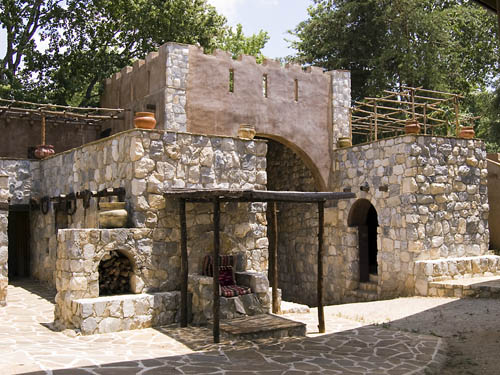
The city gate at Exploration in Antiquities Center. Photo by David Padfield.

The city gate at Exploration in Antiquities Center. Photo by David Padfield.

You may access the Center’s web site here.

David Padfield is well known for his helpful web site, Padfield.com.

Breakfast with Jesus

Jesus told the disciples that after His resurrection He would go ahead of them to Galilee (Matthew 26:32). His third appearance to the disciples was on the shore of the Sea of Tiberias (Galilee/Gennesaret).

Tradition locates the place of His meeting with the disciples at (or near) Tabgha on the northwest shore of the Sea of Tiberias. The events are recorded in John 21. The disciples had fished during the night and caught nothing. At day break Jesus invited them to “Come and have breakfast.”

The small church, made of the local basalt stone, is called the Church of the Primacy of Peter. Roman Catholics believe Christ promised and conferred the primacy of jurisdiction over the entire church on the Apostle Peter at this time and place (John 21:14-17). Need I say that many do not agree with this interpretation?

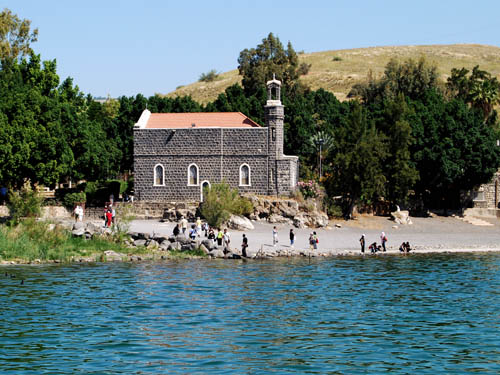
The traditional site where Jesus prepared breakfast for the disciples. Photo by Ferrell Jenkins.

The traditional site where Jesus prepared breakfast for the disciples. The building covers what Catholics call the Mensa Christi (the Table of Christ). Photo by Ferrell Jenkins.

Observe in the photo that the shoreline is far from the building. This is because the water level has been extremely low in the past few years. Remnants of a small harbor can be seen beside the building. Mendel Nun, in his well-known article about the 15 man-made harbors around the Sea of Galilee, writes about Tabgha:

In the winter, fishermen from Capernaum worked at Tabgha, where several warm mineral springs attracted musht, popularly called St. Peter’s Fish. (The name Tabgha is a corruption of the Greek for “Seven Springs.”) Today the remains of this small harbor’s breakwater can be seen when the water level is low. Christian tradition ascribes the meeting place of Jesus with his disciples to a prominent rock at the warm springs. From a fisherman’s viewpoint, this is the correct choice. This is the area where musht schools formerly concentrated in the winter and spring. Here Jesus met his disciples for the first—and also the last—time (Luke 5:1–7; John 21:1–8). On this rock, now known as the rock of the primacy of Peter, stands a small modern Franciscan chapel, the Church of the Primacy of Peter. It was built on the foundations of earlier churches, the oldest of which dates from the first half of the fourth century. The altar is built around a stone outcropping known to pilgrims as the Lord’s Table (Mensa Domini), on which Jesus served the disciples after the miraculous draught of fishes (John 21:13). (Nun, Mendel. “Ports of Galilee.” Biblical Archaeology Review. July/August 1999).

I take every step with them

A couple of my friends, Royce and Luke Chandler, are in Israel to participate in the archaeological dig at Khirbet Qeiyafa. The site, overlooking the Valley of Elah, is also called the Elah Fortress. They are spending a few days traveling in Israel prior to joining the dig.

Luke is posting some of his photos and a bit of information about the places on his A Bible, History & Travel Blog. Today he has a great photo of the Jezreel Valley from the Spring of Harod to the Hill of Moreh (Judges 7). Take a look.

More information on Judean exiles in Babylon

Abraham Rabinovich, a long time writer for the The Jerusalem Post, has compiled some fascinating information about the Judeans in Babylonian Exile during the time of Nebuchadnezzar.

King Jehoiachin was only 18 years old and had occupied the throne of Judah barely three months when he was led off into Babylonian captivity in 598 BCE together with his wives, his mother, his servants, his eunuchs and thousands of “the chief men of the land.”

But what happened to them when they reached Babylon? And what happened there to the tens of thousands of others who joined them in exile when the First Temple was destroyed a decade later? The Bible tells us of the return to Judah half a century later but virtually nothing of what the expellees experienced in Babylon itself…

However, scholars have been able to gain a measure of access to these missing years from cuneiform documents unearthed in Iraq in the last century, including a trove illicitly dug up in the final years of Saddam Hussein’s regime and only now nearing publication. The documents are innocuous – business records, land deeds, tax accounts – but together are able to shed light, feeble but suggestive, on this central period in Jewish history.

Rabinovich comments specifically on the fate of Jehoiachin, the young Judean king.

“We have been able to make history out of dry documents,” says Prof. Israel Eph’al of the Hebrew University, an epigrapher and historian of the ancient Near East.

Early last century, archeologists digging in Babylon, the capital of Babylonia, uncovered cuneiform tablets in a vaulted chamber beneath the ruins of an ancient structure believed by some to have been the base of the fabled “Hanging Gardens” of Babylon. These tablets, deciphered in the 1930s by German Assyriologist Ernst Weidner, detailed the storage of oil and other commodities and their distribution. Four of the badly damaged tablets concerned the supply of oil to “Jehoiachin, king of Judah” and his five sons. The date is five years after he was taken captive. The fact that he was being provisioned by the Babylonian authorities and that he retained his royal title suggests that he was being treated with deference even though he had been taken captive because his father, Jehoiakim, had rebelled against Babylon. Favorable treatment is also suggested by the fact that at 23 he already has five sons, indicating that the young royal was not deprived of the wives who had accompanied him.

Read the entire article here.

Because German archaeologists worked at Babylon for more than a decade in the early part of the 20th century, the best collection of archaeological artifacts are in the Pergamum Museum in Berlin. Here is a photo of one of the ration tablets mentioned in the article.
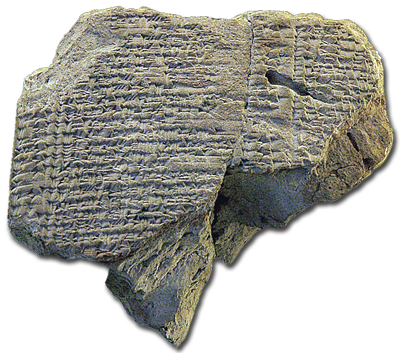
Ration tablet from Babylon, now in Berlin. Photo by Ferrell Jenkins.

Ration tablet from Babylon mentioning Jehoiachin, the exiled king of Judah. Photo by Ferrell Jenkins.

This information harmonizes with what we are told in the Bible, under  (2 Kings 25:27-30). This text describes an event some years later under the reign of Evil-merodach. Verse 30 says of Jehoiachin,

He was given daily provisions by the king for the rest of his life until the day he died. (2 Kings 25:30 NET)

Here are the dates I normally follow in the study of this part of Bible history:

  • Nebuchadnezzar takes Daniel and other royal youths to Babylon (605 BC).
  • Jerusalem captured by the Babylonians. Jehoiachin taken to Babylon (597 BC). Zedekiah was made king. Ezekiel was among the prophets taken to Babylon.
  • Zedekiah was blinded and taken to Babylon (586 BC). Jerusalem destroyed. Many exiles taken to Babylon. Jeremiah was left in the land of Judah.
  • Babylon captured by the Medes and Persians (539 BC).
  • Judean exiles allowed to return to Judah (536 BC).
  • A second group of exiles returned in the days of Ezra (458 BC). Some remained in Babylon.

HT: Joseph I. Lauer

The Valley of Aijalon and Joshua’s Long Day

The events of Joshua 9 and 10 are likely well-known to all readers of this page. After the Israelites entered Canaan and captured Jericho and Ai, the inhabitants of Gibeon acted craftily to deceive the Israelites into making an alliance with them. Even though Israel had been deceived they kept their end of the bargain when the Gibeonites were threatened. Adoni-zedek, king of Jerusalem, headed up a group of Amorite kings to fight against Gibeon.

The LORD helped Israel by sending large hailstones upon the enemy. Joshua spoke to the LORD in the presence of Israel: “O sun, stand still at Gibeon, And O moon in the valley of Aijalon” (Joshua 10:12). Gibeon sits on the central mountain range about 6 miles north, and slightly west, of Jerusalem. As one makes the descent from Gibeon westward toward the coastal plain he goes through the valley of Aijalon.

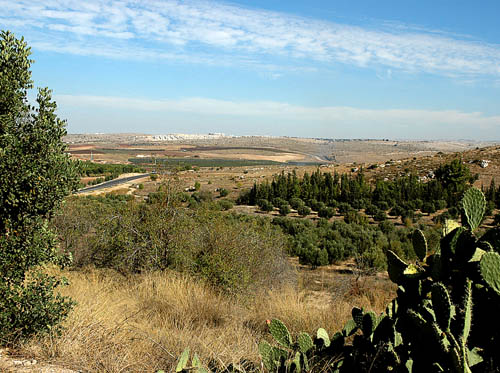
When we travel on the modern highway from Jerusalem down to the Ben Gurion Airport we cross over the valley of Aijalon. Our photo of the valley is made below traditional Emmaus (Nicopolis) looking northwest. The terrain shows the Shephelah, or as many English versions indicate, the lowland. To the right is the way up to Gibeon. To the left one continues past the towns of Aijalon and Gezer down to the coastal plain.

Overlooking the Valley of Aijalon. Photo by Ferrell Jenkins.

Overlooking the Valley of Aijalon. Photo by Ferrell Jenkins.

Three east-west valleys divide the Shephelah and provide access between the plain and the mountains. To the north is the valley of Aijalon. Further south is the valley of Sorek, and then the valley of Elah. Significant battles took place in the valley of Aijalon and the valley of Elah.

The town of Aijalon which overlooks the valley was allotted to the tribe of Dan (Joshua 19:42), but Dan moved to the northern part of the country and Aijalon was considered one of the cities of Judah and Benjamin (2 Chronicles 11:5-12). In the days of King Ahaz the city had fallen under Philistine control (2 Chronicles 28:16-20).

Have scientists discovered Joshua’s long day?

In 1969 an article began to be circulated in church bulletins, and more recently by Email, claiming that scientists had found evidence of the missing day of Joshua 10. Harry Rimmer had reported a similar story in The Harmony of Science and Scripture in 1936. There is no truth to this claim. I have an article written in response to it available at bibleworld.com. An article by Dr. Bryant Wood is available at the ABR web site here.

This article was published in Biblical Insights, Feb. 2007.

Extraordinary Finds at the Mt Zion Excavation

That the title of the July update after three weeks of digging at the Mt Zion Excavation. The report by James D. Tabor is available here. The location is a beautiful one. It lies between the road and the old city wall on the south side of the Old City of Jerusalem, and it overlooks the Hinnom Valley (Joshua 18:16). There are some nice photos of the site and some of the discoveries.

Discoveries in the past three weeks include:

  1. A stone vessel with an ancient inscription of ten lines in archaic Jewish script.
  2. Murex snail shells with holes drilled in them.
  3. A fire pit dated to just after the Roman destruction of Jerusalem in A.D. 70.
  4. The threshold of a Fatimid period double gate.
  5. An arched doorway with mosaic floor and plastered wall.
  6. Several 2nd temple vaulted chambers that likely contained mikvot (ritual baths).
  7. Miscellaneous items such as coins, intact lamps, etc.
Herodian lamp from Mt Zion Excavation. Photo: Tabor Blog.

Herodian lamp from Mt Zion Excavation. Photo: Tabor Blog.

The excavators, Tabor and Gibson, have found evidence in some of these items that causes them to think this might have been an area were priests from the Second Temple period lived. (Second Temple means the Herodian Temple, which was really the Third Temple!).

Archaeology is hard work, but as these little things come to light it is exciting to have a better understanding of the past.

HT: Joseph I. Lauer

Could this be the quarry of Herod the Great?

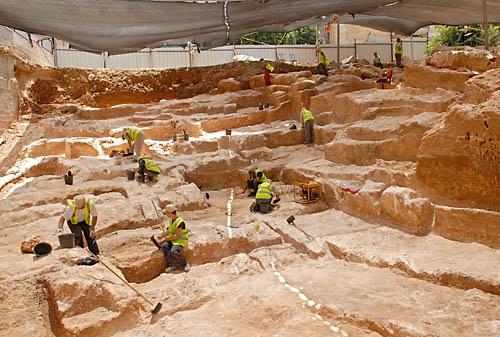
The Israel Antiquities Authority announced Monday the discovery of a large stone quarry dating to the first century B.C. It is suggested by the director of the excavation that this was one of the quarries used by Herod the Great in his building projects in Jerusalem.

First century B.C. quarry on Shmuel HaNavi Street. Photo: Assaf Peretz, courtesy IAA.

First century B.C. quarry on Shmuel HaNavi Street. Photo: Assaf Peretz, courtesy IAA.

Dr. Ofer Sion, the excavation director on behalf of the Israel Antiquities Authority, believes, “The immense size of the stones (maximum dimensions: length 3 m, width 2 m, height 2 m) indicates it was highly likely that the large stones that were quarried at the site were destined for use in the construction of Herod’s magnificent projects in Jerusalem, including the Temple walls. It seems that a vast number of workers labored in the quarry where various size stones were produced: first they quarried small stones and when the bedrock surface was made level they hewed the large stones. The stones were quarried by creating wide detachment channels that were marked by means of a chisel which weighed c. 2.5 kilograms. After the channels were formed the stones were severed from the bedrock using hammers and chisels”.

The full news release may be read here. Similar quarries have been discovered in Jerusalem in the decade. Todd Bolen, at Bible Places Blog, provides some links to the earlier quarries as well as some good photos. One photo shows the Ketef Hinnom quarry that has since been covered by the Menahem Begin Heritage Center. I’m glad Todd was there to capture that one.

HT: Todd Bolen; Joseph Lauer

Flag faux pas

We have been flying our flag since a few days before Memorial Day.

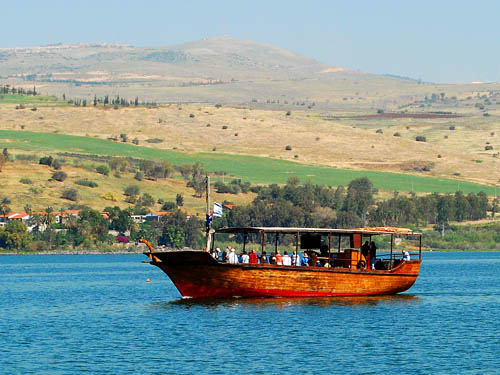
When traveling outside the United States it is fairly common to see the flag of the USA displayed in front of hotels that cater to citizens of the USA. Dozens of boats carry tourists across the Sea of Galilee from one port to another. This is an important part of our tours to give the travelers some sense of the elevation of the sea, and of the quietness of its water.

Tourist boat on Sea of Galilee. View to East. Photo by Ferrell Jenkins.

Tourist boat on Sea of Galilee. View to East. Photo by Ferrell Jenkins.

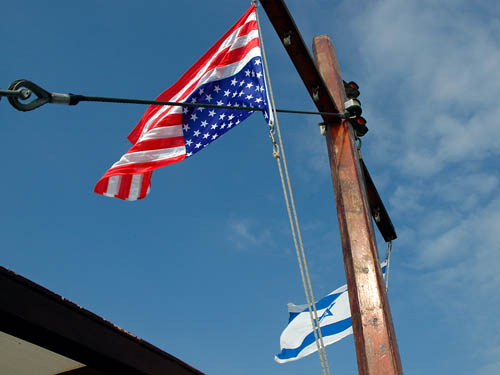
It is fairly typical of these boats to hoist a flag of the country from which its passengers come. In 2006 the boat we were on had inadvertently hoisted the USA flag upside down. The rules of etiquette for the display of the flag say that the flag should be flown upside down only as a distress signal. Fortunately we did not have a storm like the one mentioned in the gospels. Such storms still occur when the strong winds come down upon the sea from the surrounding mountains. In that case I suppose a distress signal might have been helpful.

But as they were sailing along He fell asleep; and a fierce gale of wind descended on the lake, and they began to be swamped and to be in danger. They came to Jesus and woke Him up, saying, “Master, Master, we are perishing!” And He got up and rebuked the wind and the surging waves, and they stopped, and it became calm. (Luke 8:23-24 NAU)

United States flag upside down on Israeli boat. Photo by Ferrell Jenkins.

United States flag upside down on Israeli boat. Photo by Ferrell Jenkins.

Happy fourth of July to my USA friends. Fly your flag proudly, but don’t turn it upside down!

The Sea of Galilee

A boat ride on the Sea of Galilee is one of the highlights of a trip to Israel for most Christian tourists. They enjoy seeing the lake and recognizing the places they have read about so much in their Bible study: Tiberias, Magdala, the Mount of Beatitudes, Capernaum. They reflect on the accounts of Jesus walking on the water and stilling the tempest, etc.

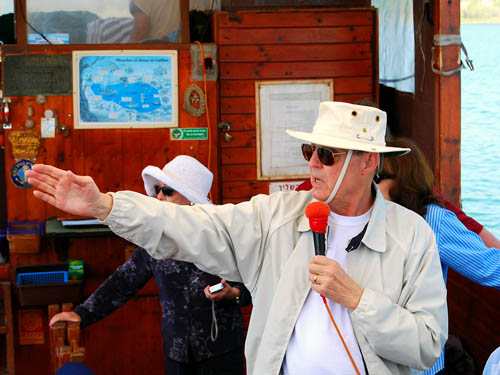
My wife had someone shooting photos while I was pointing out sites of interest along the shores of Galilee. I think I was pointing out the possible location of the account of the swine rushing down the steep bank into the sea (Matthew 8:28 – 9:1).

Ferrell Jenkins pointing out sites of interest on the shore of Galilee.

Ferrell Jenkins pointing out sites of interest along the shore of Galilee.

Luke calls the Sea of Galilee a lake (Luke 5:1-2; 8:22-23,33).

Now Jesus was standing by the Lake of Gennesaret, and the crowd was pressing around him to hear the word of God. (Luke 5:1 NET)

Herod built a hippodrome at Caesarea Maritima

Herod the Great built a hippodrome along the coast at Caesarea Maritima in 10 B.C. to celebrate the opening of the city. In the second century A.D. the south side of the hippodrome was reconstructed as an amphitheater to be used for gladiatorial contests. New sections with beautiful frescoes have been uncovered.

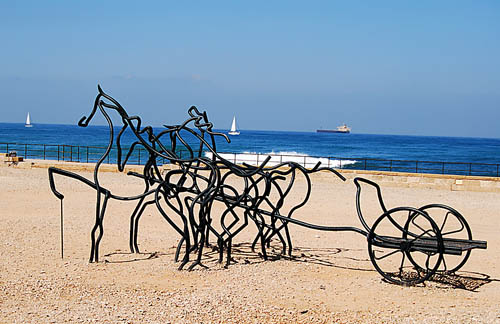
This metal sculpture has been erected on the north end of the hippodrome along the beautiful Mediterranean.

View in the hippodrome at Caesarea Maritima. Photo by Ferrell Jenkins.

View from the hippodrome at Caesarea Maritima. Photo by Ferrell Jenkins.

The theater we showed in the previous post is on the south end of the hippodrome. The harbor built by Herod the Great is a little to the north of the hippodrome. The apostle Paul was in prison at Caesarea for two years between A.D. 58 and 60 (Acts 23:23 – 26:32).

We discussed Paul’s possible use of the charioteer in Philippians 3:12-14 here.

New paintings of the hippodrome mosaics. Photo by Ferrell Jenkins.

New paintings of the hippodrome frescoes. Photo by Ferrell Jenkins.