Category Archives: Israel

Archaeologist Gabriel Barkai discusses digging on the Temple Mount

Israel National News has posted a video featuring Dr. Gabriel Barkai.

In wake of the claims that Israel is excavating under the Dome of the Rock on the Temple Mount and undermining Muslim mosques in order to cause them to collapse, archaeologist Dr. Gabriel Barkai told IsraelNN TV the opposite is true.

He charged that it is the Arabs who have acted against the status quo and have “brutally” excavated land that contains many ancient artifacts from Jewish history.

Dr. Barkai spoke about the “Sifting Project,” in which countless archaeological finds are being discovered in the rubble dug up by the Muslims. He also discussed his most famous discovery: small silver plaques containing the Priestly Benediction from the Book of Numbers, which he found in 1979.

These plaques contain the oldest surviving Biblically-related inscription discovered to date, dating back to 600 B.C.E.

Some of the comments made by Dr. Barkai are controversial, but I think readers who are interested in the archaeology of Jerusalem will find this 10-minute video beneficial.

The link takes you to the report and the video with all of the associated ads.

HT: Joseph I. Lauer
The Tel Dor Excavation Project

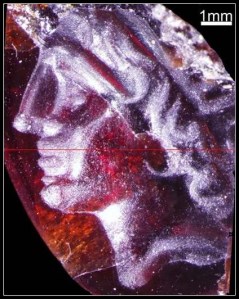
About two months ago we wrote about Tel Dor here. The day before that we noted the discovery of the miniature carving of Alexander the Great here.

Alexander carving from Tel DorAlexander Carving from Tel Dor

Paula Waiman, a PhD student at the University of Haifa, left a comment on the post about the Alexander carving. Her advisor is Dr. Ayelet Gilboa, co-director of the Tel Dor Excavation. I suggested to her that we move up her comment so it would be easier for readers to see.

The exquisite gemstone of Alexander the great that captured your attention, as seen in you website, is only the tip of the iceberg, so to speak, of one of the largest, long lasting and high profile archaeological projects in Israel. If you care about the archaeology of biblical times (Israelites, Phoenicians and Sea People), the Classical periods, and the cultural heritage of Israel and the Mediterranean; and if you are interested in forging a bond between Israel and the international community – please take a moment to look at the attached file [see Tel Dor website for full info]. Like almost cultural projects around the globe, we need your help to endure.

We would be grateful if you could pass this message to any other interested parties.

Tel Dor website: dor.huji.ac.il
Tel Dor has also a facebook wall. You are welcome to visit us.

Prof. Sarah Stroup, University of Washington, has posted some nice photos of the excavation here.

Looking for Libnah

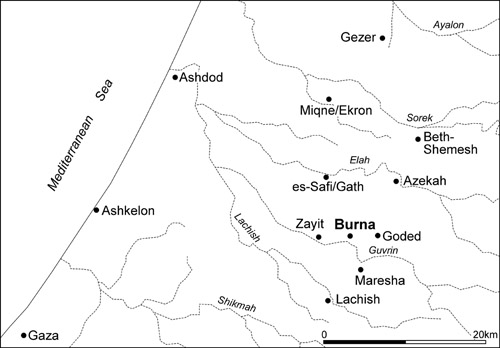
A new blog, called The Tel Burna Excavation Project, has been launched to report on the preliminary survey of Tel Burna. The tel is located in the Shephelah of Israel among such sites as es-Safi/Gath, Zayit, Goded, Mareshah, Azekah and Lachish.

The Shephelah. Map: Tel Burna Excavation Project.

The Shephelah. Map: Tel Burna Excavation Project.

In the case of Tel Burna, with no excavation material available, the problem is even more difficult. despite this, several scholars have suggested identifying the site with Biblical Libnah (although one should note that nearby Tel Zayit is a very likely candidate as well – as Ron Tappy, the excavator there, has recently published).

Libnah was a Canaanite town that was conquered by Joshua who allotted it to the tribe of Judah (Joshua 10:29-30; 15:42). The city was chosen as one of the Levitical cities (Joshua 21:13), which points to its role as a border site. According to 2 Kings 8:22 (and 2 Chronicles 21:10), the city of Libnah was involved in the rebellion against Jehoram the king of Judah (in 9th century BCE) and later, a woman from Libnah married King Josiah in the 7th century BCE (Kings 23:31-32;2 Kings 24:17-18; Jeremiah 22:11).

In any case, even if the site is not Libnah, it is clear for the survey results (which will be mentioned in an upcoming post) that the site was a very important site in the Iron Age, along the border between Judah and the Philistines.

HT: Luke Chandler’s Blog; Aren Maeir.

Al Aqsa Mosque in Jerusalem

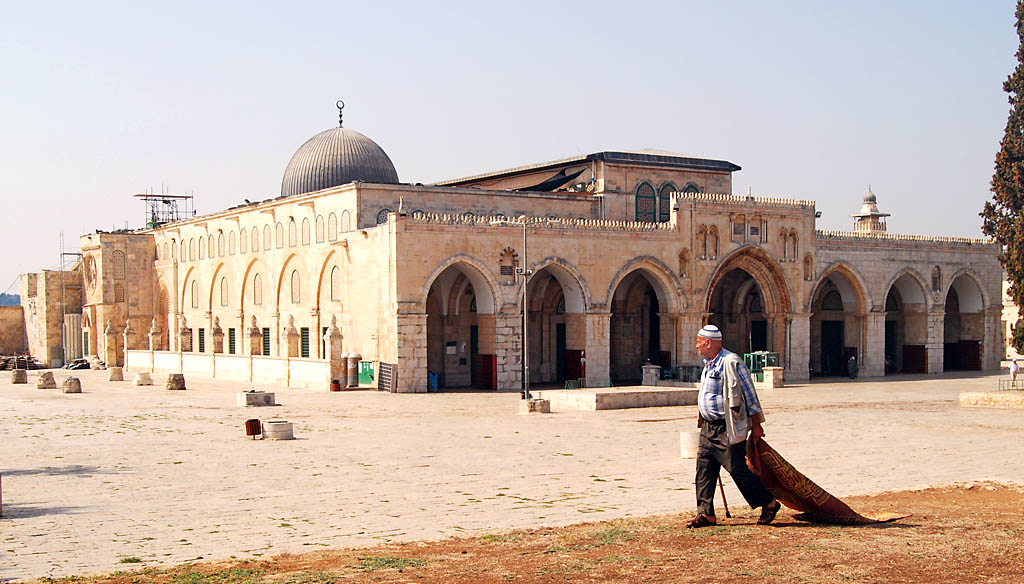
The Al-Aqsa (or Al-Aksa) Mosque is one of the two important buildings erected by Moslems on the platform built by Herod the Great. A Brief Guide to the Dome of the Rock and Al-Haram Al-Sharif, published in 1965, says the Al-Aksa Mosque was built in A.D. 693 or A.D. 705. The other significant building on the platform is called The Dome of the Rock or the Mosque of Omar. It is built over the rock where, according to tradition, Abraham offered Isaac (Genesis 22), and where the Temple of Solomon once stood (1 Kings 6).

Al-aksa Mosque. View toward south west. Photo by Ferrell Jenkins.

This building has often been in the news. In 1951 King Abdullah of Jordan was assassinated in the Mosque. In 1969 an Australian tourist set fire to the building. Just a couple of days ago we saw news reports of disturbances in the Mosque. The Guardian of London headline reports,

Palestinians clash with Israeli troops at al-Aqsa mosque in Jerusalem. Demonstrations at holy shrine erupt into violence as youths fight battles with riot police.

The Western Wall tunnel

Most first time visitors to the Western Wall in Jerusalem, whether in 1967 or 2009, probably think they are looking at a wall seen by Jesus and other first century characters prior to AD 70. In a sense they are. That is, they are seeing the same wall, but not at the first century level.

The Western Wall is the western side of the temple platform enclosure built by Herod the Great. Jesus drove money changers out of the temple precinct (hieron) (John 2:13-17). In their discussion with Jesus the Jews called attention to the length of time the temple (naos) had been under construction (John 2:19-21).

Jesus answered them, “Destroy this temple, and in three days I will raise it up.” The Jews then said, “It took forty-six years to build this temple, and will You raise it up in three days?” But He was speaking of the temple of His body. (John 2:19-21 NAU)

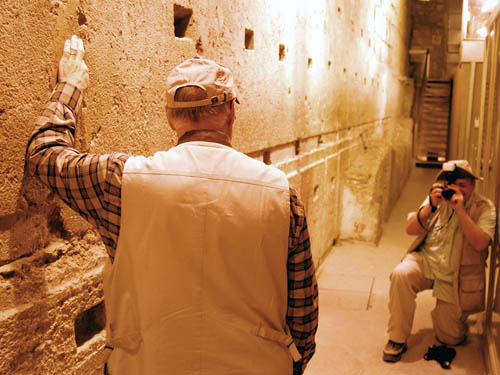
The photo below shows the largest visible stone in the western side of the Temple precinct. According to the Western Wall Tunnel web site, this stone is the largest one in the tunnel. It is 41 feet long, 11.5 feet high, and 15 feet deep. The web site says that this stone is 20 feet above the street level of the first century.

The largest visible stone in the Western Wall tunnel. Photo by Ferrell Jenkins.

The largest visible stone in the Western Wall tunnel. Photo by Ferrell Jenkins.

The Tunnel was dug in the years following 1967, but an exit was not cut on the north end until 1996.

Israel plans major excavation at Western Wall

Israel National News reports, in an article by Samuel Sokol, plans to conduct a archaeological dig under the Western Wall in Jerusalem.

Israel is planning a major archaeological dig under the Western Wall (Kotel) plaza, opposite the Temple Mount, officials announced Thursday. The excavations will create an archaeological park directly underneath the area where worshippers currently stand while praying at the Kotel.

The current prayer area will remain open, supported by pillars, while a new area will be added underneath, at the level at which worshippers at the ancient Temple stood in the past.

The complete article may be read here, and another here from The Jerusalem Post.

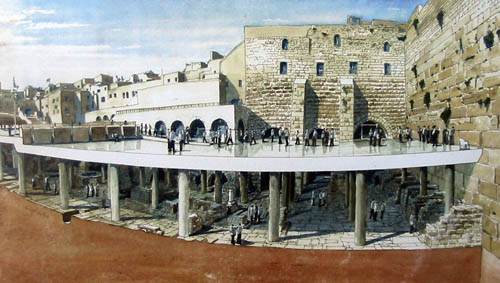
This drawing shows the planned part underneath the present pavement at the Western Wall.

Proposed Western Wall archaeological park. Photo: Antiquities Authority.

Proposed Western Wall archaeological park. Photo: Antiquities Authority.

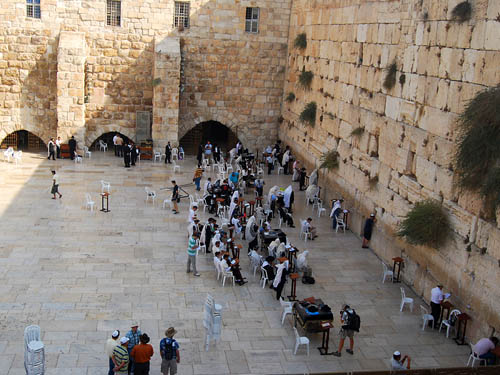
Here is the way this area looks at the present time.

The Western Wall platform. View to north toward Wilson's Arch. Photo by F. Jenkins.

The Western Wall platform. View to north toward Wilson's Arch. Photo by F. Jenkins.

HT: Joseph Lauer

Nabataean site in the Negev vandalized

Ynet News reports that Avdat, a Nabataean site in the Negev, has been severely damaged by vandals. In August, 2008, I had Avdat on my list of places to visit. We made it to the site, but it was within 30 minutes of closing time and the guard would not allow us to go to the top. I regret that we missed seeing everything — even more now.

The Nabataean site of Avdat in the Negev. Photo by Ferrell Jenkins.

The Nabataean site of Avdat in the Negev. Photo by Ferrell Jenkins.

Raviv Shapira, director of the southern district of the Israel Nature and Parks Authority told Ynet that the sight of the destruction was awful: “We came in the morning and found the place in shambles,” described Shapira, “They broke the staircase, destroyed the walls, and painted on them. The worst is that the two most ancient churches in Israel were destroyed, and 13-foot columns were shattered with hammers along with artifacts and the authentic marble alter, which is the most important (artefact) in the city.”

The Nabataeans founded Avdat around the 3rd century BC, along the “Perfume Road” which stretched between the Jordanian city of Petra and Gaza. The place was named after the Nabataean king, Avdat, who was also buried at the site. According to Shapira, Avdat was the most important historic city on the “Perfume Road” after Petra between the 1st century BC and the 7th century AD, and was inhabited by Nabataeans, Romans and Byzantines.

We typically refer to the “Perfume Road” as the “Spice Road.” Read the full story here (including a video).

HT: Joseph I. Lauer

Todd Bolen announces the Jerusalem CD

Todd Bolen has announced the publication of Jerusalem: Volume 2 of The American Colony and Eric Matson Collection. We mentioned this marvelous set of photographs earlier here. For more information on the current CD on Jerusalem click here

Cache of Bar-Kokhba coins found

Arutz Sheva, Israel National News, reports the discovery of a treasure chest of Bar-Kokhba period (132-35 AD) coins in the Judean Hills.

The largest-ever known number of coins from the time of Bar-Kokhba, the Jewish leader against Roman invaders, has been discovered in the Judean Hills by cave researchers from Hebrew and Bar-Ilan universities.

The research team found three batches of bronze, silver and gold coins in a deep cavern in a nature reserve. Pottery and weapons also were discovered during a research project by Prof. Amos Frumkin of Hebrew University and Prof. Hanan Eshel and Dr. Boaz Zissu of Bar-Ilan.

They found the approximately 120 coins in a “hidden wing” of the cave where the only opening is via a narrow and dangerous approach. Beyond the opening, a small chamber leads to a hall where Bar-Kokhba’s army apparently hid.

Most of the coins are in excellent condition, and Bar-Kokhba’s followers imprinted their own designs over the currency, which is of Roman origin.

Bar Kokhba coins. Photo: Jerusalem University & Israeli Government.

Bar Kokhba coins polished for presentation. Israeli news photo, Sasson Tiram.

The Arutz Sheva report is here. A G News report, with beautiful photos, is here.

HT: Joseph Lauer

Todd Bolen’s new collection of old photos

Todd Bolen has produced a new collection of photos. These are not his photos. They are the famous photos of The American Colony and Eric Matson Collection. This set of 8 volumes features 4,000 high-resolution photographs taken by resident photographers in the Holy Land from 1898 to the 1940s.

Every Bible student who has been using Bible study resources for several years has seen the photographs of The American Colony photographers and Eric Matson. When I edited the Truth in Life Bible class literature in the early 1970s we purchased and obtained permission to use several of the photographs in the literature.

The American Colony in Jerusalem was founded in 1881 by Horatio Spafford (author of the famous hymn, It is Well With My Soul). Eric Matson, one of the photographers inherited the collection, added his own work, and later donated his negatives to the Library of Congress. These photos have been available to the public for some time, but it has been difficult to locate a particular photo. And the quality of some of them, after so many years, is not good.

Bolen describes the collection:matson_dvd_front_200

This collection includes more than 4,000 selected photographs of sites and scenes from Palestine, Lebanon, Syria, Jordan, and Egypt. All of the images are included in pre-made PowerPoint® files for quick and easy use, as well as in high-resolution jpg format, suitable for projecting or printing. Quotations from 19th-century travelers give additional context to many of the photographs.

The Collection Includes:

  • Volume 1: Northern Palestine
  • Volume 2: Jerusalem
  • Volume 3: Southern Palestine
  • Volume 4: Lebanon, Syria, and Jordan
  • Volume 5: Egypt and Sinai
  • Volume 6: Traditional Life and Customs
  • Volume 7: Early 20th-Century History
  • Volume 8: People of Palestine

The first volume has been released on CD. Other volumes are being released one CD a month. The complete 8-volume set is available now on 2 DVDs.

In recent weeks Todd has written about Shechem, Samaria, and Beth Shean. Almost every tour group visits Beth Shean, but many are unable to go to the other sites. Take a look here at the way Beth Shean looks now and the way it looked in the 1920s.

Complete information on this set is available at Life in the Holy Land.