Category Archives: Egypt

Pardon the absence

Since returning from Israel we have been trying to catch up, preparing for some lectures on Daily Life in Bible Times at the Church of Christ in Centreville, Virginia, and now trying to catch up from that and get ready for the next series.

I am still working on sorting the photos that have been made in Egypt and Israel this year.

Thanks for continuing to follow the blog.

Places less visited in Israel

Today we got a fairly early start and went through the Shephelah to Lachish. This takes about an hour or so from Jerusalem. We did not go to visit Lachish, but to continue east to a small kibbutz called Shekef. From here we would try to locate Tel Eiton (also Tel ‘Eton and Tel Aitun). I had been in the area before but did not locate the tel. The reason for going so far out of the way to get to the site is that it is situated on Israel’s border with the Palestinian West Bank. Just before reaching Shekef we began to  drive on the new highway 358 to Beersheba, parallel to the border. Soon we realized that we must be bypassing the place we want to go.

We backtracked and eventually after doing what men “never do”, ask for directions, we located Tel Eiton. Palestine is on the east side of the mound and a military firing range is on the west side. We decided it would be best to stick to the gravel road without straying too far to the left or the right — sort of like Joshua.

“Be very firm, then, to keep and do all that is written in the book of the law of Moses, so that you may not turn aside from it to the right hand or to the left,  so that you will not associate with these nations, these which remain among you, or mention the name of their gods, or make anyone swear by them, or serve them, or bow down to them.  (Joshus 23:6-7 NAU)

Tel Eiton currently is equated with biblical Eglon by many scholars. Recent excavations have been conducted under the direction of Prof. Avi Faust, now of Bar Ilan University.

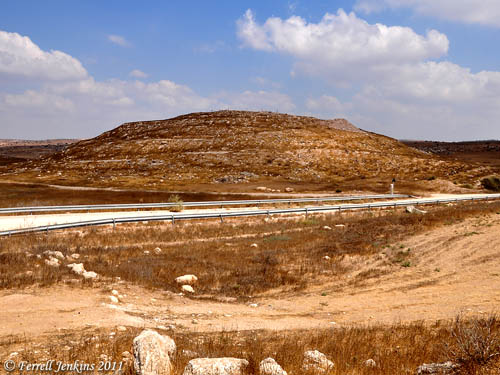
Here is a photo of the tel from the south and perhaps a little to the east.

Tel Eiton (Tel Aitun), possibly biblical Eglon.

Tel Eiton (Tel Aitun) from the south (and east). Photo by Ferrell Jenkins.

Eglon is mentioned at least eight times in the Bible, all in the book of Joshua (10:3, 5, 23, 34, 36, 37; 12:12). The Scripture emphasizes that Israel defeated the king of Eglon. Notice the relationship between Lachish, where we started our trek, and Eglon.

And Joshua and all Israel with him passed on from Lachish to Eglon, and they camped by it and fought against it.  They captured it on that day and struck it with the edge of the sword; and he utterly destroyed that day every person who was in it, according to all that he had done to Lachish.  Then Joshua and all Israel with him went up from Eglon to Hebron, and they fought against it.  (Joshua 10:34-36 NAU)

We also visited the following places.

Tel Bet Mirsim, a site identified as Debir by William F. Albright (Joshua 10:38, 39). Albright identified Tel Eiton as Libnah, but scholars today question this.

Tel Halif, north and slightly east of Beersheba, is thought by some to be biblical Ziklag, . Others place the biblical city at Tel Shera, northwest of Beersheba.

Finally we visit the Brook Besor and Tel el-Farah South. Israel calls the site Tel Sharuhen (1 Samuel 30). This tel is located in the Plain of Philistia, not far from the borders with Egypt and the Gaza Strip.

Hopefully we will be able to share more photos and information about this places with you at a later time. It is all very fascinating to the student of the Bible. Right now it is too late and I need to be sleeping.

Luxor’s Avenue of Sphinxes set to open in October

Many changes are taking place in Luxor. The residents of certain areas are being moved from their older houses in town to new locations. All of this is happening in order to do additional archaeological work and turn the town into an even more popular tourist area. At least that is my idea of what is happening.

The Luxor Times report on the scheduled opening of the Avenue of Sphinxes here.

A grand opening is due to take place in October 2011 to celebrate the newly restored Avenue of Sphinxes.…

Lined with sphinxes, the 2.7 km [1.68 miles] route that connects the grand temples of Luxor and Karnak will be lit by the Sound and Light Company of Egypt.…

For the last 5 years, the restoration project has focused on excavation, conservation, treatment of the water table, and the establishment of protective walls and entrances for tourist. The 120 million LE [20+ million US$] project also involved relocating houses and removing roads, with full compensation paid to all those affected by the development.

The impressive avenue has long been a place of religious significance. In her red chapel in Karnak, Queen Hatshepsut (1502-1482 BC) recorded that she built six chapels dedicated to the god Amun-Re on the route. Successive construction and restoration work commenced during the reigns of Akhenaten (1353-1336 BC), Tutankhamun (1336-1327 BC) and Horemheb (1323-1295 BC).

King Nectanebo I (380-362 BC) of the 30th Dynasty constructed the Avenue of Sphinxes on the older path. It was used for religious ceremonies and processions, marking the annual journey of the sacred boat of Amun on the god’s visit to his wife, Mut, at Luxor temple. An inscription from this time reads “I have built a beautiful road for my father Amun-Re surrounded by walls and decorated with flowers for the journey to the temple of Luxor”. Another inscription bears a cartouche for Queen Cleopatra. It is most likely to be from her visit to the avenue during a Nile trip with Mark Anthony.

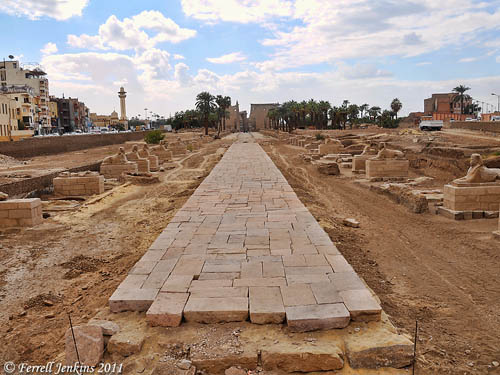
Here is a photo I made of a portion of the Avenue of Sphinxes with a view toward the Luxor Temple.

Avenue of Sphinxes with view toward Luxor Temple. Photo by Ferrell Jenkins.

Avenue of Sphinxes with view toward Luxor Temple. Photo by Ferrell Jenkins.

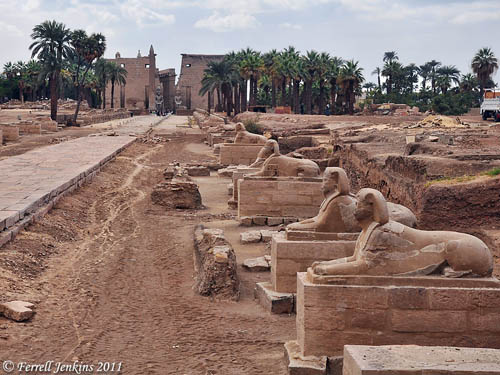
And here is a closer view.

Avenue of Sphinxes with a view view the Luxor Temple. Photo by Ferrell Jenkins.

Avenue of Sphinxes with a view toward the Luxor Temple. Photo by Ferrell Jenkins.

Luxor was known as Thebes in Old Testament times. Both Jeremiah and Ezekiel prophesied the Lord’s judgment of the city. Jeremiah says,

The LORD of hosts, the God of Israel, says, ‘Behold, I am going to punish Amon of Thebes, and Pharaoh, and Egypt along with her gods and her kings, even Pharaoh and those who trust in him’” (Jeremiah 46:25; see also Ezekiel 30:14-16).

HT: Bible Places Blog

Comments on the detestable shepherds in Egypt

A few days ago we wrote in response to the question, “Why were shepherds detestable to Egyptians?”

We get more comments on the posts at Facebook than on the blog itself. Often I wish the (serious) comments were added here. I am going to share some comments made on this post. Christine, a regular reader of the blog and a friend from church, wrote:

“the cattlemen and the sheep herders of the American west were at odds, and I have read that sheep eat roots and all of the grass, ruining the grazing for cattle…could have an economic basis. And I could be wrong.”

Mark T., former student, wrote: “I learned that from reading cowboy books as a teenager. :-) ” [During class? FJ]

Mark B., former tour member, wrote:

“I never thought about the animosities between cattlemen and sheep herders here in the old west and how the sheep tear up the good grass if left to graze too long in one spot. What a great point!”

Listening to the sound tract of Oklahoma would give a tip about the conflict between the cowmen and the farmers. I think the point about the cattlemen and the farmers is a great one to show the conflict that often exists in a society.

However, we must not overlook the point made by John T. Willis that the term livestock includes cattle, sheep, goats, etc. Note the comment.

John T. Willis points out that the term livestock (or cattle; Hebrew, miqneh) is “a comprehensive term including cattle, sheep, goats, and the like” (Genesis in The Living Word Commentary on the Old Testament).

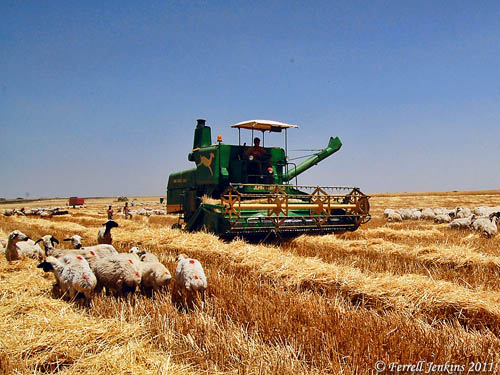
It is common in the Middle East for shepherds to take sheep into a grain field as soon as the harvesting is complete. This could be a real problem if cattle of any kind got into the fields in advance of harvesting. Remember that fences are virtually unknown there.

This photo is one I made in eastern Turkey north of Sanliurfa (and Haran). Even before the combine gets out of the field the shepherds are there with their sheep.

Sheep grazing as a field is being harvested. Photo by Ferrell Jenkins.

Sheep grazing in Eastern Turkey as a field is being harvested. Photo by Ferrell Jenkins.

Recently we posted a photo of sheep grazing in a field that had been harvested in the Shephelah of Israel here.

Archaeologist Sarah Parcak discovers lost pyramids and other antiquities in Egypt

UAB News (University of Alabama at Birmingham) announces a significant discovery by one of their professors.

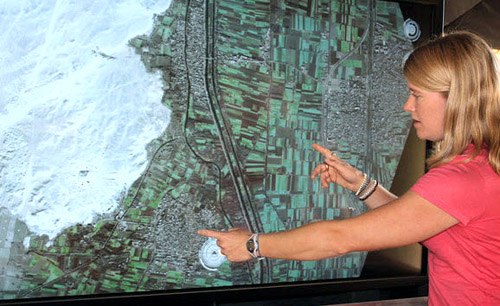
Sarah Parcak, Ph.D., an Egyptologist and assistant professor of archaeology at UAB, used infra-red satellite imaging to discover 17 lost pyramids as well as more than 1,000 tombs and 3,100 ancient settlements.

Dr. Sarah Parcak, UAB, discusses her recent discoveries in Egypt.

Dr. Sarah Parcak, UAB, discusses her recent discoveries in Egypt.

The discovery will be revealed in a BBC documentary next Monday. A different program will be aired on the Discovery Channel later this summer.

At Tanis … Parcak discovered an ancient network of streets and houses, which are completely invisible from the ground.

More information is available in the UAB News here.

Dr. Parcak is well known for her archaeological work and is a member of the American Schools of Oriental Research.

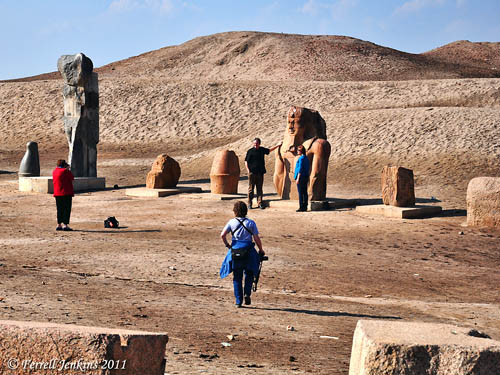
Tourists pose beside ancient monuments at Tanis. Photo by Ferrell Jenkins.

Tourists pose beside ancient monuments at Tanis. Photo by Ferrell Jenkins.

Here we see tourists posing beside the ancient monuments at Tanis. Imagine the complex of houses and streets that may be hidden under the tons of accumulated dirt.

Tanis, modern site of San el-Hagar,  is thought by some Egyptologists to correspond to the Zoan mentioned in several Old Testament references (Numbers 13:22; Psalm 78:12, 43). Kenneth Kitchen says the reference to Hebron being built seven years before Zoan

may indicate a refounding of Zoan in the Middle Kingdom (c. 2000-1800 B.C.), or more probably by the Hyksos kings in the 16th century B.C., whose N capital Avaris Zoan may possible be.” (The New Bible Dictionary, 3rd Ed., 1271)

Location of the Red Sea crossing and Mount Sinai

Others, in addition to the late Ron Wyatt, advocate the Red Sea Crossing at the Gulf of Aqaba/Eilat. Those who take this view also place Mount Sinai in Saudi Arabia.

If you have not taken a look at Life and Land by Gordon Franz, I suggest you do so. Gordon is a careful scholar. His material is always well researched and documented. One category that caught my attention at Life and Land is called Cracked Pot Archaeology. Here is how he describes this category.

The Cracked Pot Archaeology category contains articles about popular, contemporary archaeological theories and ideas that, like cracked pots, hold no water! These articles are a review, scholarly analysis and critiques of theories and ideas that have been presented on the Internet or popular books, movies, DVD’s and videos.

Over the past few years Gordon has written a number of articles about the claims of the late Ron Wyatt and Robert Cornuke. Cornuke claims to have found an anchor from Paul’s shipwreck on Malta. He also claims to have photographed an inscription with the name Yahweh (LORD/Jehovah) on it. The inscription was found near Jebel al-Lawz, in Saudi Arabia, which, according to Cornuke, Wyatt, and several others, is the real Mount Sinai.

Read the response by Franz here. The final sentence by Franz sums it up:

The assertion that Mount Sinai is at Jebel al-Lawz in Saudi Arabia still lacks credible and verifiable historical, geographical, archaeological, or biblical evidence.

You will find links to three articles dealing with the claim that Jebel al-Lawz in Saudi Arabia is Mount Sinai. Another, more technical article by Franz, is entitled “Mount Sinai is not Jebel al-Lawz in Saudi Arabia.” It is available at the ABR web site here.

Franz claims that the article,

will conclusively demonstrated that there is no credible historical, geographical, archaeological or Biblical evidence to support the thesis that Mt. Sinai is at Jebel al-Lawz in Saudi Arabia.

Later on, over a period of weeks (months?), as time permits, I hope to deal with specific questions about the biblical places mentioned in the account of the exodus.

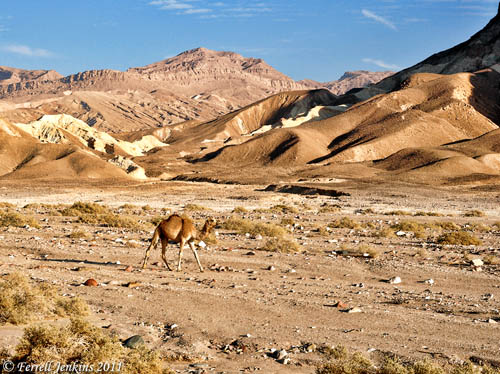
The terrain in the Sinai peninsula is varied. The photo below shows one scene. This photo was made January 25, 2011, the day the Revolution began in Egypt.

A scene in the Sinai Peninsula. Photo by Ferrell Jenkins.

A scene in the Sinai Peninsula. Photo by Ferrell Jenkins.

Pharaoh’s chariot wheels and other things that won’t float — Examining the claims of the late Ron Wyatt

The late Ron Wyatt is noted for his fabulous claims to have located just about every secret thing there is, including Noah’s Ark, the location of Sodom and Gomorrah and the other cities of the plain, Mount Sinai, the location of the crossing of the Red Sea, wheels from Pharaoh’s chariots, the ashes of the red heifer, the ark of the covenant, etc., etc., etc.

Standish and Standish, two Seventh Day Adventist researchers, wrote a response to Wyatt, who was also a Seventh Day Adventist. In Holy Relics or Revelation, they give a list of 92 things Wyatt claimed to have found. This book is available at Amazon, and is partially available online at Google Books.

Ron Wyatt (1933-1999) was a nurse-anesthetist with no training in archaeology. We might more correctly call him an explorer. Few famous, recognized archaeologists have more than one or two fabulous finds to their credit, but Wyatt found almost everything that was missing!

Typically I receive several Emails each year asking about some of the claims of Wyatt, though they do not always mention his name. Recently I received a PowerPoint presentation attached to the Email. The presentation is entitled “Moses & the Red Sea Crossing Truth or Fiction?” Of course, I believe Moses led the developing nation of Israel through the sea. No one takes credit for producing the presentation. There is no documentation other than Scripture references. Looking at the “Properties” of the presentation that someone borrowed a template from some other presentation.

The Claim

The presentation includes a map showing Succoth immediately north of the Gulf of Suez. That is the wrong position. Israel then traveled across the Sinai peninsula through a wadi running east toward Eilat/Aqaba, then southerly to Nuweiba on the Gulf of Aqaba (Eilat). This, according to Wyatt, is exactly where the Israelites crossed the Red Sea out of Egypt (he considered the Sinai peninsula as Egypt) into the wilderness on the east of the Gulf of Aqaba. This is necessary to place Mount Sinai in Saudi Arabia. Wyatt did some scuba diving and found Pharaoh’s chariot wheels, chariot bodies, human and horse bones.

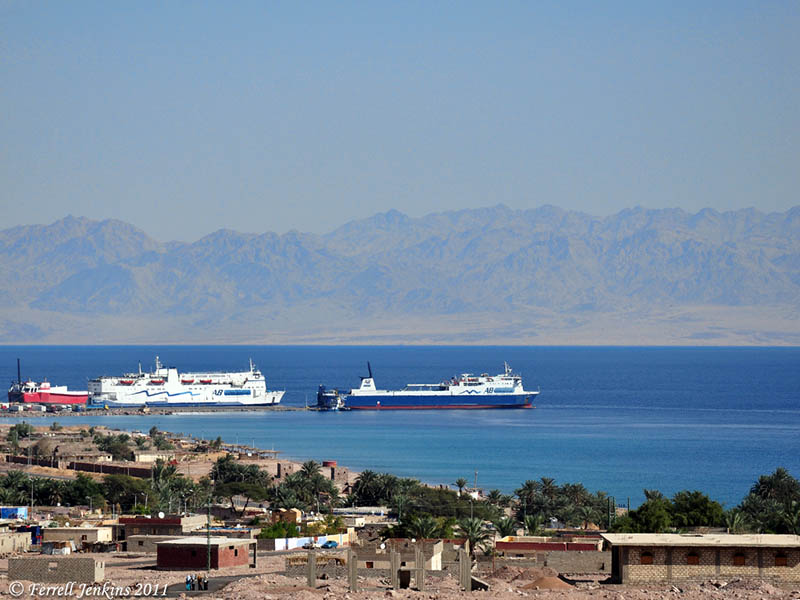
The photo below is one I took in the vicinity of Nuweiba January 26, 2011. The view is east from the Sinai Peninsula to Saudi Arabia. This point is about 160 miles on a straight line from where the presentation map shows Israel leaving Succoth. It is about 45 miles south of Eilat/Aqaba. Eilat is in Israel; Aqaba is in Jordan. Even the modern roads in the Sinai are not built on a straight line.

So he made his chariot ready and took his people with him; and he took six hundred select chariots, and all the other chariots of Egypt with officers over all of them. The LORD hardened the heart of Pharaoh, king of Egypt, and he chased after the sons of Israel as the sons of Israel were going out boldly. Then the Egyptians chased after them with all the horses and chariots of Pharaoh, his horsemen and his army, and they overtook them camping by the sea, beside Pi-hahiroth, in front of Baal-zephon. (Exo 14:6-9 NAU)

Think about it. A large, powerful, professional Egyptian army had to chase “about six hundred thousand men on foot, aside from children” (Exodus 12:37-38). The Israelites also had their “flocks and herds” and “a very large number of livestock” with them. Yet, the Egyptians could not catch them for more than 160 miles!
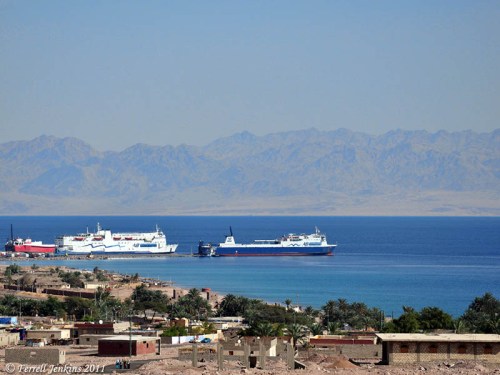
Peninsula east to Saudi Arabia. Photo by Ferrell Jenkins.

View from Sinai Peninsula east to Saudi Arabia. Photo by Ferrell Jenkins.

I don’t have the time now to do more, but I have located some articles that raise serious questions about Wyatt’s claims. Wyatt was never taken seriously by archaeologists (whether conservative or liberal).

Being Certain About What is Uncertain

Carl Rasmussen comments on the scholarly divide concerning landmarks like the Red Sea and Mount Sinai:

Indeed there are at least ten different proposals for the location of the Red Sea or Reed Sea — including three lakes near the Mediterranean Sea, five lakes along the line of the present-day Suez Canal, as well as the Gulf of Suez and the Gulf of Elath. In addition, there are at least twelve different candidates for Mount Sinai: five in the southern part of the peninsula, four in the north, one in the center, one in Midian (Saudi Arabia), and another in Edom (southern Transjordan). (Zondervan Atlas of the Bible, Rev. Ed., 103).

Responses to Wyatt

Wyatt was a Seventh Day Adventist, but when he was actively making his claims several Seventh Day Adventists scholars took up pen to respond to him. We have already mentioned the book by Standish and Standish.
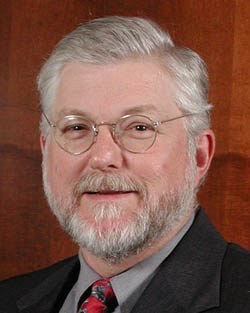
Dr. David Merling

Dr. David Merling

Dr. David Merling is currently Research Associate in Near Eastern Archaeology at Andrews University, Institute of Archaeology, Berrien Springs, MI. For a number of years he served as Curator of the Horn Archaeological Museum. During the 1990s Merling wrote a number of short articles responding to the claims of Ron Wyatt. These have been archived on the Andrews University web site. Merling discusses the following questions:

  • Who am I and why have I opened this Web site? He explains something about his credentials and states that he has been asked these questions “over and over again.” His comments were last updated in 2006.
  • Has Noah’s ark been found?
  • Ark of the Covenant, has it been found?
  • Did the Israelites cross the Red Sea or the Gulf of Aqaba? This is the specific question that we are now discussing.

You may find Dr. Merling’s material here.

The page dealing with the question of the Red Sea crossing includes maps showing the difference between what the Bible says and what Wyatt claimed. There is also a photo of the column that Wyatt claims is from the time of Solomon. Merling shows that it is from the time of Jesus [Roman], and unlike columns from the time of Solomon.

In another post we will mention more material responding to Wyatt and other pseudo-archaeologists.

Camels in biblical times

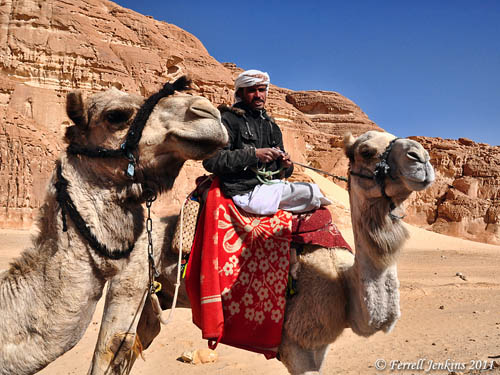
Camels are mentioned in the Bible from the days of Abraham (Genesis 12:16) to New Testament times (Mark 1:6). Recently while traveling in the eastern Sinai peninsula near the Gulf of Aqaba (Eilat) we saw a large number of camels with their riders.

Camels in the Eastern Sinai Peninsula. Photo by Ferrell Jenkins.

Camels in the Eastern Sinai Peninsula. Photo by Ferrell Jenkins.

When the Queen of Sheba visited Jerusalem to quiz Solomon she brought with her a large retinue, with camels carrying valuable gifts for Solomon.

Now when the queen of Sheba heard of the fame of Solomon, she came to Jerusalem to test Solomon with difficult questions. She had a very large retinue, with camels carrying spices and a large amount of gold and precious stones; and when she came to Solomon, she spoke with him about all that was on her heart. Solomon answered all her questions; nothing was hidden from Solomon which he did not explain to her. (2 Chronicles 9:1-2 NAU)

Understanding modern and ancient Egypt

The ancient Egyptians were descendants of Ham through his son Mizraim (Genesis 10:6). Mizraim is “the correct Hebrew word for Egypt, comprising the lower and upper divisions of that land” (The Wycliffe Bible Commentary 14). Most of the inhabitants of Egypt today are Arabs (Semitic, descendants of Shem and Abraham through Ishmael).

Modern Egyptians are caretakers of a history left by an ancient people. I note in recent days that President Mubarak and antiquities director Zawi Hawass try to tie themselves with the ancient Egyptians. They have no genetic connection with the ancient people. That ancient empire crumbled centuries ago.

By the Persian, Hellenistic, and Ptolemaic periods of history, we no longer observe an Egypt ruled by Egyptians but one ruled by foreigners. Descendants of Ham no longer controlled the land, but it was dominated by foreigners who were descendants of Japheth. In the 7th century A.D. the country came under the control of Arab rulers who were descendants of Shem. This same rule by foreigners now continues in the present Egyptian government headed in recent time by presidents Nasser, Sadat, and Mubarak. The modern Egyptians are simply caretakers of the ruins of ancient Egypt.

The prophecy of Ezekiel has been fulfilled.

Thus says the Lord GOD, “I will also destroy the idols And make the images cease from Memphis. And there will no longer be a prince in the land of Egypt; And I will put fear in the land of Egypt. (Ezekiel 30:13).

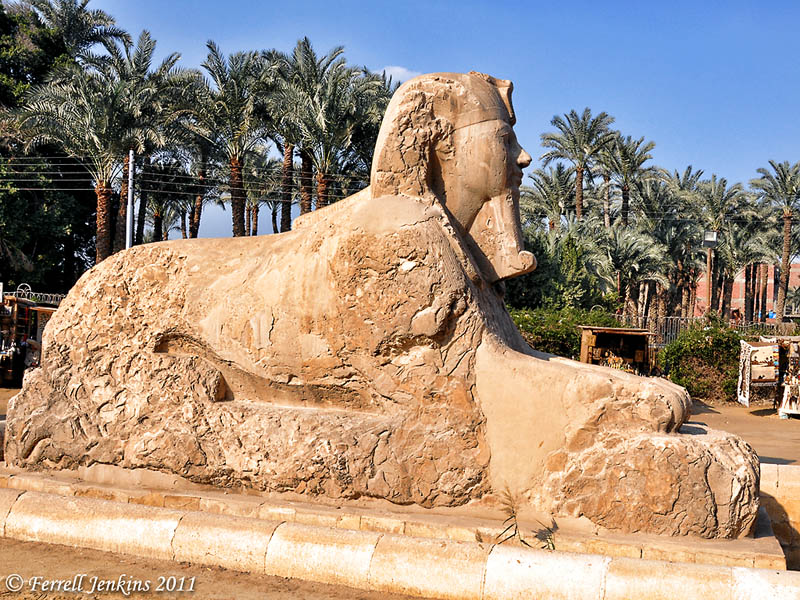
The alabaster sphinx of Memphis, one of the few ruins at the site of the ancient city, has been variously identified. Some suggest that it represents Amenophis II (about 1427-1400 B.C.). The current sign at the site dates the sculpture to 1200 B.C. without the name of any ruler.

The Sphnix of Memphis, Egypt. Photo by Ferrell Jenkins.

The Sphnix of Memphis, Egypt. Photo by Ferrell Jenkins.

The rule of Egypt by foreigners now continues in the present Egyptian government headed in recent time by presidents Nasser, Sadat, and Mubarak. The modern Egyptians are simply caretakers of the ruins of ancient Egypt.

Keeping informed

Egyptian Antiquities. Keep up with breaking news about Egyptian antiquities at Andie Byrnes’ the Egyptology News.

Tomb of the Prophet Zechariah at the Madras Ruins. See the report of the Israel Ministry of Foreign Affairs here. James Davila raises lots of questions about this report. See his Feb. 3, 2011, post here.

HT: Paleojudaica

Photos of Turkey and Greece. Mark Hoffman is making available some nice photos of his recent trip in Turkey and Greece. Read, and find the link to the photos here. The photos are geotagged so you may spot the location in Google Earth.

Birdwatching in Israel.

“There were some 25,000 cranes crowded around us this evening,” reports Judith Schwartz, a Kibbutz Ginosar resident. “One night last week there were 42,000. Your eyes can’t quite believe what you’re seeing. They stand in the lake all night, safe from the bobcats in the area. And here they rest, and lift off in their masses at dawn, blackening the sky like a swarm of gigantic locusts, to continue their 5,000 mile trip to their winter home in Africa.”

At least 500 million birds of 200 different species fly across Israel each spring and fall on their way to and from Africa, Europe and Asia, says Dr. Reuven Yosef, director of Eilat’s International Birding and Research Center. And more than 70 native Israeli species head to warmer Africa in winter, such as the cuckoo, Egyptian vulture, short-toed eagle, hobby and lesser kestrel.

See the full article here.

HT: BiblePlaces Blog