Category Archives: Culture

More about Royal Purple

Reader/friend A.D. Riddle has supplied me with a nice photo of some Murex shells that he made in the Beirut National Museum.

Murex Shells in the National Museum of Beirut. Photo by A.D. Riddle.

Murex Shells in the National Museum of Beirut. Photo by A.D. Riddle.

Riddle also sent a copy of a 2004 essay by Joseph Doumet on “Purple Dye” (in Decade: A Decade of Archaeology and History in the Lebanon. Ed. C. Doumet-Serhal. Beirut: Lebanese of the National Museum). This is fascinating for those who may be interested in following up on this subject.

Some of the comments about the process of dyeing by Pliny the Elder impressed me. Pliny wrote his Natural History during the three years preceding his death in the eruption of Mount Vesuvius (A.D. 79). Pliny writes about the Murex Trunculus in Book 1x.

The murex also does this in a similar manner, but it has the famous flower of purple, sought after for dyeing robes, in the middle of its throat: here is a white vein of very scanty fluid from which that precious dye, suffused with a dark rose colour, is drained, but the rest of the body produces nothing. People strive to catch this fish alive, because it discharges this juice with its life; and from the larger purples they get the juice by stripping off the shell, but they crush the smaller ones alive with the shell, as that is the only way to make them disgorge the juice. The best Asiatic purple is at Tyre.
Notice especially these expressions:

  • Sought after for dyeing robes.
  • Precious dye.
  • The best Asiatic purple is at Tyre.
When purple is blue

The Mosaic law commanded the Israelites to put a blue cord on the corner tassels of their garments.

“Speak to the Israelites and tell them that throughout their generations they are to make tassels for the corners of their garments, and put a blue cord on the tassel at each corner. (Numbers 15:38 CSB)

“Dyeing To Be Holy” is the title of a feature article in The Jewish Daily Forward by Nathan Jeffay. The article says that the source of the dye used to obey the command of the law has been lost for more than 1,200 years.

Roman emperors from the first century BCE onward wanted tekhelet reserved as a status symbol for the governing classes, meaning that it became progressively more difficult for Jews to obtain it. This, together with other political and economic factors, meant that by the eighth century, Jews had lost the tradition of how to obtain the dye, and tzitzit became the all-white fringes that are familiar today.

But now, a Jerusalem-based not-for-profit organization, Ptil Tekhelet, claims to have rediscovered it. “This is the experience of a mitzvah’s renaissance,” said the man leading the group of Talmud-studying snorkelers, Mois Navon, a computer programmer, ordained rabbi and Ptil Tekhelet board member. “For a biblical commandment to be returned to the people is really something significant.”

In the past, rabbinic sources have stated that tekhelet comes from a snail called the hilazon. But hilazon isn’t a biological species name, just a rabbinic name. The mystery was figuring out the species to which they were referring.

The modern search for the answer began in earnest in the early 20th century, when Isaac Herzog, who went on to become the first Ashkenazi chief rabbi of Israel, wrote a doctoral thesis in which he concluded that a snail called the Murex trunculus (the scientific name for hilazon) was the “most likely candidate” for the source of tekhelet.

Hilazon snail. Photo courtesy Ptil Tekhelet.

Hilazon snail. Photo courtesy Ptil Tekhelet.

The report continues,

Key to Herzog’s conclusion was the fact that archaeological digs uncovered large ancient dyeing facilities close to Haifa, and mounds of Murex trunculus broken open, apparently to access their dye.

But Herzog hit a snag. The snail’s dye was purplish blue, not the pure blue described in the Talmud. It took until the early 1980s for this riddle to be solved. In research unrelated to the search for the biblical dye, Otto Elsner, a professor at Shenkar College of Engineering and Design, near Tel Aviv, noticed that on sunny days, Murex trunculus dye became more blue and less purple. It turned out that the missing link between Herzog’s experiments and biblical dyeing methods was ultraviolet light, which transforms the blue-purple colorant to unadulterated blue.

Read the full article here.

There are some dissenting comments with the article.

HT: Joseph Lauer

U.S. Religious Knowledge Survey

During the past week the news media mentioned The Pew Forum’s U.S. Religious Knowledge Survey. This morning the full Survey is available in PDF here.

The warning of the prophet Hosea seems appropriate.

My people are destroyed for lack of knowledge; because you have rejected knowledge, I reject you from being a priest to me. And since you have forgotten the law of your God, I also will forget your children. (Hosea 4:6 ESV)

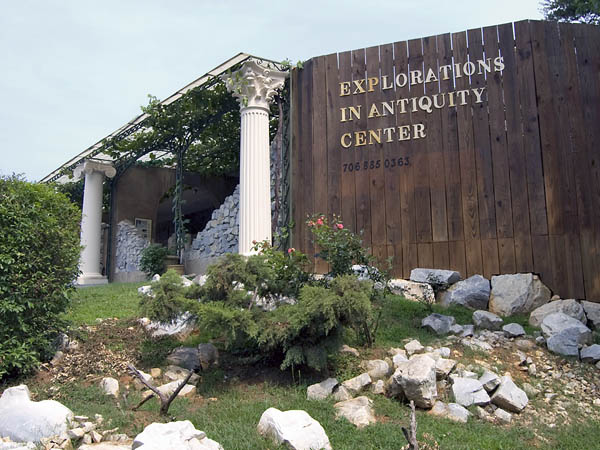
Explorations in Antiquity Center — change of web site

We have called attention to the Explorations in Antiquity Center, LaGrange, Georgia, here, here, here, and here.

Explorations in Antiquity Center. Photo by David Padfield.

Explorations in Antiquity Center. Photo by David Padfield.

Derrick Lewis, manager of EIA, informs us that the website address has changed to http://www.explorationsinantiquity.com. We are pleased to pass along this information.

King of Israel felled by stray arrow

The story is in 1 Kings 22. Ahab, king of Israel (874-853 B.C.), and Jehoshaphat, king of Judah (870-848), decided to try to take back the city of Ramoth-gilead which had fallen under the control of the king of Aram (Syria). Ramoth-gilead is a city of tranjordan, now in the northern part of Jordan near the border with modern Syria.

Ahab was fearful to be seen in battle and disguised himself to avoid attack.

Now an archer shot an arrow at random, and it struck the king of Israel between the plates of his armor. The king ordered his charioteer, “Turn around and take me from the battle line, because I’m wounded.” (1 Kings 22:34 NET)

The king of Israel died and was taken to Samaria for burial.

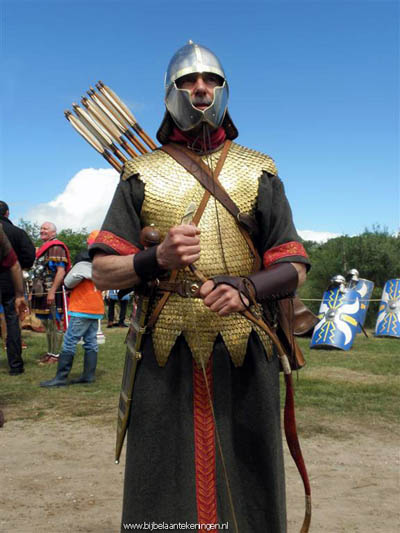
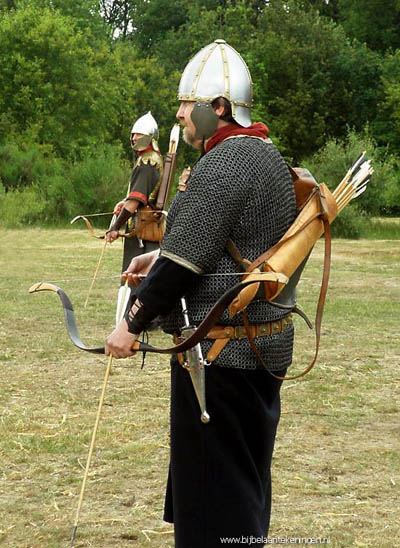
JP van de Giessen, a fellow blogger at Aantekeningen bij de Bijbel, has kindly granted permission for the use of these wonderful photos he made at the Romanfestival in Nijmegen (the Netherlands). He tells me that the festival is organized every two years with many actors. At this festival there were about 100 soldiers, 10 calvary and 120 civilian people (from slave to noble).

JP says the archers he photographed are Persian archers dressed according to the time of the Seleucids (the period between the testaments). They provide great illustrations for a lesson on 1 Kings 22.

Persian archer dressed as at the time of the Seleucids. Photo: JP van de Giessen.

Archer from the time of the Seleucids. Photo: JP van de Giessen.

According to JP, one of the archers he spoke with said he needed a year to create his costume, and another year for his bow and sword.

Archer from time of Seleucids. Photo by archer dressed as at the time of the Seleucids. Photo: JP van de Giessen.

Archer dressed as at the time of the Seleucids. Photo: JP van de Giessen.

More photos may be viewed here. JP van de Giessen holds the rights to these photos, but I think he is pleased when they are used in teaching. Click on the photo for a larger image.

Samaritan synagogue discovered near Beth-shean

The Israel Antiquities Authority announced the discovery of a 1,500 year old Samaritan synagogue southwest of Beth-shean (Bet She’an).

The remains of a synagogue and farmstead that operated in the Late Byzantine period, which were unknown until now, were exposed in an archaeological excavation conducted on behalf of the Israel Antiquities Authority and underwritten by the Ministry of Construction and Housing, prior to enlarging a residential quarter south of Bet Sheʽan, c. one half kilometer west of the Jordan Valley highway (Route 90).

According to Dr. Walid Atrash and Mr. Ya’aqov Harel, directors of the excavation for the Israel Antiquities Authority, “The discovery of another Samaritan synagogue in the agricultural hinterland south of Bet She’an supplements our existing knowledge about the Samaritan population in this period. It seems that the structures uncovered there were built at the end of the fifth century CE and they continued to exist until the eve of the Muslim conquest in 634 CE, when the Samaritans abandoned the complex. The synagogue that is currently being revealed played an important part in the lives of the farmers who inhabited the surrounding region, and it served as a center of the spiritual, religious and social life there. In the Byzantine period (fourth century CE) Bet She’an became an important Samaritan center under the leadership of Baba Rabbah, at which time the Samaritans were granted national sovereignty and were free to decide their own destiny. This was the case until the end of the reign of Emperor Justinian, when the Samaritans revolted against the government. The rebellion was put down and the Samaritans ceased to exist as a nation.”

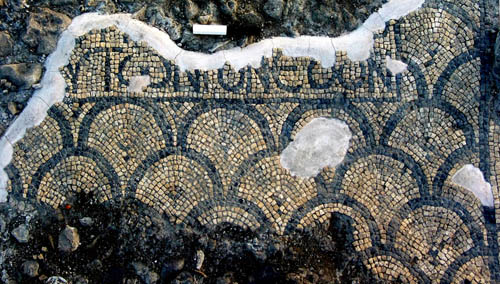
The building, facing Mount Gerizim, had a mosaic floor. The last line of a Greek inscription was revealed. According to the report, the inscription reads,

T[ ]OUTON NEWN — meaning “This is the temple.”

There will likely be other suggestions on the reading of the inscription.

Samaritan Synagogue Inscription. Photo by Tal Rogovski, IAA.

Samaritan Synagogue Inscription. Photo courtesy IAA.

This is the third Samaritan synagogue to be found in the vicinity of Beth-shean.

The full report may be read here.

Bible students know that the Samaritans play an important role in both the Old Testament and the New Testament. Follow these references for some information: 2 Kings 17:29; Luke 9:52; John 4; Acts 8;25.

HT: Joseph Lauer; Todd Bolen, Bible Places Blog.

Uchisar in Cappadocia

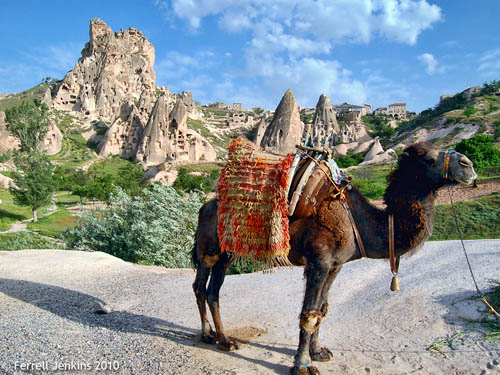
This photo was made in Uchisar in the region of Cappadocia in Turkey.

Uchisar in Cappadocia, Turkey

A camel at Uchisar in the region of Cappadocia. Photo by Ferrell Jenkins.

The Bible tells us that Jews of Cappadocia were present in Jerusalem on the day of Pentecost (Acts 2:9). Peter wrote his epistles to saints scattered throughout Cappadocia and other places in Roman Asia Minor (modern Turkey).

Peter, an apostle of Jesus Christ, To those who are elect exiles of the dispersion in Pontus, Galatia, Cappadocia, Asia, and Bithynia,  2 according to the foreknowledge of God the Father, in the sanctification of the Spirit, for obedience to Jesus Christ and for sprinkling with his blood: May grace and peace be multiplied to you. (1 Peter 1:1-2)

A real Word Press

Monday I visited the Ulster-American Folk Park in County Tyrone, Northern Ireland. This is a marvelous open-air museum with old houses, some of which have been moved from their original place to the Park for preservation. One of the houses belonged to Judge Thomas Mellon,  founder of the Pittsburgh banking dynasty.

One of the houses that caught my attention was the house of a common (poor) family of about 1790. I wrote about it in a different blog here.

The park traces the movement of immigrants from Ireland to America. Having been interested in printing since taking a course in letter press printing during my Junior year in high school, I found the print shop of interest.

There was an old Remington typewriter in the window of the print shop.

Typewriter at Ulster-American Folk Park

Typewriter at Ulster-American Folk Park. Photo by Ferrell Jenkins.

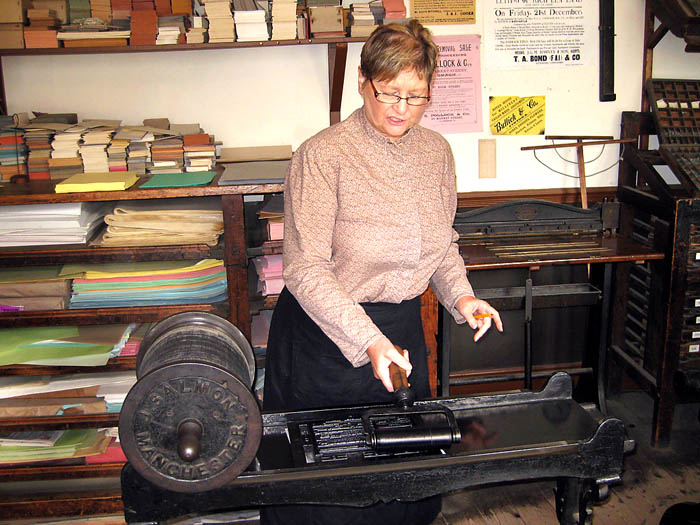
The lady printer is operating a proof press. She actually printed a contract of passage for me to board a ship and sail for the New World.

Proof press at ulster-American Folk Park. Photo by Ferrell Jenkins.

Proof press at Ulster-American Folk Park. Photo by Ferrell Jenkins.

Now that’s a real Word Press.

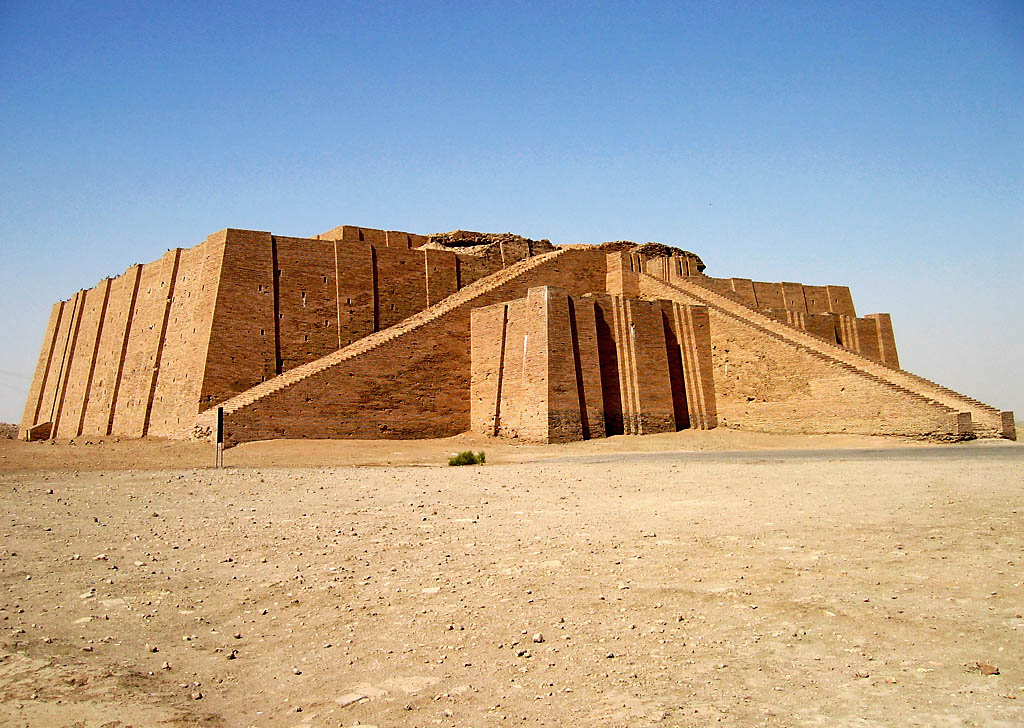
The ziggurat at Ur

The pyramids of Egypt are fairly well known to students in the Western world. Some study is made of them in the elementary grades. The ziggurats of Mesopotamia (mostly present day Iraq) are not as well known. In Egypt we have some pyramids, like the great pyramids of Giza, which are still standing to almost their original height. Having been made of stone, they have been fairly well preserved.

The ziggurats of Mesopotamia were made of baked bricks. Over the centuries they have tended to become piles of mud. The only one I saw during my only visit to Iraq in May, 1970, that had any semblance of a defined shape was the ziggurat at Ur. That was because it had been reconstructed up to about the fourth story.

The ziggurat was a staged temple tower. The temple at the top of the tower was considered the dwelling place of the particular god worshiped at a site. The kings of Ur are thought to have built the first ziggurat about the 27th century B.C., though some may have been erected on older structures going back to about 3100-2900 B.C. (The Middle East, Hachette World Guides, 1966). A model, like the one below from the Pergamum Museum in Berlin gives us a good impression of the original appearance of the ziggurats.

Ziggurat Model at the Pergamum Museum, Berlin. Photo by Ferrell Jenkins.

Ziggurat Model at the Pergamum Museum, Berlin. Photo by Ferrell Jenkins.

Every now and then I search the Internet for photos of Iraq. Sometimes I locate a nice photo made by a soldier who has been stationed there. One day I came across a really great photo on Flickr made by Josh McFall. It took a while to track down Josh and ask his permission to use the photo on the web site. He enthusiastically grated permission, only asking that I comply with the attached Creative Commons license. That, I was pleased to do. The Creative Commons license on this photo requires Attribution, Non-commercial Use, and No Derivative works. Josh, I am sure many of my readers thank you.

The ziggurat at Ur is attributed to the third dynasty of Ur (2124-2015 B.C.).

Ziggurat at Ur in Iraq. Photo by Josh McFall.

Reconstructed Ziggurat at Ur in Iraq. Photo by Josh McFall.

Perhaps we should think of something like the ziggurats when we study the account of the building of the tower of Babel in Genesis 11.

Then they said, “Come, let us build ourselves a city and a tower with its top in the heavens, and let us make a name for ourselves, lest we be dispersed over the face of the whole earth.” (Genesis 11:4 ESV)

And it might help with the understanding of what Jacob saw in his dream at Bethel.

And he dreamed, and behold, there was a ladder set up on the earth, and the top of it reached to heaven. And behold, the angels of God were ascending and descending on it! (Genesis 28:12 ESV)

When John calls attention to this scene he says the angels were ascending and descending on the “Son of Man” (John 1:51).

Both photos are available in presentation size for those who would like to use them. Just click on the image.

The Ostrich in Bible Times

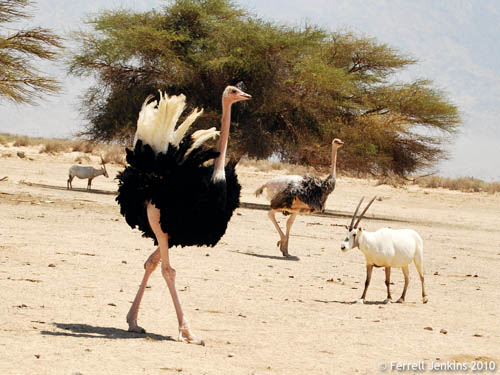
The ostrich is listed among the unclean birds for the Israelites in Leviticus 11:16 and Deuteronomy 14:15. Job laments that he is “a companion of ostriches” (Job 30:29). The longest section of scripture mentioning the ostrich is in the the response by the LORD.

“The wings of the ostrich wave proudly, but are they the pinions and plumage of love? For she leaves her eggs to the earth and lets them be warmed on the ground, forgetting that a foot may crush them and that the wild beast may trample them. She deals cruelly with her young, as if they were not hers; though her labor be in vain, yet she has no fear, because God has made her forget wisdom and given her no share in understanding. When she rouses herself to flee, she laughs at the horse and his rider. (Job 39:13-18 ESV)

Ostrich at the Hai Bar Nature Reserve. Photo by Ferrell Jenkins.

Ostriches at the Hai Bar Nature Reserve. Photo by Ferrell Jenkins.

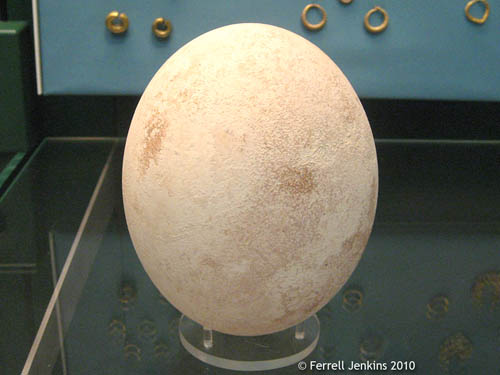
Archaeologists uncovered this ostrich egg pictured below from the MB II level (1750–1550 B.C.) at Lachish. The sign with the display at the British Museum says,

Ostriches were native to the Levant and their eggs, plain or decorated were often included in tomb deposits.

Ostrich Egg discovered at MB II Lachish. British Museum. Photo by Ferrell Jenkins.

Ostrich Egg discovered at MB II Lachish. British Museum. Photo by Ferrell Jenkins.

After the destruction of Jerusalem in 586 B.C., Jeremiah lamented that “the daughter of my people has become cruel, like the ostriches in the wilderness.” (Lamentations 4:3 ESV)