Category Archives: Culture

The sheep of His pasture

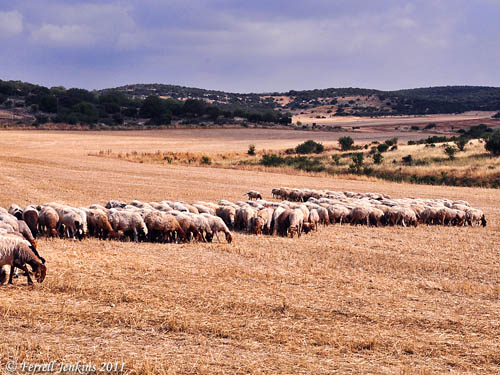
The photo we are sharing today is typical of the beautiful scenes in the Shephelah (lowland) of Israel in the spring (Obadiah 1:19). After the grain has been harvested the sheep are led by their shepherd into the fields to graze. The photo today shows the fields and hills between the Valley of Elah and Beit Guvrin to the east of Highway 38. This is near the entry to the Adullam Grove Nature Reserve and Horbat Midras.

Sheep grazing in the Shephelah. Photo by Ferrell Jenkins.

Sheep grazing in the Shephelah. Photo by Ferrell Jenkins.

Numerous biblical references come to mind. Note what the Psalmist said about the role of man in relation to the animals.

You have given him dominion over the works of your hands; you have put all things under his feet, all sheep and oxen, and also the beasts of the field, the birds of the heavens, and the fish of the sea, whatever passes along the paths of the seas. O LORD, our Lord, how majestic is your name in all the earth!  (Psalm 8:6-9 ESV)

Or, the reference to God’s people as the sheep of His pasture.

But we your people, the sheep of your pasture, will give thanks to you forever; from generation to generation we will recount your praise. (Psalm 79:13-1; cf. 100:3 ESV)

Or, perhaps the most familiar of all:

The LORD is my shepherd; I shall not want. (Psalm 23:1 ESV)

A hi-res photo suitable for use in teaching is available by clicking on the image. You can make your own caption across the sky or the grain field.

Archaeologist Sarah Parcak discovers lost pyramids and other antiquities in Egypt

UAB News (University of Alabama at Birmingham) announces a significant discovery by one of their professors.

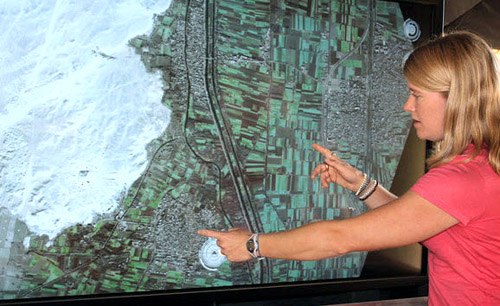
Sarah Parcak, Ph.D., an Egyptologist and assistant professor of archaeology at UAB, used infra-red satellite imaging to discover 17 lost pyramids as well as more than 1,000 tombs and 3,100 ancient settlements.

Dr. Sarah Parcak, UAB, discusses her recent discoveries in Egypt.

Dr. Sarah Parcak, UAB, discusses her recent discoveries in Egypt.

The discovery will be revealed in a BBC documentary next Monday. A different program will be aired on the Discovery Channel later this summer.

At Tanis … Parcak discovered an ancient network of streets and houses, which are completely invisible from the ground.

More information is available in the UAB News here.

Dr. Parcak is well known for her archaeological work and is a member of the American Schools of Oriental Research.

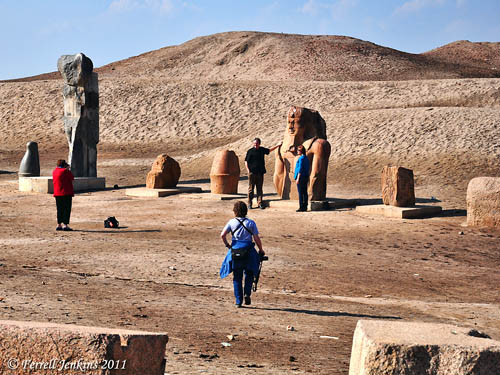
Tourists pose beside ancient monuments at Tanis. Photo by Ferrell Jenkins.

Tourists pose beside ancient monuments at Tanis. Photo by Ferrell Jenkins.

Here we see tourists posing beside the ancient monuments at Tanis. Imagine the complex of houses and streets that may be hidden under the tons of accumulated dirt.

Tanis, modern site of San el-Hagar,  is thought by some Egyptologists to correspond to the Zoan mentioned in several Old Testament references (Numbers 13:22; Psalm 78:12, 43). Kenneth Kitchen says the reference to Hebron being built seven years before Zoan

may indicate a refounding of Zoan in the Middle Kingdom (c. 2000-1800 B.C.), or more probably by the Hyksos kings in the 16th century B.C., whose N capital Avaris Zoan may possible be.” (The New Bible Dictionary, 3rd Ed., 1271)

The Golden Age of Ebla — before the biblical Patriarchs

My only visit to Ebla was in 2002. This means I do not have hi-res photos, except for a few slides that I have had digitized, but I am delighted to have any photos. At the site I picked up a small booklet, Tell Mardikh — Ebla, written by Faja Haj Muhammad that gives a short presentation of the history and remains of the kingdom of ancient Ebla. I will share a couple of photos with some brief info from that book.

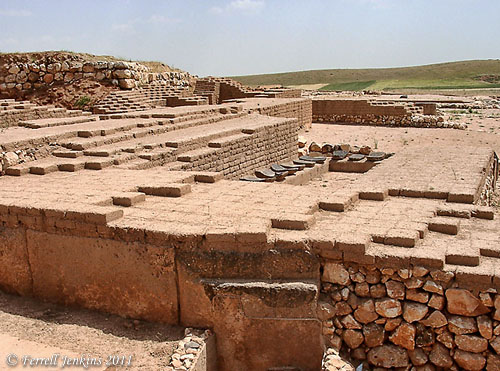
The first photo shows the reconstruction of the Palace of the Crown Prince (Palace Q or Western Palace). This palace, built of mud brick, is “located in the lower town, west of the Acropolis.” In the portion of the palace shown here you will see “a well preserved room, used for the grinding of cereals, in order to prepare bread for hundreds of persons.”

Ebla Western Palace Reconstruction. Photo by Ferrell Jenkins.

Ebla Western Palace Reconstruction. Note the grinding stones. Photo by Ferrell Jenkins.

The Royal Archives. In 1975 the excavators discovered a square room west of the Administrative Wing, on the wall, filled with 17,000 clay tablets. The large square tablets had been on shelves. The small round one were found in baskets on the floor.

… the texts were placed according to their subject, and different subjects corresponded to different shapes of tablet.

… There are administrative, economical, historical, judicial, religious texts. The writing is cuneiform. The language is a local language, now called by scholars (Eblaite), which belongs to the same family as Akkadian of Mesopotamia.

Ebla Archives Room. Photo by Ferrell Jenkins.

Ebla Archives Room. Photo by Ferrell Jenkins.

The Western Palace and the Archive are dated to the first golden age of Ebla, 2400–2250 B.C. This is long before the time of Abraham who lived north of Ebla at Haran in Padan Aram for a time. Haran is about 150 miles north of Ebla.

So Abram went, as the LORD had told him, and Lot went with him. Abram was seventy-five years old when he departed from Haran.  (Genesis 12:4 ESV)

Isaac took Rebekah, the daughter of Bethuel the Aramean of Paddan-aram to be his wife (Genesis 25:20). Jacob spent more than two decades in the same area. Most of the children of Jacob (= Israel) were born in the region.

God appeared to Jacob again, when he came from Paddan-aram, and blessed him. (Genesis 35:9 ESV)

When did Abraham live? I don’t want to begin a fight, but I will note several dates suggested by scholars for Abraham.

  • Between 2000 and 1700 B.C. A large number of scholars such as Glueck, Albright, and Wright took this position.
  • 14th Century B.C. This was the view of Cyrus Gordon. (Too late for me.)
  • Born 2165 B.C. The view of John Davis in his excellent book, Paradise to Prison. Davis understands Galatians 3:17 to begin with the arrival of Abraham in Egypt.
  • Born 1950 B.C. This view says Galatians 3:17 is dated from the entrance to Canaan (Genesis 12:4). My inclinations are here.

Now you have something to work on. My only point here is to show that Ebla was a powerful, thriving, economic power long before Abraham. Ebla flourished again in Middle Bronze I-II (1850-1600 B.C.). It is possible that Isaac and Jacob knew of the city.

Fields white for harvest

Many biblical accounts contain information not easily understood without some knowledge of the history and culture of the time. Such is true in the account of Jesus traveling through Samaria in John 4. You probably recall that He met the woman of Samaria when she came to the well to draw water.

While His disciples were in the city buying food Jesus taught the Samaritan woman. She then went into the city and began to tell the men that she had met this man who knew her intimate life.

When the disciples returned to Jesus He said,

Do you not say, ‘There are yet four months, then comes the harvest’? Look, I tell you, lift up your eyes, and see that the fields are white for harvest. (John 4:35 ESV)

This is one of those statements with a literal meaning as well as a spiritual one. What did he mean by four months? Four months separate the sowing and the harvesting. Barley harvest could begin around April 15. Wheat harvesting begins six weeks later in late May or early June. In May the fields would be white unto harvest. This helps to date the episode in John 4 to December or January, depending on whether the crop was barley or wheat.

When Jesus said the fields were white for harvest He was speaking of a spiritual harvest. The disciples did not know that He and the woman had already sowed the seed. They would reap the harvest. It is not inappropriate to see the harvesting in the two days Jesus stayed there teaching (John 4:39-43), or in the later events of Acts 8:39-43.

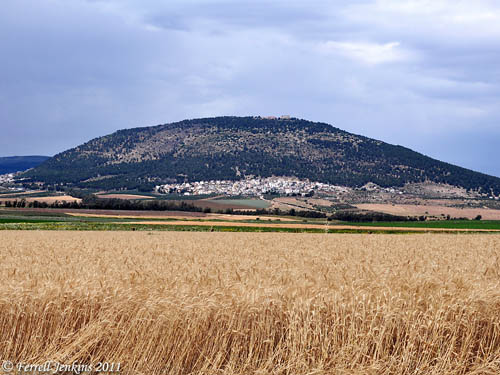
The photo below was made from En-Dor, looking north to Mount Tabor. The wheat fields are almost ready for harvesting.

Wheat ready for harvest at En-Dor near Mount Tabor. Photo by Ferrell Jenkins.

Wheat ready for harvest at En-Dor near Mount Tabor. Photo by Ferrell Jenkins.

Under some light the fields even have a white appearance, as you see in the photo below.

Wheat ready for harvest near En-Dor and Mount Tabor. May 13. Photo by Ferrell Jenkins.

Wheat white for harvest. May 13. Photo by Ferrell Jenkins.

These little tips, scattered here and there in Scripture, reveal much about the daily life and culture of Bible times.

Shepherd with sheep and goats at Socoh

Today we visited sites in the Shephelah (lowlands, foothills, Deuteronomy 1:7). We discussed the importance of the Sorek Valley, Beth Shemesh, Timnah, Eshtaol, Zorah. Think of Samson. We noted the important sites associated with the Valley of Elah: Azekah, Khirbet Queiyafa (the Elah Fortress), and Socoh. Think of David and Goliath.

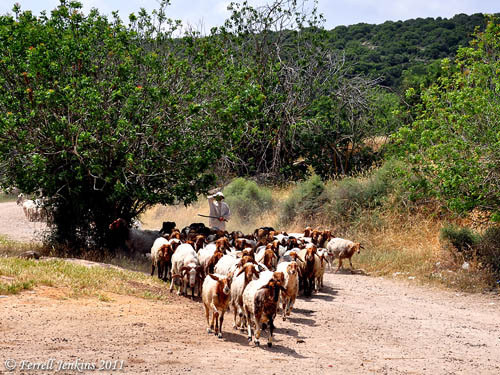
At Socoh (1 Samuel 17:1) we had one of those nice moments on tour when something unexpected comes along. We saw two shepherds bringing their sheep and goats to water. The photo below is one of several that I made.

Shepherd with sheep and goats at Soccoh. Photo by Ferrell Jenkins.

Shepherd with sheep and goats at Socoh. Photo by Ferrell Jenkins.

I am reminded of the teaching of Jesus about the importance of the shepherd.

When he saw the crowds, he had compassion on them because they were bewildered and helpless, like sheep without a shepherd. Then he said to his disciples, “The harvest is plentiful, but the workers are few. Therefore ask the Lord of the harvest to send out workers into his harvest.” (Matthew 9:36-1 NET)

We also made stops at Lachish and Gath before dinner along the Mediterranean Sea at Joppa, and then heading for the airport.

Our group is scheduled to depart for the USA shortly after midnight. Six tour members are staying over for varying length to pursue additional visits throughout the area.

Thank you for following the blog these past two weeks. I have written less than usual due to the demands of the tour, and this will continue for another week as I spend time in additional study here. Stay with me.

Prayers disturbed by a snake in the wall

Our group went to the Western Wall this afternoon. The Western Wall, sometimes called the Wailing Wall by non-Jews, is part of the enclosure built by Herod the Great around the temple precinct in Jerusalem. The temple and everything else on the top of the platform was destroyed by the Romans in A.D. 70.

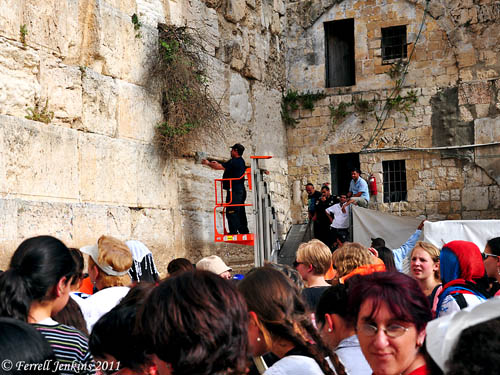
The Western Wall is now a place for prayer. Men have a large portion of it for their use. To the south there is a small area for women. I entered the enclosure north of the men’s section to get a photo of Wilson’s Arch. When I came out I noticed a workman on the lift trying to get something out of the wall with a long stick. At first I thought he was removing some of the paper prayers that had been left in the wall by worshipers. I learned from one of our ladies who was there that a snake had been seen by the ladies.

Of more interest to me was that the snake was somewhere around the lintel of Barclay’s Gate.

Women watch at the Western Wall while workmen remove snake from the wall. Photo by Ferrell Jenkins.

Women watch at the Western Wall while workmen remove snake from the wall. Photo by Ferrell Jenkins.

It is not often that one see’s men on the women’s side of the Western Wall plaza. Well, I never have before.

A number of biblical references come to mind. The prophet Amos says,

18 Alas, you who are longing for the day of the LORD, For what purpose will the day of the LORD be to you? It will be darkness and not light;
19 As when a man flees from a lion And a bear meets him, Or goes home, leans his hand against the wall And a snake bites him.
20 Will not the day of the LORD be darkness instead of light, Even gloom with no brightness in it?  (Amos 5:18-20 NAU)

I imagine the same thing would happen to a woman as well as to a man.

We recall the serpent of the Garden of Eden (Genesis 3). Paul used that event as an illustration.

 But I am afraid that, as the serpent deceived Eve by his craftiness, your minds will be led astray from the simplicity and purity of devotion to Christ. (2 Corinthians 11:3 NAU)

Earlier today we visited the Herodian Family tomb, the Second Temple Model, Shrine of the Book, and the archaeological section of the Israel Museum. I had visited the renovated Museum in January and was ready to take the group to some of the more significant biblically related artifacts. For the earlier discussion of some of these things see here (Old Testament) and here (New Testament).

In the afternoon we entered the Old City and visited the Jewish Quarter and the Western Wall.

We look forward to completing our planned visit of the Old City tomorrow. Lots of walking in the Old City.

Everyone in the group is doing well and seems to be enjoying the experience. We have about a dozen who have been here at least once before. They are seeing new things every day and enjoying a revisit to things they saw on a previous tour.

The mosaics of the Antakya Museum

Yesterday’s post about Antakya, Turkey (biblical Antioch of Syria, Acts 11), was highly popular. We had more than 1400 hits. Thanks for your interest. We hope you will find other entries of interest as well.

Take a look at the two good comments on the previous post. One from Balagebalogh calls attention to the mosaics from Antakya that are in the Baltimore Museum of Art and to his illustration of Antioch, and another from TBrinley calling attention to the mosaics in the Antakya Museum. I haven’t had the opportunity to visit the Baltimore museum, but I have been to the Antakya Museum a few times.

I thought I would share just one of the many mosaics displayed in the Antakya Museum. These mosaics typically date to the fourth or fifth century as I recall. (I am away from home and do not have access to my usual sources.)

Our photo shows a beautifully preserved mosaic displayed on a large wall. I am taking the liberty of copying info about it from Sacred Destinations, a site we have recommended before. Regarding this mosaic the site says,

Detail of mosaic from the floor of the 5th-century Bath of Apolausis, a small suburban bath uncovered in the Antioch excavations on the slopes of Mount Silpios, east of the city. The woman depicted in the middle is Soteria (Salvation) who formed a pair with Apolausis (Enjoyment). Soteria and Apolausis were minor deities who had the power to deliver people from danger and were popularly associated in late antiquity with baths, whose warm waters could give pleasure and soothe pain. Antakya Museum.

Antakya Museum mosaic displayed on wall. Photo by Ferrell Jenkins.

Antakya Museum mosaic displayed on wall. Photo by Ferrell Jenkins.

Beautiful, isn’t it? Turkey is filled with similar mosaics. I recall especially those from Zeugma displayed in the Gaziantep Museum.

Homemade in the Golan Heights

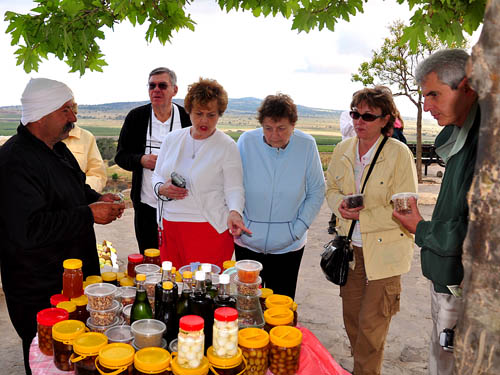
Today I am traveling, but I thought I would share a photo that illustrates one of the educational and sometimes fun things about travel in cultures other than our own. This Arab peddler has set up his table in the Golan Heights at the overlook from Israel into Kuneitra (Quneitra), Syria.

He seems to have a nice variety of the local goodies: olives, olive oil, nuts, and various fruits. Are those pickled eggs? He has already made two sales and it appears he is about to make a third. It can be really chilly in the Golan Heights, even in early May. Some of the potential customers would probably more quickly buy a sweat shirt.

Peddling homemade goodies in the Golan Heights. Photo by Ferrell Jenkins.

Peddling homemade goodies in the Golan Heights. Photo by Ferrell Jenkins.

Could the ancient metal books be more Kinderhook Plates?

The late Dr. James D. Bales, one of the founding members of the Evangelical Theological Society, and long-time Professor of Christian Doctrine at Harding University, wrote The Book of Mormon? in 1958 (Rosemead, CA: Old Paths Book Club). In this book he tells the story of the Kinderhook Plates.

The Kinderhook Plates were concocted by a few citizens of Kinderhook, Illinois, to demonstrate that the Mormon leader Joseph Smith was not able to read ancient plates like those he claimed to have read in the production of the Book of Mormon.

Bales explains the background of the fraud:

The following is found in Times and Seasons (IV:186-187, May 1, 1843). We quote it as we copied it from the Millennial Star. “On the 16th of April last a respectable merchant by the name of Robert Wiley, commenced digging in a large mound near this place: he excavated to the depth of ten feet and came to rock; about that time the rain began to fall, and he abandoned the work. On the 23rd he and quite a number of the citizens with myself, repaired to the mound, and after making ample opening, we found plenty of rock the most of which appeared as though it had been strongly burned; and after removing full two feet of said rock, we found plenty of charcoal and ashes; also human bones that appeared as though they had been burned; and near the eciphalon a bundle was found that consisted of six plates of brass, of a bell shape, each having a hole near the small end, and a ring through them all, and clasped with two clasps, the ring and clasps appeared to be of iron, very much oxidated. The plates appeared first to be copper, and had the appearance of being covered with characters. It was agreed by the company that I should cleanse the plates. Accordingly, I took them to my house, washed them with soap and water, and a woolen cloth; but, finding them not yet cleansed, I treated them with dilute sulphuric acid which made them perfectly clean, on which it appeared that they were completely covered with hieroglyphics that none as yet have been able to read. Wishing that the world might know the hidden things as fast as they come to light, I was induced to state the facts, hoping that you would give it an insertion in your excellent paper; for we all feel anxious to know the true meaning of the plates, and publishing the facts might lead to the true translation. They were found, I judged, more than twelve feet below the surface of the top of the mound.

“I am. most respectfully, a citizen of Kinderhook,

W. P. Harris, M. D.”

Nine citizens of Kinderhook signed a statement certifying the truthfulness of the statement by Dr. Harris.

Smith agreed that he would translate the plates if they were first submitted to some learned societies for translation. Eventually, after no one was able to translate the Plates,  Smith translated them. According to Bales, he said,

I have translated a portion of them, and find they contain the history of the person with whom they were found. He was a descendant of Ham, through the loins of Pharaoh, King of Egypt, and that he received his kingdom from the Ruler of Heaven and earth” (Millennial
Star, XXI:41. Extract from Smith’s diary, dated Monday, May 1, 1843).” (Bales, 92-93).

Bales also cites the testimony of the famous Egyptologist James H. Breasted.

James H. Breasted, Orientalist, Historian, Egyptologist, and Professor of Egyptology in the University of Chicago — from 1905 and a number of years thereafter — stated in a letter of R. B. Neal, on April 20, 1914 that the “Kinderhook Plates are, of course, childish forgeries, as the scientific world has known for years.” (Bales, 98)

You may see facsimiles of the Kinderhook Plates in the Salt Lake City Messenger, October, 1981) here, and at a Mormon apologetic site here.

When I first saw the photographs of the ancient lead codices we wrote about in the previous post, I immediately thought of the Kinderhook Plates.

But, maybe I am wrong! Time will tell, and I will be delighted to change my mind.

This should be a good one for April 1.

The pot may be calling the kettle black

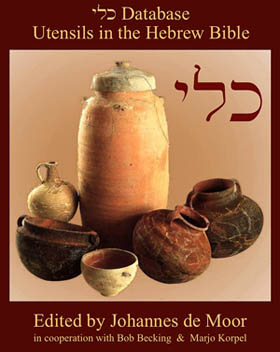
KLY Website - Dutch society for Old Testament Studies.The Dutch society for Old Testament study (OTW), after ten years of planning and work, has put online a research project to “elucidate the names of utensils in biblical Hebrew making methodical use of partially new approaches.”

The new web site, KLY, is written in the Dutch language, but there is an introduction in English. Here is a portion of it:

The problem with identifying utensils in the Hebrew Bible is that their common everyday use made it superfluous to provide detailed descriptions of the vessels or implements in written form. Everyone knew from experience what was meant. As a result dictionaries of biblical Hebrew often have to content themselves with non-descript generalizations like “bowl”, “jar”, “pot”, “knife”. Mostly the shape and purpose of a given utensil can not be established on the basis of context alone because the number of occurrences is too low. Archaeology has brought to light large quantities of pottery and implements, but in many cases we do not know which word in ancient Hebrew was used for the object unearthed.

Meanwhile the possibilities for resolving such problems have increased dramatically. Not only archaeology, but also comparative linguistics, iconography, anthropology, improved understanding of the ancient versions of the Bible have enhanced our chances to come closer to the precise nature of the objects.

Some knowledge of Hebrew will be helpful, but English-only readers will be able to go to the KLY database, click on a Hebrew letter, and see the terms considered with the English usage. From there you can move to the dictionary entry on the term. The entries are in Hebrew and English. Distribution of each term in the Torah (Law), Nebiim (Nevi’im, prophets), and Ketubim (Writings) is given.

As a future project, an English Index could make this an extremely valuable  project for many more readers.

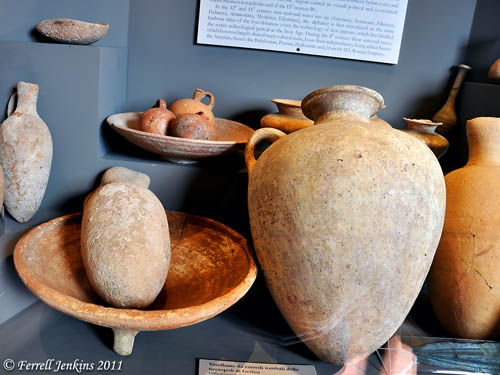
MB2 Pottery from Jericho. Vatican Museum. Photo by Ferrell Jenkins.

MB2 Pottery from Jericho. Vatican Museum. Photo by Ferrell Jenkins.

It would be possible for an energetic person to download all of the PDF entries and compile them into one document. This would make for easy searching.

If our Dutch friends and colleagues miss the English idiom used as a title for this blog, the definition is given here.

Idiom Meaning — Accusing a person of a misdemeanour whilst the accuser is guilty of the same thing.

I am using the title to suggest we may be using the wrong term for certain biblical pots and pans. The KLY Database of Utensils in the Hebrew Bible will help us not to make the mistake again.

Thanks for the help.

: J.P. van de Geissen, Aantekeningen bij de Bijbel