Category Archives: Culture

Weaving exhibit at the Hecht Museum

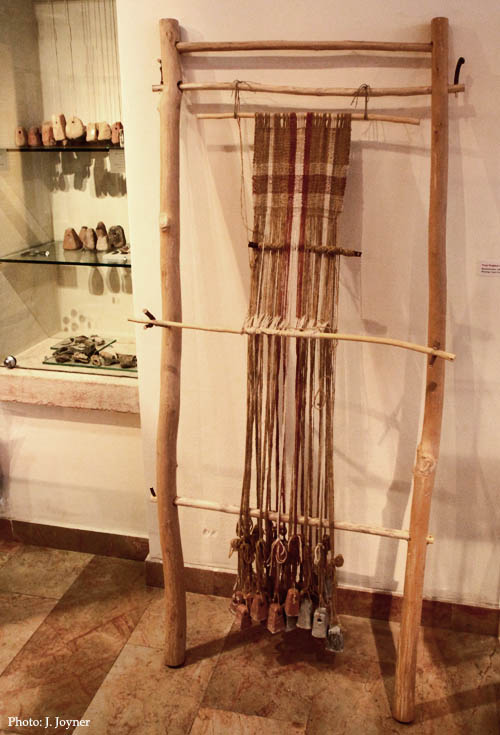
Jim Joyner shares some photos of an exhibit at the Hecht Museum, University of Haifa, in Haifa, Israel. These photos show a reconstructed primitive vertical loom.

Weaving Loom with weights from Yodefat. Hecht Museum, Haifa. Photo by J. Joyner.

Weaving Loom with weights from Yodefat. Hecht Museum, Haifa. Photo by J. Joyner.

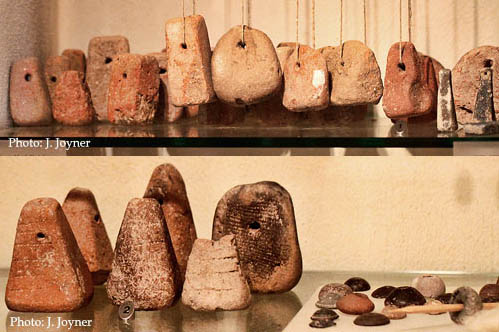
Yodefat (Jotapata, and various spellings) was the home of Josephus, commander of the Jewish forces in Galilee. The loom weights and whorls were excavated at Yodefat and Gamla. Most of the weights are made of clay, but a few are made of clay and lead.

Loom weights from Yodefat and Gamla. Hecht Museum, Haifa. Photo: J. Joyner.

Loom weights from Yodefat and Gamla. Hecht Museum, Haifa. Photo: J. Joyner.

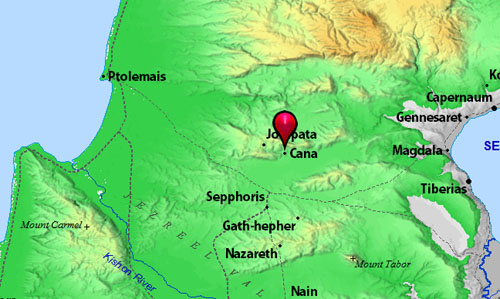
Yodefat was one of the first towns to feel the terror of the Roman army in A.D. 66 when they entered Galilee. The map below from BibleAtlas.org marks the site of (Khirbet) Cana (not traditional Kerf Cana). Note Jotapata a few miles west of Cana.

Note location of Jotapata and (Khirbet) Cana. Map by BibleAtlas.org.

Note location of Jotapata and (Khirbet) Cana. Map by BibleAtlas.org.

For those who might have an interest in following up on the site of Jotapata (Yodefat, Yodfat), I suggest you begin at Bible Walks here. References to the account by Josephus in the Jewish Wars are also given.

Thanks, Jim.

Weaving in Bible times

In describing the work of spinning we quoted from the lavishly illustrated Life in Biblical Israel by King and Stager. Another good book dealing with this sort of material is Daily Life in Biblical Times by Oded Borowski. Borowski’s book is much smaller and has no photos. There are a few black and white diagrams.

Here is how Borowski explains weaving.

The term weaving refers to the production of fabric by interlacing two sets of yarn so that they cross each other at a right angle.… The large numbers of loom weights, spindle whorls, and other weaving tools in domestic contexts indicate that weaving was a major occupation among the Israelites. (page 31)

He says that two kinds of looms were in use. One was horizontal; the other was the upright warp-weighted loom. The large number of loom-weights that have been uncovered in excavations indicate that this was the more common method of weaving.

Weaving was considered a woman’s job. Note the description of the Worthy Woman (or Capable Wife, as some designate her) in Proverbs 31. In the previous post we wrote of the work of spinning.

She stretches out her hands to the distaff, And her hands grasp the spindle. (Proverbs 31:19 NAU)

The same chapter also describes the materials she uses in her work of spinning and weaving.

She looks for wool and flax And works with her hands in delight. (Proverbs 31:13 NAU)

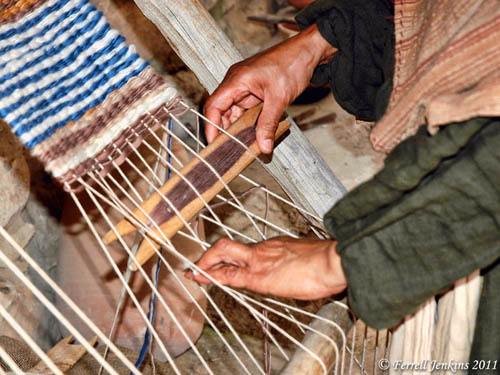
Demonstration of weaving at Nazareth Village. Photo by Ferrell Jenkins.

Demonstration of weaving at Nazareth Village. Photo by Ferrell Jenkins.

A display in the Istanbul Archaeology Museum shows loom weights and spinning tools uncovered at Gezer. I think these would be from the excavations conducted by Clermont-Ganneau between 1870-1873 or that conducted by Macalister between 1902 and 1905 when the Ottoman Empire ruled the land. Many artifacts from that period are in the Istanbul museum.

Tools Used in Weaving. From Gezer. Istanbul Arch. Museum. Photo by Ferrell Jenkins.

Tools Used in Weaving. From Gezer. Istanbul Arch. Museum. Photo by Ferrell Jenkins.

The priestly garments were woven (Exodus 28:39). We recall that Jesus had a undergarment (chiton, tunic) that was seamless, woven in one piece.

Then the soldiers, when they had crucified Jesus, took His outer garments and made four parts, a part to every soldier and also the tunic; now the tunic was seamless, woven in one piece. (John 19:23 NAU)

The distaff and the spindle

Most of the clothing in use during Bible times was made from flax or wool. The “worthy woman” or “capable wife” of Proverbs 31:13 “looks for wool and flax And works with her hands in delight.” The raw product must be spun in preparation for weaving.

She stretches out her hands to the distaff, And her hands grasp the spindle. (Proverbs 31:19 NAU)

King and Stager describe the process of spinning:

Spinning is done by means of the distaff and spindle. The distaff (a large stick) holds on its cleft end the unspun flax or wool from which the thread is drawn. The hand-held spindle, which is used to this day, is the rotating rod or shaft on which the fibers are twisted to form thread and are then wound. The spindle may be weighted by pierced, circular objects known as spindle whorls, which have been recovered in large quantity at practically every excavation of Palestine. (Life in Biblical Israel, 152)

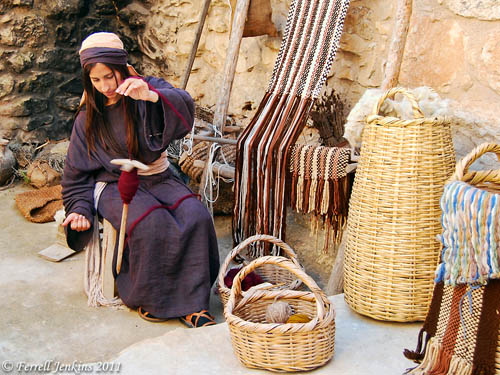
The following photo shows a young woman spinning wool at Nazareth Village.

Spinning dyed wool in preparation for weaving on the loom. Photo by Ferrell Jenkins.

Spinning dyed wool in preparation for weaving on the loom. Photo by Ferrell Jenkins.

Have you ever heard someone speak of the distaff or the “distaff side” in reference to a woman or women? Maybe not, unless you were born in the first half of the last century. I checked the Webster’s Revised Unabridged Dictionary of 1913 for the use of the word distaff. At that time the first definition was “the staff for holding a bunch of flax, tow, or wool, from which the thread is drawn in spinning by hand.” The dictionary also points out that the term was “used as a symbol of the holder of a distaff; hence, a woman; women, collectively.”

Moving back to 1828, Webster states that the term distaff was also used “figuratively, a woman, or the female sex.”

Some more recent dictionaries give the figurative meaning but some of these say the use is archaic.

Women who were skilled in this work prepared materials for the tabernacle during the wilderness wandering.

All the skilled women spun with their hands, and brought what they had spun, in blue and purple and scarlet material and in fine linen. All the women whose heart stirred with a skill spun the goats’ hair. (Exodus 35:25-26 NAU)

Here is a basket of wool waiting to be spun.

Basket of wool ready to be spun. Nazareth Village. Photo by Ferrell Jenkins.

Basket of wool ready to be spun. Nazareth Village. Photo by Ferrell Jenkins.

Perhaps latter we will say a few things about weaving.

Long may it wave

Flag of the United States of America.

The flag of the United States of America. July 4, 2011.

Check Google’s fourth of July image.

Google Fourth of July 2011

Comments on the detestable shepherds in Egypt

A few days ago we wrote in response to the question, “Why were shepherds detestable to Egyptians?”

We get more comments on the posts at Facebook than on the blog itself. Often I wish the (serious) comments were added here. I am going to share some comments made on this post. Christine, a regular reader of the blog and a friend from church, wrote:

“the cattlemen and the sheep herders of the American west were at odds, and I have read that sheep eat roots and all of the grass, ruining the grazing for cattle…could have an economic basis. And I could be wrong.”

Mark T., former student, wrote: “I learned that from reading cowboy books as a teenager. :-) ” [During class? FJ]

Mark B., former tour member, wrote:

“I never thought about the animosities between cattlemen and sheep herders here in the old west and how the sheep tear up the good grass if left to graze too long in one spot. What a great point!”

Listening to the sound tract of Oklahoma would give a tip about the conflict between the cowmen and the farmers. I think the point about the cattlemen and the farmers is a great one to show the conflict that often exists in a society.

However, we must not overlook the point made by John T. Willis that the term livestock includes cattle, sheep, goats, etc. Note the comment.

John T. Willis points out that the term livestock (or cattle; Hebrew, miqneh) is “a comprehensive term including cattle, sheep, goats, and the like” (Genesis in The Living Word Commentary on the Old Testament).

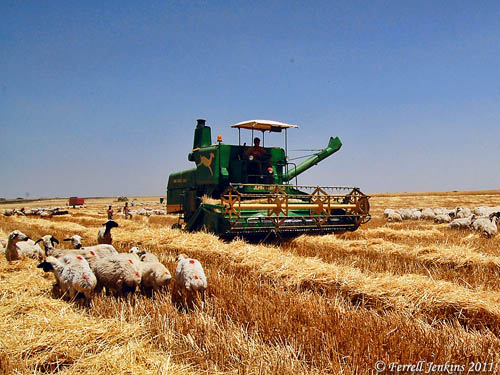
It is common in the Middle East for shepherds to take sheep into a grain field as soon as the harvesting is complete. This could be a real problem if cattle of any kind got into the fields in advance of harvesting. Remember that fences are virtually unknown there.

This photo is one I made in eastern Turkey north of Sanliurfa (and Haran). Even before the combine gets out of the field the shepherds are there with their sheep.

Sheep grazing as a field is being harvested. Photo by Ferrell Jenkins.

Sheep grazing in Eastern Turkey as a field is being harvested. Photo by Ferrell Jenkins.

Recently we posted a photo of sheep grazing in a field that had been harvested in the Shephelah of Israel here.

Why were shepherds detestable to Egyptians?

A readers asks about Joseph’s instruction to his family when they moved to the land of Goshen in Egypt.

“When Pharaoh calls you and says, ‘What is your occupation?’ you shall say, ‘Your servants have been keepers of livestock from our youth even until now, both we and our fathers,’ that you may live in the land of Goshen; for every shepherd is loathsome to the Egyptians.”  (Genesis 46:33-34 NAU)

Why was every shepherd loathsome (an abomination, disgusting, abhorrent, detestable) to the Egyptians. Here are some suggestions.

G. J. Wenham says,

Shepherds are detestable to the Egyptians probably reflects a common distrust of nomadic peoples by urban dwellers (cf. attitudes to gypsies and ‘travellers’ in modern society). (The New Bible Commentary)

The IVP Bible Background Commentary says,

It is unlikely that native Egyptian herdsmen would be detested by other Egyptians. Joseph’s advice to his father is both a warning about Egyptian attitudes toward strangers and a piece of diplomacy in that they would claim independent status (they had their own herds to support them) and show they were not an ambitious group who wished to rise above their occupation as shepherds.

Derek Kidner likes the explanation of J. Vergote:

A more likely explanation is that of J. Vergote, that this is only the perennial antipathy of the town-dweller for the nomad or the gipsy [gypsy]. Joseph saw the importance of emphasizing this, to ensure that Pharaoh’s goodwill would be to the family’s real benefit, not to their detriment by drawing them into an alien way of life at the capital. ( Tyndale Old Testament Commentaries)

Howard Vos says,

The reason for Joseph’s concern was that Egyptians considered shepherds an abomination. Settlement in Goshen would separate them from the Egyptian cattlemen of the Nile Valley and thus reduce friction with Egyptians and preserve their distinctiveness as a people. (Genesis in Everyman’s Bible Commentary)

John T. Willis points out that the term livestock (or cattle; Hebrew, miqneh) is “a comprehensive term including cattle, sheep, goats, and the like” (Genesis in The Living Word Commentary on the Old Testament).

The biblical Land of Goshen, where Israel settled, is the eastern portion of the Nile Delta. This was the home of the Israelites for many years.

Joseph went and told Pharaoh, “My father and brothers, with their flocks and herds and everything they own, have come from the land of Canaan and are now in Goshen.” (Genesis 47:1 NAS)
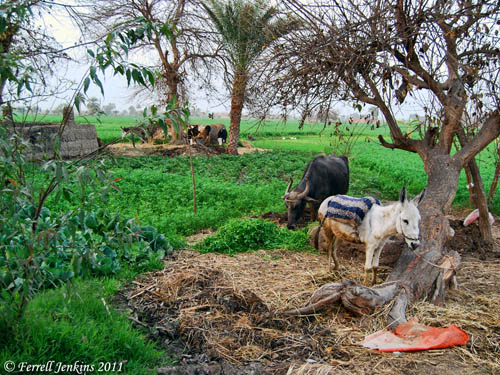
A typical scene in the Eastern Nile Delta. Photo Ferrell Jenkins.

A typical scene in the Eastern Nile Delta near Tel Daba. Photo Ferrell Jenkins.

To think of the stereotypical view of Egypt as a pyramid in the desert is to misunderstand the area where Israel settled.  Goshen is a flat, fertile, area, situated along the Pelusiac branch of the Nile River. That branch has now been replaced by a canal that runs generally along the same course. Cattle, including sheep, are common in the Eastern Nile Delta today. The canal in the photo below is one of the numerous smaller canals providing water to the farm land of the region.
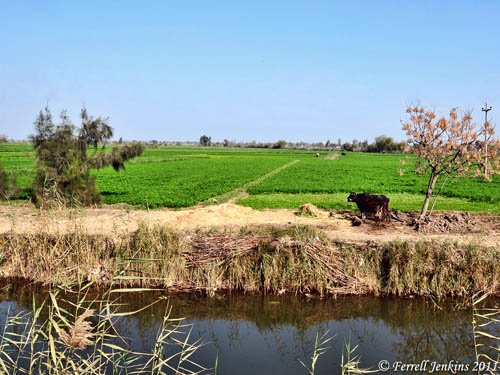
The land of Goshen near ancient Tanis. Photo by Ferrell Jenkins.

The land of Goshen between ancient Tanis and Tel Daba. Photo by Ferrell Jenkins.

I enjoy the vividness of The Five Books of Moses by Everett Fox. Fox translates Genesis 46:34 as follows:

Then say: Your servants have always been livestock men, from our youth until now, so we, so our fathers—
in order that you may settle in the region of Goshen.
For every shepherd of flocks is an abomination to the Egyptians.

This will give you something to consider. Hopefully it will be helpful. We have mentioned Goshen several times in this blog. Put the word goshen in the search box to locate them.

Latakia, Syria, and possible biblical connections

News coming out of Syria is not good. Syria’s dictatorial leadership has oppressed the people of Syria and tried to keep them uninformed about world events.

My first visit to Damascus, the capital of Syria, was in 1967 — just a day visit from Beirut. I returned several times during the next decade and made one trip by road from Beirut to Damascus and on to Amman. During that trip I left my camera in the seat of the car when we stopped at the Syrian border with Jordan. When I got back in the car I noticed that my camera back was open. The film had been exposed. I still remember that some of my best photos ever were on that roll. Sort of like the fish that got away. 🙂

My only visit throughout the country of Syria was in May, 2002, when a teaching colleague and I spent a week in the country driving to most of the major cities and historical sites.

We drove along the Mediterranean coast from south to north in order to visit Ras Shamra (Ugarit), significant because of what the site revealed about Canaanite culture. This means that we needed to spend the night at Latakia, about 6 or 7 miles south of Ugarit. We stayed at the nice LeMeridien seaside hotel.

Internet use was difficult. I recall dialing long distance from the Commodore Hotel in Damascus to Beirut in order to have dial-up service to AOL. We had set up AOL and Excite accounts, having heard that some hotels would allow one, and some another. AOL generally was not allowed in the country. I have a copy of the short Email we sent home from Latakia.

Today we go to Ebla and on to Aleppo. We are unable to check our mail here. Access to AOL and Excite are prohibited on this server, but the hotel staff was kind to allow us to use one of the office computers. So we can at least let you know we are fine. Hope to have some mail from you when we arrive in Aleppo.

Later from Aleppo I wrote,

Hotel personnel are helpful and friendly. I am not able to go to AOL or Excite to get mail. A backroom manager-type allowed me to use the hotel email to write.

Latakia is not named in the Bible, but the city is important in wider biblical history. In 1967 I purchased a copy of The Middle East, one of the Hachette World Guides, published in 1966. Here are a few facts garnered from that book.

  • In the 2nd millennium B.C. Latakia was part of the territory of Ugarit
  • Latakia became part of the Assyria empire during the 9th century B.C.
  • In 604 B.C. Latakia was controlled by the Babylonians.
  • The town became part of the 5th Persian satrapy.
  • After the Battle of Issus (333 B.C.) Alexander conquered the city.
  • Seleucus I named the city Laodicea in honor of his mother.
  • The city later came under Roman, Byzantine, Islamic, Crusader, again Islamic, French, modern Syria, etc.

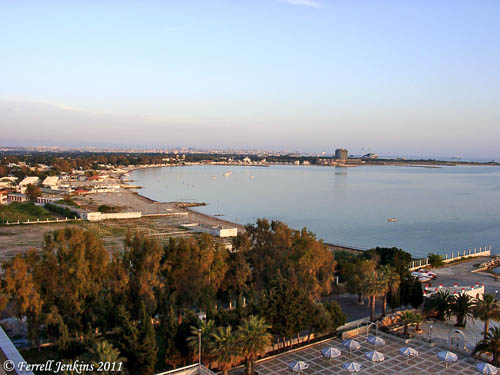
This late afternoon photo shows the harbor on the north side of Latakia. This is probably not more than 30 miles south of the Syria-Turkey border.

Harbor north of Latakia, Syria. Photo by Ferrell Jenkins.

Harbor north of Latakia, Syria. Photo by Ferrell Jenkins.

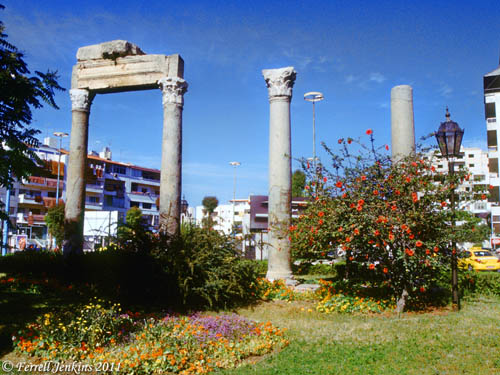
The next photo was made in the center of town. Ross Burns, Monuments of Syria, says,

In Jumhuriye Square (where the Damascus and Ugarit roads start) stand a grouping of four elegant monolith columns, topped with Corinthian capitals. This may have been part of the Temple of Adonis whose myth, sourced to the mountainous region of Northern Lebanon, was strong in this area. (p. 145)

Surviving columns may be from the temple of Adonis. Photo by Ferrell Jenkins.

Surviving columns may be from the temple of Adonis. Photo by Ferrell Jenkins.

It would not be out of place to suggest that Paul (Saul) sailed by Latakia (Laodicea) when he went from Caesarea to Tarsus (Acts 9:30), and when he sailed from Caesarea to Rome (Acts 27:3-5). Perhaps Barnabas and Saul traveled this way when they took the financial aid from Antioch to Judea (Acts 11:29-30).

A new tomb at Nazareth Village

Nazareth Village has become a necessary stop on my tours to Israel. The eyes of ministers and Bible class teachers are opened quickly to the reality of Bible stories. Some of the “exhibits” change with the season; others remain constant.

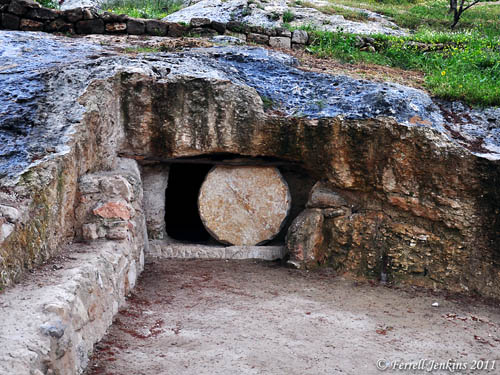
There was something new at Nazareth Village this year — a tomb cut out of the rock with a rolling stone.

New tomb with rolling stone at Nazareth Village. Photo by Ferrell Jenkins.

New tomb with rolling stone at Nazareth Village. Photo by Ferrell Jenkins.

This new tomb “where no one had yet been buried” is a good reminder of the type of tomb in which Jesus was buried (John 19:41 NET).

After Joseph bought a linen cloth and took down the body, he wrapped it in the linen and placed it in a tomb cut out of the rock. Then he rolled a stone across the entrance of the tomb.  (Mark 15:46 NET)

An image suitable for use in teaching is available by clicking on the photo above.

Contemplating the power of a single grain

Last Sunday evening I heard a good sermon based on John 12:24-26.

Truly, truly, I say to you, unless a grain of wheat falls into the earth and dies, it remains alone; but if it dies, it bears much fruit. (John 12:24 ESV)

This simple statement by Jesus is followed by a difficult lesson.

Whoever loves his life loses it, and whoever hates his life in this world will keep it for eternal life. If anyone serves me, he must follow me; and where I am, there will my servant be also. If anyone serves me, the Father will honor him. (John 12:25-26 ESV)

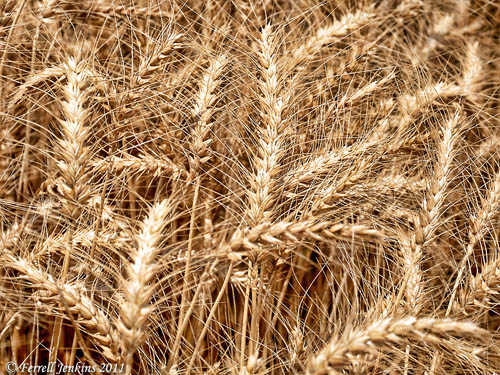
A grain of wheat must fall into the earth and die before it can produce fruit. Depending on the circumstances the grain can produce thirty-, sixty-, or a hundredfold (Matthew 13:8).

Wheat ready for harvest at En Dor. Photo by Ferrell Jenkins.

Wheat ready for harvest at En Dor. Photo by Ferrell Jenkins.

A single grain of wheat must die in order to produce much fruit. Jesus spoke of the necessity of His own death, and taught the tough lesson of giving up one’s life to serve Him.

Note the comment by William Hendriksen.

The illustration was very clear, especially at the moment when it was spoken, not more than a few days before the (religious and) harvest feast of Passover. The kernels or seeds had been entrusted to the soil. As seeds they had died. But by means of this very process of dissolution they had brought forth an abundant harvest. If a seed is not sown, it remains alone, producing no fruit. So also if Jesus does not die, he will remain alone, without spiritual fruit (souls saved for eternity). His death, however, will result in a rich, spiritual harvest. (New Testament Commentary : Exposition of the Gospel According to John).

We have included a larger image suitable for use in teaching. It is available by clicking on the image above.

Memorial Day 2011

Memorial Day, originally called Decoration Day, is a day of remembrance for those who have died in our nation’s service. There are many stories as to its actual beginnings, with over two dozen cities and towns laying claim to being the birthplace of Memorial Day. (Memorial Day History)

When I was a kid, growing up in the American South, the day we now call Memorial Day was called Decoration Day. Families went to the local cemeteries to clean up the grave sites of relatives and leave fresh flowers. If it was known that there were no family members left in the community, those graves also were cleaned. I don’t recall when I first began to hear, or think, that the day was intended to honor those fallen in war.

Like many holidays, the original purpose has changed. Memorial Day, Independence Day, Labor Day, Christmas, Easter, and other holidays, have become times for picnics, trips, vacations, and assorted non-related practices. Every holiday has become a time for stores to have sales.

I like the idea of Memorial Day. I am pleased to join in the remembrance of troops fallen in battle, and all of the dead who have played a significant role in my life.

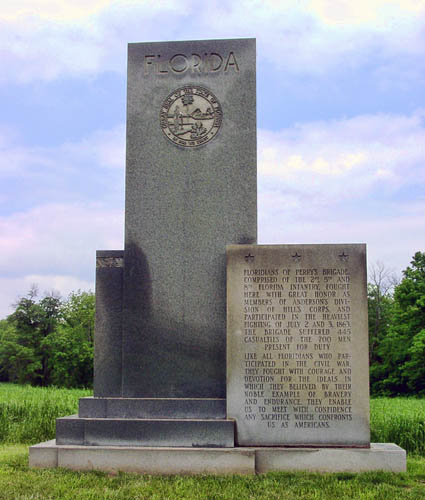
I have chosen a photograph that I made at the Gettysburg National Military Park of the monument erected to the men of Florida who fought in the American Civil War.

Gettysburg monument to Floridians who fought in the Civil War. Photo by Ferrell Jenkins.

Gettysburg monument to Floridians who fought in the Civil War. Photo: F. Jenkins.

On July 2 and 3, 1863, the 700 Floridians of Perry’s Brigade suffered 445 casualties. The monument reads this way:

Like all Floridians who participated in the Civil War, they fought with courage and devotion for the ideals in which they believed by their n0ble example of bravery and endurance. They enable us to meet with confidence any sacrifice which confronts us as Americans.

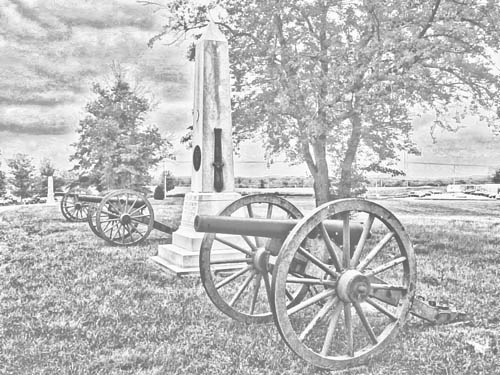
The photo below is another I made on the battlefield. It has been converted to a pencil drawing using a program called Topaz Adjust.

The Gettysburg Battlefield. Photo by Ferrell Jenkins.

The Gettysburg Battlefield. Photo by Ferrell Jenkins.

How good and pleasant it is when brothers live together in harmony! (Psalm 133:1 CSB)

The first portion of this post has been repeated from a year ago.