Category Archives: Church History

Persecution of Christians in Thessalonica

Earlier we posted information about the Arch of Galerius. Galerius was the Roman Emperor from 305 to 311 A.D. The arch was erected in Thessalonica to commemorate his victory over the Persians in 297 A.D. The reliefs on the arch are about this victory.

The most interesting portion of the relief to me is the one showing Galerius offering a sacrifice. The relief has been somewhat defaced, but it appears to me that he is pouring a libation on the altar. To the left, as we view the scene, is the Emperor Diocletian, the father in law of Galerius. The lady on the right is the wife of Galerius, daughter of Diocletian. Note the animal, awaiting his turn to be offered on a larger altar. The altar scene reminds us of the Emperor worship which was prevalent from the close of the first century onward.
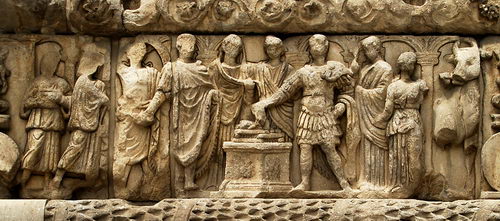
Sacrifice scene on the Arch of Galerius in Thessaloniki. Photo by Ferrell Jenkins.

Sacrifice scene on the Arch of Galerius in Thessaloniki. Photo by Ferrell Jenkins.

Diocletian is noted for his decree in 303 A.D. that ordered the burning of all Bibles and church records. This is one reason we have so few manuscripts before the fourth century A.D. Some credit Galerius as the brain back of this decision. He was responsible for considerable persecution of Christians during his reign. This persecution would be that spoken of in the Book of Revelation that we associate with Emperor worship.

The Danish archaeologist Dyggve excavated a Palace, Hippodrome, and Mausoleum belonging to Galerius. He also was able to show that the Arch was part of the complex of buildings (Blue Guide Greece).
Codex Sinaiticus now online

According to a BBC report, the 4th century Codex Sinaiticus is now available online. More information about the project is available in this report by Reuthers. The link to Codex Sinaiticus is here.

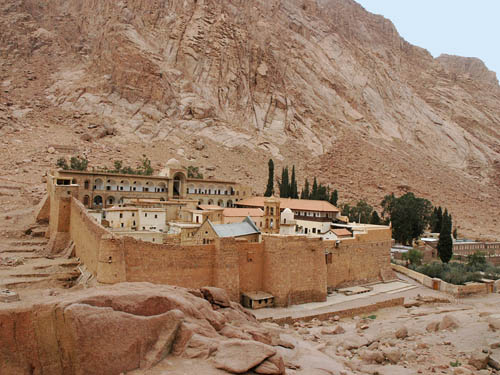
Here is a photo of Saint Catherine’s monastery, at the foot of Jebel Musa, the traditional Mount Sinai, where the manuscript was discovered in the 19th century.

St. Catherine's Monastery at Jebel Musa. Photo by Ferrell Jenkins.

St. Catherine's Monastery at Jebel Musa. Photo by Ferrell Jenkins.

HT: Paleojudaica; Frank Walton

Underground quarry discovered in Jordan Valley

Israeli papers are reporting the discovery of an underground quarry in the Jordan Valley. Prof. Adam Zertal and a team of archaeologists from the University of Haifa are working on the hypothesis that this is the site of biblical Gilgal.
The biblical account in Joshua reads,
Now the people came up from the Jordan on the tenth of the first month and camped at Gilgal on the eastern edge of Jericho. Those twelve stones which they had taken from the Jordan, Joshua set up at Gilgal. (Joshua 4:19-20 NAU)
The report in Ha’aretz gives more information about the discovery.

A spectacular underground quarry has recently been discovered in the Jordan Valley north of Jericho, which archaeologists believe may have marked a biblical site sacred to ancient Christians.

The large cave was discovered by Prof. Adam Zertal and a team from the University of Haifa which has been conducting a survey of the region since 1978. “When we reached the entrance to the cave, two Bedouin approached us and warned us not to go in, because it was cursed and inhabited by wolves and hyenas,” Zertal said yesterday from the site.

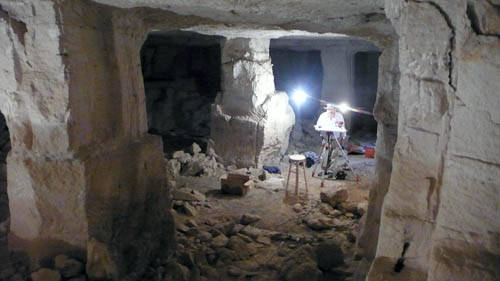
They entered anyway, discovering a ceiling supported by 22 gigantic columns on which various symbols were carved, including 31 crosses, a possible wheel of the Zodiac and a Roman legionary symbol. The columns also had niches for the placement of oil lamps and holes that apparently served as hitching posts.

Jordan Valley cave. Photo courtesy of University of Haifa.

Jordan Valley cave. Photo courtesy of University of Haifa.

The Ha’aretz article continues,

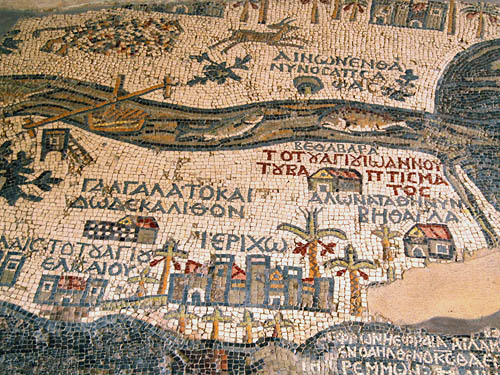
Zertal says their working theory is that the site is Galgala, biblical Gilgal, mentioned on the sixth-century Madaba mosaic map. The cave, buried 10 meters underground, is about 100 meters long, 40 meters wide and 4 meters high, is the largest artificial cave so far discovered in Israel.

Potsherds found in the cave and the carvings on the columns led Zertal to date the first quarrying of the cave to around the beginning of the Common Era. It was used mainly as a quarry for 400 to 500 years, “but other finds give the impression it was used for other purposes, perhaps a monastery or even a hiding place,” Zertal said.

Zertal said scholars wondered why people would dig a quarry underground considering the effort needed just to pull the stones out of the ground.

A possible answer may be in the famous Madaba Map of ancient Palestine, found in Jordan. In it, a place named Galgala is marked and an accompanying Greek word meaning “12 stones.” The map also depicts a church near the site. Archaeologists say they have found two ancient churches near the cave.

According to Zertal, scholars had always assumed that “12 stones” referred to the biblical story of the 12 stones the Israelites set up at Gilgal after they crossed the Jordan. However, the discovery of the quarried cave may mean the reference was to a quarry established where the Byzantines identified Gilgal. Zertal explains that in antiquity sanctuaries were built out of stones from sacred places.

If the Byzantines identified the site as biblical Gilgal, it would have been considered sacred and quarrying would have remained underground to preserve it.

Here is a photo of a portion of the Madaba Map that I made last year.

Madaba Map showing Gilgal, Jericho, Jordan River. Photo by Ferrell Jenkins.

Madaba Map showing Gilgal, Jericho, Jordan River. Photo by Ferrell Jenkins.

This portion of the map shows the northern end of the Dead Sea and the Jordan River. You will notice fish turning around when they reach the Dead Sea. I think everyone can make out the city of palm trees, IERIXW (Jericho, Deuteronomy 34:3). To the north of Jericho, and a little east toward the river, is the site of Gilgal.

The inscription reads “Galgala, also the twelve stones.” Below the inscription is a small church with its entrance hidden by a long structure with 12 white spots on it (two rows of six). The Madaba map is dated to about A.D. 560 to 565. You may read more about the Madaba Mosaic Map here.

HT: Joseph I. Lauer

UPDATE: A short video showing the cave and featuring Dr. Zertal is available from BBC here.

Cappadocia was home to early Christians

John Freely describes Cappadocia in these words:

“Most of this part of Cappadocia is covered with a deep layer of tufa, a soft stone of solidified mud, ash and lava which once poured down from the now extinct volcanoes on Hasan Dagi and Ericiyes Dagi, the two great mountain peaks of Cappadocia. In the eons since then the rivers of the region have scoured canyons, gorges, valleys and gulleys through the soft and porous stone, and the elements have eroded it into fantastic crags, folds, turrets, pyramids, spires, needles, stalagmites, and cones, creating a vast outdoor display of stone sculptures in an incredible variety of shapes and colours” (The Companion Guide to Turkey, 238).

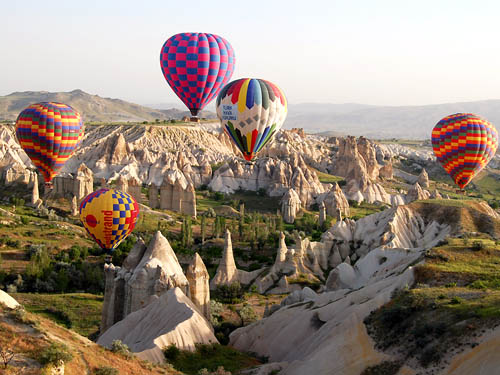
Devout Jews from Cappadocia were present in Jerusalem on Pentecost (Acts 2:9). Peter=s letters were addressed to Christians living in Cappadocia (1 Pet. 1:1). In the centuries after New Testament times many Christians settled in this volcanic region of perhaps 50,000 cones.

Gliding gently over Cappadocia. Photo by Ferrell Jenkins.

Gliding gently over Cappadocia. Photo by Ferrell Jenkins.

The best way to enjoy the Cappadocian landscape is by taking a hot air balloon early in the morning. Drifting gently over the landscape is a unique experience.

Todd Bolen calls attention to a nice photo gallery of Cappadocia in the Los Angeles Times here.

The Pool of Siloam

More than 700 years before Christ, the Judean King Hezekiah dug a tunnel to bring the water of the Gihon spring to a new pool which he constructed on the west side of the city of David (2 Kings 20:20; 2 Chron 32:30; Sirach 48:17). This pool would later be known as the pool of Siloam.

One of the great signs of Jesus, recorded in the Gospel of John, is the healing of a man born blind (John 9). Jesus spat on the ground and made clay of the spittle. He then applied the mud to the blind man’s eyes and told him, “Go, wash in the pool of Siloam.” We understand that mud made from saliva and water from Siloam will not normally cause a blind person to see. This sign demonstrates the power of Jesus over blindness and demonstrates the validity of His claim to be “the Light of the world” (9:5). The blind man’s faith to obey Jesus clearly played a role in his healing.

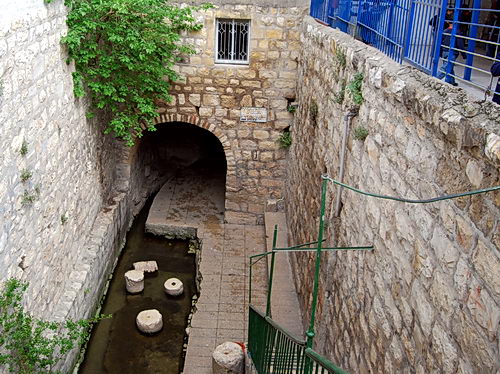
For many years we have been aware of the Pool of Siloam at the southern end of Hezekiah’s tunnel. A church dedicated to “Our Savior, the Illuminator” was built here in the fifth century by the Byzantine Empress Eudokia, but was destroyed in A.D. 614 and never rebuilt. Some columns from the building can still be seen. See Hoade, Guide to the Holy Land, and Murphy-O’Connor, The Holy Land, for details.

This photo shows the Byzantine pool at the southern end of Hezekiah’s tunnel. Note the present ground level along the blue fence.

Ruins of the Byzantine church at end of Hezekiah's Tunnel. Photo by F. Jenkins.

Ruins of the Byzantine church at end of Hezekiah's Tunnel. Photo by F. Jenkins.

In a post to follow we will discuss the newly discovered Pool of Siloam from the Roman period.

The Way of the Cross – Via Dolorosa

Numerous events from the last day prior to the crucifixion of Jesus are recorded in the New Testament (Matthew 26-27; Mark 14-15; Luke 22-23; John 18-19). As early as Byzantine times Christians began to follow the final steps of Jesus on specified days. Over the centuries many changes were made in the route and the stops. The traditional Via Dolorosa, as known today, was fixed in the 18th century.

Jerome Murphy-O’Connor says,

The Via Dolorosa is defined by faith, not by history. (The Holy Land, 5th edition, 37)

He continues,

The present Way of the Cross has little chance of corresponding to hsitorical reality… (38)

According to tradition, the third station of the cross is where Jesus falls the first time under His cross. It sounds reasonable, but the Gospels make no specific mention of this.

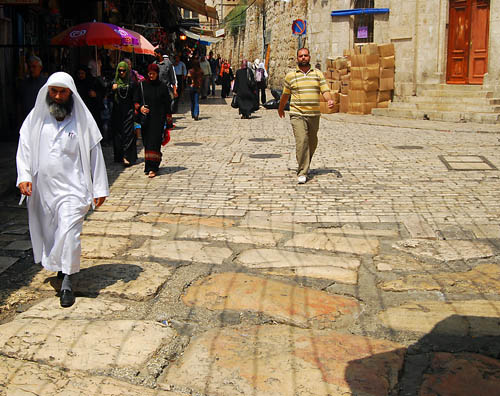
Roman period street near 3rd station of the cross. Photo by F. Jenkins.

Roman period street near 3rd station of the cross. Photo by F. Jenkins.

This photo shows the street in front of the third station. The plaque in Hebrew, Arabic and English provides the following information about the street.

Paving stones, apparently from the Second Temple Period (ca. 100 B.C.C. – 100 C.E.). The street was found in its entirety 3 meters below the existing level and was partially restored by the Municipality of Jerusalem … 1980-1981.

This means that the street Jesus might have walked is at least 10 feet below the present street level.

The monastery of the Gerasene swine

Stephen G. Rosenberg, senior fellow of the W. F. Albright Institute of Archeological Research in Jerusalem, has an article about the monastery of the Gerasene swine in The Jerusalem Post here. Take a look.

This site, located on a hill above the eastern shore of the Sea of Galilee, marks the traditional site of the miracle of the swine running down the steep cliff into the sea.

When He came to the other side into the country of the Gadarenes, two men who were demon-possessed met Him as they were coming out of the tombs. They were so extremely violent that no one could pass by that way. And they cried out, saying, “What business do we have with each other, Son of God? Have You come here to torment us before the time?” Now there was a herd of many swine feeding at a distance from them. The demons began to entreat Him, saying, “If You are going to cast us out, send us into the herd of swine.” And He said to them, “Go!” And they came out and went into the swine, and the whole herd rushed down the steep bank into the sea and perished in the waters. The herdsmen ran away, and went to the city and reported everything, including what had happened to the demoniacs. And behold, the whole city came out to meet Jesus; and when they saw Him, they implored Him to leave their region. (Matthew 8:28-34 NAS)

The article by Rosenberg points out that this would have been the land of Geshur in Old Testament times. David was married to Maacah, “the daughter of Talmai, king of Geshur” (2 Samuel 3:3). Maacah was the mother of Absalom. The Bible points out that Absalom spent three years in exile after killing Amnon.

Rosenberg says,

Geshur is well-known from the Bible. King David married Maacah, the princess of Geshur, in the early years of his reign. That will have been for political reasons, to ensure a security pact with Geshur, which could shield David from the power of Aram (Syria) to the north, but this lady must have been powerfully beautiful as well. Her two children by David, Tamar and Absalom, are both described as being unusually good-looking. Tamar was “beautiful” and as for Absalom, “there was none in Israel to be so much praised for his beauty.”

Remember that the excavators of et-Tell like to identify it as Old Testament Geshur and New Testament Bethsaida. The sites are not far apart and both belonged in the general region of Geshur.

This photo of the basilica, made of black basalt with white limestone columns, was made last August. This site provides a wonderful view west across the Sea of Galilee.

The basilica at Kursi. Photo by Ferrell Jenkins.

The basilica at Kursi. Photo by Ferrell Jenkins.

Murphy-O’Connor says this has been a place of pilgrimage since the fifth century A.D. He suggests the name of the place, Kursi, “is possibly a dialectical deformation” of Chorazin. (The Holy Land).

HT: Joseph I. Lauer

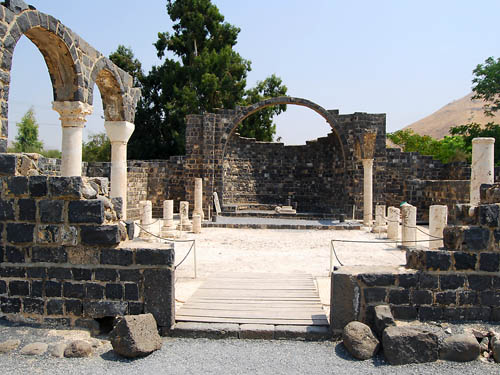
Another Byzantine church uncovered

The Israel Antiquities Authority announced today the discovery of a church building dating to the Byzantine period. This one is located near Moshav Nes-Harim, about 3.11 miles east of Beth Shemesh. The full press release may be read here. The Byzantine period in Israel may be dated from about A.D. 325 to the early part of the 7th century.

Christianity grew out of the soil of Judaism. In the early part of the first century Jesus said, “for salvation is from the Jews” (John 4:22).

Max Miller says,

The population of the Holy Land became almost entirely Christian, except for Jewish enclaves primarily in Galilee. moreover, Christian pilgrims flocked to the Holy Land from all over the Roman-Byzantium world and Christian churches were built over virtually every spot which could be imagined to have any connection with a biblical event. (Introducing the Holy Land, 130-131).

He continues to say,

By 640 most of Egypt, the Holy Land and Syria were under Islamic control.

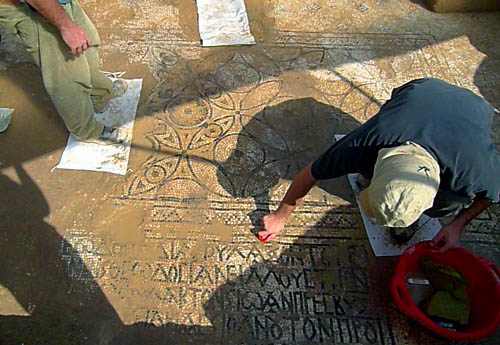
Mosaic dedicatory inscription in Greek. Photo by Daniel Ein Mor, IAA.

Mosaic dedicatory inscription in Greek. Photo by Daniel Ein Mor, IAA.

Evidence for the existence of Jewish and Christian buildings and settlements continues to become known rapidly. It has become common among some Muslim sources to deny the existence of Jews in the land of Palestine before the 20th century. The evidence of archaeology says otherwise. The Old Testament scriptures say otherwise. The New Testament, and the existence of the church in those early centuries, say otherwise.

The sad thing is that buildings are found, not churches composed of Christians. The church had so departed from the New Testament order that it was not able to effectively survive the pressures of  the Muslim invasion. The church of our day appears very weak as it faces the cultural pressures of the postmodern world.

HT: Joseph I. Lauer

Hierapolis, Philip and Papias

Early tradition associates Philip with the city, but scholars differ over whether it was Philip the apostle (Matthew 10:3) or Philip the evangelist (Acts 21:8).

This was the home of Papias (about A.D. 60 to 130) who was a disciple of the apostle John and a companion of Polycarp. Fragments of his writings about the apostles survive in Irenaeus and Eusebius of Caesarea. Eusebius (about A.D. 265 − about A.D. 339), tells us that Papias wrote as follows:

“Matthew also issued a written Gospel among the Hebrews in their own dialect, while Peter and Paul were preaching at Rome, and laying the foundations of the Church. After their departure, Mark, the disciple and interpreter of Peter, did also hand down to us in writing what had been preached by Peter. Luke also, the companion of Paul, recorded in a book the Gospel preached by him.” He adds that John, the disciple who leaned on Jesus’ breast, published a Gospel from Ephesus (Against Heresies III.1.1).

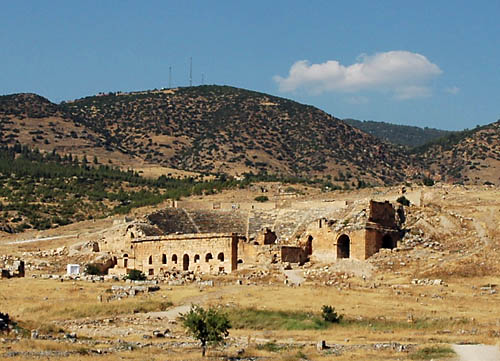
Some things of interest to see at Hierapolis include the hot springs and limestone formations, the monumental Arch of Domitian and Roman Street. This entire region suffered from the policies of the Emperor Domitian. The photo below shows the theater set against the surrounding hills.

Roman theater at Hierapolis. Photo by Ferrell Jenkins.

Roman theater at Hierapolis. Photo by Ferrell Jenkins.

The theater was built in the 2nd century A.D., renovated in the 3rd century, and again in the 4th century.

During the 4th-century renovations, the orchestra area of the theater was altered to allow it to be filled with water for staging mock naval battles and other water presentations. (Fant and Reddish, A Guide to Biblical Sites in Greece and Turkey, 213)

Bethlehem and Shrines

Shrines. Throughout the lands where Bible events transpired church buildings have been erected over this or that “sacred spot.” These buildings, whether in Jerusalem, Nazareth or Bethlehem are little more than show places. Tourists stream through them at a steady rate observing the ancient ornamentation.

In Bethlehem the traditional place where Jesus was born, now covered by the Basilica of the Nativity, would hardly remind one of anything he reads in the New Testament. The visitor now finds a building which reveals “a succession of slow decay and hasty repairs” The Middle East, 1966 ed., 622). In this building he sees mosaics with gold backgrounds dating from the 12th century, and art of the middle ages. The ruins of the large buildings erected by Justinian in the 6th century simply serve to cover the 4th century building by Constantine. The student of church history never forgets that all of this was the activity of an apostate church and does not reflect New Testament Christianity.

Their value. The shrines do serve a useful purpose. We have no record to indicate that the earliest Christians built any shrines at the sites associated with the ministry of Jesus. One can imagine, however, that fathers would tell their sons and that residents would tell visitors where certain events happened. If this information was faithfully transmitted from the first to the fourth century when the first shrines were erected, then the shrine has kept alive the memory till now.

The shrines have preserved sites, which if left in the open would have eroded or been damaged or built over so that the memory would be lost.

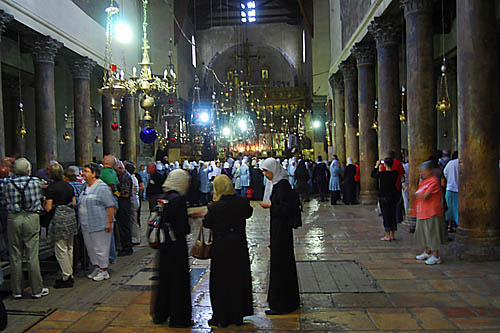
This photo shows the interior of the Greek Orthodox Church that is said to be built over the birthplace of Jesus.

Interior of the Church of the Nativity. Photo by Ferrell Jenkins.

Interior of the Church of the Nativity. Photo by Ferrell Jenkins.

Our study about Bethlehem brings to our mind the reality of the earthly ministry of Jesus. In Bethlehem we see the expression of the love of God who sent His own son to the earth.

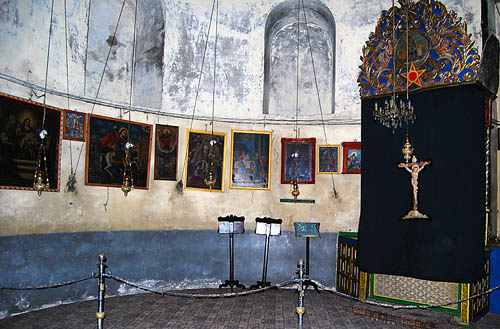
The next photo shows the Armenian chapel in the Church of the Nativity. It stands between the Greek Orthodox and Roman Catholic churches.

Armentian altar in the Church of the Nativity. Photo by Ferrell Jenkins.

Armenian altar in the Church of the Nativity. Photo by Ferrell Jenkins.