Category Archives: Books

Sir William M. Ramsay – New Testament Scholar

As a student Ramsay had been influenced by Baur and the Tubingen School and doubted the historical trustworthiness of the New Testament. His studies in Asia Minor caused him to study the book of Acts, which he accepted as a document of the second half of the second century. He tells in The Bearing of Recent Discovery on the Trustworthiness of the New Testament how he came to change his mind about this. In a study of Acts 14, Ramsay saw that Luke listed Lystra and Derbe as cities of Lycaonia, but did not include Iconium (Acts 14:6). He thought this had been deliberately invented by Luke because he was under a false impression. Check maps you have in your Bible and various Bible Atlases. You will probably see that some of them still have this incorrect. The SN (Study Note) in the NET Bible contains this note:

Iconium was a city in Lycaonia about 90 mi (145 km) east southeast of Pisidian Antioch. It was the easternmost city of Phrygia.

This comment relies on the older classical location of Iconium, but it was not this way during the Roman Imperial period.

In The Bearing of Recent Discovery…, Ramsay says that the purpose of his book, St. Paul the Traveler and the Roman Citizen, is to show:

“that Luke is a historian of the first rank; not merely are his statements of fact trustworthy; he is possessed of the true historical sense; he fixes his mind on the idea and plan that rules in the evolution of history, and proportions the scale of his treatment to the importance of each incident. He seizes the important and critical events and shows their true nature at greater length, while he touches lightly or omits entirely as much that was valueless for his purpose. In short, this author should be placed along with the very greatest of historians” (222).

The people of Lystra spoke the Lycaonian language (14:11). They called Barnabas, Zeus, and Paul, Hermes (14:12). Inscriptions have been found that identify these particular gods with Lycaonia.

F. F. Bruce mentions his debt to the writings of Sir William Ramsay, and frequently calls attention to Ramsay’s works. Colin Hemer’s works on Acts and Revelation build on the work of Ramsay.

Dr. Mark W. Wilson, of Seven Churches Network has edited and updated at least four of Ramsay’s works: The Letters to the Seven Churches (Hendrickson), St. Paul the Traveler and Roman Citizen (Kregel), and Historical Commentary on First Corinthians (Kregel). This makes these older works much more valuable.

Our photo below shows a portion of a Roman road a few miles north of Tarsus, home of Saul of Tarsus. I think this is the route that would have been taken by Paul and Silas to connect them to the Cilician Gates and the Anatolian plateau. See Acts 15:41 – Acts 16:2.
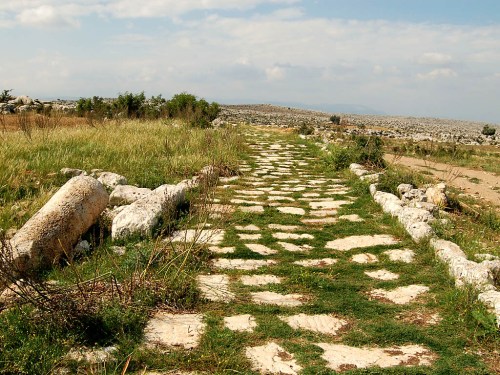
Roman Road north of Tarsus. Note the fallen milestone. Photo by Ferrell Jenkins.

Roman Road north of Tarsus. Note the fallen milestone. Photo by Ferrell Jenkins.
Sir William M. Ramsay

William M. Ramsay (1851-1939), a native of Scotland, studied classics at the University of Aberdeen. In 1880 he won a traveling studentship to study in Asia Minor. For several decades he was able “to study the geography and archaeology of Roman proconsular Asia, Phyrgia, Lycaonia, Cappadocia, and Galatia” (Gasque, Sir William M. Ramsay Archaeologist and New Testament Scholar, 15; I am indebted to this work for much information about Ramsay). He was knighted in 1906.

Gasque’s book has recently been made available here by Rob Bradshaw of Biblical Studies.org.uk in either PDF or Scribd. Grab it while it is available. Rob is providing a wonderful service in making works like this available.

Some of Ramsay’s more significant writings include The Historical Geography of Asia Minor, The Cities and Bishoprics of Phrygia, St. Paul the Traveller and the Roman Citizen, The Bearing of Recent Discovery on the Trustworthiness of the New Testament, The Letters to the Seven Churches, and A Historical Commentary on St. Paul’s Epistles to the Galatians. He wrote many articles for the 9th edition of Encyclopedia Britannica and for the five-volume Dictionary of the Bible by Hastings, including “Roads and Travel in the New Testament.”

This photo of a butterfly among wild flowers was made west of Konya, Turkey. Konya was biblical Iconium (Acts 13:51 – Acts 14).

Spring wild flowers growing west of Konya, Turkey. Photo by Ferrell Jenkins.

Spring wild flowers growing west of Konya, Turkey. Photo by Ferrell Jenkins.

In the next post we will explain more about the significance of Ramsay to New Testament studies.

Traveling without a bag

Read the previous post, Treasures old and new, for an introduction to this one.

Recently I was reading a section in Light From the Ancient East by Adolf Deissman about the value of understanding the meaning of New Testament words through words in common use in New Testament times.

Deissman takes up the account of Jesus sending out the twelve and shows how one simple word is understood better through the use of documents from the same time period.

Jesus said to the disciples,

“Heal the sick, raise the dead, cleanse the lepers, cast out demons. Freely you received, freely give. “Do not acquire gold, or silver, or copper for your money belts, or a bag for your journey, or even two coats, or sandals, or a staff; for the worker is worthy of his support. (Matthew 10:8-10 NASB)

See also Mark 6:8 (the KJV uses scrip for the Greek pera) and Luke 9:3; 22:35-36.

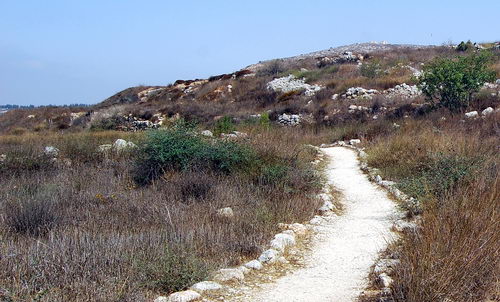
A path at Shiloh. Photo by Ferrell Jenkins.

A path at Shiloh. Photo by Ferrell Jenkins.

Below is the rather lengthy quotation from Deissman which I have in the Libronix format now. Because of the length of this paragraph I will not indent it as we normally do, and will divide it into three paragraphs for ease of reading.

——

One of the characteristic utterances of Jesus has here been handed down, not without variations, but still in such form that the original can be discerned beneath them: the apostles were told to take with them for their journey only the barest necessaries, among which was to be reckoned neither money nor bread. According to St. Matthew’s report they were further forbidden even to earn money on their way, as they might have done by working miracles of healing, etc. The meaning of the “wallet” (A.V. “scrip”) has seldom been questioned, because it seems so obvious: most commentators probably think of it as a travelling-bag, or, more precisely defined, as a bread-bag.

The word in the original Greek, πήρα, is capable of either meaning, according to circumstances. In the context “travelling-bag” would do very well; “bread-bag” not so well, being superfluous after the mention of “bread,” and tautology seems out of place in these brief, pointed commands given by Jesus. But there is a special meaning, suggested by one of the monuments, which suits the context at least as well as the more general sense of “bag” or “travelling-bag.” The monument in question was erected in the Roman Imperial period at Kefr-Hauar in Syria by a person who calls himself, in the Greek inscription, a “slave” of the Syrian goddess. “Sent by the lady,” as he says himself, this heathen apostle tells of the journeys on which he went begging for the “lady” and boasts triumphantly that “each journey brought in seventy bags.”

The word here employed is πήρα. Of course it has nothing to do with well-filled provision-bags for the journey: it clearly means the beggar’s collecting-bag. The same special meaning would make excellent sense in our text, particularly in St. Matthew’s version: there is to be no earning, and also no begging of money. With this possible explanation of the word πήρα the divine simplicity of Jesus stands out afresh against the background suggested by the heathen inscription. While Christianity was still young the beggar-priest was making his rounds in the land of Syria on behalf of the national goddess. The caravan conveying the pious robber’s booty to the shrine lengthens as he passes from village to village, and assuredly the lady will not forget her slave. In the same age and country One who had not where to lay His head sent forth His apostles, saying:—

“Freely ye received, freely give. Get you no gold, nor silver, nor brass in your purses: no wallet for your journey.”

——

I was looking at some material on the financial support of preachers. John encouraged his readers to receive those who come preaching the gospel. He says,

You will do well to send them on their journey in a manner worthy of God. For they have gone out for the sake of the name, accepting nothing from the Gentiles. (3 John 1:6-7)

The Linguistic and Exegetical Key to the Greek New Testament points out the difference between those who went out preaching the message of Christ and those who were out for the money. The preachers of Christ were to be supported by fellow Christians. This was “in marked contrast both to the wandering philosophers of the day and to the beggar priests of the Syrian goddess” [mentioned by Deissmann].

Treasures old and new

The use of current, reliable sources in our study and teaching is important. A study of the background and customs in Bible times is essential if we want to come to an understanding of the original meaning of the biblical text. One set of books that are helpful in this area is entitled New Testament Documents Illustrating Early Christianity. I think Eerdmans now handles the complete set of 9 volumes.

This is not to say, however, that older works are without value in our study. I have observed that some important material, after being noted by several scholars, will then be overlooked by later writers. Eventually few people have the original book and are unaware of the material.

One of the valuable older works is Light From the Ancient East by Adolf Deissman which was published originally in English in 1910. Deissman is the scholar who informed us that the Greek of the New Testament was the koine, common, vernacular Greek of everyday communication. Soon I plan to share a comment from Deissman about travel and preaching.

Listen to one of the parables of Jesus:

Then he said to them, “Therefore every expert in the law who has been trained for the kingdom of heaven is like the owner of a house who brings out of his treasure what is new and old.” (Matthew 13:52)

The Semitic Museum at Harvard

Friday afternoon I went with two of my former students, friends, and fellow-preachers to visit the Semitic Museum at Harvard. Tim Reeves preaches in Providence, RI. He offered to take Leon Mauldin and me to our hotel in Boston. I suggested going by the Museum before going to the hotel so Tim could visit also. I have been at the Museum before, but not since the new exhibit has been on view.

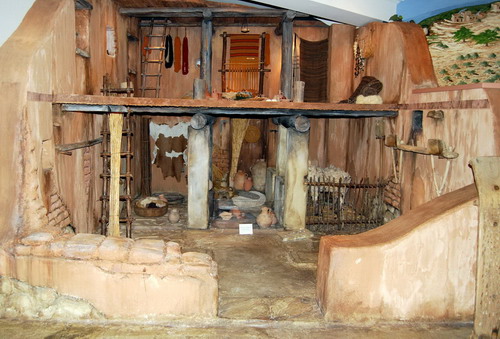
The Houses of Ancient Israel: Domestic, Royal, Divine is the featured exhibit at the Semitic Museum now. This exhibit traces the development and importance of the house in ancient Israel, from the family dwelling to the house of the king, and the house of the Lord (the temple). Here is a photo of the typical pillared “four-room” Israelite house that was common during the periods of the United and Divided Kingdoms.

Typical Iron Age (1200-586 B.C.) Israelite house. Photo by Ferrell Jenkins.

Typical Iron Age (1200-586 B.C.) Israelite house. Photo by Ferrell Jenkins

It would take several pages of writing to explain all of the items on display in the house. Their use could be illustrated with a variety of Bible verses. The research back of this house has been presented by Phillip J. King and Lawrence E. Stager in Life in Biblical Israel (Knox/Westminster, 2001). I highly recommend this book to all Bible teachers.

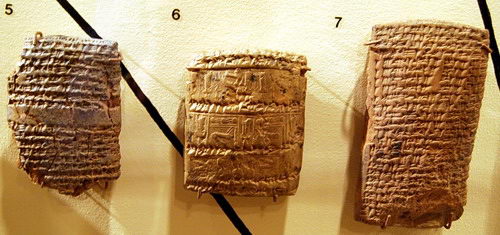
This is the only Museum I know about with displays of tablets from ancient Nuzi. About 4000 tablets in the Hurrian language were discovered by archaeologists in the early part of the twentieth century. Ancient Nuzi was not an important urban center, but these tablets reveal much about economic and domestic life from a period beginning about 2400 B.C. and continuing several centuries. It has been pointed out that several events associated with the biblical patriarchs, mentioned in the Book of Genesis, can better be illustrated  through an understanding of these documents.

Three Nuzi tablets at the Semitic Museum at Harvard. Photo by Ferrell Jenkins.

Three Nuzi tablets at the Semitic Museum at Harvard. Photo by Ferrell Jenkins.

For more information about the Semitic Museum at Harvard University check the web page here.

Text and Canon in Providence, RI

For the past few days I have been in Providence, RI, attending meetings of the Evangelical Theological Society (ETS) and the Near East Archaeological Society (NEAS). The theme for the ETS annual meeting was Text and Canon. I attended the four plenary session papers. These were extremely worthwhile. Here are the topics and speakers:

  • Old Testament Text – Peter J. Gentry
  • Old Testament Canon – Stephen Dempster
  • New Testament Text – Daniel B. Wallace
  • New Testament Canon – Charles E. Hill

Current, scholarly, material on these topics are needed among God’s people today.

I also attend several sessions of the NEAS. I heard Bryant Wood present evidence suggesting that Mount Sinai possibly should be identified with Gebel Khashm et-Tarif, and calling for more research in the area. This site is located about 22 miles north-northwest of the Gulf of Aqaba/Eilat in the Wilderness of Paran on the current Egyptian side of the border. For more information check the Associates for Biblical Research website here.

In one session I heard Rex Geissler present some of the historical evidence for the area of ancient Urartu as the place associated with Noah’s Ark. Rex is president of Archaeological Imaging Research Consortium (ArcImaging). Over at the Biblical Studies Info Page I have several links to good photos by Rex in various parts of the world. You can get to his material at the ArcImaging page.

Bill Crouse presented material to bolster the case for an identification of the landing place of the ark with Mount Cudi in southereastern Turkey. I think Gordan Franz presented material in defense of this view also, but I was unable to be present.

There were two reports on the excavations this year at Tel Gezer in Israel.

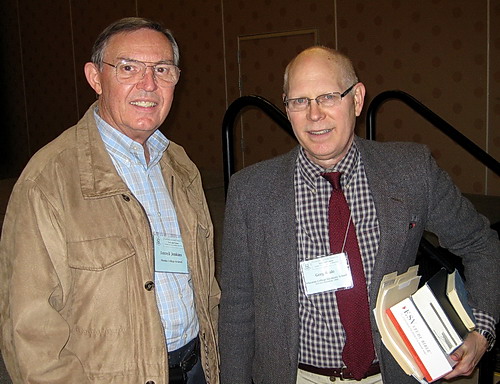
Crossway, publisher of the English Standard Version of the Bible, has been sponsoring a special lecture for the past few years. The lecture this year featured Gregory K. Beale of Wheaton College on The Authority of Scripture: A Biblical Theology According to John’s Apocalypse. This was a great paper. Beale is author of The Book of Revelation: A Commentary on the Greek Text (New International Greek Testament Commentary). I had heard Beale speak before, but it was a pleasure to hear him again and visit for a few moments. I am honored that my The Old Testament in the Book of Revelation is mentioned in a footnote of this commentary.

Ferrell Jenkins and Gregory K. Beale at ETS Annual Meeting. Photo by Leon Mauldin.

Ferrell Jenkins and Gregory K. Beale at ETS Annual Meeting. Photo by Leon Mauldin.

The book display at ETS has grown substantially over the years I have been attending the annual meetings(since 1975). The professors and others who attend get an opportunity to buy the recent publications in biblical studies at a sizable discount. I buy very few these days, but I have taken advantage of this opportunity over the years.

Well, its on to Boston for more meetings.

For a Florida guy, I must say that it is cold up here.

Byblos in Lebanon

Byblos is located on the Mediterranean Sea about 25 miles north of Beirut, Lebanon.The ancient Phoenician city of Gebal (modern Arabic Jbeil) was called Byblos by the Greeks because they saw scrolls there made from imported papyrus sheets. The Greek word byblos is translated book in our English versions of the Bible. In fact, our word Bible is derived from the work byblos.

The Gebalites worked with the builders of  Solomon and Hiram to fashion and prepare timber and stone to build the temple (1 Kings 5:17-18). The old men of Gebal are mentioned in the lamentation over Tyre.

The elders of Gebal and her skilled men were in you, caulking your seams; all the ships of the sea with their mariners were in you to barter for your wares. (Ezekiel 27:9 ESV)

Byblos is now designated as a UNESCO World Heritage Site. The history of Byblos is revealed in the excavated ruins.

  • Canaanite or Phoenician ruins as early as 3000 B.C.
  • Egyptian ruins from about 1300 B.C. Rib Addi, king of Byblos wrote letters to Pharaoh Amenophis III to request reinforcements against his neighbors. These letters are part of the collection of letters found at Amarna.
  • Roman ruins from the time of Pompey, about 65 B.C.
  • Crusader ruins from the 12th century A.D.

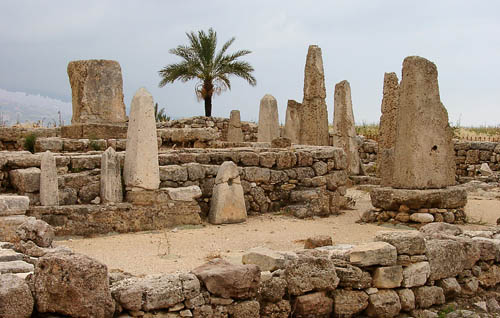
My last visit to Byblos was in 2002. This is a photo I took of the Egyptian Temple of Obelisks which was dedicated to the Egyptian god Reshef.

The Temple of Obelisks at Byblos. Photo by Ferrell Jenkins.

The Temple of Obelisks at Byblos. Photo by Ferrell Jenkins.

The tabernacle in the wilderness

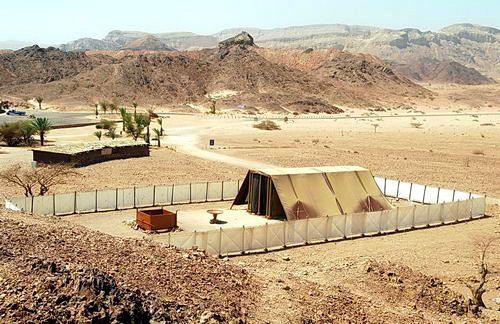
A full size model of the Israelite tabernacle has been constructed in Timna Park, 17 miles north of Eilat. This was one of the big reasons I wanted to visit Eilat on this trip. The tabernacle was built while the Israelites were at Mount Sinai (Exodus 25-40). The tabernacle was a movable tent of worship which was taken each place Israel wandered during the forty years in the wilderness. Stephen spoke of the tabernacle this way:

“Our fathers had the tabernacle of testimony in the wilderness, just as He who spoke to Moses directed him to make it according to the pattern which he had seen. (Acts 7:44)

I walked up hill above the tabernacle model and took this view of the tabernacle with the laver and the altar of burnt offering in the courtyard.

The tabernacle in the wilderness. Photo by Ferrell Jenkins.

The tabernacle in the wilderness. Photo by Ferrell Jenkins.

If you are ever near Eilat, drop by and see this wonderful model.

Was John the Baptist a member of the Dead Sea Sect?

Identifying the Dead Sea Sect. We are speaking of the Jewish group responsible for preparing and hiding the scrolls that were discovered in and around Qumran on the shores of the Dead Sea beginning in 1947. The sect living here was likely the Essenes. I am aware of the numerous controversies about Qumran, but have not been impressed by the alternative views.

Was John the Baptist an Essene? It has been popular among some scholars to claim that John was an Essene. A suggestion is made that John’s parents died while he was yet a child. The Essenes were known to have cared for orphan children. So, they cared for John. Some comparisons may be drawn concerning John and the Essenes.

  1. John was in the deserts (Luke 1:80). The Essenes were in the desert.
  2. Both John and the Essenes used Isaiah 40:3 to describe themselves as the voice in the wilderness.
  3. The baptism (or washing) practiced by John and the Essenes required a change of heart.

There are significant differences between John and the Essenes.

  1. The Essenes hid themselves away from society in the wilderness. John was a very public figure.
  2. John had a much more strict diet (Luke 7:33) than did the Essenes.
  3. John preached Jesus as the Messiah. The Essenes did not recognize Jesus as Messiah, but they thought that the Teacher of Righteousness would arise from within their group.
  4. There was a strong organization among the Essenes that is missing among John’s disciples.

In the early days of my study about the Dead Sea Scrolls I found the book by F. F. Bruce, Second Thoughts on the Dead Sea Scrolls. I am pleased to inform you that you may download this book free of charge here.

Here is a photo of Cave 4 at Qumran. Many of the important scrolls were located here.

Cave 4 at Qumran. Photo by Ferrell Jenkins.

Cave 4 at Qumran. Photo by Ferrell Jenkins.

Video introduction to the ESV Study Bible

Here is a promotional video about the ESV Study Bible which is to be released October 15th

I think the maps and drawings will make this Bible especially useful for Bible students who want to put their study into a geographical and historical setting.