Category Archives: blog

Group photo at the Pyramids

The first day of a tour is always a bit tiring. Travelers are getting over jet lag. In spite of that we had a good day with a visit to the Egyptian Museum and the great pyramids of Giza. The weather today was cool, but in the afternoon the sky cleared and provided a nice view. You can even detect the eastern ridge of the Nile Valley in the background.

At the moment I am having difficulty uploading the photo, and I am running out of time on my $28 investment. The entire Dashboard of WordPress is different from anything I have seen before.

Tomorrow we rise early and take a flight to Luxor. I will try to upload the photo from another place. Sorry.


Biblical Studies Info Page

Biblical Studies Information Page. For the past ten years I have maintained the Biblical Studies Info Page here. The site was established under another name about four years earlier, then transferred to my own domain. While there are some articles posted there, the site is mostly a series of links to material that I consider worthwhile, especially for the person who has a limited number of sources available in his/her own library. I have fewer hits now than I did several years ago. I think one major reason is that people use search engines such as Google and Yahoo.

Let me suggest that there is still a value to using the Biblical Studies Info Page. The material is divided into several categories which are noted on the left side of the home page. The Links page is of primary interest to readers associated with churches of Christ. The Bible Places category can be very helpful if one is looking for information on biblical sites. (Incidentally, to my knowledge this page was online a few months prior to the highly popular Bibleplaces.com.)

Biblical Studies Info Page

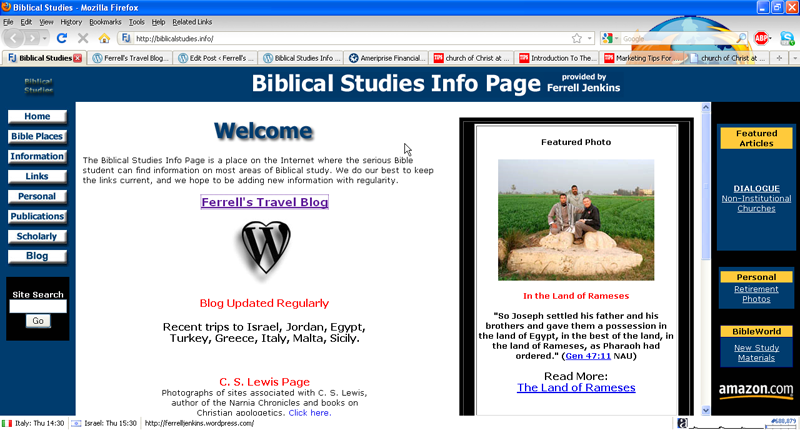
Front page of the Biblical Studies Info Page.

Probably the most important category is marked Scholarly. This page is not scholarly in the sense of doctoral dissertation’s are scholarly (or should be!). I envisioned it as a page of material that a “lay” person could read and be able to have some confidence in. Sometimes there are two links to differing views on a subject. I intend for people to think, examine, and draw their own conclusions. The categories within the page are important: Apologetics, Culture; Archaeology & the Bible; Bible Study Software & Tools; Bibles Available Online; Biblical Backgrounds; Biblical Criticism: Manuscripts & Translations; Blogs and News Pertaining to Biblical Studies; Books; Church History; Documenting Your Online Research; Evangelism; Greek Studies; Judaism; Maps of Bible Lands; Museums and Traveling Exhibits; New Testament Background; Old Testament Materials; Patristics; Periodicals: Scholarly Journals; Photos and Art; Resource Indices; Restoration Movement (history); Study Materials: Online; Theology.

A Video Surprise

By surprise one day I received an Email from Tony Eldridge, a young author and book marketing expert. Tony writes a blog filled with good tips for people who have books to promote. Begin with his home page here, and move on to the blog.

What surprised me was that Tony had prepared a short video explaining the value of the Biblical Studies Info Page for members of the church where he is a member. You might enjoy his introductory video here. He also reviews other web sites that he considers helpful to Bible students.

Our thanks to Tony.

2010 in review — according to WordPress

The stats helper monkeys at WordPress.com mulled over how this blog did in 2010, and here’s a high level summary of its overall blog health:

Healthy blog!

The Blog-Health-o-Meter™ reads Wow.

Crunchy numbers

Featured image

The Louvre Museum has 8.5 million visitors per year. This blog was viewed about 240,000 times in 2010. If it were an exhibit at The Louvre Museum, it would take 10 days for that many people to see it.

In 2010, there were 277 new posts, growing the total archive of this blog to 907 posts. There were 425 pictures uploaded, taking up a total of 40mb. That’s about 1 pictures per day.

The busiest day of the year was October 28th with 1,134 views. The most popular post that day was Prof. Ehud Netzer critically injured at Herodium.

Where did they come from?

The top referring sites in 2010 were blog.bibleplaces.com, biblicalstudies.info, facebook.com, lajupaulk3.blogspot.com, and Google Reader.

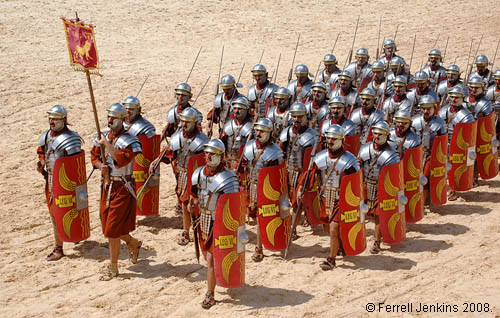
Some visitors came searching, mostly for roman soldiers, roman army, chariots, euphrates river, and roman soldiers pictures.

Attractions in 2010

These are the posts and pages that got the most views in 2010.

1

Prof. Ehud Netzer critically injured at Herodium October 2010
1 comment

2

Roman soldiers and chariot races at Jerash March 2008
5 comments

3

The tabernacle in the wilderness August 2008
5 comments

4

The Corinth Canal March 2008

BiblePlaces List of Top Stories of 2010

Over the past few weeks I have been busy with numerous things other than blogging that I considered important. In the meantime I have followed several blogs to keep up with what’s going on in those areas in which I have interest. I always check Todd Bolen’s BiblePlaces Blog, because it covers the specific areas that we try to cover here.

As the year 2010 comes to an end, Todd has listed what he considered the Top Discoveries of 2010, the Top Technology-Related Stories of 2010, and Losses (deaths). He promises to post other related lists tomorrow.

I suggest you take a look at the lists. We have commented on several of these same stories because we considered them important in assisting Bible students.

Opportunity to win Pictorial Library

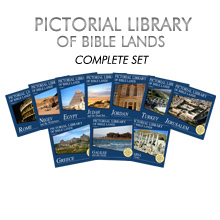
We have repeatedly recommended the Pictorial Library of the Bible Lands. Todd Bolen is giving away two 10-volume sets of this valuable resource. You have until Sunday at 5 p.m. to enter the drawing.

The Pictorial Library is being offered at a 20% discount for the first time. This offer extends through Sunday.

Full details are available at the Bible Places Blog here.

Another jumping off place — the pinnacle of the temple

A couple of days ago we wrote about the pinnacle of the temple (Mark 11:11; Luke 4:9). We followed the common suggestion that the reference was to the southeast corner of the temple mount precinct.

We mentioned that the late Benjamin Mazar, The Mountain of the Lord (page 149), shows a photo of the southeast corner of the wall with the comment that this “is known as the ‘pinnacle of the Temple’ (Mark 11:11; Luke 4:9).”

Leen Ritmeyer left us a comment to say that “Mazar actually had a different idea,” and called attention to his own post at ritmeyer.com.

Dr. Ritmeyer, author of The Quest: Revealing the Temple Mount in Jerusalem, provided some insight into the subject that is helpful and appreciated. He says,

Although this statement does appear in the book, I remember discussing this problem with him and he said that he actually saw the  southwest corner of the Temple Mount as a more likely candidate for the pinnacle of the Temple. One needs to determine what was the most important element in the temptation of Jesus to throw himself down from the pinnacle. Was it the height of the corner above what lay below or did the temptation lie in impressing as many people as possible with that jump?

As the southwest corner was a busy junction between the major north-south street running through Jerusalem and the Plaza in front of the Southern Wall of the Temple Mount, there would have been many more people to impress here than on the much quieter southeast corner.

It is in a setting such as this that we can visualise the dramatic scene that would have taken place had not Jesus challenged the temptation with the power of God’s Word.

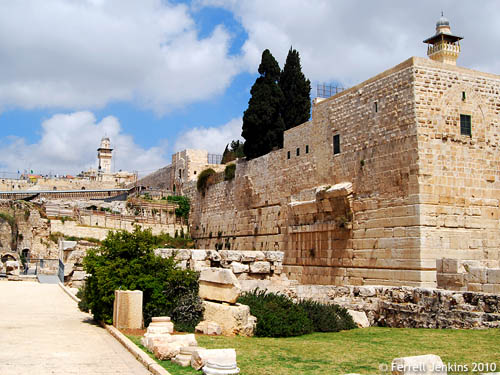
The Temple Mount Southwest Corner. Photo by Ferrell Jenkins.
The Southwest Corner of the Temple Mount. Photo by Ferrell Jenkins.

The western side of the Temple Mount enclosure ran along the Tyrophean Valley from north to south. A few years ago archaeologists found the first century street level at the southwest corner. The stones you see protruding from the wall are known as “Robinson’s Arch”, named for 19th century explorer Edward Robinson. When I first visited Jerusalem in 1967 it was commonly thought that the arch was the beginning of a bridge across the Tyrophean Valley, similar to Wilson’s Arch which is north of the Western Wall plaza. Now we know that the arch was the beginning of a winding staircase that allowed access to the Royal Stoa on the temple platform. (You will see a nice drawing of this staircase in Ritmeyer’s post.)

In my original post I said, “In a post to follow I will mention another view.” The other view I had in mind was the southwest corner.

Richard M. Mackowski, Jerusalem City of Jesus, says this corner “may be identified with the biblical Pinnacle of the Temple” (page 122). This is the comment I intended to use in today’s post. I am delighted that Dr. Ritmeyer calls attention to the discussion he had with Benjamin Mazar. We expect scholars to change their minds as they gain new information. It is also possible that an editor added the note in the book.

My bottom line is that we do not know for certain where the pinnacle of the temple is located. Either of these views suggest a good possibility.

Half a millionaire!

Compared with many websites and blogs, reaching the 500,000 hits level, as we did a few minutes ago, is not much. However, for a blog by an obscure writer dealing with the narrow topic of the Bible lands this might be impressive.

During our first month online (May, 2007) we averaged about 81 hits a day. The blog was intended to provide an opportunity for friends of those traveling with me on a tour of Anatolian Turkey and the area of Paul’s first journey to keep in touch. I think there was no thought of continuing the blog on a regular basis.

When we discovered that there was continuing interest in the photographs and bits of information we provided, we continued to write. The growth of readership was gradual. This month we are averaging about 885 hits a day. At the annual professional meetings of the NEAS, ETS, and SBL several people who saw my name badge mentioned reading the blog.

We always have in mind those who preach and teach the Bible as we prepare our material.

Thank you for your interest in this material and for your kind words of encouragement from time to time. I must confess that some days I give thought to discontinuing the blog. Except for the evidence that some of the readers are finding this material helpful I probably would.

I am grateful to others who have called attention to my blog through their links and honorable mentions. Every time Todd Bolen mentions my posts at Bible Places Blog I note an uptick in hits. I continue to be thankful for WordPress and the platform provided to anyone who wishes to post their thoughts/materials on the Internet.

Just had a thought. What if I had a dollar for each hit? It was just a thought.

For this special occasion I wanted to share a nice photo of the site of Paneas /Banias/Caesarea Philippi. This photo shows the site of the Pan shrine at the foot of the vast rock which is part of the the foothills of Mount Hermon. A spring flows from beneath the rock to form the Banias River which in turn joins other branches to form the Jordan River. Click on the photo to get an image suitable for use in sermon and class presentation.
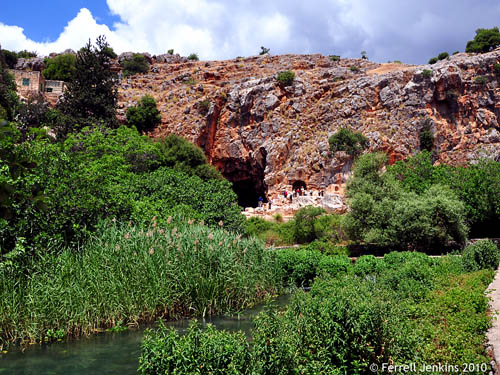
The site of Paneas was Caesarea Philippi in the time of Jesus. Photo by Ferrell Jenkins.

The site of Paneas was Caesarea Philippi in the time of Jesus. Photo by Ferrell Jenkins.

Here is the Bible text that goes with the photo.

13 Now when Jesus came into the district of Caesarea Philippi, He was asking His disciples, “Who do people say that the Son of Man is?”
14 And they said, “Some say John the Baptist; and others, Elijah; but still others, Jeremiah, or one of the prophets.”
15 He said to them, “But who do you say that I am?”
16 Simon Peter answered, “You are the Christ, the Son of the living God.”
17 And Jesus said to him, “Blessed are you, Simon Barjona, because flesh and blood did not reveal this to you, but My Father who is in heaven.
18 “I also say to you that you are Peter, and upon this rock I will build My church; and the gates of Hades will not overpower it.
19 “I will give you the keys of the kingdom of heaven; and whatever you bind on earth shall have been bound in heaven, and whatever you loose on earth shall have been loosed in heaven.” (Matthew 16:13-19 NAU)

A look at copyright basics

The other day, on some source I look at, someone said something like this, “I don’t know anything about copyright.” Earlier this year I had a problem with a blogger who copied my articles and photos, even replacing my copyright notice with his own. Read here, if interested.

WordPress features some of their more successful blogs each day under the title “Freshly Pressed.” One of them caught my eye this morning. It has to do with misconceptions about copyright at it applies to blog posts.

I suggest that everyone who writes a blog, edits a bulletin, prepares presentations, wants to copy a handout, or posts info on a social network take a look at this article on Blogger Basics: Copyright by Deirdre Reid. She also explains Creative Commons.

Some think the solution to the copyright problem is just to label everything as “anonymous.” Not so.

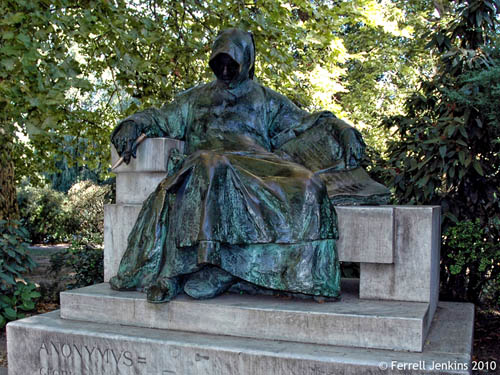
Statue of Anonymous in Budapest. Photo by Ferrell Jenkins.

In Budapest, Hungary, near the entrance of Vajdahunyad Castle, there stands a statue of Anonymous by Miklos Legeti. The statue commemorates a 12th or 13th century unknown chronicler of one of the several rulers named King Bela.

New website on biblical archaeology

Rob Bradshaw, in the United Kingdom, adds another website where he provides out-of-print books and periodical articles. This time the subject matter is biblical archaeology. I expect that we will see it grow in helpfulness as has been true of his other sites. Here is his own announcement.

I am very pleased to announce that my new website aimed at providing resources for those studying the archaeology of the Bible lands is officially launched today.

Over the last few months it became apparent that the range of material relating to archaeology would no longer fit within the structure of the biblicalstudies.org.uk website. The new site will eventually offer detailed coverage of all aspects of biblical archaeology from artefacts to bibliographies of noteable archaeologists. Collapsible menus will be added once the site structure is finalised.

Click here to visit the new site.

Decorations from Herod’s tomb

Joseph I. Lauer calls attention to a photo-essay of the announcement of the discovery of Herod’s tomb at the Herodium. This essay dates back to May 10, 2007, but there may be new readers who have not seen this. Check here.

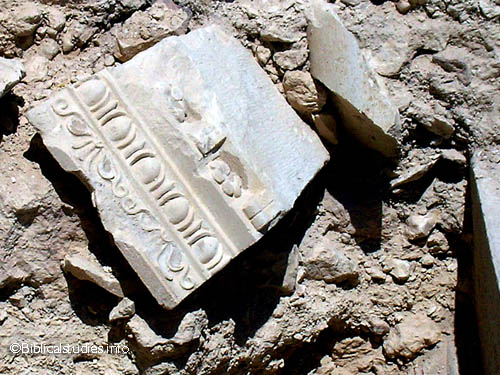
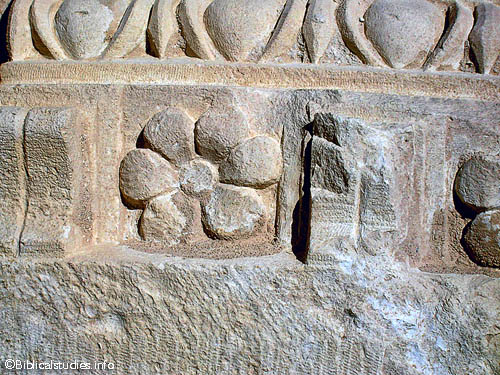
Shortly after the announcement, Elie Ben Meir, a guide/friend of mine in Israel, shared a few of his photos made at the Herodium on June 24, 2007. I had intended to publish, with his permission, some of these earlier but overlooked it. You might enjoy these closeup of some of the stone decorations found at the site.

Herodium tomb ornament. Photo by Elie Ben Meir.

Herodium tomb ornament. Photo by Elie Ben Meir.

Notice the beautiful carvings.

Decoration of Herod's tomb at the Herodium. Photo by Elie Ben Meir.

Decoration of Herod's tomb at the Herodium. Photo by Elie Ben Meir.

I found Leen Ritmeyer’s post about the passing of Prof. Netzer interesting. Check it here.

Herod the Great was the “king of Judea” from 37 to 4 B.C. Near the close of his reign Jesus was born in Bethlehem.

After Jesus was born in Bethlehem of Judea in the days of King Herod, wise men from the east arrived unexpectedly in Jerusalem, (Matthew 2:1 CSB)