Category Archives: blog

Comments on the detestable shepherds in Egypt

A few days ago we wrote in response to the question, “Why were shepherds detestable to Egyptians?”

We get more comments on the posts at Facebook than on the blog itself. Often I wish the (serious) comments were added here. I am going to share some comments made on this post. Christine, a regular reader of the blog and a friend from church, wrote:

“the cattlemen and the sheep herders of the American west were at odds, and I have read that sheep eat roots and all of the grass, ruining the grazing for cattle…could have an economic basis. And I could be wrong.”

Mark T., former student, wrote: “I learned that from reading cowboy books as a teenager. :-) ” [During class? FJ]

Mark B., former tour member, wrote:

“I never thought about the animosities between cattlemen and sheep herders here in the old west and how the sheep tear up the good grass if left to graze too long in one spot. What a great point!”

Listening to the sound tract of Oklahoma would give a tip about the conflict between the cowmen and the farmers. I think the point about the cattlemen and the farmers is a great one to show the conflict that often exists in a society.

However, we must not overlook the point made by John T. Willis that the term livestock includes cattle, sheep, goats, etc. Note the comment.

John T. Willis points out that the term livestock (or cattle; Hebrew, miqneh) is “a comprehensive term including cattle, sheep, goats, and the like” (Genesis in The Living Word Commentary on the Old Testament).

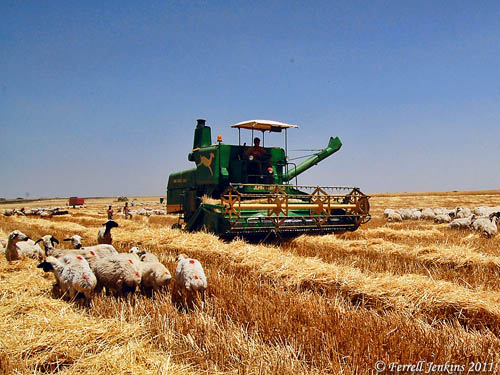
It is common in the Middle East for shepherds to take sheep into a grain field as soon as the harvesting is complete. This could be a real problem if cattle of any kind got into the fields in advance of harvesting. Remember that fences are virtually unknown there.

This photo is one I made in eastern Turkey north of Sanliurfa (and Haran). Even before the combine gets out of the field the shepherds are there with their sheep.

Sheep grazing as a field is being harvested. Photo by Ferrell Jenkins.

Sheep grazing in Eastern Turkey as a field is being harvested. Photo by Ferrell Jenkins.

Recently we posted a photo of sheep grazing in a field that had been harvested in the Shephelah of Israel here.

Searching for info on David (or other Bible characters)

A former student left a comment at another place on this blog:

I’ve been enjoying your blog and the pictures! What a blessing that you’ve been able to travel to all these places and then share that info with those of us who have never been! I’m looking for some information about David for teaching 7th-8th graders and was wondering if you could direct me to where to look on your blog or website. I wanted to be able to show them some ancient historical evidences. Also, may I have permission to use some pictures as visual aid in the classroom? Thank you!

Always nice to hear from former students and friends.

First, regarding permission. You certainly have permission to use any of this material in Bible classes as long as the credit line is maintained. I am honored and delighted that you find the material helpful.

Locating material on David (or anyone else, or any place). The search box on the blog is not the greatest in the world, but it can be helpful. Just put the word David in the search box. It is true that you may get a mention of some other person named David, but I think you will find it helpful. Also try Saul, Elah, Kiriath (as in Kiriath Jearim), En Gedi, stronghold, Ziklag, Bethlehem, Jerusalem, or any other person or place you are studying about. We certainly haven’t covered every Bible character or place, but we have covered a lot in past four years.

Also take a look at the Biblical Studies Info Page. Look under Scholarly, then Photos and Art, for photo sources. I think every church should have the collection of photos from Bible Places. Good photos can be found at Holy Land Archives, and Bible Land Photographs.  Also check the Maps of Bible Lands category. Bible Atlas is especially helpful in identifying the places associated with David (or any other Bible character).

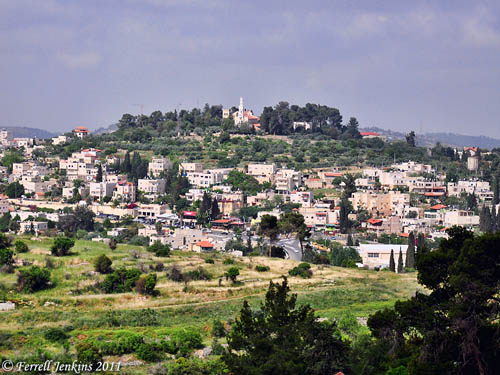
I am including a recent photo of Abu Ghosh and the site of biblical Kiriath-jearim (or Kiriath Jearim). The view is to the west.

Abu Ghosh and the site of Kiriath Jearim. This is where the Ark of the Covenant rested for 20 years until David took it to Jerusalem. Photo by Ferrell Jenkins.

Abu Ghosh and the site of Kiriath Jearim. This is where the Ark of the Covenant rested for 20 years until David took it to Jerusalem. Photo by Ferrell Jenkins.

Kiriath-jearim’s highest honor is in the association with the ark of the covenant. The Israelites took the ark from the tabernacle at Shiloh to the battle field at Ebenezer when they were fighting with the Philistines (1 Samuel 4). The ark was captured by the Philistines and taken to Ashdod, then to Gath, and finally to Ekron before they decided to get rid of it. The ark was returned to Beth-shemesh (1 Samuel 4-6).

The men of Beth-shemesh sent messengers to the residents of Kiriath-jearim asking them to come and take the ark to their town. The ark was brought into the house of Abinadad on the hill. His son, Eleazar, was consecrated by the men of the city to keep the ark of the LORD. The ark remained there for many years until David had it brought to Jerusalem (1 Samuel 6:21-7:2; 2 Samuel 6).

Check Bible Atlas here for maps showing Kiriath-jearim.

Friday’s findings

Looking for Joshua’s Ai. Gary Byers, administrative director of the Khirbet el-Maqatir excavation, has already posted info on six days of the dig. Because I assume this series will continue, I suggest you begin with Day One here. The expedition has posted photos on Facebook here. This will give prospective diggers some idea what goes on during a dig. Information about the purpose of the dig, a project of the Associates for Biblical Research, is posted here. Dr. Bryant Wood, and others associated with this dig, are looking for an alternative site for Ai.

Hidden Pyramids. Dr. Zahi Hawass has called in question the BBC program about the work of Dr. Sarah Parcak using satellite imagery to discover 17 new pyramids and other structures.

Although satellite imaging is useful for discovering new sites and monuments, interpretation of the images is not straightforward. No one can say with certainty that the features displayed under the sand are actually pyramids. Such anomalies could be houses, tombs, temples, pyramids, buried cities or even geological features. The only way we can definitely identify what is there is by excavating it – by investigating it physically. This was not made clear in the article.

Read the complete article here. See our earlier report here.

Corinth Matters. David Pettegrew, assistant Professor of History at Messiah College near Harrisburg, PA., has started a blog called Corinth Matters. Pettegrew completed a dissertation on Corinth on the Isthmus. The new blog deals with the ancient city of Corinth, the Isthmus, the Diolkos, and other things Corinthian. You will find readings lists, links to conferences, info on excavations, maps and images relating to Corinth and the Corinthian correspondence.

Dr. Pettegrew currently is traveling in Albania, the location of ancient Illyricum, visiting Corinthian colonies from the pre-Christian period. Paul made reference to preaching as far as Illyricum.

by the power of miraculous signs and wonders, and by the power of God’s Spirit. As a result, I have fully proclaimed the good news about the Messiah from Jerusalem all the way around to Illyricum. (Romans 15:19 CSB)

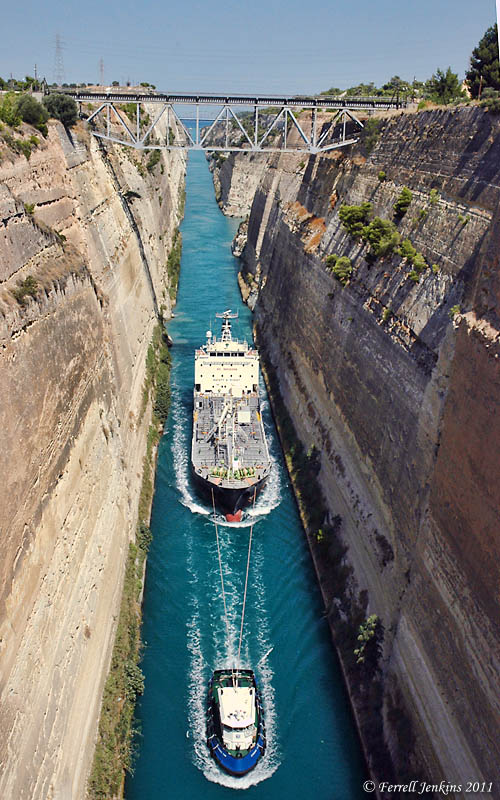
Corinth Canal - Photo by Ferrell Jenkins.

A ship is towed through the Corinth Canal. View west toward the Gulf of Corinth. Photo by Ferrell Jenkins.

Having taught the Corinthian correspondence for several year, I find this blog especially interesting.

Following Larry on the “Jesus Trail”

Last week Larry and I spent the week traveling here and there in Israel to many places not easily accessible to a tour group. Friday afternoon I dropped Larry in Nazareth where he would spent the night and begin the next morning walking the five-day jaunt on the Jesus Trail from Nazareth to Capernaum and Bethsaida.

He tells about the beginning in Nazareth here. He reports on finding the Roman Road earlier on Friday, May 13 here.

The events of Saturday, May 14, from Nazareth through Sepphoris (Zippori) to Cana of Galilee, is recorded here.

Day 2 (May 15) of the journey from Cana (Kefr Kanna) of Galilee to Ilaniya is recounted here. He includes photos of flowers and butterflies that he saw along the way, and records his encounter with three vicious-appearing sheep dogs.

By the time you look at these blogs you will be ready to continue following the rest of the journey without any notification from me.

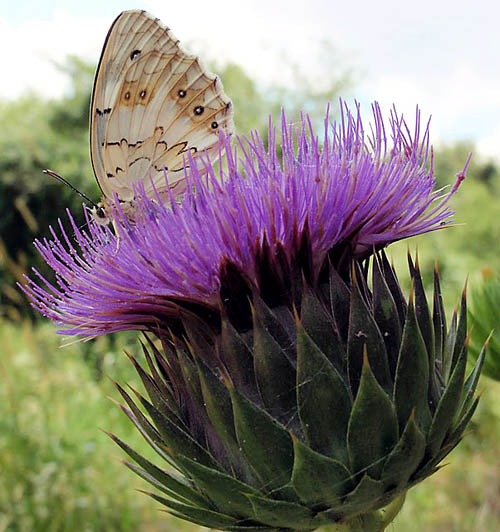
I am taking the liberty to include two of Larry’s many photos to entice you to take a look at his blog. The first shows one of the beautiful butterflies on a thistle bloom. There are several varieties of thistles (or briers) mentioned in the Bible. (If I am wrong about this, I know one of our readers who will send the correct information.)

Butterfly on a thistle bloom. Photo © Larry Haverstock.

Butterfly on a thistle bloom. Photo © Larry Haverstock.

This is where Larry spent the second night of his “Third Journey.”

Accommodation on the Jesus Trail - Night 2. Photo © Larry Haverstock.

Accommodation on the Jesus Trail - Night 2. Photo © Larry Haverstock.

No matter how “primitive” our accommodations may be, we are reminded of Jesus’ statement about his own situation on earth:

Jesus said to him, “The foxes have holes and the birds of the air have nests, but the Son of Man has nowhere to lay His head.” (Matthew 8:20 NAU)

Here is a self-photo of Ferrell (l) and Larry (r) on the Roman Road near Golani Junction.

Ferrell Jenkins & Larry Haverstock on Roman Road at Golani Jct.

Ferrell Jenkins & Larry Haverstock on Roman Road at Golani Jct.

For better photos of the Road see Larry’s blog (linked above) or this blog, here.


New photos of the pinnacle of the temple

A few months ago we wrote about the pinnacle of the temple here and here. At that time I included comments by William Barclay, Benjamin Mazar, William Hendriksen, and Josephus, Leen Ritmeyer, and Mackowski.

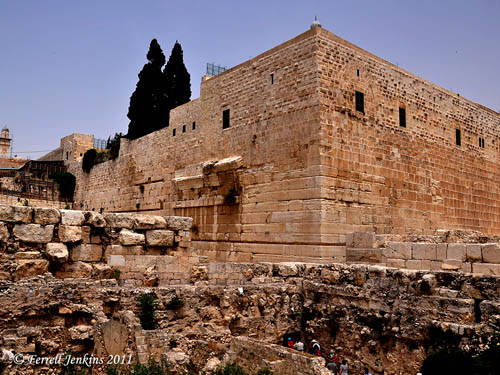
Today I made a new photo of the southeast corner of the Herodian temple precinct.

The southeast corner of the temple precinct. Photo by Ferrell Jenkins.

The southeast corner of the temple precinct. Photo by Ferrell Jenkins.

Here is a new photo of the southwest corner of the temple precinct. Notice the people at the bottom of the photo.

Southwest corner of the Herodian temple precinct. Photo by Ferrell Jenkins.

Southwest corner of the Herodian temple precinct. Photo by Ferrell Jenkins.

And he led Him to Jerusalem and had Him stand on the pinnacle of the temple, and said to Him, “If You are the Son of God, throw Yourself down from here; (Luke 4:9 NAU)

See also Matthew 4:5.  Be sure to read or review the previous posts.

A day in the Shephelah

Today proved to be an exciting and profitable one for Larry Haverstock and me. We traveled south along highway 60 from Jerusalem, past Bethlehem, and almost to Hebron before turning back and heading west to the Elah Valley. On the way to Hebron one sees many examples of terraced farming, and vineyards in wadis.

In the Elah Valley vicinity we stopped at Socoh, the Brook Elah, and the Elah Fortress at Khirbet Qeiyafa. We also had a nice view of Azekah. This area is associated with the events of 1 Samuel 17 (David and Goliath).

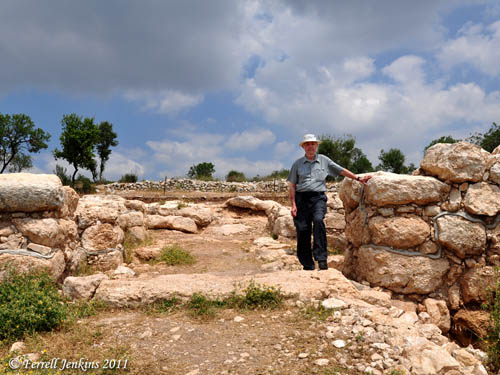
The photo below shows the Iron Age, four chamber gate at the Elah Fortress. This is the northern gate which faces Azekah. This scene is reminiscent of the reference to the worthy woman in Proverbs 31.

Her husband is known in the gates when he sits among the elders of the land. (Proverba 31:23 ESV)

Ferrell Jenkins in the Gate at Elah Fortress at Khirbet Qeiyafa

Ferrell Jenkins in the Gate at Elah Fortress at Khirbet Qeiyafa.

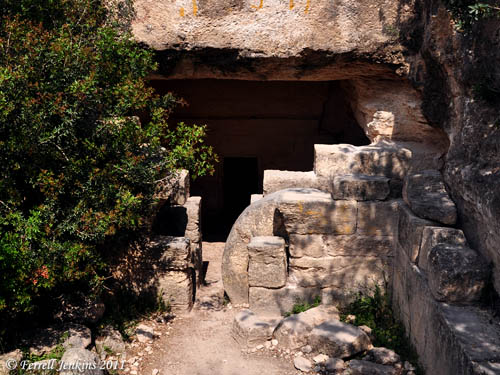
Next we went to the Midras Ruins to see the Roman period tomb with a rolling stone. This is the tomb that was vandalized more than 15 years ago. (At the moment the photo below is not showing when I preview it, but it is visible when I click on the link.)

Roman Period Tomb at Midras Ruins in the Shephelah. Photo by Ferrell Jenkins.

Roman Period Tomb at Midras Ruins in the Shephelah. Photo by Ferrell Jenkins.

The Midras Ruins (Horvat Midras) in Israel are part of the Adulam Grove Nature Reserve east of Hwy 38 between the Elah Valley and Beit Guvrin. According to the Parks department sign at the site, the ruins are part of an ancient settlement including caves, pits, and other installations. The Carta touring atlas says the area was continuously inhabited from the time of the Kings of Judah to the Roman period.

For a more complete discussion of the Midras Ruins tomb, along with links to photos before the tomb was vandalized, read here.

We made a few photos of Tel Burna. This tel is often identified with Moresheth Gath, the home of the prophet Micah. The current excavators think it may prove to be biblical Libnah. One of the significant events that took place at Libnah is recorded here:

The Rabshakeh returned, and found the king of Assyria fighting against Libnah, for he heard that the king had left Lachish. (2 Kings 19:8 ESV)

The Tel Burna Archaeological Excavation is under the direction of Itzhaq Shai and Joe Uziel. Check their web site here.

Our last stop was for a photo of nearby Tel Zayit. The archaeologists who have worked there suggest that it may be Libnah or Ziklag. Hopefully we will learn something more definitive in the years to come. Ron E. Tappy is director of the Zeitah Excavations. Check their web site here.

We visited Lachish and Gath last Friday with our group. All in all, it was a wonderful day.

The group photo in Jerusalem

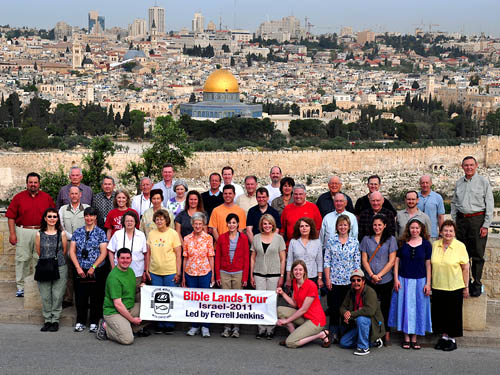
Our group had a wonderful day for the traditional photo from the Mount of Olives with Jerusalem as a backdrop.

Bible Land Tour of Israel Group Led by Ferrell Jenkins.

Bible Land Tour of Israel Group Led by Ferrell Jenkins.

If you know some of the folks in the group you might like to look at a larger image here.

Post Number 1,000

This, incidentally, is post number 1,000 for this blog. I have never tried to emphasize an abundance of posts, but to concentrate on posts of some quality. And, I have tried to stay close to the general purpose that we set forth at the beginning. We concentrate on places and significant events in the Bible World.

Thanks for following our journeys.

A personal note about other traveling bloggers

In recent years it is common for tour members to begin a blog and post their impressions and photos during the tour. I must say that this isn’t always easy. First there is the problem of connecting to the Internet. I have an unlocked air card that has worked with a local data SIM card. This time I am having trouble with it. The rates for the use of the Internet at the Tiberias hotel was $23 a day. Highway robbery! The hotel here in Jerusalem charges $15 a day. Local street robbery!  Then there is the problem of time. I have seen bloggers up until late hours just getting online, preparing photos and writing readable info for friends back home.

The bloggers also lug around expensive computer and photographic equipment in order to accomplish the self-appointed task.

I thought that some of our readers might like to take a look at how these bloggers are handling the matter. A couple of them are using WordPress, and one is using Blogger.

Nick and Erin Smith are blogging at Oh, the Places We Go here. Nick and Erin are a young married couple making their first foreign trip.

Stephen Cook is blogging under the title From Athens to Israel here. Stephen is from Athens, Alabama. Stephen has done some foreign travel before.

All three of these folks are on their first tour of the Bible Lands. Their perspective will reveal the approach of a first time traveler to the area. They are looking forward to using their new knowledge and photos in Bible teaching. And they all come from North Alabama, an area hit by the recent tornadoes that devastated some areas of the South last Wednesday. Fortunately their property was untouched.

Larry Haverstock is blogging under his own name here. This is Larry’s second tour in as many years. He knows exactly why he is here this year. He wishes to gain a deeper understanding of the land and its relation to the Word. He is an experienced minister who already understands exactly how he will use what he is learning.

Former Travelers Back Home Braving the Storms

Olen and Jane Britnell, also from North Alabama, have traveled with us on a number of tours. Jane blogs when she travels. She is not on this tour, but she is blogging again. This time it is about the devastating storms that hit all around them a few days ago. You might enjoy reading this first hand report. She also includes info on Shirley — another personal friend who lost her house in the storm. Shirley has traveled with us on numerous tours, and  is a faithful follower of this blog. The blog, wesurvivedthestorms, is here.

Pilate delivered Jesus to be crucified

About 1968 I was speaking in Lethbridge, Alberta (Canada), on Christian Evidences (or Apologetics). At the close of the lessons one of the attendees said, “I would believe, except for all of the contradictions in the Bible.” Already I had learned that “all of the contradictions” were too big for me to handle at one time. I said, “Name two.” He said, “There is no record of Pontius Pilate outside the New Testament.”

Pilate is mentioned no less than 56 times in the New Testament. Most of the references are in the Gospels (Matthew, Mark, Luke, and John). There are four references in Acts (3:13; 4:27; 13:28), and one in 1 Timothy 6:13.

I charge you in the presence of God, who gives life to all things, and of Christ Jesus, who testified the good confession before Pontius Pilate, (1 Timothy 6:13 NAU)

Except for Luke 3:1 and 13:1, the references in the Gospels are clustered in the final chapters of each book, the section dealing with the crucifixion of Jesus (Matthew 27; Mark 15; Luke 23; John 18-19).

I have no idea why one would think that having no external reference to a person named in the Bible would mean that the Bible was not true.

In fact, there are many literary references to Pilate outside the New Testament. A quick computer check shows at least 21 references to Pilate in Josephus (Antiquites and Jewish Wars).

Note this brief paragraph by Gary R. Habermas from The Historical Jesus: Ancient Evidence for the Life of Christ, page 221.

After suffering persecution (Gospel of Truth) and as a result of his teachings (Lucian), Jesus was put to death (Gospel of Thomas, Treatise on Resurrection). He died at the hands of Roman procurator Pontius Pilate (Tacitus), who crucified him (Josephus, Talmud, Lucian, Gospel of Truth, Acts of Pilate) during the reign of Emperor Tiberius (Tacitus, Phlegon).

And there is much more in Habermas’ book about Pilate, as well as in other secondary sources that point to the primary sources.

Pilate is well attested on Roman coins. Many coins were minted during the reign of Pontius Pilate as Prefect of Judea under the Roman Emperor Tiberius. Check Jean Philippi Fontanille’s Menorah Coin Project here. Scroll down to Pilate, click on one of the coin images and you will be able to spend as much time as you can afford in one day learning about the coins of Pilate. Fontanille is author of The Coins of Pontius Pilate (Marco Polo Monographs series)

I was able to say to the skeptic in Lethbridge that an inscription bearing the name of Pilate had been found at Caesarea Maritima in 1961. The photo below shows a replica of the inscription which was found in the excavation of the Roman theater. The original is in the Israel Museum. A large copy suitable for use in teaching presentations is available by clicking on the image.
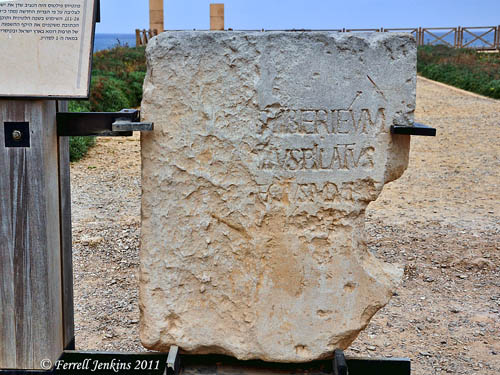
Pilate Inscription (Replica) at Caesarea Maritima. Photo by Ferrell Jenkins.

Pilate Inscription (Replica) at Caesarea Maritima. Photo by Ferrell Jenkins.

In an earlier post I mentioned that this inscription was found June 15, 1961. A reader who is doing research on Pilate asked about the specific date. As I began to look at various books dealing with archaeology, I noted that all I have looked at only mention the year 1961. In 1976 I self-published a book called The Book and the Land (now OP) primarily for use by persons joining my tours to the Bible Lands. Since that time I have thoroughly and continuously updated the material in connection with various tours. In those works, beginning in 1976, I cited The Israel Digest, a publication that I received for several years. I usually clipped the pages I was interested in and filed them. I spent several hours recently going through a multitude of folders without locating that particular page. However, I have had some success.
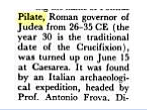
Israel Digest snippet mentioned Pilate Inscription.

Israel Digest, 1961.

A snippet view of a volume containing The Israel Digest for 1966 is available at Google Books here. Fortunately it contains a snippet showing the date that the Italian Expedition, headed by Prof. Antonio Frova, discovered the inscription. Click on the 1961 book and then search for Pilate. The digitized original is said to be from Indiana University.

Well, I know that most readers do not have this kind of curiosity, but I can’t avoid it. I like to know precisely where a writer or speaker got his info when he makes an unusual claim. We owe it to our readers and listeners.

Perhaps someday, if I live long enough, I will find the folder with the complete article.

Oh, and by the way, the guy in Lethbridge never mentioned the second “contradiction.”

Keeping informed

Egyptian Antiquities. Keep up with breaking news about Egyptian antiquities at Andie Byrnes’ the Egyptology News.

Tomb of the Prophet Zechariah at the Madras Ruins. See the report of the Israel Ministry of Foreign Affairs here. James Davila raises lots of questions about this report. See his Feb. 3, 2011, post here.

HT: Paleojudaica

Photos of Turkey and Greece. Mark Hoffman is making available some nice photos of his recent trip in Turkey and Greece. Read, and find the link to the photos here. The photos are geotagged so you may spot the location in Google Earth.

Birdwatching in Israel.

“There were some 25,000 cranes crowded around us this evening,” reports Judith Schwartz, a Kibbutz Ginosar resident. “One night last week there were 42,000. Your eyes can’t quite believe what you’re seeing. They stand in the lake all night, safe from the bobcats in the area. And here they rest, and lift off in their masses at dawn, blackening the sky like a swarm of gigantic locusts, to continue their 5,000 mile trip to their winter home in Africa.”

At least 500 million birds of 200 different species fly across Israel each spring and fall on their way to and from Africa, Europe and Asia, says Dr. Reuven Yosef, director of Eilat’s International Birding and Research Center. And more than 70 native Israeli species head to warmer Africa in winter, such as the cuckoo, Egyptian vulture, short-toed eagle, hobby and lesser kestrel.

See the full article here.

HT: BiblePlaces Blog