Category Archives: blog

Tired of watching the second hand on your watch?

Well, now your troubles are over. You can watch the Tell es-Safi/Gath Excavation in progress each day (Monday through Friday) at 6 a.m. to 1 p.m., and on Sunday through Thursday from 2:30 p.m. to 4:30 p.m. That is Israel time, which is 7 hours ahead of Eastern time in the USA.

In the Eastern time zone in the USA the live video feed may be seen from 11 p.m. to 6 a.m. (Monday-Friday) and 6:30 a.m. to 8:30 a.m. (Sunday-Thursday). Not the best times for the working American. But, what if it were the World Cup? Same response.

Well, I hope to catch the show beginning tonight at 11 p.m. I will get to watch those young college age volunteers wiping the matter from the corners of their eyes. This all reminds me of the conversations I have with my wife when I travel in Israel and she remains at home. I usually talk at 6 a.m., and she talks at 11 p.m. I say “Good Morning!” and she says “Goood Niighht…”.

Can’t make the show at all? Then go back to other exciting things like watching the second hand on your watch.

Seriously, this is a great thing. I suppose it is a first. Digging into the past streaming live. Dr. Aren Maeir, the director of the Tell es-Safi/Gath dig, keeps us updated on the progress of the dig.

Go to the Bar Ilan University web page and look for the banner about the streaming video here.

The direct URL to the feed is: http://media.motion-stream.com/biulive.

The dig blog may be read here.

Last December I made some aerial photographs above Tell es-Safi. Here is a photo showing a view to the southeast. This ancient Philistine city is located at the point where the coastal plain (to the west) meets the Shephelah (to the east). You should be able to make out the line of the Elah brook along the bottom and right of the photo.

Today we are trying to post these photos in a 1024 x 768 pixel size to make this more usable in PowerPoint presentations. Let us know if this is helpful. It require more time and attention, but we may be able to do this occasionally if you find it useful.

Tell es-Safi - Gath. Aerial SE view by Ferrell Jenkins.

Aerial view of Tell es-Safi/Gath looking SE. Photo by Ferrell Jenkins.

Dr. Maeir posted an aerial view of the tell at the end of the 2009 season here. Our next photo is a close look at Areas E (left) and A (right). Both areas continue to be worked this season.

Tell es-Safi/Gath Areas E and A. Photo by Ferrell Jenkins.

This site is important for those interested in the biblical history of Israel. Gath was one of the five cities of the Philistines, and the home of Goliath (Joshua 13:3; 1 Samuel 6:17; 17:4).
Excitement in the Shephelah

Luke Chandler hands out a teaser about “Fantastic (somewhat secret) new finds at Khirbet Qeiyafa” here. Whether his “Best case scenario” or the “Alternate scenario” turns out to be correct, there are discoveries that date to the Early Iron Age (about 1200 to 900 B.C.).

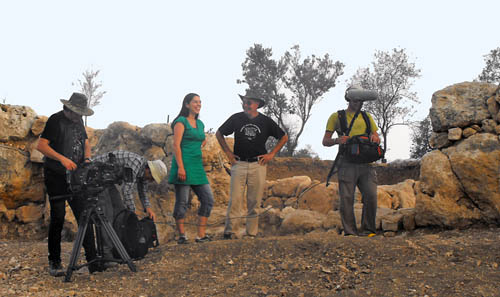
BBC is filming a documentary including Khirbet Qeiyafa and Gath. Luke posts a larger photo showing the BBC team with Dr. Yossi Garfinkel, director of the excavation, at the western gate. I recall that National Geographic did some filming there last year.

BBC filming documentary at Khirbet Qeiyafa. Photo by Luke Chandler.

BBC filming documentary at Khirbet Qeiyafa. Photo by Luke Chandler.

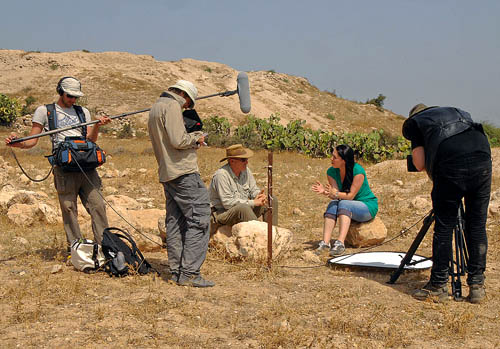
Earlier, the BBC team had been at Tell es-Safi/Gath with Professor Aren Maeir. The interviewer (in green) is Dr. Francesca Stavrakopoulou, a biblical scholar from Exeter University in the U.K. With a doctorate from Oxford, she worked at Tell es-Safi three years ago.

BBC filming documentary at Tell es-Safi/Gath. Photo: dig website.

BBC filming documentary at Tell es-Safi/Gath. Photo: dig website.

Aren describes today at the dig as “Just another fantastic day…” I will leave it for you to check out the other photos and a sketch of some of the discoveries of the day here. One thing that relates to what we posted earlier is about evidence of metallurgy at the site. Maeier says,

Adi and Naama continue to uncover additional evidence of metallurgy, apparently both Iron and Copper production!

Both Khirbet Qeiyafa, overlooking the Valley of Elah, and Gath, have a connection with the account of David and Goliath (1 Samuel 17).

Following current excavations

Prof. Aren Maeir reports the discovery of evidence of Philistine metallurgy at Tell es-Safi/Gath. He says the slag “is definitely copper-based material.” He mentions two experts in ancient metallurgy who came to supervise the excavation of the context of the metallurgical areas.

They found additional evidence of bronze production, including additional fragments of a crucibles, possible tuyeres, and many more small fragments of slag. This definitely is becoming very interesting!

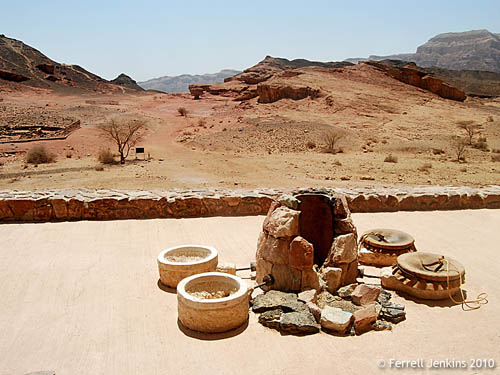
If I correctly understand what I read, the tuyere is the tube through which air is pumped into the crucible to make the heat in the furnace more intense. Perhaps this illustration of the copper mining process at Timna will be helpful. I am talking in an area where I know very little. If this is not correct, I will be pleased to receive a comment with a better explanation.

Copper smelting at Timna. Photo by Ferrell Jenkins.

Copper smelting at Timna. Photo by Ferrell Jenkins.

There are a few references to copper in the Bible. The land promised to the Israelites is described as,

“a land whose stones are iron, and out of whose hills you can dig copper.” (Deuteronomy 8:9 ESV)

The process of smelting is mentioned in the book of Job.

“Iron is taken out of the earth, and copper is smelted from the ore.” (Job 28:2 ESV)

More information is available at the Tell es-Safi/Gath Excavations website here.

Excavations in Jordan resulting in evidence of copper smelting in 10th century B.C. Edom is reported here.

Being able to keep up with some of the excavations by means of the blogs is exciting. Todd Bolen has compiled a list of 2010 Excavation Blogs at the Bible Places Blog here.

Archaeology Illustrated by Balage Balogh

His work has been featured on the Discovery Channel and in many scholarly books. A native Hungarian, Balage now creates images of ancient Israel, Egypt, Babylon, Greece, Rome, and other civilizations. He tell the story in these words:

I began working with archaeologists, scholars and experts in the field in the Department of Archaeology at the Hebrew University of Jerusalem, the Albright Institute, the Israel Museum, and universities throughout the United States.  My archaeological illustrations were published in National Geographic Hebrew edition,  A Guide to Jerusalem, The World of the New Testament, The World of the Old Testament, Excavating Jesus, and The Jesus Dynasty among others and many of my illustrations were part of exhibits at the Israel Museum, the Welcome Center in the City of David, Jerusalem, and permanently displayed in the Archaeology Department at the Hebrew University of Jerusalem.

Balage Balogh contacted me with the request that I offer some of his art free of charge on my web sites in exchange for a permanent link. Since I have more readers of the blog than of the web sites I decided to begin here. As time permits I will post a few more of his illustrations here and at the Biblical Studies Info Page and Bible World.

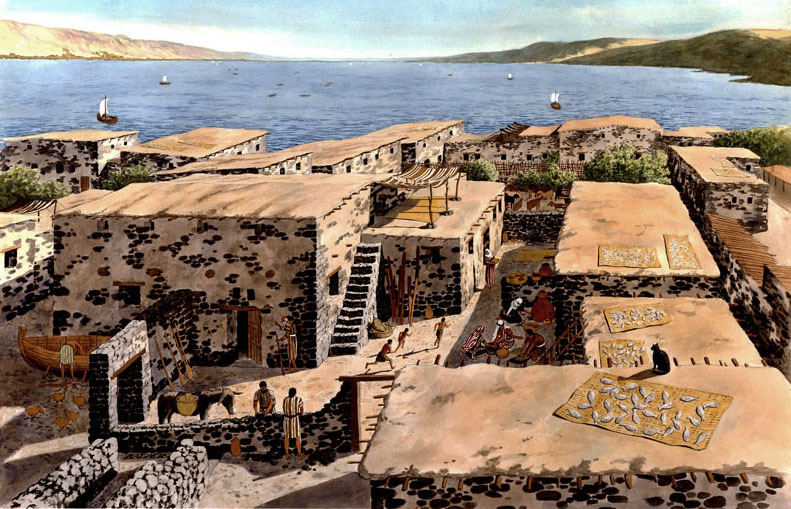
Here is a wonderful drawing of Capernaum at the time of Jesus. One need only know something about the archaeological discoveries of the first century to see the accuracy of this drawing. Notice the basalt stone and the way the roofs are constructed. A larger image is available by clicking on the drawing.

Capernaum at the time of Jesus. Art by Balage Balogh.

Capernaum at the time of Jesus. Art by Balage Balogh.

Take a look at Archaeology Illustrated. Balogh’s work may be purchased for use in presentations or publications. This illustration is © Balage Balogh 2010.

Reaching 400,000

Moments ago someone recorded hit number 400,000 for this blog. Your words of appreciation are greatly appreciated. In the past few weeks, while traveling on the West Coast, numerous people told me they found the posts helpful. The comments left on the blog, and the Emails received are also appreciated.

400,000 hits at ferrelljenkins.wordpress.com.

Ferrell's Travel Blog recorded his number 400,000 this evening.

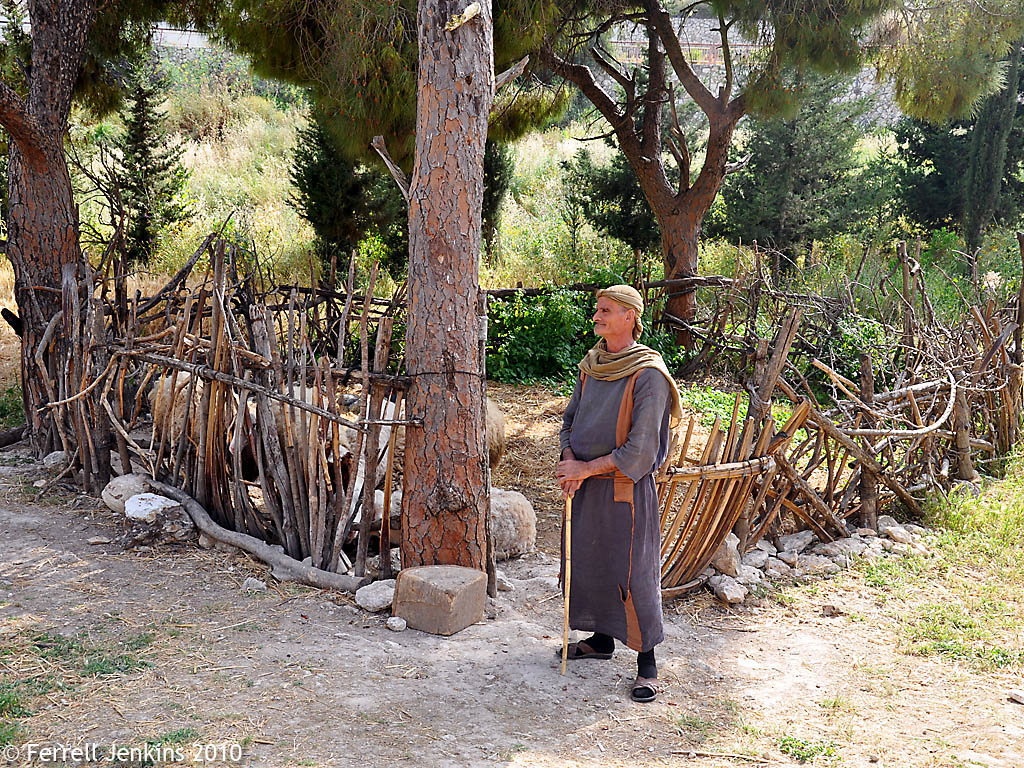
As a marker of this milestone I am posting a photo I think many of you will be able to use in the Bible classes you teach. Click on the photo for a larger image suitable for use in PowerPoint.

Shepherd and sheepfold at Nazareth Village. Photo by Ferrell Jenkins.

Shepherd and sheepfold at Nazareth Village. Photo by Ferrell Jenkins.

This photo might be used in teaching any of the texts mentioning the sheepfold (Genesis 49:14; Numbers 32:16; Judges 5:16; 1 Samuel 24:3; 2 Chronicles 32:28; Psalm 28:13; Psalm 78:70).

It provides a good illustration of the teaching of Jesus in John 10.

“Truly, truly, I say to you, he who does not enter by the door into the fold of the sheep, but climbs up some other way, he is a thief and a robber.  “But he who enters by the door is a shepherd of the sheep. “To him the doorkeeper opens, and the sheep hear his voice, and he calls his own sheep by name and leads them out. (John 10:1-3 NAU)

Featured on The Book & The Spade program

“The Sewers of Jerusalem” is featured as the lead to program #1235 on The Book & The Spade radio program. This long-running radio program providing backgrounders on the Bible through Biblical archaeology is hosted by Gordon Govier and Professor Keith Schoville. Govier is the archaeology correspondent for Christianity Today magazine. Professor Schoville is retired professor of Hebrew and Semitic Studies at the University of Wisconsin, Madison. His book, Biblical Archaeology in Focus, has been used by many students of archaeology.

The link to the newly designed blog of The Book & the Spade is here. You may listen to the entire radio broadcast, or download it in MP3 format, here. I think you will need to use Internet Explorer to be able to save the program. The current program remains available for free download for only a few weeks. The programs produced by Govier and Schoville are always interesting and informative. I keep a permanent link to the site at the Biblical Studies Info Page (under Scholarly).

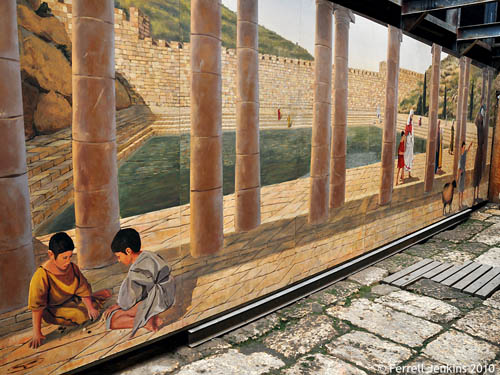
Our post on “The sewers of first century Jerusalem” may be read here. There are four recent photos with the post. Here is a photo of Roman street and mural of the Pool of Siloam as it is thought to have looked. This is where we expected to turn back and leave the area when one of the booksellers told us the sewer was open.

Perhaps the Pool of Siloam looked like this in the time of Jesus. Photo by Ferrell Jenkins.

Perhaps the Pool of Siloam looked like this in the time of Jesus. Photo by Ferrell Jenkins.

Moving on to the Northwest

Stop blogging? Not yet. We just had an extremely busy week in San Jose. Now I am on my way to the Seattle area where I will be speaking for a couple of days.

Excitement in Silcon Valley

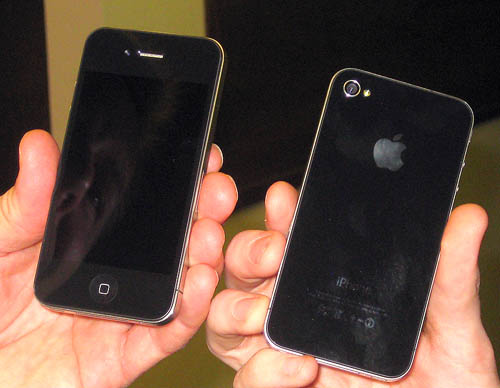
This evening (Wednesday, June 23) at the Miller Avenue lectures in San Jose I saw three new iPhone 4’s. There may have been more. Living in the Silicon Valley has its advantages, you know. Some people get this new toys early.

iPhone 4 in San Jose - June 22, 2010

iPhone 4 in San Jose - June 23, 2010

You can see from the smudges that the phones have been handled by a group of admiring friends.

There is a lot of excitement at the Miller Avenue Church of Christ lectures this year, too. Don Truex is speaking twice each day on some practical bible themes. I am presenting illustrated lectures each morning on Exploring the Bible World. In the evening the presentation are on Bible History and Archaeology. There is an additional speaker each morning.

This is why the posts have been sparse this week. Add to the lectures, some social appointments, reviewing the lessons, a little nap in the afternoon, and there is not much time left to blog.

Useful photo and information sites

Because I maintain the Biblical Studies Info Page, I don’t list a lot of links on this page. I suggest you check the Scholarly page, and then click on the Blogs and Photos. Here are a few sites dealing with archaeology and the Bible World that should be of special interest to readers of this blog. I am not listing the better known sites such as Bible Places Blog, Bible Places, and Holy Land Photos.

  • Through the Land of Israel III. Laju Paul is publishing hundreds of photos from all over Israel.
  • Photographs of Bible Lands. David Padfield, a friend who has traveled with me several times, has a great collection of photos available for download.
  • Leon’s Message Board. Leon Mauldin, a friend who has traveled with me several times, is posting good photos of the Seven Churches of the Book of Revelation and other places he has visited.
  • Bible Walks. Rotem, a young lady who lives in lower Galilee, has posted more than 2500 photos with maps, historical, and biblical information.
  • See the Holy Land. This site, the retirement work of a journalist in New Zealand, intends to serve as a guide to visitors of the Holy Places. (HT: Bible Places Blog)
  • Sacred Destinations. Religious and cultural sites around the world.
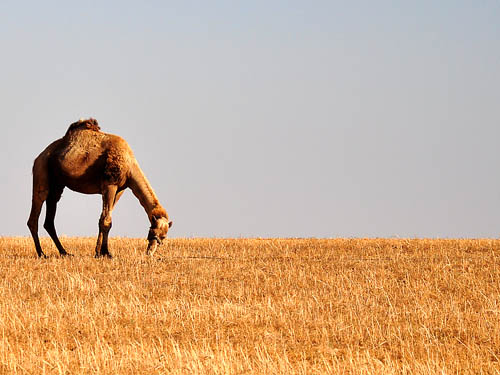
A camel along the road from Beersheba to Arad. Photo by Ferrell Jenkins.

A camel along the road from Beersheba to Arad. Photo by Ferrell Jenkins.

And for her sake he [Pharaoh] dealt well with Abram; and he had sheep, oxen, male donkeys, male servants, female servants, female donkeys, and camels. (Genesis 12:16 ESV)

Safe arrival in Israel

Our group arrived safely in Israel at the Ben Gurion Airport near Tel Aviv about 5:10 p.m. (7 hours ahead of EDT). After claiming all but 2 pieces of luggage for the entire group, we had time to go to Joppa for a short visit before sundown.

Later we drove north along the Plain of Sharon to Netanya where we are staying at a hotel overlooking the Mediterranean Sea. This provides a beautiful view of the sea, and the moon is full. I look forward to seeing the waves by day light.

Tomorrow we plan to visit Caesarea Maritima, Mount Carmel, Mediggo, and the Nazareth Village before arriving at Tiberias on the Sea of Galilee.

Jane and Olen have been with me on several tours, and many of you have come to enjoy Jane’s blog. She reports on lots of interesting stuff that goes on behind the scene. I encourage you to follow her Journeys With Jane as we make this journey through Israel and Jordan. The URL is http://journeyswithjane.blogspot.com.