Category Archives: blog

Archaeologist Netzer dies after fall

The Jerusalem Post reported here this afternoon that Prof. Netzer succumbed to the injuries sustained during his fall at the Herodium.

Renowned archaeologist Ehud Netzer died of his wounds at the Hadassah Ein Kerem hospital in Jerusalem Thursday night, days after he fell during an excavation.

On Monday Prof. Netzer was hospitalized in critical condition after a wooden railing he leaned on gave way, at the Herodion archeological site in the West Bank.

Jim West was kind enough to leave a comment on our blog this  morning once he was certain that Prof. Netzer had died.

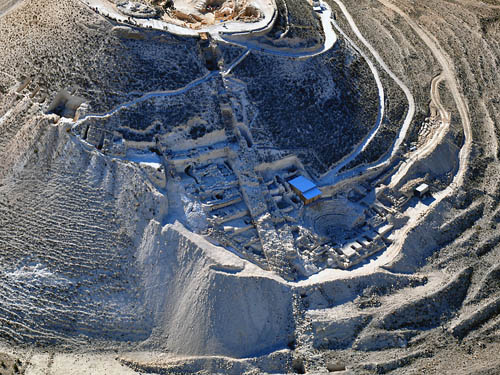
Recently we discussed here some of the work at the Herodium. Below I am including a closer view of the area where Prof. Netzer was working. This aerial photo shows a clear view of the theater. The roofed structure covers the royal theater box.

The Herodium excavation. Photo by Ferrell Jenkins, Dec. 15, 2009.

The Herodium excavation. Photo by Ferrell Jenkins. Dec. 15, 2009.

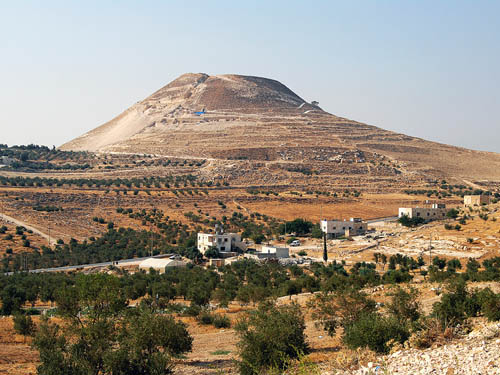
Without the determination of Ehud Netzer the north side of the Herodium would still look like the view below, and we would still be wondering about the location of Herod’s burial place.

The Herodium from the north. Photo by Ferrell Jenkins, Aug. 23, 2008.

The Herodium from the north. Photo by Ferrell Jenkins, Aug. 23, 2008.

The Herodium is located a few miles east of Bethlehem, the birthplace of Jesus (Matthew 2).

Report on Khirbet Qeiyafa — the Elah Fortress

Luke Chandler has participated in the excavation at Khirbet Qeiyafa the past two summers. Recently he posted two brief articles on some of the discoveries during the past summer. Read here and here.

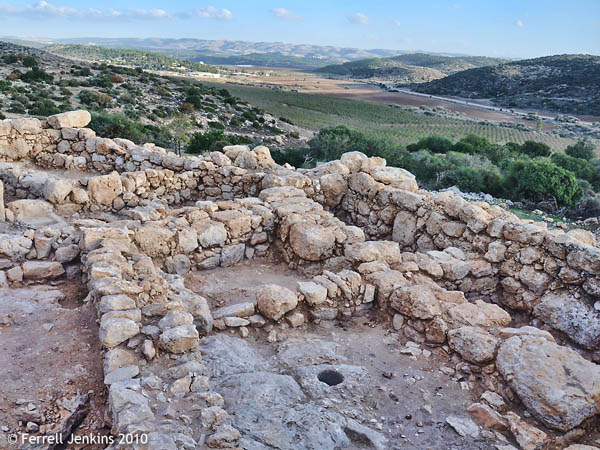
This area is associated with the events of 1 Samuel 17 (David and Goliath).

View to southeast over Elah Valley from Khirbet Qeiyafa. Photo by F. Jenkins.

View to southeast over Elah Valley from Khirbet Qeiyafa. Photo by Ferrell Jenkins.

Temple of Olympian Zeus in Athens

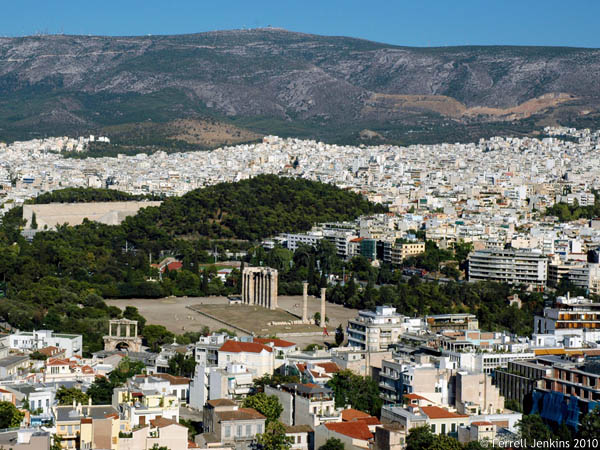
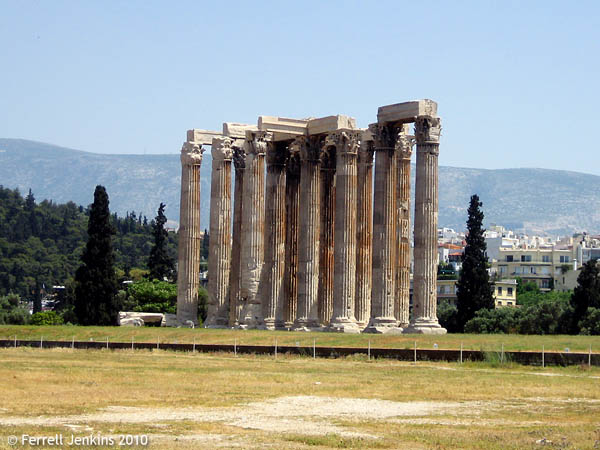
A reader asks about the location of the Arch of Hadrian that we wrote about in the previous post. The Arch is on the busy Leoforos Amalias. If you approach the arch and go through it, it leads to a park where the  Temple of Olympian Zeus, or Olympieion, stands. This is the area east of the Acropolis. The first photo shows the view from the Acropolis. The Temple is clearly visible. On the left you may also see the Olympic Stadium. The Arch of Hadrian is visible near the lower left corner.

The Temple of Olympian Zeus from the Acropolis. Photo by Ferrell Jenkins.

The Temple of Olympian Zeus from the Acropolis. Photo by Ferrell Jenkins.

If you enter the park through the Arch of Hadrian you will have a nice view of the what remains of the Temple.

The Temple of Olympian Zeus in Athens. Photo by Ferrell Jenkins.

The Temple of Olympian Zeus in Athens. Photo by Ferrell Jenkins.

The Blue Guide on Athens and Environs says this is “the largest temple in Greece. It took 700 years to complete.” A temple was begun here as early as 550 B.C., but was not completed until the time of Hadrian.

Perhaps Paul saw this temple as he visited the sites of the city while awaiting the coming of Silas and Timothy from Macedonia.

For as I passed along and observed the objects of your worship, I found also an altar with this inscription, ‘To the unknown god.’ What therefore you worship as unknown, this I proclaim to you. (Act 17:23 ESV)

A map of Athens showing the central area, including the Arch of Hadrian, is available here.

A real Word Press

Monday I visited the Ulster-American Folk Park in County Tyrone, Northern Ireland. This is a marvelous open-air museum with old houses, some of which have been moved from their original place to the Park for preservation. One of the houses belonged to Judge Thomas Mellon,  founder of the Pittsburgh banking dynasty.

One of the houses that caught my attention was the house of a common (poor) family of about 1790. I wrote about it in a different blog here.

The park traces the movement of immigrants from Ireland to America. Having been interested in printing since taking a course in letter press printing during my Junior year in high school, I found the print shop of interest.

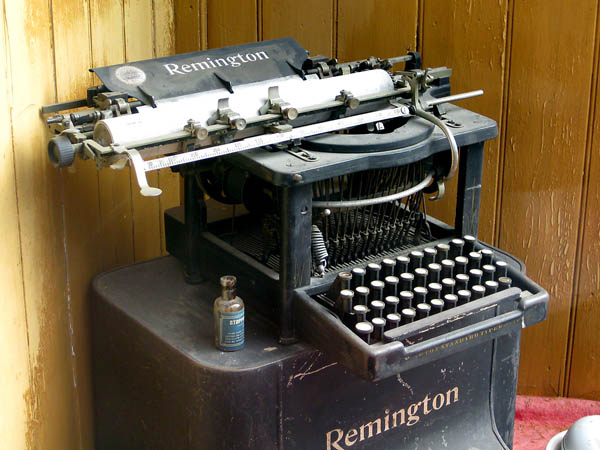
There was an old Remington typewriter in the window of the print shop.

Typewriter at Ulster-American Folk Park

Typewriter at Ulster-American Folk Park. Photo by Ferrell Jenkins.

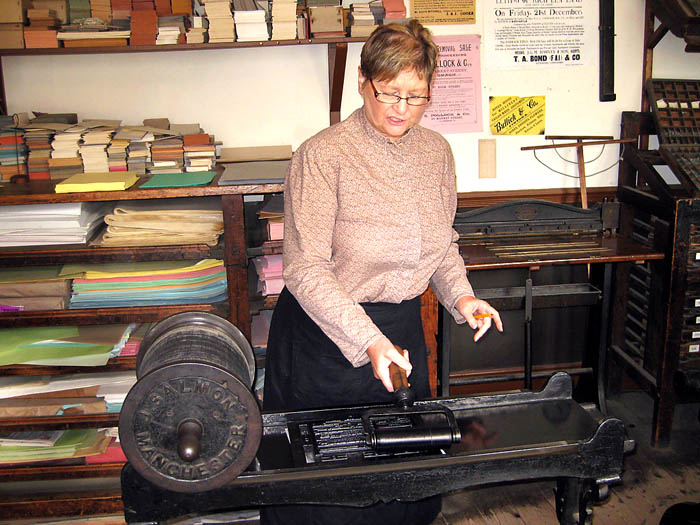
The lady printer is operating a proof press. She actually printed a contract of passage for me to board a ship and sail for the New World.

Proof press at ulster-American Folk Park. Photo by Ferrell Jenkins.

Proof press at Ulster-American Folk Park. Photo by Ferrell Jenkins.

Now that’s a real Word Press.

Only today and tomorrow

Todd Bolen is offering the Picturesque Palestine 4-volume set of photos and engravings for only $20 with free shipping. That price is available only today and tomorrow.

He also tells you how to get his current Bible Places Newsletter, and I can tell you that it offers a great slide show on Samaria that you can download.

Get details here.

The Queen of the coin

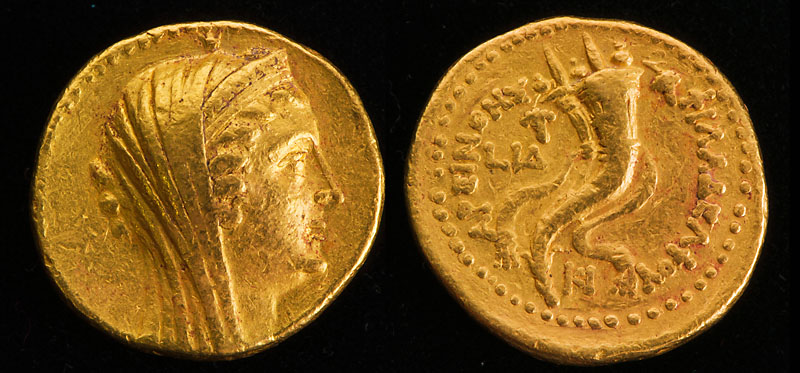
Last week we posted a note about the discovery of a rare Ptolemaic gold coin at Tel Kedesh in northern Israel. See here.

Gold coin of Arsinoë Philadelphus (II) discovered at Tel Kedesh. Photo by Sue Webb, courtesy IAA.

Gold coin of Arsinoë Philadelphus (II) discovered at Tel Kedesh. Photo by Sue Webb, courtesy IAA.

If you would like to read about a truly mixed up family, I suggest you read Judith Weingarten’s post on “The Uppity Queen Arsinoë II” at Zenobia: Empress of the East blog here. I think this story tops almost anything I have read. It is too complicated for me to try to retell it in a few words. It will be especially helpful in speaking with those who think today’s culture is the worse the world has ever known.

HT: Paleojudaica

Recent photos from Magdala

Several times in the past three years we have called attention to the site of Magdala (Migdal). Last September we noted announcement by the Israel Antiquities Authority of the discovery of a synagogue from the Second Temple period (50 BCE—100 CE).

A synagogue from the Second Temple period (50 BCE—100 CE) was exposed in archaeological excavations the Israel Antiquities Authority is conducting at a site slated for the construction of a hotel on Migdal [Magdala] beach, in an area owned by the Ark New Gate Company. In the middle of the synagogue is a stone that is engraved with a seven-branched menorah (candelabrum), the likes of which have never been seen. The excavations were directed by archaeologists Dina Avshalom-Gorni and Arfan Najar of the Israel Antiquities Authority.

The town of Magdala is not mentioned in the Bible, but Mary Magdalene is mentioned a total of 12 times in the four gospels. This place may have been her birthplace or her home. A few late manuscripts mention Magdala (Matthew 15:39 KJV), but earlier manuscripts read Magadan. Magdala is located about 4 miles north of Tiberias on the western shore of the Sea of Galilee.

The Hebrew word Magdala means tower. In New Testament times the city had become Hellenized and bore the Greek name Tarichea because of the importance of the salted-fish industry there. Mendel Nun located a harbor at the site. He says,

“In ancient times, pickled sardines were an important element of diet throughout the country–especially for those who lived near the lake” (BAR, Nov/Dec 1993).

Josephus had his headquarters at Magdala during the first Jewish Revolt against Rome (A.D. 66-70). He was able to get a group of at least 230 boats to go from Magdala to Tiberias (Jewish Wars 2.635-637). Vespasian attacked the town from the sea and destroyed it.
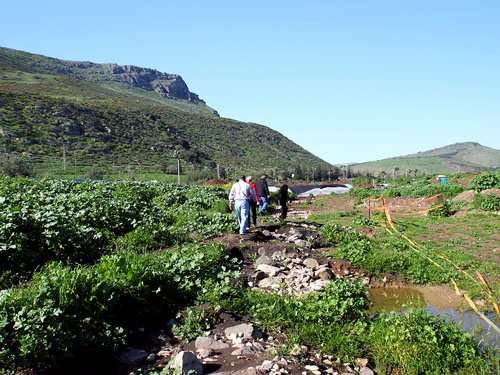
Magdala with Mount Arbel to the West. Photo by Jim Joyner.

Magdala with Mount Arbel to the West. Photo by Jim Joyner.

Recently Jim Joyner, one of our readers, offered to share a few of his photos made at Magdala earlier this year. The photo above shows part of the residential area of Magdala with Mount Arbel in the distance to the west. The synagogue excavation is under the tent in the distance. The Sea of Galilee would be to our back.

Jim explains,

The residences were first excavated. Eventually the remains of a synagogue were discovered. It was a magnificent discovery! The walls of the synagogue are clear, and the places where seats were located in the synagogue are obvious.  The walls were beautifully frescoed, and the remains of the colors are still obvious on the uncovered portions of the walls.
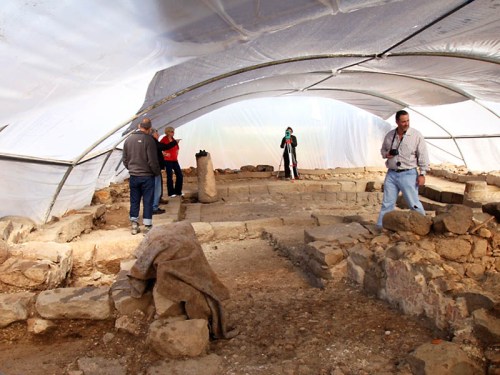
The Magdala/Migdal Synagogue. Photo by Jim Joyner.

The Magdala/Migdal Synagogue. Photo by Jim Joyner.

Thanks, Jim. We look forward to seeing more of these great photos.

We wrote about the Magdala Excavation Project here.

Is this scary?

Google CEO Eric Schmidt issued some scary comments in a recent interview with the Wall Street Journal. The comments below are taken from an article by Murray Wardrop in the Telegraph. You may read the entire article here.

Eric Schmidt suggested that young people should be entitled to change their identity to escape their misspent youth, which is now recorded in excruciating detail on social networking sites such as Facebook.

“I don’t believe society understands what happens when everything is available, knowable and recorded by everyone all the time,” Mr Schmidt told the Wall Street Journal.

In an interview Mr Schmidt said he believed that every young person will one day be allowed to change their name to distance themselves from embarrasssing photographs and material stored on their friends’ social media sites.

The 55-year-old also predicted that in the future, Google will know so much about its users that the search engine will be able to help them plan their lives.

Using profiles of it customers and tracking their locations through their smart phones, it will be able to provide live updates on their surroundings and inform them of tasks they need to do.

“We’re trying to figure out what the future of search is,” Mr Schmidt said. “One idea is that more and more searches are done on your behalf without you needing to type.

There may be some bibliobloggers who will wish they had used more discretion in what they posted.

A good name is to be more desired than great wealth, Favor is better than silver and gold. (Proverbs 22:1 NAU)

HT: Biblical Paths

Friday variety

Israel Photos. J P vd Giessen has been posting photos from a trip to Israel over the past few weeks at his Aantekeningen bij de Bijbel [Notes on the Bible] blog. You will find photos of Megiddo, Caesarea Maritima, Capernaum, Gamla and other places. Start here. I know, the blog is in Dutch. I follow the blog regularly. When I see something that is of special interest I go to Google Translate and paste in the article for a translation. It is not ideal, but it helps.

Turkey Photos. Ben Witherington III is posting photos of a recent trip to Greece and Turkey at his Bible and Culture blog. You will find photos of Corinth (Acts 18), Sagalassos, Assos (Acts 20:13-14), Alexandria Troas (Acts 16:8), Patara (Acts 21:1), Myra in Lycia (Acts 27:5), Cappadocia (Acts 2:9; 1 Pet. 1:1), and others. The site is not very user friendly, but you may find something of interest. Start here and then use the search box.

Tell es-Safi/Gath. Prof. Aren Maeir has posted several aerial photos of Tell es-Safi/Gath made at the end of the 2010 archaeological excavation season. If you look soon you may just scroll back through the photos here.

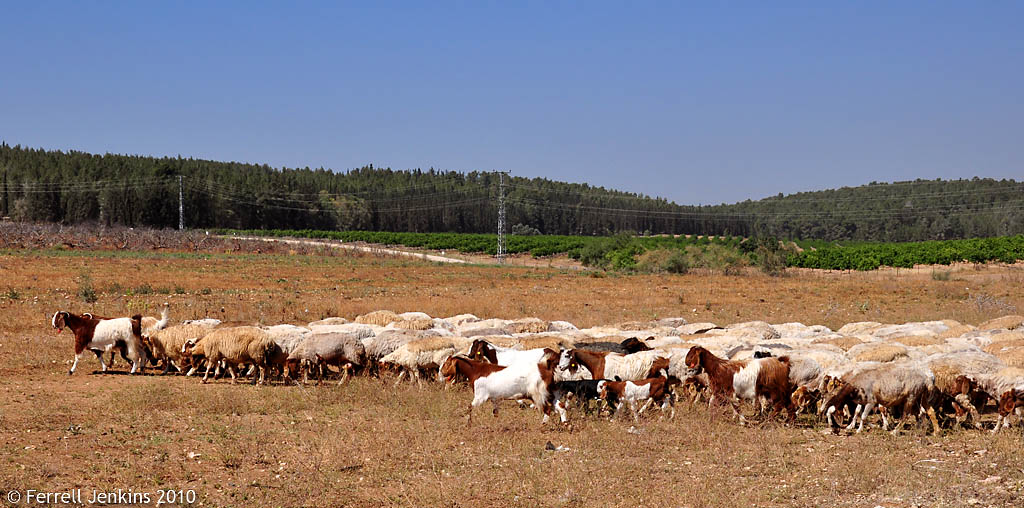
Our photo was made just below Tell es-Safi/Gath just after crossing the Elah brook. This shows the beginning of the coastal plain.

Sheep and goats at Tell es-Safi/Gath. Photo by Ferrell Jenkins.

Sheep and goats at Tell es-Safi/Gath. Photo by Ferrell Jenkins.

Greek, anyone? Rod Decker, a professor of Greek and New Testament, calls attention to some classic essays on using Greek in ministry. Perhaps some readers might find this helpful. Click here.

Help! Appearance changed

Suddenly the appearance of Ferrell’s Travel Blog has been changed. I was using Cutline by Chris Pearson. Now, all of my widgets are missing. Anyone else had a problem like this?

Update: I think WordPress removed the theme I was using and replaced it with one of their own. I had some problems with it, so am changing to Pressrow. I trust this style and text will be readable to each one who comes our way.