Category Archives: Bible Study

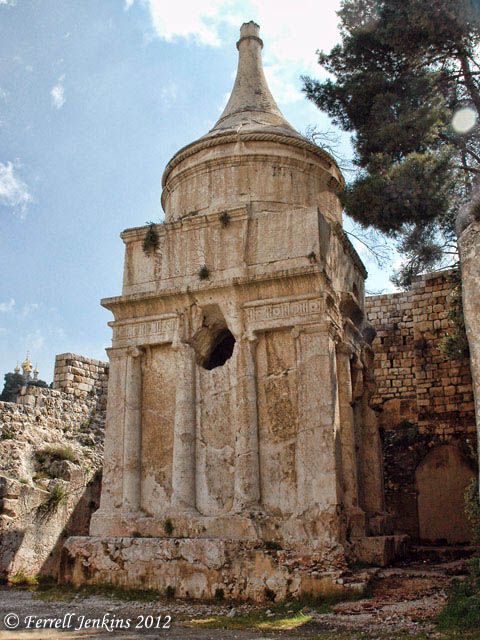
Absalom’s Pillar and the Tomb of Zacharias, father of John

Yesterday we wrote about the mistaken identification of a first century B.C. tomb in the Kidron Valley as the monument Absalom built for himself (2 Samuel 18:18).

About 12 years ago an art history student at Hebrew University turned in a paper to Joe Zias which included an old photo of an inscription on the south side of the Pillar of Absalom. The inscription is difficult to see because the monument is cut from the natural rock. After many late afternoon visits to the site in 2002, waiting for the sun to be in the right spot to highlight the inscription, Zias finally saw it. Afterwards, efforts were made to photograph it.
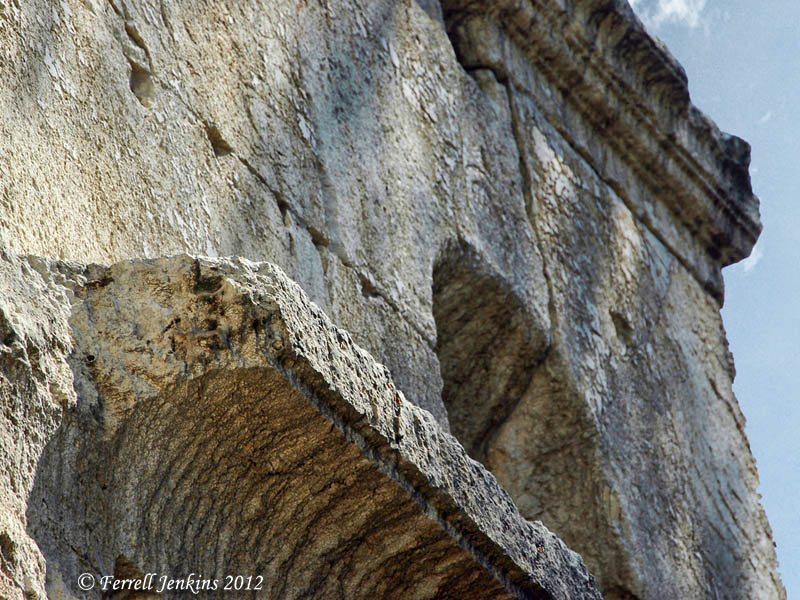
South side of the Pillar of Absalom. Photo by Ferrell Jenkins.
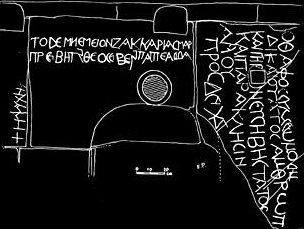
South side of the Pillar of Absalom. Photo by Ferrell Jenkins.

Zacharias and Simeon inscriptions on the Absalom Pillar.

Zacharias & Simeon inscriptions on the Absalom Pillar.

There are two inscriptions on the south side of the monument. This little drawing, made available  shortly after the announcement, shows a horizontal inscription and a vertical one. The horizontal inscription is the one pertaining to Zacharias and John. In my photo you only see a small portion of the area where the Zacharias inscription is located.

Due to a number of circumstances it was thought best to make a cast of the inscription so it could be studied in the lab. Numerous scholars from various fields of study were called in to assist and give advice. This photo shows Joe Zias, a physical anthropologist, with the cast.
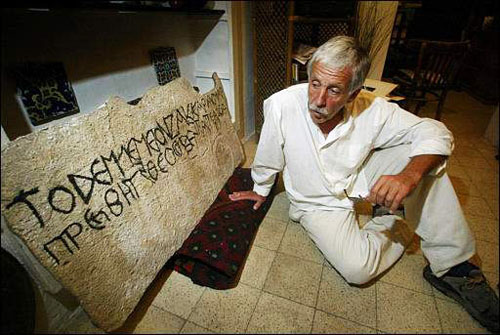
Joe Zias with cast of Zacharias inscription from Absalom Monument.

Joe Zias with cast of Zacharias inscription from Absalom Monument.

The inscription is written in Byzantine Greek of the fourth century A.D. Zias teamed up with Fr. Émile Puech, a professor at the École Biblique in Jerusalem, to read the inscriptions. The horizontal inscription reads,

This is the tomb of Zacharias, martyr, very pious priest, father of John.

Luke records the naming of John by Zacharias this way:

And it happened that on the eighth day they came to circumcise the child, and they were going to call him Zacharias, after his father. 60 But his mother answered and said, “No indeed; but he shall be called John.” 61 And they said to her, “There is no one among your relatives who is called by that name.” 62 And they made signs to his father, as to what he wanted him called.  63 And he asked for a tablet and wrote as follows, “His name is John.” And they were all astonished.  64 And at once his mouth was opened and his tongue loosed, and he began to speak in praise of God.  (Luke 1:59-64 NAU)

I had the opportunity to hear Joe Zias and Émile Puech make their presentation about this discovery at the annual meeting of the Society of Biblical Literature in 2003. The discovery was published in Revue Biblique, July 2003.

Could this be the priest Zacharias (also spelled Zechariah in some English versions) the father of John the Baptist? We may think that it does, but it might be best to agree with Jerome Murphy-O’Connor who says that this inscription only reflects a tradition from the 4th century A.D.

Such Byzantine identifications reflect the piety of the period and have no historical value.

Another scholarly article appeared in Near Eastern Archaeology, Dec. 2005. It includes photos showing how these scholars were able to make the cast. One of the best popular articles I saved was published in The Christian Science Monitor. I see that it is no longer available online. If you have additional interest you might take a look at the Associated Press article here.

The vertical inscription may be even more significant. Perhaps I can get to that in a future post.
Men who honor themselves. Exhibit one: Absalom

Both Old Testament and New Testament provide illustrations of men who honor themselves, and the folly of doing so. The elder John wrote of a man named Diotrephes “who loves to be first” among his brethren (3 John 1:9).

In the Old Testament no case is more prominent than that of Absalom the rebellious son of David.

Now Absalom in his lifetime had taken and set up for himself a pillar which is in the King’s Valley, for he said, “I have no son to preserve my name.” So he named the pillar after his own name, and it is called Absalom’s Monument to this day. (2 Samuel 18:18 NAU)

In earlier times it was common for pilgrims to the Holy Land to be told that this or that structure belonged to a certain Biblical character or event.  I will show you one such example.

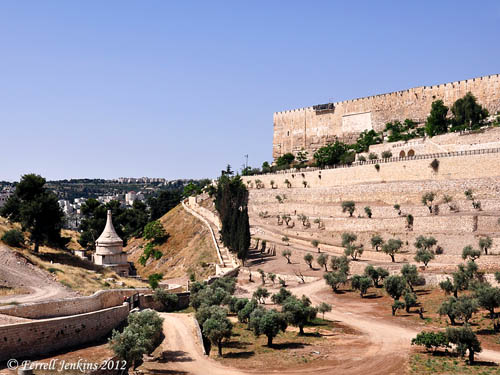
The photo below was made in the Kidron Valley with a view to the south. On the right you see the eastern wall of the Old City of Jerusalem. On the left of the photo, where the valley becomes narrow, you can see the top of the monument called Absalom’s Pillar. An image suitable for presentations is available here. This photo would look good in PowerPoint. There is room on the upper left side sky to include appropriate scriptures.

Kidron Valley View South. Absalom's Pillar on left. Wall of Jerusalem on right. Photo by Ferrell Jenkins.

Kidron Valley view to the south. Photo by Ferrell Jenkins.

In AD 1170 Benjamin of Tudela associated this monumentsin the Kidron Valley with the monument of Absalom. The monument actually belongs to the early first century B.C., and not to the time of Absalom. It is a funerary monument in front of an eight-chambered tomb.

A closeup view of the monument may be seen in the following photo.

Absalom's Pillar. Photo by Ferrell Jenkins.

Absalom's Pillar. Photo by Ferrell Jenkins.

Soon I plan to explain what this monument might have to do with Zacharias, the father of John the Baptist.

En Karem (Ain Karim) — traditional home of John the Baptist

Tradition has it that John the Baptist was born in En Karem (or Ain Karim) in the hill country of Judea. According to Shimon Gibson, the earliest document linking John to En Karem is a legendary account dated to A.D. 385-395 (The Cave of John the Baptist, 30). In that account En Karem is said to be “in the mountain” and with a “spring of water” (31). From the sixth to the eighth centuries the traditions multiply.

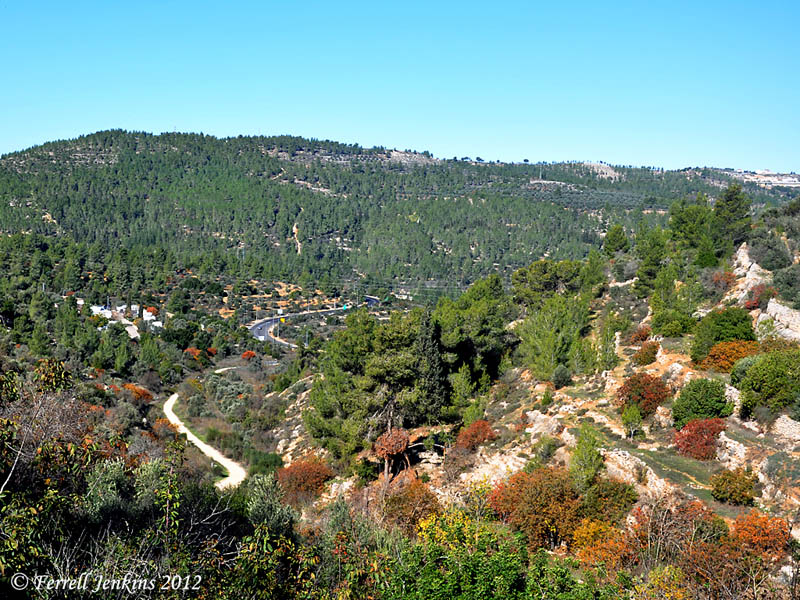
En Karem is about 5 miles west of Jerusalem. This photo shows a general view of the hill country of Judea. En Karem is in the valley below.

The vicinity of En Karem in the hill country of Judea. Photo by Ferrell Jenkins.

The vicinity of En Karem in the hill country of Judea. Photo by Ferrell Jenkins.

Luke provides the account of the announcement of the birth of John, Mary’s visit to Elizabeth the mother of John, and the birth of John (Luke 1). It is interesting that Luke prefaces the announcement of the birth to Zacharias by saying that it was “in the days of Herod, king of Judea” (Luke 1:5).

No specific town is mentioned, but Luke says that Mary visited Elizabeth in the hill country of Judah.

Now at this time Mary arose and went in a hurry to the hill country, to a city of Judah, and entered the house of Zacharias and greeted Elizabeth. (Luk 1:39-40 NAU)

The biblical text says that after the birth of John,

Fear came on all those living around them; and all these matters were being talked about in all the hill country of Judea. (Luke 1:65 NAU)

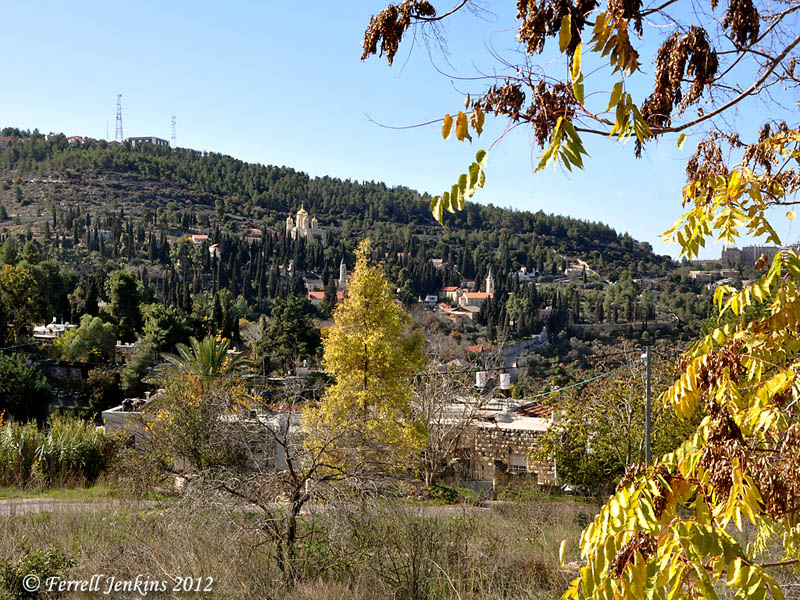
In the next view we see several churches. The one right of center with the single tower is known as the Church of St. John the Baptist. A church was built at this site as early as the 5th century A.D.

Several churches are visible in this view of En Karem. Photo by Ferrell Jenkins.

Several churches are visible in this view of En Karem. Photo by Ferrell Jenkins.

Bread stamp with Temple Menorah discovered near Acco

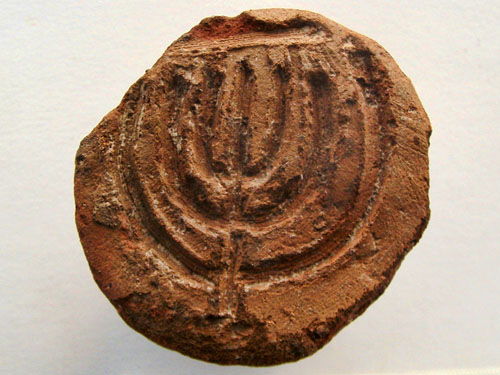
The Israel Antiquities Authority announces the discovery of a stamp used to identify baked products from an excavation near the coastal town of Acco (Akko; Acre). The stamp dates to the 6th century A.D. (the Byzantine period). The suggestion is made that it may have been used by a baker who made kosher bread for the Jews in the area.

Bread stamp discovered at Acco. Photo: Dr. Danny Syon, courtesy IAA.

Bread stamp discovered near Acco. Photo: Dr. Danny Syon, courtesy IAA.

The IAA news release says,

According to Gilad Jaffe and Dr. Danny Syon, the directors of the excavation on behalf of the Israel Antiquities Authority, “A number of stamps bearing an image of a menorah are known from different collections. The Temple Menorah, being a Jewish symbol par excellence, indicates the stamps belonged to Jews, unlike Christian bread stamps with the cross pattern which were much more common in the Byzantine period”. According to Syon, “This is the first time such a stamp is discovered in a controlled archaeological excavation, thus making it possible to determine its provenance and date of manufacture. The stamp is important because it proves that a Jewish community existed in the settlement of Uza in the Christian-Byzantine period. The presence of a Jewish settlement so close to Akko — a region that was definitely Christian at this time — constitutes an innovation in archaeological research”. The excavators add, “Due to the geographical proximity of Horbat Uza to Akko, we can speculate that the settlement supplied kosher baked goods to the Jews of Akko in the Byzantine period”.

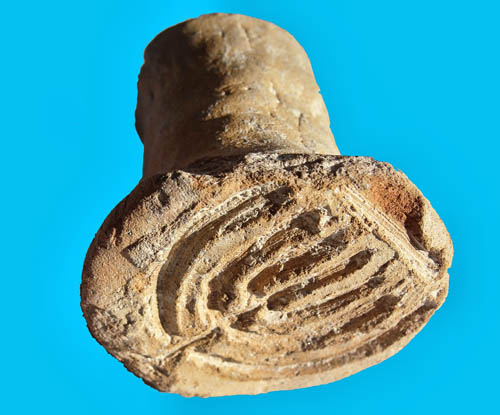
The stamp is engraved with a seven-branched menorah atop a narrow base, and the top of the branches forms a horizontal line. A number of Greek letters are engraved around a circle and dot on the end of the handle. Dr. Leah Di Segni, of the Hebrew University of Jerusalem suggested this is probably the name Launtius. This name was common among Jews of the period and also appears on another Jewish bread stamp of unknown provenance. According to Dr. Syon and Gilad Jaffe, “This is probably the name of the baker from Horbat Uza.”

Bread stamp discovered at Acco. Photo: Dr. Danny Syon, courtesy IAA.

Bread stamp discovered at Acco. Photo: Dr. Danny Syon, courtesy IAA.

Dr. David Amit, who has made a study of bread stamps, adds,

“A potter engraved the menorah image in the surface of the stamp prior to firing it in a kiln, whereas the owner’s name was engraved in the stamp’s handle after firing. Hence we can assume that a series of stamps bearing the menorah symbol were produced for Jewish bakers, and each of these bakers carved his name on the handle, which also served as a stamp. In this way the dough could be stamped twice before baking: once with the menorah — the general symbol of the Jewish identity of Jewish bakeries, and the private name of the baker in each of these bakeries, which also guaranteed the bakery’s kashrut.

The full IAA report is available at a temporary link here.

English Bible versions commonly translate the Hebrew menorah by the word lampstand. The King James Version’s candlestick is no longer used because we know that candles were not in use in Bible times (cf. Revelation 1:12).

The seven-branched lampstand is probably the best known symbol of the tabernacle and temple, and of Jews generally. The first biblical reference to the menorah is in the account of the building of the tabernacle.

“Then you shall make a lampstand of pure gold. The lampstand and its base and its shaft are to be made of hammered work; its cups, its bulbs and its flowers shall be of one piece with it.  “Six branches shall go out from its sides; three branches of the lampstand from its one side and three branches of the lampstand from its other side.  (Exodus 25:31-32 NAU)

As a parallel, one might think of the hot cross buns commonly eaten on Good Friday in many Christian communities.

HT: Joseph Lauer

Free Ebook on Ephesians

Baker Academic announces a series of ebook shorts from Robert H. Gundry. Last week the Commentary on Mark was given away. Today only, the Commentary on Ephesians is available free. Baker Academic E-NOTES says,

Baker Academic is proud to announce new ebook shorts from Robert H. Gundry.

In these verse-by-verse commentaries taken from Commentary on the New Testament, Robert Gundry offers a fresh, literal translation and a reliable exposition of every book of the New Testament.

Students and scholars will welcome Gundry’s nontechnical explanations and clarifications, and readers at all levels will appreciate his sparkling interpretations. Priced from $1.99 to $5.99 these affordable and convenient resources are available wherever ebooks are sold.

As we celebrate the release of this series, Baker Academic will be making selected entries from this commentary series free for one day only.

This will be followed by other selections for free download on January 16th and 23rd.

Here is the direct link to the free ebook.

Do you need a Kindle? Click on the link below to check the selections.
Kindle Fire, Full Color 7″ Multi-touch Display, Wi-Fi.

Bust of king from Hellenistic Period found in Turkey

The country of Turkey now occupies the territory of ancient Asia Minor. It is filled with Greek and Roman ruins — especially in the western area and along the Mediterranean coast. Archaeological excavations are active in the country.

Today’s Zaman, a Turkish newspaper, reported on January 4 the discovery of the relief bust of a king from the Hellenistic period. We are given no hint regarding the identity of the king. We know that Alexander of Macedon crossed Asia Minor in the 4th century B.C. From that time the Greeks had a great influence on the country. Later, in the Roman period this would be the territory visited by Paul on his preaching journeys.

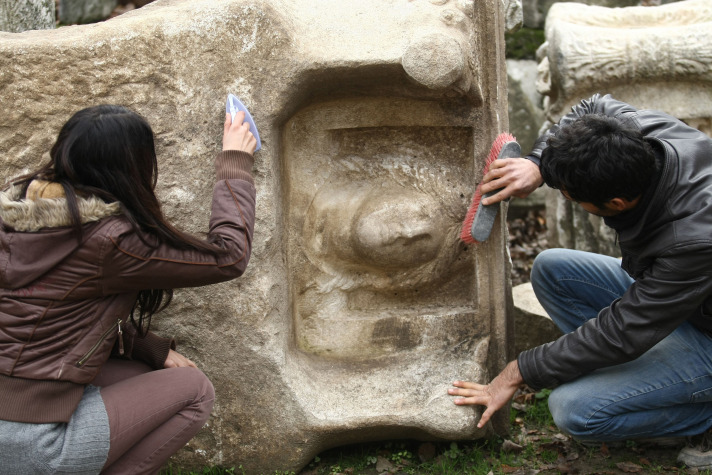
Relief bust of Hellenistic king discovered in Turkish excavation.

Relief bust of Hellenistic king discovered in Turkish excavation. Today's Zaman.

Today’s Zaman says,

A 2,000-year-old relief bust of a king was discovered during excavations in ancient Stratonikeia in Muğla’s Yatağan district.

Dr. Bilal Söğüt, a professor of archeology at Pamukkale University and head of the excavations, told the Anatolia news agency that they found a street in the ancient city which began with a gate and was lined with columns. During their excavations, they also discovered the bust of a king dating back to the Hellenistic period. The bust, which is one-and-a-half meters tall and nearly two meters wide, features depictions of bull heads and the figure of a goddess, Söğüt said.

“The depictions of bull heads on the bust represent wealth and power. It was in this region that we previously found a racing chariot. The discovery of 1,500-year-old mosaics here was another welcome breakthrough for us,” he said.

Stratonikeia is located in the southwestern region of Turkey. The excavation is under the direction of professor from Pamukkale, a site known as Hierapolis in the New Testament (Colossians 4:13).

The entire article may be read here.

New theory on rare Second Temple “seal”

Recently we reported the discovery of a rare Second Temple inscription seal here. The original announcement said the inscription was inscribed with an Aramaic inscription which could be translated “Pure for G-d.”

Rare Second Temple Inscription Seal. IAA photo by Vladimir Naykhin.

Rare Second Temple Inscription Seal. IAA photo by Vladimir Naykhin.

It is not surprising to learn that not all scholars agree with the reading. The Israeli newspaper Ha’aretz calls attention to the theory of Prof. Shlomo Naeh, of the Hebrew University’s Talmud department, who says the inscription calls attention to the type of sacrifice purchased for offering.

Naeh also believes the object is related to Temple worship and purity, but reads the inscription differently, as “Dakar a Leyehoyariv.” Dakar in Aramaic means ram and a stands for aleph, the first day of the week, when the priestly order of Yehoyariv was on duty in the Temple.

Thus, the object was used in Temple worship, but not how Reich and Shukron believe it was, says Naeh. To ensure the purity of animal sacrifices offered in the Temple — and to maintain an economic monopoly, Naeh believes — pilgrims had to buy their offerings in the Temple courts. They gave money to a treasurer who would exchange it for a token inscribed with the type of sacrifice they had purchased and the date.

Like Reich and Shukron, Naeh supports his theory with a mishnaic verse citing the existence of such tokens. With regard to Reich and Shukron’s interpretation, he said: “Purity was very fluid; the touch of an impure person was enough to make the object impure, so it is unlikely such a seal existed.”

He also said the object could not be a seal because it lacked a hole for a thread or a handle to affix it to another object.

The full article in Ha’aretz may be read here.

Jesus and the funeral procession at Nain

The town of Nain is mentioned only once in the New Testament.

Soon afterward Jesus went to a town called Nain, and his disciples and a large crowd went with him. (Luke 7:11 NET)

In the full account, Luke (7:11-17) reports that as Jesus approached the town gate a funeral procession was in progress. When Jesus saw the widow He had compassion and told her to stop weeping. Luke, the physician (Colossians 4:14), reports that Jesus touched the bier and said, “Young man, I say to you, get up!” Then, as a simple matter of fact, Luke says,

So the dead man sat up and began to speak, and Jesus gave him back to his mother. (verse 15)

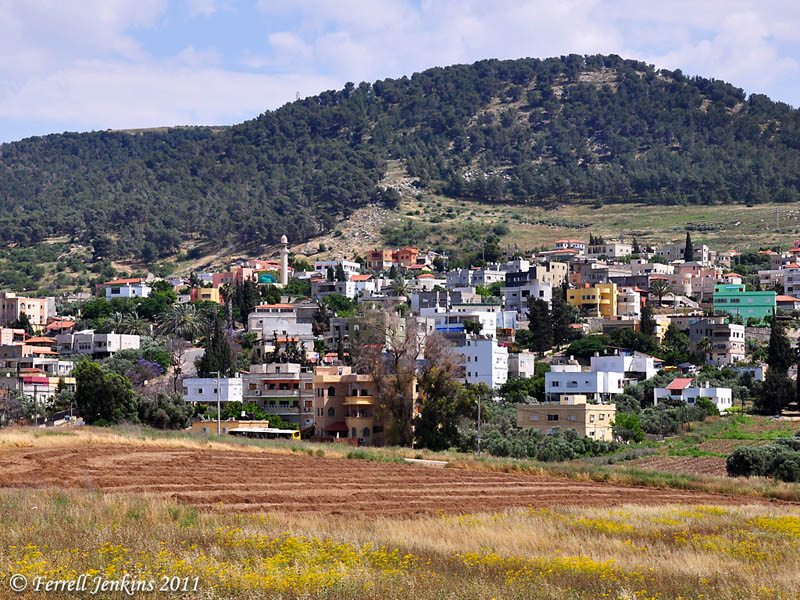
Nain is identified with the Arab village of Nein on the north slope of the Hill of Moreh. Nein is said to mean pleasant. Nain was a city of Issachar in Old Testament times. Here is a photo I made of the little Arab village last May.

The Village of Nain on the north slope of the Hill of Moreh. Photo by Ferrell Jenkins.

The Village of Nein on the north slope of the Hill of Moreh. Photo by Ferrell Jenkins.

Ralph Earle describes the pleasant location of Nain.

The town of Jesus’ day may have stood higher on the hill than the present village. It probably was named for the pleasant view that the site affords across the plain of Esdraelon. To the west one can see Mt. Carmel, and to the north the hills behind Nazareth stand out, about 9½ km [6 mi] away. To the northeast one can look past nearby Tabor (3 km [2 mi] away) to snowcapped Mt. Hermon in the distance. Southward lies Mt. Gilboa. (The International Standard Bible Encyclopedia, Revised, 3:480)

Our new header, which we will use for a while, is a 3-image panorama of Nain and the north side of the Hill of Moreh.

2011 in review — according to WordPress

The WordPress.com stats helper monkeys prepared a 2011 annual report for this blog.

Here’s an excerpt:

London Olympic Stadium holds 80,000 people. This blog was viewed about 270,000 times in 2011. If it were competing at London Olympic Stadium, it would take about 3 sold-out events for that many people to see it.

Click here to see the complete report.

Personal Note: Thanks to the readers who keep me going. You are literally scattered all over the earth. Your interest is appreciated. We are thankful for anyone who has been instructed or encouraged.

Please forgive our failure to answer all of the requests for info and photos. We do as many as we can, but to borrow from and paraphrase Jesus, “Sufficient unto the day are the Emails thereof.”

Five Day Bible Reading Program for 2012

Mark Roberts (the Irving, TX one) is making his Five Day Bible Reading Program for 2012 available free of charge this year. This is an excellent program for reading through the entire Bible in a year. For a copy of the schedule that you can print on a single sheet of paper (front and back), click here.

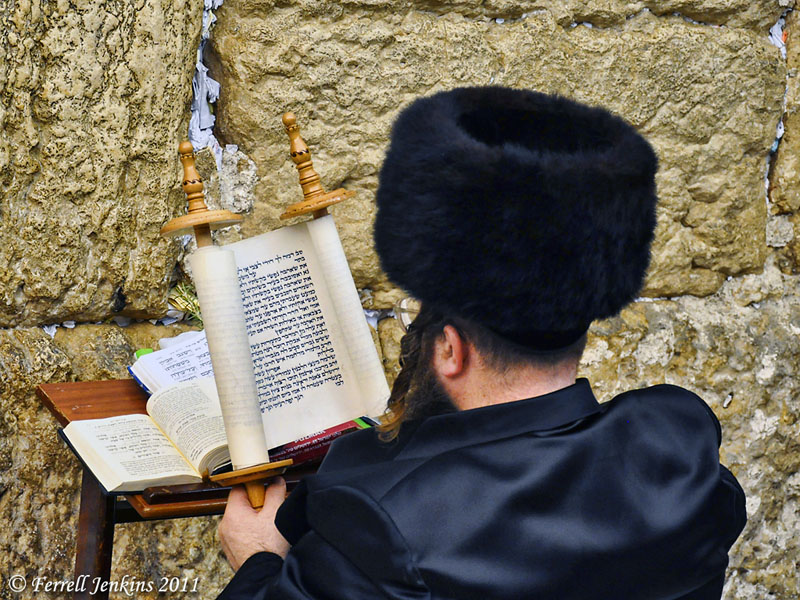
Reading the Bible at the Western Wall. Photo by Ferrell Jenkins.

Reading the Bible at the Western Wall. Photo by Ferrell Jenkins.

A few Scriptures on the subject of Bible reading seem appropriate:

…and the scroll of the prophet Isaiah was given to him [Jesus]. He unrolled the scroll and found the place where it was written…, (Luke 4:17 NET)

…and [the Ethiopian court official] was returning home, sitting in his chariot, reading the prophet Isaiah. (Acts 8:28 NET)

You [Timothy], however, must continue in the things you have learned and are confident about. You know who taught you  and how from infancy you have known the holy writings, which are able to give you wisdom for salvation through faith in Christ Jesus.  Every scripture is inspired by God and useful for teaching, for reproof, for correction, and for training in righteousness,  that the person dedicated to God may be capable and equipped for every good work. (2 Timothy 3:14-17 NET)

The Reading Program is also available for the Kindle (or iPad) this year. Details are on the page linked above.

While you are in the neighborhood, take a look at some of the material at Mark’s BibleClassMaterial.com.