Category Archives: Bible Study

Paul stopped at Miletus

This morning our group visited Ephesus, the site of the Temple of Aretmis, and the Ephesus Museum. In the book of Revelation, Ephesus is the first of the cities mentioned (Revelation 1:11; 2:1-7), but for our tour it was the seventh. Ephesus was also the location of much work by the Apostle Paul (Acts 19).

In the afternoon we drove south to the ruins of the city of Miletus.  Miletus is mentioned only two places in the New Testament. The first is on Paul’s return from the third journey about A.D. 57 (Acts 20:15, 17). The other time is when Paul tells Timothy, in his last letter, that he had left Trophimus “sick at Miletus” (2 Timothy 4:20). This indicates that Paul stopped at Miletus on the voyage to Rome, but no activity is recorded.

From Miletus, on the first visit, Paul sent for the elders of the church at Ephesus. In those days it would be a lengthy journey for a messenger to go from Miletus to Ephesus. The distance by land would have been about 63 miles. If the couriers went across the Gulf of Latmos (Latmus) the distance would be about 38 miles. The map below shows the location of Miletus on the south of the Gulf of Latmos. Over the centuries the harbor, fed by the Meander River (see our masthead), silted up. Today Miletus is landlocked about five miles away from the Aegean Sea.

Think about how long it took the courier to go from Miletus to Ephesus, locate the elders, and for them to make their way to Miletus.
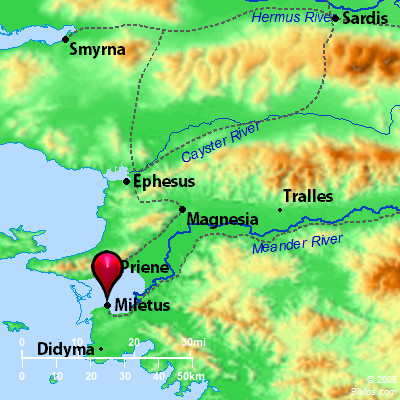
Map showing Miletus and Ephesus. BibleAtlas.org.

Map showing Miletus and Ephesus. Map courtesy BibleAtlas.org.

Paul’s speech to the Ephesian elders is recorded in Acts 20:18-38. The photo below shows the ruins of the large Harbor Monument which was built originally in 63 B.C. This monument was at the end of the Lions’ Harbor, one of four harbors at Miletus.
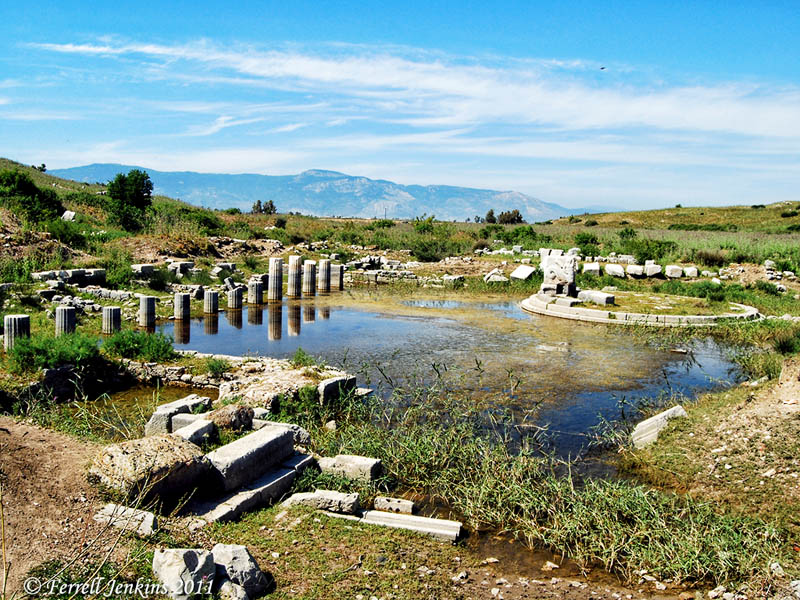
Ruins of the large harbor at Miletus. Photo by Ferrell Jenkins.

Ruins of the large harbor at Miletus. Photo by Ferrell Jenkins.

At this harbor, or somewhere very near, Paul’s ship docked. After his meeting with the elders from Ephesus, they accompanied him to the ship for his departure to Jerusalem.

When he had said these things, he knelt down and prayed with them all. And they began to weep aloud and embraced Paul, and repeatedly kissed him,  grieving especially over the word which he had spoken, that they would not see his face again. And they were accompanying him to the ship.  (Acts 20:36-38 NAU)

Tomorrow we begin the Aegean cruise portion of the tour. In the afternoon we will visit Patmos. The next day we will be at Rhodes, and the following day at Crete and Santorini.

It may be difficult or impossible for me to blog during the cruise. Using the Internet on the ship would cost a fortune, and the time at port will be used for excursions.  Please check each day to see if we are able to post info.
More about Hierapolis

After a period of worship this morning we began our touring day in Pamukkale (ancient Hierapolis). From there we continued to Aphrodisias, a Roman city that gives an impression of the reality of life in the period when Christianity was first being spread across the Empire. From there we continued to our hotel on the Aegean Sea.

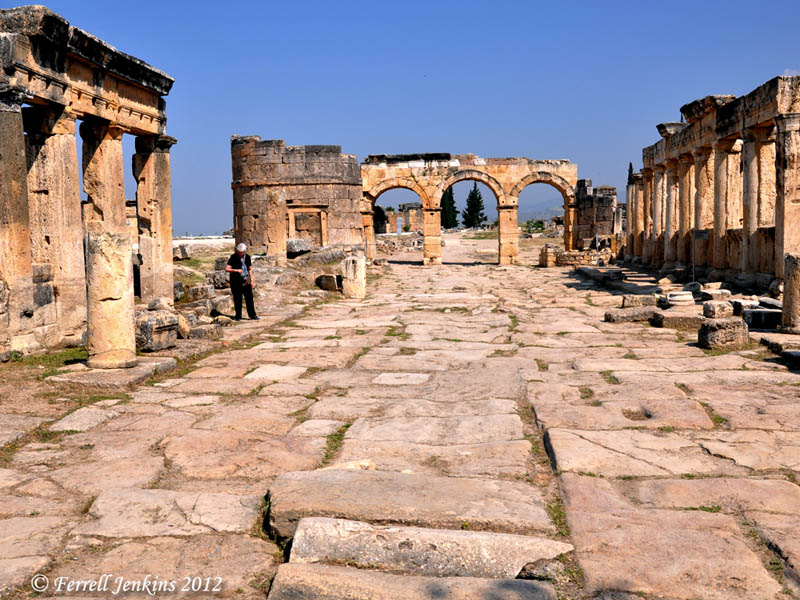
The photo below was made at Pamukkale, Turkey (ancient Hierapolis). We are standing on the colonnaded Roman road, and the monumental gateway behind us is the Arch of the Emperor Domitian (A.D. 81-96). It was constructed in A.D. 82-83.

It was during the reign of Domitian, or shortly thereafter, that the book of Revelation was written by the Apostle John.

Arch of Domitian at Pamukkale (ancient Hierapolis). Photo by Ferrell Jenkins.

Arch of Domitian at Pamukkale (ancient Hierapolis). Photo by Ferrell Jenkins.

Hierapolis was the home of Papias (c. A.D. 60 to c. A.D. 130). He was a disciple of the apostle John and a companion of Polycarp. There are some traditions associating Philip (apostle?, evangelist?) with the city.

The city of Hierapolis is one of the three cities of the Lycus River valley named in the New Testament.

For I testify for him that he has a deep concern for you and for those who are in Laodicea and Hierapolis. (Colossians 4:13).

Tomorrow we hope to visit Ephesus and Miletus.

Sardis, Philadelphia, Laodicea, Colossae, and Hierapolis

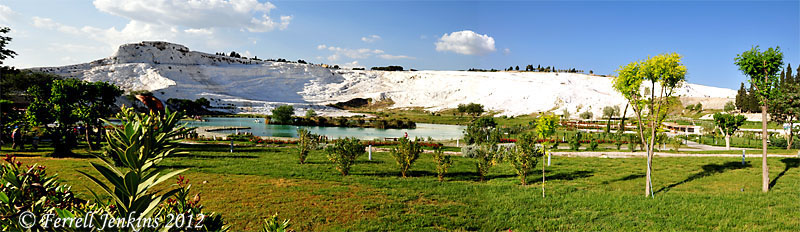
There were many sites to see today. We left Izmir (Smyrna) in the morning and drove east to the site of ancient Sardis (Revelation 3:1-6). From there we continued to in a southeast direction to Philadelphia (Revelation 3:7-13). Then we made our way to the Lycus River valley. The first stop was at Colossae (Paul’s epistle to the Colossians). After viewing the ancient mound which still awaits excavation, we went to Laodicea (Revelation 3:14-22). On the way to the hotel we stopped for a photo of the cliffs at Pamukkale (ancient Hierapolis, Colossians  4:13). The name Pamukkale means  “cotton castle” or “cotton fortress.”

Mellink describes the formation here. He says the city,

… is famous for its continuing geological transformation. Hot mineral springs issue from the rock in the city, and the waters streaming down the cliffs have deposited limestone in large formations, the surface of which is made a gleaming white ‘frozen cascades’ (IDB II:601).

'Pamukkale 'frozen cascades'. Photomerge by Ferrell Jenkins.

‘Pamukkale ‘frozen cascades’. Photomerge by Ferrell Jenkins.

We could see the white hillside clearly from Laodicea about six miles to the south. The photo above was made just below the cliffs. Hierapolis sits on the plateau. Click on the photo for a larger image.

Nothing has changed in the past few years at Sardis, Philadelphia, and Colossae. A tremendous change is taking place at Laodicea. Portions of the city that had remained buried until the past decade are now coming to light. I was surprised at the changes just in the past four years since I was here. Later on we will try to show you some of these new things.

Tomorrow we plan to visit Hierapolis and Aphrodisias before arriving at Kusadasi on the Aegean Sea near Ephesus.

Everyone in our group remains well and seems to be enjoying the visits and the study time together.

Visiting Pergamum and Thyatira

Today we went north from Izmir (Smyrna) to Pergamum (Revelation 2:12-17) where we visited the citadel, the Ascleipion, and the local museum. From there we continued in a southeastly direction to Thyatira before returning to Izmir.

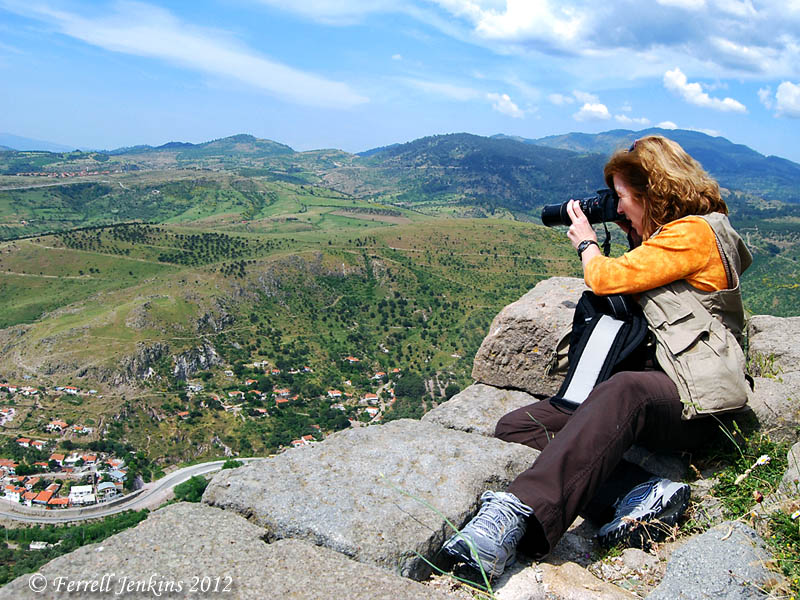
This first photo was made on the acropolis of Pergamum sitting atop a high hill overlooking the territory around it. Sharon, from a previous tour, tries to get a good view of the landscape below.

View from the Acropolis of Thyatira. Photo by Ferrell Jenkins.

View from the Acropolis of Pergamum. Photo by Ferrell Jenkins.

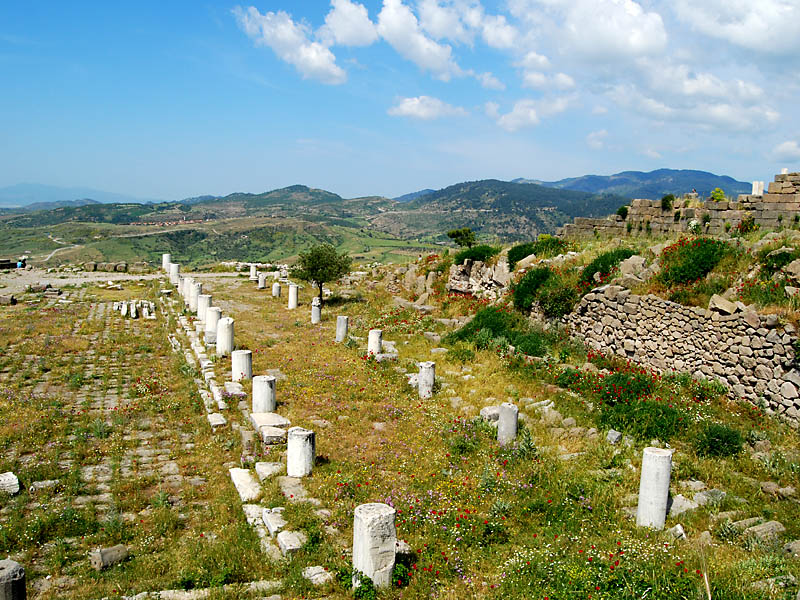
At Pergamum we saw the partially reconstructed Temple of the Emperor Trajan (A.D. 98-117), the area where the famous library of the ancient world stood, the foundation of the temple of Athena, the theater, and the site of the Zeus Altar. The altar has now been reconstructed in the Pergamum Museum in Berlin.

The area of the famous Pergamum library. Photo by Ferrell Jenkins.

The area of the famous Pergamum library. Photo by Ferrell Jenkins.

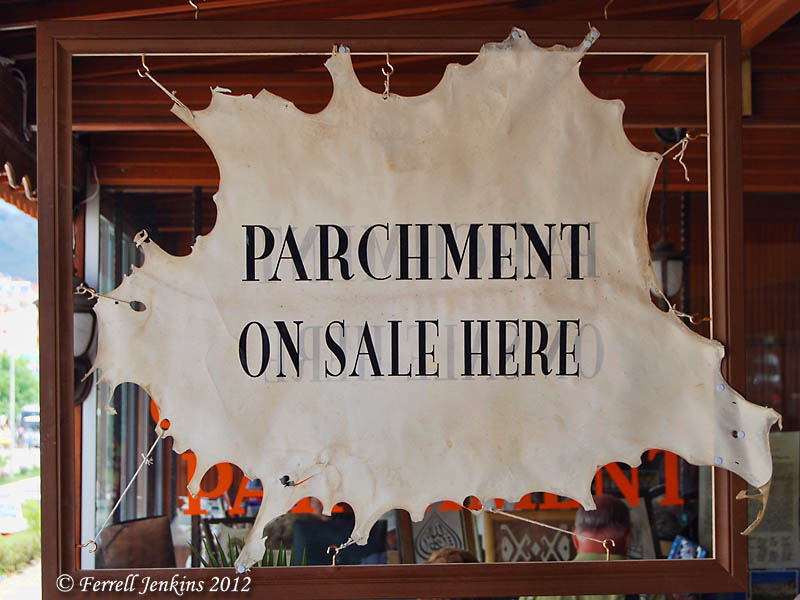
When Pergamum could no longer get papyrus sheets from Egypt they developed the writing material called parchment. There are a few shops in the city today (modern Bergama) selling parchment made from goat skin.

Parchment for sale at Bergama. Photo by Ferrell Jenkins.

Parchment for sale at Bergama. Photo by Ferrell Jenkins.

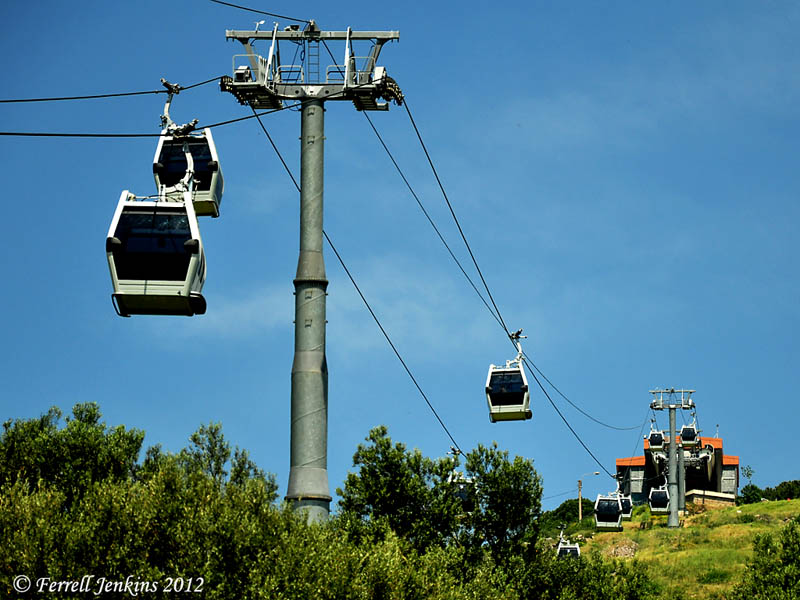
One interesting difference between our visit to Pergamum today and the last time we visited the site is the addition of a cable car. Buses are no longer allowed to drive to the top of the Acropolis. Visitors take the cable cars to the entrance of the archaeological site.

Cable cars to reach the Acropolis at Pergamum. Photo by Ferrell Jenkins.

Cable cars to reach the Acropolis at Pergamum. Photo by Ferrell Jenkins.

There is still little to see at Thyatira. A few scattered ruins can be seen in one square block in the center of the little town of Akhisar. In New Testament times this was the home of Lydia, the seller of purple (Acts 16:14). One of the letters in the Book of Revelation was addressed to the church in the city (Revelation 2:18-29).

I was pleased to see Mark Wilson’s Biblical Turkey: A Guide to Jewish and Christian Sites of Asia Minor, available in a bookshop at Pergamum. Several members of our group who had failed to buy a copy in advance did so today.

Smyrna — a city that came back to life

Our group arose early this morning in Istanbul in order to make our flight to Izmir. Izmir is a beautiful city on the Aegean coast of Asia Minor about 35 miles north of Ephesus. It is known as the location of the Biblical city of Smyrna.

Smyrna is mentioned only twice in the New Testament as the location of one of the seven churches addressed in the Book of Revelation (1:11; 2:8-11).

“And to the angel of the church in Smyrna write: The first and the last, who was dead, and has come to life, says this: ‘I know your tribulation and your poverty (but you are rich), and the blasphemy by those who say they are Jews and are not, but are a synagogue of Satan. ‘Do not fear what you are about to suffer. Behold, the devil is about to cast some of you into prison, so that you will be tested, and you will have tribulation for ten days. Be faithful until death, and I will give you the crown of life. He who has an ear, let him hear what the Spirit says to the churches. He who overcomes will not be hurt by the second death.’ (Revelation 2:8-11 NAU)

The earliest city of Smyrna was founded in the first half of the third millennium B.C. at Bayrakli, a few miles from the present city of Izmir. In 600 B.C. the city was captured and utterly destroyed by King Alyattes of Lydia. During the 5th and 4th centuries B.C. the city was insignificant.

All of this changed after the time of Alexander the Great when a new city was founded on the slopes of Mount Pagos.

Our visit today included Mount Pagos. From there we had a magnificent view of the city and the harbor. We also visited the Roman Agora, and two archaeological museums.

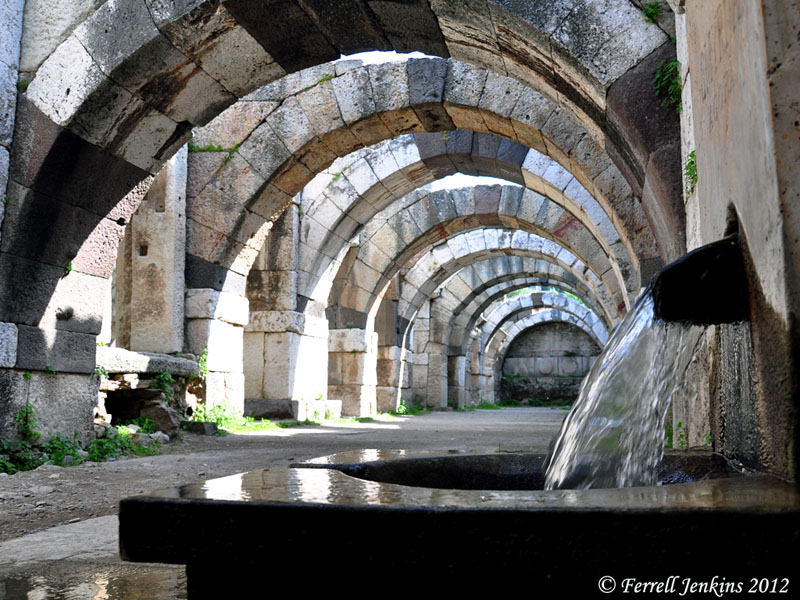
This photo shows the great arches in the lower level of the three story civic agora dating to the second century A.D., and a powerful spring of water that was discovered only a few years ago.

Lower level of the agora of Smyrna and a powerful spring. Photo by Ferrell Jenkins.

Busy day in Istanbul

We had a full day of sightseeing in Istanbul today. Tomorrow we have to get up early to make our flight to Izmir (Biblical Smyrna, Revelation 2). I made several nice photos, but not enough time to prepare them for the blog. Maybe by tomorrow night we will be able to post a photo or two.

Two young ladies on the tour are writing blogs. Both have traveled with us before. You might enjoy reading what they write.

The Other Side of the World. Here is the link to today’s post. You will be able to locate the others from there.
http://stacyjobe.blogspot.com/2012/05/14-istanbul-day-two.html

Jessica’s Jaunts: http://jessicarice.wordpress.com/

Grinding grain in Bible times

The grinding of grain was an important part of the life of people in Bible times. After the grain was gathered from the fields it had to be threshed. This was done by running a threshing sledge over the stalks of grain on the threshing floor (2 Samuel 24:22). The stalks, now cut into small pieces, was then winnowed with “shovel and fork” to separate the chaff from the good grain (Isaiah 41:16; Ruth 3:2; Luke 3:17; Psalm 1:4). Next came the sifting of the grain to further removed small pieces of debris. Jesus makes reference to this practice when he predicts Peter’s denial:

“Simon, Simon, pay attention! Satan has demanded to have you all, to sift you like wheat, (Luke 22:31 NET)

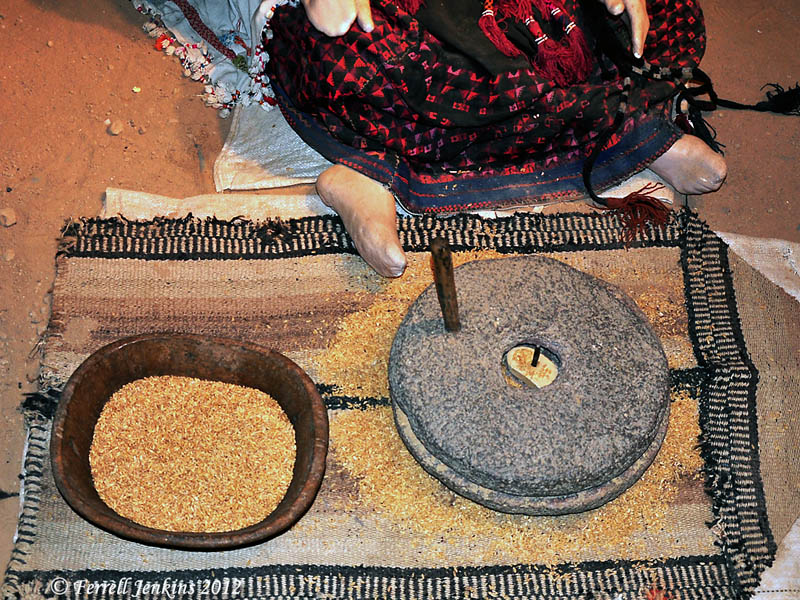
After that, there was still hard work to be done. The grain had to be ground between two millstones. The photo, below taken at The Museum for Bedouin Culture at Kibbutz Lahav in the Negev, shows the process.

Grinding grain. Exhibit at Museum of Bedouin Culture at Kibbutz Lahav. Photo by Ferrell Jenkins.

Grinding grain. Exhibit at The Museum of Bedouin Culture at Kibbutz Lahav in the Negev. Photo by Ferrell Jenkins.

There will be two women grinding grain together; one will be taken and the other left. (Luke 17:35 NET)

There was still the necessary kneading before the bread could be baked and eaten.

I am worn out. I think I will run down to the store and get a loaf of bread.

Mummies of the World at MOSI in Tampa

Mummies of the World Exhibition opens at MOSI in Tampa, Florida, today. Details here. The exhibition includes mummified humans and animals from several places around the world in addition to those from Egypt.

According to local television reports, the exhibit runs through September 9, 2012.

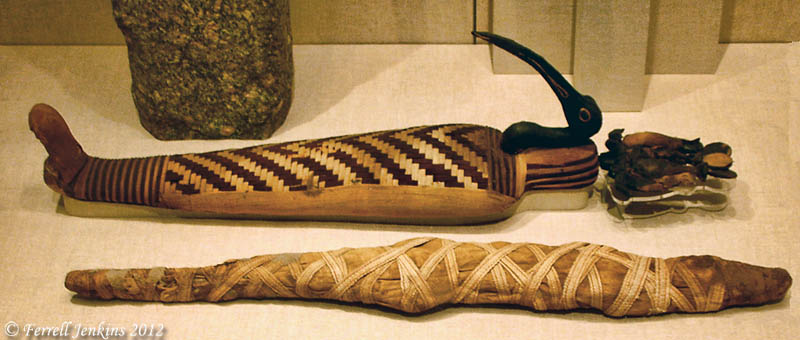
In the photo below we see a mummified Ibis and a mummified Crocodile from the Roman period of Ancient Egypt. The Egyptians considered various animals as gods and mummified them when they died.

Mummiried Ibis and Crocodile from Egypt. Roman Period. Brooklyn Museum.

Mummified Ibis and Crocodile from Egypt. Roman Period. Brooklyn Museum.

The Apostle Paul describes the condition of the Gentiles in the Greco-Roman world in these words:

Claiming to be wise, they became fools,  and exchanged the glory of the immortal God for images resembling mortal man and birds and animals and creeping things. (Romans 1:22-23 ESV)

Two Biblical characters  from the Patriarchal period were mummified in Egypt.

Then Joseph fell on his father’s face and wept over him and kissed him. And Joseph commanded his servants the physicians to embalm his father [Jacob]. So the physicians embalmed Israel. Forty days were required for it, for that is how many are required for embalming. And the Egyptians wept for him seventy days.  (Genesis 50:1-3 ESV)

So Joseph died, being 110 years old. They embalmed him, and he was put in a coffin in Egypt. (Genesis 50:26 ESV)

Of camels and needles

Jesus warned His disciples about the danger of riches. On one occasion He said,

In fact, it is easier for a camel to go through the eye of a needle than for a rich person to enter the kingdom of God.”  Those who heard this said, “Then who can be saved?”  He replied, “What is impossible for mere humans is possible for God.”  (Luke 18:25-27 NET; cf. Matthew 19:24-26; Mark 10:25-27)

I suppose in the time of Jesus almost everyone had seen a camel and understand what Jesus was talking about. And most of them also had seen a needle.

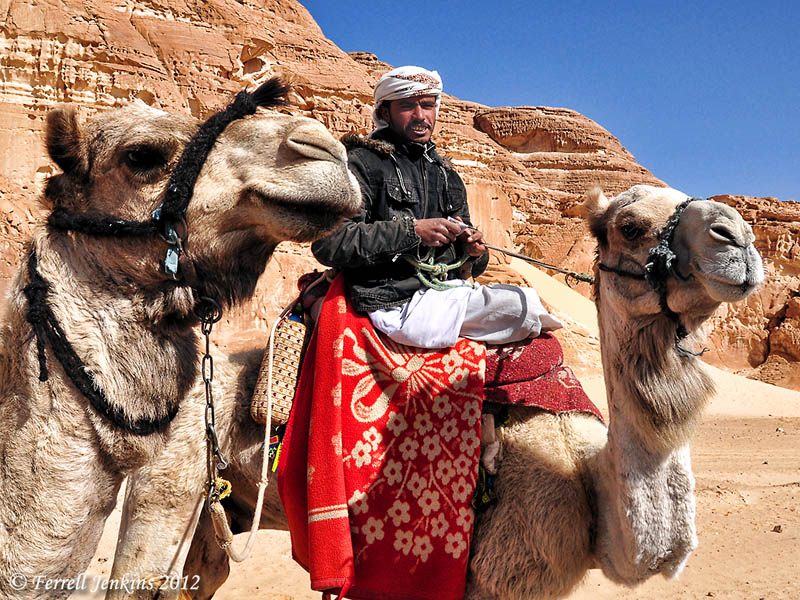
Camels and rider in the Sinai Peninsula. Photo by Ferrell Jenkins.

Camels and rider in the Sinai Peninsula. Photo by Ferrell Jenkins.

The bronze needle below is displayed in the British Museum. The camel above is greatly reduced, and the needle below is greatly enlarged.

Bronze needle from the Roman period. British Museum. Photo by Ferrell Jenkins.

Bronze needle from the Roman period. British Museum. Photo by Ferrell Jenkins.

What did Jesus mean? There is a popular theory that there was a gate in Jerusalem with a smaller gate called the eye of the needle. It is said that the camel could go through the small gate when the burden was unloaded.

Sounds good doesn’t it? But it destroys the teaching of Jesus. Jesus spoke of something that was impossible for mere humans, but possible for God.

Many of the medieval gates we know of in ancient cities had a small gate within the larger gate. There was no need to open a huge gate just for any individual to pass.

Authors of Hard Sayings of the Bible, after mentioning this legend, say,

But this charming explanation is of relatively recent date; there is no evidence that such a subsidiary entrance was called the eye of a needle in biblical times. (438)

They also warn of the temptation to tone down the teaching of Jesus.

There is probably no saying of Jesus which is harder in the Western mind today than the saying about the camel and the needle’s eye, none which carries with it such a strong temptation to tone it down. (439).

The IVP Bible Background Commentary: New Testament comments on the eye of the needle at Mark 10:25.

This image reflects a Jewish figure of speech for doing something impossible (a large animal going through a needle’s eye). The saying, a hyperbole, refers to a literal needle. (Those who think Jesus refers here to a gate in Jerusalem called the “eye of a needle” are mistaken, because that gate was built in medieval times.) A wealthy person could relinquish wealth only by God’s grace (10:26–27).

Scribes kept important records

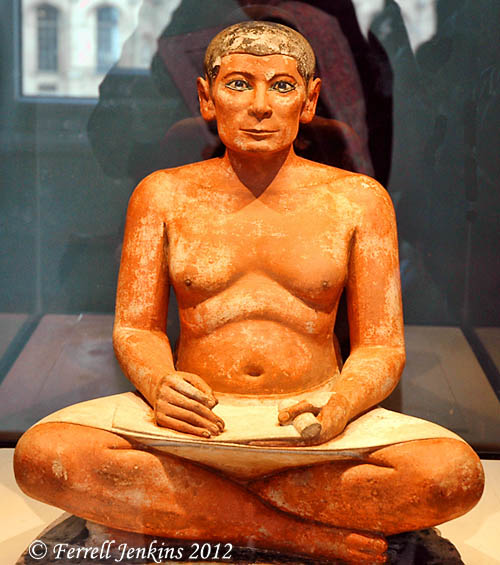
The picture below shows a scribe from ancient Egypt. The statue from Saqqara dates to the 4th or 5th dynasty — about 2600 to 2350 B.C. The limestone statue is painted with encrusted eyes of rock crystal. The statue is on display in the Louvre.

Scribe from Saqqara displayed in the Louvre. Photo by Ferrell Jenkins.

Scribe from Saqqara displayed in the Louvre. Photo by Ferrell Jenkins.

We do not have a great number of examples of writing from ancient Israel, but the Bible is abundant with references to writing and record keeping. The entry on the Hebrew word katab in the Theological Wordbook of the Old Testament says,

katab is the only general word for “write” and it is widely used. Curiously, it is not used in Genesis. Moses wrote on a scroll God’s curse on the Amalekites (Exo 17:14 ). God himself wrote the Ten Commandments (Exo 31:18). Moses also is specifically said to have written the Book of the Covenant (Exo 24:4), the Sinai legislation (Exo 34:27), the names of the leaders of the tribes (Num 17:2-3), the wilderness itinerary (Num 33:2), the law “from beginning to end” (Deut 31:9, 24) and Moses’ final song (Deut 31:22, 24). It is quite possible that the general references of Deut 31:9  and Deut 24 refer to the whole of the Pentateuch (cf. Deut 28:58-61; Deut 29:20-21) although critical scholars refer it only to Deut and question even that.

I think the reference to Moses writing the wilderness itinerary of the Israelites is interesting.

Moses wrote down their starting places, stage by stage, by command of the LORD, and these are their stages according to their starting places. (Numbers 33:2 ESV)