Category Archives: Bible Study

The historical credibility of the Gospel of John

Over at Parchment and Pen, Dan Wallace has written on “The Gospel of John and Historical Realibility – Part 1. Already I am looking forward to Part 2+. Wallace says,

In 1844, the Tübinger Jahrbuch published an essay by F. C. Baur to the effect that John’s Gospel should be dated no earlier than AD 160, and probably closer to 170.

Everyone who has studied New Testament introduction knows that this view was dominant for nearly a century. Wallace tells what rocked Baur’s view:

Ninety years after Baur first published his thesis on John, a young doctoral student studying at Manchester University came across a scrap of papyrus in the John Rylands Library. Colin H. Roberts was intrigued by the papyrus fragment, which had been excavated decades earlier from rubbish heaps in Egypt. It was only 2 & ½ inches by 3 & ½ inches, but its importance far outweighed its size. Roberts immediately recognized it as a fragment of John’s Gospel—chapter 18, verses 31 to 33 on one side, and chapter 18, verses 37 and 38 on the other, to be exact. He sent the photographs of the fragment to three of the leading papyrologists in Europe. Each one reported independently that this fragment should be dated, on paleographical grounds, between AD 100 and AD 150. A fourth scholar disagreed, arguing that the fragment should be dated in the 90s of the first century!

This tiny fragment of John’s Gospel rocked the scholarly near-consensus on the date of John, for it is impossible for a copy to be written before the original text is produced. It effectively sent two tons of German scholarship to the flames. As one wag put it, “This manuscript must have been written when the ink on the original text was barely dry.”

A number of years ago, while leading a tour of the British Isles, I called the Rylands Library at the University of Manchester to ask if I could see the Rylands Fragment. After being assured that I could, I took the train from York to Manchester. At the time, the little fragment was between two pieces of glass taped around the edge. There is only one piece of the fragment, but the image below (from a library slide) shows both sides.
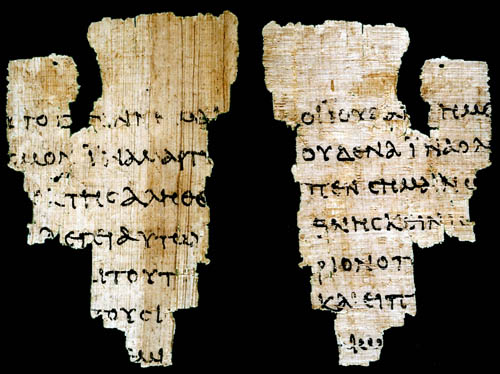
We think the Gospel of John was written by John in Ephesus sometime during the 80s, but this manuscript is thought to have originated in Egypt between A.D. 100 and 150 (or earlier?). This is a small illustration of the rapid spread and copying of the Gospel.

The John Rylands Library has a page devoted to the fragment here.
Home again!

We arrived at our normal abode a short time ago (Friday evening about 9 p.m.). Traveling to educational, inspirational, and exciting places is rewarding, but there is no place like home.

Hopefully we can continue several times a week to post a few photos of places we visited. First, some rest.

Thessalonica in Macedonia

The Capsis hotel in Thessalonica was our home for two nights. Wednesday we used our time visiting the city. Thessalonica (called Thessaloniki now) is in biblical Macedonia. The area is still known as Macedonia, but is not to be confused by the modern country by that name. It is marked on maps of Greece as FYROM (former Yugoslav Republic of Macedonia). I know too little about the dispute to make any comments.

Paul came to Thessalonica on his second journey (A.D. 50-53; Acts 17). He wrote two letters to the church at Thessalonica while he was at Corinth. Aristarchus, a Macedonian of Thessalonica accompanied Paul on the voyage to Rome (Acts 27:2). When Demas forsook Paul he went to Thessalonica (2 Timothy 4:10).

I went to the Archaeological Museum of Thessalonica thinking I would jump in, make a few shots of some items I had need of and then move along. In fact, I found a new (since my last visit in 2001) museum with wonderful educational exhibits, nice displays, and great lighting.

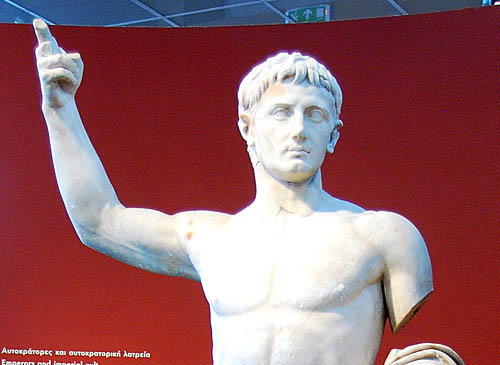
There is an impressive full-length statue of the Emperor Augustus (30 B.C. to A.D. 14). Augustus was emperor at the time of the birth of Jesus (Luke 2:1). Here is a photo of the top portion of the statue. This gives some indication of the wonderful lighting in the museum. This photo was made without flash.

On the display around the statue of the emperor there is a statement about the cult of the emperor. In our travels in Asia Minor (western Turkey) we saw many evidences that the admiration of the emperor grew into worship of the emperor as a divine being. This placed a real burden on the Christians of the time. It is this type of tribulation that the book of Revelation addresses.

The cult of the emperor was both an instrument of imperial policy progaganda and a means for the transmission of Roman culture. The image of the emperor gives a concrete form to the abstract idea of the Empire. Whether a full-lenth statue [as this one] of a bust, it makes his presence felt everywhere; in outoor and indoor spaces, in fora, in villas, and in libraries.

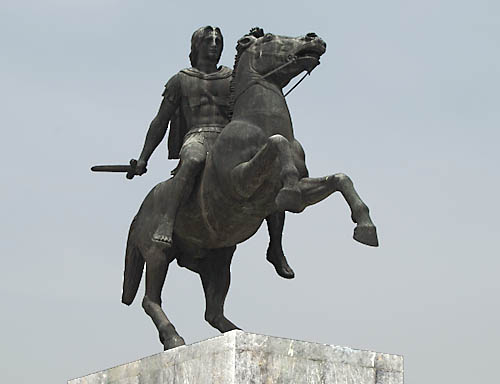
Elizabeth and I walked down by the harbor to see the colossal statue of Alexander the Great on his horse, ready to go into battle with sword drawn. We must put Alexander of Macedon among the most influential people of world history. His conquest of the areas we know as the Bible world continue to influence us till this day. He left his mark with the introduction of the oikumene concept of one world and the introduction of Greek culture and language. The Hebrew scriptures were translated into Greek in Alexandria beginning about 280 B.C. The New Testament was written in Greek. Even Paul, the Hebrew of Hebrews (Philippians 3:5), could speak Greek (Acts 21:37).

We visited the Arch of Galerius on the modern Via Egnatia, one of the main streets of Thessalonca. I made a few photos in the Roman agora before we rushed to get our bags packed to fly back to Athens.

By the time we arrived at our hotel, near the airport we had both decided that we were too tired to try to go to Delphi today. From our hotel room we are enjoying the beautiful view of a small town surrounded by mountains draped by blue sky with white clouds.

Paul’s journey in Macedonia

During his second journey, while at Troas, Paul saw a vision of a man of Macedonia. Luke gives the following record of the vision and of the subsequent action of the apostle.

A vision appeared to Paul in the night: a man of Macedonia was standing and appealing to him, and saying, “Come over to Macedonia and help us.” When he had seen the vision, immediately we sought to go into Macedonia, concluding that God had called us to preach the gospel to them. (Acts 16:9-10)

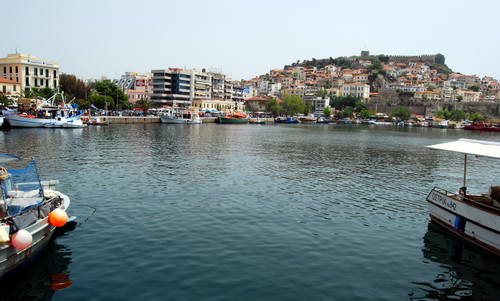
Paul and his companions, including Luke, landed at Neapolis (modern Kavalla). The text indicates that the real goal of their mission was to reach the Roman colony of Philippi. Someone has commented that it is often the case that preachers have a call from a man to come preach somewhere. When they arrive they find mostly women. Paul found Lydia of Thyatira. She was a seller of purple. Whether the cloth or the dye, we are not told. She was the first convert on European soil. We make much of the fact that this was the first preaching in Europe. At the time the most important thing is that it was the first preaching in the Roman province of Macedonia (now northern Greece). Here is a photo of the modern port at Kavalla.

Luke’s account of the first convert in the city is recorded in Acts 16.

And on the Sabbath day we went outside the gate to a riverside, where we were supposing that there would be a place of prayer; and we sat down and began speaking to the women who had assembled. A woman named Lydia, from the city of Thyatira, a seller of purple fabrics, a worshiper of God, was listening; and the Lord opened her heart to respond to the things spoken by Paul. And when she and her household had been baptized, she urged us, saying, “If you have judged me to be faithful to the Lord, come into my house and stay.” And she prevailed upon us. (Acts 16:13-15)

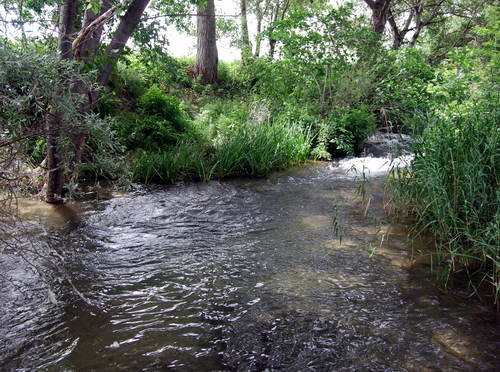
The river Ganga (some say Gangites) is a short distance north of the Agora of Philippi (IDB, III.787). This must be the river under consideration in the biblical account. Here is a photo of the river that I made yesterday.

We also visited Neapolis (modern Kavalla), Amphipolis and Appollonia.

Now when they had traveled through Amphipolis and Apollonia, they came to Thessalonica, where there was a synagogue of the Jews. (Acts 17:1)

Today we plan to visit some important sites in Thessalonica.

Group back in the USA

Early yesterday our group left for home. We have received several Emails from tour members saying that they have arrived home safely. For this we are thankful.

Elizabeth and I are spending a few days in northern Greece (biblical Macedonia). Yesterday we visited Berea (Acts 17) and Dion. Dion is in the shadow of Mount Olympus and is suggested by some as the place where the brethren from Berea took Paul down to the sea so he could continue on to Athens.

Today we plan to visit Neapolis, Philippi, et al. (Acts 16). We are staying in Thessalonica. Photos later.

Corinth, where Paul stood before Gallio

Corinth is one of my favorite places to visit. I think that is because it plays such a prominent role in the New Testament story. Paul first came to Corinth on his second journey, after visiting Philippi, Thessalonica, and Berea in Macedonia (now northern Greece), and Athens in Achaia. Another reason I enjoy going here is becaue we know the names of so many people associated with the city: Chloe, Aquila, Priscilla, Crispus, Gaius, Apollos, Stephanos, Erastus, et al.

Luke’s historical account is recorded in Acts 18. Paul met Aquila and Priscilla, natives of Pontus, who had been expelled from Rome because of a decree by the Emperor Claudius. There was success in the work at Corinth as individuals heard the gospel of Christ and were baptized.

But there was also opposition. Soon, the Jews brought charges against Paul and had him brought before the proconsul Gallio.

But while Gallio was proconsul of Achaia, the Jews with one accord rose up against Paul and brought him before the judgment seat, saying, “This man persuades men to worship God contrary to the law.” But when Paul was about to open his mouth, Gallio said to the Jews, “If it were a matter of wrong or of vicious crime, O Jews, it would be reasonable for me to put up with you; but if there are questions about words and names and your own law, look after it yourselves; I am unwilling to be a judge of these matters.” And he drove them away from the judgment seat. (Acts 18:12-16)

The Gallio inscription, now exhibited in the museum at Delphi, provides the date for the time when Gallio was proconsul. This, in turn, helps us build a chronology for Paul’s ministry. Based on this information we generally think of Paul entering Corinth in the fall of A.D. 51, and leaving in the spring of A.D. 53.

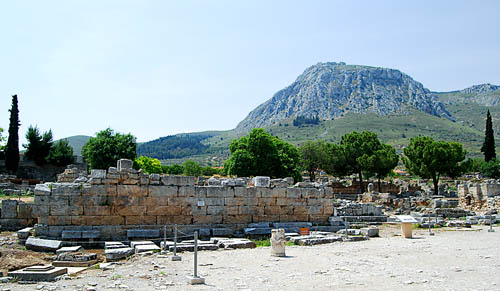
Our photo shows the “judgment seat” (Greek, bema) in the agora (marketplace) at Corinth. The Acrocorinth is the mountain in the background. The Temple of Aphrodite stood on the Acrocorinth in New Testament times.

Earlier I have written two posts on dealing with Corinth. Check here for Did the apostle Paul attend the Isthmian Games?, and here for The Corinth Canal. We visited both sites yesterday.

Maps and Geography in Biblical Studies

Some time back I wrote about Selecting a Bible Atlas here.

I keep a link to Tyndale Tech (Electronic Resources for Biblical Studies) at Biblical Studies Info Page (under Scholarly, then Blogs). David Instone-Brewer surveys various sources for maps here, including making your own. Later I will try to write about BibleMapper. I have downloaded it and it really looks great.

Not everyone has the opportunity to visit Bible Lands and make good photographs for use in teaching, but there are many sources for photos.

These statement by Instone-Brewer really impressed me:

There is now no excuse to teach or preach without pictures and maps.

Hint. If you aren’t using many pictures, wait till the latter half of your teaching, and then wake them up with a map and some photos.

Santorini and the Minoan Civilization

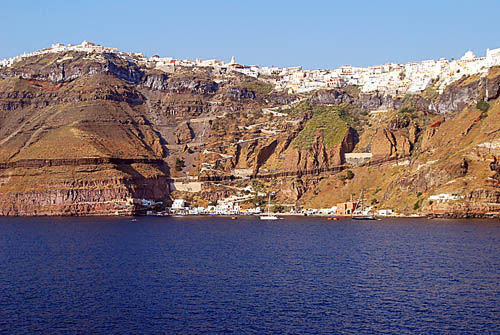
Last Thursday we visited Santorini on the way from Crete to Athens. Ships anchor (not dock) at Santorini while tender boats ferry the passengers back and forth to the island city built on the half-moon rim of the crater. Some writers hold that Santorini is the ancient island of Atlantis. Santorini is not mentioned in the Bible, but several writers have tried to connect it to biblical events. It has been suggested that one of the several volcanic eruptions at Santorini is to be connected with the drying up of the Red Sea when the Israelites crossed. This is highly speculative, and there are chronological difficulties.

Items from Akrotiri, Santorini, a city covered by volcanic ash about 1600 B.C. are part of the collection of the National Archaeology Museum in Athens. It is good to see these things in Athens because the ruins at Akrotiri are closed for reconstruction. These artifacts from Akrotiri provide a good look at the Minoan civilization.

This photo was made from our ship which was anchored in the crater. The city is built along the rim of the crater. We are able to look into the heart of the volcano.

Paul and his companions stopped in Rhodes

I thought I posted this article yesterday, but see that I left it as a draft. Anyway, here goes. After a three day cruise we are now in Athens, Greece. Due to the expensive time on board the ship, and lack of time to seek other arrangements, I was unable to post since Patmos. I will try to catch up over the next few days. Below is the post on Rhodes.

———

Paul and his companions stopped at Rhodes on the return portion of the third journey, but nothing is said in Luke’s historical account about any activities on the island.

When we had parted from them [the Ephesian elders at Miletus] and had set sail, we ran a straight course to Cos and the next day to Rhodes and from there to Patara; and having found a ship crossing over to Phoenicia, we went aboard and set sail. (Acts 21:1-2)

Our ship docked at the harbor of the city of Rhodes, capital of the island of Rhodes. Here, in ancient days, stood the colossus of Rhodes — one of the seven wonders of the ancient world. The statue fell during an earthquake in 226 B.C., but remains of it were seen as late as the 7th century A.D. Assuming that Paul’s ship docked here, he would have seen ruins of the famous monument. Considering the course of travel mentioned in the text (Cos, Rhodes, and Patara) this appears more likely.

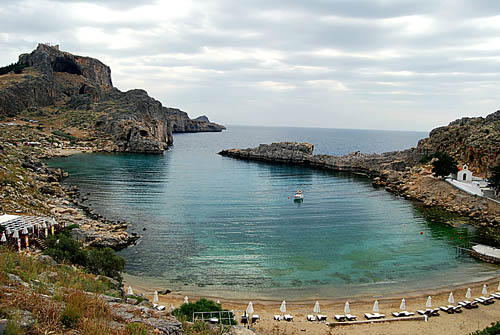
Another tradition has it that Paul’s contact with the island was at Lindos, one of the three ancient cities of the island. It is located about 34 miles from the town of Rhodes. A small Greek Orthodox chapel commemorates the landing and preaching of the apostle. In this photo showing St. Paul’s harbor you can see the chapel on the right. The acropolis with ruins of the Temple of Athena are on the left. Fant and Reddish, A Guide to Biblical Sites in Greece and Turkey, say that “The harbor was once the location of the fleet of Lindos and the only natural harbor on the island of Rhodes” (114).

Rhodes is not mentioned in most English translations of the Old Testament. Ezekiel 27:15, in translating the Masoretic Text, mentions the “men of Dedan” or the Dedanites. The Greek version (LXX, Septuagint) uses words that mean “men of Rhodes.” I note that the New American Bible, the NIV, and the NRS, follow the Greek in their trasnlation. Rhodes is also mentioned in 1 Maccabees 15:23. Dedan is identified as “an important settlement located at one of the major oases in NW Arabia (Gen. 10:7; Gen. 25:3)” (Anchor Dictionary of the Bible, 123). For now, this remains a problem.

Titus was left in Crete

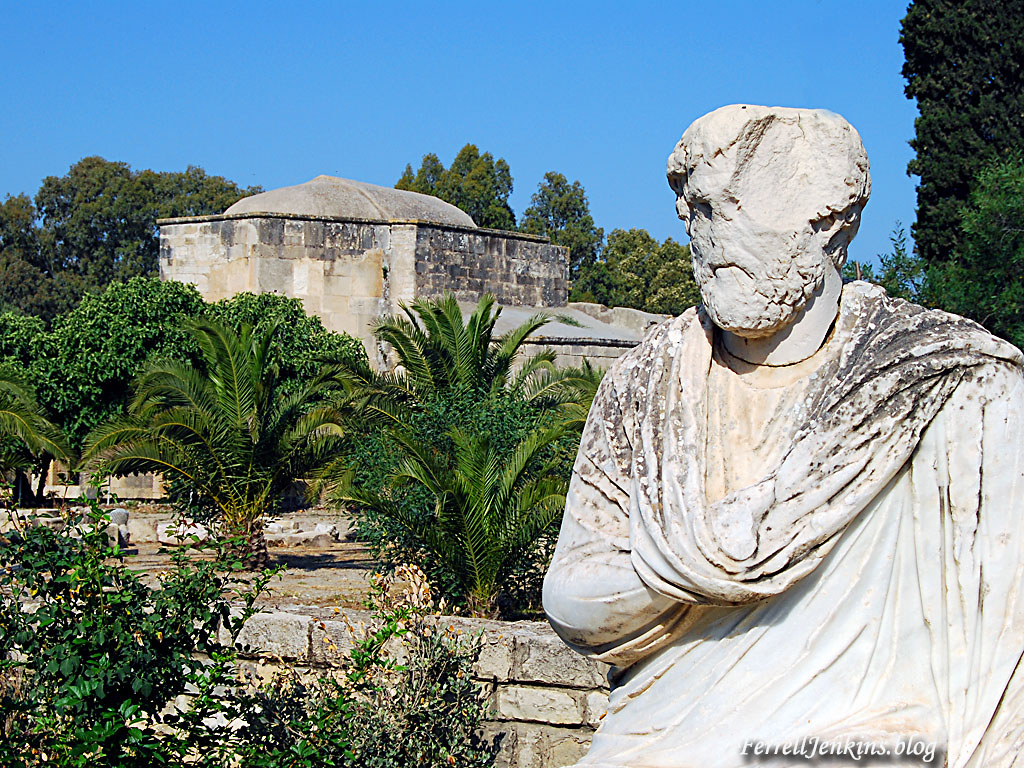
Paul left Titus in Crete to set in order what was lacking in the churches, and appoint elders in every city (Titus 1:5). This indicates that Paul visited Crete with Titus and left Titus there. It is difficult to fit this into the information we know about Paul’s life, but likely came after the first Roman imprisonment. Tradition has it that Titus was the first bishop of Gortyn. There we saw the ruins of the Basilica of St. Titus (4th to 8th centuries). Here is one of the photos from this site was was on the main road from Heraklion to Fair Havens.

The back of the basilica of Titus at Gortyna, Crete. Roman statue in foreground. Photo by Ferrell Jenkins.

The back of the basilica of Titus at Gortyna, Crete. Roman statue in foreground. Photo by Ferrell Jenkins.

This photo shows the back of the basilica because the front was in the shadows. One of our tour members was looking at the photo. I said, “We could say that this Roman statue is of Titus.” She said, “It looks as if he has a splitting headache.”