Category Archives: Bible Study

The number of New Testament textual variants

This note is not about travel, but it is about an extremely important subject. Sometime during 2008 Daniel Wallace wrote a series of articles on the subject of Textual Variants. Due to a crash these articles were lost. Recently the one on “The Number of Textual Variants: An Evangelical Miscalculation” was recovered and posted at Parchment and Pen. Go directly to the post here.

At the bottom of his post you will see links to several Related Posts.

Earlier I posted a note about two recent lectures by Dr. Daniel Wallace here.

A visit to the Siegfried H. Horn Museum

Andrews University in Berrien Springs, Michigan, has long been associated with archaeological work, especially in Jordan. This work is carried out under the name of the Institute of Archaeology.

The interesting history of the Siegfried H. Horn Museum may be read here. The name of Siegfried H. Horn is well known to anyone who had read about biblical archaeology in modern times.

Last week I was at Valparaiso, Indiana, presenting a series of lessons on Bible History and Archaeology. I had long wanted to visit the Horn Archaeological Museum. When we learned that we were slightly more than an hour away, Mark Russell, Steve Wolfgang and I made the trip one morning. The Museum is hopeful of moving into a new facility as soon as the project can be funded. At this time the small museum is open only on Saturday afternoon, but they will open by appointment, as they did for us.

The Siegfried H. Horn Archaeological Museum houses over 8,500 artifacts, but only a small portion of those are on display. There are replicas of a few famous artifacts such as the Black Obelisk of Shalmannessar II and the Moabite Stone

There are significant original pieces from most areas of the Bible world with Mesopotamia and Transjordan being featured. There is a mummified Ibis from Egypt. The Egyptian god Thoth was portrayed with the head of an Ibis. I never see representations of these gods without thinking of Paul’s description of the Roman world prior to the coming of Christ.

Claiming to be wise, they became fools, and exchanged the glory of the immortal God for images resembling mortal man and birds and animals and creeping things. (Romans 1:22-23 ESV)
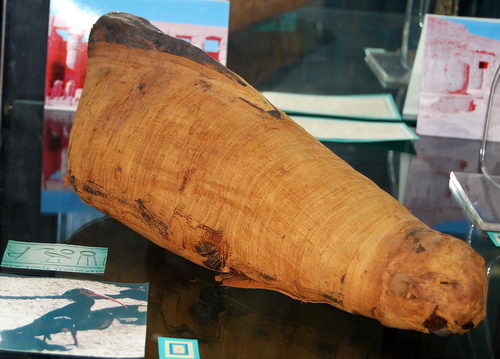
Mummfied Ibis from Egypt. Photo by Ferrell Jenkins.

Mummified Ibis from Egypt. Photo by Ferrell Jenkins.

In the main exhibit hall there is a life-size Bedouin tent. This makes a good background for explaining patriarchal life.
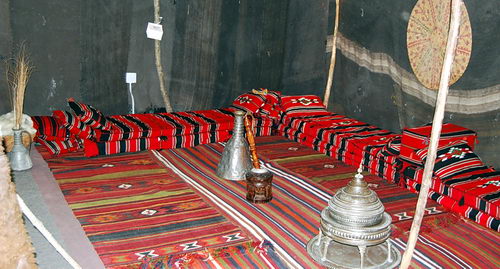
Authentic Bedouin Tent at Horn Museum. Photo by Ferrell Jenkins.

Authentic Bedouin Tent at Horn Museum. Photo by Ferrell Jenkins.

By faith Abraham obeyed when he was called to go out to a place that he was to receive as an inheritance. And he went out, not knowing where he was going. By faith he went to live in the land of promise, as in a foreign land, living in tents with Isaac and Jacob, heirs with him of the same promise. For he was looking forward to the city that has foundations, whose designer and builder is God. (Hebrews 11:8-10 ESV)

Two other things should be mentioned. There are some wonderful models. One that impressed me was of the Roman rolling-stone tomb at Heshbon. The murals covering biblical and modern church history are impressive.

I recommend that anyone traveling in the vicinity of Berrien Springs, or those living within driving distance, take advantage of this opportunity to visit. Bible class teachers would do well to become familiar with this Museum and arrange for their students to see it.

Our thanks to Jody Washburn, an Administrative Assistant at the Institute of Archaeology, for her help in making our visit pleasant.

The Oriental Institute

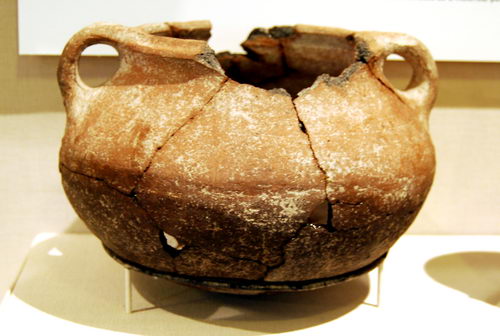
Yesterday I visited the Oriental Institute of the University of Chicago.  When I visit a museum such as this I am not only looking for items with a specific connection to a biblical account, such as the prism which mentions Hezekiah, but also for artifacts that might illustrate daily life in Bible times.

Cooking pots are mentioned several times in the Scripture. One such reference is a sort of proverb.

It is better for a man to hear the rebuke of the wise than to hear the song of fools.  For as the crackling of thorns under a pot, so is the laughter of the fools; this also is vanity. (Ecclesiastes 7:5-6 ESV)

This cooking pot is from Iron IIc at Megiddo (732-600 B.C.).

Cooking pot from Megiddo. OIUC. Photo by Ferrell Jenkins.

Cooking pot from Megiddo. OIUC. Photo by Ferrell Jenkins.

Notice the interesting account from the days of the prophet Elisha.

When Elisha returned to Gilgal, there was a famine in the land. As the sons of the prophets were sitting before him, he said to his servant, “Put on the large pot and boil stew for the sons of the prophets.” Then one went out into the field to gather herbs, and found a wild vine and gathered from it his lap full of wild gourds, and came and sliced them into the pot of stew, for they did not know what they were. So they poured it out for the men to eat. And as they were eating of the stew, they cried out and said, “O man of God, there is death in the pot.” And they were unable to eat. But he said, “Now bring meal.” He threw it into the pot and said, “Pour it out for the people that they may eat.” Then there was no harm in the pot.  (2 Kings 4:38-41 NASB)

One wonders what might have been cooked in that now-broken pot from Megiddo.

Bronze Age gate at Dan opened

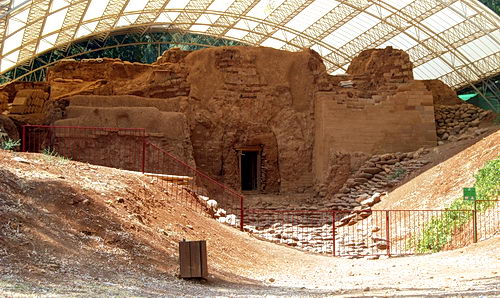
Ha’aretz announces the opening of the Bronze Age gate at Dan after restoration.

The Nature and National Parks Protection Authority yesterday opened “Abraham’s Gate” at Tel Dan in the north, for visits by the public.

The ancient structure from the Canaanite period of the Bronze Age is made of mud and is thought to have been built around 1750 B.C.E. The authority named the archaeological site for Abraham, the first patriarch of the Jewish people, indicating that it dates from the period of Abraham.

The gate was uncovered in 1979 but more recently underwent restoration. It is composed of three arches and constructed of sun-dried mud brick on a foundation of large basalt stones. The gate, which in ancient times stood seven meters tall, has been restored to its original height. It features two towers and a horizontal structure linking them below the arches, the oldest arches ever found in the Land of Israel.

Read the full article here.

This photo shows the condition of the gate August 31, 2008. I don’t know what has been done to “open” the gate to the public.

Bronze age gate at Dan. Photo by Ferrell Jenkins.

Bronze age gate at Dan. Photo by Ferrell Jenkins.

This gate was dubbed “Abraham’s Gate” in the Ha’aretz headline. We have no way of knowing that Abraham saw this gate, but he might have. The Bible records that when the kings of the east took Lot captive, Abraham pursued them as far as Dan (Genesis 14:14).

HT: Joseph I. Lauer

Mount Hor

The Scripture records that Aaron was buried on Mount Hor (Numbers 20:25-29). We wrote about this here. A few interesting questions have been left in a comment. I am away from home for the week and do not have access to all the materials I might check, but here is a brief response.

1. How long would it take to walk unaided up Mt. Hor? Are there clearly marked-out historical trails?

Hikers make the trek. My recollection is that one should allow between a half and a full day for the trip up and down. A guide book such as Lonely Planet would surely answer this question. Perhaps some reader has made the climb and will tell us.

2. Do you know anything about the history of the Muslim shrine at the summit? I’m sure there have been quite a bit of academic research into this over the years, but I’m hoping for a simple answer about how reliable is this tradition about the exact location of Mt. Hor?

Not really. There are many “traditional” places identified by Jews, Christian, and Muslims, but a large number of them are without any historical foundation. Todd Bolen has this comment, along with a nice photo, at Bible Places.

In Bedouin tradition, Jebel Haroun is Mt. Hor where Moses’ brother Aaron was buried.  Most scholars reject this, locating Mt. Hor near Kadesh-barnea to the west.

I trust this will be helpful.

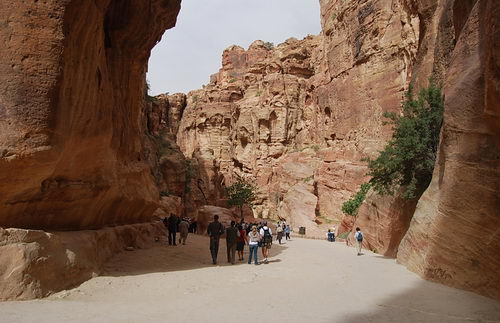
Here is a photo of the beginning of the Siq at Petra. Almost everyone likes to show the photos of the narrow part. It is beautiful, even from the beginning.

The beginning of the Siq at Petra. Photo by Ferrell Jenkins.

The beginning of the Siq at Petra. Photo by Ferrell Jenkins.

Like an owl in a desolate place

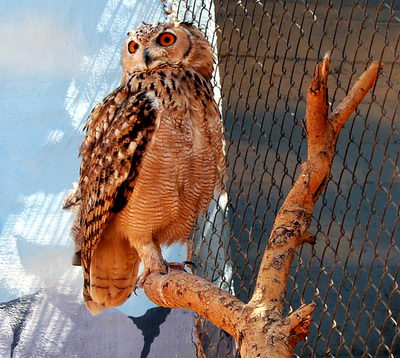
The owl, as a bird of prey, is mentioned among the unclean birds — those that were not to be eaten by the ancient Israelites (Leviticus 11:16; Deuteronomy 14:15).

Owl at Hai-Bar Nature Reserve in Israel. Photo by Ferrell Jenkins.

Owl at Hai-Bar Nature Reserve in Israel. Photo by Ferrell Jenkins.

Psalm 102 is described as “A Prayer of the Afflicted when he is faint and pours our his complaint before the LORD.” The owl is mentioned in Psalm 102:6 NASB.

I resemble a pelican of the wilderness; I have become like an owl of the waste places.

According to Keil and Delitzsch the owl mentioned here is “the night-raven or the little horned owl.” Note the comparison of the pelican and the owl with the person who is afflicted.

They are both unclean creatures, which are fond of the loneliness of the desert and ruined places. To such a wilderness, that of the exile, is the poet unwillingly transported. He passes the nights without sleep, … and is therefore like a bird sitting lonesome, … upon the roof whilst all in the house beneath are sleeping.

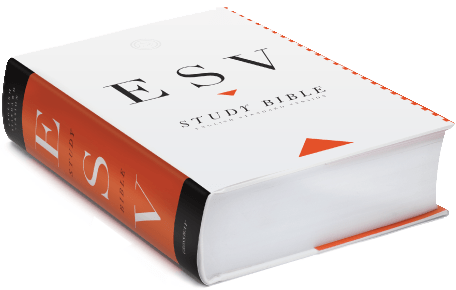
ESV Study Bible online free (for a while)

Recently I received a copy of the ESV Study Bible from the publisher, Crossway Books and Bibles, for review. Hopefully I will be able to get to this in the next week or two.

Meanwhile, you have the opportunity to use the ESV Study Bible online free of charge until March 31, 2009. The Bible has been available online and in several computer Bible programs for some time. The Study Bible has many additional features such as explanatory notes, charts, maps, diagrams, etc. This will give you a few weeks to read some passages you may be studying and check the additional resources.

Check the ESV Bible Blog for complete information.

ESV Study Bible

ESV Study Bible

Or, you may go to this link, create a login and password and begin using all features of the ESV Study Bible.

The cost of discipleship: “foxes have holes”

Jesus used simple illustrations to reach the heart. When someone said, “I will follow You wherever You go,” He responded this way:

As they were going along the road, someone said to Him, “I will follow You wherever You go.” And Jesus said to him, “The foxes have holes and the birds of the air have nests, but the Son of Man has nowhere to lay His head.” (Luke 9:57-58 NASu; see Matthew 8:19-20)

Foxes have holes. Photo at Hai Bar Nature Reserve by Ferrell Jenkins.

Foxes have holes. Photo at Hai Bar Nature Reserve by Ferrell Jenkins.

William Barclay, in The Daily Study Bible, comments on this account at Matthew 8:19-20.

It is as if Jesus said to this man: “Before you follow me—think what you are doing. Before you follow me—count the cost.

Jesus did not want followers who were swept away by a moment of emotion, which quickly blazed and just as quickly died. He did not want men who were carried away by a tide of mere feeling, which quickly flowed and just as quickly ebbed. He wanted men who knew what they were doing. He talked about taking up a cross (Matthew 10:38). He talked about setting himself above the dearest relationships in life (Luke 14:26); he talked about giving away everything to the poor (Matthew 19:21). He was always saying to men: “Yes, I know that your heart is running out to me, but—do you love me enough for that?”

Jesus still demands full allegiance.

Nineveh in danger of urban sprawl

It is no longer news that the ancient sites of Iraq are in danger of destruction. This has been caused by war, looting, and now urban sprawl. There is an informative article about the threat facing Ninevah (spelled Nineveh in English Bible translations) in The Christian Science Monitor here.

We can be thankful that many of the artifacts of ancient Sumer, Akkad, Assyria, Babylon, et al. are now displayed in the great museums of the world. The reliefs from the palace of the Assyrian king Sennacherib are displayed in the British Museum.

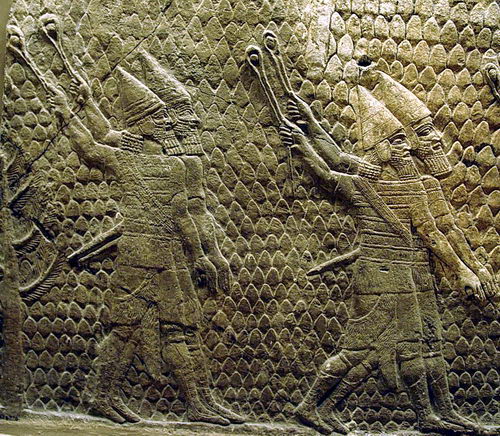
The panel below is a portion showing the Assyrian slingers at Lachish at the end of the 8th century B.C. The Bible says,

Then Sennacherib king of Assyria departed and went home and lived at Nineveh. (2 Kings 19:36)

King Sennacherib had these reliefs carved on his palace walls in Nineveh. Click on the image for a larger one.

Assyrian slingers at Lachish. Photo by Ferrell Jenkins.

Assyrian slingers at Lachish. Photo by Ferrell Jenkins.

The greatness of Nineveh is mentioned in the book of the prophet Jonah.

Arise, go to Nineveh, that great city, and call out against it the message that I tell you. (Jonah 3:1)

It would be nice if world conditions (economic, political, and religious) allowed renewed archaeological excavation of sites such as Nineveh.

HT: Joseph I. Lauer

Epaphras worked hard for the Laodiceans

Laodicea is mentioned only in Paul’s epistle to the Colossians (2:1; 4:13-16) and in the Revelation of John (1:11; 3:14). Paul says that Epaphras worked diligently for the saints in Colossae, Laodicea, and Hierapolis.

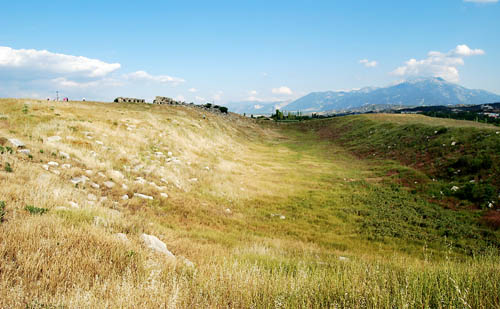
Here is a photo of the ruins of the stadium at Laodicea. Mount Cadmus can be seen in the distance to the east. Colossae was located at the foot of Mount Cadmus. Hierapolis was located to the north of Laodicea.

The stadium at Laodicea. Photo by Ferrell Jenkins.

The stadium at Laodicea. Photo by Ferrell Jenkins.

The stadium was an enclosed structure used for gladiatorial games. An inscription tells that a wealthy family dedicated it to Vespasian and Titus. One still can make our the unexcavated ruins of the 1000 feet long stadium.