Category Archives: Bible Study

Taxes the easy way

Working on tax return preparation for the past two days got me to thinking about this episode from the ministry of Jesus:

24 When they came to Capernaum, the collectors of the two-drachma tax went up to Peter and said, “Does your teacher not pay the tax?” 25 He said, “Yes.” And when he came into the house, Jesus spoke to him first, saying, “What do you think, Simon? From whom do kings of the earth take toll or tax? From their sons or from others?” 26 And when he said, “From others,” Jesus said to him, “Then the sons are free. 27 However, not to give offense to them, go to the sea and cast a hook and take the first fish that comes up, and when you open its mouth you will find a shekel. Take that and give it to them for me and for yourself.” (Matthew 17:24-27 ESV).

Fishing is still important on the Sea of Galilee. Our groups usually have at least one meal of the famous St. Peter’s Fish when we are in the Galilee.
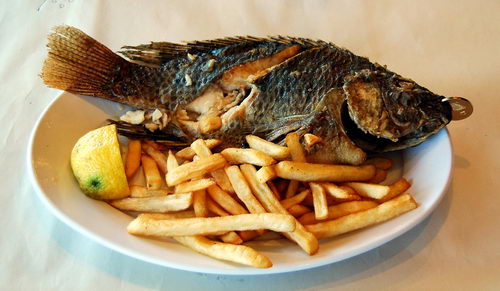
A fish from the Sea of Galilee with a coin in its mouth. Photo by F.Jenkins.

A fish from the Sea of Galilee with a coin in its mouth. Photo by Ferrell Jenkins.

Mendel Nun spent more than 50 years fishing the Sea of Galilee. He became an expert in the history of fishing on the Sea.  His article, “Cast Your Net Upon the Waters: Fish and fishermen in Jesus’ Time” (Biblical Archaeology Review, 19:06), includes information on this episode. Because this is a lengthy quotation I will leave it full width for easier reading.

– – – – – –

The musht is the only large fish in the lake that moves in shoals, which of course is a key to the identification of the fish in the story in Luke, although not the only one.

The flat shape of the musht makes it especially suitable for frying. The skeleton consists of an easily detachable backbone and relatively few small bones, and thus it is easy to eat. It has long been known as St. Peter’s fish. Recently, it has even been exported under this name. But, alas, the name is a misnomer.

Presumably the fish got its name because of an incident recorded in the Gospel of Matthew (Matthew 17:24–27). In this episode, the tax collectors come to Capernaum to collect the half-shekel Temple tax that each Jew was required to pay annually. Jesus tells Peter, “Go to the sea and cast a hook, and take the first fish that comes up, and when you open its mouth you will find a shekel; take that and give it to them for me and yourself.”

The musht was probably given the name St. Peter’s fish because of this miracle. However, this cannot have been the fish Peter caught with a hook and line. The reason is simple: Musht feeds on plankton and is not attracted by other food. It is therefore caught with nets, and not with hook and line. The fishermen on the lake have, since time immemorial, used a hook baited with sardine to fish for barbels, which are predators and bottom feeders. Peter almost surely caught a barbel. There can be only one explanation for the confusing change of name. It was good for tourism! The Sea of Galilee has always attracted pilgrims; musht (today raised mostly in ponds) is part of the unique local cuisine. It is delicious, especially when freshly fried. In ancient times, just as today, the fishing boats delivered their catch to the eating places on shore. Indeed, the proverbial metaphor for speed in the Talmud is “as from the sea into the frying pan.” This expression was part of daily speech in Tiberias and clearly refers to musht and not barbels; the latter are best when boiled.

The first Christians were local people and were therefore familiar with the various fish. They of course knew that the fish Peter caught could only have been a barbel and not a musht. However, as pilgrims began to come from distant regions, it no doubt seemed good for business to give the name “St. Peter’s fish” to the musht being served by the early lakeside eating houses. The most popular and easily prepared fish acquired the most marketable name! But even if Peter did not catch a musht, he deserves to have his name associated with the best fish in the lake.

The empty tomb

The women who came to the tomb of Jesus on the first day of the week found the stone rolled away from the tomb. When they entered the tomb the body was not there (Luke 24:1-3).

The two men (Matthew says angel) said,

He is not here, but has risen. Remember how he told you, while he was still in Galilee, that the Son of Man must be delivered into the hands of sinful men and be crucified and on the third day rise.” (Luke 24:6-7 ESV)

Several tombs of the type in which Jesus was buried have survived the centuries. This one was discovered during road construction a few years ago near Mount Carmel.

A Roman Period tomb with a rolling stone. Photo by Ferrell Jenkins.

A Roman Period tomb with a rolling stone. Photo by Ferrell Jenkins.

The women told the apostles what happened when they went to the tomb.

1 Now on the first day of the week Mary Magdalene came to the tomb early, while it was still dark, and saw that the stone had been taken away from the tomb. 2 So she ran and went to Simon Peter and the other disciple, the one whom Jesus loved, and said to them, “They have taken the Lord out of the tomb, and we do not know where they have laid him.” (John 20:1-2 ESV)

The Gospel of John records the reaction of Peter and the other disciple [John]:

3 So Peter went out with the other disciple, and they were going toward the tomb. 4 Both of them were running together, but the other disciple outran Peter and reached the tomb first. 5 And stooping to look in, he saw the linen cloths lying there, but he did not go in. 6 Then Simon Peter came, following him, and went into the tomb. He saw the linen cloths lying there, 7 and the face cloth, which had been on Jesus’ head, not lying with the linen cloths but folded up in a place by itself. 8 Then the other disciple, who had reached the tomb first, also went in, and he saw and believed; 9 for as yet they did not understand the Scripture, that he must rise from the dead. 10 Then the disciples went back to their homes. (John 20:1-10 ESV)

I asked Frank and Norm, two living disciples, to stoop and look into an empty tomb much the way Peter and John did on that first day of the week.

Two disciples look into an empty tomb. Photo by F. Jenkins.

Two disciples look into an empty tomb. Photo by F. Jenkins.

The tomb of Jesus

The New Testament describes the tomb and burial of Jesus:

When it was evening, there came a rich man from Arimathea, named Joseph, who also was a disciple of Jesus. He went to Pilate and asked for the body of Jesus. Then Pilate ordered it to be given to him. And Joseph took the body and wrapped it in a clean linen shroud and laid it in his own new tomb, which he had cut in the rock. And he rolled a great stone to the entrance of the tomb and went away. Mary Magdalene and the other Mary were there, sitting opposite the tomb. (Matthew 27:57-61 ESV)

The Church of the Holy Sepulchre likely contains the empty tomb of Jesus. Since 1810 the tomb has been covered by a monument that hides the original appearance of the tomb. In fact, even in the 4th century Constantine changed the natural appearance of the area by cutting away some of the natural stone.

The tomb is similar to other tombs from the first century. This one is small, but that would be consistent with the fact that it was the personal tomb of Joseph of Arimathea. The museum of the Studium Biblicum Franciscanum in the Old City has a model of the tomb showing a side view. From right to left one enters the tomb when the rolling stone is moved away. The first room serves as a vestibule. The second room contains a bench or shelf cut into the rock. This was called the arcosolium. The wrapped body would be placed on this bench.

Model of the tomb in the Church of the Holy Sepulchre. Photo by F. Jenkins.

Model of the tomb in the Church of the Holy Sepulchre. Photo by F. Jenkins.

Believers appreciate the loving care Joseph gave the body of Jesus.

The house of Caiaphas

Jesus observed the Passover of the Jews somewhere in the upper city of Jerusalem, the present Mount Zion. Scholarly consensus locates the house of Caiaphas at a site near the Cenacle on Mount Zion. Another site, further down the slope toward the Pool of Siloam, is held by some as the house of Caiphas. It is  called St. Peter in Gallicantu (cock-crow). According to this tradition, it is the place where Jesus was taken after His arrest (Matthew 26:57). If correct, this would be the site of Peter’s denial of the Lord.

The late W. Harold Mare says,

Whatever interpretation is accepted, one is impressed with the ancient stone stairs that run from the vicinity of the Cenacle down past the Church of St. Peter in Gallicantu to the Pool of Siloam, stairs that are thought to be from the Jewish period. It could be that these were the very stairs used by Jesus as he went down from the Last Supper to the Kidron Valley and on to Gethsemane (John 18:1). (The Archaeology of the Jerusalem Area. Baker, 1987)

My understanding is that Jesus would have observed the Passover and instituted the Lord’s Supper in the Upper City. He then went with His disciples to Gethsemane. From there He was taken to the House of Caiaphas. Jesus may have taken these steps in both directions. Here is a photo of those stone stairs that I made in 1979.

First century steps leading to the Upper City. Photo by Ferrell Jenkins.

First century steps leading to the Upper City. Photo by Ferrell Jenkins.

Inscription from time of Kings of Judah

The Israel Antiquities Authority announced the discovery of a fragment of a Hebrew inscription from the period of the Kings of Judah. Here is the complete news release.

In Archaeological Excavations the Israel Antiquities Authority is Conducting at the City of David, in the Walls Around Jerusalem National Park:

A Fragment of a Hebrew Inscription from the Period of the Kings of Judah was Found

A fragment of a limestone plaque bearing several letters of ancient Hebrew script was discovered while sifting soil that was excavated in the vicinity of the Gihon Spring, within the precincts of the “Walls around Jerusalem National Park”. The excavation is being carried out on behalf of the Israel Antiquities Authority, under the direction of Professor Ronny Reich of the University of Haifa and Eli Shukron of the IAA, and is sponsored by the ‘Ir David Foundation.

The stone fragment dates to the eighth century BCE and this is based on the numerous pottery sherds that were discovered together with it, as well as the shape of the Hebrew letters that are engraved in the inscription.

The plaque is broken on all sides. All that remains of the inscription are two lines of writing: In the upper line the last part of a given name is preserved: …]קיה, or as it is transliterated into English …]kiah. Unfortunately the remains of another letter before the kof cannot be discerned. If the letter preceding the kof was a zayin, we could complete the name to read חזקיה, or Hezekiah in English, and perhaps ascribe historical importance to the inscription. On the other hand, there are other first names that were used in Judah and Jerusalem at that time that could be mentioned here such as Hilkia, Amekiya, etc.

In the second line are the remains of two words. Here too, is a suffix of a word: …]כה, or as it is transliterated into English …]ka. Here we have several possibilities for completing the word such as: בְּרָכָה, or birqa, that is, a greeting expressing best wishes (a possible ending for some sort of commemorative inscription). Another possibility is the word בְּרֵכָה, or brecha, meaning water reservoir. The reconstruction of this word is possible based on the fact that Brechat HaShiloah, or the Shiloah Pool in English, is located nearby, and also based on the fact that a pool is mentioned in the famous Shiloah inscription that was discovered close by.

In any event the fact that we are dealing with a stone plaque indicates that this is a commemorative inscription that may have been meant to celebrate some sort of building project.

All that remains is to wait and hope that in time other fragments of the inscription will be found.

The IAA news release is available here. Below is a photo of the inscription.

Inscription from Kingdom of Judah.  Photo: Vladimir Naikhin, courtest IAA.

Inscription from time of the Kingdom of Judah. Photo: Vladimir Naikhin, courtest IAA.

According to Thiele’s chronology, Hezekiah was king of Judah from 716/15 to 687/86 B.C. The book of Chronicles mentions his important work of bringing water from the Gihon spring to the west side of the city of David.

It was Hezekiah who stopped the upper outlet of the waters of Gihon and directed them to the west side of the city of David. And Hezekiah prospered in all that he did. (2 Chronicles 32:30; see 2 Kings 20:20 also).

HT: Joe Lauer

Hellenistic pier found at Akko – Ptolemais

A harbor from the Hellenistic period was found at Akko on the Mediterranean coast. Here is a brief description of the discovery provided by the Israel Antiquities Authority.

The part of the floor that has been revealed so far extends for a distance of 15 meters and is 4 meters wide (the full dimensions of the floor have not yet been exposed). The floor was built of rectangular, smoothly dressed kurkar stones that were placed atop a foundation course of roughly hewn kurkar stones arranged next to each other as “headers”. In probes that were conducted beneath the floor, numerous fragments of ceramic jars of Aegean provenance (from Rhodes, Kos and elsewhere) were found that were used to transport wine, as well as tableware and cooking vessels. Among the other artifacts recovered were a Greek style bronze arrowhead and bronze coins that are covered with marine encrustations. A preliminary identification of the finds shows that the floor was constructed in the Hellenistic period (end of the third century until the middle of the second century BCE) as part of a national project.

Akko Crusader wall. Excavated area of Hellenstic Harbor. Photo: Kobi Sharvit, IAA.

Akko Crusader wall. Excavated area of Hellenistic pier. Photo: Kobi Sharvit, IAA.

The photo below shows some of the kurkar stone pavement discovered one meter under the present water level.

The floor from the Hellenistic period. Photo: Kobi Sharvit, IAA.

The floor from the Hellenistic period. Photo: Kobi Sharvit, IAA.

Akko (Acre or Accho) is mentioned in Judges 1:31 as a city of the tribe of Asher. During the late 3rd or early 2nd century B.C. Akko was given the name Ptolemais by Ptolemy I or II of Egypt. Ptolemais is the name we read in the New Testament. Paul and his companions stopped at Ptolemais for one day on the return from his third journey in the Greco-Roman world.

When we had finished the voyage from Tyre, we arrived at Ptolemais, and we greeted the brothers and stayed with them for one day. (Acts 21:7 ESV)

Several things are learned from this text (and context). The previous stop was a few miles north at Tyre where they had stayed for seven days (Acts 21:4-6). After Ptolemais they arrived at Caesarea.

Paul’s companions included all of those “messengers” of the churches who were taking the contributions of the churches of Macedonia and Achaia to the poor among the saints at Jerusalem (Romans 15:25-27; 2 Corinthians 8-9). A list of names is given in Acts 20:4.

A view of the Mediterranean from the Crusader ramparts at Akko. Photo by Ferrell Jenkins.

A view of the Mediterranean from the Crusader ramparts. Photo by Ferrell Jenkins.

The Wilderness of Judea

John the Baptist preached in the wilderness of Judea (Matthew 3:3), and Jesus was tempted in the wilderness (Matthew 4:1). Jesus spoke to the crowds about John this way:

What did you go out into the wilderness to see? A reed shaken by the wind? (Luke 7:24 ESV)

The wilderness (Greek eremos) of Judea is described this way in Bauer (BDAG):

Of the Judean wilderness, the stony, barren eastern declivity of the Judean mountains toward the Dead Sea and lower Jordan Valley.

The Hebrew word for this wilderness is midbar. Charles F. Pfeiffer said the wilderness of Judea,

is the region of rugged gorges and bad lands in the eastern part of Judah where the land slopes off toward the Jordan Valley. In ancient times this area was infested with wild animals. Except for a brief time during the spring rains the wilderness is arid. (Baker’s Bible Atlas, 201)

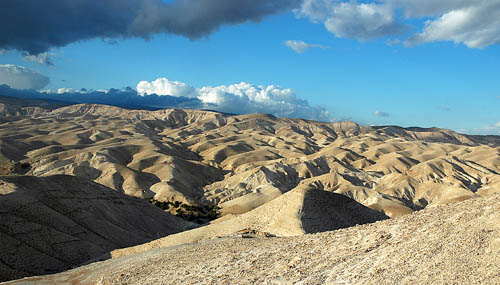
Many people who read the Bible in English, without checking into the matter, think of the wilderness as being a place filled with wild growth and underbrush. Jesus’ question to the crowds indicates that no reeds are to be found in the wilderness. In this case a picture really is worth a thousand words. This shows one of the many changing views one might see in the wilderness. This one was made in the month of November and shows a view west toward Jerusalem.

The wilderness of Judea. Looking west up toward Jerusalem. Photo by Ferrell Jenkins.

The wilderness of Judea. Looking west toward Jerusalem. Photo by Ferrell Jenkins.

The wilderness of Judea stretches west from the Jordan Valley up to the Mount of Olives. Of course, it extends much farther south along the Dead Sea.

Update: 04/01/09

Green pastures and quiet waters

Psalm 23 is one of the best known and most loved chapters of the Bible. In it David describes his relationship to the LORD under the analogy of a sheep and his shepherd.

The LORD is my shepherd, I shall not be in want. He makes me lie down in green pastures, he leads me beside quiet waters, he restores my soul. He guides me in paths of righteousness for his name’s sake. Even though I walk through the valley of the shadow of death, I will fear no evil, for you are with me; your rod and your staff, they comfort me. (Psalm 23:1-4 NIV)

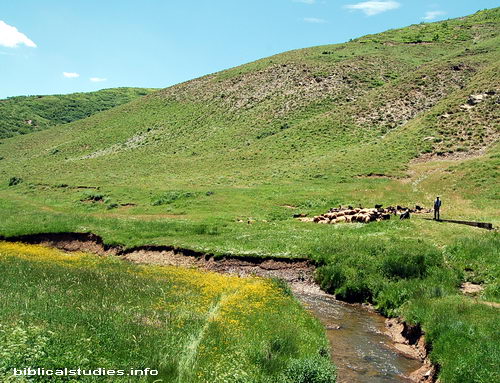
This Psalm  describes one of the common scenes in certain parts of the Middle East. Our photo was made in the mountains of ancient Urartu (Ararat) in eastern Turkey. Notice especially the green pastures and the quiet waters.

A shepherd provides green pastures and quiet water for his sheep. Photo by Ferrell Jenkins.

A shepherd provides green pastures and quiet water for his sheep. Photo by Ferrell Jenkins.

Jesus called Himself the “good shepherd” (John 10:11, 14). Jesus wants the same of elders or overseers in the local church, and He reminds them that it is God’s flock and that He is the Chief Shepherd (1 Peter 5:4).

To the elders among you, I appeal as a fellow elder, a witness of Christ’s sufferings and one who also will share in the glory to be revealed:  Be shepherds of God’s flock that is under your care, serving as overseers– not because you must, but because you are willing, as God wants you to be; not greedy for money, but eager to serve;  not lording it over those entrusted to you, but being examples to the flock. (1 Peter 5:1-3 NIV)

Good shepherds serve God’s flock willingly to provide food, care, and protection for the sheep. The concept of “lording it over” the flock or “domineering” is foreign to the spirit of a good shepherd. Overseers lead the flock by their example of godliness.

The Watchman

The watchman (or watchmen) is mentioned at least 35 times in the Old Testament. His role was one of great significance in keeping a city safe from attackers.

The prophet Ezekiel was appointed as a watchman over the house of Israel.

Son of man, I have appointed you a watchman for the house of Israel. Whenever you hear a word from my mouth, you must give them a warning from me. (Ezekiel 3:17 NET)

Further explanation is given in chapter 33.

But suppose the watchman sees the sword coming and does not blow the trumpet to warn the people. Then the sword comes and takes one of their lives. He is swept away for his iniquity, but I will hold the watchman accountable for that person’s death. (Ezekiel 33:6 NET)

The Psalmist reminds us that the LORD must be the true guard of a city.

If the LORD does not build a house, then those who build it work in vain. If the LORD does not guard a city, then the watchman stands guard in vain. (Psalm 127:1 NET)

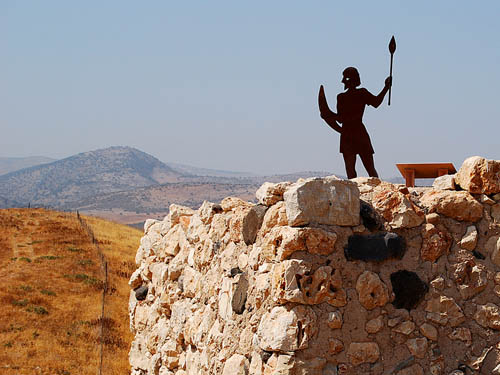
This photo was made a the site of Hazor where a warrior stands in the position of a watchman over the city. The watchtower allows him to look in all directions, but especially to the north. The prophets of Israel warned of the approaching enemy from the north. See Jeremiah 1:14 and Isaiah 14:31.

The Watchman at Hazor. Photo by Ferrell Jenkins.

The Watchman at Hazor. Photo by Ferrell Jenkins.

The closest thing to the concept of the watchman in the New Testament is found in the description of the “leaders” among Christians mentioned in Hebrews 13:17.

Obey your leaders and submit to them, for they keep watch over your souls and will give an account for their work. Let them do this with joy and not with complaints, for this would be no advantage for you. (NET)

William Hendriksen points out that the identity of the leaders is not specified.

Those leaders who had spoken the Word of God in earlier days were no longer present. They must be remembered for their conduct and faith, says the author of Hebrews 13:7. Successive leaders have taken their place. The writer is not interested in the status of these leaders—he gives no hint whether they were elders, overseers, preachers, or teachers. Rather, he asks the reader to obey them. (New Testament Commentary: Exposition of Hebrews, 426)

The shepherd and his sheep

Scenes typical of biblical times are common Jordan, Turkey, and portions of the West Bank of Palestine today. There are some differences, of course.

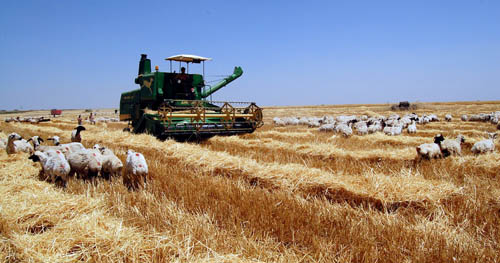
We were traveling between Diyarbakir and Sanliurfa, Turkey, in early June. Several farmers were harvesting their grain using modern combines.

Harvesting grain in Eastern Turkey. Photo by Ferrell Jenkins.

Harvesting grain in Eastern Turkey. Photo by Ferrell Jenkins.

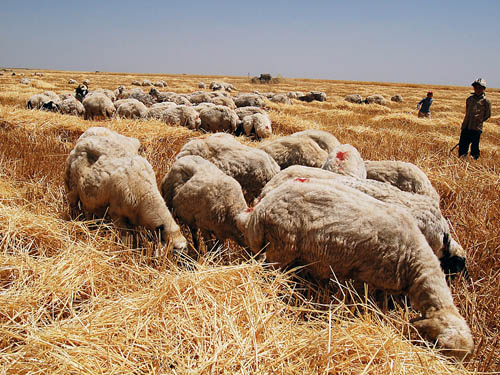
As quickly as the combine passed by, the shepherds brought in the sheep to feed.

The sheep/shepherd analogy was used by Jesus to describe His relationship to His disciples.

I am the good shepherd. The good shepherd lays down his life for the sheep. (John 10:11 ESV)

When Paul spoke to the elders of the Ephesian church he instructed them “to shepherd the church of God” (Acts 20:28 NAS). I note that the ESV uses the term care instead of shepherd to translate the Greek poimaino. That certainly conveys the right idea.

Shepherds care for their sheep in Eastern Turkey. Photo by Ferrell Jenkins.

Shepherds care for their sheep in Eastern Turkey. Photo by Ferrell Jenkins.

Peter instructed elders to “shepherd the flock of God among you” (1 Peter 5:2). The NET Bible says, “Give a shepherd’s care to God’s flock among you.” Lest these men who have been appointed to this work be elevated in their own importance, Peter added,

And do not lord it over those entrusted to you, but be examples to the flock. (1 Peter 5:3 NET)

not domineering over those in your charge, but being examples to the flock. (1 Peter 5:3 ESV)

J. B. Phillips, in his translation of this text, used a vivid phrase to illustrate the overreaching of some elders:

You should aim not at being “little tin gods” but as examples of Christian living in the eyes of the flock committed to your charge. And then, when the chief shepherd reveals himself, you will receive that crown of glory which cannot fade.