Category Archives: Bible Places

New Testament artifacts in the Israel Museum

There are some highly significant artifacts relating to the study of the New Testament in the Israel Museum.

  • The Pilate inscription from Caesarea Maritima (Acts 13:28; 1 Timothy 6:13).
  • The ossuary of the high priest Caiaphas (Matthew 26:3). An inscription on the ossuary reads “Yehosef bar Qafa” (Joseph the son of Caiaphas). There are several ossuaries bearing common names of the New Testament period such as Mary and Jesus.
  • The fragment of one of the warning inscriptions once in the wall separating the Court of the Gentiles from the Court of the Women (Acts 21:29; cf. Ephesus 2:14). The only full inscription discovered in Jerusalem is now in the Istanbul Archaeological Museum.
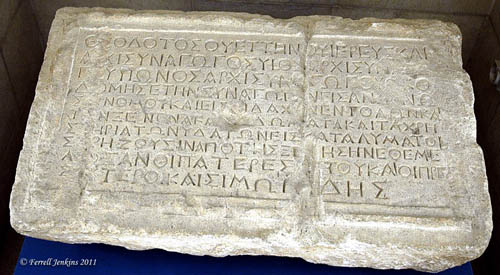
  • The Theodotus Inscription. This inscription came from a Synagogue of Freedmen (liberated slaves). Stephen contended with some men from this synagogue (Acts 6:9). This item was previously displayed in the Rockefeller Museum.
Theodotus Inscription now displayed in the Israel Museum.

Theodotus Inscription now displayed in the Israel Museum.

And more….

One item I failed to see (if it was on display) was the “Chair of Moses” from the Synagogue at Chorazin (Matthew 23:2). In some cases the replicas at the site of discovery are good — and they may be photographed. Examples are the chair of Moses and the Pilate inscription.

The Israel Museum should reevaluate the policy of not allowing photographs. There is nothing on display that has not already been published in numerous places. Teachers like to have their own photos to show their students.

Impressions about the “new” Israel Museum

Many groups visit the campus of the Israel Museum. There are now three areas of interest:

  • The Israel Museum
  • The Shrine of the Book where some Dead Sea Scrolls are displayed
  • The Second Temple Model

We wrote about the planned reopening of the Israel Museum here, and about the opening here. The Shrine of the Book remained open during the time the Museum was closed, and the Second Temple Model has been open since it was moved from the grounds of the Holyland Hotel in the middle of 2008. See here.

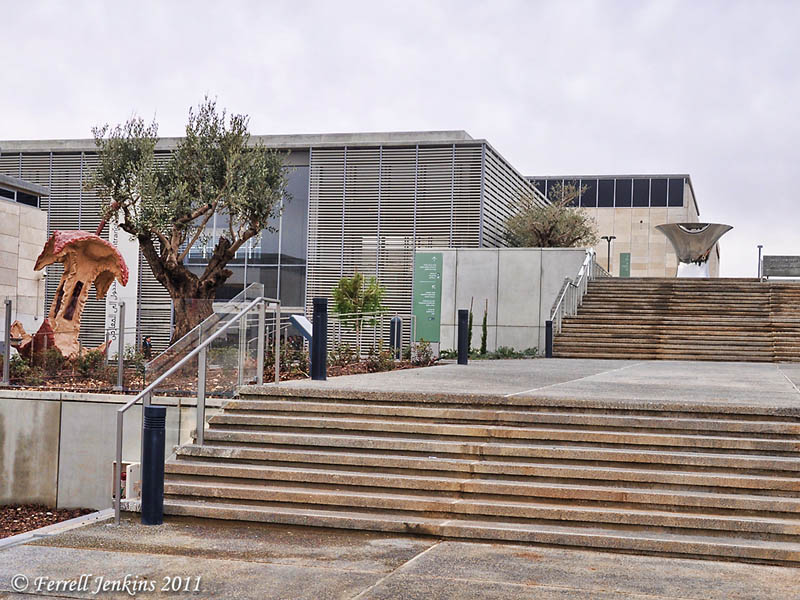
The  galleries devoted to archaeology remain in the same place as before, but there is a significant difference from before. The entrance to the galleries is not at the top of the steps, but about half way up by the apple core sculpture. There is a small cafe with snacks and drinks at the entrance. Tickets are purchased down below at the entrance to the entire complex.
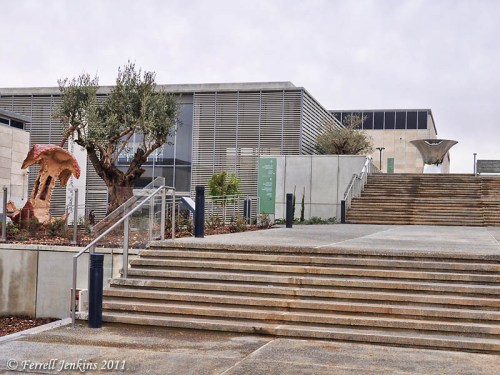
Entrance to Israel Museum. Photo by Ferrell Jenkins.

Entrance to Israel Museum. Photo by Ferrell Jenkins.

Once inside the galleries entrance, the archaeology section is on the left. One is greeted by a display of seven standing anthropoid clay coffins from Deir el-Balah, a site south of Gaza city excavated by Trude Dothan in 1972. These coffins which bear the evidence of Egyptian influence date to the 13th century B.C.
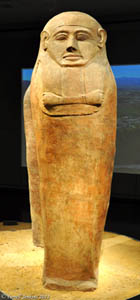
Clay coffin (sarcophagus) from Deir el-Balah.

Clay coffin from Deir el-Balah

In the March, 1976, issue of Biblical Archaeology Review, Hershel Shanks closed an article about the discovery of these sarcophagi this way:

We may close on a Biblical note. “Aron”, or coffin, is used only once in the Bible (Genesis 50:26)—in connection with Joseph’s burial. Joseph, a high-ranking minister in the Egyptian government was naturally buried in accordance with Egyptian rites, including mummification and a coffin. It is likely that his coffin resembled the anthropoid coffins unearthed at Deir el-Balach.

Many sections of the archaeology section remains much the same as before. I will list a few of the items that I think are extremely important to biblical study.

  • The Tel Dan “House of David” Inscription (Isaiah 22:22, et al.)
  • The cult shrine from Hazor.
  • A few pieces of ivory from Samaria (1 Kings 22:39; Amos 3:15; 6:4).
  • Ekron inscription found at Tel Miqne, naming the city and five of its rulers (1 Samuel 6:17).
  • Silver plaques inscribed with the priestly blessing (Numbers 6:23-26). Also known as the Ketef Hinnom discovery.
  • The “Holy of Holies” from the temple at Arad.
  • The Edomite Shrine from biblical Tamar (aka Ein Hazevah).
  • The basalt stele showing a stylized figure of a horned bull from Geshur (aka New Testament Bethsaida).
  • Sennacherib’s siege of Lachish. The original is in the British Museum, but the replica in the Israel Museum has been enhanced to better show the scene (2 Chronicles 32:9).
  • Lachish Ostracon. I only saw one of the letters on display.

And much more…. My time was limited, but I look forward to returning for a longer visit in a few months.

A few things I had seen before, but did not see this time. (It may be that I missed some of these items.)

  • The broken inscription from Ashdod naming Sargon (Isaiah 20:1).
  • The inscribed ivory pomegranate mentioning donations for the priests of the house of the [LORD]. The Israel Museum declared the inscription a forgery in late 2004. There are scholars who believe it to be genuine.

General comments. The display are beautiful and the halls are spacious. Many of the artifacts are displayed in the open (without glass). Visitors are allowed to enter the museum with their cameras. In the past cameras had to be checked. I saw no signs about photography. Shortly after making my first photos I was admonished by one of the docents.

Information about location, hours, tickets, etc. is available at the museum website here.

In another post I will make reference to some of the items of importance to New Testament study.

Here and there in the Holy City

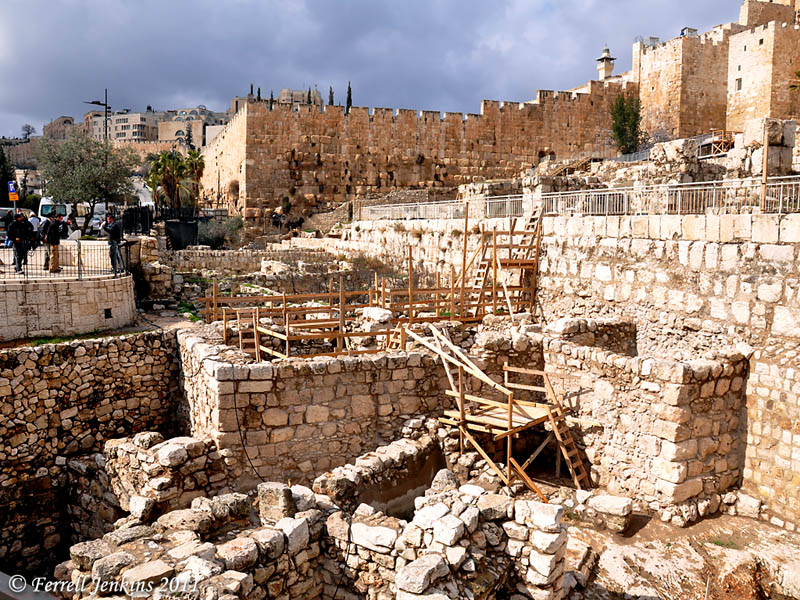
About a year ago we were reporting on the work being done by Dr. Eilat Mazar, of Hebrew University, in the area next to the street that runs along the south side of the Temple Mount. The area is part of what is called the Ophel. Eilat Mazar worked here with her grandfather, Benjamin Mazar, in the 1980s.

It seems uncertain whether this gate belongs to the 8th century B.C., 9th century, or 10th century. Eilat Mazar says it belongs to the 10th century B.C. based on pottery and a comparison of the architecture with that in other excavated cities.

Take a look at our earlier report here.

Jerusalem Ophel Excavations. Photo by Ferrell Jenkins.

Jerusalem Ophel Excavations. Photo by Ferrell Jenkins.

We spent several hours walking the City of David tour. I was disappointed that the new steps leading from the pool of Siloam to the Visitor’s Center and the sewer were closed today due to flooding. I wrote about the sewer, with photos, here.

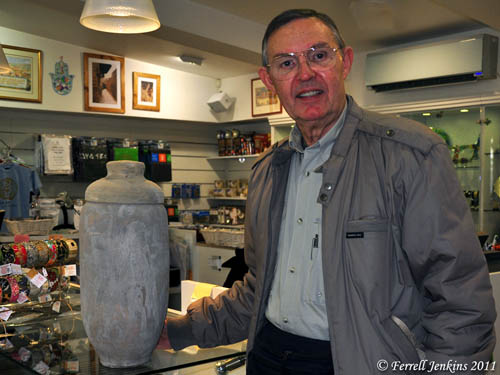
We actually enjoyed a few minutes in the shop. Take our poll.

Ferrell with Qumran Replica Jar

Ferrell with Qumran Replica Jar. Photo by Elizabeth Jenkins.

In the afternoon we went to the Herodium. Another disappointment. The new excavations of Herod’s Tomb are still under cover and fenced off.

Going up to Jerusalem

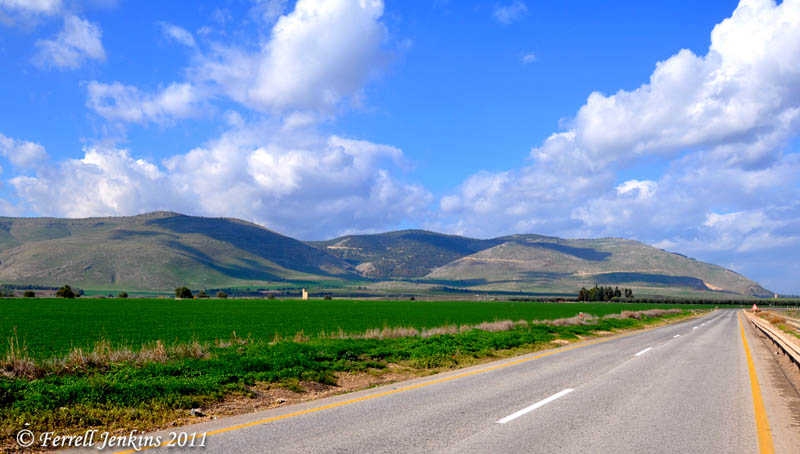
The photo of Mount Gilboa was made from Highway 669 west of Beth Shean. Mount Gilboa is remembered as the place where King Saul was defeated by the Philistines (1 Samuel 31). Notice David’s lament:

“You mountains of Gilboa, let there be no dew or rain upon you, nor fields of offerings! For there the shield of the mighty was defiled, the shield of Saul, not anointed with oil. (2 Samuel 1:21 ESV)

A view of Mount Gilboa from the east. Photo by Ferrell Jenkins.

A view of Mount Gilboa from the east. Photo by Ferrell Jenkins.

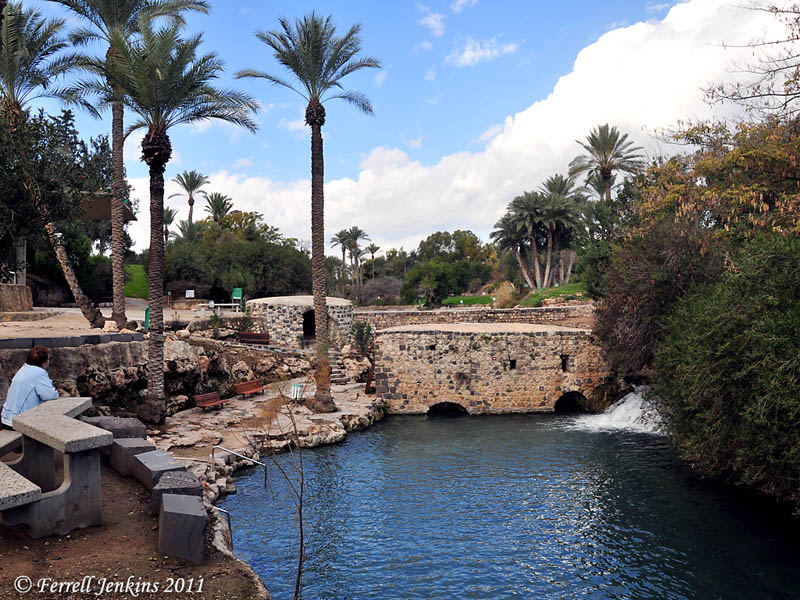
You may recall that the Spring of Harod, where Gideon chose the warriors the LORD wanted (Judges 7) is located at the base of Mount Gilboa in the Jezreel Valley. From that point east down to the Jordan River, there are numerous sources of water. One interesting place is known as Gan Hashlosha (Park of the Three), or by its Arabic name Sakhne (hot springs). There are other sources of water in the vicinity.

I suggest that it may have been in this general area that John the Baptist did some of his baptizing.

John also was baptizing at Aenon near Salim, because water was plentiful there, and people were coming and being baptized (John 3:23 ESV)

I know there are other suggestions, but I am writing on the run and not intending to explore all possibilities.

Gan Hashlosha. Photo by Ferrell Jenkins.

Gan Hashlosha. Photo by Ferrell Jenkins

We encountered rain a few miles north of  Jericho. I turned east on the road going to the traditional Baptism Site (in Israel), but came to the same closed military gate that I had seen before. I called a travel friend in Jerusalem who told me that the site was open for a couple of days in January. He said it will be open for two or three days a week to groups with special permission.

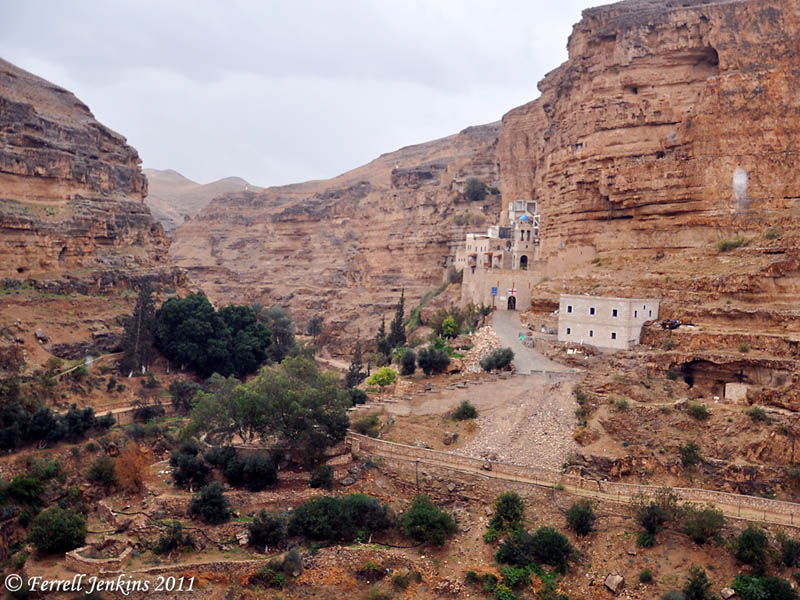
On the way up to Jerusalem we turned aside to view Wadi Qilt (Kelt) and the St. George Monastery. The view below was taken in the rain. The monastery was begun in the fourth century, but the structure you see was built in the late 5th century. For a brief summary and good photos see BiblePlaces.com.

St. George Monastery in the Wadi Qilt. Photo by Ferrell Jenkins.

St. George Monastery in the Wadi Qilt. Photo by Ferrell Jenkins.

We are in Jerusalem.

Sunshine, rain, and wind in Galilee

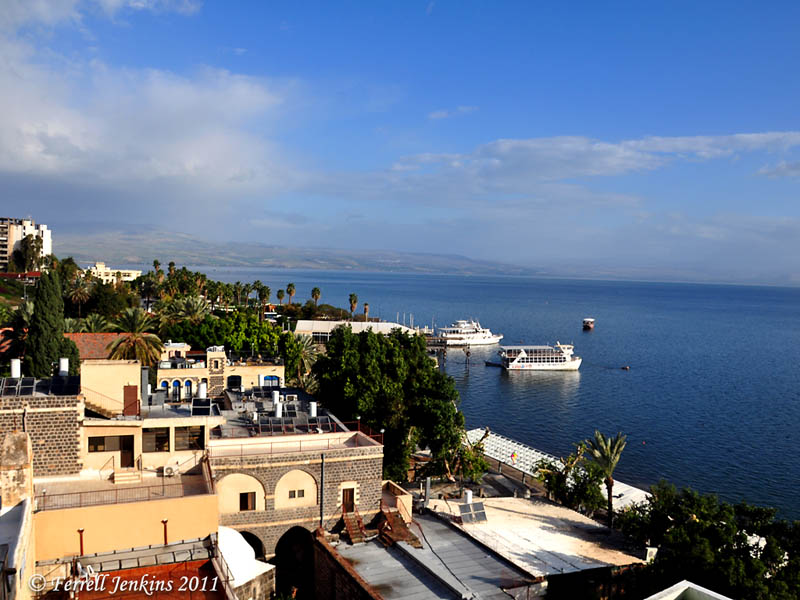
When I first looked from the hotel balcony in Tiberias this morning the sun was shining and the Sea of Galilee was calm.

The Sea of Galilee from my hotel balcony in Tiberias. Photo by Ferrell Jenkins.

The Sea of Galilee from my hotel balcony in Tiberias. Photo by Ferrell Jenkins.

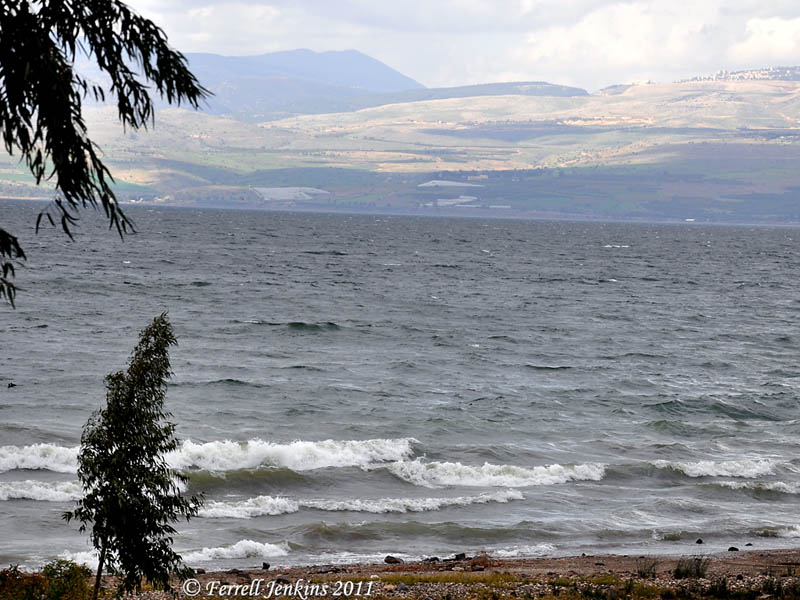
Later in the day, by early afternoon we were on the eastern side of the lake. The weather was cool and the wind from the west was rather strong. We stopped a few places along the shore to make photos. In the photo below you can see the small waves on the sea. In the distance, to the northwest, you will note that the sun is shining on the hills. While this may not qualify as a violent storm it demonstrates the sudden change that can take place when the wind comes down on the sea.

One day Jesus got into a boat with his disciples and said to them, “Let’s go across to the other side of the lake.” So they set out, and as they sailed he fell asleep. Now a violent windstorm came down on the lake, and the boat started filling up with water, and they were in danger. They came and woke him, saying, “Master, Master, we are about to die!” So he got up and rebuked the wind and the raging waves; they died down, and it was calm.
(Luke 8:22-24 NET)

A stormy Sea of Galilee looking West. Photo by Ferrell Jenkins.

A stormy Sea of Galilee looking West. Photo by Ferrell Jenkins.

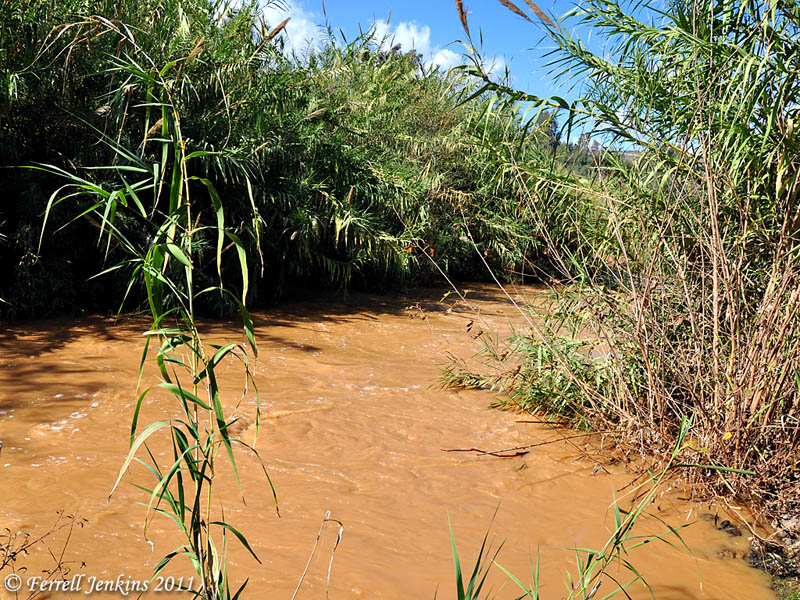
A little earlier we visited the suggested site of New Testament Bethsaida and Old Testament Geshur. While in the vicinity we went to the Jordan River in the Jordan River Park. This park is probably less than 2 miles north of the Sea of Galilee. The water was muddy and running swift because of the rains over the past few days in the north.

Jordan River at Jordan River Park, N of Sea of Galilee

Jordan River at Jordan River Park, N of Sea of Galilee. Photo by Ferrell Jenkins.

We circled the Sea of Galilee, went to En Gev, drove up into the Golan Heights past Susita (Greek Hippos), visited the Peace Vista for a view of the entire lake, and then down along the Yarmuk Valley, and back to Tiberias. Later in the day we went to Mount Arbel.

A profitable day, I think.

A rainy Sunday in Galilee

Sunday was a rainy day with periods of sunshine in Galilee. Sunday morning we went to Nazareth to meet with the Church of Christ there. Even though Nazareth is only a short distance from Tiberias, it was considerably cooler there. During the service we could hear rain falling on the roof.

On the outskirts of Nazareth I stopped to make a photo of the city. The dome of the Church of the Annunciation is visible in the left of the photo. The older part of the city, from the time of Jesus, is located there. The ridge slightly visible in the far distance is the eastern end of Mount Carmel.

View of Nazareth. Photo by Ferrell Jenkins.

View of Nazareth. Photo by Ferrell Jenkins.

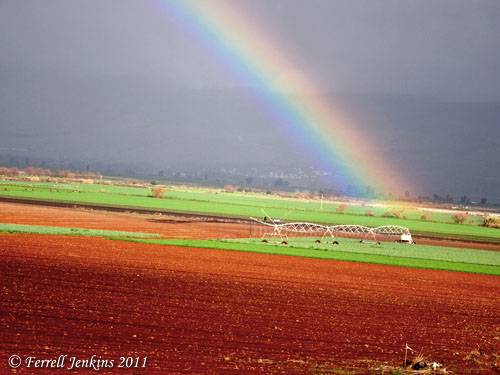
In the afternoon we drove north toward the border with Lebanon in hopes that the sky might clear there to give us a good view of Mount Hermon. We were not successful, but we did enjoy the drive as far as Dan and Caesarea Philippi. During the day we saw many beautiful rainbows. At one point over the fertile Hula Valley there was a complete rainbow visible at times. Here is a photo I made looking east toward the Golan Heights.

Rainbow over Hula Valley. View to Golan Heights. Photo by Ferrell Jenkins.

Rainbow over Hula Valley. View to Golan Heights. Photo by Ferrell Jenkins.

On the return to Tiberias we turned east to drive past Chorazin and get a view of the northeast corner of the Sea of Galilee. Those who have seen this view before will be impressed with how low the water level is.

Northeast corner of the Sea of Galilee. Photo by Ferrell Jenkins.

Northeast corner of the Sea of Galilee. Photo by Ferrell Jenkins.

We enjoyed the day, and thankful to visit the areas where Jesus did so much of His work, even when it rained.

Jesus went throughout all of Galilee, teaching in their synagogues, preaching the gospel of the kingdom, and healing all kinds of disease and sickness among the people. (Matthew 4:23 NET)

Life in the wilderness of Zin

Yesterday we drove north from Eilat to Beersheba (Be’er Sheva). Beersheba, the ancient home of the patriarch Abraham, is the heart of the Negev (the Southland in some English versions).

In the wilderness of Zin, where the ancient Israelites wandered (Numbers 33:36), we saw two female shepherds bringing their large flock of sheep and goats across the main highway 40. This photo shows them after they had crossed the highway on their way to their community of Bedouin. We saw the tents in the distance a little further south.

If you can not see the photo click here.

Sheep in the Wilderness of Zin. Photo by Ferrell Jenkins.

Sheep in the Wilderness of Zin. Photo by Ferrell Jenkins.

The wilderness of Zin included Kadesh Barnea and was the southern boundary for the tribe of Judah.

The land allotted to the tribe of Judah by its clans reached to the border of Edom, to the Wilderness of Zin in the Negev far to the south. (Joshus 15:1 NET)

We enjoyed a Big Mac at the McDonald’s at Avdat, an important town along the Nabatean spice route between Petra and Gaza.

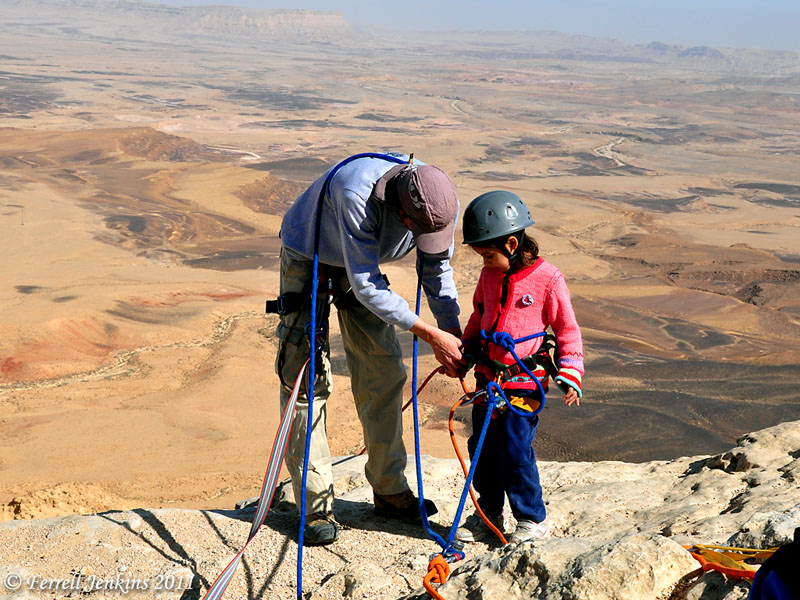
We continued along the way north to Makhtesh Ramon Crater. This crater, about fifty miles south of Beersheba, is said to be the largest crater in the world. We went to the observation point to take a look at the crater. Several people were preparing to rappel the cliff. The most interesting one was a little girl who was not quite six years old. After watching her be instructed in how to handle the rope, we saw her begin down the cliff. We went down to a lower point to see her. By the time we got there she was almost at the bottom and was being helped by (possibly) her mother who had come down before her.

(I am having a little problem uploading photos. If the photo below does not show, click here link to see it.)

Young girl gets ready to rappel at Makhtesh Ramon Crater. Photo by Ferrell Jenkins.

Young girl gets ready to rappel at Makhktesh Ramon Crater. Photo by Ferrell Jenkins.

Egyptian miners had a temple at Timna

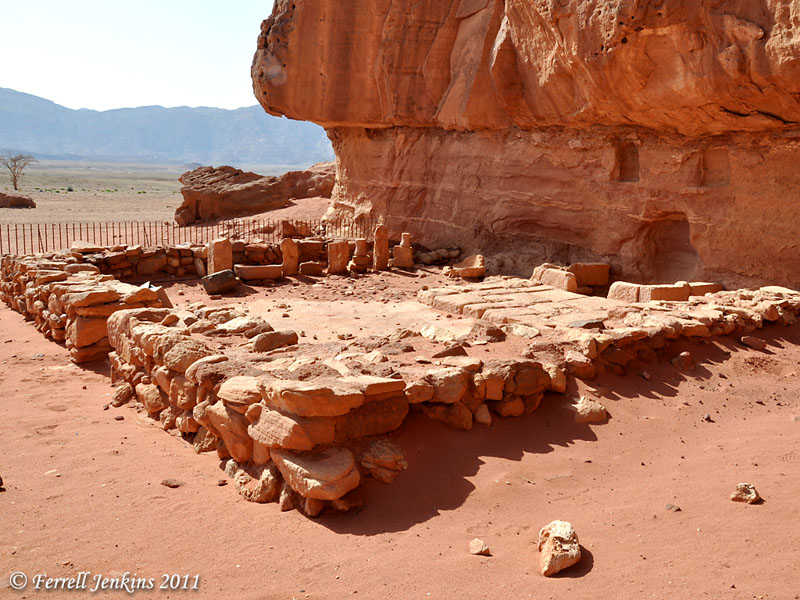
Timna is located about 20 miles north of Eilat in Israel. The Rothenberg Expedition discovered a cultic temple used by Egyptian miners at a time when the Egyptians were actively mining copper in the region.

One of the main deities worshiped at the site was Hathor. Having recently seen numerous images of Hathor in Egypt, I thought this was an appropriate follow up.

Cultic temple at Timna devoted to Hathor, et al. Photo by Ferrell Jenkins.

Cultic Temple at Timna devoted to Hathor, et al. Photo by Ferrell Jenkins.

Those who have visited Petra will notice a similarity in the color of the rocks and soil.

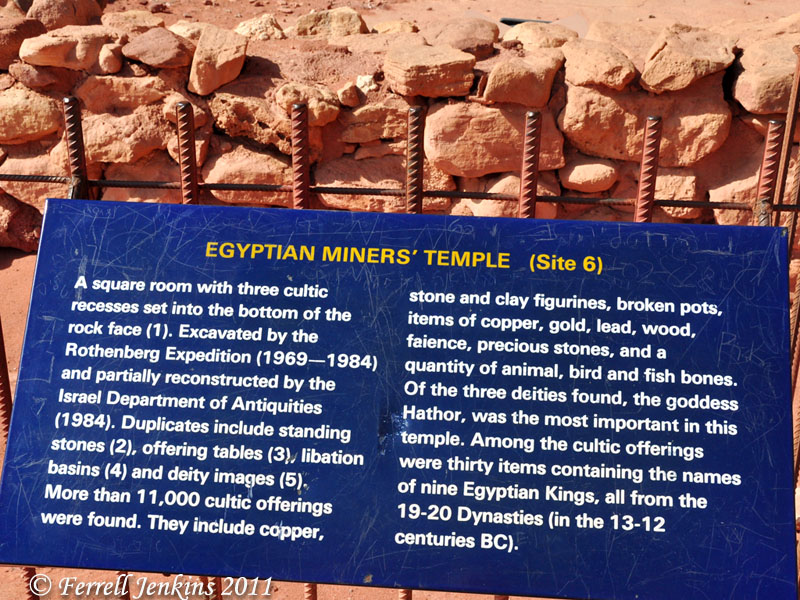
The sign at the site gives a brief summary of the excavation and the items discovered.

Timna Hathor Temple Sign

Sign at Cultic Temple in Timna. Photo by Ferrell Jenkins.

The LORD promised the Israelites that they would dwell in a land that included copper and iron. It is impossible to say whether this is one of those places.

… a land whose stones are iron, and out of whose hills you can dig copper. (Deuteronomy 8:9 ESV)

Traveling across the Sinai Peninsula

Over the past two days my wife and I have traveled through the Sinai Peninsula. We left Cairo Tuesday morning and traveled somewhat along the traditional route of the Israelites in the wilderness to Jebel Musa (Mount Sinai/Horeb).

Tuesday night we stayed at the Morganland Hotel near Saint Catherine’s Monastery. This photo was made Wednesday morning from the hotel grounds.

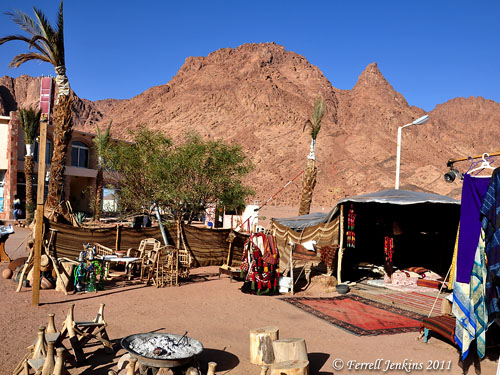
View of the granite mountains of Sinai. Photo by Ferrell Jenkins.

I am reminded of the stanza in Deborah’s song:

The mountains trembled before the LORD, the God of Sinai; before the LORD God of Israel. (Judges 5:5 NET)

After visiting Saint Catherine’s Monastery, we continued east to the Gulf of Aqaba/Eilat to Tabah, Egypt. Then, moving north, we crossed into Israel at Eilat. We were traveling in a van. The trip from Sinai to Tabah took more than 2 and 1/2 hours, but by the time we cleared all of the customs things in Egypt and Israel it took a total of 4 hours.

We enjoyed the two weeks in Egypt, but delighted to be in Israel again.

Sunset on the Suez Canal and Lake Timsah

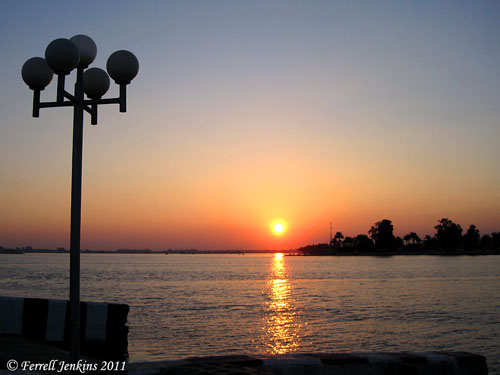
Our photo today was made from the Asia side of the Suez Canal. The view is west toward Africa. At this point the Suez Canal cuts through Lake Timsah.

Sunset over Lake Timsah and the Suez Canal. Photo by Ferrell Jenkins.

Sunset over Lake Timsah and the Suez Canal. Photo by Ferrell Jenkins.

Some scholars have suggested that the crossing by the Israelites as they left Egypt may have been in the area around Lake Timsah (through, south or north of it). Other suggestions include a site in the vicinity of Lake Ballah or the Great Bitter Lake for the crossing.

Read the biblical account in Exodus 13.