Category Archives: Bible Places

Pharaoh’s chariot wheels and other things that won’t float — Examining the claims of the late Ron Wyatt

The late Ron Wyatt is noted for his fabulous claims to have located just about every secret thing there is, including Noah’s Ark, the location of Sodom and Gomorrah and the other cities of the plain, Mount Sinai, the location of the crossing of the Red Sea, wheels from Pharaoh’s chariots, the ashes of the red heifer, the ark of the covenant, etc., etc., etc.

Standish and Standish, two Seventh Day Adventist researchers, wrote a response to Wyatt, who was also a Seventh Day Adventist. In Holy Relics or Revelation, they give a list of 92 things Wyatt claimed to have found. This book is available at Amazon, and is partially available online at Google Books.

Ron Wyatt (1933-1999) was a nurse-anesthetist with no training in archaeology. We might more correctly call him an explorer. Few famous, recognized archaeologists have more than one or two fabulous finds to their credit, but Wyatt found almost everything that was missing!

Typically I receive several Emails each year asking about some of the claims of Wyatt, though they do not always mention his name. Recently I received a PowerPoint presentation attached to the Email. The presentation is entitled “Moses & the Red Sea Crossing Truth or Fiction?” Of course, I believe Moses led the developing nation of Israel through the sea. No one takes credit for producing the presentation. There is no documentation other than Scripture references. Looking at the “Properties” of the presentation that someone borrowed a template from some other presentation.

The Claim

The presentation includes a map showing Succoth immediately north of the Gulf of Suez. That is the wrong position. Israel then traveled across the Sinai peninsula through a wadi running east toward Eilat/Aqaba, then southerly to Nuweiba on the Gulf of Aqaba (Eilat). This, according to Wyatt, is exactly where the Israelites crossed the Red Sea out of Egypt (he considered the Sinai peninsula as Egypt) into the wilderness on the east of the Gulf of Aqaba. This is necessary to place Mount Sinai in Saudi Arabia. Wyatt did some scuba diving and found Pharaoh’s chariot wheels, chariot bodies, human and horse bones.

The photo below is one I took in the vicinity of Nuweiba January 26, 2011. The view is east from the Sinai Peninsula to Saudi Arabia. This point is about 160 miles on a straight line from where the presentation map shows Israel leaving Succoth. It is about 45 miles south of Eilat/Aqaba. Eilat is in Israel; Aqaba is in Jordan. Even the modern roads in the Sinai are not built on a straight line.

So he made his chariot ready and took his people with him; and he took six hundred select chariots, and all the other chariots of Egypt with officers over all of them. The LORD hardened the heart of Pharaoh, king of Egypt, and he chased after the sons of Israel as the sons of Israel were going out boldly. Then the Egyptians chased after them with all the horses and chariots of Pharaoh, his horsemen and his army, and they overtook them camping by the sea, beside Pi-hahiroth, in front of Baal-zephon. (Exo 14:6-9 NAU)

Think about it. A large, powerful, professional Egyptian army had to chase “about six hundred thousand men on foot, aside from children” (Exodus 12:37-38). The Israelites also had their “flocks and herds” and “a very large number of livestock” with them. Yet, the Egyptians could not catch them for more than 160 miles!
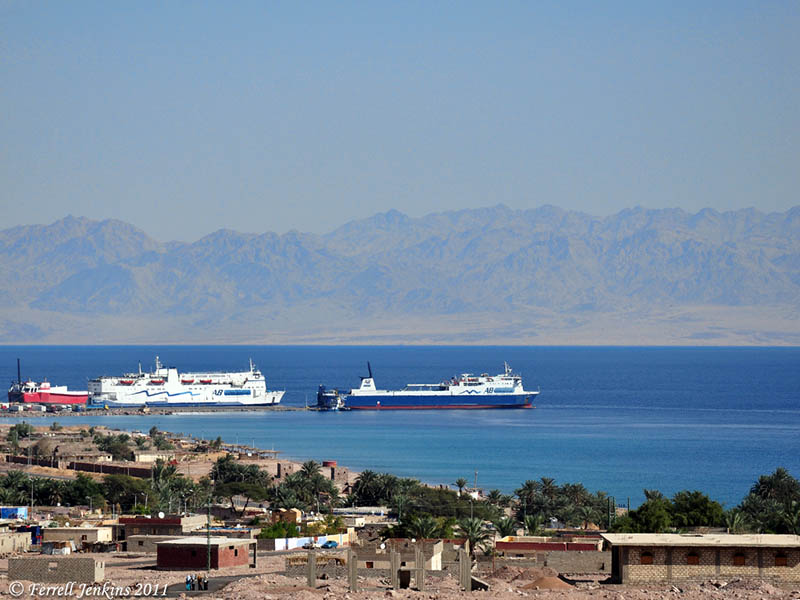
Peninsula east to Saudi Arabia. Photo by Ferrell Jenkins.

View from Sinai Peninsula east to Saudi Arabia. Photo by Ferrell Jenkins.

I don’t have the time now to do more, but I have located some articles that raise serious questions about Wyatt’s claims. Wyatt was never taken seriously by archaeologists (whether conservative or liberal).

Being Certain About What is Uncertain

Carl Rasmussen comments on the scholarly divide concerning landmarks like the Red Sea and Mount Sinai:

Indeed there are at least ten different proposals for the location of the Red Sea or Reed Sea — including three lakes near the Mediterranean Sea, five lakes along the line of the present-day Suez Canal, as well as the Gulf of Suez and the Gulf of Elath. In addition, there are at least twelve different candidates for Mount Sinai: five in the southern part of the peninsula, four in the north, one in the center, one in Midian (Saudi Arabia), and another in Edom (southern Transjordan). (Zondervan Atlas of the Bible, Rev. Ed., 103).

Responses to Wyatt

Wyatt was a Seventh Day Adventist, but when he was actively making his claims several Seventh Day Adventists scholars took up pen to respond to him. We have already mentioned the book by Standish and Standish.
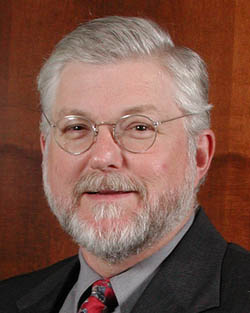
Dr. David Merling

Dr. David Merling

Dr. David Merling is currently Research Associate in Near Eastern Archaeology at Andrews University, Institute of Archaeology, Berrien Springs, MI. For a number of years he served as Curator of the Horn Archaeological Museum. During the 1990s Merling wrote a number of short articles responding to the claims of Ron Wyatt. These have been archived on the Andrews University web site. Merling discusses the following questions:

  • Who am I and why have I opened this Web site? He explains something about his credentials and states that he has been asked these questions “over and over again.” His comments were last updated in 2006.
  • Has Noah’s ark been found?
  • Ark of the Covenant, has it been found?
  • Did the Israelites cross the Red Sea or the Gulf of Aqaba? This is the specific question that we are now discussing.

You may find Dr. Merling’s material here.

The page dealing with the question of the Red Sea crossing includes maps showing the difference between what the Bible says and what Wyatt claimed. There is also a photo of the column that Wyatt claims is from the time of Solomon. Merling shows that it is from the time of Jesus [Roman], and unlike columns from the time of Solomon.

In another post we will mention more material responding to Wyatt and other pseudo-archaeologists.
Camels in biblical times

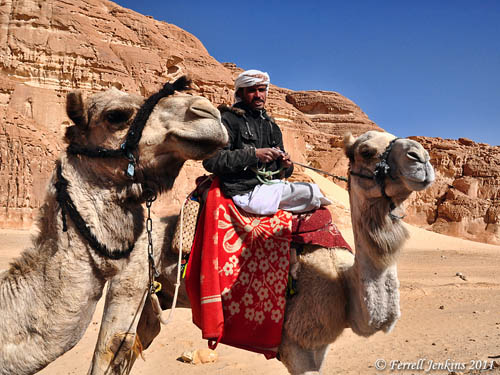
Camels are mentioned in the Bible from the days of Abraham (Genesis 12:16) to New Testament times (Mark 1:6). Recently while traveling in the eastern Sinai peninsula near the Gulf of Aqaba (Eilat) we saw a large number of camels with their riders.

Camels in the Eastern Sinai Peninsula. Photo by Ferrell Jenkins.

Camels in the Eastern Sinai Peninsula. Photo by Ferrell Jenkins.

When the Queen of Sheba visited Jerusalem to quiz Solomon she brought with her a large retinue, with camels carrying valuable gifts for Solomon.

Now when the queen of Sheba heard of the fame of Solomon, she came to Jerusalem to test Solomon with difficult questions. She had a very large retinue, with camels carrying spices and a large amount of gold and precious stones; and when she came to Solomon, she spoke with him about all that was on her heart. Solomon answered all her questions; nothing was hidden from Solomon which he did not explain to her. (2 Chronicles 9:1-2 NAU)

Mahanaim — where Jacob wrestled with an angel

The name Mahanaim is found 13 times in the Old Testament. The site is where Jacob and Laban met and made a covenant. Mahanaim seems to mean “two camps” (Genesis 32:2). This is where Jacob’s name was changed to Israel after he wrestled with a man (angel, Hosea 12:4). When morning came Israel crossed over Penuel (Genesis 32:31).

Two large tells face each other and the Jabbok River flows in an S-curve between them. The tells are now named Tall adh-Dhahab East and Tall adh-Dhahab West. These tells are located a few miles east of the Plains of the Jordan and Tell Deir Allah (likely the site of biblical Succoth). Some scholars identify Dhahab West as Mahanaim and Dhahab East as Penuel. Other scholars reverse the identifications.

When Transjordan was divided among the tribes, Mahanaim was located in the territory of Gad on the boundary with East Manasseh (Joshua 13:26, 30). It was one of the cities allotted to the Levites (Joshua 21:38; 1 Chronicles 6:80).

After the death of Saul, Abner made Ishbosheth, the son of Saul, king over all Israel from Mahanaim (2 Samuel 2:8, 12, 29).

When David fled from his rebellious son Absalom he fled across the Jordan to Mahanaim (2 Samuel 17:24, 27; cf. 2 Kings 2:8). Absalom met his death in a nearby forest.

A Gileadite by the name of Barzillai took care of King David while he stayed at Mahanaim (2 Samuel 19:32). The city became one of Solomon’s administrative centers (1 Kings 4:14).

Song 6:13 describes gazing upon the Shulammite girl to be like looking on “the dance of the two camps” or “dance of two companies” (CSB, JPS, NAU, NKJ). Other translations use the expression “the dance of Mahanaim” (ASV, NIV, NJPS, TNIV) or “dance of the Mahanaim” (NET).

Recent excavations at Dhahab West, conducted by a German team, have revealed what they believe to be part of a monumental building of Herod the Great. They think this was the Hellenistic and Roman site described by Josephus as Amathus.

Tall adh-Dhahab East (left) and Tall adh-Dhahab West (right). Photo by Ferrell Jenkins.

Tall adh-Dhahab East (left) and Tall adh-Dhahab West (right). These are thought to be the sites of Mahanaim and Penuel. Photo by Ferrell Jenkins.

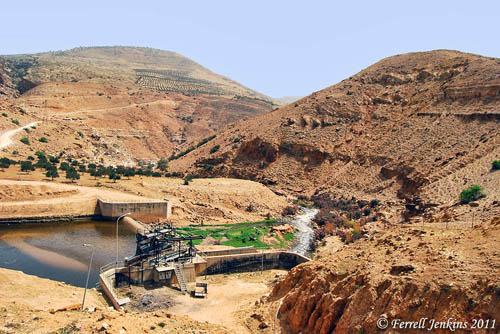
Our photo shows both tells. (Tall adh-Dhahab East is on the left. Tall adh-Dhahab West is on the right.) There is a pumping station on the Jabbok to provide agricultural irrigation. The Jabbok continues in the valley separating the two hills and tells.

Click on the photo for an image suitable for use in teaching presentations.

A rooster can wake you up

Having been brought up in the country, I learned early about the annoyance of the rooster as well as his usefulness. His crowing awakened those who wanted to get up early and those who would have preferred sleeping. Without the rooster there would be no more chicks. Bantam roosters were especially known for their strutting. The writer of Proverbs mentioned this attribute:

Three things are stately in their stride, even four are stately in their walk: a lion, which is mightiest among beasts and doesn’t retreat before anything, a strutting rooster, a goat, and a king at the head of his army. If you have been foolish by exalting yourself or if you’ve been scheming, put your hand over your mouth. For the churning of milk produces butter, and twisting a nose draws blood, and stirring up anger produces strife. (Proverbs 30:29-33 CSB)

The rooster strutted as if he owned the yard. Our backyard was barren. Chicken scratch was scattered across the yard and the chickens scurried to get their share.

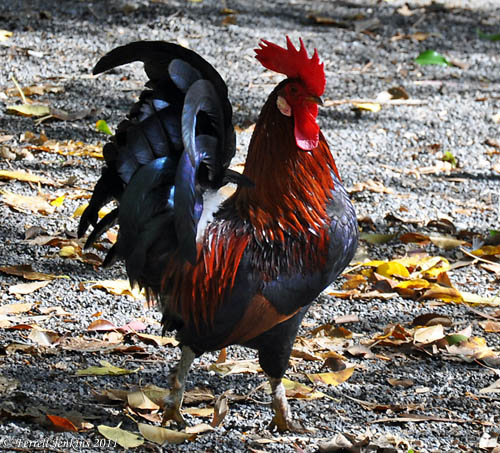
The photo below was made recently at the Jordan River Park north of the Sea of Galilee.

Rooster at Jordan River Park. Photo by Ferrell Jenkins.

Rooster at Jordan River Park. Photo by Ferrell Jenkins.

We especially remember the rooster in connection with Peter’s denial of the Lord. Note first the Lord’s prediction:

“I assure you,” Jesus said to him, “tonight, before the rooster crows, you will deny Me three times!” “Even if I have to die with You,” Peter told Him, “I will never deny You!” And all the disciples said the same thing. (Matthew 26:34-35 CSB)

Matthew records what happened after the denial:

Then he started to curse and to swear with an oath, “I do not know the man!” Immediately a rooster crowed, and Peter remembered the words Jesus had spoken, “Before the rooster crows, you will deny Me three times.” And he went outside and wept bitterly. (Matthew 26:74-75 CSB)

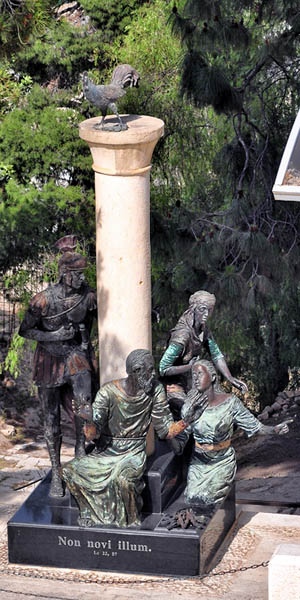
If you have visited St. Peter in Galicantu (St. Peter of the Cock Crowing) in Jerusalem recently, you have seen this sculpture showing Peter saying “I do not know Him.” Note the rooster on the top of the column.

Sculpture at St. Peter in Galicantu. Photo by Ferrell Jenkins.

Sculpture at St. Peter in Galicantu. Photo by Ferrell Jenkins.

Then the Lord turned and looked at Peter. So Peter remembered the word of the Lord, how He had said to him, “Before the rooster crows today, you will deny Me three times.” And he went outside and wept bitterly. (Luke 22:61-62 CSB)

Prof. Anson F. Rainey — 1930-2011

Word comes today of the passing of Prof. Anson F. Rainey. He was Emeritus Professor of Ancient Near Eastern Cultures and Semitic Linguistics, Tel Aviv University. He taught in some of the most prestigious programs both in Israel and the United States.

One might disagree with his conclusions, but you never went away wondering about his position.

A list of his publications and teaching positions may be found at the website of the Department of Archaeology at Tel Aviv University here.

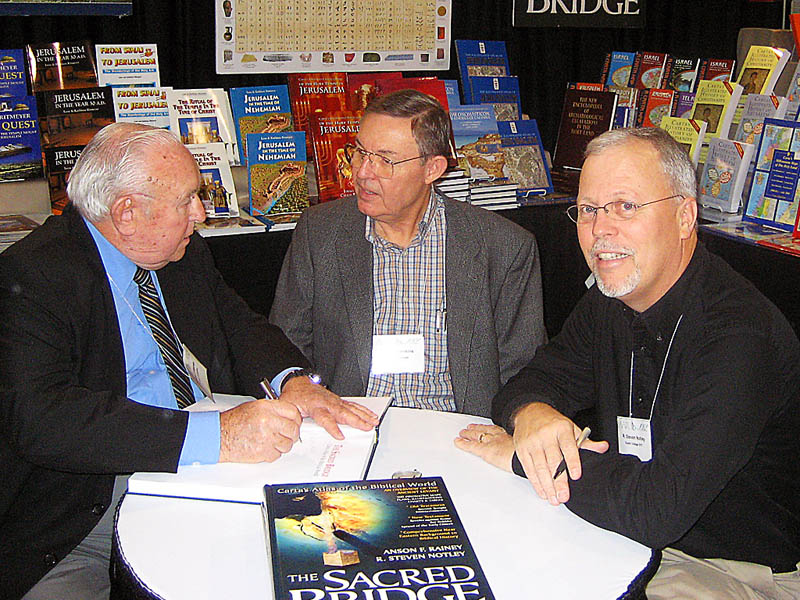
I am delighted to have an autographed copy of The Sacred Bridge. In the general category of Bible Atlases it stands in a field by itself as the most thorough and comprehensive. Todd Bolen said the book is “probably the most important work of historical geography ever written” while admitting that it is over the head of most students, and sometimes his own. See here and here.

Anson Rainey, Ferrell Jenkins, and Stephen Notley at SBL, 2006.

Anson Rainey, Ferrell Jenkins, and Stephen Notley at SBL, 2006.

HT: Joseph I. Lauer

The donkey: beast of burden

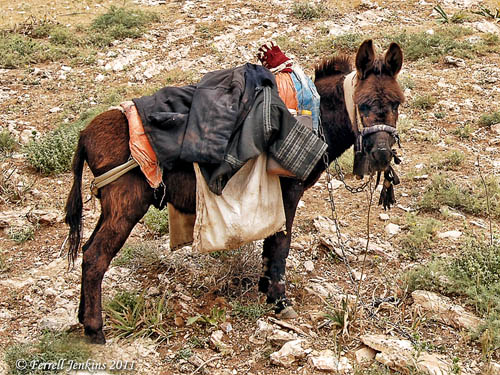
Donkeys are mentioned throughout the Bible beginning in Genesis 16:12. This photo shows the donkey belonging to a shepherd in the area of Gilead in Transjordan.

A donkey in Gilead (Transjordan). Photo by Ferrell Jenkins.

A donkey in Gilead (Transjordan). Photo by Ferrell Jenkins.

Abraham took a donkey when he went to the land of Moriah to offer Isaac.

So Abraham rose early in the morning and saddled his donkey, and took two of his young men with him and Isaac his son; and he split wood for the burnt offering, and arose and went to the place of which God had told him. (Genesis 22:3 NAU)

Jesse loaded a donkey with food supplies to send to Saul when the Israelites fought against the Philistines in the Valley of Elah.

Jesse took a donkey loaded with bread and a jug of wine and a young goat, and sent them to Saul by David his son. (1 Samuel 16:20 NAU)

Qumran after 62 years

February 15 was an anniversary of the discovery of Qumran on the shores of the Dead Sea. Note the article in The Jewish Chronicle Online.

In 1949 the site was identified by European and US archeologists, and on February 15 1949 a team lead by Roland de Vaux and Gerald Lankester Harding began excavating the area. The excavations continued until 1956.

The article does not say that east Jerusalem and Qumran was part of the Hashemite Kingdom of Jordan at the time, or that G. Lankester Harding was the Director of Antiquities. He is author of The Antiquities Of Jordan.

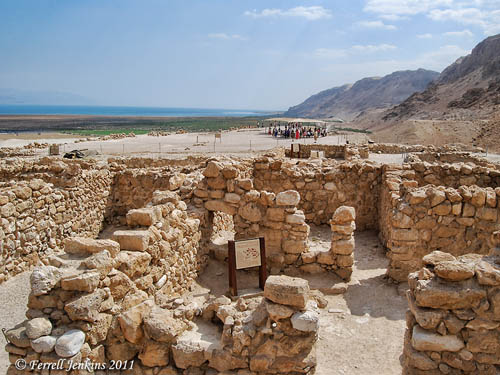
Qumran study room. NE view to Dead Sea. Photo by Ferrell Jenkins.

Qumran study room. NE view to Dead Sea. Photo by Ferrell Jenkins.

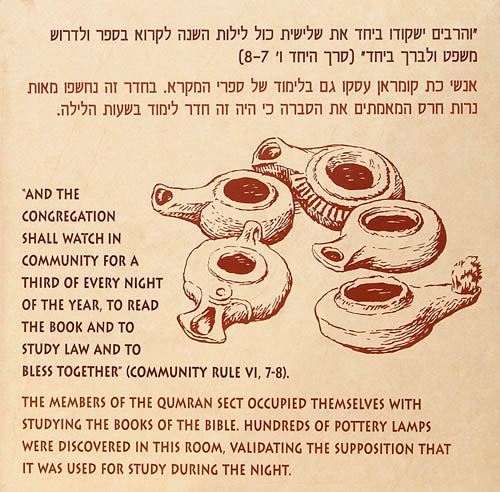
The sign in the proposed Study Room is shown below.

Sign in Qumran Study Room. Photo by Ferrell Jenkins.

Sign in Qumran Study Room. Photo by Ferrell Jenkins.

Haaretz, an Israeli daily newspaper, runs an article from 1955 about the scrolls here. It states that all seven scrolls were at that time “all seven Dead Sea Scrolls are now  in Israel’s hands.”

Haaretz added that “we have learned from reliable sources that $1 million was requested for the scrolls, but they were purchased for slightly more than $250,000,” a “bargain,” according to archaeologist Prof. William Albright, who played an important part in their acquisition.

Albright estimated the scrolls’ value at half a million dollars, and guessed that their relatively low price reflected, among other things, “propaganda by Prof. [Samuel] Zeitlin, who denied the antiquity of the scrolls, a point of view which is no longer accepted.”

We have written about Qumran and the Dead Sea Scrolls many times. Just use the search box to locate the articles, or begin here.

HT: Paleojudaica

Walking on Roman roads

Gordan Franz, Life and Land Seminars, recently led the 2011 Talbot Bible Lands study tour of Turkey and Greece. He writes about the Roman roads used by Paul in his journeys. See here.

Photos are included of the following roads, portions of which still exist.

  • The Via Taurus, “a beautifully preserved road between Tarsus and the Cilician Gates” (Acts 15:36).
  • The Via Sebaste (“Emperor’s Road”) connecting Iconium and Pisidian Antioch (Acts 13:51; 14:21-23).
  • The Roman Road west of Assos (Acts 20:22-23).
  • The Roman Road inside the city of Alexandria Troas leading to the harbor (Acts 16:8-11).
  • The Via Egnatia which connected Neapolis and Philippi (Acts 16:11-12; 20:6).
  • The Appian Way (Acts 28:14-16).

The link to photos made by one of the tour members is given at the bottom of the article. At this moment you will need to copy the link and paste it into your browser. There is an extra http// in the embedded code.

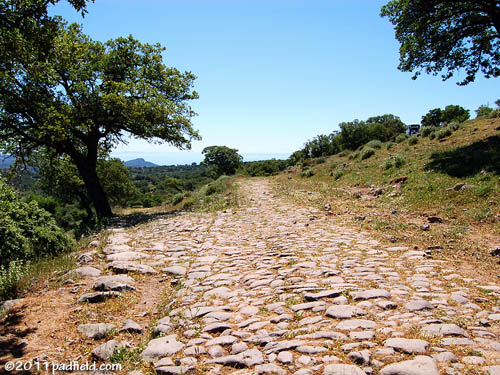
The photo below is one provided by friend David Padfield of the Roman road near Assos.

Roman Road near Assos. Photo by David Padfield.

Roman Road near Assos. Photo by David Padfield.

I have been on journeys many times, in dangers from rivers, in dangers from robbers, in dangers from my own countrymen, in dangers from Gentiles, in dangers in the city, in dangers in the wilderness, in dangers at sea, in dangers from false brothers… (2 Corinthians 11:26 NET)

Was this Jericho tower the world’s first skyscraper?

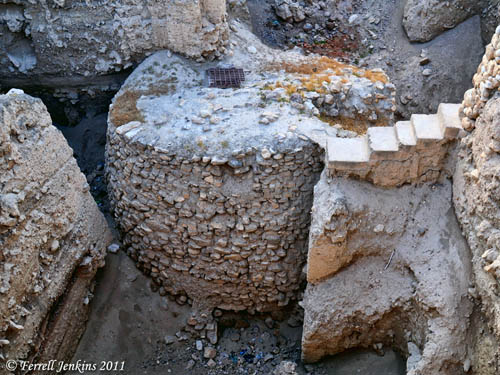
Many who have visited Tell es-Sultan, the site of Old Testament Jericho, have been amazed at the tower built on the inside of the city wall. The tower was uncovered during the excavation by Kathleen Kenyon in 1952-1958. Kenyon dated the tower to the Neolithic period, about 7000 B.C. The current material makes the tower 11,000 years old, but the entry by Kenyon in the International Standard Bible Encyclopedia, Revised, gives the date of 7000 B.C.)

Holland describes the tower:

On the West side of the town in Trench I, the first town wall was associated with a large stone-built tower situated against its inner side, 8.5 meters in diameter [almost 28 feet] at the base with a surviving height of 7.75 meters [about 25½ feet]. The construction of the tower was solid except in the center, which had a staircase providing access to the top from the interior of the town. — The Anchor Bible Dictionary 3:727

A photo suitable for use in teaching is available by clicking on the image. This tower is definitely in need of cleaning and restoration.

The Tower excavated by K. Kenyon at Jericho. Photo by Ferrell Jenkins.

The Tower excavated by K. Kenyon at Jericho. Photo by Ferrell Jenkins.

Kenyon thought the tower served some defensive purpose. A new computer analysis study by two Israeli archaeologist, Ran Barkai and Ron Liran, has led to the conclusion that when the tower “was built the nearby mountains cast a shadow on it as the sun sets on the longest day of the year.” They say, “The shadow fell exactly on the structure and then spread out to cover the entire village.”

A brief article in the The Jerusalem Post says,

The world’s first skyscraper was built by early farmers, who were frightened into erecting a solar marker by mankind’s early bosses, archaeologists say.

Long before its Biblical walls came tumbling down, Jericho’s residents were being enticed to give up hunting and gathering and start farming for a living. They settled in this oasis next to the Jordan River and built a mysterious 8.5-meter (28-foot) stone tower on the edge of town.

When discovered by archaeologists in 1952, it was dated at over 11,000 years old, making it the first and oldest public building even found. But its purpose and the motivation for erecting it has been debated ever since.

Now, using computer technology, Israeli archaeologists are saying it was built to mark the summer solstice and as a symbol that would entice people to abandon their nomadic ways and settle down.

“The tower was constructed by a major building effort. People were working for a very long time and very hard. It was not like the other domestic buildings in Jericho,” said Ran Barkai of the Department of Archaeology at Tel Aviv University, who was part of a team that did the computer analysis.

The stone tower is about nine meters in diameter at its base and conical in shape. Built out of concentric rows of the stones, it also contains an enclosed stairway. Archeologists say it wasn’t used as a tomb.

Barkai and fellow archaeologist Roy Liran used computers to reconstruct sunsets and found that when the tower was built the nearby mountains cast a shadow on it as the sun set on the longest day of the year. The shadow fell exactly on the structure and then spread out to cover the entire village.

The complete article may be read here. The brief article is based on a scholarly article by the two archaeologists in Time and Mind: the Journal of Archaeology, Consciousness and Culture, available in PDF here. There is a short article by Liran and Barkai in the March, 2011, issue of Antiquity, here. There is also an article in The Media Line here.

It may be that the tower served an astronomical purpose, but the suggestion that it was built to entice the local inhabitants to become farmers is nothing more than an interesting speculation.

Note also that this tower has nothing to do with the biblical account of the destruction of the city of Jericho as recorded in Joshua 6. That did not occur until about 1400 B.C. (or later, according to the “late date” theory of the Exodus).

HT: Joseph Lauer

Understanding modern and ancient Egypt

The ancient Egyptians were descendants of Ham through his son Mizraim (Genesis 10:6). Mizraim is “the correct Hebrew word for Egypt, comprising the lower and upper divisions of that land” (The Wycliffe Bible Commentary 14). Most of the inhabitants of Egypt today are Arabs (Semitic, descendants of Shem and Abraham through Ishmael).

Modern Egyptians are caretakers of a history left by an ancient people. I note in recent days that President Mubarak and antiquities director Zawi Hawass try to tie themselves with the ancient Egyptians. They have no genetic connection with the ancient people. That ancient empire crumbled centuries ago.

By the Persian, Hellenistic, and Ptolemaic periods of history, we no longer observe an Egypt ruled by Egyptians but one ruled by foreigners. Descendants of Ham no longer controlled the land, but it was dominated by foreigners who were descendants of Japheth. In the 7th century A.D. the country came under the control of Arab rulers who were descendants of Shem. This same rule by foreigners now continues in the present Egyptian government headed in recent time by presidents Nasser, Sadat, and Mubarak. The modern Egyptians are simply caretakers of the ruins of ancient Egypt.

The prophecy of Ezekiel has been fulfilled.

Thus says the Lord GOD, “I will also destroy the idols And make the images cease from Memphis. And there will no longer be a prince in the land of Egypt; And I will put fear in the land of Egypt. (Ezekiel 30:13).

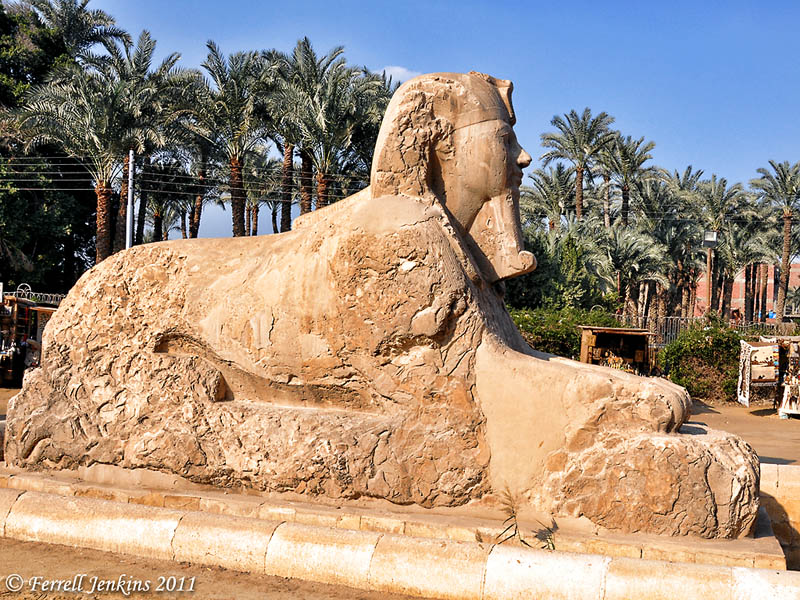
The alabaster sphinx of Memphis, one of the few ruins at the site of the ancient city, has been variously identified. Some suggest that it represents Amenophis II (about 1427-1400 B.C.). The current sign at the site dates the sculpture to 1200 B.C. without the name of any ruler.

The Sphnix of Memphis, Egypt. Photo by Ferrell Jenkins.

The Sphnix of Memphis, Egypt. Photo by Ferrell Jenkins.

The rule of Egypt by foreigners now continues in the present Egyptian government headed in recent time by presidents Nasser, Sadat, and Mubarak. The modern Egyptians are simply caretakers of the ruins of ancient Egypt.