Category Archives: Bible Places

Somthing new, something old in Israel

No, we did not attend a wedding today. Leon and I are trying to see some places we have missed before. I have traveled here more than Leon, so I don’t like passing up a place he hasn’t visited.

As we left Jerusalem this morning we missed a turn and ended up in one of the new Israeli suburbs called Pisgat Ze’ev Ma’arav (West). This suburb is on the east side of Tell el-Ful (Hill of Beans in Arabic), identified as biblical Gibeah. In an effort to find our way back to the main street to get on the highway to go to the Jordan Valley I saw a side of Tell el-Ful that I had not seen before. I had always seen the tell from the West, but now I was was looking at the East side.

How does one recognize Tell el-Ful? Beans no longer grow on the mound. Prior to the 1967 war, when the Old City of Jerusalem and the area under consideration was in Jordan, the late King Hussein of Jordan was beginning to build a palace on the top of the tell. The uncompleted structure still stands there as a silent monument to a failed plan.

The view from the east is impressive. The tell can be seen framed between the new buildings of Pisgat Ze’ev Ma’arav (West). I was beginning to fume a bit about missing the road I intended to take until I saw Tel el-Ful (Gibeah).
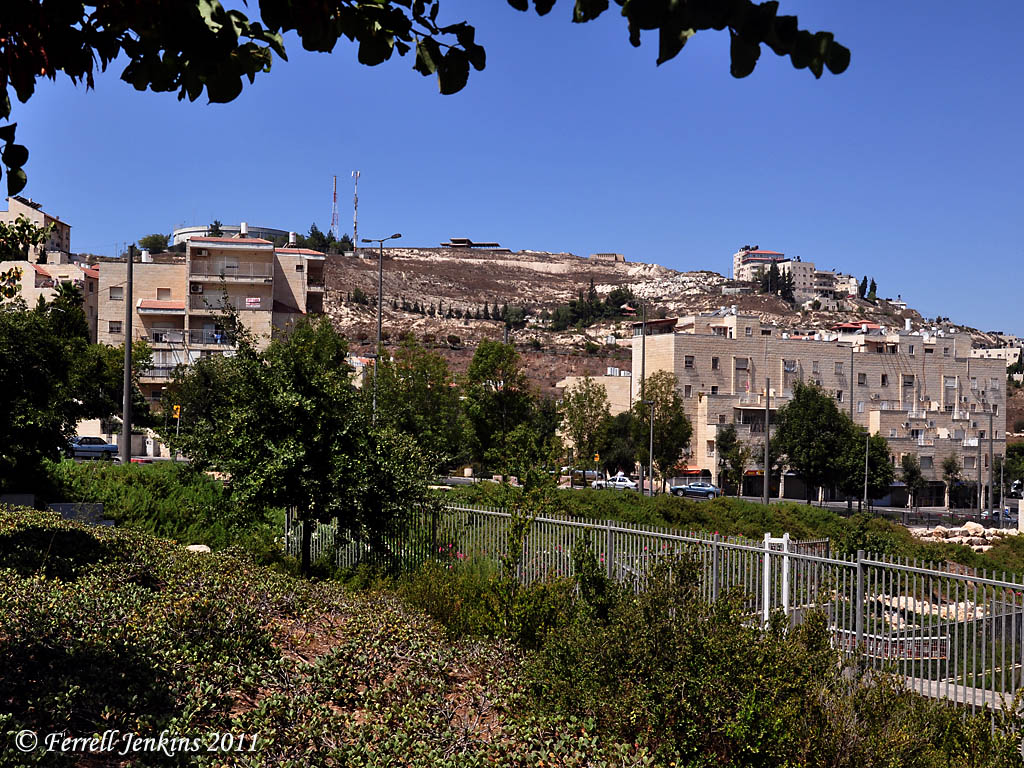
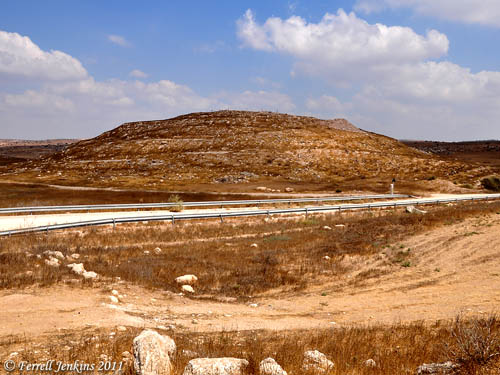
Gibeah of Saul (Tel el-Ful) from the east. Photo by Ferrell Jenkins.

Gibeah of Saul (Tel el-Ful) from the east. Photo by Ferrell Jenkins.

Several biblical references mention Gibeah as the home of Saul. In fact the city is even called Gibeah of Saul in 2 Samuel 21:6, and Gibeah of Benjamin in 1 Samuel 13:2. Saul was the first king of Israel from about 1050 to 1010 B.C.

William F. Albright excavated Tell el-Ful and found evidence of a fortress. Many think this would have been the palace of King Saul. An iron plowshare was also found in the excavation.

There is a nice photo by Eli Berckovitz of the skeleton structure of King Hussein on Wikipedia here.

We visited some new places, too. But it is late, and those will have to wait.

David escaped to the Cave of Adullam

One of the important places on our “bucket list” was the Cave of Adullam. The main reason we had never visited Adullam before is that it requires a long, difficult, walk or a four-wheel-drive vehicle. We made arrangements with Haelah Desert Tours, a company at Aderet, a moshav on the north side of Adullam, for a guide/driver who could take us there. Once we reached the forested mound we enjoyed a wonderful view to the north, east, and south. Our guide, Daphna, inquired first about our interest in the site. How did we even know about the site, she wondered. She is a Sabre, a native-born Israeli, who lives at Aderet.

The view below is to the east where you will see the border between Israel and the West Bank. The central mountain range is visible in the distance.

Daphna, our guide, and Leon look east from Tel Adullam. Photo by Ferrell Jenkins.

Daphna, our guide, and Leon look east from Tel Adullam. Photo by Ferrell Jenkins.

There is a large cave at Adullam. Is it the cave where David stayed while fleeing from Saul? Can’t say, but if it was not this one it had to be another one near by. The next photo was made from inside the cave.

View north from interior of the Cave of Adullam. Photo by Ferrell Jenkins.

View north from interior of the Cave of Adullam. Photo by Ferrell Jenkins.

Adullam is significant in several biblical accounts. Here are a few.

Judah stayed with an Adullamite man named Hirah. He married the daughter of a Canaanite man named Shua.

At that time Judah left his brothers and stayed with an Adullamite man named Hirah. There Judah saw the daughter of a Canaanite man named Shua. Judah acquired her as a wife and had marital relations with her. (Genesis 38:1-2 NET)

The episode of Onan and his failure to fulfill his responsibility to bring up children to his deceased brother (the Levirate marriage; Genesis 38:3-10).

Joshua defeated the king of Adullam during the Conquest (Joshua 12:15), and became one of the Shephelah (lowland) cities of the tribe of Judah (Joshua 15:35).

The cave of Adullam is associated with David. When he left Gath he went to Adullam before sending his parents to Moab for safety.

So David left there and escaped to the cave of Adullam. When his brothers and the rest of his father’s family learned about it, they went down there to him. (1 Samuel 22:1 NET)

In fact, David spent much time at Adullam. I suggest you read the entire account in 2 Samuel 23:13ff.

When the prophet Micah warned Judah about the coming Assyrian invasion he said,

…the leaders of Israel shall flee to Adullam (Micah 1:15 NET)

Just like David did about three centuries earlier.

One more point. Jesus was a descendant of David and Judah, both of whom had an association with Adullam (Revelation 5:5).

What a wonderful experience.

My thanks to Gordon Franz and Carl Rasmussen with whom I have corresponded about Adullam.

Update. In my orignal post I made a mistake in saying that Judah married the daughter of Hirah. I caught this mistake a few days ago and have now corrected it. Judah married the daughter of a Canaanite man named Shua.

Places less visited in Israel

Today we got a fairly early start and went through the Shephelah to Lachish. This takes about an hour or so from Jerusalem. We did not go to visit Lachish, but to continue east to a small kibbutz called Shekef. From here we would try to locate Tel Eiton (also Tel ‘Eton and Tel Aitun). I had been in the area before but did not locate the tel. The reason for going so far out of the way to get to the site is that it is situated on Israel’s border with the Palestinian West Bank. Just before reaching Shekef we began to  drive on the new highway 358 to Beersheba, parallel to the border. Soon we realized that we must be bypassing the place we want to go.

We backtracked and eventually after doing what men “never do”, ask for directions, we located Tel Eiton. Palestine is on the east side of the mound and a military firing range is on the west side. We decided it would be best to stick to the gravel road without straying too far to the left or the right — sort of like Joshua.

“Be very firm, then, to keep and do all that is written in the book of the law of Moses, so that you may not turn aside from it to the right hand or to the left,  so that you will not associate with these nations, these which remain among you, or mention the name of their gods, or make anyone swear by them, or serve them, or bow down to them.  (Joshus 23:6-7 NAU)

Tel Eiton currently is equated with biblical Eglon by many scholars. Recent excavations have been conducted under the direction of Prof. Avi Faust, now of Bar Ilan University.

Here is a photo of the tel from the south and perhaps a little to the east.

Tel Eiton (Tel Aitun), possibly biblical Eglon.

Tel Eiton (Tel Aitun) from the south (and east). Photo by Ferrell Jenkins.

Eglon is mentioned at least eight times in the Bible, all in the book of Joshua (10:3, 5, 23, 34, 36, 37; 12:12). The Scripture emphasizes that Israel defeated the king of Eglon. Notice the relationship between Lachish, where we started our trek, and Eglon.

And Joshua and all Israel with him passed on from Lachish to Eglon, and they camped by it and fought against it.  They captured it on that day and struck it with the edge of the sword; and he utterly destroyed that day every person who was in it, according to all that he had done to Lachish.  Then Joshua and all Israel with him went up from Eglon to Hebron, and they fought against it.  (Joshua 10:34-36 NAU)

We also visited the following places.

Tel Bet Mirsim, a site identified as Debir by William F. Albright (Joshua 10:38, 39). Albright identified Tel Eiton as Libnah, but scholars today question this.

Tel Halif, north and slightly east of Beersheba, is thought by some to be biblical Ziklag, . Others place the biblical city at Tel Shera, northwest of Beersheba.

Finally we visit the Brook Besor and Tel el-Farah South. Israel calls the site Tel Sharuhen (1 Samuel 30). This tel is located in the Plain of Philistia, not far from the borders with Egypt and the Gaza Strip.

Hopefully we will be able to share more photos and information about this places with you at a later time. It is all very fascinating to the student of the Bible. Right now it is too late and I need to be sleeping.

Traveling in Israel

Last evening I arrived in Israel with Leon Mauldin. We made our way from the Ben Gurion Airport at Lod in the Plain of Sharon up to Jerusalem in the mountains of Judah.

There is always a bit of jet lag to deal with. I got a good night of sleep on the flight from Atlanta to Tel Aviv, but didn’t do so well the first night at the hotel. Nonetheless, after a late start and securing a data card for the air card we spent a good bit of time in the Shephelah (lowlands) of Israel (Deuteronomy 1:7).

We have determined for this trip that we will concentrate on places we have not seen before, or where we think we need new photos for use in teaching.

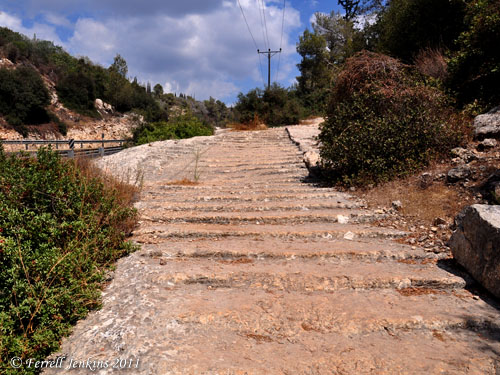
Our first major stop was 4.2 km west of Mata on Highway 375. I am not sure of the date of this unusual stretch of Roman Road, but I think most of the Roman roads date to the late first century or the second century A.D.

These steps would have made the trip up into the mountains of Judea easier for both man and beast.

Roman Road 4.2 km west of Mata on Hwy 375. South side of road. Photo by Ferrell Jenkins.

Roman Road 4.2 km W of Mata on Hwy 375. S of Hwy. Photo by Ferrell Jenkins.

Incidentally, this road is only a short distance from the Valley of Elah.

Later we photographed three significant archaeological mounds (tel or tell, depending on the languages), and saw several others.

  • Tel Goded (Tell ej-Judeideh is thought my many to be Moresheth-Gath, the home of Micah the prophet (Micah 1:1, 14).
  • Tel Burna is thought by the current excavators to be Libnah (2 Kings 19:8).
  • Tel Zayit is thought by the current excavators to be Libnah.

Yes, you read that correctly. More at a later time, perhaps.

Most of our time was spent searching for the correct field road to get close enough to Tel Batash, the site of Timnah, for a photograph. We succeeded! We remember Timnah because Samson got into trouble with a woman of Philistia there (Judges 14).

Be assured that this is fun as well as educational. Who knows what excitement awaits us tomorrow.

Monday meandering — August 29

Looking for a beautiful photo of the Cedars of Lebanon. Try one of these by Mark Connolly, posted by Carl Rasmussen on the HolyLandPhotos’Blog here. I understand that the oldest of the cedars are located at an elevation of about 6,500 feet above sea level at the village of Bchareé  in Mount Lebanon. The cedars are beautiful at any time of the year, but these snow photos are especially beautiful. I have seen them twice, but only with a little bit of snow. Note just two of the significant references to the cedars in the Bible.

  • Hiram of Tyre floated cedar from Lebanon to Joppa for Solomon’s Temple (966 B.C.; 2 Chronicles 2:16).
  • Cedars were floated to Joppa for the rebuilding of the temple (520-516 B.C.; Ezra 3:7).

Gordon Franz sent me an advance notice of an article you may read on his Life and Land blog. He is coining a new phrase be included in his Cracked Pot Archaeology category. It is a sub discipline of pseudo-archaeology called “Apostolic” Archaeology.

The practitioners of this discipline are usually adventurers, sometimes treasure hunters, and generally with neither field training in archaeological methodology nor academic credentials in Near East archaeology, but perhaps a superficial knowledge of the Bible. They claim to have discovered objects or places of great Biblical importance and declare it to be whatever they want it to be. They usually try to justify their pronouncements with a Bible verse. Their declarations are made as if they were speaking ex cathedra (i.e., with authority).

Read more here. We will be on the alert for more of Gordon’s exposés.

Dr. Claude Mariottini writes about what it is like to go back to teaching after the summer break. He comments on the plague of Email here.

In addition, with the advent of computers, we also had the birth of emails, that modern plague that invades one’s life day and night.  With the growth of technology, now one can check emails at the office or at home.  In addition, email follows you on your iPad and on your smart phone.  Emails are everywhere.

Last month my wife and I went on a vacation.  When I returned to the office, I had to process hundreds of emails.  I have an email at school, one at home, and another for the blog.  Just to process all the emails that had accumulated over a two-week period, it took me almost two days.  Maybe, some of us are luddites at heart, yearning for the good old days that never existed.

There is more good stuff there. I suggest you read it.

Which reminds me. I get more questions by Email, comments, and messages on FB, than I am able to answer. I want to answer most of them, but it is difficult to get to them. Hope you understand.

Logos Community Pricing — some great bargains

If you use Logos (or Libronix) Bible Software you probably already know about Community Pricing. Logos takes on some older works and produces them in the Logos format only when there is sufficient interest to pay. Some may take a year; other may never make it to production.

Todd Bolen is hoping that more people will make a bid on the 16-volume collection of William M. Ramsay before the deal closes on Friday. At this time you can get the entire collection for $20. More orders might even push the price down. Info here. Even Ramsay’s less valuable works are worth $1.25.

See earlier posts about Sir William Ramsay here and here.

While you are at the Logos web site take a look at Travels through Bible Lands Collection (15 volumes). It is expected to sell for $20, but is still gathering interest.

Also take a look at the following books or sets:

  • Cambridge Greek Testament for Schools and Colleges (21 vols.)
  • A Dictionary of Christ and the Gospels (2 vols.), Hastings.
  • A Dictionary of the Bible (5 vols.), Hastings.
  • Critical and Exegetical Commentary on the New Testament (21 vols.), including 16 volumes by Meyer.

I have bids on all of these. Every bid moves us closer to being able to use these works with our Libronix/Logos Bible Software. These books are all old and some material is  out of date, but there is much of value.

Don’t have any Logos software? You can buy from Logos, or you can get started with some really great bargains from Rejoice Christian Software. (I have no stock in either company.) You can buy the Essential IVP Reference Collection 3.0 for $89.95. Start here. This offer is good through Aug. 30. Check for other specials. The Baker New Testament Commentary is available for $80. That is the set by Hendriksen and Kistemaker.

Short video on Masada

The Israel Nature and Parks Authority has prepared a short video on Masada. The narrator presents a brief history of the fortress of Masada while beautiful scenes of the site are shown.

Arutz Sheva (Israel National News) provides a link to the video with an article about Masada here. (A direct link to the video on You Tube is here.) Elad Benari, author of the article, describes Masada in these words:

The top level had four bedrooms and a semicircular balcony, from which there was a spectacular view of the Dead Sea, Ein Gedi, and the Moab Mountains. A sophisticated and hidden staircase led to a middle level in which a large hall was built, surrounded by a veranda whose poles were placed at the edge of the cliff. The staircase went down to the bottom level, in which a large hall surrounded by vestibules was established. The walls of the hall were decorated with spectacular frescoes. A private bathhouse was built adjacent to the hall for the occupants of the northern palace.

At the peak were 29 large warehouses, each one 27 meters long. Excavations of the site found hundreds of pottery vessels in which huge amounts of food were stored. Thus, using a rare combination of natural conditions and human endeavors, Masada became a cliff that was almost impossible to conquer.

The great halls of the palaces were unsuitable for housing families, and thus became headquarters and public buildings.

The building near the north wall, which served as a stable in the days of Herod, was later turned into a synagogue. This is one of the Jewish people’s most ancient synagogues, known to be in use during the period of the second Holy Temple in Jerusalem, an unusual occurrence as synagogues became the accepted place to pray only after the destruction of the second Temple.

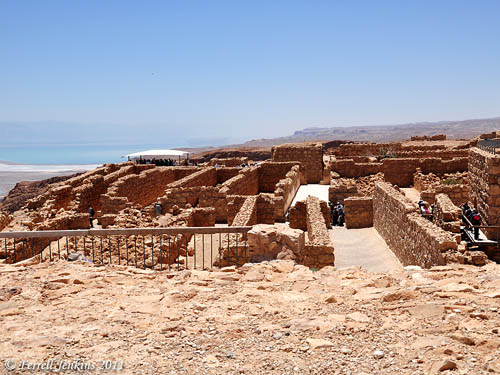
Our photo shows some of the large warehouses at the fortress. The Dead Sea and the mountains of Edom are visible in the left background.

Warehouses at Masada with the Dead Dea visible in the distance. Photo by Ferrell Jenkins.

Warehouses at Masada with the Dead Sea visible in the distance. Photo by Ferrell Jenkins.

It is possible that David visited the site of Masada long before it was turned into a fortress by King Herod. Gordon Franz has examined evidence for this suggestion at his Life and Land blog here.

One of the verses examined is Psalm 18:2 in which the term for fortress is the Hebrew metsudah (our English masada)

To the choirmaster. A Psalm of David, the servant of the LORD, who addressed the words of this song to the LORD on the day when the LORD rescued him from the hand of all his enemies, and from the hand of Saul. He said: I love you, O LORD, my strength.
2 The LORD is my rock and my fortress and my deliverer, my God, my rock, in whom I take refuge, my shield, and the horn of my salvation, my stronghold. (Psa 18:1-2 ESV)

HT: Joseph I. Lauer

“Known but mostly unknown”

The late Paul W. Lapp is well known among students of archaeology for his 1963 article saying that the archaeology of Palestine (West Bank and Israel) is “known but mostly unknown.” Lapp died in a swimming accident in Cyprus in April, 1970) a few months prior to his 40th birthday.

Lapp’s article in Biblical Archaeologist (Vol. 26) begins this way:

Palestine (West Bank Jordan and Israel today) is perhaps the most excavated land in the world. Certainly the archaeological history of no country is better known. Since the beginning of archaeological work in Palestine at Tell el-Ḥesī in 1890 there have been few periods when there were not several expeditions in the field.

He continues by asking,

How Much Do We Know?

With some knowledge of the scope of archaeological activity in Palestine visitors in Jerusalem frequently ask: Are there still new sites to dig? Are there still exciting finds to be made in Palestine? One might go on to ask: Isn’t our knowledge of biblical times fairly complete? Don’t we have a picture of daily life at the time of Jesus which can be modified only in detail by future discoveries? The confidence with which archaeological conclusions are frequently drawn and the long books devoted to daily life in Palestine at the time of Jesus might suggest an affirmative answer.

My viewpoint here is that such a tiny fraction of the archaeological material has been excavated, and such a small fraction of that satisfactorily published, that even the most assured archaeological conclusions must still be considered far from final. This does not mean that all archaeological conclusions must be basically vague and noncommittal. Our knowledge of Palestinian archaeology has been built step by step, from the best hypothesis explaining evidence available at an early stage of exploration to the best hypothesis to explain evidence currently at hand. Without the discipline of continuous updating of hypotheses as new evidence comes to light chaos would prevail. The nonspecialist would find it much more difficult to judge among interpretations than is now the case. All that is stressed here is that in view of the vast amount of unknown material, archaeologists will be forced to modify or reformulate many, if not all, their hypotheses regarding the development of Palestine as the flood of new evidence continues to grow. Palestinian archaeology may be past infancy but has hardly gotten beyond childhood.

I have no current figures about the percentage of known sites that have been excavated. Often in speaking about the archaeology of Israel and the West Bank I say that the surface has hardly been scratched.

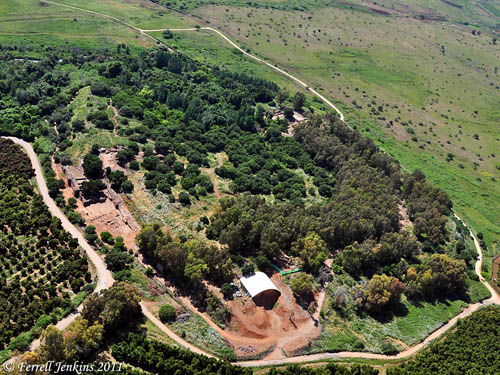
What got me to thinking about Lapp’s article was this aerial photo of Tel Dan that I made in May. Prof. Avraham Biran began the excavations at Tel Dan in 1966 and worked at the site for more than 30 years. Others have continued the work. If you have been to Tel Dan you will recognize the three main areas that have received attention (1) the Middle Bronze city gate, (2) the Iron Age gate complex, and (3) the High Place (bama). Would you agree that there may still be some work to be done at the site?

Aerial view of Tel Dan. Photo by Ferrell Jenkins. 2011.

Aerial view of Tel Dan. Photo by Ferrell Jenkins. 2011.

Is there still much archaeological work to be done? Is it still mostly unknown? Are you kidding? Extend this thought to Jordan, Syria, Lebanon, Turkey, Greece, Turkey, et al.  This is why we must sometimes be satisfied with a limited amount of evidence.

Got to go. Today is Grandson Day prior to school beginning tomorrow.

Video on Jerusalem

Prof. Aren Maeir shares this video on Jerusalem: Filmed in 3D. We probably have a few readers who do not regularly visit his Tel es-Safi/Gath blog. Lots of good stuff there.

Jerusalem | Filmed in Imax 3D from JerusalemGiantScreen on Vimeo.

Mount Hermon from the Damascus Road

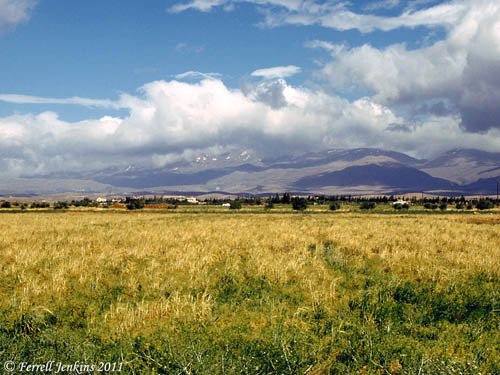
Mount Hermon is the southern end of the Anti-Lebanon mountain range. The mountain is about 20 miles long and has three peaks. At 9,232 feet above sea level it is the highest mountain of Canaan, or Roman Syria, named in the Bible. The mountain now is shared by the countries of Lebanon, Syria, and Israel. The photo below shows mount Hermon from the east, a few miles south of Damascus toward Quneitra. This is roughly the route of the famous Damascus Road taken by Paul as he went from Jerusalem to Damascus. This photo was made the middle of May, 2002. There was more snow on the west side of the mountain in Lebanon than you see here.

View of Mount Hermon from the East. Photo by Ferrell Jenkins 2002.

View of Mount Hermon from the East. Photo by Ferrell Jenkins 2002.

The first biblical reference to Mount Hermon is found in Moses’ account of the Israelite conquest of transjordan (Deuteronomy 3:8). He says that Israel took the land from the hand of two Amorite kings “from the valley of Arnon to Mount Hermon.” The Sidonians, of ancient Phoenicia, called the mountain Sirion, and the Amorites called it Senir (Deuteronomy 3:9). The half-tribe of Manasseh lived in the area of Bashan which is south of Mount Hermon (1 Chronicles 5:23). The Mountain of Bashan is probably a reference to Mount Hermon (Psalm 68:15). Hermon is mentioned in four references in the poetic books of the Old Testament (Psalm 42:6; 89:12; 133:3; Song of Solomon 4:8).

The heavens are yours; the earth also is yours; the world and all that is in it, you have founded them. The north and the south, you have created them; Tabor and Hermon joyously praise your name. (Psalm 89:11-12 ESV)

This post is a slightly revised post from 2009, but the photo is a new one digitized from a slide made in 2002.