Category Archives: Bible Places

The monastery of the Gerasene swine

Stephen G. Rosenberg, senior fellow of the W. F. Albright Institute of Archeological Research in Jerusalem, has an article about the monastery of the Gerasene swine in The Jerusalem Post here. Take a look.

This site, located on a hill above the eastern shore of the Sea of Galilee, marks the traditional site of the miracle of the swine running down the steep cliff into the sea.

When He came to the other side into the country of the Gadarenes, two men who were demon-possessed met Him as they were coming out of the tombs. They were so extremely violent that no one could pass by that way. And they cried out, saying, “What business do we have with each other, Son of God? Have You come here to torment us before the time?” Now there was a herd of many swine feeding at a distance from them. The demons began to entreat Him, saying, “If You are going to cast us out, send us into the herd of swine.” And He said to them, “Go!” And they came out and went into the swine, and the whole herd rushed down the steep bank into the sea and perished in the waters. The herdsmen ran away, and went to the city and reported everything, including what had happened to the demoniacs. And behold, the whole city came out to meet Jesus; and when they saw Him, they implored Him to leave their region. (Matthew 8:28-34 NAS)

The article by Rosenberg points out that this would have been the land of Geshur in Old Testament times. David was married to Maacah, “the daughter of Talmai, king of Geshur” (2 Samuel 3:3). Maacah was the mother of Absalom. The Bible points out that Absalom spent three years in exile after killing Amnon.

Rosenberg says,

Geshur is well-known from the Bible. King David married Maacah, the princess of Geshur, in the early years of his reign. That will have been for political reasons, to ensure a security pact with Geshur, which could shield David from the power of Aram (Syria) to the north, but this lady must have been powerfully beautiful as well. Her two children by David, Tamar and Absalom, are both described as being unusually good-looking. Tamar was “beautiful” and as for Absalom, “there was none in Israel to be so much praised for his beauty.”

Remember that the excavators of et-Tell like to identify it as Old Testament Geshur and New Testament Bethsaida. The sites are not far apart and both belonged in the general region of Geshur.

This photo of the basilica, made of black basalt with white limestone columns, was made last August. This site provides a wonderful view west across the Sea of Galilee.
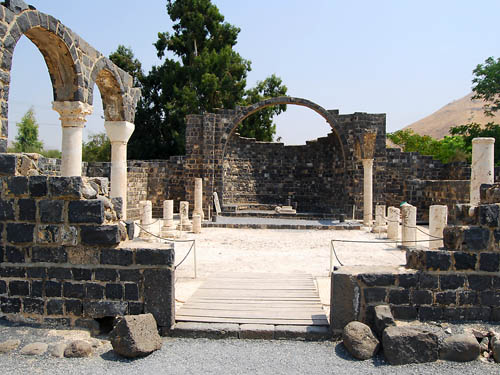
The basilica at Kursi. Photo by Ferrell Jenkins.

The basilica at Kursi. Photo by Ferrell Jenkins.

Murphy-O’Connor says this has been a place of pilgrimage since the fifth century A.D. He suggests the name of the place, Kursi, “is possibly a dialectical deformation” of Chorazin. (The Holy Land).

HT: Joseph I. Lauer
The Wilderness of Judea

John the Baptist preached in the wilderness of Judea (Matthew 3:3), and Jesus was tempted in the wilderness (Matthew 4:1). Jesus spoke to the crowds about John this way:

What did you go out into the wilderness to see? A reed shaken by the wind? (Luke 7:24 ESV)

The wilderness (Greek eremos) of Judea is described this way in Bauer (BDAG):

Of the Judean wilderness, the stony, barren eastern declivity of the Judean mountains toward the Dead Sea and lower Jordan Valley.

The Hebrew word for this wilderness is midbar. Charles F. Pfeiffer said the wilderness of Judea,

is the region of rugged gorges and bad lands in the eastern part of Judah where the land slopes off toward the Jordan Valley. In ancient times this area was infested with wild animals. Except for a brief time during the spring rains the wilderness is arid. (Baker’s Bible Atlas, 201)

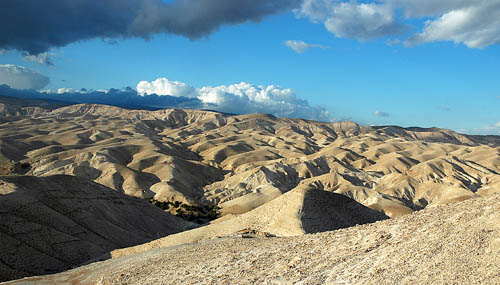
Many people who read the Bible in English, without checking into the matter, think of the wilderness as being a place filled with wild growth and underbrush. Jesus’ question to the crowds indicates that no reeds are to be found in the wilderness. In this case a picture really is worth a thousand words. This shows one of the many changing views one might see in the wilderness. This one was made in the month of November and shows a view west toward Jerusalem.

The wilderness of Judea. Looking west up toward Jerusalem. Photo by Ferrell Jenkins.

The wilderness of Judea. Looking west toward Jerusalem. Photo by Ferrell Jenkins.

The wilderness of Judea stretches west from the Jordan Valley up to the Mount of Olives. Of course, it extends much farther south along the Dead Sea.

Update: 04/01/09

Green pastures and quiet waters

Psalm 23 is one of the best known and most loved chapters of the Bible. In it David describes his relationship to the LORD under the analogy of a sheep and his shepherd.

The LORD is my shepherd, I shall not be in want. He makes me lie down in green pastures, he leads me beside quiet waters, he restores my soul. He guides me in paths of righteousness for his name’s sake. Even though I walk through the valley of the shadow of death, I will fear no evil, for you are with me; your rod and your staff, they comfort me. (Psalm 23:1-4 NIV)

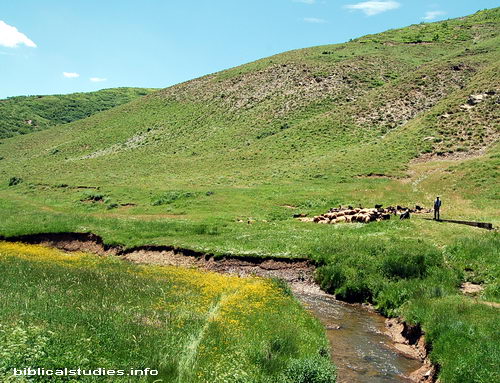
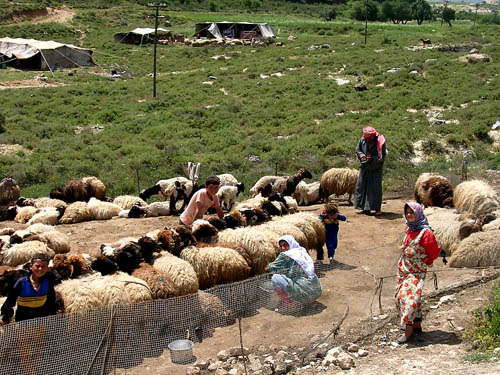
This Psalm  describes one of the common scenes in certain parts of the Middle East. Our photo was made in the mountains of ancient Urartu (Ararat) in eastern Turkey. Notice especially the green pastures and the quiet waters.

A shepherd provides green pastures and quiet water for his sheep. Photo by Ferrell Jenkins.

A shepherd provides green pastures and quiet water for his sheep. Photo by Ferrell Jenkins.

Jesus called Himself the “good shepherd” (John 10:11, 14). Jesus wants the same of elders or overseers in the local church, and He reminds them that it is God’s flock and that He is the Chief Shepherd (1 Peter 5:4).

To the elders among you, I appeal as a fellow elder, a witness of Christ’s sufferings and one who also will share in the glory to be revealed:  Be shepherds of God’s flock that is under your care, serving as overseers– not because you must, but because you are willing, as God wants you to be; not greedy for money, but eager to serve;  not lording it over those entrusted to you, but being examples to the flock. (1 Peter 5:1-3 NIV)

Good shepherds serve God’s flock willingly to provide food, care, and protection for the sheep. The concept of “lording it over” the flock or “domineering” is foreign to the spirit of a good shepherd. Overseers lead the flock by their example of godliness.

A visit to the Siegfried H. Horn Museum

Andrews University in Berrien Springs, Michigan, has long been associated with archaeological work, especially in Jordan. This work is carried out under the name of the Institute of Archaeology.

The interesting history of the Siegfried H. Horn Museum may be read here. The name of Siegfried H. Horn is well known to anyone who had read about biblical archaeology in modern times.

Last week I was at Valparaiso, Indiana, presenting a series of lessons on Bible History and Archaeology. I had long wanted to visit the Horn Archaeological Museum. When we learned that we were slightly more than an hour away, Mark Russell, Steve Wolfgang and I made the trip one morning. The Museum is hopeful of moving into a new facility as soon as the project can be funded. At this time the small museum is open only on Saturday afternoon, but they will open by appointment, as they did for us.

The Siegfried H. Horn Archaeological Museum houses over 8,500 artifacts, but only a small portion of those are on display. There are replicas of a few famous artifacts such as the Black Obelisk of Shalmannessar II and the Moabite Stone

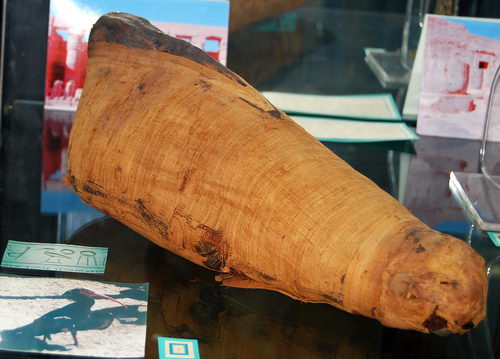
There are significant original pieces from most areas of the Bible world with Mesopotamia and Transjordan being featured. There is a mummified Ibis from Egypt. The Egyptian god Thoth was portrayed with the head of an Ibis. I never see representations of these gods without thinking of Paul’s description of the Roman world prior to the coming of Christ.

Claiming to be wise, they became fools, and exchanged the glory of the immortal God for images resembling mortal man and birds and animals and creeping things. (Romans 1:22-23 ESV)

Mummfied Ibis from Egypt. Photo by Ferrell Jenkins.

Mummified Ibis from Egypt. Photo by Ferrell Jenkins.

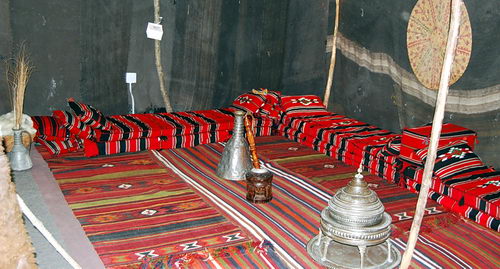
In the main exhibit hall there is a life-size Bedouin tent. This makes a good background for explaining patriarchal life.

Authentic Bedouin Tent at Horn Museum. Photo by Ferrell Jenkins.

Authentic Bedouin Tent at Horn Museum. Photo by Ferrell Jenkins.

By faith Abraham obeyed when he was called to go out to a place that he was to receive as an inheritance. And he went out, not knowing where he was going. By faith he went to live in the land of promise, as in a foreign land, living in tents with Isaac and Jacob, heirs with him of the same promise. For he was looking forward to the city that has foundations, whose designer and builder is God. (Hebrews 11:8-10 ESV)

Two other things should be mentioned. There are some wonderful models. One that impressed me was of the Roman rolling-stone tomb at Heshbon. The murals covering biblical and modern church history are impressive.

I recommend that anyone traveling in the vicinity of Berrien Springs, or those living within driving distance, take advantage of this opportunity to visit. Bible class teachers would do well to become familiar with this Museum and arrange for their students to see it.

Our thanks to Jody Washburn, an Administrative Assistant at the Institute of Archaeology, for her help in making our visit pleasant.

Kenyon

Einstein. That all we have to say. When it comes to the archaeology of Palestine the name Kenyon needs no supporting terms. Professor Magen Broshi, an archaeologist and historian, and the former curator of the Shrine of the Book in Jerusalem, wrote a review of Dame Kathleen Kenyon, Digging up the Holy Land, by Miriam C. Davis.

Here are a few interesting statements by Broshi:

She was, however, one of the most important archaeologists ever to dig in the Land of Israel.

That is not a negligible achievement, because more archaeological work has been done in the land between the Mediterranean Sea and the Jordan River, in other words in the State of Israel and the territories, than anywhere else in the world. There is no other country that has been so thoroughly researched, and the number of digs and surveys carried out here is incomparably greater than what has been done in far larger countries. Kenyon is not only one of the most important archaeologists to have worked here (and they number over 1,000), she is also the leading female archaeologist to have worked anywhere (along with the prehistorian Dorothy Garrod).

Kenyon dug at Samaria, Jericho, and Jerusalem. Broshi concludes,

The figure of Kenyon as portrayed in the book is a model of diligence and dedication. The book is based on thorough research, including written and oral testimony. It is well-written and the story is appealing. In my opinion it deserves high praise.

The complete review may be read on the Haaretz web site.

There are several articles on the Associates for Biblical Research web page about the excavations at Jericho. This one by Bryant G. Wood on “The Walls of Jericho” is a non-technical article that is helpful. Wood wrote a doctoral dissertation evaluating the evidence at Jericho. He discovered some oversights in Kenyon’s conclusions. Notice one of the concluding paragraphs of the popular article.

Jericho was once thought to be a “Bible problem” because of the seeming disagreement between archaeology and the Bible. When the archaeology is correctly interpreted, however, the opposite is the case. The archaeological evidence supports the historical accuracy of the Biblical account in every detail. Every aspect of the story that could possibly be verified by the findings of archaeology is, in fact, verified.

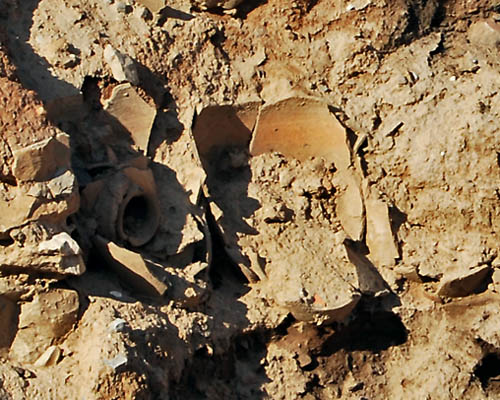
Both Garstang (excavated Jericho between 1930 and 1936) and Kenyon (excavated Jericho between 1952 and 1958) found evidence of pottery jars full of grain in destruction levels. Even with the constant deterioration of the exposed evidence, we still see fragments of jars in the side of the balk.

Pottery in the side of a trench at Jericho. Photo by Ferrell Jenkins.

Pottery in the side of a trench at Jericho. Photo by Ferrell Jenkins.

Wood argues that “this is a unique find in the annals of archaeology.” He says,

Grain was valuable, not only as a source of food, but also as a commodity which could be bartered. Under normal circumstances, valuables such as grain would have been plundered by the conquerors. Why was the grain left to be burned at Jericho?

The Bible says,

The city and all that is in it must be set apart for the LORD, except for Rahab the prostitute and all who are with her in her house, because she hid the spies we sent. But be careful when you are setting apart the riches for the LORD. If you take any of it, you will make the Israelite camp subject to annihilation and cause a disaster. All the silver and gold, as well as bronze and iron items, belong to the LORD. They must go into the LORD’s treasury.” (Joshua 6:17-19 NET)

But they burned the city and all that was in it, except for the silver, gold, and bronze and iron items they put in the treasury of the LORD’s house. (Joshua 6:24 NET)

HT: Joseph I. Lauer

After completing my comments, I see that Todd Bolen has commented on the review of the Kenyon biography here.

Reminders of Patriarchal Life

The Bible paints a clear picture of the life of the patriarchs, especially Abraham, Isaac, and Jacob. Just type the words tent and tents in your computer Bible search engine. Here are a few things said about the biblical patriarchs. (You need to remove the hits referring to the “tent of meeting” or tabernacle.)

  • Lot and Abraham had flocks and herds and tents (Genesis 13:5).
  • Numerous references mention moving the tent (see Genesis 13:18).
  • Jacob was a peaceful man, living in tents (Genesis 25:27).
  • Even as late as the time of David many were living in tents (2 Samuel 18:17).

The writer of Hebrews describes the faith of Abraham this way:

By faith he lived as a foreigner in the promised land as though it were a foreign country, living in tents with Isaac and Jacob, who were fellow heirs of the same promise. (Hebrews 11:9)

One of the values of travel to the lands of the Bible is to see many customs reminiscent of Bible times. In 2002 I spent nearly a week in Syria with a colleague visiting biblical and historical sites. North of Latakia, almost to the border with Turkey, we saw a settlement of what appeared to be at least three families living in tents. One man was clearly the “patriarch” of the group. Several women were busy working. One was milking the sheep. The tents were spread out over about an acre or more of land.

Shepherd settlement in northeastern Syria. Photo by Ferrell Jenkins.

Shepherd settlement in northeastern Syria. Photo by Ferrell Jenkins.

I think one could envision Abraham and his family in much the same way.

Riblah in the land of Hamath

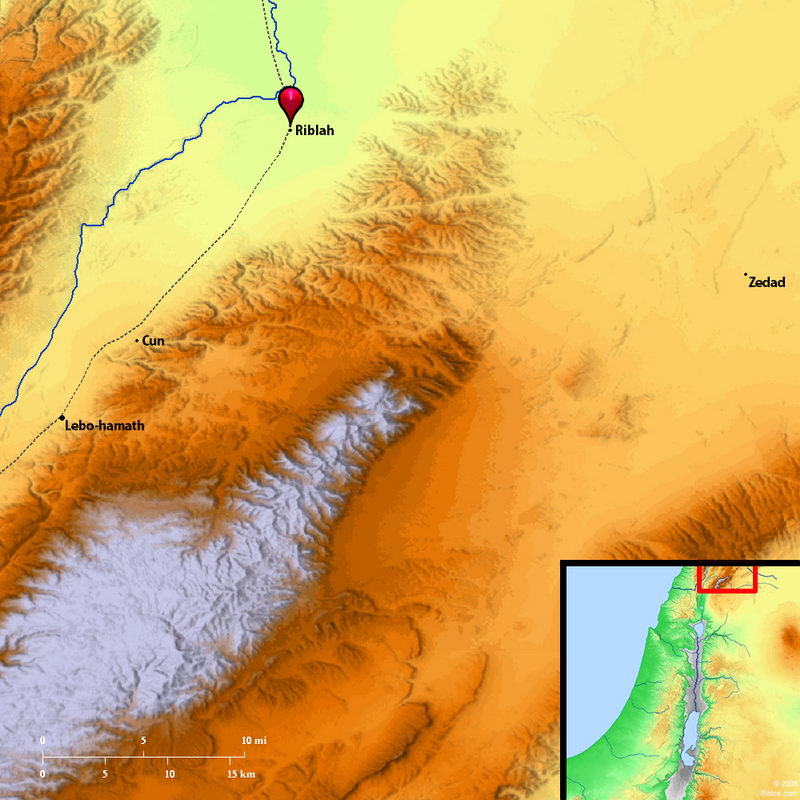
Riblah served as a base of operation for the Egyptian Pharaoh Necho and the Babylonian King Nebuchadnezzar. The city is located on a broad plain about 20 miles south of Hamath (modern Hama in Syria), on the main road between Egypt and Mesopotamia. The Orontes River flows past the site on the west side. On a modern map you will locate Riblah in Syria immediately north of the border with Lebanon.

There is little more than a “country store” at the site today, but the name Riblah is preserved as Ribleh, Syria.

Riblah in the land of Hamath. Courtesy BibleAtlas.org.

Riblah in the land of Hamath. Courtesy BibleAtlas.org.

  • Pharaoh Necho imprisoned Jehoahaz, king of Judah, at Riblah. He later took him to Egypt where he died. The date was about 609 B.C. (2 Kings 23:31-34).
  • Zedekiah, puppet king of Judah, tried to escape capture by the Babylonians. He fled Jerusalem but was captured on the plains of Jericho and brought to Riblah. There Nebuchadnezzar passed sentence on him. His sons were slaughtered in his sight and he was bound with brass fetters and taken to Babylon. The date was 586 B.C. (2 Kings 25:5-7; see also Jeremiah 39:5-6; 52:9-10).
  • The officials of Zedekiah were taken to Riblah where they were put to death (2 Kings 25:19-21; see also Jeremiah 52:26-27).

In 2002 a colleague and I spent several days visiting sites in Syria. Riblah was the most difficult to locate. Most folks, after seeing the site, would probably say, “What’s the big deal?”  Even though Riblah is mentioned only these few times in the Old Testament, it’s location makes it important in all movement between the south (Egypt and Israel) and Mesopotamia.

Riblah in the land of Hamath. Photo by Ferrell Jenkins.

Riblah in the land of Hamath. Photo by Ferrell Jenkins.

The slopes of this tell are now used as a cemetery. We know that this would make it difficult to negotiate rights to excavate.

IBR discussions on Jesus now online

Members of the Institute for Biblical Research who specialize in historical Jesus research have been meeting for the past 10 years to discuss essays written by group members. You may recognize the names of Darrell Bock, Craig Evans, Grant Osborne, Michael Wilkins, et al. During June, 2008, several members of the group met in Jerusalem. While there they were filmed at various sites discussing the relevant issues.

These scholars did not start with the assumption that the Bible is the world of God. Rather, they asked, is the Bible consistent with other documents of the first century? How would one go about to establish the historicity of Alexander the Great, Julius Caesar, or Jesus?

The Day of Discovery TV program filmed these scholars on site in Israel discussing the various issues involved. Jesus: Man, Messiah, or More? is the theme of the presentations. The first was filmed in the Synagogue in Capernaum; the second from Caesarea Philippi. From now through early April there will be a total of eight presentations. These will certainly be a fresh breath of air compared to the usual Easter fare on cable and network TV.

Enter the discussion here.

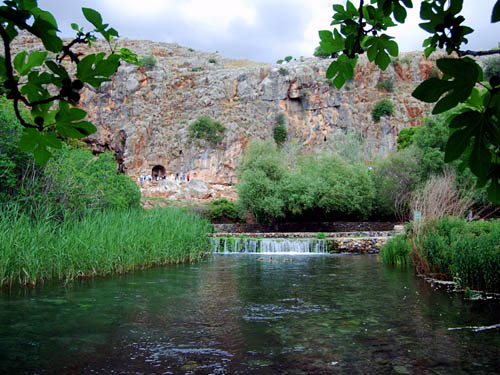
This photo shows the Banias River, one of the major sources of the Jordan River, at the site of Caesarea Philippi. It was in this region that Jesus was confessed to be the Son of the Living God by the apostle Peter (Matthew 16:13-20).

The Banias River at Caesarea Philippi. Photo by Ferrell Jenkins.

The Banias River at Caesarea Philippi. Photo by Ferrell Jenkins.

HT: Primetime Jesus

James B. Pritchard on film in 1967

Last evening I watched The Book and the Spade, a documentary film produced in 1967 by the University Museum of the University of Pennsylvania. The film is about the archaeological work in Jordan. At the time that included Jerusalem, Gibeon, Shechem, Samaria, Bethlehem, Qumran, Amman, Jerash, and Tell es Sadiyeh in the Jordan Valley. Pritchard is seen on the film at Tell es Saidiyeh, east of the Jordan River, giving an account of the discoveries there. He believed the site to be Zarethan. The Bible says that the bronze utensils which Hiram made for King Solomon were made,

In the plain of the Jordan the king cast them, in the clay ground between Succoth and Zarethan. (1 Kings 7:46)

This film is of great historical significance because it features Pritchard and because it shows places that no longer look the way they did in 1967. I suggest you take the time to watch it. Here is the link to The Book and the Spade. The film is about 28 minutes long.

Excavations were resumed in 1985 by Jonathan N. Tubb of the British Museum.

Some scholars have suggested that Zarethan should be located on the west side of the Jordan Valley.

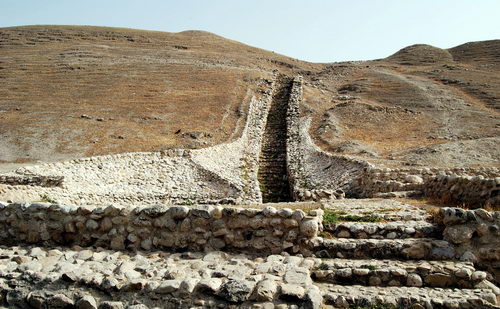
This photo shows the north side of Tell es Saidiyeh with the steps leading to the spring that Pritchard mentions in the film.

Tell es Sadiyeh, excavated by James B. Pritchard. Photo by Ferrell Jenkins.

Tell es Saidiyeh, excavated by James B. Pritchard. Photo by Ferrell Jenkins.

HT: The Book and the Spade blog by Gordon Govier.

Royal seals from the time of Hezekiah

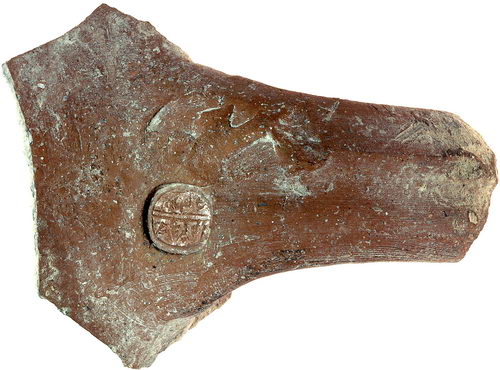
The Israel Antiquities Authority has announced the discovery of several impressive artifacts from Umm Tuba, in the southern hill of Jerusalem. These items include royal seal impressions from the time of Hezekiah, king of Judah (c. 716-687 BC; Schultz, ISBE).

A large building that dates to the time of the First and Second Temples, in which there was an amazing wealth of inscriptions, was discovered in a salvage excavation conducted by Zubair Adawi, on behalf of the Israel Antiquities Authority, in the village of Umm Tuba in southern Jerusalem (between Zur Bahar and the Har Homa quarter), prior to construction work by a private contractor.

Considering the limited area of the excavation and the rural nature of the structure that was revealed, the excavators were surprised to discover in it so many royal seal impressions that date to the reign of Hezekiah, King of Judah (end of the eighth century BCE). Four “LMLK” type impressions were discovered on handles of large jars that were used to store wine and oil in royal administrative centers. These were found together with the seal impressions of two high ranking officials named Ahimelekh ben Amadyahu and Yehokhil ben Shahar, who served in the kingdom’s government. The Yehokhil seal was stamped on one of the LMLK impressions before the jar was fired in a kiln and this is a very rare instance in which two such impressions appear together on a single handle.

Royal seal from the time of Hezekiah. Photo: Mariana Saltzberger, IAA.

Royal seal from the time of Hezekiah. Photo: Mariana Saltzberger, IAA.

The site of this discovery has been identified as Biblical Netofa (English Netophah). Two of David’s “mighty men” (or warriors) were from Netophah.

Zalmon the Ahohite, Maharai the Netophathite, Heleb the son of Baanah the Netophathite, Ittai the son of Ribai of Gibeah of the sons of Benjamin (2 Samuel 23:28-29).

The full press release may be seen at the IAA site at the bottom of the page.  A ZIP file of the seven pictures is available here for those interested.

HT: Joseph Lauer and several bloggers.