Category Archives: Bible Places

Babylon ruins reopen to tourists

The New York Times recently carried an article about the reopening of Babylon to tourists. Most of the attention is given to locals getting a chance to see Saddam Husein’s former palace built to overlook the ruins of the ancient city. Some of the photos are nice. (HT: Todd Bolen, BiblePlaces Blog)

Here is an article I published in Biblical Insights several years back.

– – – – – –

The site of Babylon is located about 55 miles southwest of Baghdad near Hillah in Iraq. The city was located on the River Euphrates, but is now a few miles east of the river on one of the canals. The rivers of Mesopotamia have frequently changed their course.

The earliest ancient name for Babylon, given in the table of nations, was Babel (Gen. 10:10). Babylon was ruled by Hammurabi, best known for his law code, in the 18th century B.C.

The city reached its peak during the Neo-Babylonian empire (626-539 B.C.). The Bible refers to Babylon as “the beauty of kingdoms, the glory of the Chaldeans’ pride” (Isaiah 13:19).

The greatest king of the Neo-Babylonian empire was Nebuchadnezzar (605-562 B.C.). There is abundant evidence of the activities of his reign. The best collections of artifacts are to be found in the British Museum in London and the Museum of the Near East (part of the Pergamon Museum) in Berlin. In Berlin one may see the reconstructed Procession Street, the Ishtar Gate, and the decorated facade of the Throne Room of Nebuchadnezzar from Babylon.

The photo below shows my first view of the site of ancient Babylon in 1970. Jeremiah 51:37 provides a wonderful caption: “And Babylon will become a heap of ruins.”
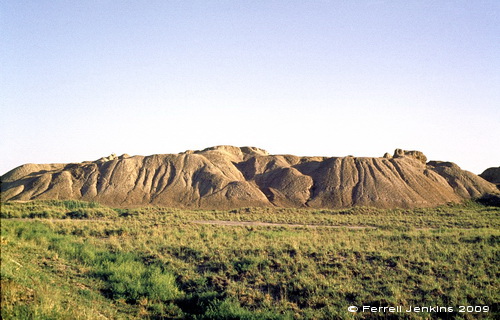
My first view of Babylon in 1970. Photo by Ferrell Jenkins.

My first view of Babylon in 1970. Photo by Ferrell Jenkins.

The kingdom of Judea had much contact with the Babylonians. Daniel was in the first group of Judean royal youths taken into Babylonian exile in 605 B.C., and was educated in the literature and language of Babylon (Daniel 1:1-6). Jerusalem fell to Nebuchadnezzar’s army March 15/16, 597 B.C. At that time Jehoiachin and 10,000 captives were taken as prisoners to Babylon (2 Kings 24:8-16). The prophet Ezekiel was among that group of captives. His prophetic call came in the fifth year of his exile by the river Chebar, a tributary of the Euphrates (Ezekiel 1:1-3).

The Judean captives remained in Babylon until the time of the Medes and Persians (Jeremiah 25:11-12). Cyrus, according to a clay cylinder now in the British Museum, allowed captives to return to their home land, build their temples and serve their own gods. This is in harmony with the biblical account in 2 Chronicles 36 and Ezra 1.

Excavations were conducted at Babylon by German archaeologists between 1899 and 1917. Discoveries included the main palace of Nebuchadnezzar, the procession street, some temples, and the Ishtar gate. The most fabulous of the items to be found have been reconstructed in the Museum of the Near East in Berlin. I have been able to visit Babylon only once in 1970.
Robert Jackson – Gospel Preacher

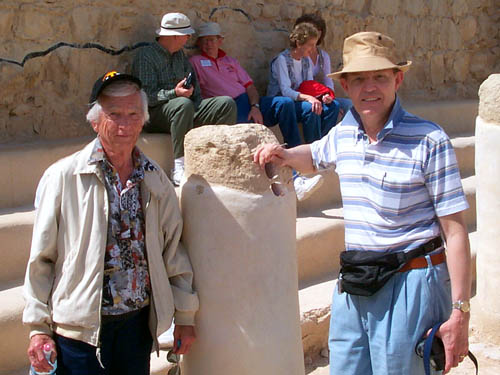
Word has come today of the passing of Robert Jackson, long-time minister of the gospel. I have many fond memories of time spent with Robert. He strengthened and encouraged me in one very difficult time in gospel work. I was especially pleased when he was able to join one of my tours in 2000. Phil Cavender made this photo in the synagogue at Masada.

Robert Jackson and Ferrell Jenkins at Masada in 2000.

Robert Jackson and Ferrell Jenkins at Masada in 2000.

Our deepest condolences go to Robert’s family. May the Lord raise up others like him!

Jacob’s Well — from Jacob to Jesus

Jesus came to Sychar, a city of Samaria, near the piece of land Jacob had owned (John 4:5; Genesis 33:19). The territory was apportioned to the descendants of Joseph, and Joseph was buried there at Shechem (Joshua 24:32). It was a place of great historic importance.

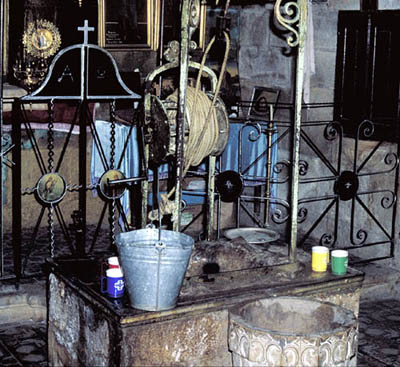
We are not able to speak with certainty regarding the location of Sychar. Some scholars associate the site with Shechem; others think it should be identified with the village of Askar which is located a short distance north. The traditional Jacob’s Well is located at Shechem in the valley between Mount Gerizim and Mount Ebal. The modern town of Nablus now fills this valley.

André Parrot says,

“Of all the ‘holy places’ of Palestine, none has more reason to be considered authentic than Jacob’s well. Indeed, there is no reason why its authenticity should be questioned” (Land of Christ 65).

Parrot describes the water as “cool and pleasant-tasting…drawn from a depth of 128 feet.” I have drunk the water several times, but in the past couple of decades my guides have advised against it due to pollution in the area.

The Samaritan woman said, “the well is deep” (John 4:11). Parrot reports the well is 128 feet deep. Murphy-O’Connor says it is 22.5 meters deep (about 74 feet). McGarvey cites several measurements mentioned in 19th century writers and reminds us that the well became filled with stones cast in by travelers trying to hear how long it would take a stone to hit the bottom (Lands of the Bible 283). He reports that the well was often dry.

There are numerous springs in the area of Shechem. Jacob, as a late-comer to the region, might have found it necessary to dig a well to assure water for his family and cattle.

A church was erected over the well about A.D. 380. The Crusaders built another church on the site in the 12th century. The property came under the control of the Greek Orthodox church in 1860. By the end of the 19th century the Greeks began a new church, but construction was halted during World War I. The last time I was at Jacob’s well (2000) construction had resumed and Murphy-O’Connor reports completion in 2007.

It has been difficult for groups to visit Jacob’s Well in recent years due to the situation in Nablus.

Jacob's Well. Most likely the well where Jesus met the woman of Samaria (John 4). Photo by Ferrell Jenkins.

Jacob's Well. Most likely the well where Jesus met the woman of Samaria (John 4). Photo by Ferrell Jenkins.

With this information, I leave it to you to study the great lessons of John 4. They are deep, too.

He had to pass through Samaria

The Gospel of John informs us that Jesus had to pass through Samaria (4:4). The most direct travel route between Judea and Galilee was through Samaria. Josephus says, “it was the custom of the Galileans, when they came to the holy city at the festivals, to take their journeys through the country of the Samaritans….” (Ant. XX.118). He also informs us that the trip took three days (Life of Flavius Josephus 1.269). This route ran along the central mountain range, sometimes called the water-parting route.

Carson says geography determined that Jesus had to go through Samaria, but some scholars believe the term had indicates necessity. The following conversation with the woman of Samaria and the visit with the people of Sychar may explain why He had to go through Samaria.

We know that Jesus and His disciples encountered problems when traveling through Samaria (Luke 9:51-56). When Jesus sent out the twelve He told them not to enter any city of the Samaritans (Matthew 10:5).

The Jews, on their way from Galilee to Judea, could travel through Transjordan (Perea). It seems that Jesus took this route when He traveled through Jericho up to Jerusalem (Luke 19).

This photo was made in 1981 from the hill of Samaria with a view of the surrounding “mountains of Samaria” (Amos 3:9). One can easily imagine Jesus and His disciples traveling paths such as this.

samaria_path_mountains_1981-t

A place called Fair Havens

Last year I wrote here about a visit to Fair Havens on the island of Crete. I have been thinking about the rugged beauty of that place and decided to share a different photo with you. This one emphasizes the mountains surrounding the harbor of Fair Havens. The white Greek Orthodox chapel adds to the beauty of the area today.

Mountains surrounding Fair Havens in Crete. Photo by Ferrell Jenkins.

Mountains surrounding Fair Havens in Crete. Photo by Ferrell Jenkins.

Crete is associated with Paul’s voyage to Rome. The biblical account is found in Acts 27:7-15. Note verses 7 and 8.

When we had sailed slowly for a good many days, and with difficulty had arrived off Cnidus, since the wind did not permit us to go farther, we sailed under the shelter of Crete, off Salmone; and with difficulty sailing past it we came to a place called Fair Havens, near which was the city of Lasea.

The ship sailed under the shelter of Crete and came to Kali Limenes (Fair Havens) near the city of Lasea. Because Fair Havens was not a suitable harbor for wintering, the pilot and captain of the ship decided to sail on in hopes of reaching “Phoenix, a harbor of Crete, facing southwest and northwest,” and spend the winter there. Because of a severe wind, called Euraquilo, which came down from the land, they were driven by the wind and eventually wrecked on the island of Malta.

The tomb of Jesus

The New Testament describes the tomb and burial of Jesus:

When it was evening, there came a rich man from Arimathea, named Joseph, who also was a disciple of Jesus. He went to Pilate and asked for the body of Jesus. Then Pilate ordered it to be given to him. And Joseph took the body and wrapped it in a clean linen shroud and laid it in his own new tomb, which he had cut in the rock. And he rolled a great stone to the entrance of the tomb and went away. Mary Magdalene and the other Mary were there, sitting opposite the tomb. (Matthew 27:57-61 ESV)

The Church of the Holy Sepulchre likely contains the empty tomb of Jesus. Since 1810 the tomb has been covered by a monument that hides the original appearance of the tomb. In fact, even in the 4th century Constantine changed the natural appearance of the area by cutting away some of the natural stone.

The tomb is similar to other tombs from the first century. This one is small, but that would be consistent with the fact that it was the personal tomb of Joseph of Arimathea. The museum of the Studium Biblicum Franciscanum in the Old City has a model of the tomb showing a side view. From right to left one enters the tomb when the rolling stone is moved away. The first room serves as a vestibule. The second room contains a bench or shelf cut into the rock. This was called the arcosolium. The wrapped body would be placed on this bench.

Model of the tomb in the Church of the Holy Sepulchre. Photo by F. Jenkins.

Model of the tomb in the Church of the Holy Sepulchre. Photo by F. Jenkins.

Believers appreciate the loving care Joseph gave the body of Jesus.

The house of Caiaphas

Jesus observed the Passover of the Jews somewhere in the upper city of Jerusalem, the present Mount Zion. Scholarly consensus locates the house of Caiaphas at a site near the Cenacle on Mount Zion. Another site, further down the slope toward the Pool of Siloam, is held by some as the house of Caiphas. It is  called St. Peter in Gallicantu (cock-crow). According to this tradition, it is the place where Jesus was taken after His arrest (Matthew 26:57). If correct, this would be the site of Peter’s denial of the Lord.

The late W. Harold Mare says,

Whatever interpretation is accepted, one is impressed with the ancient stone stairs that run from the vicinity of the Cenacle down past the Church of St. Peter in Gallicantu to the Pool of Siloam, stairs that are thought to be from the Jewish period. It could be that these were the very stairs used by Jesus as he went down from the Last Supper to the Kidron Valley and on to Gethsemane (John 18:1). (The Archaeology of the Jerusalem Area. Baker, 1987)

My understanding is that Jesus would have observed the Passover and instituted the Lord’s Supper in the Upper City. He then went with His disciples to Gethsemane. From there He was taken to the House of Caiaphas. Jesus may have taken these steps in both directions. Here is a photo of those stone stairs that I made in 1979.

First century steps leading to the Upper City. Photo by Ferrell Jenkins.

First century steps leading to the Upper City. Photo by Ferrell Jenkins.

A place called Gethsemane

Gethsemane is a place well known in the minds of Christians, for according to the Gospels it was there that Jesus prayed alone to the Father before his arrest and trial. The word Gethsemane means oil-press. It is the name of an olive orchard on the Mount of Olives. Not many olive trees remain on the mountain originally named for them. This photo was made in the modern Garden at the Church of All Nations.

Garden of Gethsemane on the Mount of Olives. Photo by Ferrell Jenkins.

Garden of Gethsemane on the Mount of Olives. Photo by Ferrell Jenkins.

Take time to meditate on the events of that night.

Then Jesus came with them to a place called Gethsemane, and said to His disciples, “Sit here while I go over there and pray.” And He took with Him Peter and the two sons of Zebedee, and began to be grieved and distressed. Then He said to them, “My soul is deeply grieved, to the point of death; remain here and keep watch with Me.” And He went a little beyond them, and fell on His face and prayed, saying, “My Father, if it is possible, let this cup pass from Me; yet not as I will, but as You will.”

And He came to the disciples and found them sleeping, and said to Peter, “So, you men could not keep watch with Me for one hour? “Keep watching and praying that you may not enter into temptation; the spirit is willing, but the flesh is weak.” He went away again a second time and prayed, saying, “My Father, if this cannot pass away unless I drink it, Your will be done.” Again He came and found them sleeping, for their eyes were heavy. And He left them again, and went away and prayed a third time, saying the same thing once more.

Then He came to the disciples and said to them, “Are you still sleeping and resting? Behold, the hour is at hand and the Son of Man is being betrayed into the hands of sinners.  “Get up, let us be going; behold, the one who betrays Me is at hand!” (Matthew 26:36-46 NASu)

The Way of the Cross – Via Dolorosa

Numerous events from the last day prior to the crucifixion of Jesus are recorded in the New Testament (Matthew 26-27; Mark 14-15; Luke 22-23; John 18-19). As early as Byzantine times Christians began to follow the final steps of Jesus on specified days. Over the centuries many changes were made in the route and the stops. The traditional Via Dolorosa, as known today, was fixed in the 18th century.

Jerome Murphy-O’Connor says,

The Via Dolorosa is defined by faith, not by history. (The Holy Land, 5th edition, 37)

He continues,

The present Way of the Cross has little chance of corresponding to hsitorical reality… (38)

According to tradition, the third station of the cross is where Jesus falls the first time under His cross. It sounds reasonable, but the Gospels make no specific mention of this.

Roman period street near 3rd station of the cross. Photo by F. Jenkins.

Roman period street near 3rd station of the cross. Photo by F. Jenkins.

This photo shows the street in front of the third station. The plaque in Hebrew, Arabic and English provides the following information about the street.

Paving stones, apparently from the Second Temple Period (ca. 100 B.C.C. – 100 C.E.). The street was found in its entirety 3 meters below the existing level and was partially restored by the Municipality of Jerusalem … 1980-1981.

This means that the street Jesus might have walked is at least 10 feet below the present street level.

Hellenistic pier found at Akko – Ptolemais

A harbor from the Hellenistic period was found at Akko on the Mediterranean coast. Here is a brief description of the discovery provided by the Israel Antiquities Authority.

The part of the floor that has been revealed so far extends for a distance of 15 meters and is 4 meters wide (the full dimensions of the floor have not yet been exposed). The floor was built of rectangular, smoothly dressed kurkar stones that were placed atop a foundation course of roughly hewn kurkar stones arranged next to each other as “headers”. In probes that were conducted beneath the floor, numerous fragments of ceramic jars of Aegean provenance (from Rhodes, Kos and elsewhere) were found that were used to transport wine, as well as tableware and cooking vessels. Among the other artifacts recovered were a Greek style bronze arrowhead and bronze coins that are covered with marine encrustations. A preliminary identification of the finds shows that the floor was constructed in the Hellenistic period (end of the third century until the middle of the second century BCE) as part of a national project.

Akko Crusader wall. Excavated area of Hellenstic Harbor. Photo: Kobi Sharvit, IAA.

Akko Crusader wall. Excavated area of Hellenistic pier. Photo: Kobi Sharvit, IAA.

The photo below shows some of the kurkar stone pavement discovered one meter under the present water level.

The floor from the Hellenistic period. Photo: Kobi Sharvit, IAA.

The floor from the Hellenistic period. Photo: Kobi Sharvit, IAA.

Akko (Acre or Accho) is mentioned in Judges 1:31 as a city of the tribe of Asher. During the late 3rd or early 2nd century B.C. Akko was given the name Ptolemais by Ptolemy I or II of Egypt. Ptolemais is the name we read in the New Testament. Paul and his companions stopped at Ptolemais for one day on the return from his third journey in the Greco-Roman world.

When we had finished the voyage from Tyre, we arrived at Ptolemais, and we greeted the brothers and stayed with them for one day. (Acts 21:7 ESV)

Several things are learned from this text (and context). The previous stop was a few miles north at Tyre where they had stayed for seven days (Acts 21:4-6). After Ptolemais they arrived at Caesarea.

Paul’s companions included all of those “messengers” of the churches who were taking the contributions of the churches of Macedonia and Achaia to the poor among the saints at Jerusalem (Romans 15:25-27; 2 Corinthians 8-9). A list of names is given in Acts 20:4.

A view of the Mediterranean from the Crusader ramparts at Akko. Photo by Ferrell Jenkins.

A view of the Mediterranean from the Crusader ramparts. Photo by Ferrell Jenkins.