Category Archives: Bible Places

Archaeologist Netzer dies after fall

The Jerusalem Post reported here this afternoon that Prof. Netzer succumbed to the injuries sustained during his fall at the Herodium.

Renowned archaeologist Ehud Netzer died of his wounds at the Hadassah Ein Kerem hospital in Jerusalem Thursday night, days after he fell during an excavation.

On Monday Prof. Netzer was hospitalized in critical condition after a wooden railing he leaned on gave way, at the Herodion archeological site in the West Bank.

Jim West was kind enough to leave a comment on our blog this  morning once he was certain that Prof. Netzer had died.

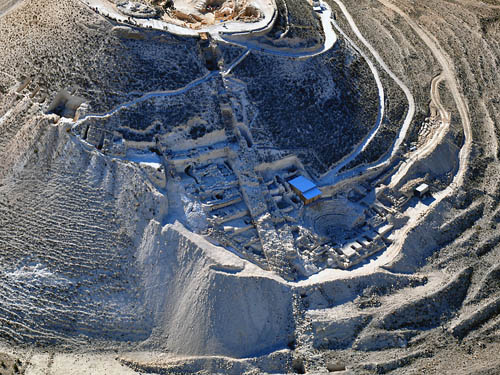
Recently we discussed here some of the work at the Herodium. Below I am including a closer view of the area where Prof. Netzer was working. This aerial photo shows a clear view of the theater. The roofed structure covers the royal theater box.

The Herodium excavation. Photo by Ferrell Jenkins, Dec. 15, 2009.

The Herodium excavation. Photo by Ferrell Jenkins. Dec. 15, 2009.

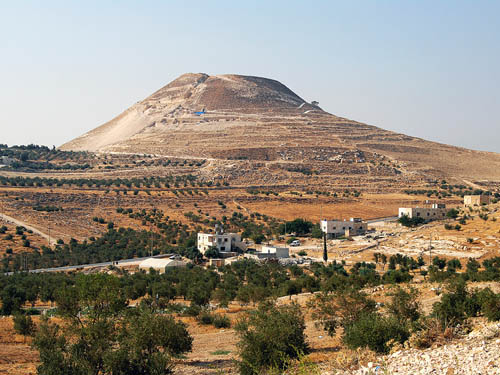
Without the determination of Ehud Netzer the north side of the Herodium would still look like the view below, and we would still be wondering about the location of Herod’s burial place.

The Herodium from the north. Photo by Ferrell Jenkins, Aug. 23, 2008.

The Herodium from the north. Photo by Ferrell Jenkins, Aug. 23, 2008.

The Herodium is located a few miles east of Bethlehem, the birthplace of Jesus (Matthew 2).

Prof. Ehud Netzer critically injured at Herodium

According to The Jerusalem Post, well known archaeologist Ehud Netzer has been critically injured in a fall at the Herodium (Herodion). The full report by Ben Hartman may be read here.

Well-known Israeli archeologist Ehud Netzer remained in critical condition Wednesday at Hadassah-University Medical Center, Ein Kerem, two days after he suffered a serious fall during a dig at the Herodion archeological site in the West Bank.

Netzer was reportedly leaning against a wooden railing on Monday when it gave way. He fell nearly 10 feet before landing – only to roll and fall an additional 10 feet. He suffered fractures in his cranium and vertebrae and was rushed to Hadassah in critical condition.

The 76-year-old archeologist is one of the foremost experts on Herodion, a man-made mountain built by King Herod near Bethlehem. Netzer has carried out digs at the site for more than three decades; three years ago, he found the site of Herod’s grave – a discovery that was considered the pinnacle of his career.

Digs he performed in 1968 in Jericho unearthed a Hasmonean winter palace that sported bathing pools and gardens, widely considered the most significant archeological site dealing with that period in Jewish history. The digs also unearthed the Jericho synagogue, considered the largest Jewish house of worship ever discovered.

In 1978, Netzer finished his PhD dissertation at Hebrew University, which focused on Herod’s palaces at Herodion and Jericho. He became a senior lecturer at the university in 1981, where he has taught ever since.

There were blog reports yesterday that Netzer had died, but these are being corrected this morning.

Cenchrea — a port used by Paul and Phoebe

Cenchrea is located a few miles east of Corinth on the Saronic Gulf, an arm of the Aegean Sea. In the time of the Apostle Paul Cenchrea was considered the eastern port of Corinth. It was here that Paul had his hair cut before sailing for Syria.

Paul, having remained many days longer, took leave of the brethren and put out to sea for Syria, and with him were Priscilla and Aquila. In Cenchrea he had his hair cut, for he was keeping a vow. (Acts 18:18 NAU)

Our photo provides a view of the port and the northern breakwater.

The port of Cenchrea with view toward the northern breakwater. Photo by Ferrell Jenkins.

Port of Cenchrea with view toward the northern breakwater. Photo by Ferrell Jenkins.

Cenchrea was the home of Phoebe, who was a servant of the church there. Cenchrea would have been one of the unnamed churches “in the whole of Achaia” (2 Corinthians 1:1).

I commend to you our sister Phoebe, who is a servant of the church which is at Cenchrea; that you receive her in the Lord in a manner worthy of the saints, and that you help her in whatever matter she may have need of you; for she herself has also been a helper of many, and of myself as well. (Romans 16:1-2 NAU)

I think we may safely conclude that Phoebe sailed from this port to Rome with the epistle Paul write to the saints at Rome about A.D. 57.

Except for the port, little is to be seen of ancient Cenchrea. Some underwater excavations have taken place. Perhaps at a later time we will call attention to some of the discoveries.

Click on the image if you would like to have a copy of the photo suitable for use in teaching Acts, Romans, or the life and ministry of Paul.

Murex is not the only source of purple

Royal purple dye was made from the secretion of the Murex snail, typically found along the eastern Mediterranean coast, especially near Tyre.

In New Testament times (the first century A.D.), several cities in Asia Minor were noted as producers of dye. Colossae and Thyatira were located inland, far away from the Sea. These, and other cities of the region, made purple from the madder root.

Madder root, a source of purple in Turkey. Photo by Ferrell Jenkins.

Madder root, a source of purple in Turkey. Photo by Ferrell Jenkins.

The three colors shown in the yarn below come from the madder root. The darker color on the right might more closely resemble royal purple.

Yarn dyed with madder root. Photo by Ferrell Jenkins.

Yarn dyed with madder root. Photo by Ferrell Jenkins.

Thyatira was noted as a great center for the wool trade and for its dyeing industry. Lydia, the first convert of the gospel in Europe, was a native of Thyatira (in Asia). She seems to have represented this industry in Philippi. One inscription, found at Philippi in 1872, honored from among the purple dyers a man named Antiochus who was a “native of Thyatira” (Meinardus, St. John, 93).

The purple dye used around Thyatira was evidently a vegetable dye from the madder root which grew in abundance in the region. Hemer says that the madder root “was still cultivated in the district at least until the end of the last century.” The pigment is commonly called Turkey red. In addition to the colors shown in the yarn above, I am told by the Turkish carpet sellers that the “red” in this beautiful Turkish carpet comes from the madder root.

Carpet made from yarn made from the madder root. Photo by Ferrell Jenkins.

Carpet using yarn made from the madder root. Photo by Ferrell Jenkins.

Now when you read about Lydia as a seller of purpose you should think of the dye made from the madder root, or from the dyed products.

A woman named Lydia, a dealer in purple cloth from the city of Thyatira, who worshiped God, was listening. The Lord opened her heart to pay attention to what was spoken by Paul. (Acts 16:14 CSB)

More about Royal Purple

Reader/friend A.D. Riddle has supplied me with a nice photo of some Murex shells that he made in the Beirut National Museum.

Murex Shells in the National Museum of Beirut. Photo by A.D. Riddle.

Murex Shells in the National Museum of Beirut. Photo by A.D. Riddle.

Riddle also sent a copy of a 2004 essay by Joseph Doumet on “Purple Dye” (in Decade: A Decade of Archaeology and History in the Lebanon. Ed. C. Doumet-Serhal. Beirut: Lebanese of the National Museum). This is fascinating for those who may be interested in following up on this subject.

Some of the comments about the process of dyeing by Pliny the Elder impressed me. Pliny wrote his Natural History during the three years preceding his death in the eruption of Mount Vesuvius (A.D. 79). Pliny writes about the Murex Trunculus in Book 1x.

The murex also does this in a similar manner, but it has the famous flower of purple, sought after for dyeing robes, in the middle of its throat: here is a white vein of very scanty fluid from which that precious dye, suffused with a dark rose colour, is drained, but the rest of the body produces nothing. People strive to catch this fish alive, because it discharges this juice with its life; and from the larger purples they get the juice by stripping off the shell, but they crush the smaller ones alive with the shell, as that is the only way to make them disgorge the juice. The best Asiatic purple is at Tyre.

Notice especially these expressions:

  • Sought after for dyeing robes.
  • Precious dye.
  • The best Asiatic purple is at Tyre.

Murex is the source of Royal Purple

From 1967 to 1975 I took a group to Lebanon each year except one. Tyre was always an important stop on the tour. Tour members were interested in understanding the prophecies of Ezekiel and the historical context associated with both the Babylonian king Nebuchadnezzar and Alexander the Great.

It was possible in the early days to find Murex shells like the two I have included in the photograph below. Click on the image for a larger photo suitable for use in teaching.

Murex shells collected at Tyre. Photo by Ferrell Jenkins.

Murex shells collected at Tyre. Photo by Ferrell Jenkins.

There are different species of the Murex. A display in the British Museum mentions Purpura haemastoma, Murex trunculus, and Murex brandaris. I think the shells above are Murex trunculus. If a reader knows otherwise, please leave a comment. The Museum sign says,

The prized purple dye, for which the Phoenicians were renowned, came from a gland of the murex snail. Each snail yielded only a drop of yellow liquid which darkened to purple on exposure to light. Processing required slow simmering for almost two weeks. Up to 60,000 snails were needed for a pound of dye. Different tints were achieved by varying the amounts of extract from different species.

Patricia M. Bikai writes about the value of Royal Purple and the legend about the discovery of it.

Royal Purple had an enormous value, worth as much as 10 to 20 times its weight in gold (Born 106-11, 124-128).

According to legend, Royal Purple was discovered by Melkart (Hercules), the city-god and king of Tyre, when he and the nymph Tyros were walking along the Phoenician shore with their dog. The dog, playing with a large Murex, bit into it and it stained his mouth purple. Melkart then dyed a robe with it and gave it to Tyros. (Bikai in Martha Sharp Joukowsky, ed., The Heritage of Tyre, 68)

The citizens of the island city of Tyre remember the history of their city. On my last visit in 2002 I noticed a sign announcing the opening of the Murex cafe. I wonder if they have wifi.

Murex Cafe at Tyre, Lebanon. Photo by Ferrell Jenkins.

Murex Cafe at Tyre, Lebanon. Photo by Ferrell Jenkins.

Purple was the royal color in ancient times. The prophet Ezekiel mentions blue and purple as symbolic of Tyre.

Your sail was made of fine embroidered linen from Egypt, and served as your banner. Your awning was of blue and purple fabric from the coasts of Elishah. (Ezekiel 27:7 CSB)

The great harlot of Revelation 17 is clothed in purple.

The woman was dressed in purple and scarlet, adorned with gold, precious stones, and pearls. She had a gold cup in her hand filled with everything vile and with the impurities of her prostitution. (Revelation 17:4 CSB)

Scroll down two or three posts to read more about Phoenicias and purple.

CBS 60 Minutes to include feature on archaeology in Jerusalem

The promo for 60 Minutes, October 17, 2010, includes the following:

Lesley Stahl reports on an archeological dig in Jerusalem that is stirring up controversy.

This is likely a reference to the City of David excavations.

The watershed ridge — Part 2

Walking to the top of Bible Hill we continue to look north with St. Andrews Church before us. Looking over to the right you may see some of the building of the old city of Jerusalem.

Bible Hill, the water parting ridge, and St. Andrews. Photo by Ferrell Jenkins.

Bible Hill, the water parting ridge, and St. Andrews. Photo by Ferrell Jenkins.

Next we take a look north east. The western side of the Old City wall is clearly visible. Jaffa Gate and the Citadel are can be seen near the middle of the wall. The tower of the Church of the Dormition is visible at the extreme right of the photo. The Valley of Hinnom lies between Bible Hill and the Old City.

View north east from Bible Hill. Photo by Ferrell Jenkins.

View north east from Bible Hill. Photo by Ferrell Jenkins.

As we look to the west we see the flat top of Bible Hill and some of the buildings of Jerusalem on the slope of the ridge.

View to the east from Bible Hill. Photo by Ferrell Jenkins.

View to the east from Bible Hill. Photo by Ferrell Jenkins.

The watershed ridge

Those who study Bible geography learn about the extension of the Lebanon Mountains that runs south through Upper Galilee, Lower Galilee, the mountains of Samaria, and the mountains of Judea. Every mountain ridge has a right side and a left side. The ridge of the central mountain route in Israel provides the watershed to the east and the west.

St. Andrew’s (Scottish) Church sits on the watershed ridge in Jerusalem. When you travel from the west side of the old city of Jerusalem crossing the Hinnom Valley on the way south to Bethlehem and Hebron, you pass the watershed ridge and St. Andrew’s Church on your right. The Menachem Begin Heritage Center Museum and the Church sit up above the road and are lost to view as you watch the traffic.

This view, showing the east side of the watershed ridge, looks north to the Church.
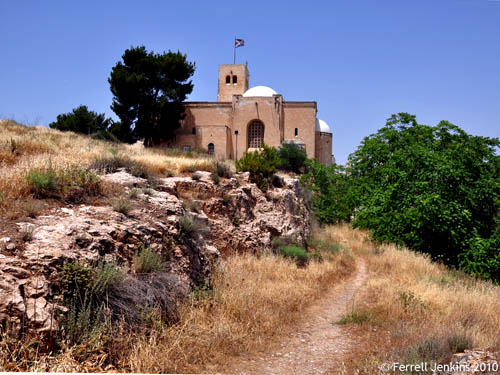
The watershed ridge in Jerusalem. Photo by Ferrell Jenkins.

The watershed ridge in Jerusalem. Photo by Ferrell Jenkins.

St. Andrew’s Church has an interesting history which is described briefly.

St Andrew’s Church, Jerusalem, was built as a memorial to the Scottish soldiers who were killed fighting the Turkish Army during World War I, bringing to an end Ottoman rule over Palestine. It is a congregation of the Church of Scotland. (Wikipedia)

A cornerstone on the Church indicates that the stone was laid on May 7, 1927, by Field Marshal the Viscount Allenby in commemoration of the liberation of Jerusalem on December 9, 1917. We have a photo of the liberation here. Another plaque in the Church indicates that King Robert Bruce wished for his heart to be buried here.

Before his death Bruce required Sir James Douglas to carry his heart to Jerusalem, in redemption of his unfulfilled vow to visit the Holy City. Accordingly Sir James set out, bearing with him the embalmed heart. On his way he fell fighting the Moors in Spain. The heart was recovered and found its resting-place at Melrose, while the body rests at Dunfermline, Scotland. (Vilnay, Israel Guide 1978, 87)

The barren hill on which the Church is built is called Bible Hill.
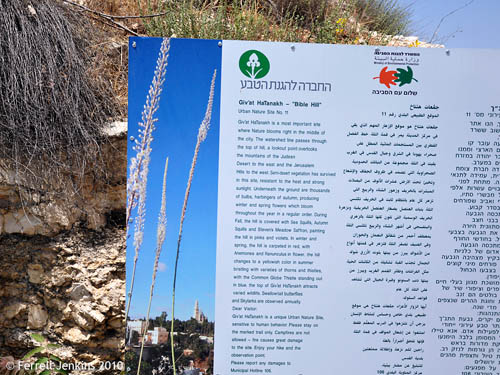
Sign marking Bible Hill, the watershed ridge in Jerusalem. Photo by Ferrell Jenkins.

Sign marking Bible Hill, the watershed ridge in Jerusalem. Photo by Ferrell Jenkins.

This hill marks a portion of the boundary of the biblical tribe of Judah. Notice the reference to “the top of the mountain.”

Then the boundary goes up by the Valley of the Son of Hinnom at the southern shoulder of the Jebusite (that is, Jerusalem). And the boundary goes up to the top of the mountain that lies over against the Valley of Hinnom, on the west, at the northern end of the Valley of Rephaim. (Joshua 15:8 ESV)

In another post we hope to show you more photos of the watershed ridge and the view on each side of it from this same location. Meanwhile, take a look at several photos of the Church, and a satellite view of the area at Bible Walks.

Jericho celebrates 10,000 years on 10-10-10

Since the excavations of Tell es-Sultan by Kathleen Kenyon (1952-1958), Jericho has publicized itself as the oldest city in the world. Kenyon thought she had found the earliest known fortifications.

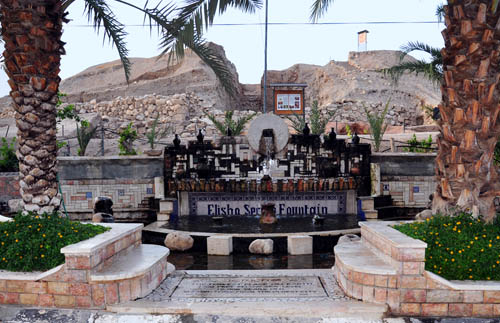
Tell es-Sultan has been neglected as a tourist site over the years. In May I was pleased to see that the site had been cleaned up a bit with clearly marked paths and new signs. One new thing I saw was a fountain marked as “Elisha Spring Fountain.” It is probably the same water one would find in the toilet [for those who have not traveled outside the USA, that is a Restroom].

Jericho Fountain and Tel es-Sultan

Elisha Spring Fountain & Tell es-Sultan (Jericho). Photo by Ferrell Jenkins.

Elisha’s Spring is on the east side of the tell. See our earlier post here. But, back to the 10,000 years. The mosaic in front of the fountain touts Jericho as “the lowest place on earth” and  “10,000 years old.” In fact, Jericho is about 82o feet below sea level (Encyclopaedia Judaica, 2nd ed., Vol. 11).

Jericho sign in 2010 claims to be oldest city. Photo by Ferrell Jenkins.

Jericho sign in 2010 claims to be oldest city. Photo by Ferrell Jenkins.

The Palestinian Prime Minister held his weekly Cabinet meeting at Jericho Sunday “to mark the town’s birthday.” Authorities said the choice of October 10, 2010 (10-10-10) was random.

Biblical Jericho attracts a steady flow of pilgrims, but the small Jordan Valley oasis is making a major push these days to become a magnet for tourists, presenting itself as the oldest city on earth. Marking the 10,000th birthday Sunday is entirely random, though, with archaeologists saying they could be off by hundreds of years in dating the first human settlement in the area.

Read the complete article, which is mostly about Hisham’s Palace from the 8th century A.D., here.

One Sunday my wife and I were eating with an attorney and his wife. Through the window we could see the sign of the restaurant next door. It said something about serving the world’s best chicken. I asked my friend about the legality of signs like that. He said it was “acknowledged puffery.” I suspect we should view the signs at Jericho, and a lot of other places, in the same light.

Todd Bolen has a post about this subject, with additional photos, on the Bible Places Blog here.