Category Archives: Archaeology

Todd Bolen and the BiblePlaces Newsletter

Just when I had about given up,
what to my wondering eyes did appear,
but a BiblePlaces Newsletter with 8 tiny photos of Jerusalem and Judah in Snow. (with apologies to no one!)

When Todd Bolen left Israel to come to the USA to pursue doctoral work I surmised that he would soon become too busy to continue with his Newsletter. He has done a fine job of keeping the Bible Places Blog up to date with notices of important archaeological news from Israel.

I have encouraged many people to subscribe to Todd’s BiblePlaces Newsletter and to buy his wonderful Pictorial Library of Bible Lands. After nearly forty trips to Israel, I still find that I am sometimes lacking the exact photo I need. I often find just the right one in this collection.

In the December BiblePlaces Newsletter there are 8 beautiful photos of Jerusalem and Judah in the snow. Todd was in the country about 10 years and had the opportunity to get photos at the right time.

Here is a small photo of the Mount of Olives and Kidron Valley. From the Newsletter you may download high resolutions copies of all eight photos. For those who use PowerPoint the photos are also available in PowerPoint format.
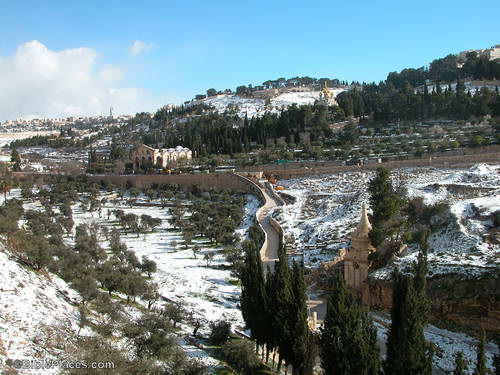
Mount of Olives and Kidron Valley in Snow

Here is Todd’s comment on the photo:

Looking northeast from the City of David, one gets an impressive view of the Kidron Valley and the Mount of Olives. Several stories occurred within the view of this photo, including David’s fleeing from Absalom (2 Sam 15:30) and Jesus’ crossing the Kidron Valley on his way to Gethsemane (John 18:1). The church in the center left of the photo is built over the traditional Gethsemane and the impressive tomb monument in the lower right is incorrectly known as the “Pillar of Absalom.”

To see the BiblePlaces Newsletter, December, 2007, click here. Opportunity to subscribe to the Newsletter is available at the bottom of the page. You can also learn how to order the Pictorial Library there.

Thanks, Todd. Your work has been a blessing to many.
Archaeological work at Ephesus might take centuries

Today’s Zaman, reports that the archaeological excavation at Ephesus may continue “for centuries.” The article says that work began at Ephesus 138 years ago. This reference seems to be to 1869 when the English architect J. T. Wood found the marble floor of the temple of Diana. Some research had been done as early as 1845.

Most of the archaeological work at Ephesus has been done by Austrians. They began the work in 1895 and have continued until the present time.

The article reports an interview with Dr. Fritz Krinziner, director of the dig and head of the Austrian Archaeology Institute. I note that Dr. Krinziner wrote Preface 2 in Ephesus: 100 Years of Austrian Research, published in 1996. Here are a few interesting comments from the article.

” He [Krinziner] stressed that it would be impossible to uncover the entire ancient city at once, underlining that only 10-15 percent of the site has been unearthed so far.”

“The excavation work may last for centuries. This is not an easy job. We focus on spots where we are likely to find something important as we cannot carry out the entire excavation at once.”

The article says that 1.5 million people visited Ephesus last year. An added note says that the Greater Izmir Municipality has announced plans “to establish an electric railway connection, similar to a tram, in Ephesus.”

The complete article may still be available here.

I speak to some people who seem to think that most of the archaeological work in various biblical cities has already been done. The work is complete! Think again.

Ephesus is visited by many tourists who have no interest in the Bible. They arrive on the cruise ships that dock at nearby Kusadasi. Others find the ruins interesting because the city was the site of Paul’s work (Acts 19). I think the tradition that the apostle John was here prior to being exiled to Patmos is a reliable one. The first letter within the book of Revelation is addressed to the church at Ephesus (Rev. 2).

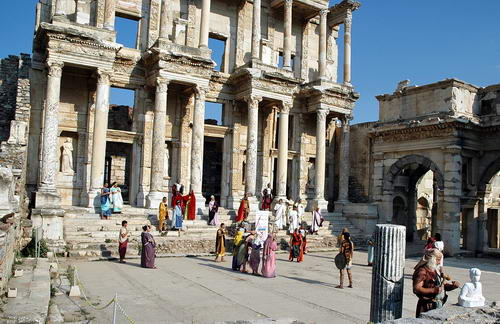
This photo shows the Library of Celsus and some costumed actors from one of the cruise ships putting on a show for the passengers.

Library of Celsus at Ephesus. Photo by Ferrell Jenkins.

The Library was built in A.D. 135, after the time of Paul and John. The first time I saw this area, in 1968, only the steps were visible. The Austrian excavators did a marvelous job of reconstruction between 1970 and 1978. It is estimated that the Library could hold between 9,500 and 12,000 rolls. The arch to the right leads to the ancient agora.

We visit Ephesus on our Steps of Paul and John tour.

Temple Mount controversies

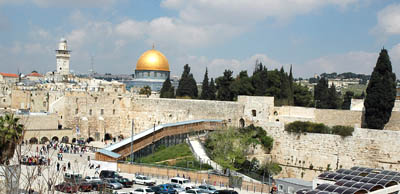
On recent tours to Israel we have been unable to visit the Temple Mount. The Islamic buildings there, the Mosque of Omar (Dome of the Rock) and the Al Aksa Mosque, have no spiritual significance for us. The site, however, is very important biblically. It was likely here on Mount Moriah that Abraham offered Isaac (Genesis 22). It is where David placed the ark of the covenant, and where the Temple was built by Solomon in 966 B.C. ( 2 Chronicles 3). That temple was destroyed by the Babylonians in 597 B.C.. After the return from captivity, the Jews rebuilt the temple with the help of the Persian king Darius in 520-516 B.C. Herod the Great more or less replaced this structure with his magnificent temple beginning in 19 B.C. Jesus visited this temple numerous times (John 2:19). In this area the gospel was preached for the first time on the Pentecost of Acts 2.

In the late 7th century A.D., a Muslim ruler constructed the building we now commonly call the Dome of the Rock.

The Temple Mount in Jerusalem

The photo above, made April 3, 2006, shows the Western Wall of the temple enclosure built by Herod. The temple platform, where you see the golden dome, is where the biblical temple once stood. Many news items have been written about the temporary bridge leading to the Temple Mount, and the removal of the earth by archaeologists to reveal more of the Western Wall. There has also been considerable controversy over repairs being made by the Muslims on the Temple Mount.

One good source to help you keep up with this controversy is Dr. Leen Ritmeyer’s blog. There you will find pictures of the terrible destruction taking place. Ritmeyer has drawn many of the excellent plans you may have seen published in various books.

Hezekiah’s Tunnel

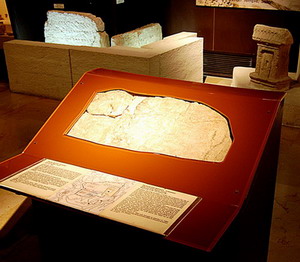
In Istanbul we visited the Palestine Room at the Istanbul Archaeological Museum. There we saw the stone inscription, sometimes called the Siloam Inscription, which was taken from Hezekiah’s tunnel in Jerusalem during the Ottoman period. Recently I posted an article about Hezekiah’s Tunnel at BiblicalStudies.info, along with several photographs of the tunnel. This tunnel, built by the King of Judah about 710 B.C., is mentioned in 2 Kings 20:20.

The photo below shows the inscription in its case in Istanbul. There is some recent talk indicating that this inscription might be returned to Jerusalem.

Hezekiah’s Tunnel (Siloam) Inscription

Psychological Study of Herod the Great

A historian from Tel Aviv University (Kasher) and a psychiatrist from Ben-Gurion Uniersity of the Negev (Witztum) have written King Herod: A Persecuted Persecutor: A Case Study in Psychohistory and Psychobiography. This book sells for $193, so I suspect that most of us will be satisfied to read a good review. Magen Broshi, a well-known Israeli archaeologist, has a review in Haaretz. Don’t expect this review to stay online very long. I suggest you go immediately and copy this good review.

With the recent interest in Herod due to the discovery of his tomb at the Herodium, this book is timely. If you had thought Herod was cruel, just wait till you read this.

I copy (print) article like the one mentioned above in Adobe PDF, and then save them in the appropriate folder on my computer (the new filing cabinet!).

HT: Paleojudaica.

The UP Museum of Archaeology

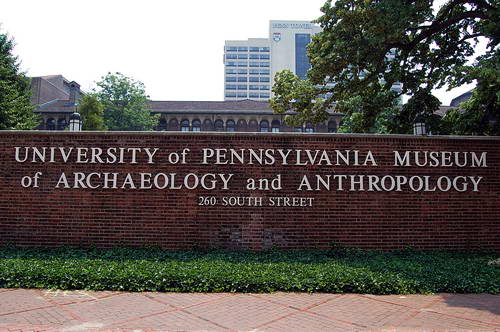
Tuesday I spent some time in the University of Pennsylvania Museum of Archaeology and Anthropology, Philadelphia. The museum has a nice collection of artifacts of interest to the student of the Bible. One of the best known names associated with the museum in the field of biblical archaeology is that of James Pritchard. Professor Pritchard edited The Ancient Near East Texts and The Ancient Near East in Texts and Pictures. He was also well known for his work at Gibeon and the book, Gibeon, Where the Sun Stood Still.

The museum has a nice collection from Egypt, Canaan, and Mesopotamia. The section on Mesopotamia is now closed with many of the items included as part of a traveling exhibit. One of the retired professors at UP told me 4 years ago that the museum has 40,000 clay cuneiform tablets, but I saw none of them on display during this visit. Currently there is an exhibit on Amarna, but I did not find it especially impressive after having visited museums in Egypt, London, and Berlin.

There is a good section on Rome, especially dealing with Emperor Worship. This is a helpful resource in studying Revelation.

University of Pennsylvania Musem of Archaeology and Anthropology

The Museum does not permit copies of photos made in the museum to be posted on other web sites (without some special permission, perhaps). If you are in the area, it is a worthwhile visit.

Gaziantep Museum, Mayberry, and Mount Nemrut

This morning we visited the Muze in Gaziantep. This museum contains many of the mosaics and some statues from the Roman city of Zeugma. Zeugma has been covered by the waters of the Euphrates River due to one of the dams built by the Turkish government to provide hydro-electric power and water for irrigation for southeastern Turkey. Archaeologists worked diligently over a period of years to preserve as much of the material as possible. The small mosaic below had been called Gypsy Girl. I think it would rival the Mona Lisa.

Gypsy Girl from Zeugma in Gaziantep, Turkey, Museum. Photo by Ferell Jenkins.

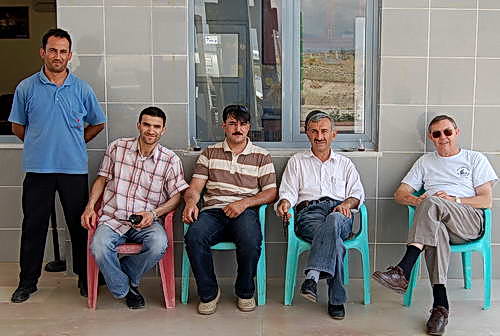
By 11 a.m. we headed for Mount Nemrut. We stopped at a gas station in Bezni for a comfort break. The locals who were sitting around talking did their best to communicate with us. Everyone we meet is friendly. I call this photo “Mayberry, Turkey.”

“Mayberry” Turkey. Ferrell with men at Besni. Photo by Gene Taylor.

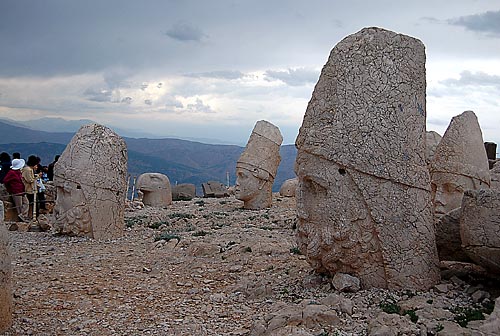
After checking in at the Zeus Hotel in Kahta, we arranged for transportation to Mount Nemrut. In 1995 I drove to the parking lot in a rental car, but decided that it would be best to leave the driving to someone else. It took about 1 1/2 hours to get to Nemrut Dagi. This mountain is part of the Anti Taurus range and is more than 7000 feet above sea level. This area was known as the Kingdom of Commangene in the three centuries preceding the Christian ear. It served as a buffer between the Seleucids and the Parthians in the third century B.C. In the first century B.C. it served as a buffer between the Romans and the Parthians. The most famous ruler was Antiochos I Epiphanes (ruled 64-38 B.C.). In 72 A.D. Vespasian made the Commangene part of Roman Asia. Being away from home I have relied on LonleyPlanet Turkey (April, 2007) for some of the facts. The sunset was not very brilliant this evening. In fact we left a little early because of an approaching shower. The tumulos was made of loose stones in the form of a pyramid. Antiochus ordered this built as a burial site for himself and some relatives. The remaining tumbled statues of rulers and gods are impressive. Some of the heads are between 6 and 7 feet tall. Take a look at the people beside one of them. The site overlooks the Euphrates River to the East.

Mount Nemrut (Nemrut Dagi). Photo by Ferrell Jenkins.

By 8:30 our driver had us back to the hotel and we enjoyed the evening meal. We thought Leon would have arrived in the USA, so we called him to tell him that this was the best day of the tour!

Perga and Attalia in Pamphylia

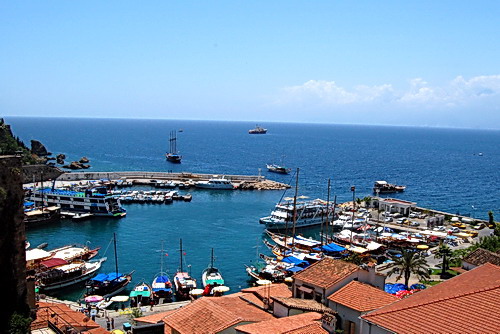
Friday we visited the historic ruins of ancient Pamphylia: Antalya (biblical Attalia, Acts 14:25) and Perge. Antalya is the modern name for Attalia which served as the port of entry from Egypt and Syria to the interior of Asia. From here Paul sailed back to Antioch (Acts 14:25). Our visit included the harbor, and Hadrian’s Gate, The photo below is of the harbor in Antalya (biblical Attalia).

The Harbor of Antalya, Turkey. This was the city of Attalia in New Testament times. Photo by Ferrell Jenkins.

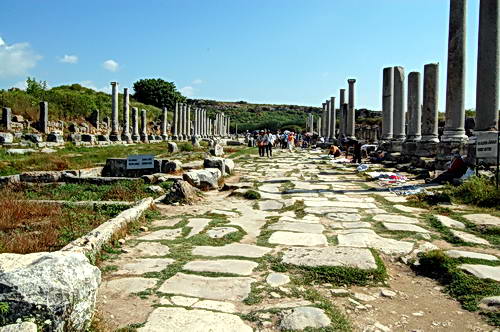
We enjoyed the visit to Perga very much. There are impressive Hellenistic and Roman ruins. Most of the Roman structures date to the second century A.D. This is where John Mark turned back from the work (Acts 13:13-14; 15:37-39). On his return from the first journey, Paul spent some time preaching here (Acts 14:25).

The Roman City of Perga in Pamphylia. Photo by Ferrell Jenkins.

The museum in Antalya is one of the nicest regional museums I have visited. Many of the artifacts, especially the statuary, are from the second century Roman city of Perga. Here is a photo of an Imperial Priest. A knowledge of the Roman Cult is important when one begins to study the book of Revelation. These were the men who gave the certificates to those who had worshiped the Emperor.

Second century Roman Imperial Priest in the Antalya, Turkey, Museum. Photo by Ferrell Jenkins.

Antalya is a popular Mediterranean resort town with many nice hotels. I would have enjoyed a few days just to relax. Next is Istanbul.

Iconium, Pisidian Antioch, Attalia

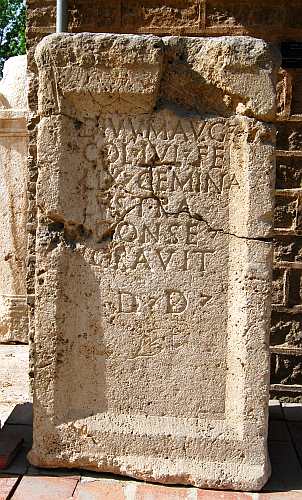
Konya is the site of ancient Iconium, one of the oldest cities of Anatolia. Paul and Barnabas encountered much opposition in this city (Acts 14:1-6). Konya is best known today as the home of the Whirling Dervishes. We made a brief visit of Konya including the Archaeological Museum. The museum contains three inscribed stone monuments of interest. One mentions Derbe, another one mentions Iconium, and the third one mentions Lystra (photo below). No ruins of Iconium have been excavated. The legendary second century Acts of Paul, telling about a convert by the name of Thecla, takes it setting in Iconium.

Lystra Inscription. Photo by Ferrell Jenkins.

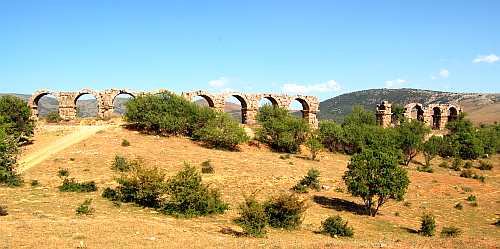
We continued west to Yalvac for a visit to the site of Pisidian Antioch. Yalvac is located on a plateau at an elevation of about 3600 feet above sea level. The nearby mound of Pisidian Antioch marks the spot where Paul presented a lesson summarizing the history of the Jewish nation, especially as it related to the Messianic promise (Acts 13:14-41). It was from this city that Paul announced that he would turn to the Gentiles (13:44-52). We also made a short stop at the archaeological museum in Yalvac and then continued through the beautiful mountains and valleys, and past Lake Egridir, to the Pamphylian coast to Antalya (Attalia) for overnight. Here is a photo of the Roman aqueduct that supplied water to the city of Antioch.

Roman aqueduct at Pisidian Antioch. Photo by Ferrell Jenkins.

Friday we visited Perga, Attalia, and the Archaeological Museum. Check back later to see the photos.

Derbe and Lystra

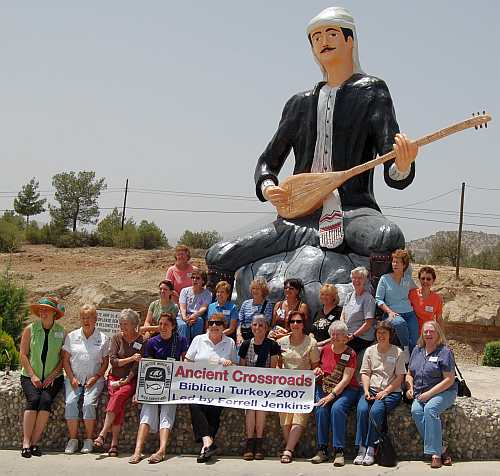
We left Adana and traveled along the beautiful Tuquoise Coast passing Mersin, Pompeipolis, Corycos and Silifke. The Mediterrenean coast is the real fruit bowl of Turkey. At Silifke we headed north and drove through another of the important passes in the Taurus Mountain highest point was about 5000 feet above sea level. We saw some Cedars of Lebanon growing in the area. That is about the same altitude of the great Cedars in Lebanon. Near Karaman we stopped for a lunch break. The ladies of the group posed under an image of one of Turkey’s famous folk musicians from the area.

The Ancient Crossroads Women near Karaman, Turkey. Photo by Ferrell Jenkins.

We visited the tell of Derbe (Kerti Huyuk; Acts 14:20-21; 16:1; 20:4). We made a short stop at the Museum in Karaman to see one of the inscriptions which helped to identify the site of Derbe. After that we headed for the mound of Lystra (Zordula) of Lycaonia near the village of Hatunsaray. It was here that the priest of Zeus wanted to offer a sacrifice to Paul and Barnabas (Acts 14:6-20). This was the home of Lois, Eunice, and young Timothy (Acts 16:1-4). These cities were in the province of Galatia (Gal. 1:2) in New Testament times. Both Derbe and Lystra await the archaeological spade.

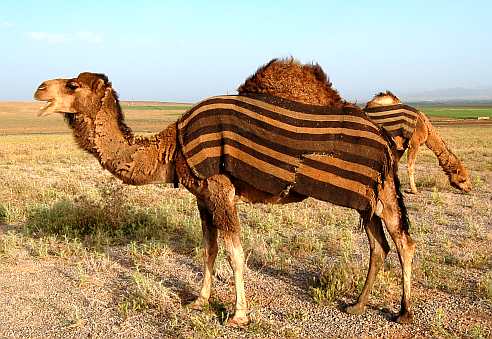
Along the way we saw a large flock of goats (several hundred) and some camels grazing in a field. The nomad family, consisting of a mother and three or four girls, had brought the animals from the Coast over a two month period. The young lady watching the camels did not know her age. She might have been between 14 and 16 told our guide they would go back “when the first snow flakes fall.” This was a good reminder of Patriarchal days of the Bible.

Migratng camels with nomads near ancient Lystra in Turkey. Photo by Ferrell Jenkins.

Thursday we plan to visit the archaeological museum in Iconium (Konya) and Pisidian Antioch before heading for Antalya (Attalia of the New Testament).