Category Archives: Archaeology

Pergamum and Thyatira

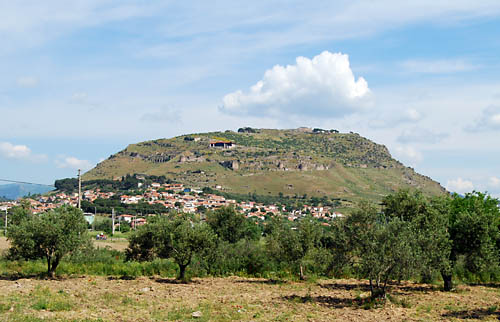
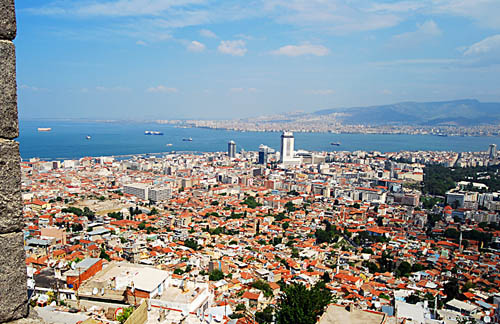
Today we drove north of Izmir to visit the Pergamum (modern Bergama), another of the cities of the seven churches of the book of Revelation. This visit included the acropolis temple of Athena, the famous library, the royal palace, the temple of Trajan, the steepest theater of the world, and site of the altar of Zeus. The weather was perfect for photography most of the day. This photo shows the acropolis of Pergamum.
We made a short visit at the Archaeological Museum to see the inscription that states that Pergamum had twice been named NEOKOROS. This term means that two temples dedicated to the Roman emperors had been erected in the city. In fact, later there was a third temple. Emperor worship presented a serious problem for the Christians of Asia Minor in the last part of the first century, and the following centuries.

We visited the ruins of the Asclepieum, the medical center of the ancient world.

After lunch we drove to Thyatira (modern Akhisar) to see the few archaeological remains of the city. Lydia, the seller of purple who was converted to Christ at Philippi, was from Thyatira (Acts 16:14).

For the letter to the church at Pergamum read Revelation 2:12-17. For the letter to Thyatire read Revelation 2:18-29.
Dr. Mark Wilson speaks to our group

Dr. Mark Wilson and his wife, Dindy, shared the evening meal with us at the hotel this evening. Afterwards, Mark spoke to the group about his work in Turkey. Dr. Wilson is the founder and director of the Asia Minor Research Center, and spends about nine months each year working and doing research in Turkey. He has updated several of the works of Sir William M. Ramsay, and written several helpful books on the book of Revelation. You will find much helpful material by Dr. Wilson on the Seven Church Network web site.

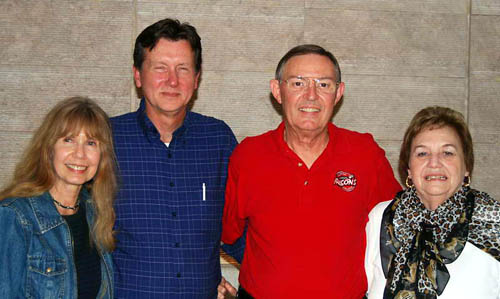
Our group listened carefully as Dr. Wilson spoke of the importance of Turkey to the study of the New Testament. Members of the group asked several interesting questions. Several of our tour members were with us last year on the Ancient Crossroads Tour of Biblical and Historical Turkey. This photo shows Dindy and Mark Wilson with Ferrell and Elizabeth Jenkins after tonight’s session.

Izmir (Smyrna of the Book of Revelation)

This morning we flew from Istanbul to Imzir, Turkey’s second largest city. Our sightseeing included Mount Pagos with its magnificent view of the city and harbor. Most of the ancient city of Smyrna is buried underneath the modern buildings. A portion of the Agora (marketplace) of Smyrna has been unearthed in the past. Houses have been demolished the a large area adjoining the agora, and preparations are being made for additional excavations. This will be exciting to watch.

There are two important archaeological museums in Izmir. We made short visits to each of them. In the older museum we saw the likeness of Flavius Damianus, an imperial priest under Emperor Septimius Severus, wearing a diadem. This provides an impressive image of the place of emperor worship in Asia Minor in the days following the writing of the book of Revelation.

And to the angel of the church in Smyrna write: ‘The first and the last, who was dead, and has come to life, says this: ‘I know your tribulation and your poverty (but you are rich), and the blasphemy by those who say they are Jews and are not, but are a synagogue of Satan. ‘Do not fear what you are about to suffer. Behold, the devil is about to cast some of you into prison, so that you will be tested, and you will have tribulation for ten days. Be faithful until death, and I will give you the crown of life. ‘He who has an ear, let him hear what the Spirit says to the churches. He who overcomes will not be hurt by the second death.’ (Revelation 2:8-11).

Significant biblical artfacts in the Istanbul Museum

My favorite place in Istanbul is the Archaeological Museum. There are several buildings. One contains items from the Ancient Orient, that is, from Mesopotamia, Assyria, Babylon, and a collection of Hittite items. Another has numerous items from the Greco-Roman world. On the third floor artifacts from Syria, Palestine, Lebanon, and Cyprus, are displayed.

The Ottoman Empire controlled Palestine in from the 16th to the 20th centuries. The earliest archaeology in Palestine was done at Megiddo, Tanaach, and Gezer. Since the Turks were in charge, many of the artifacts were brought to Istanbul. These items have not always been easy to see. Once or twice, in past years, I had to made a “donation” to the museum in order to get in room where these items are exhibited. Even now, it is difficult (for older visitors) because there are no elevators going to the third floor.

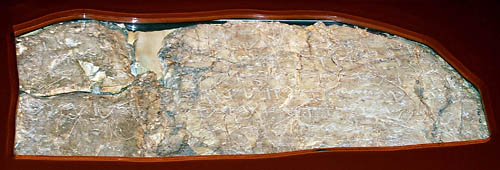
There is not time now to mention all of these items. However, I am pleased to share with you what I consider an unusually good photo made without a tripod and special lighting. It is the famous Siloam Inscription. We sometimes call its the Hezekiah;s tunnel inscription.

This inscription was cut from Hezekiah’s tunnel in Jerusalem shortly after it was discovered in 1880. The tunnel was built to connect Gihon Spring with the Pool of Siloam (ca. 710 B.C.; 2 Kings 20:20; 2 Chronicles 32:30; cf. John 9:7). Palestine was part of the Turkish empire at the time of the discovery and this is how the inscription came to be in Istanbul. The inscription, written in the ancient Hebrew script, describes the completion of the tunnel when the workers met near the middle on the last day of work. It reads, in part:

while there were still three cubits to be cut through, (there was heard) the voice of a man calling to his fellow, for there was an overlap in the rock on the right (and on the left). And when the tunnel was driven through, the quarrymen hewed (the rock), each man toward his fellow, axe against axe; and the water flowed from the spring toward the reservoir for 1,200 cubits, and the height of the rock above the head(s) of the quarrymen was 100 cubits. (Ancient Near Eastern Texts 321)

I have walked through Hezekiah’s tunnel several times and have seen the place from which the inscription was taken.

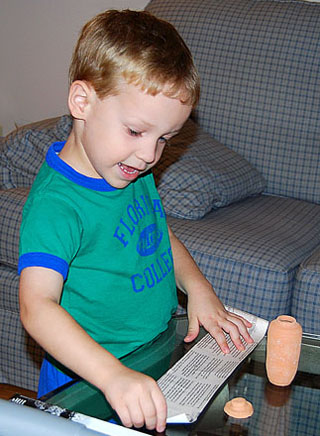
My grandparents went to Israel …

… and all I got was this little Dead Sea Scroll jar. (Of course, anyone acquainted with his grandmother knows differently!) After Grandmother read him the Mystery of the Dead Sea Scrolls, he promptly hid his jar in a secret place [behind the easy chair].

What a wonderful thing to learn about at his age. The Dead Sea Scrolls, discovered in 1947, are of great value to biblical studies.

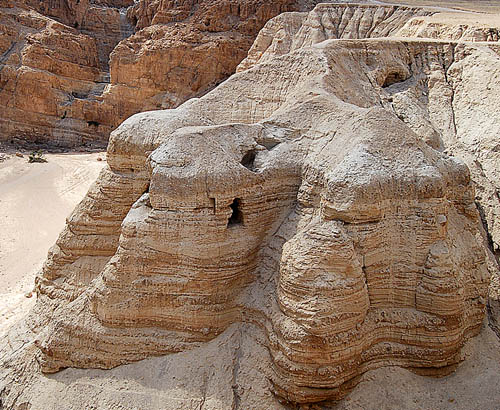
Below is a photograph of Cave 4 at Qumran, on the shores of the Dead Sea. Numerous fragments of the first five books of the Old Testament (Torah) were found in this cave. Qumran was in Jordan at the time of the initial discovery of the scrolls. Some of the scrolls are now displayed at the Shrine of the Book in Jerusalem.

City of David website wins global UN award

Our recent group to Jerusalem was able to see a few of the new discoveries made in the City of David excavations. Everyone can enjoy and profit by looking at this great website. Israel21c reports,

Israel may have missed out at the Oscars in Hollywood, but an Israel website, http://www.cityofdavid.org.il, won first prize at the UN-sponsored World Summit Awards (WSA) in Venice recently.

Selected as “the best in e-content and creativity in the category of e-culture,” “this outstanding website brings remote visitors face to face with the protagonists and locations of the living Bible,” the WSA stated in its laudatory citation.

“Its fabulous visuals and rich description of the site – in English, Spanish, Hebrew, French and Russian – bring to life the only place on earth where the only guidebook needed is the Bible itself.”

Read the full article here.

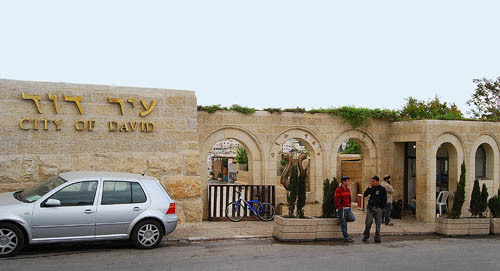
View the website of the City of David. It is a beautiful site filled with small photos, videos, and timelines. Below is a photo of the entrance to the City of David park. This entrance is located a little south of Dung Gate on the road that leads down to the point where the Kidron, Tyropean, and Hinnom valleys meet.

This area is not without political controversy and ramifications. An alternative web site, From Shiloah to Silwan, has good material.

HT: Paleojudaica.

The stadium at Aphrodisias

Aphrodisias, located in southwest Turkey, was an ancient city of Caria in Asia Minor. It is not mentioned in the Bible, but is close to the cities of Laodicea, Hierapolis and Colossae. Robert F. Tannenbaum, an ancient historian, describes the location of the city this way:

A quiet, fertile valley folded into the Mediterranean hills, clear streams, tall poplars, ancient ruins more than 1,400 years old—a picture of pastoral quiet. (Biblical Archaeology Review, Sept/Oct 1986)

The site has been excavated since 1966, beginning under the direction of Kenan Erim of New York University. Marble was readily available at a nearby quarry and the excavation has brought to light a multitude of marble inscriptions and statues from the Roman period including a statue of the Emperor Domitian. Buildings include a theater, an agora, a bath, temples, and a well-preserved stadium.

Louw-Nida describes a stadium as an “open, oval area (frequently including a racetrack) around which was built an enclosed series of tiers of seats for those who came to watch the spectacles – arena, stadium.” When Paul spoke of running the race in 1 Corinthians 9:24, he used the Greek term stadion. The term was also used as a measure of distance and is found in John 6:19. It was about one-eighth of a Roman mile. Most large Greek and Roman cities had a stadium. The figure of the stadium is in mind in Hebrews 12:1-2, where a host of witnesses watch as we run the race.

Therefore, since we have so great a cloud of witnesses surrounding us, let us also lay aside every encumbrance and the sin which so easily entangles us, and let us run with endurance the race that is set before us, fixing our eyes on Jesus, the author and perfecter of faith, who for the joy set before Him endured the cross, despising the shame, and has sat down at the right hand of the throne of God. (Hebrews 12:1-2)

The stadium at Aphrodisias is the best preserved I have seen and I wanted to share it with you in the photo I made in 2006. Picture yourself in the stadium.

This article, with minor changes, was published in Biblical Insights, September, 2006.

A day in Perea (Jordan Valley)

Yesterday we spent a large part of the day in the Jordan Valley. This area was called Perea by the Romans. We typically divide the ministry of Jesus into the Early Judean, Galilean, Perean, and Later Judean. You probably will not find the word Perea in an English translation of the Bible. The Greek word peran is translated “beyond” in passages such as Matthew 19:1 and Mark 10:1.

We visited mostly Old Testament sites, but there is considerable disagreement among scholars about the precise identification of most of these sites. Here are some possible sites we saw: Abel-Shittim, Succoth, Zarethan (or Zaphon). We also visited Tell Mazar, and the area of Tell Dhahab (possible sites of Penuel, and nearby Mahanaim). There are no road signs to these places and the locals in the nearby villages provided little help. This is the vicinity where Jacob settled for a while on his trek from Padan-Aram to Shechem.

One of our most interesting stops was at Tell Kafrein. This site had not yet been identified, but a team of archaeologists from a Greek university were working there. We met the director and received a good tour of the site and of the pottery lab.

Today we will probably go to the area south of Amman, including Heshbon, Dibon, and other sites.

Did the Apostle Paul attend the Isthmian Games?

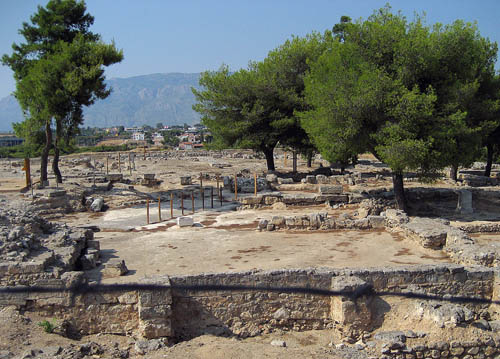
Within the past two weeks the Olympic torch was lighted at Olympia, Greece, amid political disruption. Important games were held by the Greeks at Olympia, Delphi, Nemea, and Isthmia. Isthmia is located just a few miles from ancient Corinth, near the modern Corinth Canal.

The Isthmian Games, conducted biennially in honor of Poseidon, were second in importance to the Olympics. Discoveries at Isthmia have included starting gates for the races. Professor Oscar Broneer, who excavated at Corinth, indicates that Greek athletics had become corrupt and degraded during Paul’s lifetime [like professional sports in too many places, perhaps?]. Broneer suggested that Paul was present during one of these athletic festivals (Biblical Archaeologist, Feb., 1962; Acts 18). Here is a photo from Isthmia.

Isthmia, near ancient Corinth, was the site of athletic games in honor of Poseidon. Photo by Ferrell Jenkins.

Paul made many references to athletic contests, especially in the letter to the church at Corinth. There are references to the races, and to boxing in 1 Corinthians 9:24-27. The victor’s crown at the Isthmian Games was made of wilted celery! This makes Paul’s reference to a “corruptible crown” come to life, doesn’t it (1 Corinthians 9:25)?

Note of Explanation. You may wonder how I could upload photos of Isthmia but not of those taken in the past few days. This post was already uploaded from home a couple of weeks back. Since I am still limited here I wanted to share this with you. And, the next tour is Steps of Paul and John.

At Petra in Jordan tonight

Today we left Israel, crossed the border into Jordan, and made our way to Petra for the night. We visited a site now being identified as Bethany Beyond the Jordan, Mount Nebo, Madaba, and then followed he Kings Highway and the Desert Highway to Petra. Here is the photo of the group. I know the photo is a little small, but if you know someone in the group you will probably be able to identify him/her. The photo is made from the Mount of Olives with the city of Jerusalem in the background.

Bible Land 2008 Group Photo from Mount of Olives with Jerusalem in the background.

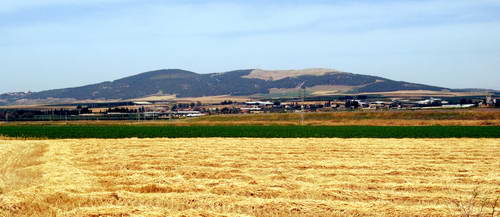
Here are a few photos I intended to upload earlier. The first one is of the Hill of Moreh. Moreh overlooks the Jezreel Valley, and is where Gideon defeated the Midianites.

Then Jerubbaal (that is, Gideon) and all the people who were with him, rose early and camped beside the spring of Harod; and the camp of Midian was on the north side of them by the hill of Moreh in the valley. (Judges 7:1)

Hill of Moreh where Gideon defeaed the Midianites. Photo by Ferrell Jenkins.

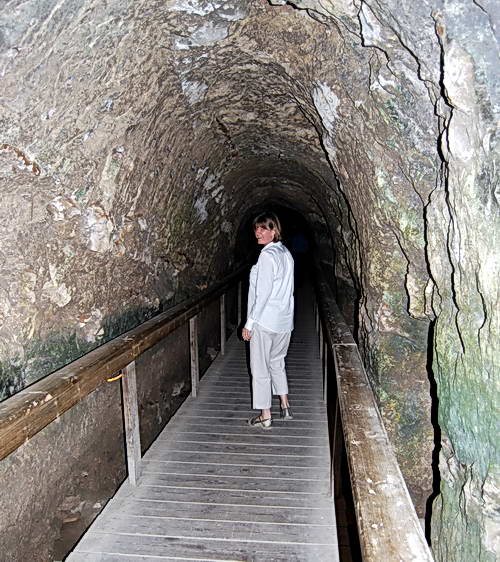
And finally, for tonight, here is a photo made in the Iron Age tunnel at Megiddo. Scholars often attribute this tunnel to the time of Ahab, king of Israel about 850 B.C. Walls, water, and food were the three most important necessary things in an ancient city. This tunnel connected the city to the spring that was outside the city.

The Iron Age water tunnel at Megiddo. Photo by Ferrell Jenkins.

Tomorrow night we probably will not have Internet access from the hotel at the Dead Sea. Perhaps I will be able to post another photo tomorrow morning before visiting Petra.