Category Archives: Archaeology

Top archaeological discoveries of 2008

Todd Bolen has posted his “Top 8 of 2008: Archaeological Discoveries Related to the Bible” at the BiblePlaces Blog. Take a look.
Satellite imagery reveals Egyptian ruins

CNN has a report on the use of satellites to help unearth ancient Egyptian ruins. Read the full article here. The report features the work of Sarah Parcak, an archaeologist at the University of Alabama at Birmingham.

In our society we tear down anything that is a decade or more old in order to build a new structure. Except, of course, for our historical districts. It wasn’t that way in the ancient world. If a structure was destroyed or ravaged, the conquerors might build a new one in the same place. They would build over and utilize any walls still standing.

Building in ancient Egypt was along the Nile River and in the Delta. Much of what shows as Egypt on a modern map is not currently habitable. Eighty two million people live in this small space, according to the CNN report. When I took my first group to Egypt in 1967 we were told that the population was 40 million. Even then it seemed crowded; now it is terrible.

Here are a few comments about Parcak’s work:

In this field, Parcak is a pioneer. Her work in Egypt has yielded hundreds of finds in regions of the Middle Egypt and the eastern Nile River Delta.

Parcak conducted surveys and expeditions in the eastern Nile Delta and Middle Egypt in 2003 and 2004 that confirmed 132 sites that were initially suggested by satellite images. Eighty-three of those sites had never been visited or recorded.

In the past two years, she has found hundreds more, she said, leading her to amend an earlier conclusion that Egyptologists have found only the tip of the iceberg.

“My estimate of 1/100th of 1 percent of all sites found is on the high side,” Parcak said.

And here are some comments made by Parcak about the value of the satellite images:

“We can see patterns in settlements that correspond to the [historical] texts,” Parcak said, “such as if foreign invasions affected the occupation of ancient sites.

“We can see where the Romans built over what the Egyptians had built, and where the Coptic Christians built over what the Romans had built.

“It’s an incredible continuity of occupation and reuse.”

The flooding and meanders of the Nile over the millennia dictated where and how ancient Egyptians lived, and the profusion of new data has built a more precise picture of how that worked.

“Surveys give us information about broader ancient settlement patterns, such as patterns of city growth and collapse over time, that excavations do not,” said Parcak, author of a forthcoming book titled “Satellite Remote Sensing and Archaeology.”

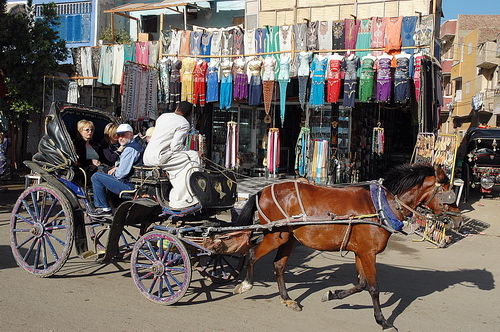
In every town along the Nile in Upper Egypt (the south) buildings crowd the river. This scene is from Edfu.

Shops at Edfu in Upper Egypt. Photo by Ferrell Jenkins.

Shops at Edfu in Upper Egypt. Photo by Ferrell Jenkins.

Museum exhibitions

Babylon: Myth and Reality runs until March 15, 2009, at the British Museum in London. Details, along with videos and photos available here. This exhibition brings together artifacts from the British Museum, Berlin, the Louvre, and other museums. If you have an opportunity to go, be sure to download our brief list of Some Biblically Related Artifacts in the British Museum here.

Tutankhamun and the Golden Age of the Pharaohs runs through May 17 at the Dallas [Texas] Museum of Art. Details here.

Tutankhamun: The Golden King and the Great Pharaohs runs through May 22 at the Civic Center in Atlanta, Georgia. Details here.

The Michael C. Carlos Museum at Emory in Atlanta has an exhibition called Wonderful Things: The Harry Burton Photographs and the Discovery of the Tomb of Tutankhamun. It runs through May 25. Details here.

Excavating Egypt is a major exhibition from the Petrie Museum of Egyptian Archaeology. This exhibition runs at the University of Kentucky, Lexington, from March 14 through June 14, 2009. Details here.

We wrote of a King Tut exhibition in Vienna, with a nice photo, here.

Pompeii and the Roman Villa (Art and Culture Around the Bay of Naples) continues at the National Gallery of Art in Washington, D.C. through March 22. Details here. Videos, audios, and other material online.

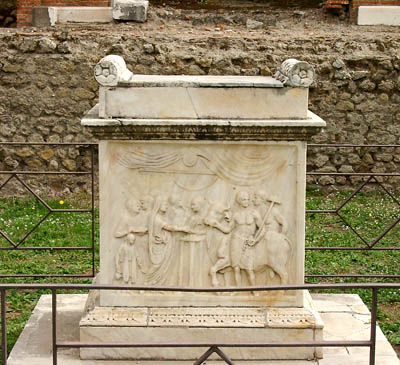
The photo below is one I made in 2001 of the altar at the Temple of Vespasian at Pompeii. Vespasian was the Roman general who led the attack on the Jewish rebels beginning in A.D. 66. Upon learning of the death of Nero he headed back to Rome. Later he became Emperor. Pompeii was covered with volcanic ash in A.D. 79. This altar shows a sacrificial scene.

Sacrificial altar, Temple of Vespasian, Pompeii. Photo by Ferrell Jenkins.

Sacrificial altar, Temple of Vespasian, Pompeii. Photo by Ferrell Jenkins.

Art and Empire: Treasures From Assyria in the British Museum continues through January 4 at the Museum of Fine Art in Boston. Details here. We wrote about visiting this exhibition here.

Most of these exhibition are listed in the Nov./Dec. 2008 issue of Saudi Aramco World.

Final SBL report

Sunday afternoon I attended a session on Rome and Religion: A Cross-Disciplinary Dialogue. The featured speaker was Karl Galinsky, a distinguished professor of classics from the University of Texas. His topic was The Cult of the Roman Emperor: Uniter or Divider. Galinsky began by saying that he was pleased to see that New Testament scholars had finally discovered the “historic context of the New Testament.”

Galinsky emphasized that the Emperor cult existed. He said that we must not think of it as the prominent cult, but as being intertwined with the other cults known throughout the Roman Empire. Another speaker, Barbette Stanley Spaeth, cited evidence of the emperor cult in Corinth. I found the information significant in the study of the book of Revelation as well as the epistles of Paul.

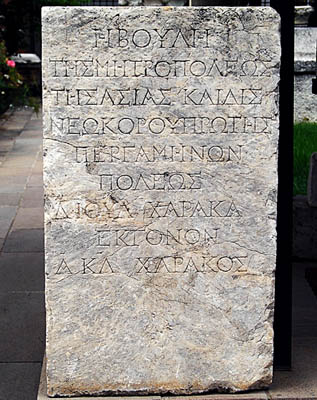
A Travel Note: The photo below shows an inscription which is now displayed in the garden of the archaeology museum in Bergama, Turkey (ancient Pergamum; Revelation 3:12-17). The inscription states that Pergamum was metropolis of Asia and twice NEOKOROS. This last word was the one commonly used when a city of Asia Minor was awarded the right to build a temple to the Emperor. This type of information must be taken into account when we consider the setting of the Book of Revelation.

Inscription at Pergamum claiming that the city was twice NEOKOROS. Photo by Ferrell Jenkins.

Inscription at Pergamum claiming that the city was twice NEOKOROS. Photo by Ferrell Jenkins.

Monday morning I attended another session on Biblical Lands and Peoples in Archaeology and Text. This one dealt with Samaria and the Samaritans. There were seven presenters. I especially enjoyed hearing Robert J. Bull of Drew University. Bull excavated a site called Tell er Ras on Mount Gerizim between 1964 and 1968 when it was under the control of the Hashemite Kingdom of Jordan. I enjoyed seeing his photos, drawings, and explanations. His work uncovered evidence of Hadrian’s temple in the early second century A.D. In more recent excavations Y. Magen claims to have discovered the Samaritan temple destroyed by John Hyrcanus. Magen was not present. Some of the speakers indicated that a final report has not been made by Magen and they did not comment on the matter.

This whole area is of great significance to students of the New Testament. The conversation between Jesus and the woman of Samarian dealt with this issue.

“Our fathers worshiped in this mountain, and you people say that in Jerusalem is the place where men ought to worship.” (John 4:20).

Treasures from Assyria

Recently I wrote about the of Assyrian treasures from the British Museum currently exhibited at the Museum of Fine Arts in Boston. See here. Monday afternoon Leon Mauldin and I spent a few hours in the MFA visiting the Assyria exhibit as well as the Roman and Egyptian sections of the Museum. We had a little time to sample some of the other great art treasures there.

I had seen quite a few of the artifacts in the British Museum, but the exhibit was well arranged and certainly worth the time and fee. I urge everyone within a reasonable distance to attend between now and January 4. Check the web site here.

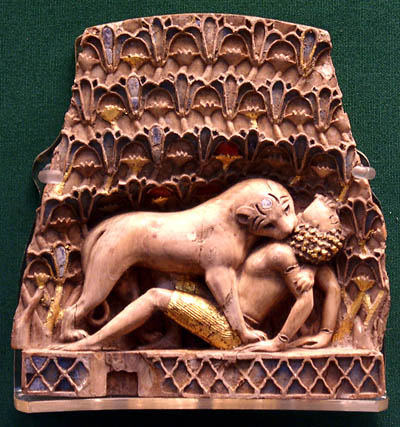
The artifact used on the front of the exhibit catalog and the advertising for the Boston exhibit shows a relief in ivory of a lioness devouring a man with negroid features in a thicket of stylized lotus and papyrus plants. This piece belongs to the Nimrud ivories displayed in the British Museum. Photos are not allowed in the Boston exhibit, but here is a picture I made about five years ago in the BM.

One of the Nimrud Ivories from the British Museum. Photo by Ferrell Jenkins.

One of the Nimrud Ivories from the British Museum. Photo by Ferrell Jenkins.

Both Israel and Judah had contact with the Assyrian Empire. There are numerous historical contacts between the two nations attested in both the Bible and the Assyrian records.

The reliefs on display show the Assyrians at war — always victorious. The kings are shown hunting lions and bulls. This spirit of conquest is mentioned by the prohphet Isaiah.

Woe to Assyria, the rod of My anger And the staff in whose hands is My indignation, I send it against a godless nation And commission it against the people of My fury To capture booty and to seize plunder, And to trample them down like mud in the streets.  Yet it does not so intend, Nor does it plan so in its heart, But rather it is its purpose to destroy And to cut off many nations. (Isaiah 10:5-7)

Learning more at the SBL meeting

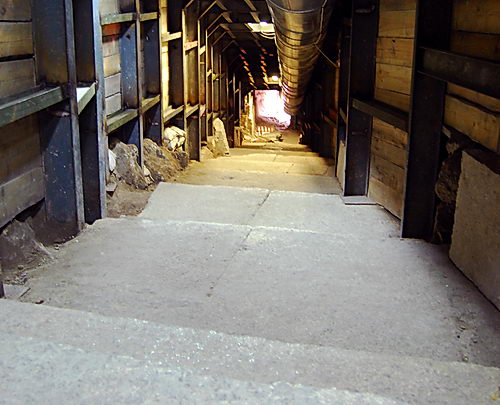
Sunday afternoon I attended two good sessions for a total of 10 papers or presentations. The first was on Biblical Lands and Peoples in Archaeology and Text. Ronny Reich of Haifa University spoke on the discovery of the road leading from the Pool of Siloam to the Temple Mount in Jerusalem. I saw a portion of this street and the tunnel underneath it earlier this year.

Street leading from Pool of Siloam up to the Temple Mount. Photo by Ferrell Jenkins.

Street leading from Pool of Siloam up to the Temple Mount. Photo by Ferrell Jenkins.

Doron Ben-Ami of the Israel Antiquities Authority spoke about the Givati Garage excavation south of Dung Gate. The structure found there is very large and is thought to have belonged to the family of Queen Helena of Adiabene. You can find more information and photos here.

One young scholar read a paper on Roman Jerusalem as a Setting of Earliest Christianity. He cited someone as saying that Acts might have been written in the middle of the second century. That theory is almost as old as the material he was dealing with. He thought that Luke’s account of the beginnings of Christianity was “magical.” Well, some presentations are well researched and profitable, and others are not.

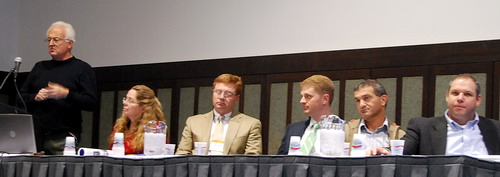
Bible Lands and Peoples in Archaeology and Text presenters. Reich is speaking. Photo by Ferrell Jenkins.

Bible Lands and Peoples in Archaeology and Text presenters.Photo by Ferrell Jenkins.

More later about the second section I attended.

Society of Biblical Literature in Boston

The annual meeting of the Society of Biblical Literature is being held in Boston this year. I have been attending these meetings for many years. I come in order to hear a few of the many valuable, and some not so valuable, presentations by scholars who are presenting their latest research on some particular topic.  When I was still actively teaching I often attended sessions that were related to the courses I was teaching. Now I tend to go to what is of interest.

These meetings attract more than 5000 members, most of whom are teachers in some field relating to biblical studies.

One of my favorite topics is archaeology and how it relates to biblical history. Many of the leading archaeologists make presentations or read papers telling about the most recent excavations. This, of course, puts me far ahead of the curve if one is waiting to read the information in a magazine or a book. In fact, I observe that many presentations given at SBL will eventually be a chapter in a volume published by the author some years later.

Saturday I heard Thomas Levy and other colleagues from the University of California San Diego tell about the recent work in southern Jordan dealing with the ancient Edomites and copper mining in the area. Levy has discovered that copper mining was common in the area from the 10th century B.C. I have already reported on this discovery, with photos, here, with a related post about mining at Timna here. I hope you will take time to read those reports.

In the afternoon I attended a session on the Wall of Jerusalem in the Persian Period. I suspect that the person making room assignments has no idea about some of the presenters. The most controversial of the speakers here was Israel Finkelstein of Tel Aviv University. He has been dubbed the father of minimalism. Actually he is currently the most prominent in a long line of those who devalue the biblical record. The room was full and overflowing. I sat on the floor in order to be able to see the screen and hear the speaker. The presentations by Ronny Reich, Alon de Groot,  and Wolfgang Zwickel were also informative. Evidence from the Persian period is limited, possibly because it was a significant but short period of biblical history. Here are some of the major events:

  • The Jews were allowed to return from Babylonian Exile in 536 B.C. because of the decree of Cyrus. Remember that only a remnant returned.
  • The temple was rebuilt in 520-516 B.C.
  • Ezra returned with a second group in 458 B.C.
  • Nehemiah returned to help rebuild the wall in 444 B.C.

The evidence presented regarding the number of inscriptions, pottery, jewelry, etc. from the Persian period indicated a small number of items in comparison to the much larger number from the Iron Age and the Hellenistic Age. This is really not surprising when we consider the the circumstances of the period, the possible reuse of materials by later builders, etc.

Everywhere one puts down a pick in Jerusalem there is evidence of earlier civilizations. Keep digging!

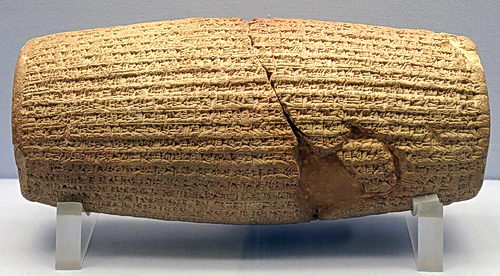
Before closing, let me add a little something Persian to this post. Here is a photo of the Cyrus Cylinder, now in the British Museum.

The Cyrus Cylinder. British Museum. Photo by Ferrell Jenkins.

The Cyrus Cylinder. British Museum. Photo by Ferrell Jenkins.

This document records that Cyrus allowed captive peoples to return to their homelands, build their temples and worship their gods. This is similar to the account given in 2 Chronicles 36 and Ezra 1 regarding the Judeans.

Now in the first year of Cyrus king of Persia– in order to fulfill the word of the LORD by the mouth of Jeremiah– the LORD stirred up the spirit of Cyrus king of Persia, so that he sent a proclamation throughout his kingdom, and also put it in writing, saying,  23 “Thus says Cyrus king of Persia, ‘The LORD, the God of heaven, has given me all the kingdoms of the earth, and He has appointed me to build Him a house in Jerusalem, which is in Judah. Whoever there is among you of all His people, may the LORD his God be with him, and let him go up!'” (2 Chronicles 36:22-23)

The Semitic Museum at Harvard

Friday afternoon I went with two of my former students, friends, and fellow-preachers to visit the Semitic Museum at Harvard. Tim Reeves preaches in Providence, RI. He offered to take Leon Mauldin and me to our hotel in Boston. I suggested going by the Museum before going to the hotel so Tim could visit also. I have been at the Museum before, but not since the new exhibit has been on view.

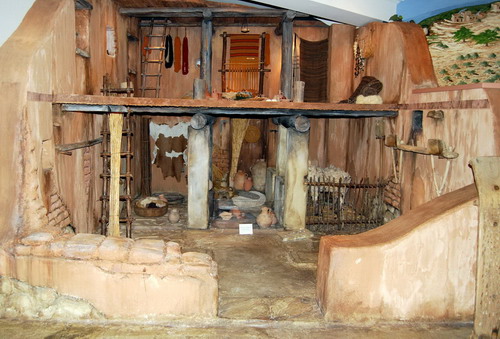
The Houses of Ancient Israel: Domestic, Royal, Divine is the featured exhibit at the Semitic Museum now. This exhibit traces the development and importance of the house in ancient Israel, from the family dwelling to the house of the king, and the house of the Lord (the temple). Here is a photo of the typical pillared “four-room” Israelite house that was common during the periods of the United and Divided Kingdoms.

Typical Iron Age (1200-586 B.C.) Israelite house. Photo by Ferrell Jenkins.

Typical Iron Age (1200-586 B.C.) Israelite house. Photo by Ferrell Jenkins

It would take several pages of writing to explain all of the items on display in the house. Their use could be illustrated with a variety of Bible verses. The research back of this house has been presented by Phillip J. King and Lawrence E. Stager in Life in Biblical Israel (Knox/Westminster, 2001). I highly recommend this book to all Bible teachers.

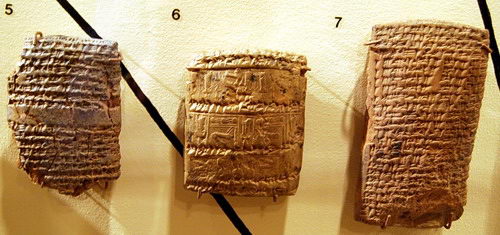
This is the only Museum I know about with displays of tablets from ancient Nuzi. About 4000 tablets in the Hurrian language were discovered by archaeologists in the early part of the twentieth century. Ancient Nuzi was not an important urban center, but these tablets reveal much about economic and domestic life from a period beginning about 2400 B.C. and continuing several centuries. It has been pointed out that several events associated with the biblical patriarchs, mentioned in the Book of Genesis, can better be illustrated  through an understanding of these documents.

Three Nuzi tablets at the Semitic Museum at Harvard. Photo by Ferrell Jenkins.

Three Nuzi tablets at the Semitic Museum at Harvard. Photo by Ferrell Jenkins.

For more information about the Semitic Museum at Harvard University check the web page here.

Medinet Habu in the Valley of the Kings

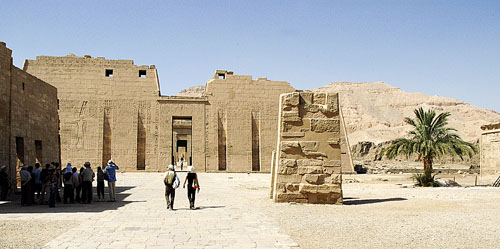
It is easy to bypass he temple at Medinet Habu when visiting the Valley of the Kings at Thebes (Luxor), Egypt. The site is definitely worth a visit.

Entrance to Medinet Habu temple. Photo by Ferrell Jenkins.

Entrance to Medinet Habu temple. Photo by Ferrell Jenkins.

Rameses III reigned from 1186 to 1155 B.C. Structures built by the Pharaoh to serve as an administrative complex and funerary temple may still be visited today at Medinet Habu. The most interesting aspects of the temple to me are the reliefs of the Sea Peoples that the king claims to have subjugated. We usually understand that the Philistines of the Old Testament were Sea People. The five major cities of the Philistines were Ashdod, Gaza, Ashkelon, Gath, and Ekron (1 Samuel 6:17).

This photo from the British Museum is a cast of one of the Sea Peoples (Philistines).

British Museum cast of one of the Sea People. Photo by Ferrell Jenkins.

British Museum cast of one of the Sea People. Photo by Jenkins.

118th Pyramid Found at Saqqara

A pyramid believed to be the tomb of Queen Sesheshet, the mother of Pharaoh Teti, has been discovered below 23 feet of sand near Saqqara. The pyramid, dating to about 2300 B.C., is the second pyramid found this year. It is the 118th pyramid discovered in Egypt.

Read a news release here. National Geographic News includes photos and a video here. Zahi Hawass, secretary general of Egypt’s Supreme Council on Antiquities is quoted as saying, “I always say you never know what the sands of Egypt might hide.”

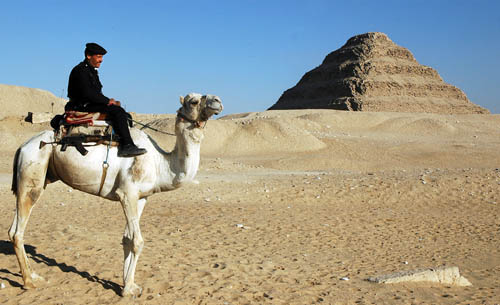
Tourists typically visit the Step Pyramid of Zoser (or Djoser) at Saqqara. This oldest freestanding stone building in the world is dated to about 2600 B.C., and is the work of the vizier and physican Imhotep.

Step Pyramid of Zoser at Saqqara. Photo by Ferrell Jenkins.

Step Pyramid of Zoser at Saqqara. Photo by Ferrell Jenkins.

These pyramids, and those of Giza, were built long before any of the biblical characters made their way to Egypt. It is conceivable that Joesph and Moses would have been familiar with these pyramids.

Then Pharaoh named Joseph Zaphenath-paneah; and he gave him Asenath, the daughter of Potiphera priest of On, as his wife. And Joseph went forth over the land of Egypt. (Genesis 41:45 NASB)

Moses was educated in all the learning of the Egyptians, and he was a man of power in words and deeds. (Acts 7:22 NASB)